This guide is independent and contains no paid placement. If affiliate links are added later, they will be clearly marked and will not change our editorial checks.
Ullapool works brilliantly with a dog because everything is close together: the ferry terminal, the harbour, the beach, the shops and the start of the North Coast 500 are all within a short walk. Arrive by road from Inverness or by ferry from Stornoway, base yourself in the village for a night or two, and use it to stock up, walk the shore and reset before the wilder single-track miles ahead.
Arriving: ferry, road and the first hour
Most visitors reach Ullapool in one of two ways, and the way you arrive shapes the first hour with your dog. Drivers come in on the A835 from Inverness, a road of about 57 miles that crosses open moorland, climbs past Loch Glascarnoch and then drops down through Glen Broom to the shore of Loch Broom. The last stretch is the best part: the road narrows between the hillside and the water, the loch opens out in front of you, and the whitewashed houses of the village appear around the bend. It is a beautiful drive and a tiring one for a dog that dislikes winding roads, so plan a stop before the final descent. The lay-bys near the head of Loch Broom work well, and there are picnic spots along the way where a dog can stretch its legs on a lead, drink some water and shake off the motion of the car.
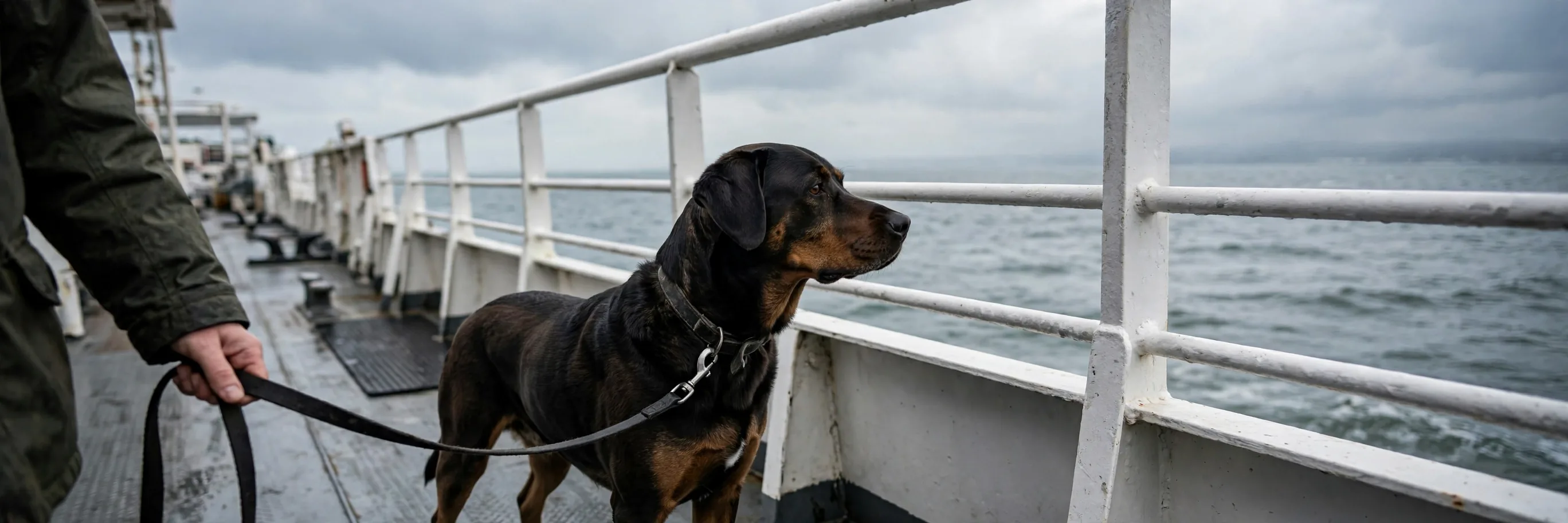
The other way in is by sea. The ferry from Stornoway on the Isle of Lewis docks at the pier in the middle of the village, and foot passengers, cars, campervans and motorhomes all come off the same boat. If you are arriving this way, your dog has already had a crossing to cope with, so the first job is a calm, unhurried walk rather than another drive. The shore path from the pier runs past the small beach and along the front of the village, and it is the obvious place to let a dog sniff, toilet and settle before you do anything else. Keep the lead on around the terminal itself: it is a working port, with lorries, forklifts and reversing vehicles, and dogs do not belong loose among them.
Whichever way you arrive, build the first hour around three simple jobs. First, walk the dog properly, not just a five-minute toilet break, because a dog that has been in a car or on a ferry for hours needs to move before it can relax. Second, find your accommodation and let the dog see the room, the bed and the water bowl before you head out again; dogs settle faster when the new place has been sniffed and claimed. Third, do the practical shopping while you are still in the village, because Ullapool is the last place with a proper supermarket for a long way in either direction on the North Coast 500. Fuel, dog food, waste bags and drinking water are all easier to buy here than on the single-track roads to the north or the west. Check the official guidance before you travel for ferry times and road closures, because both can change with the weather, and a delayed ferry or a closed road can turn a planned arrival into a late one.
Parking in Ullapool is straightforward compared with most Highland villages, but it still rewards a little planning. There is a large car park near the ferry terminal and smaller car parks and on-street spaces around the village, and most of them are a short walk from the harbour. In summer, the ferry traffic and the North Coast 500 traffic fill the village quickly, so arrive early or late in the day if you want a space near the front. Never leave a dog in a parked car in warm weather, even for a few minutes: a car in Highland sunshine can heat up fast, and the breeze off the loch is no substitute for shade and water. If you need to pop into a shop that does not allow dogs, take turns with your travel companion or use the time for a proper walk instead.
The harbour and the village
Ullapool was founded in 1788 as a fishing station, and the harbour is still the centre of the village rather than a backdrop. Fishing boats tie up alongside the pier, creels and nets are stacked on the quay, and the ferry comes and goes through the day. For a dog, the harbour is a feast of smells and sounds: fish, diesel, rope, gulls and the salt air off Loch Broom. It is also a place where a lead is not optional. The quay is a working area with moving vehicles, open water at the edge and no fences in places, so keep your dog close and under control, and keep children and dogs away from the edge where boats are being loaded.
The best way to see the harbour with a dog is the slow loop from the pier, along the shore road past the small beach, and back through the village. The whole circuit is short, flat and easy, which makes it ideal for older dogs, puppies and anyone arriving tired from a long drive. The beach by the pier is small and stony rather than a wide sandy sweep, but dogs love it all the same, and at low tide there is more shoreline to explore. Watch the tide: Loch Broom is a sea loch, and the water comes in faster than it looks on a calm day. Keep your dog in sight and away from the harbour mouth when boats are moving, and rinse sandy paws before the dog gets back in the car.
The village itself is compact enough to walk end to end in fifteen minutes, and that compactness is exactly what makes it good for dog owners. The main street runs parallel to the shore, with shops, cafes, pubs and places to stay all within a few hundred metres of each other. That means you can walk the dog, buy supplies, eat lunch and get back to the car without ever driving anywhere, which matters when the dog is happiest on foot and the weather is changeable. The whitewashed houses along Shore Street are the classic Ullapool view, and the small gardens and window boxes are worth a look, but remember that these are people's homes: keep dogs off private gardens and pick up after them on every pavement, not just on the beach.
Ullapool also has a practical side that many visitors miss. There is a bookshop, a hardware shop, outdoor clothing shops, a post office and a supermarket, and most of them are used to dog owners passing through. The village hall and the museum tell the story of the fishing station and the Highland clearances, and while the museum itself may not allow dogs inside, the walk around the village is a history lesson in itself. If you are staying more than a night, the harbour is worth visiting at different times of day: early morning when the fishing boats leave, midday when the ferry arrives, and evening when the light turns gold on the water and the mountains across the loch go pink. The dog will not care about the light, but the walk is different each time, and that variety is what keeps a working harbour interesting.
Beaches near Ullapool
Ullapool does not have a single famous beach, and that is part of its charm. Instead it has a scatter of small, quiet shores within a short drive, each with its own character, and most of them welcome dogs all year. The beach by the pier is the closest and the easiest: a short, stony shore right in the village, good for a quick run and a paddle, and ideal when you have just arrived or are waiting for a ferry. It is not a place for a long off-lead session in the middle of the day, when the pier is busy, but early in the morning or late in the evening it belongs to the dogs and the gulls.
A few miles north on the coast road, Ardmair Beach is the local favourite for a longer walk. It is a mix of sand and shingle with views across Loch Broom to the mountains, and at low tide the sand stretches out far enough for a proper game of fetch. There is a small car park and a campsite nearby, and the beach is popular with families and dog walkers in summer, so keep your dog under control around children and picnics. As with all the beaches in the area, check the local signs on arrival, because rules can change, and take waste bags with you: bins are few and far between on the smaller beaches, and the wind carries anything left behind straight into the loch. Our guide to dog-friendly beaches in Scotland covers the seasonal rules, tides and beach-day kit in more detail, and it is worth reading before you plan a day of beach hopping along this coast.
Further afield, the beaches get wilder. Gruinard Bay, about half an hour south on the A832, is a wide sweep of sand with views to the Summer Isles, and on a quiet day it feels like the edge of the world. Mellon Udrigle, to the west, is one of the most beautiful beaches in the Highlands, with white sand and turquoise water that looks Mediterranean on a sunny day and very Scottish on every other kind of day. Both are worth the drive, but both are exposed to the weather, and both have limited facilities, so bring water, food and a windbreak for the dog, and be ready to cut the visit short if the wind gets up. The sand here is soft and deep in places, which is hard work for older dogs and puppies, so watch for tired legs and carry a towel for the car.
Beach safety on this coast is mostly about the tide and the weather. The tidal range in Loch Broom is large, and a dog that runs out across the sand at low tide can find the water coming back faster than expected. Check the tide times before you go, keep your dog in sight, and avoid the harbour mouth and river mouths where currents are strongest. The other risk is less obvious: dead seabirds and washed-up jellyfish are common on Highland beaches, and both can make a dog ill if eaten. Teach a solid leave-it before the trip, keep a close eye on scavengers, and rinse your dog with fresh water after swimming in the sea, because salt water dries the coat and can upset a sensitive stomach if the dog drinks it. A dog that has been swimming in Loch Broom will smell of the sea for hours, which is half the pleasure of the trip, but a quick rinse keeps the car smelling better.
Ullapool and the North Coast 500
Ullapool sits roughly halfway around the North Coast 500, the 516-mile circular route that starts and ends at Inverness Castle, and it is the natural place to pause, restock and reset. Drivers heading clockwise reach Ullapool after the long, wild stretch from Durness and the north coast, with its single-track roads, passing places and huge empty beaches. Drivers heading anticlockwise reach it after the mountain passes of Applecross and Torridon and the gentler coastal road through Gairloch. Either way, Ullapool is the first town of any size for a long stretch, and the first place where you can do all the boring practical jobs at once: fuel, food, laundry, a proper meal and a night in a real bed.
For dog owners, that pause matters more than it does for anyone else. The North Coast 500 is a driving route, and dogs spend most of the day in the car, watching the landscape slide past. A rest day in Ullapool breaks up the driving and gives the dog a chance to walk properly, swim, and sleep in a place that is not moving. If you are doing the route over five to seven days, plan for at least one night here, and two if your dog is older or finds long drives stressful. The village is also a good place to decide which direction to tackle the next stretch: north towards the far north-west, with its single-track roads and remote beaches, or south towards Gairloch and the Applecross peninsula. Our full guide to the North Coast 500 with a dog covers the route day by day, including the campsite rules, the single-track etiquette and the daily rhythm that keeps a dog happy on a long road trip.
Single-track roads are the part of the North Coast 500 that worries dog owners most, and Ullapool is a good place to practise before the really remote stretches. The roads north and west of the village narrow quickly, and the etiquette is simple: use passing places to let faster traffic through, never park in a passing place, and pull in to let oncoming vehicles pass even if you think you could squeeze through. For the dog, the main risk is the stop-start nature of the driving, so keep the dog secure in a crate or harness, keep the car ventilated, and stop every hour or so for a short walk. The lay-bys and viewpoints around Ullapool are good places to learn the rhythm: pull over, let the dog out on a lead, take a photograph, and carry on. It is slower than driving straight through, but it is the way the route is meant to be done, and it keeps the dog settled.
One more thing about Ullapool as a base: it is the last reliable place to get things fixed. If the car needs attention, if a lead snaps, if the dog's food runs out or if you need a vet, this is where you sort it out, not on a single-track road forty miles from anywhere. The village has garages, outdoor shops and a supermarket, and the staff are used to travellers with problems. Buy the spare lead, the extra bag of food and the roll of waste bags here, because the next shops of any size are a long drive away, and a dog that runs out of its usual food on a remote stretch of the route is a problem you do not need.
The Stornoway ferry
The ferry to Stornoway is the other half of Ullapool's identity. Caledonian MacBrayne operates the crossing to the Isle of Lewis, and the sailing takes around two hours and forty-five minutes across the Minch, the stretch of sea between the mainland and the Outer Hebrides. For many travellers, Ullapool is simply the place where the ferry leaves, but for dog owners the crossing is a journey in its own right, and it needs a little planning. Dogs can travel on the route, but where your dog spends the crossing depends on the vessel and the ticket type, and the rules are not the same on every sailing. Check the official guidance before you travel, and book ahead in peak season, because the ferry is busy in summer and foot passengers with dogs need to know the arrangements before they arrive at the terminal.
In general, dogs travelling with a vehicle usually stay in the vehicle during the crossing, while foot passengers use designated pet areas on board. Some vessels have pet-friendly lounges or kennels, and some allow dogs on open decks on a lead. The right choice depends on your dog: a nervous dog may be calmer in the familiar car, while a sociable dog may prefer the open deck and the fresh air. Whatever you choose, bring water, a bowl, a familiar blanket and something to chew, and exercise the dog properly before boarding, because a tired dog copes with a crossing far better than a restless one. Our guide to dogs on UK ferries compares the rules, costs and arrangements across operators, and it is the best place to start if this is your first ferry crossing with a dog.
Day trips to Lewis are possible from Ullapool, but they are long days, and they are not right for every dog. The ferry leaves early, the crossing is nearly three hours each way, and a day trip leaves only a few hours on the island. If you do it, plan a single destination rather than trying to see the whole island: the beaches near Stornoway, the standing stones at Callanish or a walk along the coast. A better plan for most dog owners is to stay overnight on Lewis, which turns a rushed day into a proper break and gives the dog time to recover from the crossing. Either way, book the return sailing as well as the outward one, and keep an eye on the weather, because sailings can be disrupted by high winds, especially in winter.
The ferry terminal itself is part of the working harbour, and it is worth treating it with the same care as the pier. Keep your dog on a lead at all times in the terminal area, stay well clear of loading vehicles, and follow the instructions of the crew, who are used to dogs and will tell you where to go. If you are travelling as a foot passenger, arrive early enough to sort out the dog arrangements without rushing, because a stressed owner makes for a stressed dog. And if the ferry is delayed, which happens in bad weather, treat the delay as a bonus walk rather than a disaster: the shore path and the village are right there, and a dog would always rather be walking than waiting.
Walks beyond the village
Ullapool rewards walkers who look beyond the village, and the hills around Loch Broom offer some of the best dog walking in the Highlands. The most popular local walk is Ullapool Hill, also known as Meall Mor, which rises directly behind the village and gives a superb view over the loch, the harbour and the mountains beyond. The path is steep in places and the ground can be boggy after rain, but the walk is short enough for a fit dog and the view from the top is worth every step. Keep your dog on a lead near the start of the path, where it passes close to houses and gardens, and watch for sheep on the open hill, because the grazing land is unfenced and sheep are everywhere.
For a gentler walk, the shore path towards Rhue follows the coast north-east from the village, past rocky coves and small beaches, to the lighthouse at Rhue. It is a there-and-back walk on a clear path, with the sea on one side and the hills on the other, and it is ideal for a morning or evening stroll. The path is mostly flat, but there are uneven sections and a few places where the ground drops towards the water, so keep your dog under control and use a lead where the path narrows. The walk to Loch Achall, a few miles south-east of the village, is another easy option: a quiet loch surrounded by woodland, with a track that is good for a relaxed walk and a swim for dogs that like the water. The loch is popular with anglers, so keep dogs away from fishing lines and respect the anglers' space.
Further afield, the Lael Forest and the Corrieshalloch Gorge are both within an easy drive, and both are worth a visit with a dog. Lael Forest, at the head of Loch Broom, has waymarked trails through pine forest, with views up the glen and plenty of shade on a warm day. Corrieshalloch Gorge, about twenty miles south on the A835, is one of the most dramatic sights in the Highlands: a deep, narrow gorge with a Victorian suspension bridge across it and waterfalls below. Dogs are welcome on the trails, but the gorge itself is not a place for off-lead dogs, and the bridge is narrow, high and exposed, so only cross it with a dog you can carry or control confidently. Check the official guidance before you travel for path closures and conditions, because the gorge trails can be closed after storms.
Whatever walk you choose, the same Highland rules apply. Keep dogs on a lead near livestock, especially sheep and lambs in spring, and near ground-nesting birds in the breeding season. Carry water for the dog, because burns and lochs look inviting but the water is not always safe to drink, and a dog that drinks from a peaty burn can end up with an upset stomach. Check paws after walks on rough ground, because the rocky paths around Ullapool are hard on soft pads, and carry a basic first-aid kit with tick removers, because ticks are common in the Highlands from spring to autumn. The weather changes fast here, so a walk that starts in sunshine can end in rain, and a dog that is wet and cold is a dog that needs a towel and a warm car, not another hour on the hill.
Eating and drinking with a dog
Ullapool has a good range of places to eat for a village of its size, and many of them welcome dogs, but the rules vary from place to place and from season to season. The most dog-friendly spots are usually the pubs and cafes with outdoor seating, where dogs are welcome at the tables outside, and the bars with wooden floors, where a well-behaved dog under the table is part of the atmosphere. The fish and chip shops and takeaways are the easiest option of all: order at the counter, eat on a bench by the harbour, and let the dog enjoy the smells and the view. The seafood here is the real thing, landed by the boats you can see from the window, and a bag of chips eaten on the pier is one of the great simple pleasures of a Highland trip.
The practical approach is to ask before you sit down, and to make it easy for the venue to say yes. Keep your dog on a lead, bring a mat or blanket so the dog has a defined place to lie, and settle the dog before you order, because a dog that is settled and quiet is welcome everywhere, while a dog that is barking at the next table is welcome nowhere. If you are travelling with a nervous or reactive dog, choose a table at the edge of the room or outside, away from the main flow of people, and keep visits short. Lunch is usually easier than dinner, because the atmosphere is more relaxed and there is more space, and a midday meal gives the dog a rest before the afternoon walk.
Self-catering is the other half of the Ullapool food story, and for many dog owners it is the better option. The supermarket in the village stocks everything you need for a few days, including dog food, and the delicatessen and bakery sell local produce that is worth trying. Cooking for yourself means the dog can relax in the accommodation while you eat, and it means you can eat when the dog is ready rather than when a restaurant has a table. If you are staying in a cottage or a lodge, stock up on arrival, because the shops close earlier than you might expect, and the nearest alternative is a long drive away. And if you do eat out, book ahead in summer, because the village fills up with ferry passengers and North Coast 500 travellers, and a table for two with a dog is not always available on the night.
One last thing about eating in Ullapool: the village is small enough that the staff in the cafes and pubs remember regulars, and a dog that behaves well will be remembered too. Bring treats, bring patience, and tip generously, because a village that welcomes dogs is a village worth supporting. If a venue does not allow dogs inside, do not argue: thank them, eat outside or take the food away, and move on. The next place along the street may be happy to have you, and the dog will not mind where the food comes from as long as it arrives.
Where to stay with a dog
Ullapool has a good range of dog-friendly places to stay, from hotels and bed and breakfasts to self-catering cottages, lodges and campsites, but the choice matters more here than in most places, because the village is small and the good options book up early. The hotels and guest houses in the village centre are the most convenient: you can walk to the harbour, the shops and the restaurants, and the dog can settle in a room that is close to everything. Ask about the dog policy before you book, because some places welcome dogs in selected rooms only, some charge a per-night fee, and some have rules about leaving dogs unattended in the room. Get the policy in writing, along with the fee, so there are no surprises on arrival.
Self-catering cottages and lodges are the best choice for most dog owners, because they give the dog space, a garden or a yard, and a kitchen for cooking. The cottages in and around Ullapool range from small fishermen's cottages in the village to larger houses on the hillside above the loch, and many of them are genuinely dog-friendly, with enclosed gardens, hard floors and a hose for muddy paws. When you book, ask the specific questions that matter for your dog: is the garden fully enclosed, and how high is the fence; is there a place to dry a wet dog; how far is the nearest walk that does not need a car; and is there a charge per dog or per stay. A cottage that suits a calm older dog with a short walk from the door is a poor fit for a young collie that needs an hour of open running, and no booking filter knows the difference.
Campsites and campervan sites are the third option, and Ullapool has several within a short drive, including sites near the beach and sites on the edge of the village. Camping with a dog in the Highlands is a joy when the weather is good and a test of patience when it is not, so bring a drying coat, a raised bed to keep the dog off the cold ground, and a windbreak for the pitch. Check the site rules on leads, because most sites require dogs to be on a lead at all times on the site, and some have designated dog-walking areas. If you are travelling in a campervan or motorhome, the village is a good place to empty and refill, and the fuel station is on the main road through the village, but check the official guidance before you travel for opening times, because hours are shorter in winter.
Whatever you book, book early, especially if you are travelling in the summer months or during school holidays. Ullapool is a small village with a big reputation, and the dog-friendly rooms and cottages sell out months ahead. If your first choice is full, look at the villages nearby: Gairloch to the south, Lochinver to the north and the small settlements along Loch Broom all have dog-friendly options, and a twenty-minute drive to Ullapool is a small price to pay for a good night's sleep. And when you check in, take the time to walk the dog around the property before you unpack: show the dog the garden, the door, the water bowl and the bed, and let it sniff the boundaries. A dog that knows its territory settles faster, and a settled dog is a quiet dog.
Weather, midges and seasons
Ullapool sits on the north-west coast of Scotland, which means the weather is the single biggest factor in any trip, and the single hardest thing to plan for. The village faces west across Loch Broom, and the wind comes straight off the Atlantic, bringing rain, cloud and sudden changes of light. A day can start in sunshine, turn to rain by lunchtime, and end in a golden evening that makes the whole day worthwhile. The best approach is to dress for the weather you have, not the weather you want: waterproofs for everyone, including the dog, a warm layer for the evenings, and a plan for wet days that does not depend on the sun coming out.
The seasons change the village dramatically. Spring is quiet and fresh, with lambs in the fields, wildflowers on the hillsides and fewer visitors, but the weather is unpredictable and the wind can be bitter. Summer is the busiest season, with long daylight hours, the ferry running at full capacity and the North Coast 500 at its most popular, but it is also midge season, and the midges around Ullapool can be ferocious on still, damp evenings. Autumn is many people's favourite time: the light is low and golden, the hills turn russet, the crowds thin out and the midges die back, but the days get shorter and the rain gets heavier. Winter is the quietest season, with short days, cold nights and the chance of snow on the hills, but the village is at its most peaceful, and a dog that loves the cold will be in its element.
Midges deserve a section of their own, because they are the one thing that surprises first-time visitors to the Highlands. The tiny biting flies appear from late May to September, and they are worst on still, damp evenings, near water and in sheltered spots. Dogs are less bothered by midges than people, but they can still be irritated, especially around the ears and eyes. The best defence is timing: walk in the middle of the day or when there is a breeze, avoid still evenings by the water, and keep moving, because midges struggle to land on a moving target. A light midge net for yourself and a quick check of the dog's ears after an evening walk are usually enough, and the midges are gone by the time the autumn light arrives.
Whatever the season, the rule is the same: check the forecast, but do not trust it completely. The Highland weather changes faster than any forecast can follow, and a dog that is prepared for rain will enjoy a wet walk far more than a dog that is cold and miserable. Pack a drying coat, a towel and a warm blanket for the car, and always have a dry set of clothes for yourself. The rain is part of the experience here, and some of the best walks around Ullapool are the ones taken in the rain, when the hills disappear into the cloud and the loch turns the colour of slate. The dog will not mind the rain, and neither should you.
Practical kit: vets, shops and transport
Before you travel to Ullapool, sort out the practical details, because the village is remote and the nearest alternatives are a long way away. The first job is the vet: find out where the nearest veterinary practice is, save the number in your phone, and check the opening hours, because rural practices often close early and do not open on Sundays. If your dog takes regular medication, bring more than you need, and carry the prescription details with you, because a lost supply on a remote stretch of the North Coast 500 is a problem that is hard to fix quickly. A basic first-aid kit is worth packing too: tick removers, wound dressings, a bandage, and any medication your vet has recommended for travel.
Shops and supplies are the second job. Ullapool has a supermarket, a post office, a hardware shop and outdoor clothing shops, and between them they cover most emergencies, but they do not cover everything. If your dog eats a specialist food, bring enough for the whole trip, because the supermarket may not stock it. Bring spare leads, a spare collar, waste bags, a towel and a drying coat, because all of these are easy to forget and hard to replace on a single-track road. And if you are travelling by campervan or motorhome, check where you can empty and refill before you arrive, because the facilities are limited and the queues in summer can be long.
Transport is the third job, and it is the one that catches people out. Ullapool is served by buses from Inverness, but the services are infrequent, and they are not designed for dog owners with luggage and a large dog. A car is by far the best way to get around, and if you are travelling without one, plan your walks around the village and the shore path rather than trying to reach the more remote beaches by bus. Taxis are available in the village, but they are few, and not all of them take dogs, so book ahead and ask when you book. If you are arriving by ferry as a foot passenger, the terminal is in the middle of the village, which makes life easy, but the onward journey to the beaches and walks will still need a car or a taxi.
The last practical point is the phone signal. Mobile coverage around Ullapool is patchy, and it disappears altogether on some of the roads to the north and west. Download your maps before you leave the village, save the important numbers offline, and tell someone where you are going if you are heading out on a long walk. The lack of signal is part of the charm of the Highlands, but it is not charming when you need a vet or a taxi and the phone shows no bars. A paper map, a charged phone and a little preparation go a long way, and they cost nothing.
A two-day Ullapool plan
Two days in Ullapool is enough to see the village properly, walk the shore, visit a beach and reset before the next stretch of the North Coast 500, and it is a good length for a dog that has been travelling. Day one starts with arrival and a proper walk: the shore path from the pier, the small beach, and a slow loop through the village to buy supplies. Lunch is fish and chips on the pier or a cafe that welcomes dogs, and the afternoon is for the harbour and the village, with a visit to the museum and a look at the shops. The evening is for the golden hour on the pier, when the light is at its best and the fishing boats come in, and a quiet dinner in a pub that welcomes dogs, or a meal cooked in the cottage while the dog sleeps by the fire.
Day two is for getting out of the village. Start early with the walk up Ullapool Hill, or the shore path to Rhue lighthouse if you prefer a flatter route, and then drive to one of the beaches: Ardmair for a long walk on the sand, or Gruinard Bay for a wilder, emptier shore. Pack a picnic and water for the dog, and take your time, because the beaches are the reason to come to this coast. The afternoon is for the drive south to Corrieshalloch Gorge, or north along the coast road towards the Summer Isles, depending on the weather and the dog's energy. The evening is for a last walk along the harbour, a final look at the loch, and an early night, because the next day is another stretch of driving.
If you have a third day, use it for the ferry to Stornoway or for a longer walk in the hills, but do not try to do both. The Highlands reward slow travel, and a dog that has had three days of proper walks, good food and a warm bed is a dog that will enjoy the rest of the trip far more than a dog that has been rushed from one viewpoint to the next. The best souvenir from Ullapool is not a photograph, though the photographs are wonderful, but a dog that is tired, happy and ready for the next stretch of the road.
One final note on planning: Ullapool is a village, not a resort, and it works best when you let it set the pace. The ferry will be late, the rain will arrive when you least expect it, and the restaurant you wanted will be full. None of that matters. Walk the dog, eat the fish and chips, watch the light on the loch, and let the North Coast 500 wait until tomorrow. The road will still be there, and the dog will be glad of the rest.
Practical questions
Before you go
Can dogs travel on the Ullapool to Stornoway ferry?
Yes, dogs can travel on the Ullapool to Stornoway ferry, but where your dog spends the crossing depends on the vessel and the ticket type. Dogs usually travel in the vehicle or in designated pet areas, and some sailings offer pet-friendly lounges or kennels. Book ahead in peak season, arrive early, and check the official guidance before you travel, because rules differ between operators and vessels.
Is Ullapool a good base for the North Coast 500 with a dog?
Yes, Ullapool is one of the most practical bases on the North Coast 500 for dog owners. It has fuel, shops, places to eat, a choice of dog-friendly stays and the only large supermarket for many miles in either direction. From here you can run the route clockwise towards Durness and Thurso or anticlockwise towards Gairloch and Applecross, or simply use it as a rest day between longer drives.
Are the beaches near Ullapool dog-friendly all year?
Most beaches around Ullapool welcome dogs all year, and the area has no widely enforced summer dog bans of the kind found on many English beaches. Even so, rules can change for individual beaches, so check local signs on arrival. Keep dogs on a lead near livestock, nesting birds and other beach users, and take waste bags with you because bins are rare on the smaller beaches.
Can dogs go into cafes and pubs in Ullapool?
Many cafes and pubs in Ullapool welcome dogs, especially in outdoor seating areas and in bars with wooden floors, but policies change and individual venues set their own rules. Ask before you sit down, keep your dog on a lead and under the table, and carry a mat so the dog has a defined place to settle. If a venue only allows dogs outside, plan for Highland weather and bring a drying coat.
Where can I walk my dog off the lead near Ullapool?
The small beach by the pier, the shore path towards Rhue, and open stretches of the quieter beaches north of the village are the usual places for off-lead time, always subject to local signs and conditions on the day. Keep your dog on a lead near roads, the working harbour, livestock and cliff edges. Recall matters more than the location: if your dog chases sheep or seabirds, use a long line instead.
What should I pack for a dog trip to Ullapool in winter?
Pack a drying coat and extra towels, a warm layer for short-coated or older dogs, a torch and a reflective lead for dark afternoons, and a blanket for the car because Highland nights are cold even when the day was mild. Roads can be icy, so allow extra time and keep a lead on near the harbour in high winds. Check the official guidance before you travel for ferry disruptions, which are more common in winter.