This guide is independent and contains no paid placement. Product types are described generically so you can compare any brand against the same checks. Always follow the care and safety instructions supplied with the item you buy.
For most UK summer trips, start with a pressure-activated gel mat sized so your dog can lie fully on it, add a portable water bottle and a collapsible bowl, and plan walks for early morning and evening. No mat replaces shade, ventilation, water and rest — and no cooling product makes a parked car safe for an unattended dog.
Start with a heatwave decision flow
When a hot spell is forecast, the useful question is not “which mat should I buy?” but “should this journey happen in this form at all?” Run through five checks in order before you pack anything. First, look at the forecast for the hottest part of the day, not the morning average, and remember that pavements, car parks and south-facing gardens run hotter than the headline temperature. Second, ask whether the driving, the walk and the overnight stop can all be shifted to cooler hours. Third, check that every place you will pause has real shade and a water supply, rather than assuming a café terrace or a lay-by will do. Fourth, consider your individual dog: age, weight, coat, breathing and previous trouble in heat matter more than any generic temperature chart. Fifth, decide your exit option in advance — the shorter route home, the shaded indoor stop, or the willingness to cancel the walk entirely. If several answers are weak, change the plan rather than buying more gear to compensate.
That order matters because cooling products work at the margins. A mat can make a shaded rest more comfortable and help a dog settle after a gentle morning walk. It cannot rescue a midday hike, offset a sun-baked tent at two in the afternoon, or protect a dog left in a vehicle while people queue for lunch. Treating gear as the last layer, after timing, shade and water, is what keeps a summer trip kind rather than merely well equipped. Our companion guide to summer heat and dogs on the move covers temperature judgement and journey planning in more depth, and it is worth reading alongside this gear guide before a hot-weather break.
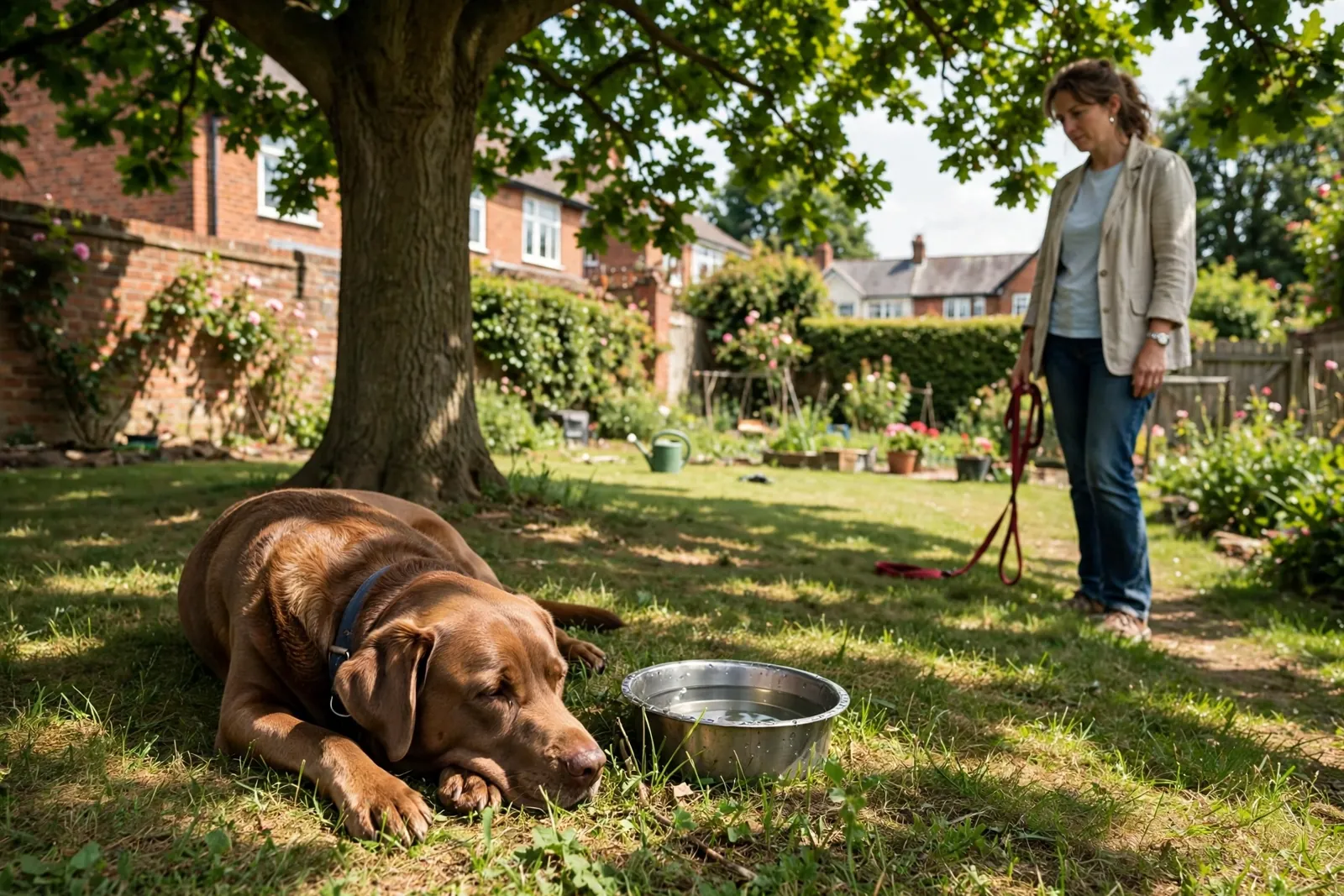
Build the decision into the day itself. Check your dog at every stop, not just at the destination: breathing, willingness to walk, gum colour and general brightness tell you more than the thermometer in the car. Offer small drinks often instead of one huge drink after exercise. If a dog seeks shade and stops, believe them and stop too. Heat problems escalate quietly, and the dogs most at risk are often the enthusiastic ones who would keep going if their people let them.
Heatstroke signs and first response
Dogs lose heat mainly by panting and, to a much smaller extent, through their paw pads, which is why humid, still air is so hard for them: panting becomes less effective just when they need it most. Warning signs that a dog is struggling include heavy or noisy panting that does not settle with rest, thick drooling, bright red or very pale gums, a rapid heartbeat, restlessness followed by wobbliness, vomiting or diarrhoea, glazed eyes and disorientation. Collapse, seizures or loss of consciousness are emergencies. Flat-faced breeds, overweight dogs, large and giant breeds, thick-coated dogs, puppies, older dogs and dogs with heart or airway conditions can deteriorate faster, but any dog can develop heatstroke in the wrong conditions.
The widely taught first-response principle is to stop exercise immediately, move the dog to shade or a cooler place, and start active cooling while you contact a vet for urgent advice. Current veterinary guidance generally favours cooling with water — pouring cool water over the body, especially the neck, armpits and groin, and using airflow from a fan or open windows — and advises against covering the dog with wet towels, which can trap heat once the towel warms. Offer small amounts of cool water to drink, but do not force water into the mouth of a drowsy or collapsed dog. Avoid ice-cold immersion for a collapsed dog unless a vet directs it, and do not delay transport to finish cooling at the roadside: call the vet, start cooling, and travel as they advise. Guidance does change, so before any summer trip, check the latest advice from your own vet or a national veterinary body and save the number of a vet near your destination. If you are in any doubt about breathing, consciousness or coordination, treat it as an emergency rather than a wait-and-see.
A cooling mat has a small, honest role here: a cool surface can form part of gentle rest for a mildly warm dog who is alert, drinking and recovering in shade under supervision. It is not a treatment for heatstroke. If signs suggest overheating, water-based cooling, airflow and veterinary help take priority, and the mat stays in the bag.
Gel, water and phase-change mats compared
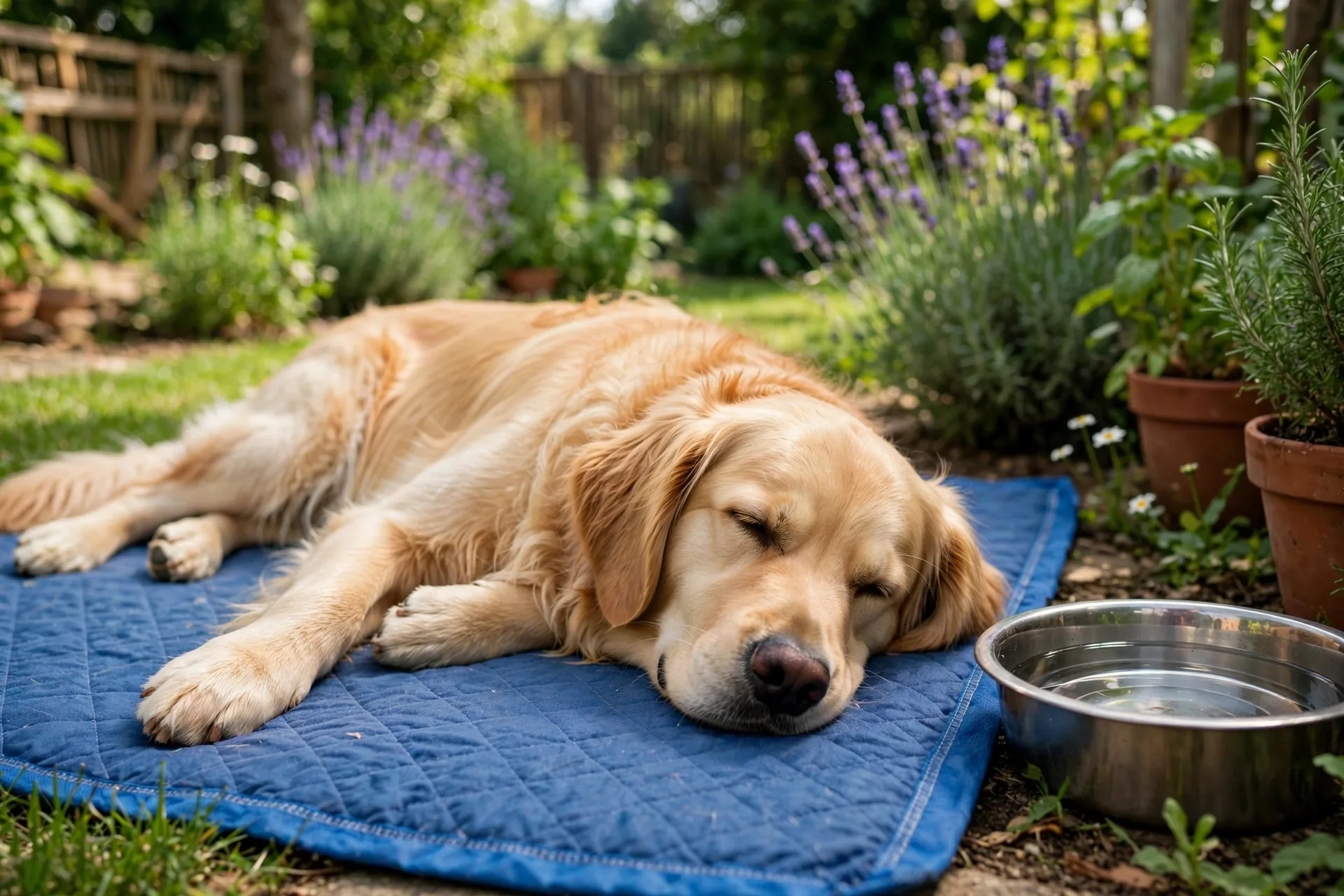
Pressure-activated gel mats are the default travel choice for good reason. Inside a sealed, wipe-clean cover, a gel layer absorbs body heat where the dog lies, so the surface feels cooler than the floor without power, water or freezing. Most reset after roughly 15 to 30 minutes with nobody on them, which suits stop-start travel days. Their limits are equally clear: in a hot room the gel gradually matches the surroundings, determined claws can puncture some covers, and the cooling effect is a gentle few degrees of comfort rather than refrigeration. Weights vary by size, but gel mats are usually light and foldable enough for a car boot or the top of a suitcase, which is why they dominate the travel market.
Water-filled mats work like a shallow, sturdy waterbed. You fill them through a valve, and the water spreads body heat across the whole pad, giving an even, noticeably cool lie for as long as the water stays cooler than the dog. Some owners add a small amount of cool water to refresh them. The trade-offs are weight and fuss: filled, even a medium mat is heavy to carry far, valves and seams need checking for leaks, and a puncture on a hotel carpet is a genuine problem. They suit car-based trips, caravans and ground-floor stays where the mat can stay filled in one place, rather than train journeys or long walks where you carry your own kit.
Phase-change mats use materials engineered to absorb heat while they change state at a set temperature, often in the high twenties Celsius. In practice they feel steadier than gel: instead of warming gradually under the dog, they hold closer to their design temperature for a period — commonly a few hours — and then need time somewhere cooler to re-solidify. They tend to cost more than basic gel mats and the choice of sizes is narrower, but for dogs who run warm, for long car journeys with planned breaks, and for owners who dislike the idea of filling and emptying water, they are a credible step up. Whichever technology you choose, check whether the filling is described as non-toxic, whether the outer can be wiped or machine-washed, and whether the maker states a weight limit — large dogs compress thin mats until they are lying on the floor through the padding.
Two simpler options deserve a mention. Raised mesh beds lift a dog off warm ground and let air circulate underneath, which helps in tents and gardens, although they offer no active cooling and are bulky to transport. Plain cotton or towelling mats soaked in water and wrung out provide cheap evaporative cooling for supervised rest, but they dampen bedding and car seats, need re-wetting, and should never be left draped over a dog. For most travellers, gel first, phase-change if budget allows, and water-filled only when weight does not matter is a sensible hierarchy.
Size, breed, age and coat: choosing the right mat
Measure your dog lying down in their favourite sprawl, not standing at the shoulder, and buy a mat that fits that footprint with a little to spare. A mat that only fits a tightly curled dog will be ignored by a dog who sleeps stretched out, and edge-hanging is where much of the benefit is lost. As a rough guide, small dogs often settle on mats around 50 by 40 centimetres, medium dogs need something closer to 65 by 50, and large dogs may need 90 by 60 or bigger — but makers size differently, so treat those figures as a starting point and check the stated internal dimensions. If you are between sizes, size up for a travel mat: the extra surface gives the dog a fresh patch to shift onto as one area warms.
Breed and build change the priority. Flat-faced dogs such as pugs, French bulldogs and bulldogs struggle to lose heat by panting, so cooling gear for them is about shortening exposure in the first place — shorter outings, stricter shade discipline and a mat waiting at every rest — rather than expecting a product to extend a walk. Double-coated breeds insulate in both directions; never shave a double coat down for summer without veterinary or professional grooming advice, because the coat also protects skin from sun. Dark coats absorb more radiant heat in direct sun, which makes shade non-negotiable for black dogs at midday. Giant and heavy breeds need thicker, firmer mats with stated weight ratings, while lean, bony dogs such as greyhounds may prefer a thin blanket over part of the mat so coolness does not come with pressure on hips and elbows.
Age refines the choice further. Puppies chew, dig and test everything with their teeth, so a puppy mat must be supervised kit: tough cover, no loose layers to shred, and removal the moment scratching turns to biting. Puppies also chill faster than adults, so offer the mat as one option beside a normal blanket rather than as the only bed. Senior dogs, and dogs with arthritis, often dislike a fully cold surface directly under sore joints; the half-on, half-off arrangement — mat overlapping their usual bed — lets them dose the coolness themselves. Dogs recovering from illness or surgery, and dogs on medication that affects temperature regulation, need individual veterinary advice before you rely on cooling products at all. When in doubt, ask your vet what to watch for in your dog specifically, and check official guidance again before you travel, because recommendations are updated as evidence develops.
In the car, tent and hotel room
In the car, place the mat where the dog legally and safely travels — in a secured crate, a guarded boot area or on a harnessed back-seat setup — and make sure it cannot slide under pedals, fold over the dog or block air vents. Pre-cool the car before the dog gets in, aim an air vent towards the dog area without blasting cold air directly at a resting dog for hours, and plan shaded breaks roughly every one to two hours on long drives so the mat can reset while the dog stretches, drinks and toilets on grass. For the rules on restraining dogs and travelling safely by road, see our guide to driving with a dog and UK law. Above all, repeat the rule until it is automatic: a cooling mat never makes an unattended dog in a parked car acceptable, even briefly, even in shade, even with windows cracked. If a service station stop means the dog cannot come too, one person stays with the car, engine and air conditioning running where permitted, or the stop does not happen.
Tents are the hardest summer sleeping environment because a closed tent in morning sun heats like a greenhouse. Pitch in shade where possible, open vents and doors to create through-flow as soon as anyone is awake, and put the cooling mat on the tent floor or over the dog bed in the shadiest corner, away from the wall the sun hits first. Wake early on hot days: if the tent feels stuffy to you at seven, it already feels worse at dog height under a flysheet. Some dogs do better sleeping in a ventilated awning or the car boot with a tailgate open and secured, but only where site rules allow it and only with supervision arrangements that keep the dog contained and safe overnight. Never zip a dog into a hot tent while you go to a shower block on a sunny morning.
Hotel rooms, holiday cottages and caravans sit between those extremes. Air conditioning helps if present, but do not point a mat setup directly under a cold unit and then leave the dog alone for hours; instead, combine a mat with curtains closed against afternoon sun, a fan moving air around the room where the dog tolerates the noise, and a normal bed so the dog can move off the cool surface at will. On hard floors a mat can slide — a non-slip underlay or placing the mat fully on a rug keeps it where you put it. In caravans, check floor vents and fridge heat: the warm patch beside a working fridge unit is the worst possible mat position. Wherever you sleep, the overnight test is simple: if you would not sleep comfortably in that spot in that heat, your dog will not either.
Cooling coats, vests and collars
Cooling coats and vests usually work by evaporation: you soak the fabric, wring it out, and as water evaporates from the outer layer it draws heat from the surface beneath. They can help during gentle activity and rest stops, provided three conditions hold. The fit must be snug enough for contact without restricting breathing or movement — measure chest and neck carefully and watch the first wear for rubbing. The fabric must be re-wetted before it dries out, because a dry insulated coat in strong sun can hold heat against the body rather than release it. And the dog must be monitored: a coat is not a licence for a longer midday walk, and any dog who pants harder, lags or seeks shade needs to stop and rest, coat or no coat. In very humid weather evaporation slows, so expect less benefit on muggy days than on dry, breezy ones.
Cooling bandanas and collars are the lighter end of the range. Some hold water-absorbing crystals or gel inserts, some are simply fabric you wet before a short outing. They cool a small area around the neck and are best thought of as comfort extras for a shaded garden rest or a slow evening stroll, not as core protection. Check that a collar cannot tighten, snag or be chewed and swallowed, keep gel inserts away from chewers, and remove anything wet before a dog settles for the night so skin underneath can dry. Dogs who dislike wearing kit, dogs with skin conditions, and very small dogs who chill quickly may be better served by shade, water and timing alone. Introduce any wearable at home first, for a few minutes at a time with rewards, so that on the trip it reads as familiar equipment rather than one more strange thing on a hot day.
Water, shade and ventilation on the move
If the mat is the comfort layer, water is the survival layer. Carry more than you expect to use: a portable bottle with an attached tray or a separate bottle plus a collapsible bowl both work, and the best system is the one you can operate one-handed on a pavement without spilling half of it. Bottles with a squeeze-to-fill tray waste less than pouring into a bowl on a slope; bowls are easier for flat-faced dogs and for sharing between two dogs. Offer water little and often, at every stop and whenever you drink yourself. At the accommodation, keep a full bowl in shade near the mat, refresh it daily, and wash bowls properly on multi-day trips — warm, slimy bowls are a common and avoidable holiday tummy upset. For beach days, remember that seawater is not drinking water; carry fresh water to the sand, and check the local rules before you go with our guide to dog-friendly beaches and their rules in the UK.
Shade and airflow deserve the same deliberate planning. Natural tree shade beats a parasol that must be re-angled hourly; a simple pop-up shade or a light blanket rigged between fences can work in gardens, but anything that encloses the dog without ventilation becomes an oven. In cars, reflective windscreen shades fitted while parked reduce the starting temperature, though they do not make waiting safe. Fans help wherever there is power or a battery pack, positioned to move air across the resting area rather than into a dog face at close range. At cafés and pubs, choose the table by where your dog will lie — cool tiles in full shade — rather than by your own view. Small environmental choices, repeated all day, do more for a travelling dog than any single purchase.
Re-timing walks and rest stops
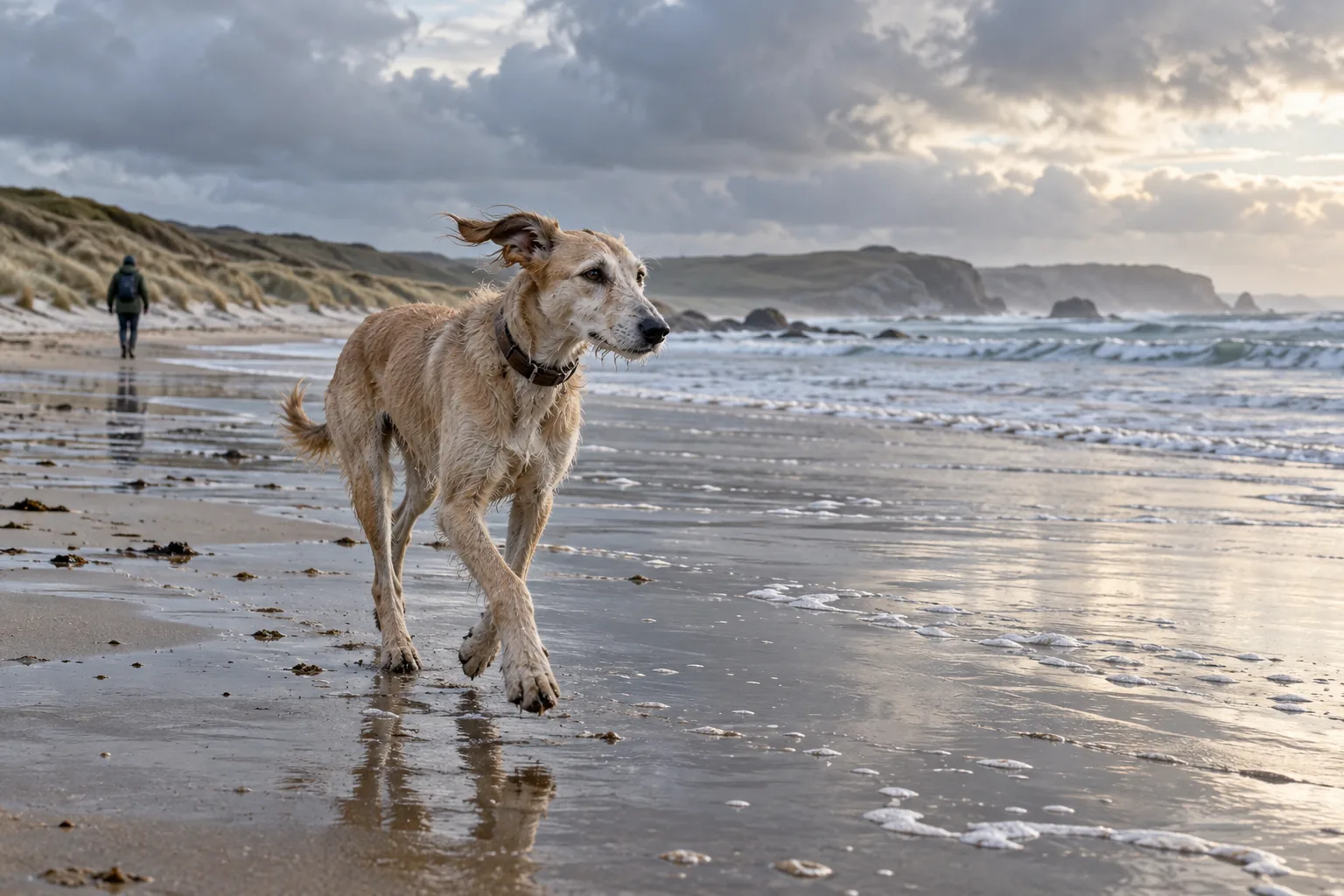
Summer travel works when the timetable bends. Main exercise belongs in the early morning, ideally before eight, and again in the evening once pavements have given back their heat. Test tarmac with the back of your hand or your own bare foot for several seconds: if it feels hot to you, it can burn pads, and the outing should move to grass, shaded woodland or water margins instead. Midday becomes the rest shift — mat down in shade, water available, toilet breaks short and on grass where possible, and no ball games on shadeless ground however keen the dog looks. Swimming and paddling cool dogs effectively, but check water quality warnings, currents and algae notices locally before letting a dog in, rinse salt and sand off afterwards, and do not let an excited dog drink large volumes of lake or sea water.
Adjust distance as honestly as timing. A dog who happily covers ten miles in April may need a third of that in a July heatwave, split into two outings with a long shaded middle. Build turnaround points into unfamiliar routes so shortening the walk is easy, carry water on even a short outing, and watch for the early signs described above rather than waiting for obvious distress. Older dogs, puppies and dogs carrying extra weight need the most conservative version of the plan. None of this spoils a holiday: most dogs are content with sniff-rich, unhurried exploring in cool hours and long companionable rests between, and most owners remember the relaxed evenings rather than the cancelled midday march.
Cleaning, drying and packing the mat
Travel mats collect sand, mud, salt water, spilled food and the occasional accident, so cleanability is a buying feature, not an afterthought. Most gel and phase-change mats are wipe-clean only: use a damp cloth with a little mild soap, wipe again with clean water so no residue remains to be licked, and air-dry flat away from radiators and direct midday sun, which can damage seams and covers. Never put a sealed gel mat in a washing machine unless the maker explicitly allows it, and never fold a mat sharply along the same crease for a whole season — roll it loosely or alternate folds to protect the internal layer. Water-filled mats need emptying, rinsing and complete drying with the valve open before storage, or they develop smells and mould that are hard to shift.
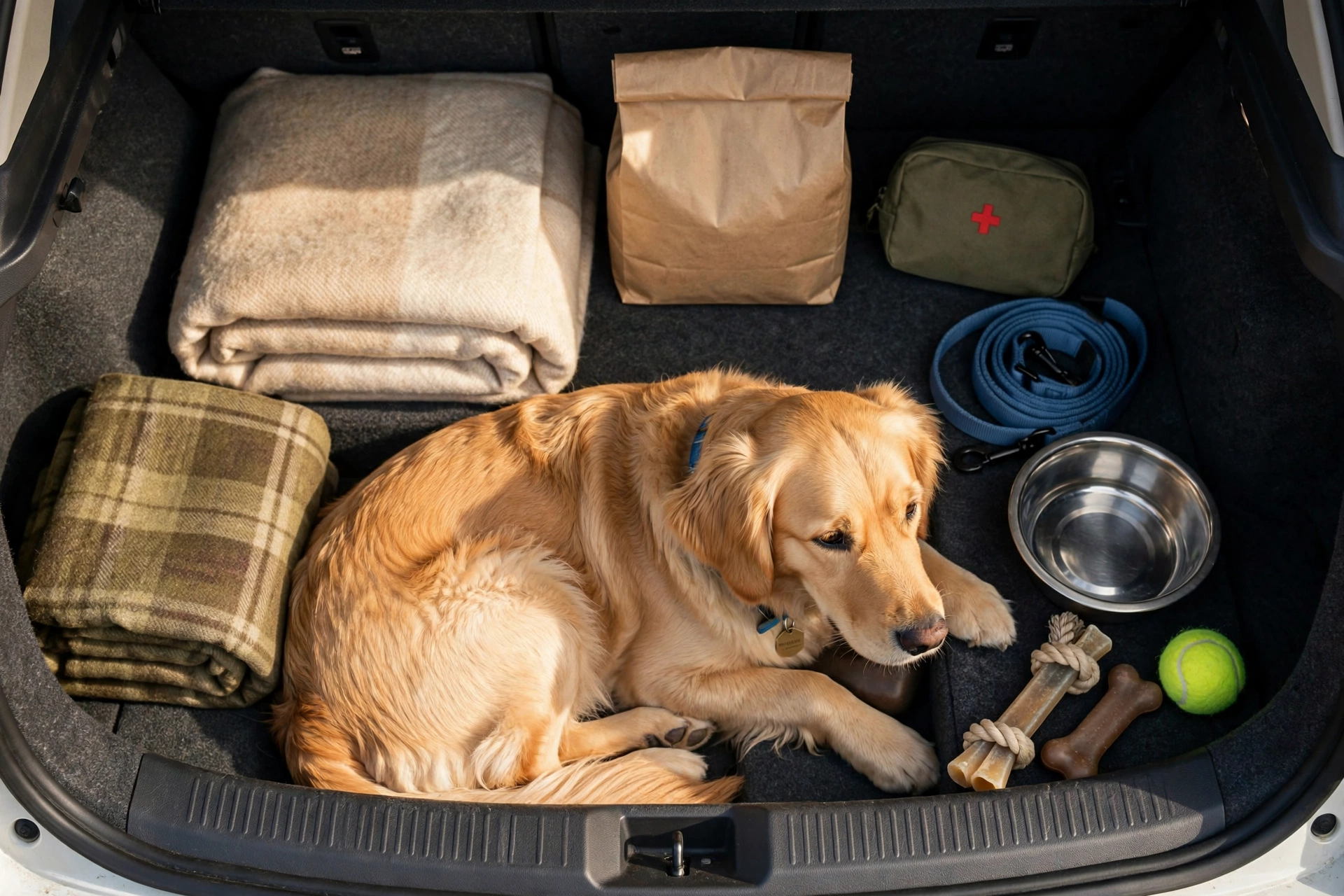
Pack the mat where you can reach it at the first stop, not at the bottom of the boot under the suitcases. A simple routine works well: mat and bowl in a single washable tote with a small towel, a bottle of water and waste bags, so every break uses the same grab-and-go kit. At the end of a trip, inspect the whole surface in good light for punctures, seam splits and chew damage, and check that valves still seal. A damaged gel mat should be retired rather than taped and trusted — leaking filling on a car seat or a cottage carpet costs more than a replacement. Store the cleaned, fully dry mat flat or loosely rolled in a cool, dry place, ideally with the maker instructions kept with it, so next summer starts with a check rather than a surprise.
Budgets: what extra money actually buys
Expect three broad tiers, with prices varying by size and retailer, so check current listings before you buy. Basic gel mats for small and medium dogs commonly sit in an entry band of roughly £10–£25. For that money you should still expect sealed edges, a wipe-clean surface and clear size and weight information; what you typically give up is thickness, durability and generous sizing. The middle band, roughly £25–£50, is where most travellers get best value: larger and thicker gel mats, better covers, and entry-level phase-change designs. Spending here usually buys a mat your dog will actually fit on and a cover that survives a season of car boots and campsite floors. Above roughly £50, premium phase-change mats, extra-large sizes and robust raised-bed combinations promise steadier temperatures and longer life, but the benefit only shows if the size and technology genuinely suit your dog — a costly mat in the wrong size loses to a modest mat that fits.
Budget for the system, not just the mat. A serviceable portable bottle or bowl often costs under £10, a well-fitting evaporative coat commonly sits in a similar range to a mid-range mat, and a windscreen shade, a small battery fan and a spare towel add modest amounts that collectively do real work. Conversely, the most expensive mistake is duplication: two mediocre mats where one good one would do, or a coat, collar and mat all bought for a dog who hates wearing kit and prefers plain shade. Buy the mat first, test it at home across a warm week, then add only what your dogs behaviour and your travel style still lack. Keep receipts and retailer returns terms in mind too — a mat tested indoors for fit is far easier to exchange than one returned muddy after a festival weekend.
Summer travel packing checklist
Use this list as a final check before a warm-weather departure, and adapt quantities to the length of the trip and the size of your dog.
- Cooling mat, checked for punctures and cleaned, packed where you can reach it at the first stop.
- Usual bed or blanket, so the mat can overlap it and the dog can choose how cool to lie.
- Portable water bottle and a collapsible bowl, plus a larger reserve bottle for the car.
- Cooling coat or vest if your dog is already comfortable wearing one, fitted and tested at home.
- Light towel for wetting down, drying paws and protecting seats from a damp coat.
- Shade help: a windscreen shade for parked-up pre-cooling, and a plan for shade at each stop.
- Lead, spare lead, waste bags and a long line for shaded, sniffy rest stops.
- Food, measured portions and any medication, stored away from heat in the car.
- Vet details: your own vet number plus a practice near the destination, saved in your phone.
- Pet insurance documents and microchip details, with your contact number current on the chip record.
Finally, rehearse the whole setup once at home. Lay the mat beside the usual bed on a warm afternoon, let your dog investigate it without pressure, reward settling on it, and practise the car arrangement on a short drive. A dog who already understands that the mat means rest will use it in a strange tent or hotel room; a dog meeting it for the first time in a hot, exciting place may reasonably choose the cool bathroom tiles instead — which, on the hottest days, is a perfectly sensible choice to allow.
Practical questions
Before you go
Do gel cooling mats work without putting them in a fridge?
Yes, within limits. Pressure-activated gel mats feel cool because the gel absorbs body heat when your dog lies down, and most regain their cool feel after 15 to 30 minutes without weight on them. They do not need a fridge, but they also cannot cool a hot room. In direct sun or a hot car they warm up like everything else, so always pair a mat with shade, airflow and fresh water.
Can a cooling mat make it safe to leave a dog alone in a car?
No. A cooling mat must never be treated as permission to leave a dog unattended in a parked car, even for a few minutes and even with a window open. Car interiors heat far faster than most people expect, and a mat cannot offset that rise. If a dog cannot come with you, the safer plan is to leave the dog at your accommodation with a responsible person or to change the stop.
How long does a travel cooling mat stay cool?
It depends on the type, the room temperature and your dog. Gel mats typically feel coolest for one to three hours of use before needing a break to reset, water-filled mats stay even for as long as the water remains cooler than the dog, and phase-change mats hold a steadier temperature for roughly two to four hours before they need to re-solidify in a cooler place. Check the maker instructions for your model before you travel.
Are cooling mats safe for puppies, seniors and chewers?
Supervise first use with every dog, and be extra careful with puppies and determined chewers. Choose a mat with sealed, non-toxic contents and a tough, wipe-clean cover, keep it out of reach when you are not there, and stop using it if the surface is punctured. For older dogs, place the mat half over their usual bed at first so they can choose how much cool surface they want.
How do I clean and store a cooling mat between trips?
Wipe most gel and phase-change mats with a damp cloth and mild soap, rinse off soap residue, and air-dry them fully away from direct heat before folding. Empty, rinse and thoroughly dry water-filled mats before storage so they do not smell or grow mould. Store any mat flat or loosely rolled in a dry place, and check seams and surfaces for damage before the next journey.