This guide is general information, not veterinary advice. If your dog shows signs of heatstroke, contact a vet urgently. Where official guidance changes, check the latest advice from your vet and relevant UK authorities before you travel.
Start from two hard facts: sun-baked pavement can burn paws long before the air feels extreme, and a parked car can heat rapidly even on a day that feels merely warm — cracking a window does not fix it. Plan backwards from that: walk early and late, carry water and shade as a system, never leave a dog in a parked car, choose accommodation that stays cool, and treat heavy panting, disorientation or collapse as a veterinary emergency.
The hard facts first: pavement and parked cars
Most summer safety advice sounds gentle — take water, find shade, slow down. The reason behind it is not gentle at all. Dogs cool themselves mainly by panting and through limited sweating through their paw pads, which makes them far less efficient at shedding heat than the people walking them. When the surrounding air is hot, when the sun is strong, or when exercise keeps generating heat inside the body, a dog's temperature can rise faster than panting can bring it down. Once that balance tips, the condition that follows — heatstroke — can damage organs and can be fatal. It is a medical emergency, not a wait-and-see problem.
Two everyday surfaces make that abstract risk concrete. The first is pavement. Tarmac and paving slabs absorb sunlight all day and can become far hotter than the air above them, especially in direct sun during the afternoon. A dog walks on that surface with bare pads, close to the ground where reflected heat is strongest. Burned or blistered pads may not be obvious until later in the day, when the dog becomes reluctant to walk, licks at its feet or limps on a route it handled happily in the morning. The second surface is the floor and air of a parked car. A car acts like a greenhouse: sunlight enters through glass, warms the seats and dashboard, and that heat has nowhere to go. As a general rule, the inside of a parked car can heat rapidly — within minutes rather than hours — even when the outside day feels only warm, even in shade that later moves, and even with a window left partly open. Precise figures vary with the car, the colour, the weather and the starting temperature, so do not bargain with any single number you have seen shared online. The safe conclusion is simpler: there is no warm-day version of leaving a dog in a parked car that you can rely on.
Everything else in this guide is the planning system that follows from those two facts. If pavement dictates when and where you can walk, then your itinerary needs early starts and shaded routes rather than midday ambitions. If a parked car is never a kennel, then every stop on a journey — fuel, food, a viewpoint, a farm shop — needs a dog plan made in advance, not improvised in a hot car park. If accommodation cannot stay cool through the afternoon, then a cheap room can cost you the whole shape of the day. Read the sections that follow as one joined-up system, and use the hottest forecast day of your trip, not the average, as the day you plan for.
Heatstroke: signs and first response
Heatstroke develops when a dog's body temperature rises beyond what panting can control. It can follow exercise in heat, being confined in a hot space, or simply resting somewhere with no airflow on an extreme day, and it can progress quickly. Knowing the early signs matters because the gap between a dog that is hot and a dog that is in danger can be short, particularly for the higher-risk dogs covered later in this guide.
Watch for heavy, noisy or laboured panting that does not settle with rest in shade; excessive drooling or thick, sticky saliva; bright red gums or, later, pale or greyish gums; restlessness followed by dullness or unsteady movement; vomiting or diarrhoea; a glazed expression or apparent confusion; and, in severe cases, collapse, tremors or seizures. A dog that stops panting and becomes quiet and limp after being very hot is not recovering — that is a deterioration. Any of these signs on a hot day should be treated seriously, and the more of them you see together, the more urgent the situation is.
The first response has three parts, and the order matters. First, stop: end the walk or activity immediately and move the dog into shade or the coolest available space. Second, call a vet urgently — before you start a long cooling routine at the roadside — and follow their instructions; they may tell you to begin cooling and then travel straight in, and our guide to finding an emergency vet on holiday explains how to locate out-of-hours help quickly when you are away from home. Third, if the vet advises cooling, use cool water — not ice and not ice-cold water — poured gently and continuously over the body, combined with air movement from a fan, a breeze or open car windows while you travel. Avoid draping the dog in heavy wet towels and leaving them in place, because a towel that warms up can trap heat against the body; if you use cloths, keep re-wetting and removing them. Offer small amounts of cool drinking water if the dog is alert and wants it, but never force water into the mouth of a drowsy or collapsed dog.
Two mistakes are worth naming plainly because they are made with good intentions. The first is delay: finishing the walk, driving back to the accommodation to decide, or waiting an hour to see if the dog perks up. Heatstroke can worsen during that hour, and vets consistently advise that suspected cases be seen urgently. The second is overcooling with ice baths or freezing water, which can constrict blood vessels at the skin and slow the release of heat from the core, as well as shocking an already stressed body. Cool, steady and supervised — alongside a vet call, not instead of one — is the pattern to remember. After any suspected episode, even one where the dog seems to recover, get veterinary advice the same day, because internal effects are not always visible from the outside.
Never leave a dog in a parked car — and what bystanders can do
The rule has no warm-weather exceptions worth relying on. Not for five minutes while you collect a parcel. Not with the windows cracked and a bowl of water on the seat. Not in a shaded bay at nine in the morning, because shade moves and queues lengthen. The interior temperature can climb rapidly, a dog cannot open a door, and by the time distress is visible from outside, the dog may already be seriously unwell. If a venue on your route does not allow dogs and nobody in your group can stay with the dog in a running, air-conditioned car, the honest options are to skip that stop, split the group, or leave the dog at your accommodation — and only then if the accommodation's rules permit dogs to be left and the room genuinely stays cool.
Build the rule into journey planning rather than treating it as a moral slogan. Before a long drive, list the stops you actually intend to make and assign each one a dog plan: dog-friendly terrace, shaded picnic area, service station with a dog exercise area, or a passenger staying in the car with the engine and air conditioning running. Supermarkets, museums and many attractions are the pinch points, because they combine a no-dogs interior with a sun-exposed car park. Decide about those before you set off, while you still have choices. If plans change mid-journey — a famous detour, a long lunch — re-run the same question: where exactly will the dog be, in what temperature, supervised by whom?
If you are a bystander who finds a dog in distress in a parked car, act on what you can see. Look for signs such as frantic panting, drooling, barking that turns weak, or a dog that is collapsed or unresponsive. Note the car, the location and the time, try to find the owner quickly in nearby shops, and if the dog appears to be suffering or deteriorating, contact the police on the non-emergency or emergency number as appropriate to the urgency, or an animal welfare helpline for advice. Official guidance in the UK has long been that breaking a window yourself can be treated as criminal damage unless you have a lawful excuse, so the safest course is to involve the police, stay with the dog, and be ready to explain the urgency clearly. If the situation becomes immediately life-threatening, say so explicitly when you call — details about the dog's condition help responders prioritise. Check current official advice before you travel if you want the exact wording, as guidance can be updated.
Walk timing, route choice and the pavement check
On hot days the walk moves to the edges of the day. Early morning, before the sun has had hours to load heat into pavements and before the air reaches its peak, is the main walking window. The second window opens in the evening, once surfaces have begun to release their heat — but test rather than assume, because tarmac can stay hot well after the air feels pleasant. Midday becomes rest time by design: shade, water, a cool floor and, if the dog needs occupation, indoor sniffing games, food puzzles and training in short bursts. A missed walk on one dangerous day will not harm a healthy dog; a forced walk at the wrong hour can.
Use the back-of-hand pavement test every time the route includes tarmac or paving in sun. Place the back of your hand flat on the surface and hold it there for several seconds. If it is uncomfortably hot for your skin, choose a different surface: grass, woodland earth, shaded lanes and towpaths all run cooler than exposed slabs. Watch your dog for its own report — lifting paws, hopping between surfaces, seeking the grass verge, slowing down or refusing to continue are all information, not stubbornness. Booties are sometimes suggested, but they interfere with the limited cooling dogs do through their pads and many dogs walk poorly in them, so treat surface choice and timing as the primary fix, not footwear.
Route design changes as much as timing. Favour loops with continuous shade over out-and-back routes across open ground, because a loop lets you shorten at several points while an exposed return leg cannot be escaped. Riversides, canal towpaths, mature woodland and north-facing slopes hold cool air longer than hilltops and beaches at midday. Carry a turnaround rule agreed before you set off — for example, turn back at the first sign of heavy panting, at half your water, or at a fixed time, whichever comes first — because optimism grows with distance from the car. Shorten expectations across the board: on a genuinely hot day, a relaxed thirty minutes of sniffing in shade is a complete walk, and toilet breaks on grass near the accommodation cover the rest. Dogs that usually run need particular care, since a keen dog will keep fetching, chasing or pulling into heat stress without self-limiting; the lead, the route and the clock are your controls, not the dog's enthusiasm.
Water and shade as a system, not an afterthought
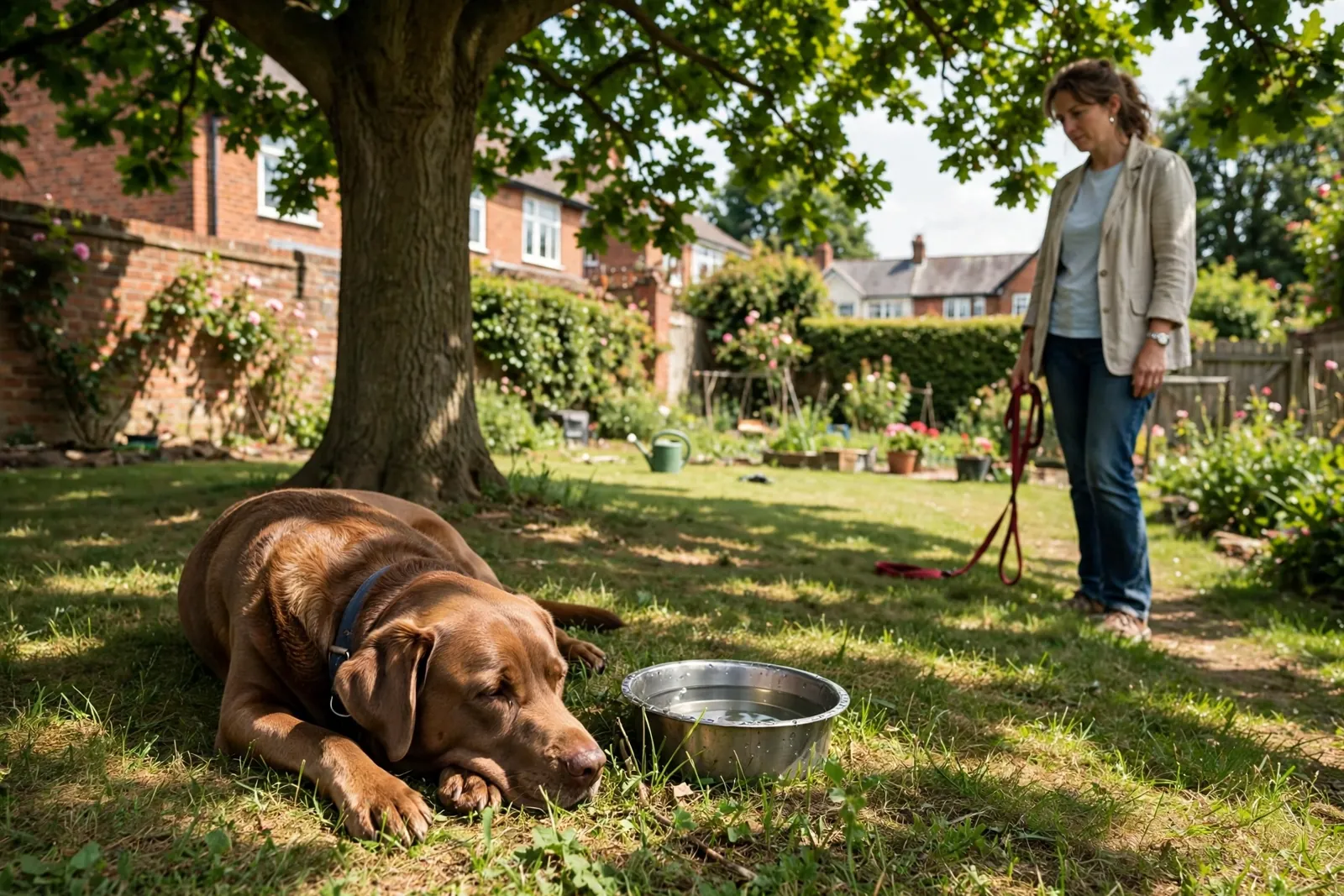
Carrying a bottle is a start, but a system is better. The system has four parts: water carried for the dog specifically, a bowl the dog will actually drink from, shade planned into the route rather than hoped for, and rest stops taken before the dog is desperate. A collapsible bowl weighs almost nothing and many dogs drink far more readily from a bowl than from a squeezed bottle stream. As a rough planning habit, carry more than you expect to use, refill at every legitimate opportunity — pubs, cafés, taps in churchyards and marinas where permitted — and offer water little and often rather than waiting for obvious thirst. A dog that refuses water while panting heavily and seeming unsettled is a dog to rest in shade and assess, not to march on to the next refill point.
Shade deserves the same deliberate treatment. A single tree at the halfway point is not a shade plan for a two-hour route; look at the map for wooded sections, walls and buildings that shadow the path at your walking hour, and beaches or hillsides where shade exists at all. Remember that shade moves: a bench shaded at ten may be in full sun by noon. At rest stops, settle the dog on grass or earth rather than hot stone, loosen nothing that keeps the dog safe, and let panting settle fully before moving on. Wetting the coat can help a dog feel cooler in a breeze, particularly on the chest and belly, but a soaked, thick coat in still humid air is not a substitute for shade and rest, and it is never a substitute for veterinary care if heatstroke signs appear.
At the accommodation, repeat the system indoors. Keep a full water bowl in the coolest room and check it at the times you would check a kettle. If you use a cooling mat, introduce it at home first if possible, place it where the dog naturally rests, and never force a dog to lie on it — some dogs love them, others avoid them, and a mat is an aid, not a treatment. Frozen treats and lick mats can occupy a dog through the hot afternoon, which matters because a bored, rested dog at six in the evening is exactly the dog that will try to persuade you into a long sunset hike; keep the evening walk to the tested, shaded plan anyway. Throughout the trip, the pattern is the same: anticipate the heat an hour before the dog feels it.
Travelling by car in heat: ventilation, breaks and cooling
A moving car with working air conditioning is a reasonable way to travel with a dog on a hot day; a car stuck in a queue with weak ventilation is not, so plan for the journey you might get, not the one you hope for. Before a summer trip, check that the air conditioning actually blows cold, that rear vents — if fitted — are open, and that the dog's travelling position gets airflow rather than sitting in a sun-trap behind glass. A boot area under a rear window can heat significantly even while the front seats feel comfortable, so check the dog's space with your hand at stops and consider a shade for the rear window that does not obstruct your view. Heat and travel rules overlap: our guide to UK car law and restraint for dogs covers how a dog should be secured, which matters even more when windows are open for air.
Never open windows wide enough for a dog to get its head fully out — flying debris can injure eyes and a sudden stop can do worse — and never rely on open windows alone once the car is stationary. Schedule breaks roughly every couple of hours at most, and more often in heat: park in shade, take the dog out on a lead for water, a toilet break on grass and a few minutes of moving air, and wet the chest and belly if the dog is warm. Choose break places in advance where possible — a shaded village green beats a tarmac service area at midday — and keep breaks calm rather than turning them into ball games that generate more heat. If traffic stops for a long period on a motorway in heat, monitor the dog continuously, maximise ventilation, offer water, and treat any heatstroke signs as the emergency described earlier; tell the police or motorway patrol if you need help for a deteriorating dog.
Cooling aids for the car are supporting actors. A cooling mat on the dog's travelling surface can help some dogs, a battery fan clipped safely out of chewing reach can move air, and a light-coloured blanket over a crate can cut direct sun — but none of these makes a parked car safe, and none compensates for failed air conditioning on a long, hot journey. If the air conditioning fails en route on a very hot day, the right decision may be to pause the journey in a shaded, dog-friendly place and travel on in the evening. That is an inconvenience. The alternative — pressing on while the dog overheats in the back — is a veterinary emergency in the making. Build slack into summer drive days so that pausing is possible without ruining bookings, and keep the number of your own vet and the accommodation saved offline in case signal drops where you stop.
Dogs at higher risk: flat faces, seniors, puppies and others
Heat risk is not evenly shared. Brachycephalic breeds — dogs with shortened faces such as bulldogs, pugs and French bulldogs — breathe through narrower airways and pant less efficiently, so they can overheat during exertion or excitement that a longer-nosed dog would handle, and they deserve the most conservative version of every rule in this guide: shorter walks, cooler hours, lower thresholds for stopping, and great caution with travel in heat. Overweight dogs carry insulation and work harder to move, dogs with heart or respiratory conditions have less reserve, and thick double coats in humid heat can struggle even when the same dog thrives in crisp winter weather. Large, very energetic dogs generate a lot of heat when they run, which is why fit young gun dogs and collies appear in heatstroke cases after exercise, not only frail dogs after confinement.
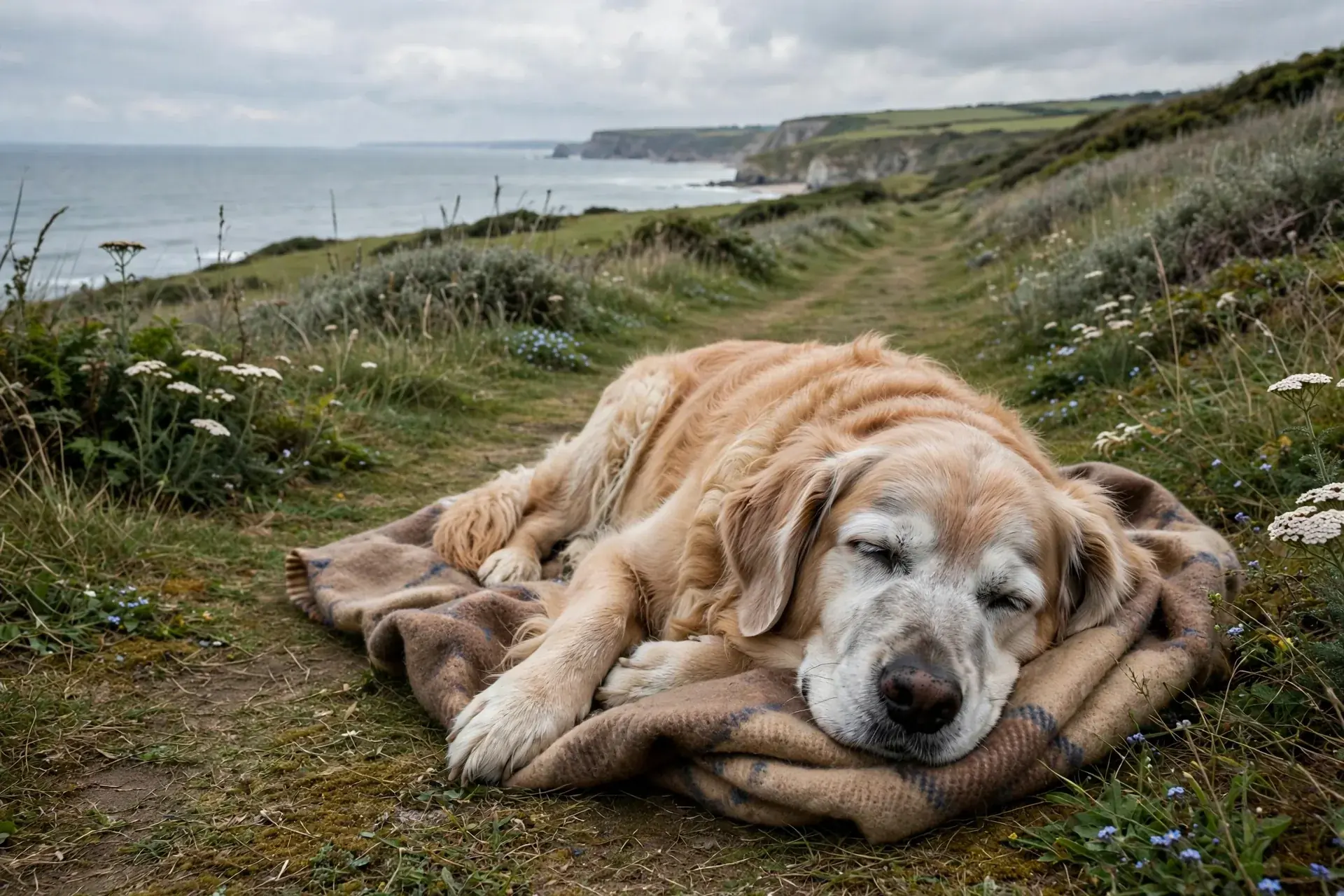
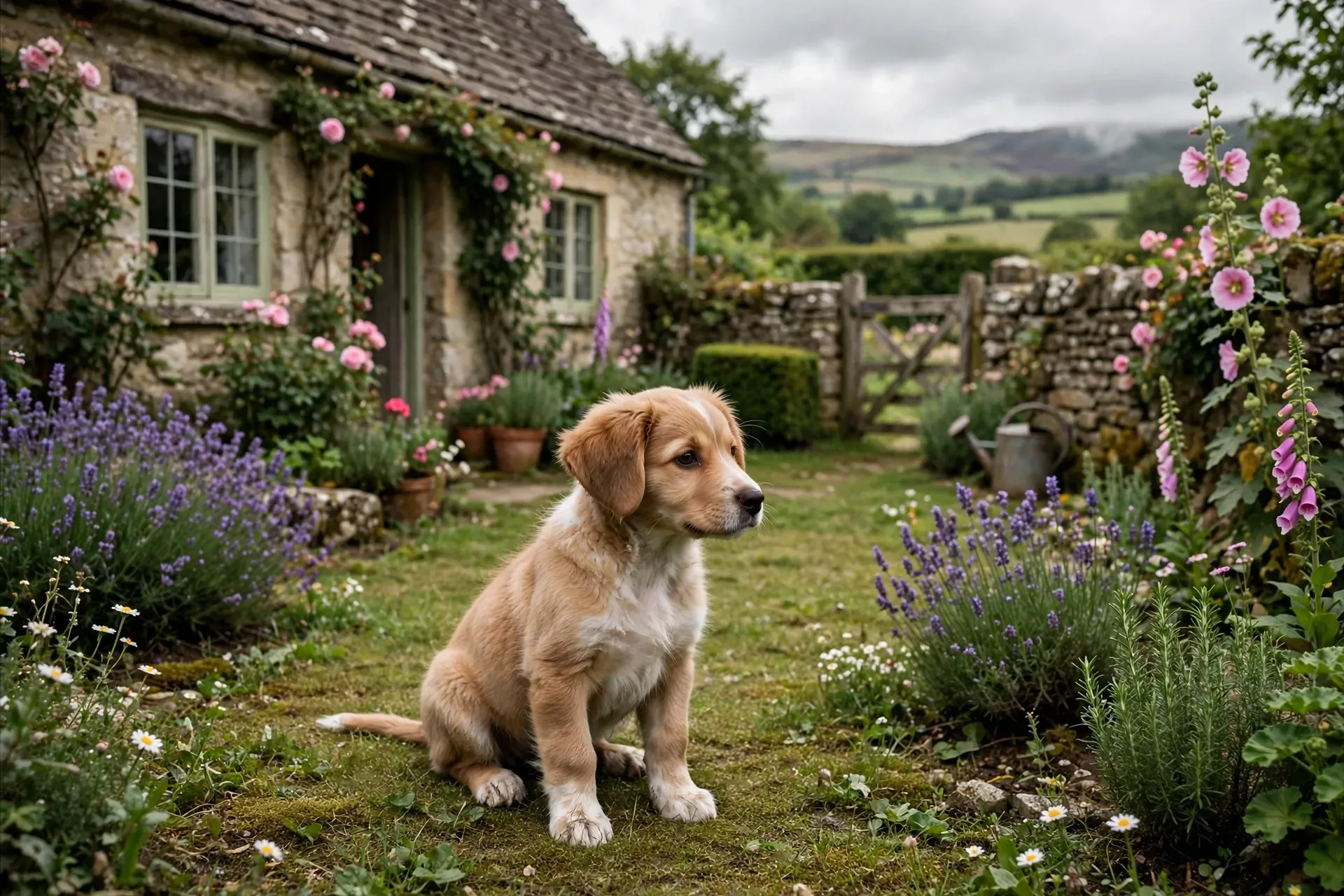
Age shifts the picture at both ends. Older dogs regulate temperature less well, may have arthritis or heart conditions that limit them, and often hide discomfort until it is advanced — our senior dog travel guide covers pacing, rest and comfort planning that pairs naturally with the heat rules here, including checking medication routines with your vet before a trip. Puppies are still developing, tire and overheat in bursts, and have vaccination and exercise limits that already restrict summer plans; if you are travelling with a young dog for the first time, read our puppy's first holiday guide and keep hot-day ambitions modest, because a puppy that flops in the shade is giving you the correct itinerary. For any dog in a higher-risk group, discuss the trip with your vet in advance — particularly if there has been any previous episode of breathing difficulty, collapse or heat intolerance, which should lower your thresholds further still.
Practical adjustments follow from the risk. Walk higher-risk dogs at the coolest end of the morning window, choose flat shaded routes over any climb, halve the distance you would offer a low-risk adult, and skip travel days that combine a long drive with a heatwave peak if the booking can move. Watch excitement as carefully as exercise: a flat-faced dog panting hard with joy at a busy holiday park meet-and-greet is still a dog working hard to breathe. None of this means higher-risk dogs cannot enjoy summer trips. It means their trips are designed differently — cool accommodation, garden shade, gentle dawn walks and long lazy middays — and, designed that way, they are often the most relaxed trips of all.
Choosing accommodation that stays cool
Accommodation decides how much of the day heat controls. When you book for summer, ask questions you would never ask in October. Which way do the main windows and any garden face? A south- or west-facing conservatory, caravan or attic room can become uncomfortably hot by afternoon, while thick-walled stone cottages, ground-floor rooms and shaded, tree-covered pitches hold coolth far better. Is there an outside space with genuine shade through the day, or a single parasol over hot paving? What are the floors made of — dogs sprawl on cool tile, stone or lino to shed heat, and a wall-to-wall carpeted, sun-facing room offers them nowhere to do it. Is there airflow: windows that open on opposite sides, a fan provided, or air conditioning that actually reaches the sleeping area?
Caravans, tents and glamping units need extra scrutiny because lightweight structures track outside temperature quickly. Ask about shade over the pitch, whether awnings or canopies are included, and how the unit is ventilated at night, since a dog that cannot cool down overnight starts the next day already behind. For hotels and inns, confirm the dog-friendly rooms are not only the small rooms beside a warm corridor or above a kitchen — a common pattern — and ask whether the dog may be in the bar or terrace with you in the evening, because a cool public room you can share beats a hot bedroom you cannot leave the dog in. Whatever the property type, check the rule on leaving dogs unattended before you rely on it for a dog-free dinner, and remember that rule and temperature interact: a room that is pleasant at six may be stifling by eight if the sun has moved onto its windows.
On arrival, set the room up for heat before you unpack anything else. Close curtains or blinds on the sun side during the hottest hours, place the dog's bed and water on the coolest floor away from windows, check any garden or terrace surface with your hand before letting the dog out at midday, and identify the coolest room as the dog's afternoon base. If the property proves far hotter than described — no shade, no airflow, a dog showing persistent heavy panting indoors — raise it with the host promptly and be prepared to change plans, including moving properties in an extreme heatwave with a high-risk dog. Comfort clauses are rare in booking terms, so prevention at the questions stage is worth ten complaints afterwards. Keep the questions specific, keep the answers in writing, and let the hottest forecast day make the decision.
Beach and swimming heat traps
The beach feels like the obvious answer to a hot day, and it hides three traps. The first is the approach: car parks and promenades are often unshaded tarmac, and dry sand in full sun can become hot enough to hurt paws long before you reach the wet, cool sand near the water. Test the sand with your hand or bare foot, carry the route across hot stretches only if the dog is small enough to carry safely, use shaded paths where they exist, and time beach visits for morning or evening — which also avoids the most crowded hours and, on many UK beaches, fits better around seasonal dog restrictions.
The second trap is exertion in disguise. Swimming and retrieving feel cooling, and in clean, safe water a short swim can help a dog shed heat — but a dog fetching repeatedly in waves is exercising hard, swallowing water, and heating up internally even while its coat feels cold. Keep swims short, build in shaded rest on a mat or towel out of the sun, offer your carried drinking water rather than letting the dog drink the sea — seawater can cause vomiting and diarrhoea — and end the game before the dog does. Dogs that are weak swimmers, very young, old or flat-faced should paddle in the shallows rather than swim out, and a well-fitting canine buoyancy aid is sensible for boat days and unsure swimmers.
The third trap is water quality. Still, warm, shallow water — lake edges, reservoirs, slow canals and ponds in summer — can develop blue-green algae, which can be extremely dangerous to dogs even in small amounts; our dedicated guide to blue-green algae and dogs explains how to recognise suspect water and what to do if a dog drinks or swims in it. The short version: if water looks green, scummy, paint-like or smells musty, keep the dog out and on the lead, and choose the sea, a clean stream or a paddling pool in the shade instead. After any swim, rinse salt and sand from the coat, dry ears gently, offer fresh water, and settle the dog somewhere cool — a dog that comes home from the beach and pants hard for an hour in a hot car or conservatory has not been cooled by its swim at all. The beach works on hot days only when the whole chain — approach, exertion, water quality and journey home — is planned, not just the middle hour.
Practical questions
Hot weather questions
What temperature is too hot to walk a dog in the UK?
There is no single safe number for every dog. Risk rises as temperatures climb into the low twenties and above, and rises faster for flat-faced, older, very young, overweight or unwell dogs. Judge the dog in front of you, check the pavement with the back of your hand, walk early or late, shorten the route and stop if panting becomes heavy or the dog lags, seeks shade or seems unsettled. When in doubt, skip the walk and use indoor enrichment instead.
What should I do if I suspect heatstroke in my dog?
Treat it as an emergency. Move the dog to shade, stop all activity, contact a vet urgently and follow their instructions while you travel. Vets generally advise starting cooling with cool — not ice-cold — water poured over the body and air movement from a fan or open window, while avoiding covering the dog with wet towels that can trap heat. Do not delay the vet call to watch and wait, because heatstroke can deteriorate quickly.
Can I leave my dog in the car if I crack a window open?
No. A partly open window, shade at the moment you parked, or a plan to be back in five minutes does not make a parked car safe on a warm day, because the interior can heat rapidly as sun moves and air stays still. Take the dog with you where dogs are allowed, leave the dog at your accommodation only if its rules allow it and the room stays cool, have a passenger stay with the engine and air conditioning running, or change the plan.
How do I check if pavement is too hot for paws?
Place the back of your hand flat on the pavement in full sun and hold it there for several seconds. If it feels uncomfortably hot for your hand, it is too hot for sustained walking on paws. Choose grass, shaded lanes or woodland earth instead, walk at cooler times, and watch for lifting paws, hopping between surfaces or reluctance to move, which can signal sore pads.
Is swimming a safe way to cool a dog on a hot day?
Only in water you have checked. Shallow, still water and reservoirs can carry blue-green algae that is dangerous to dogs, hot sand can burn paws before you reach the water, and a dog that swallows a lot of water or over-exerts while fetching can get into trouble. Prefer a shaded paddling spot with clean, gently moving water, keep swims short, offer drinking water from your bottle, and rinse and dry the dog afterwards.