This guide is independent and contains no paid placement. If affiliate links are added later, they will be clearly marked and will not change our editorial checks.
Walk the River Tone first, while the dog is fresh, then Vivary Park and the town centre at a slow pace, and finish with a drive into the Quantocks if the dog still has energy. The town is flat, compact and easy, most pubs and cafes welcome dogs, and the hills start just beyond the rooftops — check the official guidance before you travel for current rules.
Start on the River Tone: the walk that sets the day
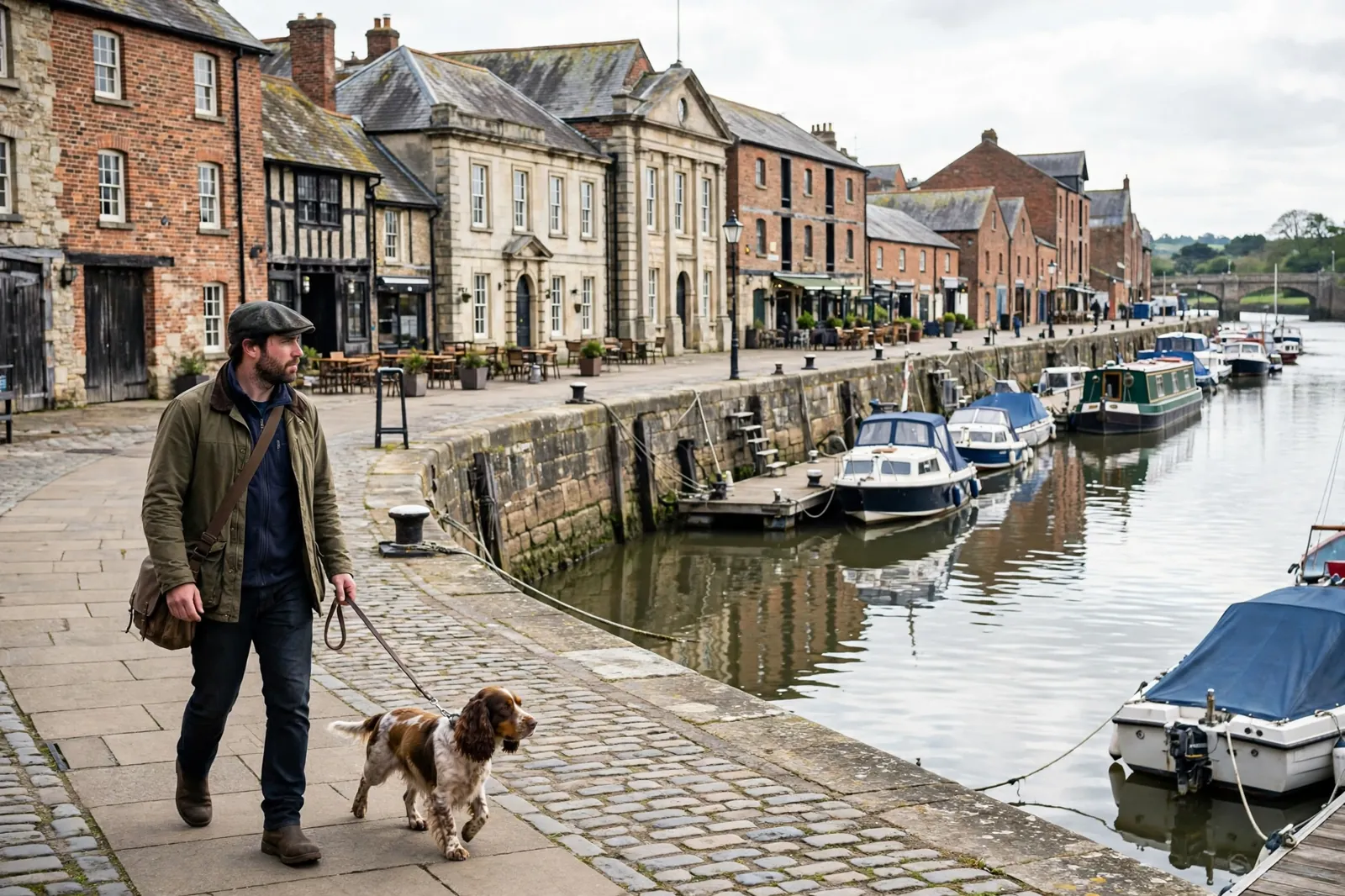
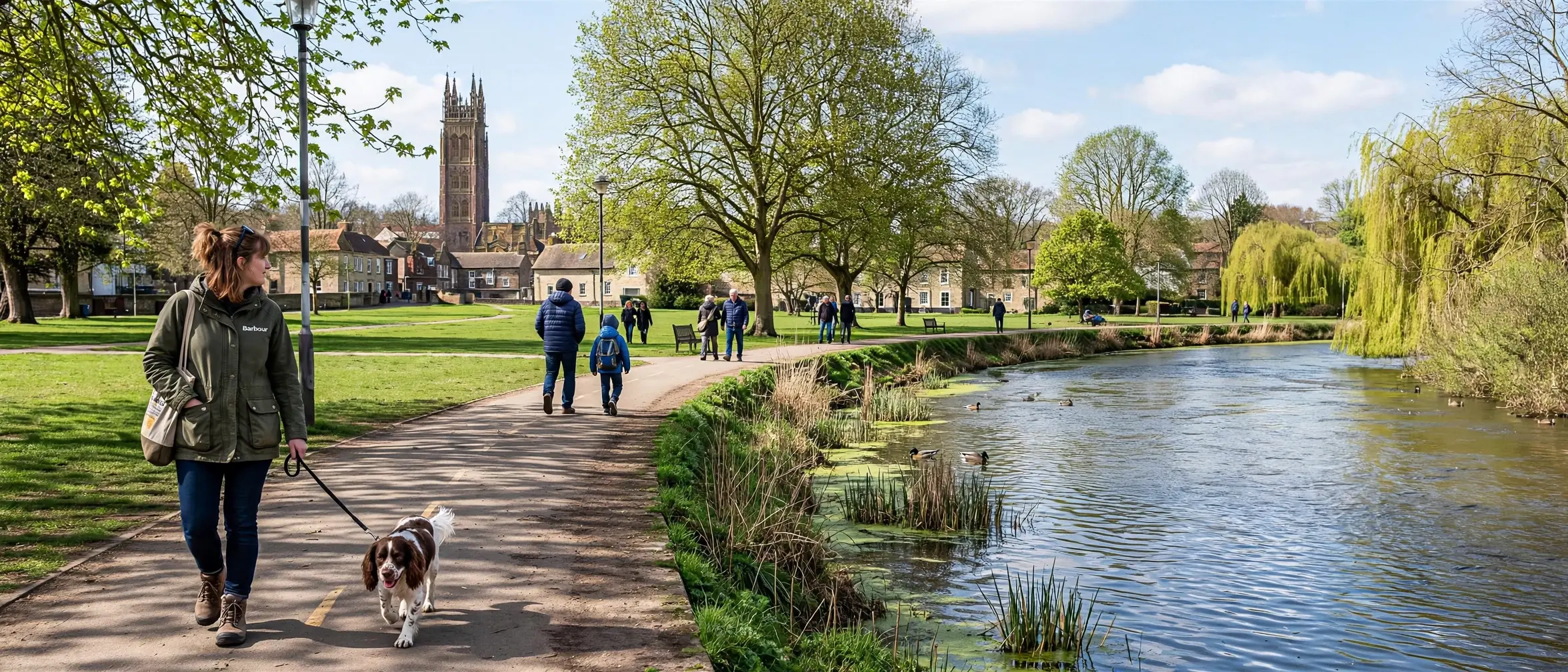
The River Tone runs through the middle of Taunton, and the riverside paths are the best place to start a visit with a dog. The river is wide and slow-moving here, with trees along the banks, grassy stretches and places for dogs to paddle, and the paths on both banks link the town centre to the quieter stretches upstream and downstream. A riverside loop of about an hour is easy to put together without crossing a busy road, and the walking is flat, which makes it ideal for older dogs, puppies and dogs that struggle with hills. Underfoot the paths are soft and easy on paws, and the river gives dogs a place to cool off on a warm day.
The riverside is also a haven for wildlife: kingfishers, herons, ducks and swans are regular sights, and the trees along the banks are full of birdsong in spring and summer. Dogs on leads are welcome on the paths, and the riverside is a good place for a quiet, unhurried walk after the journey. Stay on the lead near the water: the banks drop steeply in places, the river runs deep, and the birds on the banks should be left alone. The riverside paths can be muddy after rain, particularly in winter, so wear boots and bring a towel for the car. The river also floods after heavy rain, so check the local conditions before you set off and have a backup plan in the town if the paths are under water.
The riverside walk is at its best in the morning, when the light catches the water and the town is quiet, and again in the late afternoon, when the day visitors have gone and the paths are empty. The walk is also a good place for a picnic, with benches and open grass, and the river makes a fine backdrop for a rest. If you want a longer walk, the riverside paths link to the footpaths that lead out of town along the Tone valley, so a riverside loop can easily become a half-day outing. The Tone valley is a green corridor through the town, and it is the reason Taunton feels greener and calmer than many towns of its size.
Vivary Park and the town gardens
Vivary Park is the large park in the centre of Taunton, and it is the town's great green space for dog walkers. The park has lawns, trees, flower beds, a golf course and a war memorial, and it is a popular place for local people to walk their dogs, jog and picnic. Dogs on leads are welcome in the park, and the walking is flat and easy, with wide paths, benches and shaded spots for a rest. Keep your dog on a lead in the formal gardens and around the children's play areas, and pick up after your dog. The park is at its best in spring, when the flower beds are in bloom, and in autumn, when the trees turn gold and the leaves crunch underfoot.
The park is also a good place to understand Taunton's history, because the town grew up around the castle and the river, and the park sits on the site of the medieval fish ponds that gave it its name — vivary means a fish pond. The park's war memorial and the bandstand are local landmarks, and the golf course at the edge of the park is a reminder that the park is a working green space rather than a museum piece. Allow an hour to wander the park properly, longer if you like to sit and watch the town go by. The park has a cafe with outdoor seating where dogs are welcome, and the lawns are a good place for a picnic on a dry day.
Beyond Vivary Park, Taunton has a good spread of smaller green spaces: the riverside gardens, the churchyard of St Mary Magdalene, and the open ground around the castle. The castle itself is a ruined Norman fortress in the town centre, now home to the Museum of Somerset, and the castle green is a pleasant place to sit with a dog on a lead. Dogs are not allowed inside the museum except for assistance dogs, so plan a split visit if you want to go inside — check the official guidance before you travel for the latest rules. The town's gardens and green spaces together make Taunton a much greener town than its size suggests, and a dog owner will notice the difference within an hour of arriving.
Cricket and the County Ground
Taunton is a cricket town, and the County Ground, home of Somerset County Cricket Club, is one of the most atmospheric small grounds in England. The ground sits close to the River Tone, and on match days the town fills with supporters, the pubs are busy, and the air smells of cut grass and summer. Dogs are not allowed inside the County Ground for matches, except for assistance dogs, so plan a split visit if you want to watch the cricket: one person goes to the match while the other walks the dog along the riverside paths and in Vivary Park, then swap over for the second session. Check the official guidance before you travel for the latest rules, because the ground's policy can change for different matches and events.
The cricket season runs from spring to autumn, and the town is at its liveliest on match days, particularly for the big county matches and the one-day games. If your dog dislikes crowds, avoid the town centre on match days, or visit on a quieter weekday when the ground is empty and the riverside is calm. The area around the ground is worth a walk even when there is no match, because the riverside paths and the park give you a view of the ground and the town, and the pavilion and the stands are a reminder of the town's sporting heritage. The ground also hosts concerts and community events through the year, and the rules for dogs at those events vary, so check before you go.
If you are a cricket fan travelling with a dog, the split-visit approach works well: the match is a long day, and the dog gets two good walks instead of one long wait. The riverside paths and Vivary Park are both within a few minutes of the ground, so the waiting half of the party is never far away, and the town's pubs and cafes give both halves somewhere to meet for lunch and tea. The key is to plan the day in advance, check the match times and the dog policy, and book accommodation early if you are visiting for a big match, because the town's hotels fill up fast.
The town centre and its shops
Taunton town centre is a working county town centre, with a mix of high street shops, independent traders, cafes and pubs, and a market that has run here for centuries. The main shopping streets are pedestrianised in places, which makes walking with a dog easier, and the pavements are wide enough for comfortable walking. Dogs on leads are welcome in the town centre, and several of the independent shops and cafes welcome dogs inside, so ask at the door if you are unsure. The town also has a shopping centre with covered walkways, though dogs are generally not allowed inside the covered areas, so plan the shopping around the outdoor streets.
Market morning is when the town shows its best side. Stalls cluster around the Market House and spill along the High Street, selling Somerset cheese, cider, cut flowers, plants and bread still warm from the oven, and the traders have time to talk if you stop. A confident dog will enjoy the bustle and the smells; a nervous one will do better on a weekday, when the same shops are open and the streets belong to the locals again. The Market House itself is the old heart of the market, and the streets around it hold the town's independent shops — bookshops, delicatessens, a gallery or two — which give Taunton a character the chain stores never will.
Take the shopping at the dog's pace and it works fine. Keep the lead short in the smaller shops on Bath Place, where the aisles are narrow and the stock is close to nose height, and bring a mat so the dog has somewhere of its own to lie while you browse. The Orchard centre is covered and busy, and dogs are not generally welcome inside it, so plan the shopping around the open streets instead. Most of the independent shops will wave you in if you ask at the door, and the cafes with outdoor tables are the natural rest stops — sit, order, let the dog settle, and the town slows down with you.
Day trips: the Quantocks and beyond
The Quantocks begin where Taunton ends, and they are the town's great walking asset. The hills are England's first Area of Outstanding Natural Beauty, a ridge of heather, bracken and woodland with views across the Bristol Channel to Wales, and they are a short drive from the town centre. The most popular routes start from the villages on the edge of the hills — Crowcombe, Holford, Bicknoller and the smaller hamlets — and follow the ridge paths and the woodland tracks through the combes. Underfoot it is mostly grass and earth, firm in dry weather, and the walking is easy once you are on the ridge. Keep the dog on a lead or a long line up here: sheep and ponies graze the grassland, and the ground-nesting birds in spring and summer need space from a free-running dog.
For a longer day trip, Exmoor is within an hour's drive, with its moorland, valleys and coastal villages, and the Somerset Levels are a short drive to the east, with their flat, open paths and huge variety of birds. The Blackdown Hills to the south offer quieter walking, with wooded valleys and open commons, and the coast at Minehead and Dunster is a good option for a beach day. The Quantocks themselves are the closest and the easiest, and a half-day on the ridge is the perfect complement to a morning in town. The villages on the Quantocks have pubs and tea rooms for a rest, and the walking routes are well marked, though the hills are open and exposed, so carry a map or a phone with offline maps.
- Tone-side circuit: an hour along the river, flat, with the water beside you the whole way.
- Vivary Park circuit: forty minutes of flat, easy paths, a good first walk before the shops open.
- Quantock ridge: two hours there and back, a climb to start and open heath after; save it for a dry day.
- Towards the Levels: half a day for fit dogs; dry weather only, with water and lunch packed.
Up on the ridge there is no water and no shade, so the bottle and the bowl go in the bag before you leave the car, and the forecast gets checked before you set off — the Quantocks are exposed, and a bright morning can turn wet and windy by lunch. The paths are waymarked, but the open heath can feel featureless in mist, so carry a map or offline maps on your phone. Shut the gates as you go, stay on the waymarked paths through the crops, and clear up after your dog: the fields around the town are working farmland, and walkers stay welcome by behaving well.
Eating and drinking with a dog in Taunton
Start with the pubs facing the river and the ones tucked around Castle Green, because that is where Taunton eats best with a dog. The old coaching inns off the High Street still run a bar-and-garden split: dogs settle on the flagstones inside the bar while the restaurant side stays dog-free, and the gardens behind them fill up on the first warm evening of spring. Menus lean on Somerset produce — cider-braised ham, Cheddar-topped pies, Exmoor lamb when it is in season — and the portions are generous in the way county-town pubs tend to be. The cafe inside Vivary Park is the gentler option for a mid-morning stop: order at the counter, take a table on the terrace, and the dog can watch the lawns while you eat. Nobody here makes a fuss about a water bowl; ask once and it arrives without a second thought.
Lunch works differently depending on the day. On a market morning, buy the picnic from the stalls themselves — a loaf, some Somerset cheese, a pork pie, a bag of apples — and carry it down to the benches along the Tone, where the ducks will supervise and the dog can lie in the grass. That beats a cafe table when the dog is muddy from the riverside path, and it costs less than a pub lunch for two. If the weather turns, the covered arcades and the cafes along Bath Place give you a dry fallback, and the delicatessens there sell the same picnic supplies under a roof. Evening meals need a phone call rather than hope, especially on a cricket match day or a Saturday in summer: tell the pub you are bringing a dog when you book, ask for a corner table in the bar or the garden, and you will be seated without the awkward hover by the door.
Let the river walk decide when you eat. A dog that has walked the Tone in the morning will sleep through lunch in the shade of a pub garden, but the same dog will pant and fidget if you drag it across hot pavements at one o'clock for a table in full sun. Eat at eleven or after six on the hottest days, pick the table under the trees rather than the one in the middle of the lawn, and keep a collapsible bowl and a bottle in your day bag so you are not relying on anyone else. Dogs that bark at strangers do better at the edge of the garden with their back to a wall and the lead looped short around a chair leg, and a familiar mat from home gives them a place that smells like theirs. Get the order of the day right — river first, food second — and the pub part of the day takes care of itself.
Where to stay in and around Taunton
The station area is the place to look first for a short break. Taunton rewards staying in town, because the river, the park and the station are all within a few minutes of each other on foot, and the hotels and guest houses near the station and around Castle Green are used to dogs. Before you book, ask for a ground-floor room when you enquire, check whether there is a garden or a yard for the last walk of the night, and find out whether breakfast is served somewhere the dog can join you or whether you will be eating alone. The better hosts keep a towel and a bowl in the room already, and they will tell you straight away if the dog has to stay in the room at breakfast — that is the question to ask before you pay, not after you arrive with a hungry spaniel.
For a longer stay, or for two dogs, the cottages in the villages around the town make more sense than a hotel room. Bishops Lydeard, at the foot of the Quantocks, has stone cottages with walled gardens and a steam railway station at the end of the lane; Trull and Cotford St Luke, to the south and east, are quieter still, with lanes straight onto the Blackdowns and the Levels. Cottages usually take one or two dogs and add a small charge for each, and the details worth confirming are the height and gaps of the garden fence, whether the garden is genuinely enclosed, where the nearest field is for the morning toilet walk, and what happens if you leave the dog alone for an hour while you eat. The campsites and touring parks on the edge of town suit families, with hard standings, dog-walking fields and nobody minding a bark at breakfast time.
Write to the host before you book, and say exactly what dog you are bringing: breed, size, age, how many, whether it sleeps in a crate or on the bed. A host who knows will put you in the right room and warn you about the cat next door, while a host who finds out at the door will put you in whatever is left. Bring the dog's own bed, its usual food and a blanket that smells of home, and give it a quiet first evening so the new place becomes its place. From Taunton the whole of west Somerset opens up — the Quantocks one way, Exmoor the next, the coast at Minehead after that — and our guides to Exeter and Bristol cover the neighbouring cities, with the same attention to split visits, parking and places to stay.
Parking and getting there
Taunton sits just off the M5, between junctions 25 and 26, with the A38 running through the town and the A303 a short drive to the south, so most visitors arrive by car and the first decision is where to leave it. Canon Street car park, beside the shopping centre, is the handiest for the town centre and the river, and the station car park suits anyone arriving by train and staying nearby; both charge, so read the board at the entrance and note the maximum stay before you walk away. On market days, Saturdays and cricket days the town fills early, and by ten o'clock the central car parks are turning cars away — the trick is to arrive before nine, or to use one of the car parks a little further out and walk in along the Tone, which is a pleasanter start to the day than circling the one-way system.
Trains serve Taunton well, with direct services from London Paddington, Bristol, Exeter and Plymouth, and the station is a flat ten-minute walk from the river and the park, so a car-free weekend is realistic if you are staying in town. Dogs travel on the trains without a ticket, though they need to stay off the seats and under control, and the buses out to the villages take dogs at the driver's discretion — check with the operator for the village you want, because the rules differ between companies. The Quantocks are the one place where a car helps: the hill paths start in villages like Crowcombe and Holford, a bus ride or a short drive from town, and Bishops Lydeard, at the end of the line from Taunton, is where the West Somerset steam railway begins its run to the coast.
A parked car is never a kennel, whatever the weather looks like from the driver's seat. The town car parks have almost no shade, and the inside of a car heats up far faster than people expect, so if the dog cannot come with you — the museum, the shops, a long lunch — leave it with a companion on the riverside paths or in Vivary Park instead, and plan the day so the dog is never waiting alone in the car. Electric charging exists in a few of the town car parks but it is thin on the ground; top up before you arrive if you need it. And if the day goes wrong and the river is flooded or the car park is full, the backup is simple: park out at the retail park, walk in along the Tone, and start the day with the river instead of the traffic.
Seasons, weather and what changes
Taunton is at its easiest in late spring and early autumn, when the town is green without being crowded and the walking suits every kind of dog. May fills Vivary Park with blossom and the lanes out to the Quantocks with bluebells, and the light on the Tone in the early morning is the best the town has to offer; September brings the same warmth with thinner crowds, the cricket season winding down and the pubs easier to get into. October turns the trees along the river gold, and the Quantock ridge takes on the purple of the heather, so the walks from town change character week by week. These are the months when a dog gets the lot: a flat riverside walk in the morning, a park to sleep in at lunchtime, and hills on the doorstep for the afternoon.
The cricket calendar decides how a Taunton summer feels. A match day can double the number of people in the town centre overnight, the car parks are full by mid-morning, and the pubs near the ground fill with supporters — so the town is only quiet before ten in the morning. Walk the river early, while the trees still shade the path, and leave the Quantock ridge for the evening, when the sun drops and the breeze picks up; the open heath has no cover at midday. Test the ground with your palm before a midday walk, take a bottle for the dog, and if it starts panting hard or hanging back, get it into the shade and let it cool off before you move on.
Winter strips the town back to its quietest self, and for a dog that hates crowds it is the best season of all. The pubs are warm, the riverside is empty, and the low light across the Tone makes the town look older than it is. The price is the weather: the river floods after heavy rain and the towpaths can be under water for days, the Quantock paths turn to mud, and the short days mean the afternoon walk has to start by three if you want to be back before dark. Pack a torch, a waterproof and a drying coat for the dog, and check the forecast the night before as well as the morning you travel — Somerset weather turns on a sixpence, and a bright start can end in a soaking on the ridge.
A one-day plan that works with a dog
Give the dog the morning and the town will give you the rest of the day. Get in before nine, leave the car at Canon Street or by the station, and take the Tone path first, while the water is still and the town is quiet; an hour of flat walking, with paddling stops for the dog, is enough to take the edge off any dog. From the river, drift through Vivary Park at whatever pace the dog sets — the lawns, the flower beds, the benches under the trees — and by half past eleven you will both be ready for a coffee in town. That sequence is the whole trick: tired dog first, cafe second, and the dog sleeps under the table instead of pulling at the lead.
The afternoon is a choice between two good options, and the dog's energy decides. If it is still fresh, drive out to the Quantocks for the ridge walk, where the views open up across the Bristol Channel and the villages below have pubs waiting at the end; if it is flagging, stay in town and wander the shops and the market streets slowly, with a second riverside loop as the gentle alternative. Both end the same way: back in town by six, a table booked in a dog-friendly pub, and dinner while the dog sleeps at your feet. Book that table when you book the trip if it is a match day — the pubs near the ground fill with supporters and there will be no corner table left by evening.
- 09:00 Park at Canon Street or the station, then walk the Tone loop while the town is quiet.
- 10:00 Slow circuit of Vivary Park, with time on the lawns and under the trees.
- 11:30 Coffee in a town cafe, or on the terrace at the park.
- 13:00 Shops and market streets, or the drive out to the Quantocks.
- 15:30 Ridge walk above the town, or a second riverside loop for a tired dog.
- 18:00 Dinner in a dog-friendly pub, with the table booked in advance.
The coast at Minehead and Dunster is the third day, and Exmoor the second, and the shape never changes: the walk comes first, the sights fit around it, and the dog is never left waiting in a car or a queue. Taunton suits that shape of day better than most towns its size, and the dog will prove it by settling happily under the pub table at the end of the day. For a longer stay, our guides to Bath and Exeter cover the neighbouring cities, with split visits, parking and places to stay covered the same way.
Practical questions
Before you go
Is there a riverside walk in Taunton for dogs?
Yes, the River Tone runs through Taunton and there are riverside paths on both banks, with level walking, trees and places for dogs to paddle. The paths link the town centre to the quieter stretches upstream and downstream, and a riverside loop of about an hour is easy to put together without crossing a busy road.
Can dogs go into Vivary Park in Taunton?
Yes, dogs on leads are welcome in Vivary Park, the large park in the centre of Taunton. The park has lawns, trees, flower beds and a golf course, and it is a popular place for local dog walkers. Keep your dog on a lead in the formal gardens and around the children's play areas, and pick up after your dog.
Can dogs go to the cricket in Taunton?
No — the County Ground takes assistance dogs only, so a cricket day needs a split visit: one of you watches the match while the other walks the dog on the Tone paths or in Vivary Park, then swap over for the second session. The ground is only a few minutes from the riverside, so the waiting half of the party is never far away. Match-day rules can change, so look at the club's own page before you travel.
Where can my dog walk off the lead near Taunton?
For a proper off-lead run, head for the open heath of the Quantock Hills above the town. Stay on a long line through the spring and summer nesting season, and until you are clear of the grazing sheep — the heath is open, but the birds nest on the ground and the sheep are everywhere. The Tone paths are best on a lead, because the banks are steep and the water is deep, and Vivary Park and the town centre are lead-only. If you are unsure whether a field is stock-free, stay on the line — a long line still gives the dog room to run.
Where do I park in Taunton with a dog?
Park at Canon Street, beside the shopping centre, for the town centre and the river, or at the station car park if Canon Street is full. Market days, Saturdays and cricket days fill both, so get in before nine in summer, or use a car park further out and walk in along the Tone. A dog should never wait in a parked car — the town car parks have almost no shade.
Is Taunton a good base for exploring Somerset with a dog?
Yes, Taunton is one of the best bases in Somerset, because it sits between the Quantock Hills, the Blackdown Hills, Exmoor and the Somerset Levels. The town has good transport links, a wide range of places to stay, and the riverside and the parks give the dog a proper walk without leaving town.