This guide is independent and contains no paid placement. Opening times and dog policies can change, so check signs and staff advice on the day.
Visit Thirsk early, walk the square in a wide, unhurried circuit, explore the lanes behind it, and only then decide whether a moor-edge walk suits your dog. Keep the dog on a lead in town and near livestock, carry water, and use cafe stops as rest points rather than afterthoughts.
The square at a dog's pace
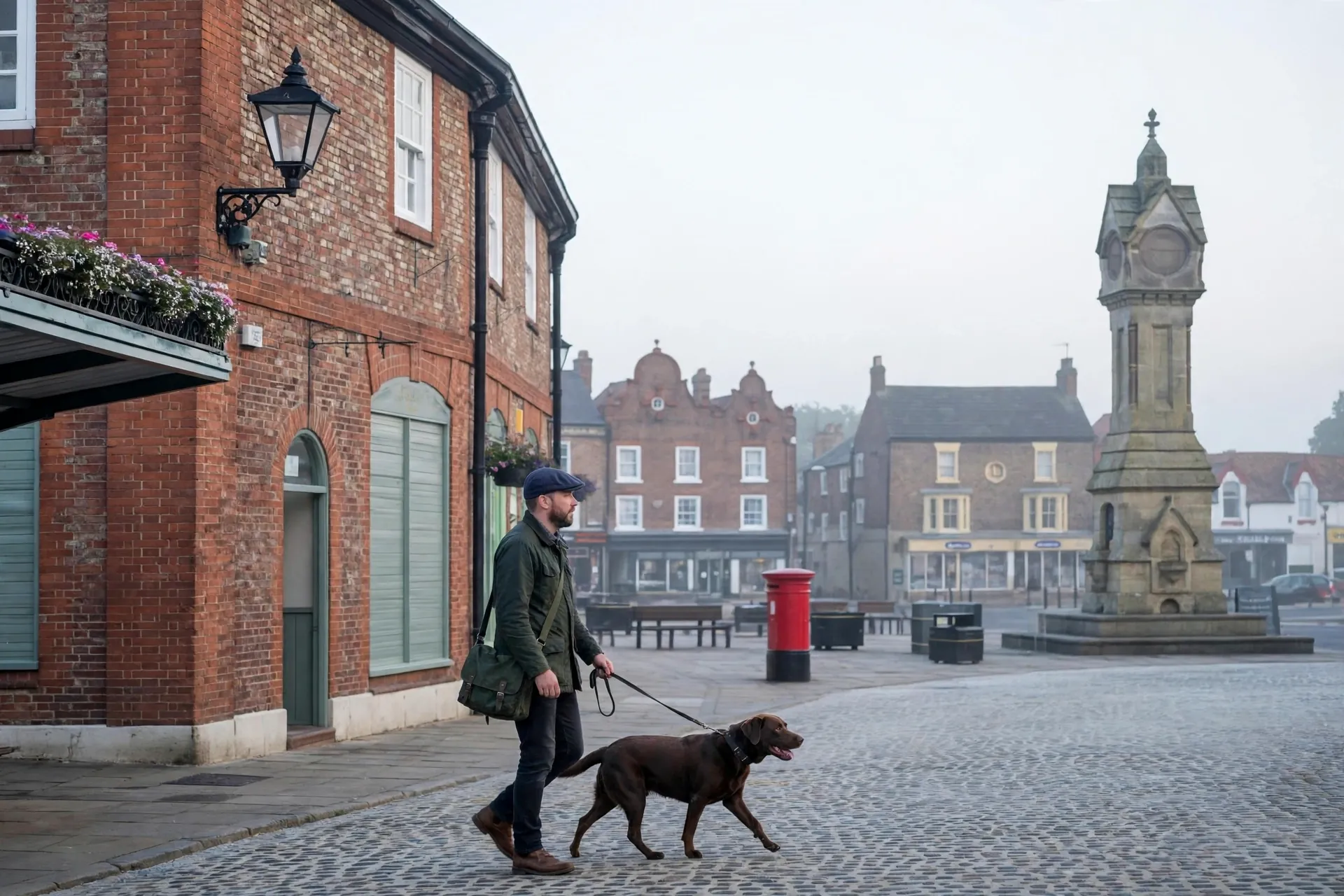
Thirsk's market square is the natural starting point, and its openness is both its charm and its challenge. Unlike a narrow market street, a square gives a dog room to keep distance from other dogs, pushchairs and groups, and room for an owner to step aside without blocking a pavement. That space only helps if you use it deliberately. Walk a wide circuit first, rather than cutting diagonally through the middle, and let the dog take in the scale of the place, the sounds of traffic at the edges, and the movement of people in a gradual way. A first lap with no shopping, no cafe stop and no pressure to perform is often the calmest possible introduction.
On market days the square changes character completely. Stalls, shoppers and vehicles compress the open space, and the wide circuit that felt easy on a quiet morning can become a series of close passes. If you visit on a market day, arrive early, keep the loop short, and use the quieter sides of the square where there is room to pause. If the dog is already showing stress signs, such as constant scanning, pulling towards every exit, or an inability to take treats, shorten the visit and move to the lanes behind the square. There is no prize for completing a market circuit with a distressed dog, and a calm exit preserves the dog's confidence for the next town visit.
Pay attention to surfaces and edges in the square. Cobbles, kerbs, drains and bollards are minor details for people but real obstacles for small, older or arthritic dogs. Choose the smoothest line across the square, avoid forcing a dog to jump kerbs repeatedly, and watch for dropped food near benches and seating areas. A dog that is allowed to sniff benches and planters at its own pace will usually settle faster than a dog that is hurried across the square on a tight lead, because sniffing is how dogs gather information about a new place.
Lanes, yards and quiet corners
Behind the square, Thirsk's lanes and yards offer a completely different walk: narrower, quieter and more sheltered from wind and traffic. These lanes are ideal for dogs that find open squares overstimulating, because the enclosed space reduces visual stimulation and gives the dog a clearer, more predictable path. Walk them slowly, allow the dog to investigate doorways, walls and hedges, and use them as a decompression route between the square and any cafe stop. A lane walk is not a shortcut to be rushed; it is the part of the visit where many dogs finally relax.
Lanes also bring their own hazards. Delivery vehicles, reversing cars, bins and narrow pavements can create sudden close encounters, and a dog that is off lead in a lane can turn a corner into traffic or another dog very quickly. Keep the dog on a short lead, walk on the side away from vehicle entrances, and pause at corners to check what is coming. Residential lanes may also have cats, garden gates and dogs behind fences, all of which can excite or alarm a passing dog. Increase distance where possible, keep moving calmly past fence-line barking, and reward the dog for continuing past a distraction rather than stopping to engage with it.
Use the lanes to build a loop that returns to the square from a different direction. A loop feels more satisfying than retracing the same pavement, and it gives the dog new scents without new crowds. Note landmarks as you go, such as a distinctive shop front, a church tower or a bend in the lane, so you can find your way back without relying on a phone in bright sunlight or rain. For dogs that need a toilet stop, quiet lanes are also more discreet than the centre of the square, provided you clean up promptly and use bins where available.
A veterinary town, without the crowds
Visitors come to Thirsk for the veterinary story as much as for the square, and the museum in the old practice building sits close enough to the centre that a dog walk and a museum stop fit naturally into the same morning. The flow that works best is to walk the dog first, square, lanes, a toilet stop and a drink, and only then approach the museum, because a dog that has already settled is far easier to manage outside while one person goes in, or to settle at a nearby cafe table during a short visit. Door policies for indoor rooms differ from the rules on the street and can shift with exhibitions, so the current position is worth confirming before the day rather than assuming a dog can follow its owner inside. Even without going in, the street outside and the surrounding lanes carry the atmosphere, and a photograph from the pavement plus a slow wander afterwards gives a visitor the flavour without leaving a dog waiting in difficulty.
Before planning a museum visit, check current opening times, ticket arrangements and dog policies, because indoor attractions often have different rules from outdoor streets. Some museums welcome dogs, others restrict them to certain areas, and policies can change with exhibitions or events. If a dog cannot enter, plan who stays with the dog, or enjoy the exterior and the surrounding streets instead, rather than leaving the dog tied outside or in a car. A short walk around the museum area, a photograph of the street, and a cafe stop nearby can still capture the atmosphere without forcing a difficult wait for the dog.
The Herriot connection also offers a useful talking point for children and for visitors who are new to Yorkshire, but it should not become a checklist that rushes the dog. A town visit that tries to cover every literary site in one morning will exhaust a dog that would have enjoyed a slower square and lane walk. Choose one or two points of interest, enjoy them at a dog's pace, and leave the rest for a return visit. Thirsk is a small town that rewards returning, and a dog that has had a calm first visit will be far more willing to explore further next time.
Stepping towards the moor edge
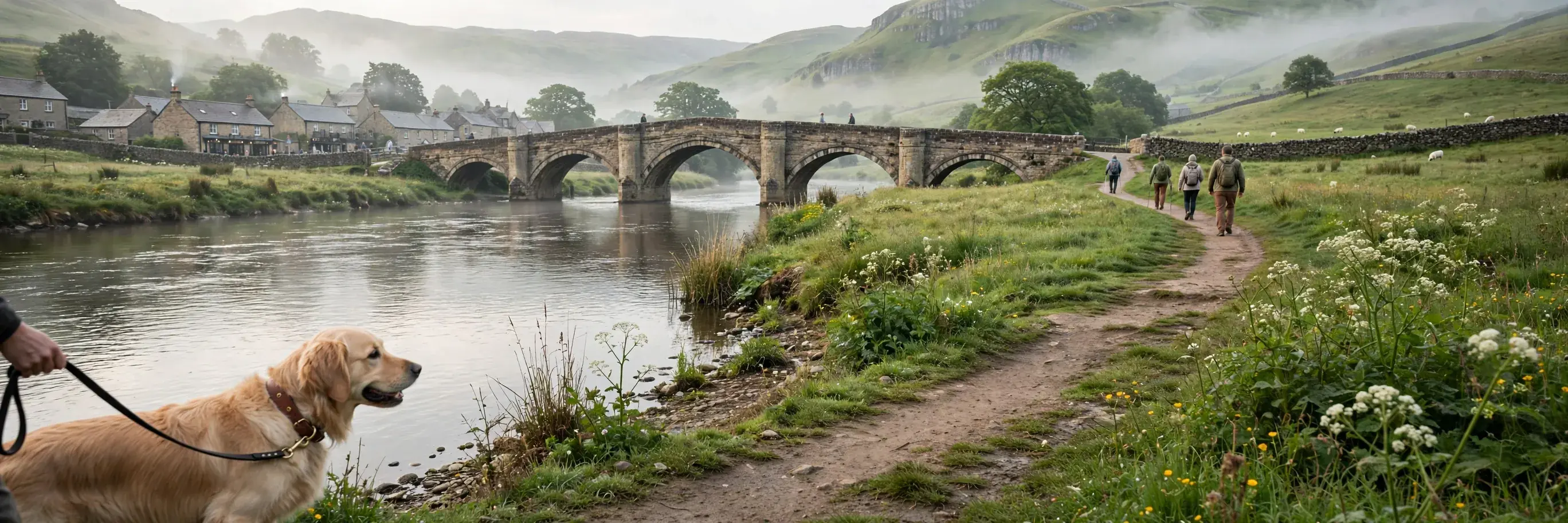
The moors beyond Thirsk are a tempting extension, but they are a different kind of walk from a town square, and the transition needs care. Moor-edge paths can be exposed, uneven and muddy, with livestock, ground-nesting birds and open access land that brings its own rules. Before setting out, check the route length, the gradient, the surface and the weather forecast, and check the official guidance before you travel if the route crosses farmland or access land. A short, level moor-edge loop is a better first step than a long, ambitious crossing, especially for dogs that have already spent a morning in town.
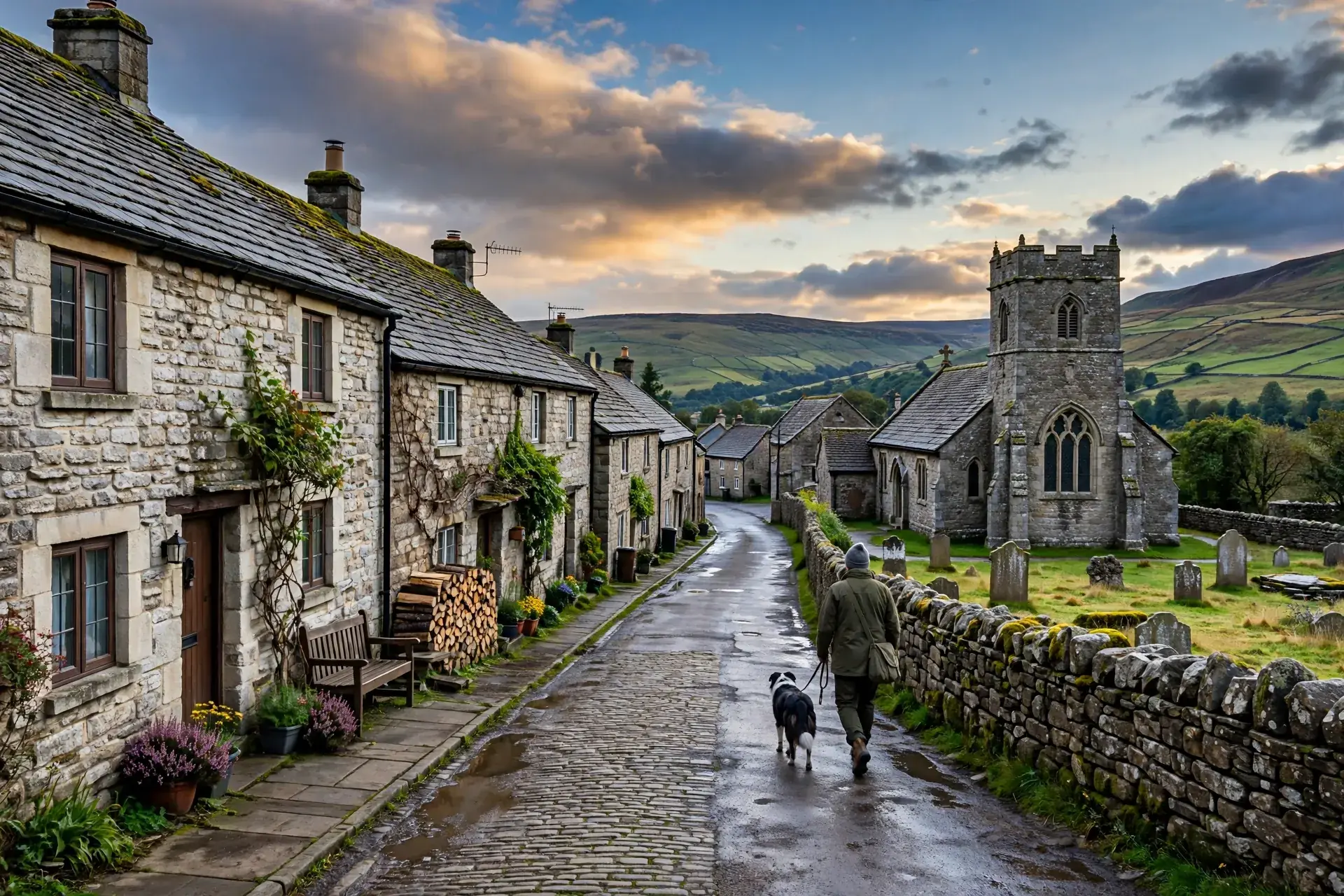
Across the field paths and the fringe of the grouse moor above Thirsk, a lead is not a courtesy. It is the tool that keeps sheep, lambs and nesting birds safe from a dog that only wants to chase. The enclosed fields between town and open ground often hold ewes with lambs in spring, and a dog running loose through a lambing field can scatter a flock in seconds, even if it never touches an animal. Higher up, where the heather begins and the ground opens out, ground-nesting birds sit almost invisible in the vegetation from March into midsummer, so a dog quartering through heather can destroy a nest without its owner ever seeing it. Notices at field gates and stiles spell out the current restriction for that particular path, and those signs override any general habit: read them at the gate, clip the lead on before the dog enters the field, and keep it on until you are back on a lane where no livestock is in sight. If the dog's recall fails around sheep, that is not a detail to work on mid-walk. It is the reason the lead stays on for the whole route. For the wider legal picture, see our guide to dog on lead law in the UK.
Deciding what to carry starts from the square, not from a list. The question is how far beyond the town the dog is actually going, and what changes when tarmac gives way to mud and heather. For a loop that only brushes the moor fringe, a short lead, a collapsible bowl and a bottle tucked into a pocket are enough, because the car and the cafes stay within easy reach. Stretch that loop into a proper hour on open ground and the kit has to change: a longer lead for the exposed stretches, a towel for the mud the dog will pick up on the field tracks, and a phone with the route saved before leaving town, because signal thins out once the ground rises. Check paws and coat for ticks and thorns on the way back into town, and if cloud drops onto the ridge or the dog begins to lag on the return slope, turning early is the right call. The moor fringe will still be there on a clearer day, and a dog that comes home sound is worth more than a finished route.
Rainy-day stops that actually work
Rain changes Thirsk from a square-and-lanes town into a series of short hops between shelter. The best rainy-day plan is not a single long walk but a chain of brief outdoor loops and indoor rests. Walk a short lane circuit, stop in a dog-welcome cafe, dry the dog, then walk another short loop, and repeat. This pattern keeps the dog moving without long exposure to rain, wind and wet pavements, and it gives the owner a chance to enjoy the town without rushing. Choose cafes with space near the door for a wet dog, a mat from home, and a table where the dog will not block a walkway.
Wet pavements and cobbles can be slippery, especially for older dogs, and umbrellas at dog height are a recurring hazard in narrow lanes. Keep the lead short, walk on the inside of the pavement away from umbrellas and shop awnings, and dry paws after each outdoor stretch. A drying coat is more practical than multiple towels on a rainy day, because it keeps working while the dog rests in a cafe, and it protects car seats on the journey home. If the dog is shivering, reluctant to walk or lifting paws repeatedly, shorten the outing rather than pushing through: cold, wet dogs lose heat quickly, and a short successful rainy visit is better than a long miserable one.
Indoor attractions, shops and cafes all have their own dog policies, so check before entering rather than assuming. Our guide to dog friendly cafes explains how to ask, where to sit, and how to settle a dog indoors, and those principles apply directly to Thirsk's rainy-day stops. If a particular venue cannot welcome the dog, move on without fuss: Thirsk is compact enough that another cafe or sheltered lane is usually only a few minutes away, and the dog will not notice a change of plan if the owner stays calm.
Parking, toilets and water
Parking in Thirsk is easiest when you arrive early and accept a short walk to the square, rather than circling for the closest space. Central car parks fill quickly on market days and Saturdays, and circling with a dog that needs the toilet is stressful for everyone. Park, note the location, and give the dog a toilet and water stop before heading to the square. That first stop also lets the dog adjust to the town's sounds and smells without immediately facing the busiest area, which is a better start than a direct march from car to square.
Thirsk's car parks sit a short walk from the square, which makes the arrival routine easy to get right and easy to rush, and rushing is the mistake. On a market morning the central spaces fill while traders are still unloading, so a driver who circles for a spot beside the square ends up with a dog that has waited too long and a walk that starts stressed. Choose the first sensible space, even if it adds two or three minutes on foot, and use that walk-in as the dog's settling time: a drink from a bottle and bowl by the car, a toilet stop on the grass or verge before the paved centre, and a few minutes sniffing the quieter approach street. Spare bags go in a pocket at this point, not discovered empty halfway around the square, and bins are worth noting on the way in so the return leg does not become a search. The warm-weather rule stays simple: the dog never waits in the car while its owner shops. On cold or wet days the same arrival stop is the moment to fit a coat and check paws before the town walk begins.
Think about the return to the car as part of the plan, not an afterthought. A dog that has walked the square, explored lanes and visited a cafe will be tired, and a long, confusing walk back through crowds can undo a calm morning. Choose a clear, quiet route back, allow a final toilet stop, and offer water before the drive. A settled dog in the car is the sign of a well-planned Thirsk visit, and it makes the journey home far more pleasant for everyone.
Seasons on the square
On the square, spring arrives as a change in light and in the ground underfoot. The mornings lengthen, the stalls spread a little wider, and the fields beyond town fill with lambs, which means the moor-fringe paths need a lead and a slower approach through the lambing months. Summer turns the same square into a hotter, busier place, where stone and tarmac hold the heat into the afternoon and outdoor tables crowd the edges, so the kindest hours for a dog are the first hour after the town wakes and the shaded lane side once the sun is high, with extra care for flat-faced, elderly or overweight dogs. Autumn usually gives Thirsk its easiest weeks, thinner crowds, cooler air, and colour on the slopes above town, but the leaves that gather in the lanes hide wet stone, and the field tracks turn to mud after rain, so a towel and a slower pace earn their place again.
Winter strips the square back to its quietest self, and that quiet is a gift for a dog that dislikes crowds, provided the cold is planned for. Grit and salt from the treated pavements sting paws and get licked off at home, so a rinse by the car at the end of the walk is worth the minute it takes, and a coat helps a short-haired dog that starts to shiver on a still afternoon. Darkness comes early, so a light on the dog's harness matters on the lanes once the shops shut, and the festive weeks deserve a check before travelling: a Christmas market or a seasonal event can pack the square that was empty the week before, turning a gentle winter loop into a crowded one unless the visit is moved earlier in the day.
The test for any Thirsk visit, whatever the month, is not how much ground the dog covered but how the dog looks at the end of it. A visit that ends with a dog lying flat under a cafe table, breathing easily and willing to walk back to the car without dragging, has worked. A visit that ends with a dog panting, pulling and refusing to settle has asked too much, however impressive the route sounded beforehand. Build the day around the square, the lanes and one rest, and let the moor fringe be a bonus rather than an obligation, and the dog will be ready to come back.
Which dogs enjoy Thirsk most
For a stiff or ageing dog, Thirsk works best when the route stays on the flat ground around the square and the short lane back towards the car, rather than pushing out towards the rising ground east of town. The square itself is mostly level, but the setts underfoot are uneven in places, and the kerbs where side streets drop away can jolt a sore hip or a weak wrist if a dog is hurried over them again and again. Pick a line across the smoother paving, pause at the benches on the quieter side where a dog can lie flat and rest its legs, and treat the lanes behind the square as the turning point instead of the start of a longer climb. Dogs that tire on gradients will find the pull up towards the moor fringe a different proposition altogether: save that slope for another day, keep the town loop to twenty or thirty minutes, and watch for the moment the dog starts choosing the shade and slowing at every corner. That slowing is the signal to head back, not to add another street.
A dog that barks, lunges or freezes when another dog appears needs Thirsk on a weekday morning, not at the height of a Saturday market. Early in the week the square is mostly empty, with long sightlines across the open ground and side streets to duck into the moment a strange dog comes into view, and those two features, space to arc wide and a quick exit, matter far more than any training trick in a new town. Hold the quiet northern and western edges, keep moving past the shop fronts where dogs wait tied outside, and avoid the funnel where shoppers queue for stalls, because a reactive dog trapped in a slow-moving queue has nowhere to go and will escalate. If the dog's breathing quickens, its tail stiffens or it stops taking food, that is the cue to slip down a side lane and end on a calm note, even if the walk has only lasted ten minutes.
Confident, sociable dogs will enjoy Thirsk most when the visit is built around people-watching rather than constant walking. On a quiet morning the square gives such a dog room to watch traders setting up, children crossing to school, and other dogs passing at a distance, all without being forced nose-to-nose with every animal in town. The trick is to protect that confidence: settle on a bench with a chew or a scatter of treats, let the dog observe from a mat, and keep greetings short and owner-initiated rather than letting the dog drag towards every friendly stranger. Young dogs in particular need that structure, because enthusiasm in a busy square quickly turns into pulling, jumping and a habit of rehearsing excitement at every doorway. Short bursts of watching, broken by slow lane strolls and a rest, will leave a sociable dog brighter at the end of the visit than an hour of non-stop hellos.
A sample slow day in Thirsk
Shape the day around the market rather than around a slow start. Arrive while traders are still setting out their stalls, when the square is noisy but not yet packed, and let the dog watch that activity from the quieter edge for a few minutes before moving off down a side lane. That early bustle, kept at a distance, teaches the dog the town's busiest version without trapping it in the thick of it, and the lane walk that follows gives it space to decompress before the stalls reach their peak. By late morning the square will be at its fullest, which is the moment to be elsewhere, a cafe table, a shaded lane, or the car for a rest, and the afternoon, once the crowds thin, is when the moor fringe earns its place, with a short out-and-back while there is still plenty of daylight for the return.
Mid-morning is a good time for a cafe rest, especially if the weather is warm, wet or windy. Choose a table with space, settle the dog on a mat, offer water, and enjoy a drink without rushing. After the cafe, a second short lane loop or a brief square circuit, depending on the dog's energy, keeps the day interesting without overloading it. If a moor-edge walk is planned, it belongs in this middle part of the day, when the dog is settled but not yet tired, and when there is still plenty of time to return before dark. A short moor-edge loop, with a lead near livestock and birds, is a satisfying extension, not a test of endurance.
End the day the way it began: slowly. A final lane walk, a toilet stop, water, and a quiet route back to the car leave the dog settled rather than overstimulated. Avoid squeezing in one more shop, one more viewpoint or one more long walk at the end of the day, when the dog is already tired. A slow Thirsk day that ends calmly is a day the dog will remember positively, and it makes a return visit easier and more enjoyable for everyone.
Thirsk market day with a dog: stalls, crowds and quiet lanes
On a market morning Thirsk stops being a quiet square with room to spare and becomes a working marketplace, and the difference is visible from the first street in. Vans reverse towards the stalls before most shops open, traders wheel crates across the paving, and canopies go up along the edges where a dog could previously walk in a wide, empty arc. The centre of the square narrows as shoppers gather around the stalls, and the routes a dog used on a weekday, straight across the middle or diagonally from corner to corner, no longer exist in any usable form. That change does not make market day a bad day for a dog, but it does make it a different kind of visit, one that needs a plan made before the car door opens rather than improvised in the middle of a crowd.
The congestion is not spread evenly, and knowing where it gathers is the main skill of a market-day visit. The worst pressure points are the fronts of the popular food stalls, where queues form sideways across the walking line and shoppers stop without warning to read a price or taste a sample, and the corners where the square meets its approach streets, where people arriving, people leaving and dogs on leads all try to use the same few metres at once. Gaps between stalls look like shortcuts and should be avoided with a dog, because they narrow to a single file, leave no room to step aside when another dog comes the other way, and often end at a van or a stack of crates rather than an open exit. A dog that is pulled through those gaps on a tight lead learns that market day means close passes and nowhere to go, which is exactly the lesson a nervous or young dog should not take home.
The escape lanes are the lanes and side streets that run off the square, and they are worth learning on a quiet day before they are needed on a busy one. From any side of the square a short turn takes a dog out of the stall area and into a narrower, calmer street, where the noise drops, the footfall thins, and there is room to stop, let the dog sniff, and decide whether to go back in or call it a day. Use those lanes as pressure valves rather than as a second route to be completed: duck out for five minutes when the square tightens, walk one quiet length, and return by a different corner so the dog meets the crowd again from a fresh angle instead of being pushed through the same pinch point twice. Owners who treat the lanes this way, in and out in short bursts, almost always get a longer, calmer market visit than owners who try to hold a position in the centre and wait for the crowd to thin on its own.
For a reactive dog the question is not whether to visit on market day but where to stand, and the answer is on the outer edges with the dog's back to a wall, a bench or a shop front, facing out across open ground so the approaching dog is seen early. That position gives two advantages a reactive dog rarely gets in a crowd: distance, because other dogs pass across the front rather than appearing suddenly from behind, and a clear retreat, because one step sideways puts the dog into a lane instead of into a queue. Keep the lead short but loose, keep treats ready for the moment another dog appears at distance, and move off before the other dog closes in, rather than waiting to see whether this time will be different. A reactive dog that watches five dogs pass at twenty metres and then leaves calmly has had a good market day, even if it never went near a stall, and that outcome beats a single close encounter that undoes weeks of careful work.
Timing decides most of the rest. Early in the morning, while stalls are still being set out, the square is busy with work rather than with shoppers, and a dog can watch the activity, hear the crates and the voices, and get used to the market atmosphere at a manageable level of intensity. Late morning is the peak, when the stalls are fully open, the queues are longest and the centre is hardest to cross, and that is the window to avoid with a nervous, young or easily overstimulated dog. By the afternoon the stalls begin to thin, traders pack away, and the square opens up again, which makes a late visit a reasonable compromise for owners who want the market flavour without the peak crowd. A Saturday market will always be fuller than a weekday one, so a first market-day visit is better made on a quieter trading day, with Saturday saved for a dog that has already proved it can cope.
A few market-day specifics are easy to forget in the excitement and worth building into the routine. Food smells are everywhere, and dropped samples, fallen fruit and scraps near the food stalls will tempt a scavenging dog at exactly nose height, so a short lead and a watchful eye around the food rows matter more than they do on a normal lane walk. Dogs tied outside shops while owners go in for a quick purchase can bark, lunge or simply stare, and a passing dog should be walked wide around them rather than allowed to approach for a greeting. Children dart between stalls, pushchairs stop suddenly, and a dog that is comfortable with adults can still be startled by a small child appearing at its head height from behind a canopy. None of this requires avoiding market day. It requires a toilet stop and a drink before entering the square, a lead kept short through the stall area, an exit lane already in mind, and a willingness to leave after twenty good minutes rather than pushing for an hour that ends badly.
A driving day from Thirsk: Sutton Bank and the White Horse
A short drive east from Thirsk lifts a dog walk out of market-town scale and onto an escarpment, and the change of landscape is the point of the trip. The road climbs from the flat vale towards a ridge that stands above the surrounding countryside, and the White Horse, cut into the hillside below the ridge, comes into view as the ground rises. That approach, town streets giving way to open slopes and then to a high viewpoint, is a satisfying contrast after a morning on the square, and it suits a day when the dog has energy to spare and the weather is clear enough to enjoy a long view. It is not, however, a longer version of a Thirsk town walk. The edge, the wind and the gradient make it a different kind of outing, with its own safety rules and its own list of dogs it suits and dogs it does not.
The viewpoint approach should be planned from the car, not discovered at the edge. The visitor-centre area at the top of the bank gives a calmer base than the viewpoint itself: space to park, a toilet stop for the dog, a drink, and a few minutes to settle after the drive before any walking begins. From there the walk towards the viewpoint crosses open ground where the wind is already stronger than it was in Thirsk, and the path narrows as it nears the edge, so a dog that was happily off lead on a lane walk should be back on a lead well before the viewpoint comes into sight. Keep the dog on the inland side of the path, away from the drop, and stop well short of the edge to take in the view rather than walking the dog right up to the lip. The White Horse is best appreciated from a little distance in any case, and a dog gains nothing from standing at the very edge that it does not gain from a few metres back.
Wind and edge safety deserve more attention here than on any walk in Thirsk itself. Gusts on an exposed escarpment arrive without warning, push against a dog's side, flap coats and leads, and can unsettle even a confident animal that is perfectly steady on a town pavement. A dog that pulls hard on the lead is a genuine hazard in this setting, because a sudden lunge towards another dog, a bird or an interesting scent near the edge can pull an owner off balance in a place where balance matters. A short lead, a well-fitted harness, and a rule that the dog never goes ahead of its owner on the final approach are the minimum precautions, and a long lead or an extendable lead should stay in the car: a dog on a long line near a drop has room to build up speed before its owner can stop it. Dogs that chase, dogs that bolt at sudden noises, and dogs that have never met a steep drop should not be taken to the edge at all on a first visit.
The visitor-centre area is also the place to make the honest decision about whether the viewpoint walk is right for the dog on the day. A fit, steady adult dog that walks calmly on a lead, tolerates wind, and has already handled gradients without tiring will enjoy the open ridge, the long views and the cooler air, and will come back to Thirsk tired in a good way. An older dog with stiff joints, a puppy still building stamina, a dog that pulls relentlessly, or a nervous dog that freezes in wind and open space will not enjoy the same walk, and pushing such a dog to the edge for the sake of a photograph helps nobody. For those dogs the better version of the driving day is to stay on the lower, sheltered paths away from the edge, keep the outing short, and return to Thirsk for a lane walk and a cafe rest, which is a complete day on its own terms rather than a failed attempt at a viewpoint.
Difficulty on this trip is easy to underestimate, because the drive is short and the viewpoint looks close from the car. The ground rises steeply, the return leg is uphill in places, and a dog that bounded happily towards the viewpoint can tire on the way back, especially in heat or in a strong wind that adds effort to every step. Carry water and a bowl even on a cool day, because there is no town tap on an exposed ridge, and watch for the signs that the outing should end: lagging behind, seeking shade or shelter, panting that does not settle during a rest, or a reluctance to go on that was not there at the start. Weather changes fast on a ridge too, and cloud dropping onto the escarpment can cut visibility to a few metres, at which point the sensible move is to turn back towards the visitor-centre area and the car, not to press on towards a view that is no longer there.
Done well, the driving day pairs naturally with Thirsk itself. A morning on the square and in the lanes, a short drive out in the middle of the day, a careful viewpoint walk for a fit and steady dog, and a return to town for a quiet lane stroll and a rest makes a full day that uses both landscapes without exhausting either the dog or its owner. The contrast is what makes it memorable: the enclosed, sociable square in the morning and the open, windswept ridge in the afternoon, with the White Horse as the landmark that ties the two together. Just keep the edge rule simple and non-negotiable. The dog stays on a short lead, stays back from the drop, and stays calm, or the viewpoint part of the day is skipped and the lower paths take its place. A dog that comes home sound and settled has had a good driving day, whatever it did or did not stand beside.
Practical questions
Before you go
Is Thirsk market square suitable for a nervous dog?
Often yes, if you visit early and keep to the quieter edges of the square. Wide open space helps nervous dogs keep distance, but market days and busy Saturdays are much harder, so choose a quiet time and a short loop.
Can dogs go on moor-edge walks near Thirsk?
Many moor-edge paths are suitable with a lead, especially where livestock, ground-nesting birds or open access rules apply. Check local signs, keep dogs on a lead near sheep and during bird nesting season, and check the official guidance before you travel.
What is the James Herriot connection in Thirsk?
Thirsk is associated with the veterinary surgeon and author James Herriot, and the town has a museum in his former practice. Check current opening times and dog policies before visiting, as museum rules can differ from outdoor areas.
Where can I park in Thirsk with a dog?
Use a car park close to the town centre, note its location, and give the dog a toilet and water stop before walking to the square. Market days fill central parking early, so an early arrival or a slightly longer walk from a quieter car park is often calmer.
What should I do in Thirsk with a dog on a rainy day?
Use short square and lane loops between cafe stops, keep the dog on a mat indoors where welcome, dry paws after wet pavements, and save longer moor-edge walks for drier weather when paths are less slippery and visibility is better.