This guide is independent and contains no paid placement. If affiliate links are added later, they will be clearly marked and will not change our editorial checks.
Thoralby is a small, quiet village at the foot of the fells where Bishopdale meets Wensleydale. It suits dogs that settle best away from crowds: village lanes, valley paths and fell-edge walks start right outside the door, while Aysgarth Falls, Leyburn and Hawes are a short drive away for everything the village does not have.
Why Thoralby suits a quiet dog break
Most Wensleydale guides start in a market town. This one starts somewhere smaller, and that is the point. Thoralby sits where the narrow valley of Bishopdale opens into the wider floor of Wensleydale, a handful of stone cottages, a village green and a church gathered around lanes that see more sheep trailers than through traffic. There is no high street, no queue for coffee and no car park full of coaches. For a dog that finds busy towns stressful, or for an owner who wants the walk to begin the moment the front door opens, that quiet is the main attraction rather than a drawback.
The village works as a base precisely because it asks so little of a dog. A nervous rescue does not have to cross a crowded market square to reach open ground. A reactive dog does not have to pass a dozen other dogs on a narrow pavement before the walk has even started. An older dog can manage a gentle circuit of the lanes and be home for a nap within half an hour, while a fit young dog can be climbing towards the fell edge in the same time. The scale of the place matches the scale of a dog's day: short, easy outings close to home, with bigger adventures available when you want them rather than forced on you by the location.
That said, Thoralby is a deliberate choice, not a default one. If you want shops, pubs and cafes within a two-minute walk, you will be happier in Leyburn or Hawes, both of which have the bustle and the facilities that Thoralby deliberately lacks. Thoralby suits people who are happy to drive ten minutes for a pub lunch and to carry their own supplies, and who regard the absence of traffic as a feature. Before you book, be honest about which kind of break you actually want, because the village will not change to suit you — and that is exactly why people who love it keep coming back.
Geography explains the rest. Thoralby stands at the southern mouth of Bishopdale, a side valley that runs north from Wensleydale towards the high moorland around Buckden Pike. The River Ure flows past a few miles to the north, the fells rise immediately to the south and west, and the village green sits at the junction of the lanes that serve both. This position gives a dog owner three different kinds of walking within a short radius: flat valley-bottom lanes and riverside paths, the enclosed green fields and dry stone walls of the lower dale, and the open, exposed fell tops for days when the weather and the dog allow it. Few villages of this size offer that range without a car journey first, and that range is what makes a week here feel varied rather than repetitive.
The other thing to understand before you arrive is that Thoralby is a working farming village, not a holiday resort dressed up as one. Sheep and cattle graze the fields around the village, farm vehicles use the lanes, and the rhythms of the place follow the farming calendar rather than the tourist season. That brings responsibilities: dogs on leads near livestock, gates closed behind you, and an awareness that a field that looks empty in the morning may hold a flock by the afternoon. It also brings rewards that a resort cannot offer — the sound of curlews over the meadows in spring, lapwings tumbling over the pastures, and the sight of the fells changing colour with the light. If you treat the village as a place where people live and work, rather than as a backdrop for a holiday, you will get far more out of it, and so will your dog.
First, the village itself
Start with the smallest walk, because it teaches you the most. A circuit of Thoralby's lanes takes twenty to thirty minutes at a dog's pace and tells you everything you need to know about the ground, the traffic and the livestock before you attempt anything longer. From the village green, the lanes run in a loose loop past stone cottages, drystone walls and small paddocks, with views opening south towards the fells at every gap in the buildings. The surfaces are mostly tarmac with grassy verges, which suits older dogs and puppies, and there are enough quiet corners for a toilet stop without blocking anyone's gateway.
The village green itself deserves a mention. It is the social heart of Thoralby: a small open space where village events gather and where a dog can have a short, calm sniff and a stretch before a longer walk. It is not a dog exercise field, and it should not be treated as one — children play here, neighbours walk through, and a dog charging across it on a long line will not be appreciated. Keep the dog on a short lead, let it sniff the edges, and move on. The green works best as a meeting point and a warm-up, not as a destination in itself.
St Andrew's Church stands at the edge of the village and is worth a slow pass on a lane walk, if only for the view from the churchyard over the valley. Churchyards in the Dales are often peaceful, walled spaces, but they are not dog exercise areas: keep your dog on a lead, keep it off graves, and do not let it drink from any water features. The same rule applies to the small beck that runs through the village. It looks inviting on a warm day, but becks in farming valleys can carry runoff after rain, so carry your own water and let the dog drink from its bowl rather than from the stream.
What Thoralby does not have matters as much as what it does. There is no shop, no pub and no cafe in the village, and no petrol station. That means you should arrive with dog food, poo bags, drinking water and any medication already in the car, and you should plan your meals around the villages nearby rather than expecting to find something on the doorstep. The nearest shops are in Leyburn, about five miles to the east, and in Hawes, about eight miles to the west; Aysgarth, three miles away, has a pub and a village store at certain times of year, but opening hours vary, so check the official guidance before you travel rather than assuming it will be open when you arrive.
Parking in the village is limited and informal. There is no dedicated public car park, so if you are staying in a cottage, use the parking that comes with your accommodation and walk from there. Day visitors should park considerately on the wider parts of the lanes without blocking gates, passing places or farm access, and should avoid parking on the green itself. A good rule is that if a tractor could not get past your car, you are in the wrong place. If you are planning a longer walk that starts in Thoralby, consider parking at Aysgarth Falls or in Leyburn and walking in from there instead, which also gives the dog a longer outing.
Finally, take the time to learn the village's rhythm on your first day. Farm vehicles move early in the morning and again in the late afternoon, and the lanes are at their quietest in the middle of the day and after dark. Sheep are moved between fields without warning, so a lane that was empty at breakfast may hold a flock by lunchtime. None of this is a problem if you expect it: keep the lead in your hand rather than clipped to a belt on a retractable line, walk on the verge facing oncoming traffic where there is no pavement, and give farm vehicles plenty of room to pass. A dog that walks calmly on a short lead through the village will be welcome here; a dog that lunges at every passing trailer will not enjoy the stay, and neither will you.
Bishopdale: the valley on the doorstep
Bishopdale is the walk that defines a stay in Thoralby. The valley runs north from the village towards the high ground around Buckden Pike, a narrow, green-sided dale with a beck running down its centre, dry stone walls climbing the slopes, and a single quiet lane following the water. It is the kind of valley that rewards a slow pace: the beck changes character every few hundred yards, from a shallow, stony run where a dog can paddle in summer to a deeper, faster stretch after rain that is best admired from the bank. Walking it with a dog is less about reaching a destination and more about the valley itself, which is why it suits repeated outings over several days rather than a single forced march.
The lower part of the valley, closest to Thoralby, is the easiest walking. The lane is quiet, the gradients are gentle, and the fields on either side are divided by walls that keep livestock where they belong and give a dog clear boundaries. This is the stretch for older dogs, for puppies on their first Dales outings, and for the first walk of the morning when nobody wants a climb. Keep the dog on a lead through the farmed sections, even when the fields look empty, because sheep graze the valley floor and a loose dog among them is a serious problem for the farmer and a legal risk for the owner. A lead does not spoil this walk; the valley is narrow enough that the dog is never far from something interesting to sniff, and the walls and the beck do the work of keeping the outing engaging.
Further up the valley the character changes. The sides steepen, the walls give way to rougher ground, and the beck is crossed by small bridges and fords that a confident dog will enjoy and a nervous one may need encouragement to cross. This is where the walk becomes a proper half-day outing rather than a stroll, and it is also where the weather starts to matter: the valley funnels wind, and rain that barely registers in Thoralby can be driving hard against the upper slopes. Check the forecast before you set out, carry a waterproof, and turn back at the first sign of the dog tiring or the weather closing in. There is no shelter and no shortcut back in the upper valley, and a wet, tired dog still has to walk the same distance home.
Wildlife is part of the pleasure here, and part of the responsibility. Curlews call over the meadows in spring, lapwings display over the rough pasture, and brown hares use the field margins at dawn and dusk. Ground-nesting birds are vulnerable between 1 March and 31 July, which is why dogs must be kept on a lead on open access land during those months and why you should keep the dog to the path even outside that window. If your dog has a strong chase instinct, this valley will test it: a hare bolting across the lane is a common sight, and a dog on a long line can cover a surprising distance before you can react. A short lead and a calm recall are worth more here than any gadget.
The valley also links to the wider network of Dales paths, which is where a longer stay starts to open up. From the upper reaches of Bishopdale, paths climb towards the moorland edge and connect with routes over to Wharfedale and back down to the River Ure. These are full-day walks for fit dogs and experienced walkers, not something to attempt on a whim, and they need a map, a charged phone and a realistic sense of your dog's stamina. For most visitors, the best use of Bishopdale is simpler: walk up the valley for an hour or two, find a good spot for a rest and a drink, and walk back down the same way, noticing how different the valley looks from the other direction. A valley walked twice is not a valley wasted.
One practical note: the beck is not a reliable water source for dogs. After rain it runs fast and brown with soil from the fields, and in dry spells it can shrink to a trickle between the stones. Carry water and a collapsible bowl on every Bishopdale walk, however short, and offer the dog a drink at regular intervals rather than waiting until it looks thirsty. The same applies to the River Ure further north: a dog that drinks from a river after heavy rain can pick up stomach upsets that spoil the rest of the holiday. Clean water from a bottle is a small weight to carry and a large comfort to have.
Fell-edge lanes and open moor
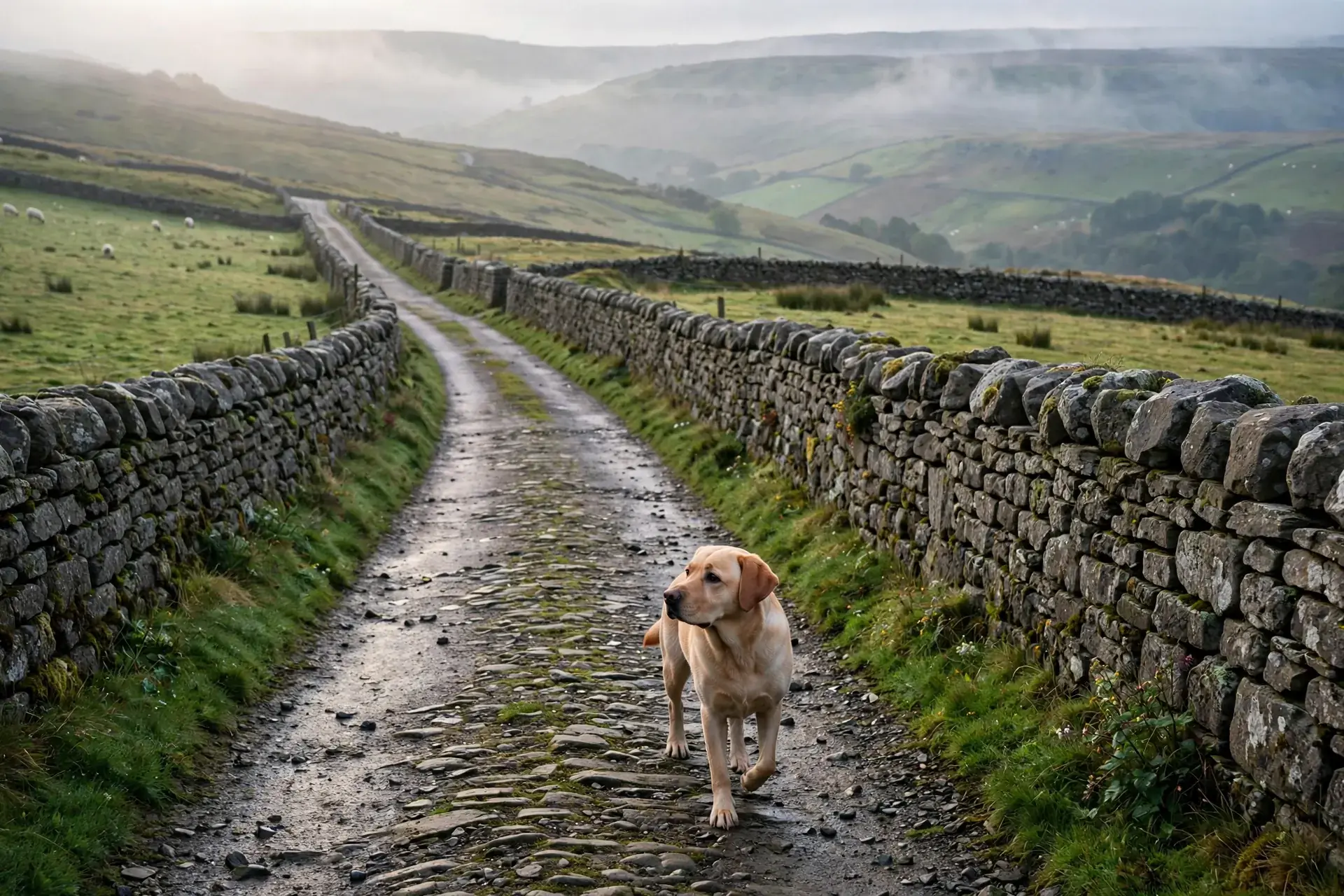
Above Thoralby, the enclosed fields give way to the fell edge, and the walking changes with them. The fell-side lanes climb gently at first, past isolated barns and walled intakes, then open onto rough grass and heather where the views stretch across Wensleydale to the fells on the far side. This is the walking that the cover photograph of this guide shows: a dog on a quiet lane with dry stone walls on one side and open fell on the other, the whole dale spread out below. It is also the walking that demands the most care, because the same openness that makes it beautiful also makes it exposed.
The first rule of the fell edge is the lead rule, and it is worth understanding properly rather than treating it as a formality. Much of the open fell around Thoralby is access land under the Countryside and Rights of Way Act, which gives walkers the right to roam but requires dogs to be kept on a short lead between 1 March and 31 July to protect ground-nesting birds, and on a lead near livestock at all times of year. Sheep graze the fell year-round, and a dog that chases sheep can be shot by a farmer under the law, which is a blunt fact but one that every dog owner walking here should know. Keep the dog on a lead unless you are certain of the ground, certain there is no livestock, and certain of your recall — and if you are not certain of all three, keep the lead on.
The second rule is about the ground itself. Fell paths are uneven, stony and often boggy where the water gathers, and the grass hides holes, rocks and old wall footings that can turn an ankle or strain a dog's leg. Fit dogs cope well, but older dogs, puppies and dogs recovering from injury will struggle on the roughest sections. Choose the surfaced lanes and the lower fell-edge tracks for those dogs, and save the pathless moor for a fit adult dog on a dry day. After rain, the peat hags and boggy patches on the high ground are best avoided entirely: a dog that sinks into a bog up to its belly is frightened, hard to extract, and likely to be filthy for the rest of the day.
Weather on the fell edge changes faster than it does in the village. A clear morning in Thoralby can turn into low cloud and driving rain on the tops within an hour, and the wind on an exposed ridge is strong enough to chill a wet dog quickly. Always carry a waterproof for yourself and a drying coat for the dog, and check the forecast for the fell tops rather than the valley floor before you set out. If the cloud is down on the tops when you leave the village, it will still be down when you get there: turn the walk into a lower lane circuit instead of pushing on into the mist. The fells will still be there tomorrow, and a dog that has a miserable day in bad weather will not want to go back.
Navigation matters more on open ground than it does on lanes. The fell edge has paths, but they are not always obvious, and in mist or low cloud it is easy to drift off course. Carry a paper map and a compass as well as a phone with offline mapping, and know how to use them before you need to. Tell someone where you are going and when you expect to be back, especially if you are walking alone with the dog. Mobile signal is patchy on the high ground, so do not rely on it for navigation or for calling for help. A simple precaution — a note left at your accommodation with your planned route — costs nothing and could matter a great deal.
For all its demands, the fell edge is the most rewarding walking near Thoralby. On a clear day, the view from the high lanes takes in the whole of Wensleydale, the fells rising on either side, and the distant peaks of the northern Dales. The dog will find scents that no valley walk can offer: grouse, hares, curlews and the wind carrying smells from miles away. Keep the outing to a sensible length, build in a rest and a drink at the highest point, and walk back down slowly, giving the dog's legs time to recover from the descent. A fell walk done well leaves a dog tired in the best way — deeply asleep by the fire, with no energy left for mischief.
Linking Thoralby to Aysgarth
Aysgarth is Thoralby's nearest neighbour with a public face, and the link between the two villages is one of the most useful walks in the area. The falls at Aysgarth, where the River Ure drops over a series of limestone steps, are the best-known natural feature in Wensleydale, and they are a natural target for a half-day outing from Thoralby. The walk between the villages takes you through Bishopdale's lower reaches and across the valley floor, and it can be done as a one-way walk with a car shuttle or as a there-and-back route for a fit dog.
The falls themselves are a managed attraction run by the Yorkshire Dales National Park Authority, and the rules there reflect that. Dogs are welcome on the paths around the falls, but they must be kept on a lead, and the riverside steps can be slippery, especially after rain. The upper falls are the most dramatic and the most crowded, so if your dog is nervous around people, visit early in the morning or late in the afternoon when the crowds thin out. The woodland paths above the falls are quieter and give a good alternative for a dog that does not enjoy the crush at the viewing areas. There is a car park and a visitor centre at Aysgarth, and the site is a good place to start or finish a longer walk rather than a destination to linger at with a restless dog.
Between Thoralby and Aysgarth, the walking is gentler than the fell edge and more varied than the village lanes. Field paths cross the valley floor, the River Ure appears and disappears behind the trees, and the views back towards Thoralby and the fells are among the best in the dale. This is also the stretch where you are most likely to meet other walkers, so it is a good place to practise the manners that make a dog welcome in the Dales: a short lead on narrow paths, the dog on the inside away from the drop or the water, and a recall that works when another dog appears around a bend. A dog that can walk politely past strangers and their dogs on this stretch can walk anywhere in the Dales.
Aysgarth also provides what Thoralby does not: a pub, a cafe at certain times, and a village store. After a walk from Thoralby, a pub garden with a water bowl is a welcome reward, but check the policy before you sit down — some pubs welcome dogs inside, others only on the terrace, and the rules can change with the season. The same applies to the cafe: call ahead or check the official guidance before you travel, and do not assume that a pub that welcomed dogs last year still does. A short phone call saves a long, awkward stand-off at the door with a tired dog.
The wider link is worth knowing about too. From Aysgarth, the valley-bottom paths continue east towards Leyburn and west towards Hawes, which means a stay in Thoralby can be the start of a chain of village-to-village walks rather than a series of isolated outings. Richmond, further east in Swaledale, makes a good contrast for a day trip: a proper market town with a castle and riverside walks, where the dog will meet far more people and other dogs than it ever will in Thoralby. The contrast is the point — a quiet village base, with livelier towns a short drive away when you want them.
Three ready-made routes
Rather than a list of vague suggestions, here are three routes that work from Thoralby itself, graded by length and effort. All three start and finish in the village, all three can be shortened by turning back at any point, and all three assume a dog on a lead unless the ground is clearly safe and empty. Distances and times are approximate: a dog that stops to sniff every wall will take longer than a dog that marches, and that is exactly as it should be.
The village loop: about 2 miles, 45 minutes to an hour
This is the route for arrival day, for the first walk of the morning, and for any day when the dog needs a gentle outing. Start at the village green and follow the lanes in a loose circuit past the church and the cottages, keeping to the quieter lanes and using the grassy verges where the road narrows. There is almost no climbing, the surface is kind to paws, and the whole loop can be done on a short lead without any off-lead sections at all. It is the route to choose for an older dog, a puppy, a dog that has travelled a long way to get here, or a first evening when everyone is tired. Do not despise it for being short: a calm, unhurried loop around a quiet village is often the walk a dog enjoys most, because it is full of new smells and none of the stress of a long climb.
The Bishopdale circuit: about 5 miles, two to two and a half hours
This is the classic Thoralby walk and the one to do on your first full day. Head north from the village into Bishopdale, following the valley lane beside the beck as far as your dog is comfortable, then cross to the far side of the valley on one of the small bridges and return down the opposite bank. The outward leg climbs gently and the return leg descends, so the effort is spread evenly, and the two sides of the valley look different enough that the walk back never feels like a repeat. Keep the dog on a lead throughout, because the valley floor is grazed and the beck is crossed by livestock. Pack water and a snack for the dog, and plan a rest at the furthest point — a wall to sit on, a drink for the dog, and a few minutes to watch the valley before you turn for home. In spring, this route is at its best: the meadows are full of flowers, the curlews are calling, and the light in the valley is at its softest.
The fell-edge day: about 8 miles, four to five hours
This is the full-day option, for a fit adult dog and a walker who is comfortable with map reading. Climb from the village to the fell edge on the lanes south of Thoralby, then follow the high tracks along the edge of the moor, with views across the whole of Wensleydale, before dropping back into the valley on a different lane. The climbing is steady rather than steep, but the ground is rough and the route is exposed, so this is a fair-weather walk: do it on a clear, calm day, carry food and water for both of you, and start early so that you are off the high ground well before dark. Dogs must be on a lead on the open fell between 1 March and 31 July, and near livestock at all times, so bring a lead you are comfortable holding for several hours. If the weather turns or the dog starts to flag, cut the route short at the first lane back down — there are several, and none of them is a failure. A fell day done at the dog's pace, with rests and a picnic, is a better day than a fell day forced to a timetable.
Whatever route you choose, build in a margin. Dales walking with a dog always takes longer than the map suggests, because dogs stop, sniff, paddle, and need rests that a walker without a dog would skip. Plan to finish an hour before you think you need to, carry a head torch in winter even for a daytime walk, and keep the car keys and the vet's number in the same pocket. The best walks from Thoralby are the ones that end with a dog asleep in front of the fire and an owner who is already planning tomorrow's route.
Seasons, weather and ground
Thoralby changes with the seasons more than a market town does, because the village is so closely tied to the farming year and the weather on the fells. Spring, from March to May, is the season of new life and new rules: lambs in the fields, curlews returning to the meadows, and the lead restrictions on open access land coming into force on 1 March. The valley is at its greenest, the beck runs high with snowmelt and rain, and the lanes are muddy in places, so pack a towel and expect to wash the dog's paws. Spring is also the season when the village is quietest for visitors, which suits a dog that prefers empty paths.
Summer brings the longest days and the warmest walking, but also the busiest paths around Aysgarth and the most livestock on the fell. The fell-edge routes are at their best in June and July, when the ground is driest and the views are clearest, but heat is a real consideration for dogs: the open fell offers no shade, and a dog that runs in the midday sun can overheat quickly. Walk early in the morning or late in the evening in hot weather, carry more water than you think you need, and watch for the signs of heat stress — heavy panting, a dry mouth, stumbling or a reluctance to keep walking. If you see them, stop, cool the dog with water on its belly and paws, and get to shade. Summer also brings midges on still evenings, especially near the beck: they bother people more than dogs, but a dog with sensitive ears may need a wipe-down after a walk through a midge cloud.
Autumn is many regulars' favourite season in Thoralby. The crowds thin, the light turns golden, and the fells take on the purple and brown of the heather and the bracken. The walking is at its most comfortable — cool enough for a long day, dry enough for the fell paths, and quiet enough that a nervous dog can have the valley almost to itself. Autumn also brings the first frosts, which firm up the muddy lanes, and the first storms, which can make the beck rise quickly after heavy rain. Check the forecast and the river levels before a valley walk after a storm, and do not let a dog swim in a beck that is running fast and brown.
Winter in Thoralby is beautiful and demanding in equal measure. Snow on the fells, frost on the walls, and the village green white in the morning light are the images that make people fall in love with the Dales — but the same conditions make the fell paths treacherous and the lanes icy underfoot. Keep to the lower valley walks in snow and ice, shorten the outings, and dry the dog thoroughly when you get home, checking its paws for ice balls between the toes and for grit from the lanes. A drying coat and a warm bed by the fire are not luxuries in a Dales winter; they are part of the routine. If you are driving to Thoralby in winter, check the road conditions before you set out, because the lanes into the village are untreated and can be impassable after heavy snow. Check the official guidance before you travel in winter conditions, and be ready to change your plans at short notice.
Eating out and staying over
Because Thoralby has no pub or cafe of its own, eating out with a dog means a short drive, and it pays to plan it properly. Aysgarth, three miles away, has a pub that has traditionally welcomed dogs, and West Burton, a similar distance in the other direction, has a pub with a garden that suits dogs in fine weather. Leyburn has several pubs and cafes, some of which welcome dogs inside and some only on the terrace, and Hawes has a wider choice again, including cafes where a tired dog can settle under the table. The pattern is the same everywhere: policies change with the season and with the management, so a phone call before you go is worth more than any guide, including this one. Ask whether dogs are welcome inside, whether there is a water bowl, and whether the dog needs to stay on a lead while you eat.
When you do eat out with a dog in the Dales, a few manners make the difference between being welcomed back and being quietly tolerated. Bring a mat or a blanket for the dog to settle on, so it is not lying on a cold stone floor. Order quickly and keep the dog's lead short and under your chair, so it does not trip the staff or greet every passing plate. Bring a chew or a stuffed Kong to keep a young dog occupied while you eat, and take the dog outside for a toilet break before you sit down. If the dog cannot settle, do not force it: take the food away, eat it in the car or back at the cottage, and try again another day. A dog that has a calm meal in a pub garden is a dog that will be welcome there again; a dog that barks at every other table will not be.
Staying overnight in Thoralby usually means a self-catering cottage or a farmhouse bed and breakfast, and the choice matters more than it does in a town. Ask the same questions you would ask anywhere — how many dogs are allowed, whether there is an enclosed garden, whether the dog can be left alone for a short time, and what the cleaning charge covers — but also ask the questions that only matter in a fell village. Is the garden wall high enough and solid enough to hold your dog? Is there a drying area for a wet dog and a place to hang a muddy lead? Is the cottage near a road where a dog could slip out, or set back from the lane with a gate? A cottage at the edge of the village with a walled garden and a drying porch will suit most dogs far better than a prettier cottage on the main lane with an open front garden.
If you are staying for a week, think about the dog's routine as well as your own. A dog that is used to a garden at home will need a safe outdoor space in the morning and last thing at night, and a cottage with no enclosed garden means every toilet trip is a lead walk in the dark. A dog that is used to being left alone for a few hours will need to be settled into the new routine gradually, with short absences first and a familiar bed and a chew to make the new place feel safe. Most cottage owners in the Dales are experienced with dogs and will tell you honestly whether their property suits your dog — listen to them, especially if they say a property is not suitable for a large or lively dog, because they know the walls, the gates and the neighbours better than any listing can convey.
Practical kit for a fell village
Packing for Thoralby is packing for a place with no shop and no vet on the doorstep, so the kit list is a little longer than it would be for a town break. Water and a collapsible bowl are the first items: carry them on every walk, however short, because the beck is not a reliable source and the fell has no water at all on the high ground. Poo bags are the second: there are few bins in a small village, so carry enough bags for the whole walk and take them home with you, because leaving a bagged deposit beside a wall or hanging it from a branch is worse than leaving nothing at all. A lead and a long line cover the third need — a short lead for the village and the livestock fields, a long line for the open ground where a little freedom is safe.
First aid deserves a proper kit rather than an afterthought. Include tick tweezers, antiseptic wipes, a bandage, a small pair of scissors, and any medication your dog takes regularly, with the vet's number saved in your phone and written on a card in the kit. Ticks are common on the fell and in the bracken from spring to autumn, so check the dog after every walk, paying attention to the ears, the belly and between the toes, and remove any tick promptly with tweezers. Adders are present on the Dales moorland, though bites are rare: keep a dog from snuffling in dry stone walls and rocky outcrops on warm days, and know the signs of a bite — swelling, pain and lethargy — so that you can get to a vet quickly if it happens.
Clothing and equipment for the dog matter more here than they do in a town. A drying coat is worth its weight in a Dales cottage: it keeps a wet dog warm while it dries and keeps the furniture dry. A waterproof coat for a short-haired dog is useful on the fell in rain, and a warm jumper for an older dog is sensible in winter. Paw care is the other half of the routine: check the paws after every walk for thorns, grit and cuts, and carry a small pot of paw balm for a dog that suffers from cracked pads on rough ground. In winter, wash the grit and salt from the paws when you get home, and check between the toes for ice balls after a walk in snow.
The nearest vets are in Leyburn and Hawes, so save the number of the closest practice before you arrive and check its opening hours, especially at weekends. If your dog has a condition that might need urgent care, find out in advance which practice offers out-of-hours cover and how far away it is from your cottage. That is not pessimism; it is the same planning you would do for yourself, and it takes five minutes. Finally, bring a torch for the dark lane walks, a charged phone with offline maps, and a paper map as a backup. The village lanes have no street lighting, and a winter evening walk with a dog is a very different experience from a summer one — magical in its own way, but only if you can see where you are going.
Practical questions
Before you go
Is Thoralby a good base for a quiet dog holiday?
Yes, if quiet is what you want. Thoralby is a small fell-foot village with lanes, a village green and direct access to Bishopdale and the open fells, but it has no shops, so you should stock up in Leyburn or Aysgarth before you arrive and plan your walks around the village.
Can dogs go off lead around Thoralby?
Only where it is safe and legal to do so. Keep your dog on a lead on lanes, near livestock and on open access land during the lambing and ground-nesting bird season, which runs from 1 March to 31 July. Short leads are required on any road, and you should check the official guidance before you travel if you are unsure about a particular route.
How far is Thoralby from Aysgarth Falls?
Aysgarth is roughly three miles from Thoralby by road, and the two can be linked on foot through Bishopdale and the valley lanes in about an hour and a half to two hours, depending on your dog and the route you choose. Driving takes around ten minutes, and there is parking at Aysgarth Falls.
Are there pubs or cafes near Thoralby that welcome dogs?
Thoralby itself has no pub, so most dog owners eat and drink in nearby villages such as Aysgarth, West Burton, Leyburn and Hawes. Policies change, so always check the official guidance before you travel and call ahead to confirm that dogs are welcome inside or on the terrace.
What should I pack for fell walking with a dog near Thoralby?
Pack water and a bowl, a lead and a long line, poo bags, a towel, a first-aid kit, tick tweezers and a map or offline navigation. The fells are exposed and the weather changes fast, so bring a waterproof for yourself and a drying coat for the dog, and check the official guidance before you travel.
Is Thoralby suitable for older dogs or puppies?
It depends on the route. The village lanes and the lower Bishopdale valley paths are gentle enough for older dogs and for short puppy outings, but the fell climbs are steep and the ground is rough underfoot. Choose a short valley loop for an older dog and save the high fell routes for a fit adult dog.