This guide is independent and contains no paid placement. If affiliate links are added later, they will be clearly marked and will not change our editorial checks.
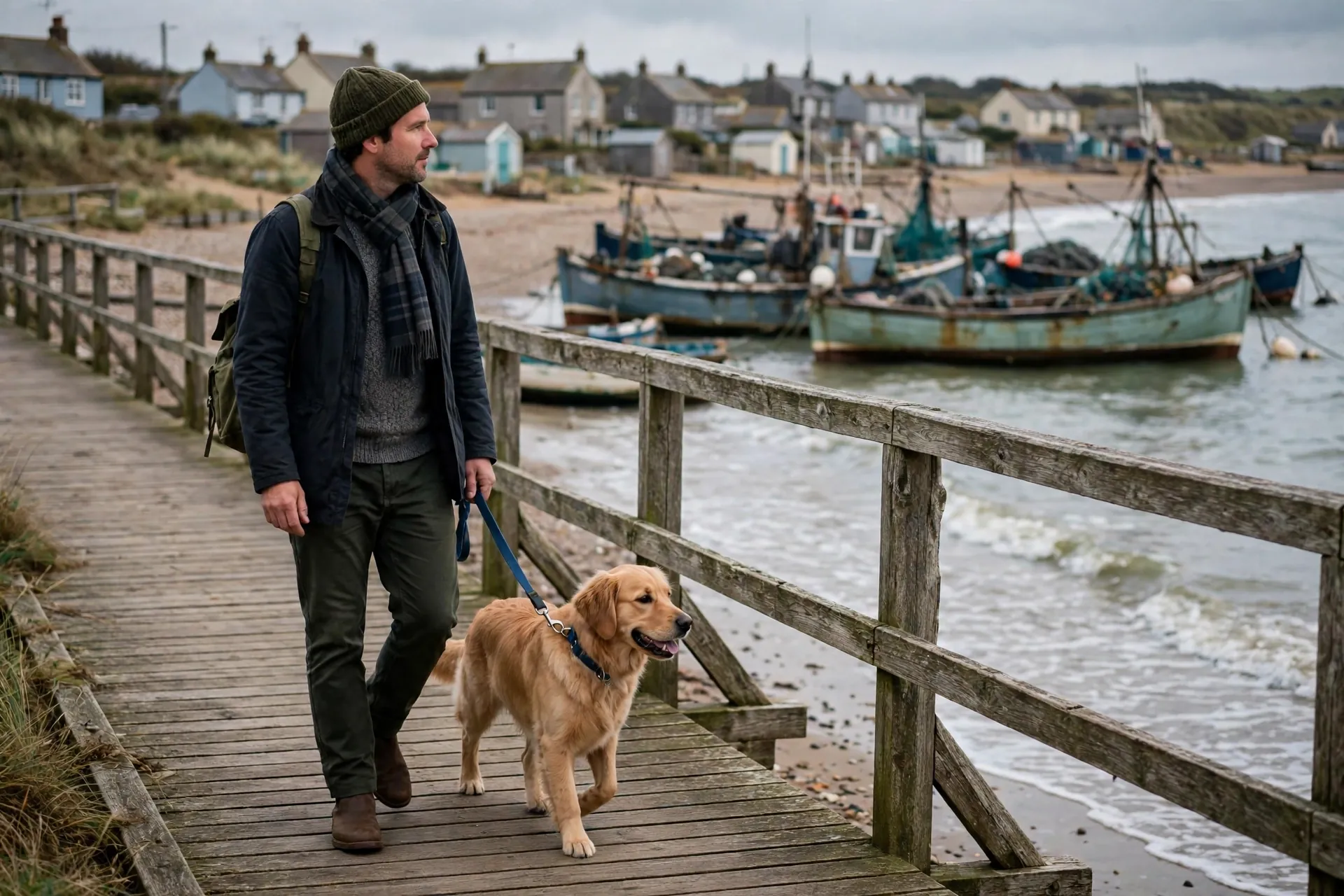
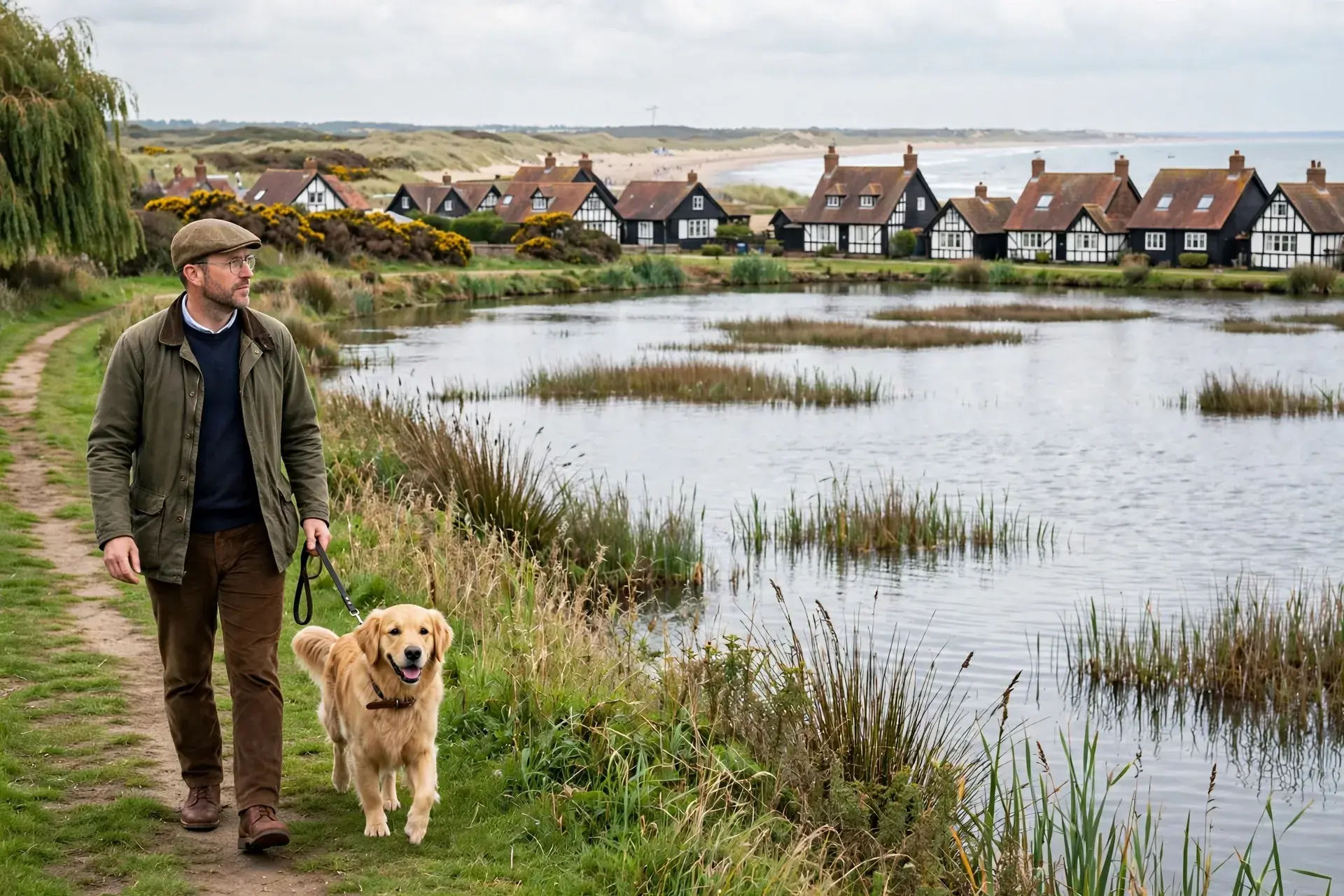
Thorpeness works best as a compact, water-led dog day: one unhurried circuit of the mere, a short detour to the House in the Clouds, a wander through the cottage streets and a beach-path finish, with parking and food stops planned before the dog gets tired.
Walking the full mere circuit
The mere is the place to start, because it sets the scale of the whole village. Thorpeness is not a sprawling resort with a long promenade and a choice of distant headlands; it is a small, purpose-built holiday village wrapped around a sheltered inland lake, and the water gives every walk a centre to return to. On a calm morning the surface is flat enough to mirror the trees and the cottage roofs, while on a breezy day small ripples break the reflection and the sound of the wind in the bankside trees becomes the main background noise. For a dog, that contrast matters. A still, quiet circuit suits a nervous dog that needs time to sniff and settle, whereas a windy day brings more movement, more birds and more distractions, so a shorter first loop is often wiser than insisting on the full distance.
Walk the circuit slowly and treat it as a loop with natural pause points rather than a route to be completed at a fixed pace. The lakeside path follows the water closely enough that a dog can watch ducks, moorhens and other water birds without being able to reach them, which is exactly the kind of controlled excitement that needs a short lead and a calm handler. Where the path narrows or passes close to benches, jetties and other walkers, bring the dog to heel, step to one side and let people pass. Where the bank opens out and the view across the water is clear, that is the moment for a longer sniffing stop, a drink and a photograph. Dogs that pull towards water should stay on a lead throughout, because a steep or muddy bank, a sudden splash and a slippery edge can turn a pleasant walk into a rescue in seconds, and wet dogs and cold wind are a poor combination on the walk back to the car.
Ground conditions around the mere change more than the distance suggests. After rain, shaded stretches stay damp and leaf-covered paths can be slippery, while sunnier, more open banks dry quickly and throw up dust in a dry summer spell. Older dogs and small dogs feel those changes first: a damp, uneven bank that a fit spaniel barely notices can be tiring for stiff hips or short legs, and a long stretch without shade can be hard for a thick-coated dog on a warm afternoon. Build in exit points in your head before you start, so that cutting the circuit short feels like a plan rather than a failure. Returning along the same bank, crossing back towards the village streets or stopping at a bench for ten minutes all count as sensible route decisions, and a dog that finishes the walk still keen for more is in a far better state for the beach path later than a dog that has been pushed around the full lake without a break.
Boats and model yachts on the mere
Water activity is part of the character of the mere, and it changes the dog walk in ways that are easy to underestimate from the bank. Hire boats, rowing boats and other small craft move slowly, but they still create ripples, splashes and voices carrying across the water, and a dog that is calm beside an empty lake can become alert, vocal or desperate to chase once boats are moving. Model yachts add a different kind of movement: small, silent-looking craft that dart and turn on the wind, sometimes in a group, sometimes with people gathered on the bank to watch. For a dog, a model yacht can look like a small animal moving just out of reach, and that is precisely the trigger that leads to lunging, barking and a lead pulled tight at the water's edge.
The practical response is distance and timing rather than correction on the spot. If boats are out, start the circuit on the quieter bank, keep well back from launching points, jetties and any place where people are carrying boats or equipment, and watch the dog for the first signs of fixation: a stiff body, a fixed stare, ears forward and a refusal to take a treat. Those signs are the moment to move on, not the moment to stand and watch for another ten minutes. A short lead, a treat pouch within reach and a habit of turning the dog away before excitement peaks will do more than any amount of scolding after the dog is already barking. If your dog is known to chase watercraft or birds, plan the mere walk for a quieter time of day and save the busiest bank for a brief, controlled pass-through rather than a lingering stop.
Rules about dogs and boats also need checking rather than assuming. Whether dogs may board a hire boat, sit on a jetty or enter a boathouse area depends on the operator and the season, and those rules can change, so check the official guidance before you travel if a boat trip is part of your plan. Even if dogs stay on the bank, keep them clear of ropes, launching trolleys and wet slipways, where a paw can slip or a lead can tangle. After any waterside walk, check paws for grit and mud, dry the chest and belly if the dog has waded at the edge, and offer water, because dogs that have been excited by boats often drink less while they are fixated and then drink too fast once the excitement passes.
The House in the Clouds viewpoint
The House in the Clouds is the landmark that gives Thorpeness its slightly storybook feel, and it is best enjoyed with a dog as a viewpoint walk rather than a destination to enter. The building sits high above the surrounding streets, its cottage-like upper part perched where a water tower once did its practical work, and from the lanes below it reads as a small house floating above the trees. That visual trick is the whole point of the visit: pause on a public street or path, look up, let the dog sniff the verge and the hedgerow, and move on. Trying to get closer by stepping into a private garden, a driveway or a gated area will spoil the walk for everyone and is not needed for a good view or a good photograph.
Approach the viewpoint as a short, calm detour from the mere rather than a separate expedition. The streets around the landmark are residential holiday-cottage streets, so keep the dog on a lead, keep voices low, stay on pavements and public paths, and be ready for cars reversing from drives, delivery vans and other dogs appearing from garden gates. Children in the party will want to point, count windows and ask how a house can sit in the clouds, and that is a good moment to stop, answer, and let the dog settle, rather than hurrying past while everyone is still looking up. On a hot day, choose a shaded side of the street for the pause, carry water, and watch for warm pavement under paws, because a viewpoint stop that stretches into a long, sun-baked standstill is harder on the dog than the walk to reach it.
Photographs work best with a little patience and a low expectation of perfection. Frame the house above the trees with the dog sitting in the foreground on a lead, rather than asking the dog to pose for a long time in the middle of a road. If another group is already taking photographs, wait for a gap, keep the dog close, and move on promptly once you have your picture. The House in the Clouds rewards a brief, unhurried look far more than a long stay: once the novelty has been absorbed, the quieter streets and the return towards the mere are usually more interesting to the dog than the landmark itself, and that is a fair trade for a family walk.
Village cottage streets
After the water and the viewpoint, the cottage streets are where Thorpeness shows its holiday-village character most clearly. The houses are varied, often with pitched roofs, gables, hedges and small front gardens, and the streets are quiet enough that a dog walk feels like a wander rather than a march beside traffic. That quietness is deceptive, though, because holiday streets bring their own hazards: gates left ajar, cats on garden walls, dogs barking from behind hedges, bicycles moving silently, and children running between houses. A lead is not optional here, even for a dog with excellent recall, because a single open gate or an unexpected cat can turn a relaxed stroll into a chase across someone else's garden.
Use the streets to manage energy rather than to add distance for its own sake. A loop that links the mere, the House in the Clouds area and the quieter back streets gives a dog a mixture of smells, surfaces and shade, and it gives the humans a chance to look at gardens, notice the mix of architectural styles and decide where to stop for food later. Pavement surfaces vary: some stretches are smooth and easy, others are uneven, edged with gravel or crossed by tree roots, so watch an older dog's footing and a small dog's paws on loose gravel. In wet weather, puddles gather at kerbs and driveways, and a dog that loves puddles will need towelling before going into a car or a cafe terrace, so a towel in the day bag is worth more than an extra lead.
Respect for residents is part of the route, not an optional extra. Keep dogs off private lawns and flower beds, pick up waste promptly even on a grass verge, and avoid letting a dog mark every gatepost and hedge in a long, slow trail down a residential street. If a resident is gardening or sitting outside, a brief greeting and a dog kept close is enough; lingering outside someone's house while the dog stares through a hedge is uncomfortable for everyone. The streets are also the place to notice practical details for later in the day: where the shop is, where a tap or a shaded bench might help, where the route back to the car park runs, and which turning leads towards the beach path without crossing a busy road.
The beach and the beach path
The beach at Thorpeness is a shingle shore rather than a wide sandy bay, and that single fact shapes the whole dog experience. Shingle is noisy underfoot, uneven for small paws and tiring over a long distance, but it also drains quickly after rain, stays cooler than dark sand in some conditions and gives a dog a rich mixture of smells from seaweed, driftwood and fishing activity. The path from the village to the shore is the transition: a dog that has been calm on the mere and the cottage streets may become excited by the sound of the sea, the wind and the open horizon, so shorten the lead before the path opens out, and let the dog adjust to the new sounds and smells for a minute before stepping onto the shingle itself.
Beach rules at Thorpeness need to be checked on the day, not assumed from another Suffolk beach. Seasonal restrictions, local signage and temporary notices can all affect where dogs may go, whether a lead is required and which stretches are open, so check the official guidance before you travel and read every sign at the beach access point before letting a dog off the lead. Even where dogs may run free, a shingle beach with other walkers, fishing lines, children and wildlife calls for judgement: keep the dog in sight, recall it before it reaches another group, and put the lead back on near access points, groynes and any place where people are fishing or launching boats. A long line is a useful compromise on a first visit, giving a keen dog room to run without giving up control on an unfamiliar shore.
After the beach, plan the practicalities before the dog is exhausted. Shingle dust sticks to wet paws and belly fur, salt water dries on coats and can irritate skin, and a dog that has been swimming or wading needs fresh water, a towel and a chance to shake off before getting into a car. Check paws for small stones and cuts, check ears if the dog has been in the water, and offer a drink away from the shore rather than letting the dog gulp seawater. The beach path back to the village is also the moment to decide whether the day is done or whether there is energy left for a shorter second loop: a dog that is still pulling happily towards the mere has energy to spare, while a dog that is lagging on the shingle should be walked gently home, not taken on an extra stretch for the sake of completeness.
Public paths by the golf course
The golf course at Thorpeness sits on the edge of the village landscape, and the public paths around it offer a different kind of dog walk from the mere circuit and the beach: more open, more exposed to wind, and with long views across grass that tempt a dog to run. That openness is the appeal and the risk in equal measure. A dog that is reliable off the lead on a quiet beach may still chase a golf ball, run towards a group of players or cut across a fairway if the boundary is not clear, and golfers do not expect a dog to appear from a hedgerow at the moment of a swing. Keep the dog on a lead near the course, stay on the marked public path, and do not assume that a gap in a hedge or an inviting stretch of grass is an invitation to enter the playing area.
Because the exact alignment of public rights of way, seasonal course rules and any temporary closures can change, check the official guidance before you travel if a golf-course-edge walk is a key part of your plan, and follow the signs on the ground on the day. That caution is not a reason to avoid the area altogether: a path that skirts the course can be a calm, breezy extension to the mere walk, especially in the morning before play builds up, and it gives a dog a chance to stretch its legs on grass after the shingle and the lakeside path. The sensible approach is to treat the course edge as a corridor to pass through, not a playground to explore, and to keep the dog's attention on the path with treats, a short lead and regular changes of direction if excitement builds.
Weather matters more on open ground than it does beside the mere. There is little shade on an exposed path, wind chill is stronger in winter, and summer sun on open grass can be hard for a thick-coated dog that has already walked the lake and the beach. Carry water, plan a shaded return route through the village streets, and watch for signs of tiredness that are easy to miss when a dog is stimulated by open space: heavy panting that does not settle, a slowing pace, a reluctance to go forward, or a dog that keeps lying down in the grass. Those are signals to turn back, not to push on to a viewpoint or a junction for the sake of finishing the route.
Food and drink stops
Food stops in a small village like Thorpeness need a different plan from a town with a long high street full of cafes. There are fewer places, opening hours can be seasonal, and a terrace that welcomes dogs on a quiet weekday may be crowded, noisy or full on a sunny weekend. The best approach is to decide before the walk whether food is a sit-down stop, a takeaway eaten on a bench or a picnic carried from the car, and to pack accordingly. A dog that has just walked the mere and the beach will settle far better under a table if it has had water, a toilet stop and a few minutes to calm down first, rather than being taken straight from an exciting shore into a busy terrace.
When choosing a stop, look for the practical details that matter to a dog owner rather than only the menu. Shade in summer, shelter from wind in winter, space for a dog to lie without blocking a walkway, a water bowl or permission to use your own bowl, and a table away from the main flow of people all make a stop work. Ask staff politely about the current dog policy on arrival, because policies can differ between an indoor room, a terrace and a takeaway hatch, and a dog that is welcome in one area may not be welcome in another. Keep the lead short, tuck it under a table leg or hold it securely, and bring a mat or blanket if the ground is cold, wet or covered in shingle dust, so the dog has a defined place to settle.
Packing a backup is not pessimism in Thorpeness; it is good planning for a small village. A bottle of water, a collapsible bowl, a few treats, a chew for a calm settle, waste bags and a towel cover most eventualities, and a simple picnic of sandwiches and fruit means a closed cafe or a full terrace does not ruin the day. If children are in the party, a food stop is also the moment to reset: toilets, a drink, a snack and a rest for the dog all happen at once, and the second half of the day goes far better after a proper pause than after a rushed takeaway eaten while walking. Finish the stop with a short toilet walk before setting off again, so the dog is not asked to settle in a car immediately after eating.
Parking and arrival
Arrival sets the tone for a Thorpeness dog day, and parking is the first decision that affects the dog rather than only the driver. Village parking is limited, streets are narrow in places, and the most convenient spaces near the mere and the beach fill first on sunny days and at weekends. Arriving early gives a calmer start, a safer unloading point away from through traffic and a shorter walk to the water, while arriving at peak time often means a longer walk from a quieter street, which is not a disaster if it is planned, but is stressful if the dog is already barking in the car while the driver circles for a space. Check signs for charges, time limits and any restrictions on arrival, because a ticket or a time limit discovered after the walk is an avoidable end to a good day.
Unload the dog with the same care as the rest of the arrival routine. Open the car door on the pavement side where possible, clip the lead on before the dog jumps out, and give the dog a minute to sniff the verge, toilet and settle before heading for the mere. Dogs that leap straight from a car into a busy village street are at risk from passing cars, bicycles and other dogs, and a dog that has been travelling for an hour or more needs water and a toilet stop before any walk, however short. Keep the car cool and shaded if you return to it during the day, and never leave a dog alone in a parked car, even for a short stop, because temperatures inside a car rise far faster than most people expect, even on a mild-looking day.
For the return journey, build in a final calm-down period rather than driving straight off after the beach. A short, gentle walk on the village streets, a drink, a towel-down and a few minutes sitting quietly near the car all help a wet, sandy or excited dog settle for the journey home. Pack a spare towel, a change of lead if the first one is muddy, and a bag for wet items, so the car stays clean and the dog stays comfortable. If the dog is travelling in a crate or behind a guard, settle it in the usual way, with water available at stops, and plan a break on a longer drive home, because a dog that has walked the mere, the beach path and the village streets has done a full day even if the distances on a map look modest.
Children and multi-dog families
Thorpeness suits families because its attractions are close together, but closeness also means that children, dogs and other visitors share the same narrow paths, benches and beach accesses, and that sharing needs a plan. Give each child a clear job before the walk starts: one child can carry the water bottle, another can hold the waste bags, and an older child can be responsible for spotting benches or signs, while an adult always holds the lead. That division keeps children engaged without giving a young child sole control of a strong dog near water, boats or a busy beach path, where a sudden pull can be dangerous for both child and dog.
Multi-dog families need to think about numbers, not just individual behaviour. Two calm dogs on separate leads are manageable on the mere circuit, but two leads tangle quickly around benches, jetties and beach groynes, and three or more dogs change the walk completely, especially where other dogs, water birds and golf-course boundaries are involved. Walk the dogs together only where the path is wide and quiet, split the handling between adults where the path narrows, and consider walking one dog at a time around the busiest stretch if the group becomes unmanageable. A dog that is usually reliable alone may behave differently in a group, feeding off the excitement of the others, so watch the group as a whole and shorten the walk if the combined energy rises.
Pacing is the other family logistics issue. Children want to stop at the mere, point at boats, look up at the House in the Clouds and paddle at the beach, while dogs want to keep moving, sniff and toilet, and adults want to keep the group together. The solution is a route with built-in stops that satisfy everyone: a bench by the water, a viewpoint pause, a food stop and a beach finish, each with a clear next step so nobody is left wondering how much further the walk goes. Carry extra water, snacks and waste bags for a family group, plan toilet stops for children as carefully as toilet stops for dogs, and accept that a shorter walk finished happily is a better family day than a full circuit completed with tired children and over-excited dogs.
Pairing Thorpeness with Aldeburgh
Thorpeness and Aldeburgh pair naturally because they are close neighbours on the same Suffolk coast, yet they offer different kinds of dog day. Thorpeness is compact, lake-centred and quiet, while Aldeburgh is a larger seaside town with a promenade, fishing boats, a longer shingle beach and more food choices, and that contrast makes a combined day work without repeating the same walk twice. The usual pattern is to start at Thorpeness in the morning, when the mere is quiet and the village streets are calm, and then move to Aldeburgh later, when a promenade stroll and a food stop fit a dog that is already settled from the morning walk. For the full Aldeburgh picture, including its seasonal beach rules and promenade details, see our Aldeburgh with a dog guide before you set off.
Logistics for the pairing are simple if they are planned as two separate stops rather than one long walk. Drive between the villages, park afresh, give the dog water and a toilet break on arrival in each place, and do not try to link the two by a long coastal walk unless the whole party, including the dog, is fit for it and the tide, weather and path conditions allow. A dog that has already walked the mere circuit and the Thorpeness beach path may have little energy left for a full Aldeburgh promenade, so shorten the second stop to a promenade stroll, a look at the fishing boats and a food pause, rather than insisting on a second full beach walk. If the weather turns, Aldeburgh's larger choice of sheltered stops makes it a useful wet-weather fallback, while Thorpeness remains the better choice for a quiet morning when the dog needs calm water and short, enclosed-feeling walks.
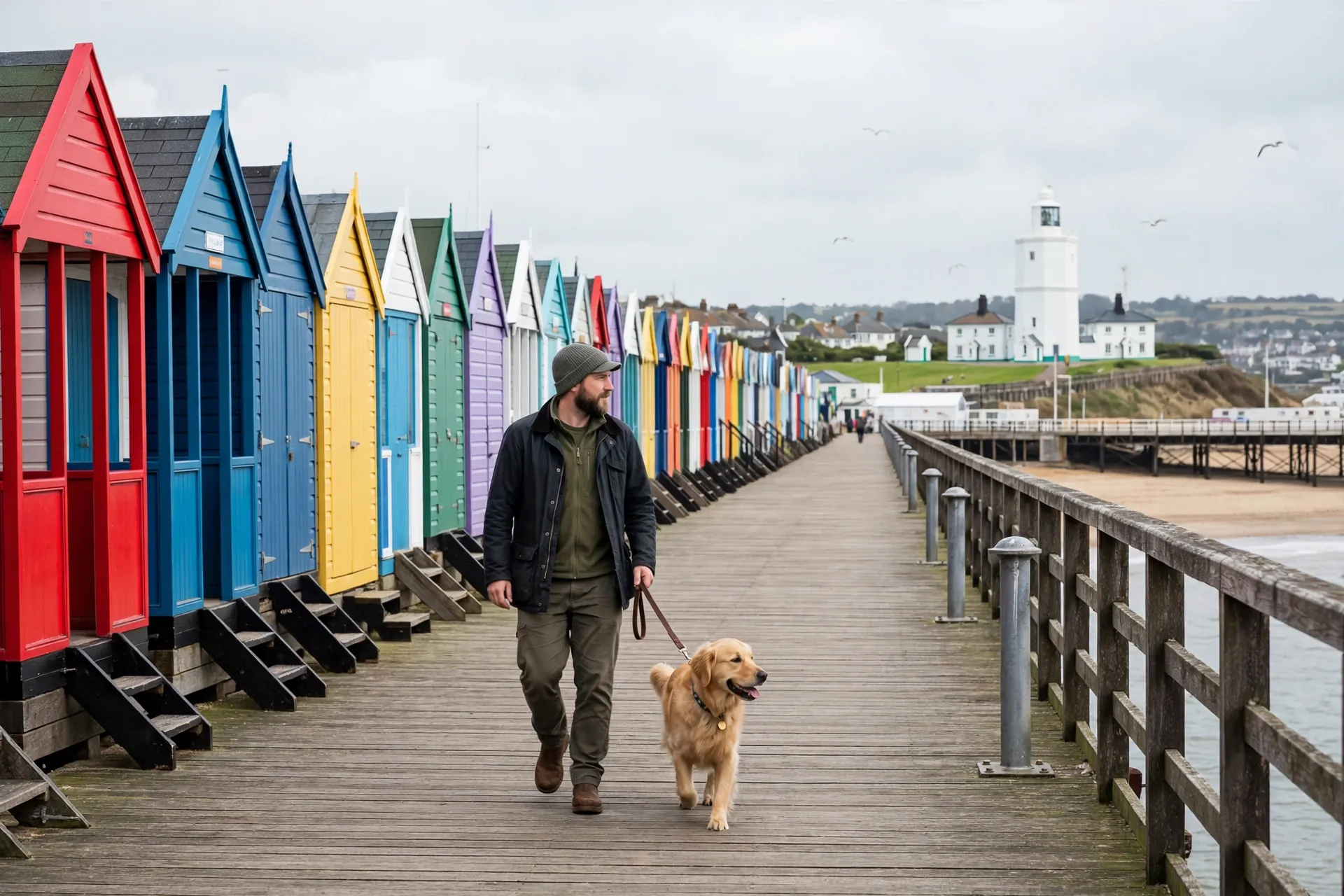
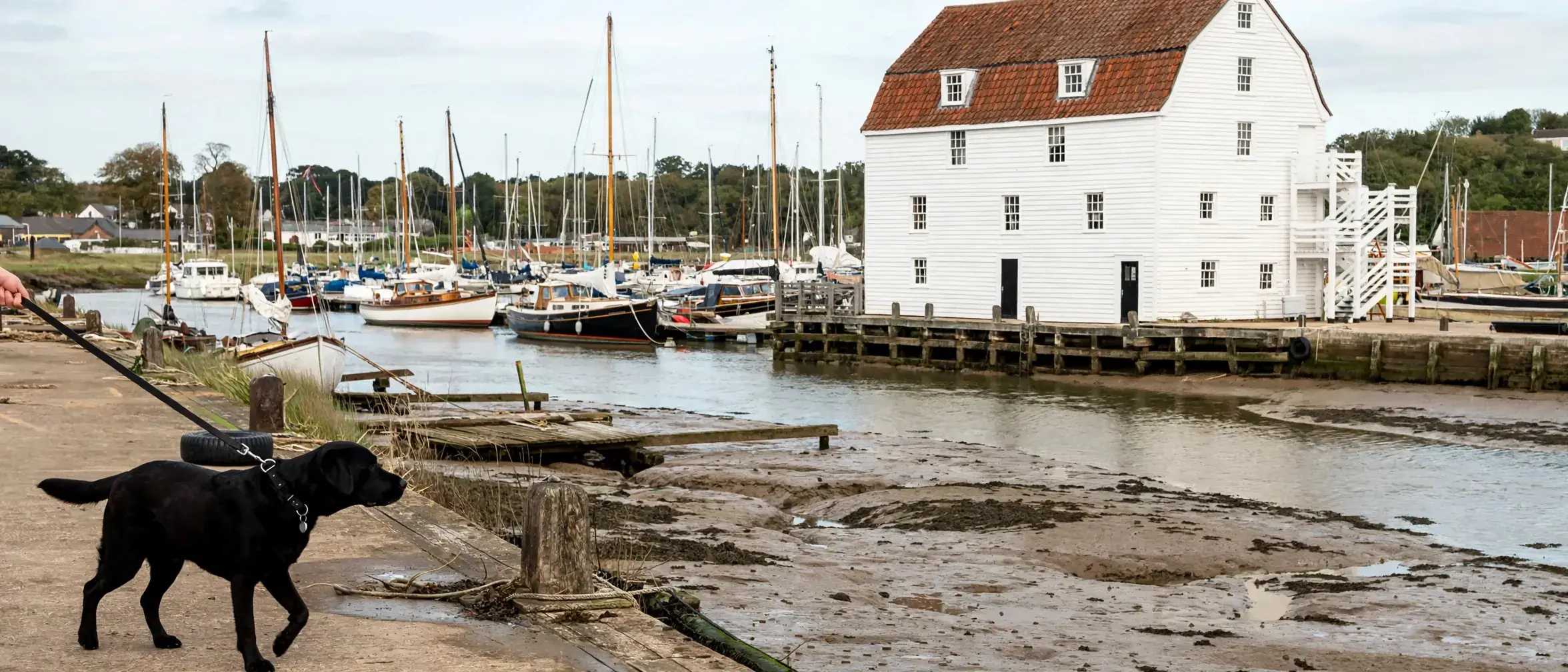
For a longer Suffolk coast stay, the same pairing logic extends north and south along the coast. Southwold with a dog offers a pier, a lighthouse and a different beach character, while Woodbridge with a dog moves inland to a tidal river town with quay walks and market-town streets. Choosing between them depends on the dog in front of you: a dog that loves open beach and promenade bustle will enjoy Aldeburgh and Southwold, a dog that prefers river paths and quieter town streets will suit Woodbridge, and a dog that is happiest beside still water will keep returning to the Thorpeness mere. That variety is the strength of a Suffolk dog trip, and Thorpeness earns its place in it as the calm, water-led start to the day.
Practical questions
Before you go
Can I walk all the way around the mere at Thorpeness with a dog?
Yes, the mere is the natural centre of a Thorpeness dog walk, and a lakeside circuit links the water, the wooded banks and the village streets. Keep your dog on a lead where other walkers, boats and wildlife are close, carry water on warm days, and be ready to shorten the loop if the ground is wet or your dog is tired. The full circuit is best treated as a relaxed stroll with pauses, not a timed route.
Do boats and model yachts on the mere affect dogs?
They can, especially for dogs that chase movement on water or bark at splashing and sudden activity. Watch your dog's reaction from a distance first, keep the lead short near launching points and jetties, and move to a quieter stretch of bank if excitement builds. If hire boats are operating, check the official guidance before you travel for the current rules on dogs on or beside the water.
Can I see the House in the Clouds with a dog?
Yes, as a viewpoint walk: the House in the Clouds is a landmark to look at from the surrounding streets and paths, not a building to enter with a dog on a casual visit. Approach on a lead, keep to public roads and paths, and do not enter private gardens or driveways to get a photograph. The best plan is a short, calm detour from the mere, with shade and water for the dog on warm days.
Are dogs allowed on Thorpeness beach?
Thorpeness beach is a shingle shore reached by paths from the village, and the rules that apply can change with the season and with local signage. Check the official guidance before you travel, read every sign at the beach access point on the day, and keep your dog on a lead where other beach users, fishing activity or wildlife are close. Take bags, water and a towel for shingle dust and salt water.
Where should I park for a dog walk at Thorpeness?
Plan around the village car parks and street parking near the mere and the beach, and check the signs for time limits and charges on arrival. Park where your dog can be unloaded safely away from through traffic, and avoid leaving a dog in a parked car. If the nearest spaces are full, a short walk from a quieter street is usually calmer for the dog than circling the village centre.