This guide is independent and contains no paid placement. Opening times, dog access and event dates can change, so check the official guidance before you travel where this guide flags a detail as uncertain.
Start at the Tissington trailhead and decide by dog, not by distance: walk a short flat section, cycle a longer one with a trailer or a running dog plan, or mix both by walking out and cycling back only if your transport and your dog allow it. Keep the dog on a lead near livestock and other trail users, carry water, and save the hall gardens, well dressings and tea rooms for the part of the day when the dog is settled and not already tired.
The trailhead decision: walk, cycle or both with a dog
Tissington works best when the first decision is made at the trailhead, not in the car on the way there. The village sits on the Tissington Trail, a former railway line that runs for about 13 miles between Ashbourne in the south and Parsley Hay in the north, and the surface is mostly flat, wide and forgiving. That flatness tempts people to plan too far. A dog that happily walks for an hour on a local path may still struggle with a long, straight, exposed trail section in wind or heat, because there are few natural stopping points, little shade in places, and a steady stream of cyclists to watch. Decide first how your dog travels, rests and drinks, and only then pick a distance.
Walking is the simplest choice and the easiest to reverse. You can walk out for twenty minutes, turn round, and still have had a proper taste of the trail, the limestone cuttings and the open fields. Walking also gives a nervous or reactive dog more time to settle: you control the pace, you can step aside for bikes, and you can practise short lead work without the added speed of a bicycle. The drawback is range. On foot you will see only a small part of the trail, and if you walk a long way south or north you still have to walk all the way back, which is where tired dogs, sore paws and fading light start to matter. A good rule is to plan the outward leg at about two thirds of what you think the dog can manage, so the return leg still feels comfortable.
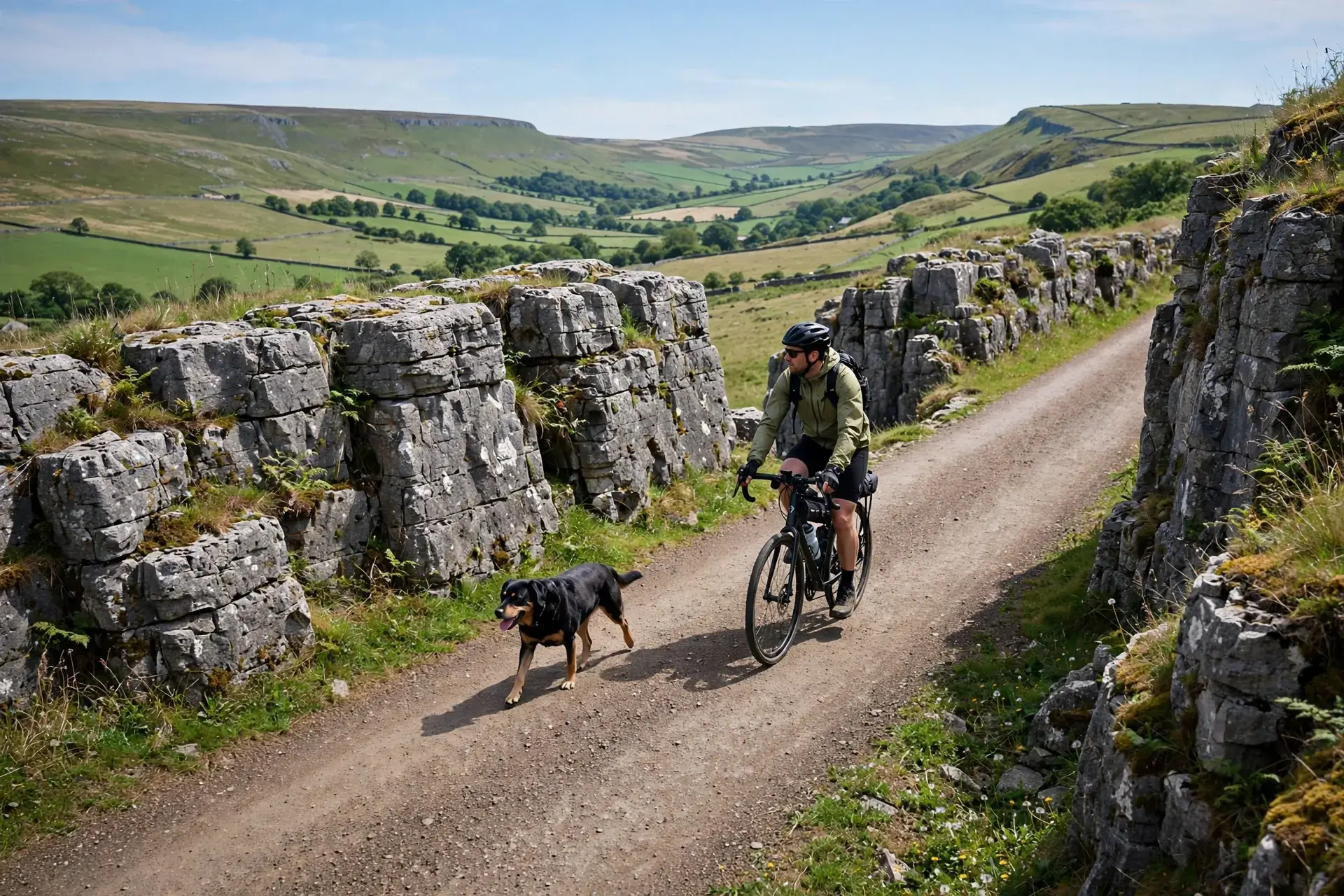
Cycling opens up much more of the trail in the same time, but it changes the dog question completely. A fit dog can run beside a bike for a short, controlled stretch on a suitable lead attachment, while many other dogs are far happier and safer in a trailer. A trailer lets an older dog, a small dog, a puppy that should not run long distances, or a dog that chases bikes enjoy the same route without the risk of a tangled lead or an exhausted sprint. It also gives you somewhere to carry water, a rug, a towel and a spare lead. The trade-off is handling: a loaded trailer changes braking and turning, gates and narrow points need more care, and a dog that has never used a trailer should not meet one for the first time on a busy trail day.
Mixing both sounds attractive, and sometimes it works, but it needs a transport plan that is honest about the return journey. Walking out and cycling back only works if a bike is waiting at the far end, or if one person cycles while another walks with the dog and you meet in the middle. Driving to one end, cycling to Tissington, and then facing a long walk back to the car with a tired dog is a common way to spoil an otherwise easy day. A cleaner mixed plan is to cycle a short section with the dog in a trailer, park the bikes, and finish with a village walk on foot. That way the dog gets movement, sniffing time and a calm finish, and nobody has to solve a one-way transport puzzle at the end of the day.
Before you set off, run through the dog in front of you rather than the dog in the brochure photograph. An older dog with stiff joints will prefer a short, flat walk and a long sit on the village green. A young, high-energy dog may need sniffing, training stops and a toilet break more than it needs extra miles. A dog that barks at bikes will need distance, treats and a quiet time of day, not a busy weekend start. A dog that pulls hard on the lead will make cycling beside the bike unsafe until lead manners improve. Pick the mode that fits that dog, and let Tissington fill in around it: trail first, village second, hall gardens and tea rooms when the dog is ready for a slower pace.
The Tissington Trail south: surface, tunnels, distances and dog logistics
Heading south from Tissington towards Ashbourne gives you a gentle, downhill-leaning start and a clear sense of the old railway line. The distance from Tissington to Ashbourne is roughly four miles, which makes a full out-and-back walk of about eight miles: too far for most dogs as a casual outing, but a sensible cycling distance and a useful distance to split. Walkers often do better with a shorter southern section, perhaps one to two miles out and the same back, which still reaches open countryside, field views and the feeling of the trail without turning the day into an endurance test. Cyclists can comfortably cover the southern stretch and still have time for the village afterwards, provided the dog is in a trailer or has a realistic running plan with frequent stops.
The surface on this section is generally firm and well suited to paws, wheels and pushchairs, because the trail follows a prepared former railway bed rather than a muddy field path. Expect crushed limestone and surfaced sections, with occasional looser stone, leaves, puddles after rain and uneven patches where tree roots or drainage have changed the ground. That firm surface is kind to older dogs and to dogs that dislike wet grass, but it can still wear paws on a long day, especially in dry, dusty weather when grit sits on top of the path. Check paws at every stop, carry water for washing grit away if needed, and shorten the route if your dog starts to lag, limp, seek shade or lie down. A dog that is asked to push on is not enjoying a longer trail; it is enduring it.
The southern stretch also includes a tunnel, which deserves a little planning with a dog. Tunnels on former railway trails are cool, echoing and darker than the open trail, and some dogs hesitate at the change in light and sound while cyclists and walkers pass through in both directions. Keep the dog on a short lead, walk on the side that gives bikes room to pass, and avoid stopping in the middle of the tunnel for photographs. If your dog is noise sensitive, talk calmly, keep moving steadily, and do not force a frightened dog to stand still while a group of cyclists approaches from behind. A small torch can help you see the surface, but it does not replace a lead, awareness and a steady pace. Check the official guidance before you travel for any tunnel closures, lighting changes or maintenance work that could affect this section.
Dog logistics on the southern trail are mostly about water, shade, livestock and other users. There is no guarantee of a tap or a stream at every mile, so carry more water than you think you need, plus a collapsible bowl and a bottle for the dog alone. Shade is patchy: cuttings and hedges give shelter in places, but long open stretches offer little cover on a hot day, so walk early or late in summer and watch for heavy panting. Fields beside the trail may hold sheep or cattle, so keep the dog on a lead where livestock are visible, where signs ask for leads, and wherever your dog cannot be trusted to ignore animals. Horses also use parts of the trail network, so give horses plenty of room, slow down on a bike, and never let a dog run up behind a horse.
Road crossings and access points need the same care as the trail itself. The trail crosses or meets minor roads and farm accesses, and a dog that has been off lead on a quiet stretch must be back on a lead well before any crossing. Car parking near Tissington can be limited on busy weekends and during well dressing events, so arrive early, park considerately, and never leave a dog alone in a car on a warm day. If you cycle south and plan to return by bike, agree the turn-back point before you start, and make it a landmark the whole party recognises, such as a bridge, a sign or a junction, rather than a vague distance. That simple agreement prevents the tired-dog argument that happens when one person wants to push on to Ashbourne and the dog has already voted with its paws.
The Tissington Trail north and shorter out-and-back options
Heading north from Tissington towards Parsley Hay is the longer commitment, at roughly nine miles to the northern end, and it suits cyclists and very fit walkers far better than it suits a casual dog walk. Most visitors with a dog should treat the northern trail as a menu of short out-and-back sections rather than as a route to complete. A one-mile walk north, a two-mile cycle with a trailer, or a gentle there-and-back to the next bridge or cutting all give you the character of the northern trail without the pressure of distance. The trail is still flat and wide, the countryside still opens out into limestone fields and dry-stone walls, and the dog still gets the main reward, which is a safe, steady path with plenty to sniff.
Shorter options work best when you choose a turn-back point that feels like a destination in itself. A bridge, a viewpoint, a cutting, a bench or a junction with a field path can all serve as a natural finish, and stopping there for water and a rest makes the walk feel complete rather than cut short. For older dogs, build the route around rests rather than miles: walk for ten or fifteen minutes, stop for a drink and a sniff, walk again, and turn back while the dog is still keen. For puppies, keep the outing short and focused on socialisation and lead skills, not on covering ground, and remember that growing joints need shorter, gentler exercise than an adult dog can manage. Check the official guidance before you travel if you are unsure about age-appropriate distances, and ask your vet if your puppy or older dog has any condition that limits walking.
The northern trail also rewards a slower eye. Because the line is straight and level, it is easy to march along without noticing the details: the stonework of bridges, the shape of cuttings, the birds along hedges, and the way the light changes as the trail dips and rises gently through the landscape. Dogs notice these details anyway, through scent, and a walk that allows sniffing stops is a richer walk for them than a walk that only counts miles. Let the dog stop, let the dog investigate a verge, and use those pauses to check paws, offer water and watch for tiredness. A dog that is allowed to sniff is usually a calmer dog when a cyclist approaches, because it has not been wound up by constant forward pressure on the lead.
If you do want a longer northern outing, plan it like a small expedition rather than an extended stroll. Carry a full water supply, food or treats for a mid-route stop, a towel for mud or rain, a spare lead, waste bags, and a phone with enough charge for maps and messages. Tell someone where you are heading if you are walking alone, and keep an eye on the time: the return leg always feels longer, especially if the wind turns against you or the dog slows down. Cyclists with a trailer should check the trailer tyres, hitch and brakes before a long northern run, and should test the loaded trailer on a short section first. Walkers who plan a long northern walk should also have a bail-out plan, such as a road access point where a car could meet them, rather than assuming the dog will manage the full distance back.
For many visitors, the best northern plan is the simplest one: walk north for as long as the dog is bright and keen, turn back at a pleasant spot, and spend the saved time in the village. That leaves energy for the hall gardens, a slow wander around the lanes, and a calm tea room stop, instead of spending the whole day on one straight path. Tissington is a village to linger in, not a checkpoint to pass through, and a dog that arrives back in the village still happy is a dog that will enjoy the rest of the day. Distance is easy to measure; enjoyment is not, and on a dog day out the second measure matters more.
Tissington Hall and its gardens with a dog
Tissington Hall sits at the heart of the village story, a historic house with gardens that reward a slow visit, but dog access here needs checking rather than assuming. Houses and gardens often have different rules: a dog may be welcome on garden paths and in outdoor areas while indoor rooms remain restricted, or access may change for events, private functions and seasonal opening. Check the official guidance before you travel for current opening days, dog rules, admission details and any areas where dogs must stay on a lead. Arriving with a backup plan matters: if indoor access is restricted, one person can visit the house while another waits with the dog in the gardens or the village, and you can swap over without rushing the dog or the visit.
Gardens suit most dogs better than formal interiors, provided the dog is on a lead, under control and kept away from planted beds, fragile borders and any areas marked as no-dogs. Garden paths can be narrow, gravelled or uneven, so watch paws on loose gravel, keep the dog from digging or marking specimen plants, and carry waste bags even in a formal garden setting. Water is important here too: a garden visit on a warm day can be surprisingly tiring, especially if the dog has already walked part of the trail, so offer water before entering the gardens and again afterwards. Shade, benches and quiet corners help a dog settle, while a crowded garden event may be too much for a nervous dog, however beautiful the setting.
Think about the order of the day when the hall gardens are part of the plan. A dog that has just finished a long trail walk may be too tired, muddy or overexcited for a formal garden, while a dog that visits the gardens first, with a short village walk beforehand, may be calmer and cleaner. If the dog is muddy from the trail, clean paws and belly before entering garden areas, and bring a towel and a rug so the dog can rest without lying directly on wet grass or gravel. If the dog barks at strangers, keep visits short, choose quieter times, and be ready to leave gracefully rather than trying to force a long garden tour. A short, calm garden visit that ends well is better than a long visit that ends with a stressed dog and an embarrassed owner.
Children, other dogs and garden wildlife also shape a hall garden visit. Keep the dog on a short lead where paths are busy, give other visitors room to pass, and do not let the dog approach other dogs without checking with their owners first. Squirrels, birds and garden cats can trigger a sudden lunge, so hold the lead firmly near trees and hedges and keep the dog close at corners and gates. If the gardens include a cafe or tea area, check whether dogs are welcome there and whether outdoor seating is available; a dog that can lie quietly under a table is a different prospect from a dog that must wait outside alone. Never tie a dog up alone outside a house or cafe while you go inside, especially in warm weather or in a busy area, because the dog may bark, slip a lead or become distressed.
Finally, treat the hall as part of the village, not as a separate attraction to rush. The approach through Tissington lanes, the views of the house and gardens, and the slower pace of the village all form part of the visit. If the hall is closed, if dog access is limited on the day, or if the dog is simply not in the mood for a formal garden, the village and the trail still give you a full day. Check the official guidance before you travel, keep expectations flexible, and let the dog's comfort decide how long the garden part of the day lasts.
Well dressings: what they are and visiting respectfully with a dog
Well dressing is a Peak District tradition in which wells and springs are decorated with pictures made from natural materials, most famously flower petals, leaves, seeds and other plant matter pressed into clay on wooden boards. The designs often show local scenes, historic themes or seasonal images, and the result is both a piece of community art and a celebration of water, which has always mattered in limestone country where springs and wells were vital. Tissington is one of the villages most closely associated with the tradition, and its wells are dressed as part of a community event that draws visitors from across the Peak District and beyond. The pictures are temporary, painstakingly made and proudly local, which is why visiting them well matters.
Dates, the number of wells dressed, and any accompanying events change from year to year, so check the official guidance before you travel rather than relying on a date remembered from a previous visit or a general guide. Tissington's well dressings are traditionally associated with May, around Ascension Day, but that general timing is not a promise for any particular year, and weather, volunteers and local arrangements can all affect the display. If you travel specifically for the dressings, confirm the dates first, arrive early on busy days, and have a quieter village and trail plan ready in case the wells are crowded. A dog day built only around a single crowded event is fragile; a dog day that includes the dressings as one part of a wider village visit is far more enjoyable.
Visiting with a dog calls for a short lead, close control and a little extra patience. The wells are often in gardens, lanes and village corners where space is limited, and other visitors will be standing still, taking photographs and reading the designs. Keep the dog beside you, not wandering ahead on a long lead, and do not let the dog sniff, paw at or drink from the dressed wells or their displays. Flower petals and clay boards are fragile, and a single paw or nose can damage hours of work. Waste bags are essential, and any toilet stops should happen well away from the displays, on a suitable verge or path, with waste picked up immediately. If your dog is reactive in crowds, visit at a quieter time, keep moving gently between wells, and skip any well where the crowd is too tight for the dog to pass calmly.
Photography with a dog at the wells needs the same restraint. Photographs of the designs are part of the pleasure, but blocking a narrow lane while posing a dog in front of a well frustrates everyone behind you. Take a quick photograph, move aside, and let others enjoy the display. Do not place a dog on a wall, a well structure or a display board for a photograph, and do not use flash in a way that disturbs other visitors. If the dog will not settle for a photograph, accept that and enjoy the wells without a posed picture; the memory of a calm visit lasts longer than a forced photograph of a stressed dog.
Respect also extends to the village around the wells. Well dressing week can bring extra traffic, parked cars and visitors to a small community, so park only where parking is allowed, keep noise down, and follow any local signs about routes, one-way lanes or restricted areas. Support the village where you can, whether that means a tea room stop, a local shop purchase or a donation where one is invited, but do not assume that every garden or well site is open to the public at all times. Some wells stand in private gardens opened for the event, and those permissions can be withdrawn if visitors behave badly. A dog that is calm, clean and on a lead helps keep those permissions open for future visitors, which is a good reason to keep the visit short, polite and well managed.
The village itself: lanes, green and tea rooms
After the trail, Tissington village itself is the reward: a small, attractive Peak District village of stone cottages, quiet lanes, a village green and a slower rhythm than the trail. The lanes are narrow in places, with stone walls, grass verges and limited pavements, so keep the dog on a lead, walk on the side that gives cars room to pass, and be ready to step onto a verge or into a gateway when a vehicle approaches. Farm traffic, delivery vans and visitors' cars all use the same lanes, and a dog that wanders across the road to sniff a wall can cause a sudden stop. Early mornings and weekday visits are usually quieter, while weekends and event days bring more people, more dogs and more cars to the same small lanes.
The village green and the open spaces around the village give a dog a chance to rest and sniff after the trail, but they are shared spaces, not a dog park. Keep the dog under control, pick up waste immediately, and respect any signs about leads, livestock or protected areas. A rug or a portable mat helps a dog settle on the green without lying on wet grass, and a chew or a quiet training game can turn a rest stop into a genuinely relaxing break. If other dogs are on the green, do not assume they want to play: ask owners first, keep greetings short, and move on if either dog shows stiffness, staring or avoidance. A calm green stop is worth more than a chaotic one, especially for a dog that has already had a long trail walk.
Tea rooms and village cafes are part of the Tissington pleasure, but dog access varies from place to place and can change with the season. Check before you sit down whether dogs are welcome inside, only outside, or in a particular seating area, and choose a table where the dog can lie out of the main walkway. A dog that has been cleaned after the trail, given water and settled on a rug is far more welcome than a muddy dog that shakes over neighbouring tables. Bring a small bowl if you are unsure whether water will be offered, keep the dog off chairs and tables unless the venue clearly invites it, and keep leads short so they do not trip staff carrying hot drinks. If a tea room is full or dogs are not welcome inside on that day, take drinks away or find an outdoor seat rather than leaving the dog tied up outside alone.
Village shops, churches and other buildings also deserve a measured approach. Many small village businesses welcome a well-behaved dog, but space is tight and stock may be at nose height, so keep the dog close, avoid letting it sniff food displays, and ask before entering if you are unsure. Churches and historic buildings may have their own rules, and a dog that is calm in a tea room may still bark in an echoing stone interior. If you are unsure, one person can look inside while another waits with the dog outside, which is kinder than taking a nervous dog into a quiet building and hoping for silence. The village rewards patience: a slow loop of the lanes, a sit on the green and a tea room stop will show you more of Tissington than a hurried dash between attractions.
Parking and facilities in a small village also need a little planning. Arrive early on busy days, park only in permitted areas, and do not block lanes, gates or driveways while you sort out the dog. Public toilets and water points may be limited, so carry water and waste bags from the start and do not rely on finding facilities at every turn. If you are staying nearby rather than visiting for the day, check with your accommodation about dog washing, drying and overnight routines, because a muddy trail dog needs a practical base. A village day works best when the practical details are sorted early, leaving the rest of the time for lanes, green, tea and unhurried sniffing.
Cycling with a dog: trailers, leads and trail etiquette
Cycling the Tissington Trail with a dog can be one of the best ways to enjoy the route, but only when the dog's mode of travel is decided in advance and practised before the day. The three realistic options are a dog in a trailer, a dog running beside the bike on a suitable attachment, and a dog carried in a suitable bike basket or backpack for a very small dog. Each option has different safety needs, and mixing them without preparation is where problems start. A trailer is the most versatile choice for most dogs, a running dog needs fitness, training and a safe lead system, and a basket or backpack only works if the dog is small, calm and securely contained. Choose one option, test it at home, and stick to it on the trail.
Trailers deserve careful preparation. Introduce the trailer at home with treats and short, stationary sessions before any ride, then practise on quiet, flat ground with the dog inside and the trailer empty of other luggage. Check the weight limit, tyre pressure, hitch, brakes and visibility flag, and make sure the trailer has ventilation, shade and a secure floor that does not slide. On the trail, keep speeds low, brake early, and take corners wide, because a trailer follows a different line from the bike and can clip a verge or a gate post. Stop often: a dog in a trailer still needs water, toilet breaks and a chance to stretch legs, and a trailer that is treated as a sealed box for miles will produce a stiff, thirsty and unhappy passenger. Bring a rug for the trailer floor, a spare lead for stops, and a towel for mud.
Running a dog beside a bike is a specialist skill, not a casual add-on. The dog must be fit, adult, well trained on lead, and comfortable with the speed and sound of the bike, and the lead system must keep the dog clear of the wheels and allow a quick release if the dog stops suddenly. Use a proper bike lead attachment rather than holding a normal lead in one hand, keep the dog on the side away from other trail users where possible, and keep speeds slow enough that the dog is trotting comfortably, not galloping to keep up. Stop before the dog shows tiredness, not after: heavy panting, lagging, seeking shade or a change in gait all mean the run should end. Hot surfaces, long distances and warm weather all increase risk, so running beside a bike is a short-distance, cool-weather option for most dogs, not an all-day plan. Check the official guidance before you travel for any local rules about dogs running beside bikes on the trail.
Trail etiquette matters as much as equipment. Cyclists should slow down well before walkers, ring a bell or call out politely in good time, and pass wide and slow, especially where a dog is on a lead. Walkers with dogs should keep the dog on the same side, shorten the lead when a bike approaches, and step aside where the trail is narrow. Both groups should give horses plenty of room and pass only when it is safe. Dogs in trailers should be kept inside the trailer when passing other users, not allowed to lean out or bark at passing dogs, because a sudden lunge can unbalance a bike. A little courtesy goes a long way on a shared trail: a smile, a thank you and a slow pass make the trail pleasant for everyone, while a fast, silent pass past a nervous dog can spoil a walk and create a lasting fear of bikes.
Cycle hire is available at points on the wider trail network, including near the trail ends, but availability, trailer hire, bike sizes and booking rules change, so check the official guidance before you travel if you plan to hire rather than bring your own bike and trailer. Book ahead on weekends and in school holidays, confirm that a trailer suitable for your dog's size and weight is available, and allow time for fitting, a safety check and a short test ride before you set off. If hire is unavailable or the trailer does not suit your dog, walking a short trail section is a better day than forcing an unsuitable cycling setup. The trail will still be there next time, and a dog that enjoys its first cycling experience is far more likely to enjoy the second.
Combining Tissington with nearby Peak District villages
Tissington pairs naturally with other Peak District villages, but the combination works best when you treat Tissington as the main event and the second village as a bonus, not as a second full day squeezed into the first. A morning on the Tissington Trail and in the village, followed by a calm afternoon drive to a nearby town for a shorter walk and a tea stop, gives the dog variety without exhaustion. A plan that tries to walk two long trails, visit two historic houses and eat in two busy tea rooms in one day will tire most dogs and frustrate their owners. Pick one long activity, one short activity, and plenty of rest in between, and let the dog set the pace for the second stop.
Bakewell with a dog makes a natural partner for Tissington, with river walks, a market town atmosphere and a different kind of Peak District day. Bakewell offers a busier, more urban contrast to Tissington's quiet lanes, so it suits a dog that enjoys people, shops and riverside paths, provided you keep the visit short and choose quieter routes if the town is crowded. A riverside stroll, a look at the town centre and a calm cafe stop can round off a Tissington morning without demanding another long walk. If your dog is already tired, skip the second walk and simply enjoy a drive through the Peak District countryside, with a short toilet and sniffing stop rather than a full outing.
Castleton with a dog offers a different contrast again, with dramatic limestone scenery, village walks and a more rugged feel than Tissington's gentle trail. Castleton suits a second day better than a second stop on the same day for most dogs, because its walks can be steeper and its village can be busy, especially around popular caves and viewpoints. If you are staying in the Peak District for a weekend, Tissington on one day and Castleton on the next gives each place proper time and gives the dog a rest overnight. If you do combine them in one trip, keep Castleton to a short village walk and a cafe stop, and save the longer hills for a day when the dog is fresh.
Other nearby options include Hartington, a village not far from the northern part of the trail network, and the wider White Peak villages that share Tissington's limestone character, quiet lanes and field paths. Hartington can work as a short stop for a village wander and a refreshment break, but check parking, dog access and route details before you travel, because small villages vary in what they offer on any given day. The White Peak generally rewards a slow approach: short field paths, village greens, tea rooms and river crossings, rather than long, exposed moorland walks that suit only fit, experienced dogs. Whatever second village you choose, check the official guidance before you travel for parking, dog rules and any seasonal restrictions that could affect your plan.
Multi-village planning also needs a car plan for the dog. Never leave a dog alone in a car while you explore a second village, especially in warm weather, and plan the day so the dog is either with you or resting comfortably at your accommodation. Carry water, a bowl, waste bags, a towel and a rug in the car, and allow time between stops for the dog to toilet, drink and settle. If the dog falls asleep in the car between villages, that is often a sign that the day has been full enough, and a quiet drive home or back to your base may be kinder than another busy village. The Peak District rewards return visits, and a dog that leaves Tissington happy is a dog that will enjoy coming back for Bakewell, Castleton and the villages in between.
Seasons, mud and trail conditions
Seasons change the Tissington Trail more than its flat profile suggests. Spring brings fresh growth, lambs in nearby fields and the well dressing season, but also changeable weather, muddy verges and the need for leads near young livestock. Summer brings long days, dry surfaces and busy weekends, but also heat, limited shade on open stretches, and the risk of overheating for dogs that run or walk too far in the middle of the day. Autumn brings colour, quieter weekdays and softer light, but also wet leaves, slippery surfaces and shorter days that make timing more important. Winter brings frost, ice in shaded cuttings, mud after rain, and early darkness, but also very quiet trails for dogs that enjoy cold, crisp walks. Each season can be excellent; none of them can be treated as identical.
Mud deserves its own planning, because the trail surface and the village lanes behave differently after rain. The surfaced trail usually drains better than field paths, but puddles, wet leaves and muddy access points still appear, and a dog that walks a field verge or a village lane after rain can return very muddy indeed. Bring a towel, a drying coat if your dog wears one, and a rug for the car, and clean paws before entering tea rooms, gardens or accommodation. Muddy paws also affect cycling: wet limestone can be slippery under tyres, and a trailer will pick up mud that then transfers to the dog and the car. Slow down in wet conditions, brake earlier, and allow extra time for cleaning up at the end of the walk.
Trail conditions also include temporary closures, maintenance work and fallen branches after storms, so check the official guidance before you travel, especially after heavy rain or high winds. A section that was perfect last month may be closed, diverted or muddy this month, and a diversion that is easy for a walker may be awkward for a bike trailer. If a section is closed, do not climb over barriers or take a dog through a work area; choose a different section or a village walk instead. Local signs at access points are worth reading on arrival, because they often carry fresher information than a general guide, including livestock notices, event information and temporary lead requirements.
Clothing and kit should follow the season, not just the forecast on the morning. Waterproofs for humans, a waterproof coat for a dog that feels the cold, a sun hat and sunscreen for summer, and warm layers for winter cuttings all make a difference. A dog that is cold and wet after a winter walk needs a warm car, a towel and a rest, not another hour on the trail to prove a point. A dog that is hot in summer needs shade, water and a shorter route, not encouragement to keep going to the next mile marker. Watch the dog, not the plan, and be ready to change the route, shorten the day or move the visit indoors to a dog-friendly tea room if conditions turn against you.
Finally, think about daylight and timing in every season. In winter, start early and plan to finish well before dark, because the trail has few lights and the village lanes are narrow. In summer, start early to avoid heat and crowds, and use the long evenings for a calm village walk rather than a long trail push. In spring and autumn, allow for sudden showers and changing light, and carry a torch for tunnels and shaded cuttings even in daylight. A well-timed Tissington day, with the trail in the best part of the day and the village at a relaxed pace, will always beat a longer day that fights the season, the mud and the clock.
Planning checklist for a Tissington day with a dog
A short checklist prevents most Tissington problems, because the village and trail are simple but the details matter. Work through the list the night before, pack the car the same way each time, and keep the dog's kit in one bag so nothing is forgotten in a rush. The list below covers the essentials for a walking day, a cycling day and a village day, and you can cross out what does not apply to your plan. If any item is missing, decide before you leave whether the day still works without it, rather than discovering the gap on the trail.
- Route and turn-back point: choose walk, cycle or both, pick a clear landmark as the turn-back point, and agree it with everyone in the party before you start.
- Water and bowl: carry water for the dog plus a collapsible bowl, and offer water at every stop, not only when the dog looks thirsty.
- Leads and control: bring a standard lead, a short lead for tunnels, crowds and road crossings, and a spare lead in case one breaks or gets muddy.
- Waste bags and towel: carry more waste bags than you expect to need, a towel for mud and rain, and a rug for rests on the green or in a tea room.
- Food, treats and medication: pack any medication, a small amount of food or treats for a long day, and a first-aid basics kit for paws and minor cuts.
- Hall and well dressing checks: check the official guidance before you travel for hall opening, dog access, well dressing dates and any event restrictions.
- Cycle and trailer checks: if cycling, check tyres, brakes, hitch, trailer weight limit and visibility, and practise with the dog before the trail day.
- Weather, mud and daylight: check the forecast, pack waterproofs and a drying coat if needed, and plan to finish well before dark, especially in winter.
- Car and parking plan: arrive early on busy days, park only where allowed, and never leave a dog alone in a car, especially in warm weather.
- Backup plan: have a shorter village walk ready if the trail is closed, the weather turns, or the dog is tired, and be ready to use it without disappointment.
On the day itself, keep the routine calm from the start. Toilet the dog before the trail, offer water, check the lead and harness, and start with a slow, sniffing section rather than a fast march. Stop often, watch for tiredness, and treat the turn-back point as a success, not a failure. After the trail, clean paws, offer water again, and let the dog rest before the hall gardens or tea rooms, so the second part of the day starts with a settled dog. If the dog is muddy, tired or overexcited, shorten the village part and head home in good time; a day that ends calmly is a day the dog will remember fondly, even if you covered fewer miles than planned.
Finally, leave Tissington as you found it. Pick up waste, keep to paths and permitted areas, respect gardens and displays, and thank the village by supporting its tea rooms and shops where you can. Small villages welcome careful dog visitors, and careful visitors keep trails, gardens and events open for dogs in the future. If something on the day was different from this guide, such as a changed dog rule or a closed section, check the official guidance before you travel next time, and plan around the new detail rather than assuming the old one still holds. That habit, more than any single route, is what makes Peak District dog days work year after year.
Practical questions
Before you go
Can dogs walk the whole Tissington Trail?
Yes, in principle, but the full trail is about 13 miles between Ashbourne and Parsley Hay, so most dogs and owners will enjoy a shorter out-and-back section instead. Choose a distance that suits your dog's age, fitness and paws, carry water, and keep your dog on a lead near livestock, cyclists and road crossings. Check the official guidance before you travel for any temporary closures or local rules.
Are dogs allowed at Tissington Hall and its gardens?
Access for dogs at Tissington Hall and its gardens can vary by season, event and the part of the estate you visit, so check the official guidance before you travel. Do not assume that a dog welcome in the grounds is also welcome inside the house, and be ready with a plan for one person to wait outside with the dog if indoor access is restricted.
When are the Tissington well dressings on display?
Tissington's well dressings are traditionally associated with May, around Ascension Day, but exact dates, the number of wells dressed and any organised events change from year to year. Check the official guidance before you travel, arrive early on busy days, and keep your dog on a short lead around the displays.
Can I cycle the Tissington Trail with a dog in a trailer?
A dog trailer can work well on the trail's generally flat, former railway line, provided your dog is comfortable in the trailer, the trailer suits the trail surface, and you can control the bike safely. Practise on quiet ground first, keep speeds low near walkers and horses, and stop often for water and toilet breaks. Check the official guidance before you travel for cycle hire and trailer rules.
Is the Tissington Trail suitable for a dog that cannot walk far?
Yes, if you pick a short, flat section and treat it as an out-and-back walk rather than a through route. The stretch immediately around Tissington village gives you a gentle taste of the trail without committing to miles, and you can turn back at any point. Bring a rug for rests, watch for tiredness or sore paws, and have a car or bike plan for getting back.