This guide is independent and contains no paid placement. If affiliate links are added later, they will be clearly marked and will not change our editorial checks.
Start at the canal basin and let the water decide the day: the Grand Western Canal towpath is flat, car-free and 11.25 miles long, the horse-drawn barge runs in season from the basin, the town centre and its castle are a short walk away, and the Exe Valley Way gives you a proper river walk to Bickleigh in about four miles. Book the barge and check castle opening days in advance, because both are seasonal and limited.
Start on the water: the Grand Western Canal
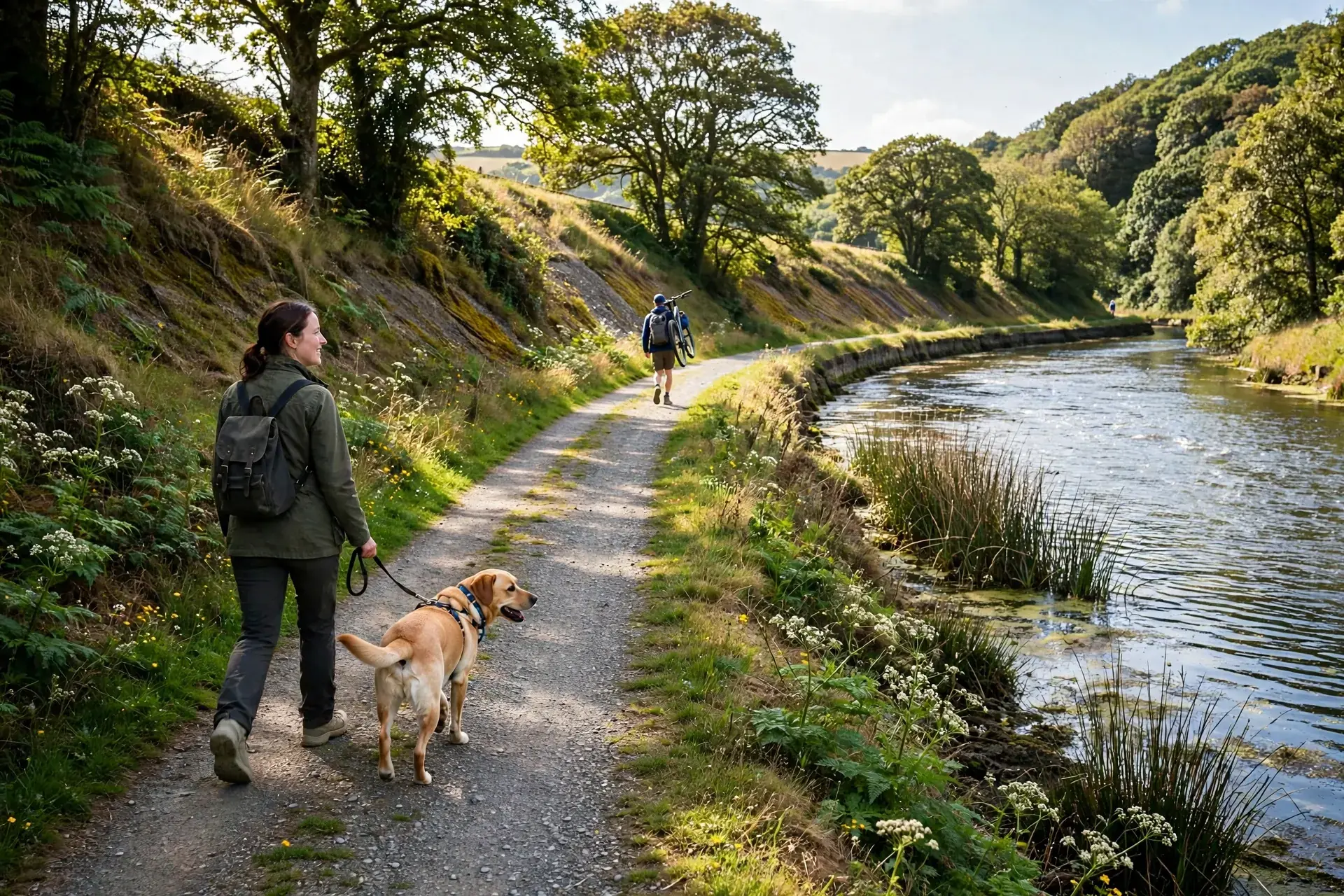
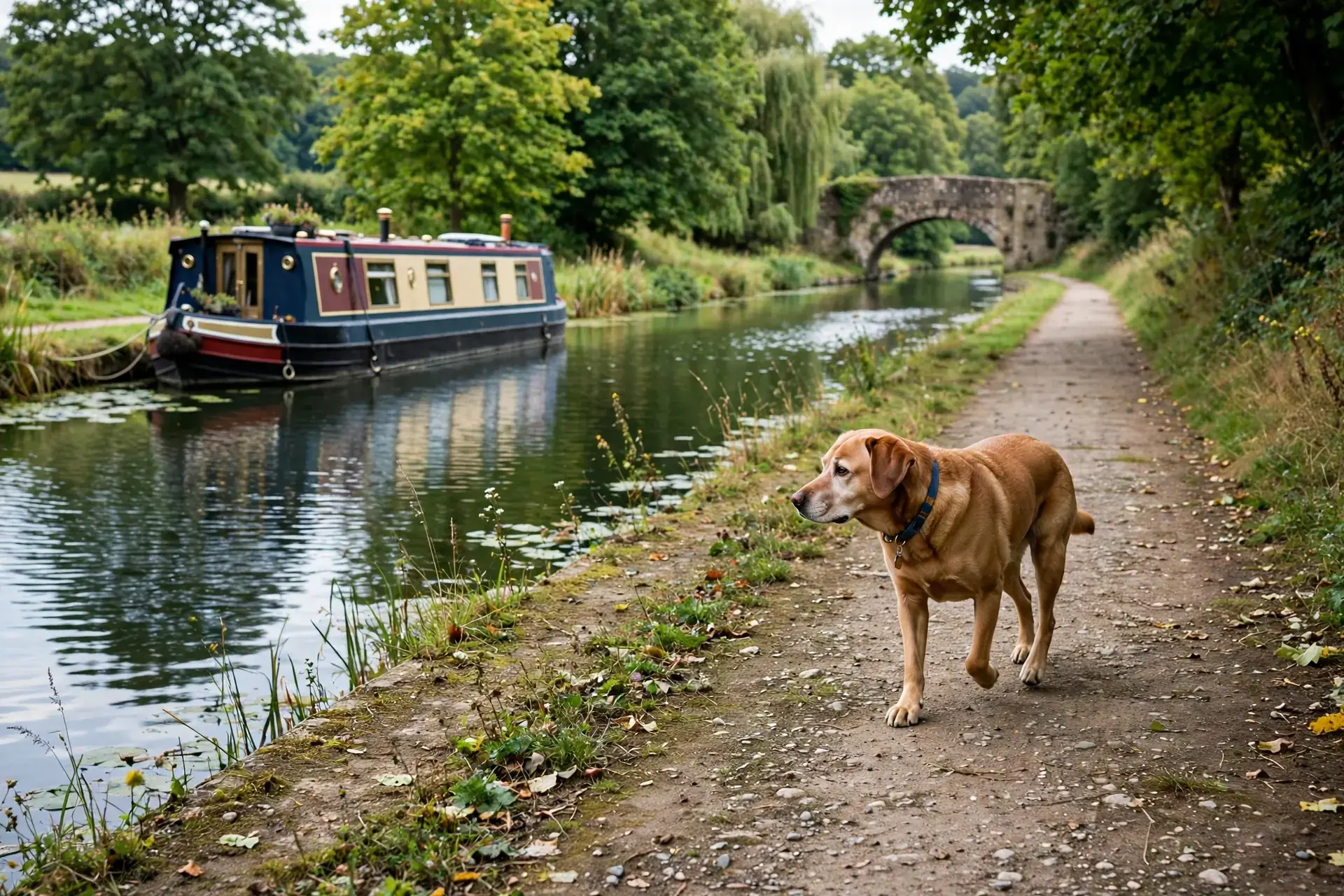
Tiverton is a town of two rivers and one canal, and the canal is the thing that decides how a day with a dog should be spent. The Grand Western Canal runs for 11.25 miles from the canal basin at Tiverton to Lowdwells, near the Somerset border, with no locks along the way. It was built to carry trade between the Bristol Channel and the English Channel, the Tiverton to Lowdwells section opening in 1814, and it stopped carrying commercial traffic in the 1920s. What survives is a level ribbon of water through Mid Devon farmland, declared a country park in 1971 and a local nature reserve in 2005, and the whole length of its towpath is a public right of way. For a dog owner that history is practical, not decorative: a canal built for horses and barges has almost no gradient, a wide towpath, and no cars, which is exactly the combination that suits an older dog, a puppy learning to walk on a lead, a dog recovering from an injury, and a fit dog that simply wants miles without hills.
The sensible way to begin is at the canal basin, off Canal Hill, where the water is at its widest and the facilities are concentrated. Park in the basin car park, give the dog a few minutes to settle and sniff, and walk out along the towpath in either direction. Heading away from the basin takes you into open countryside within minutes, past hedgerows, meadows and bridges, with the water on one side and fields or woodland on the other. The surface is mostly compacted earth and grass, firm in dry weather and softer after rain, so it is kind to paws but can be muddy in winter, and a dog that likes to paddle will find shallow edges in places. There is very little shade on some stretches and generous tree cover on others, so the same walk feels different at noon and at five in the afternoon. In summer, carry water for the dog and for yourself, because there are long stretches with no shop, no tap and no cafe, and the nearest facilities are back at the basin or in the town.
Distance is the great advantage of the canal, because you can choose almost any length and turn back at any point. A gentle first outing is thirty to forty-five minutes out and the same back, which is enough for most dogs to feel they have had a real walk without anyone getting tired. A stronger dog can do two or three miles each way, and a very fit dog can walk a much longer section, but there is no need to attempt the full 11.25 miles to Lowdwells in one day unless you have planned transport back. The towpath is shared with walkers, cyclists, runners and, in season, the horse that pulls the barge, so keep your dog on a short lead when you hear a bell, a voice or hooves behind you, and keep to the side that leaves room for others to pass. At bridges the towpath switches sides, and the crossing points are where a loose dog is most likely to cause a problem, so shorten the lead well before each bridge and keep the dog close until you are back on the straight towpath.
Wildlife is one of the quiet pleasures of the canal, and it is also the reason to keep a lead on even a well-trained dog. Kingfishers, herons, moorhens, dragonflies and damselflies are regulars along the water, and otters are occasionally reported, though they are shy and most visitors never see one. Ducks and swans are common near the basin, and a dog that chases water birds will quickly spoil a peaceful morning for everyone, including the birds. Teach the dog that the canal is for walking beside, not swimming in without thinking: the water is shallow in places and deeper in others, the banks can be steep and slippery, and a dog that jumps in at the wrong spot may struggle to climb out. A brief paddle at a shallow, clear edge on a warm day is usually harmless, but do not let a dog drink large amounts of canal water, swim in the main channel, or chase sticks into the water near a bridge or a moored boat. Rinse the dog off afterwards if it has been in the water, and check its paws and coat for mud, burrs and ticks, which are common along hedgerows in summer.
The canal also works as a wet-weather and hot-weather plan, which matters more than it sounds in Devon. In rain the towpath is still walkable, though it becomes slippery and muddy, and the tree-lined stretches give some shelter, while the open stretches do not. In heat the water keeps the air a little cooler than the town, but the sun on an exposed towpath is strong, so walk early in the morning or late in the afternoon, carry more water than you think you need, and watch for heavy panting, drooling or a dog that suddenly wants to lie down in the shade. A drying coat and a towel in the car turn a rainy canal walk from a chore into a normal outing, and a spare lead is worth packing because a muddy lead is an unpleasant thing to hold for an hour. If you want a second flat, traffic-free trail for another day, our guide to Wadebridge with a dog covers the Camel Trail, a former railway line with the same easy gradient and a very different estuary landscape, and it pairs naturally with a canal weekend for dogs that like long, level walks.
Barge trips, horse-drawn boats and the canal basin
The horse-drawn barge is the most distinctive thing about Tiverton, and it is worth understanding before you plan around it. The Tivertonian is one of the last horse-drawn passenger barges in Britain, pulled by a shire horse along the canal at walking pace, and it has been carrying passengers on trips from the canal basin since 1974. The barge runs to a timetable, normally from April to October, and the canal company is closed on Mondays except for bank holidays, so a Monday visit in season will find the basin quiet and the barge moored. Trips are typically offered in two lengths, a shorter trip of about an hour and a half and a longer trip of about two and a half hours, with a short stop at the turning point where passengers can stretch their legs and walk a little way along the towpath. The pace is the point: at walking speed there is time to watch the hedgerows, the bridges and the wildlife, and a dog that can settle for an hour will enjoy the slow movement and the new smells, while a dog that cannot settle will not, so be honest about your dog before you book.
Dogs and the barge need a direct question, not an assumption. The barge is a small, enclosed passenger boat with limited deck space, benches close together and no separate area for animals, and its dog policy can change between seasons and between trip types, so ask the canal company directly when you book — ring or message them rather than guessing. If your dog cannot board, do not treat that as a failed day: the towpath walk alongside the barge route is an excellent alternative, and a practical split works well for two people, with one person riding the barge and the other walking the dog along the towpath, meeting at the turning point or back at the basin. Never leave a dog unattended in a car at the basin while you ride, and never tie a dog up outside the visitor centre for the length of a trip. If the dog can board, bring a mat or blanket for it to lie on, keep it on a short lead for the whole trip, bring water, and choose a quieter weekday sailing rather than a busy weekend one for a first attempt. A dog that barks at horses will find the shire horse at close quarters a serious challenge, so introduce the horse from a distance on the towpath first and watch the dog's reaction before you commit to a ticket.
The canal basin itself is more than a departure point, and it is worth an hour even if you do not ride the barge. There is a visitor centre with displays about the canal's history, a small museum area, a children's play park, picnic tables, and a gift shop, and the basin is where rowing boats and Canadian canoes are hired in season for visitors who want to be on the water rather than beside it. Canoes and rowing boats are a different proposition with a dog: a calm, small dog that will sit still in a canoe can enjoy it, but a large, restless dog in a narrow boat is a capsizing risk, so ask at the basin on the day and be realistic about your dog's temperament. The floating Ducks Ditty bar and the canal tea rooms and garden are the places to sit afterwards, with the water in front of you and the barge moored nearby, and they are the natural end to a canal morning. The basin car park is close to the water, with an accessible toilet and a ramp up to the canal, and it is signed with brown tourist signs from Canal Hill, postcode EX16 4HX, which is the postcode to use for navigation.
Meeting the horse is part of the experience, and it is also a moment to manage carefully with a dog. The shire horses that pull the barge are large, calm and used to people, and visitors can usually meet them at the basin when the barge returns, but a horse is still a large animal and a dog is still a predator in its eyes. Keep the dog on a short lead, keep a respectful distance, do not let the dog run under or behind the horse, and do not let the dog bark at it. If your dog is nervous around large animals, watch from further away and let the dog decide how close it wants to be. The towpath etiquette around the barge matters too: when the horse and barge approach, step to the side, keep the dog close and quiet, and let them pass, because the horse has the right of way and the towpath is narrow at that point. The same rule applies to cyclists and runners: step aside early, shorten the lead, and give everyone room, and the canal stays pleasant for all its users.
Booking and timing are the practical details that decide whether a barge day works. Book in advance in school holidays and on summer weekends, because the barge seats a limited number of passengers and popular sailings fill up, and check the timetable on the day, because weather, water levels and horse welfare can change the schedule. Arrive at the basin at least twenty minutes before departure, use the toilets, give the dog a short toilet walk on the towpath, and settle the dog before you board rather than rushing straight from the car to the boat. If you are visiting outside the April to October season, the barge will not be running, but the basin, the towpath and the tea rooms are still worth a visit, and the canal in winter is quieter, with fewer people, lower light and a different kind of beauty. Look at the canal company's own timetable page on the morning you travel — season dates, fares and sailing times move around with the weather, the water level and the horses, and no printed guide can stay current with all of that.
Tiverton Castle, the town centre and St Peter's
Once the canal has set the pace, the town itself is a short walk away, and it is worth seeing on foot with a dog rather than from a car window. Tiverton is a historic market town on the River Exe, where the Exe meets the River Lowman, and its name is often traced to the two fords that once crossed those rivers. It grew rich on wool in the Middle Ages, and the town centre still shows that history in its streets: Fore Street and Gold Street run through the middle, the pannier market sits at the heart of the shopping area, and the church of St Peter rises above the town with a tower that is visible from much of the surrounding countryside. A dog walk through the town is not a hike, it is a stroll, and that is its charm: pavements, shopfronts, a market, a churchyard and a castle, all within a compact area that can be explored in an hour or two without ever needing to drive.
Tiverton Castle needs a clear and honest explanation, because it is the attraction most visitors ask about and the one most likely to disappoint a dog owner who has not checked in advance. The castle is a private home, not a large public attraction, and it is open to the public only on limited days, normally Sundays, Thursdays and bank holidays from Easter Sunday to the end of October, from about 2.30pm to 5.30pm, with last admission at 5pm. Its published visitor information lists guide dogs as welcome, which is not the same as a general welcome for pet dogs, and the castle's gardens and interior are not presented as a dog-friendly day out. Look at the castle's own visitor page before you set out, and treat the castle as something to admire from the surrounding streets and paths with your dog on a lead, rather than as a visit you will make together. If one person in your party wants to go inside, the other can walk the dog around the town centre or along the river in the meantime, and nobody should leave a dog unattended outside the castle gates while they go in. The castle's position above the town makes it a good landmark for navigation, and the streets around it are pleasant to walk, with views across the rooftops and the valley beyond.
St Peter's Church is the other historic building to look for, and it is a better fit for a dog walk than the castle because it can be appreciated from outside. The church stands in the town centre with a tall tower and a churchyard that is worth a slow circuit, and the building's history stretches back to the medieval wool town that built it. Dogs are not generally welcome inside parish churches except for assistance dogs, so treat St Peter's as an exterior visit: walk around the churchyard on a lead, look at the stonework and the tower, and move on. The churchyard is a quiet place, and a dog that can walk calmly on a lead will enjoy the shade and the smells, but keep the dog off graves and memorials, pick up after it, and keep it from disturbing other visitors. The streets around the church lead naturally into the shopping area, where the pannier market is the place to browse. The market hall holds stalls selling local produce, crafts, food and household goods on market days, and the surrounding streets have independent shops, cafes and charity shops that are worth a look. Some shops welcome dogs and some do not, so look for a water bowl or a sign by the door, ask before you go in, and if you are on your own, keep the shopping short and never leave a dog tied up outside a shop for long.
Getting around the town centre with a dog is straightforward if you keep to a few simple rules. The pavements on Fore Street and Gold Street are mostly wide enough for a dog and a pushchair to pass, but the main street carries traffic and the junctions are busy, so keep the dog on the pavement side, on a short lead, and watch for delivery vehicles and buses. The town is built on a slope in places, and the walk from the river up to the castle and the church involves a climb, so an older dog or a dog with joint problems will find the lower, flatter streets easier, while a fit dog will manage the hill without difficulty. There are public toilets in the town centre, benches in several places, and a choice of cafes for a break, which are covered in the eating section below. The town's museum, the Museum of Mid Devon Life, sits near the river and the bus station, and it is worth knowing about as a rainy-day option for the humans in the party, though dogs are not generally admitted inside museums, so look at the museum's own visitor notes first and plan for one person to stay outside with the dog if you want to go in.
The riverside paths in the town are the link between the castle, the church and the canal, and they are the part of the town walk that dogs enjoy most. The River Exe runs through Tiverton, and the paths beside it give you water, trees and open sky without leaving the town, while the River Lowman joins the Exe near the town centre and gives the town its second river. Walk from the bus station and the museum towards the river, follow the paths along the bank, and you will find a quieter Tiverton than the shopping streets suggest, with ducks, riverside trees and places to sit. Keep the dog on a lead beside the river, because the banks can be steep, the current is real, and a dog that jumps in may struggle to get out, and do not let the dog drink large amounts of river water. The riverside walk connects naturally to the Exe Valley Way, which is covered in the next section, so a town stroll can easily become a longer valley walk if the dog is still full of energy, and a longer walk can just as easily be cut short by turning back into the town for lunch.
Exe Valley walks and Knightshayes
The Exe Valley is where Tiverton stops being a town walk and becomes a proper countryside walk, and it is the reason many dog owners stay for a second day. The Exe Valley Way is a long-distance trail of about 50 miles, running from Starcross on the Exe estuary, through Exeter, to Exford on Exmoor, with an optional extension to Exe Head, the source of the river. Tiverton sits roughly in the middle of the southern half of the route, which makes it a natural base for a stage or two, and the stages around the town are among the most accessible on the whole trail. The route is waymarked with the Exe Valley Way logo, and the stages are described by distance and time, so you can plan with confidence rather than guessing. The valley here is broad and green, with oak woodland, farmland, meadows and the river itself, and the walking is moderate rather than mountainous, which suits most dogs and most walkers.
The best-known stage from Tiverton is the walk south to Bickleigh, which is about 4 miles (6.5 km) and takes around two and a quarter hours. It starts from the bus station area, follows Phoenix Lane, crosses the River Lowman, passes through Tumbling Fields and Collipriest, and then joins the Exe Valley Way proper, following the east bank of the Exe through Backs Wood and past farmland to Bickleigh Mill. The surface is a mixture of paved paths, field paths and woodland tracks, with some rougher and muddier stretches after rain, and the route passes through woodland beside the river and crosses farmland, so the ground underfoot changes often. Keep the dog on a lead through the woodland and farmland sections, especially where livestock may be present, and be ready for a stile or a gate. Bickleigh itself is a pretty village with a medieval bridge, thatched cottages, a mill and a riverside pub, and it is a natural turning point: have a drink at the Fisherman's Cot, which welcomes dogs in the bar and beer garden, and then either walk back to Tiverton the way you came or catch the regular bus, the 55 service between Exeter and Tiverton, which passes through Bickleigh. Check the bus times before you set out, because a one-way walk with a bus back is much more enjoyable than a there-and-back walk when the dog is tired, and the bus is the practical way to do the stage as a linear walk.
North from Tiverton, the Exe Valley Way continues towards Bampton, a stage of about 7.8 miles (12.5 km), which is a full day's walk and a serious undertaking for most dogs. The valley sides become steeper north of the town, the climbs are longer, and the route is more exposed in places, so this stage is best attempted only by fit dogs and fit walkers, with plenty of water, a proper lunch stop, and a plan for getting back. A shorter alternative is to walk the first mile or two north from Tiverton and turn back, which gives you the valley views and the riverside walking without committing to the full stage, and it is a good way to test whether your dog is ready for a longer valley day. South of Bickleigh, the route continues to Thorverton, a stage of about 4 miles, with a climb high onto the side of the valley and views across the Exe, and that stage can also be reached by bus from Tiverton, so the valley offers a whole network of walks that can be mixed and matched according to the dog's energy and the weather. Always carry an offline map, because mobile signal is patchy in the valley, and look at the trail's own updates before you set out for diversions, closures or flooded stretches — after heavy rain the riverside paths can be impassable in places.
Knightshayes is the grand day out on the edge of Tiverton, and it is the most reliably dog-friendly historic estate in the area. The National Trust property sits at Bolham, just outside the town, postcode EX16 7RQ, and it is a Victorian Gothic Revival house designed by William Burges for the Heathcoat-Amory family, set in about 262 acres of parkland with formal gardens, woodland, a walled kitchen garden and 19th-century stables. Dogs are welcome at Knightshayes on short leads in the formal and woodland gardens, the parkland and Impey Walk, and they are also allowed in the reception, plant centre, shop, cafe and second-hand bookshop, which makes it easy to spend a whole morning there with a dog. Dogs are not allowed inside the house, in the kitchen garden or on the Douglas Fir Walk at any time, so plan for one person to visit the house while the other walks the dog in the gardens, or simply enjoy the outdoor estate together and skip the house interior. There are water bowls in the courtyard, a buggy service between the stables and the main house for visitors with mobility problems, and a cafe with a separate area for visitors without dogs, so the estate is set up for dog owners rather than merely tolerating them. The gardens are at their best in spring and summer, when the roses and the planting are in full flower, but the parkland and woodland walks are enjoyable all year, and the estate is a good wet-weather alternative to the canal because the woodland gives shelter and the paths are well maintained.
Practical details make the difference between a good valley walk and a frustrating one, so plan the small things before you set out. Wear boots with grip, because the field paths and woodland tracks are slippery after rain, and the riverside meadows can be soft underfoot even in summer. Bring water and a collapsible bowl, because there is no reliable water for dogs along the valley stages, and bring poo bags and a way to carry them, because there are few bins once you leave the town. Keep the dog on a lead near livestock, which is common in the valley fields, and near the river, where the banks are steep and the current is strong. Watch for ticks in the woodland and the long grass, especially in spring and summer, and check the dog thoroughly after a valley walk, including between the toes and inside the ears. If your dog is reactive to other dogs, walk early in the morning, when the valley paths are quietest, and be ready to step aside and shorten the lead when you meet other walkers. And remember that the Exe Valley Way is a linear trail, not a circular one, so a bus timetable, a second car or a willingness to walk back are all part of the plan, and the 55 bus between Exeter, Bickleigh and Tiverton is the tool that makes the linear stages work.
Eating and drinking with a dog in Tiverton
A canal morning earns its lunch in Tiverton, and the town makes that easy because the places to eat sit within a few minutes of the water, the market and the river. Walk the towpath first, let the dog burn off the car journey, and only then look for a table: a dog that has already had its miles will curl up under a chair, while one that has waited in the car since breakfast will fidget through every course. The basin has its own tea rooms and a bar floating on the water, Fore Street and Barrington Street hold cafes and pubs with gardens and front rooms where dogs are part of the furniture, and out at Bickleigh and Chettiscombe the riverside and estate tables are worth the short drive. Pack a mat for the dog to lie on, a bowl that folds flat, and something to chew for a puppy that needs a job, and keep the lead short and tucked under your chair instead of stretched across the room where waiters and other dogs have to step over it.
The Duck and Bean, at 5 Fore Street, is the cafe to know first, because it is openly and enthusiastically dog-friendly, with water bowls, a dog menu including puppuccinos and dog treats, and a garden where dogs are welcome. It serves artisan coffee, breakfasts, lunches and sweet treats, and it has its own house dog, so a visiting dog is part of the scene rather than an exception. The cafe is fully licensed, has outdoor seating and free Wi-Fi, and it is in the middle of the town centre, which makes it an easy stop between the canal and the castle, or between a morning walk and an afternoon of shopping. Go early if your dog is nervous in crowds, because the cafe fills up by mid-morning, and choose a table near the door or in a corner where the dog can settle without blocking the aisle. If the dog is having a bad day, take the food away and eat it on a bench by the river instead, because there is no shame in a takeaway eaten outdoors, and the dog will thank you for it.
The Peryton, at 97 Barrington Street, is a newer arrival, a modern tavern that opened in April 2026 in the old Barley Mow, serving tapas-style small plates, lunchtime bowls and Sunday brunch, with a beer list drawn from independent breweries. Dogs are welcome in the front section of the pub, which is the practical detail to know before you go, and the nearest parking is on William Street or in the Market Car Park, both a short walk away. Note that the building has steps and narrow doorways in places, so a large dog or a dog that struggles with steps may find it awkward, and look at the pub's own pages for today's hours and dog rules before you go — a place that only opened in April 2026 can still be settling its policy. The Half Moon Inn, on Fore Street near the bus station and the pannier market, is the town pub by the market, serving breakfast from half past eight and good-value food at lunchtime, and it is described as family and dog friendly, which makes it a useful meeting point before a market visit or a bus out to the villages. The Racehorse, on Wellbrook Street, is a traditional locals' pub with a solid brick bar, a courtyard at the front, a large lawned garden at the rear and a covered, heated outdoor seating area, and it is family and dog friendly, with food from Wednesday to Saturday and a carvery on Sunday.
The canal and the river add two more places to eat and drink with a dog, and they are worth the short walk or drive. At the canal basin, the Ducks Ditty floating cafe bar sits on the water at Tiverton Wharf, and the canal tea rooms and garden are beside it, so a canal walk can end with a drink or a cream tea without getting back in the car. The floating bar is a distinctive setting, with the barge moored nearby and the canal in front of you, but it is closed on Mondays except during August, so look at the canal company's own opening notes before a Monday visit. At Bickleigh, about four miles south of Tiverton on the Exeter road, the Fisherman's Cot is a thatched riverside pub on the banks of the River Exe, with a beer garden, cask ale, food all day and a Sunday carvery, and it explicitly welcomes dogs in the bar and the beer garden, with muddy paws and boots welcome. It is the natural lunch stop at the end of the Exe Valley Way stage from Tiverton, and it has free parking and rooms, so it can also be a base for a longer stay. The Globe Inn at Sampford Peverell, about five miles east of Tiverton beside the Grand Western Canal at Lower Town, is another canalside village inn with rooms and locally sourced food from breakfast onwards, and it is worth knowing about if you are walking the canal east from Tiverton or driving through the village.
Two miles out of town, on the Knightshayes estate at Chettiscombe, the Long Barn holds the Lost Kitchen, a wood-fired kitchen serving seasonal brunch and lunch and sourdough pizzas, with a terrace that looks over the hills and welcomes dogs. It is the table people talk about most in Mid Devon, so at weekends it pays to book rather than turn up and hope, and the terrace is small enough that a busy Saturday fills quickly. A dog that has walked the Knightshayes parkland first will settle on that terrace far better than one driven straight from the car, so pair the meal with the estate walk and treat the two as one outing. Back in town, the Jolly Vintner, an independent wine bar and merchant, is the place for a glass rather than a meal, with dogs regularly asleep on the floor between customers. If you are staying in a cottage, the pannier market, the delis and the farm shops around town will stock a kitchen with local cheese, bread and pasties without a supermarket trip, though there is a supermarket on the edge of town for everything else. And if a longer stay stretches to the coast, our guide to dog-friendly beaches in the UK explains how seasonal bans and public space protection orders work, because the rules change from beach to beach and the fines are real.
Staying over and parking
Tiverton suits a longer stay because it is a working town first and a walking base second, and the two halves feed each other. Fore Street and Gold Street hold the shops, the pannier market sits in the middle of them, a supermarket waits on the edge of town, and there are vets, a pharmacy and cash machines all within a short walk of the centre, so a week here never turns into a series of car trips for basics. Evenings belong to the canal: park the car, walk the dog out along the towpath from the basin as the light drops, and be back for dinner without ever starting the engine. That matters most on a first Devon trip with a dog, or with an older dog that wants flat towpath miles and a soft bed rather than cliff paths and steep lanes, and it is the combination — water on the doorstep, shops around the corner — that makes the town work as a base rather than just a stop.
Places to sleep in and around Tiverton split into a few distinct kinds, and the dog rules change with each kind, so the questions to ask change too. In the town there are hotels and bed and breakfasts, including the Tiverton Hotel on Blundells Road, about half a mile from the centre, with gardens, a bar open to non-residents and a restaurant, and lift access to the first floor. Out in the villages, the Fisherman's Cot at Bickleigh and the Globe Inn at Sampford Peverell both have rooms above their pubs, which puts a dog-friendly dinner and a bed under the same roof, and the lanes towards Cullompton and Bampton hold farm stays and cottages. Self-catering cottages and apartments cluster around the town and the Exe Valley, and holiday parks and campsites sit further out in the countryside. Whatever kind you pick, ask about the exact room or cottage rather than the property as a whole, how many dogs are allowed and whether the charge is per dog or per stay, and whether any size or breed conditions apply. Ask how the garden is fenced and how high the fence runs, whether the dog may be left alone while you visit Knightshayes house — dogs are not allowed inside the house itself — and whether the floors will survive a muddy canal walk. A ground-floor room suits an older dog far better than stairs after the climb up towards the castle, and a booking site's pet-friendly filter is no substitute for getting the dog arrangements confirmed in writing, direct with the host.
A cottage of your own usually fits a Tiverton dog trip best, because the dog's day here runs on canal time rather than hotel time. A kitchen means an early breakfast before a morning barge sailing, and a garden or terrace means somewhere for the dog to stretch out between the towpath and the valley without another guest's dog in the next room. When you look at listings, weigh the practical details over the photographs: a cottage a short walk from the Canal Hill basin or the river paths saves a drive at the start of every walk, an enclosed garden keeps a dog safe after a long towpath run, and a washing machine plus somewhere to hang wet towels turns a muddy winter towpath from a problem into a load of laundry. Holiday parks and campsites around the town can work well for families, but run through the same checks — dog limits, charges, enclosed space, and the rules on leaving a dog alone — before you book. Hotels and bed and breakfasts suit a shorter stay, and several in Tiverton welcome dogs, but expect the welcome to stop at the bedroom door: the dog will usually be fine in your room and not in the dining room, so breakfast is eaten without the dog or taken in the room. The Fisherman's Cot at Bickleigh and the Globe Inn at Sampford Peverell sit in between, village inns with rooms where the bar, the garden and the bed are all part of one dog-friendly stay.
Getting to Tiverton without a car is possible, though a car makes the canal, Knightshayes and the valley walks much easier. The nearest railway station is Tiverton Parkway, about five miles east of the town on the main line between Exeter and London Paddington, and buses and taxis run from the station into town, so look at the bus company's own timetable and a local taxi number before you travel. The 55 bus service runs regularly between Exeter and Tiverton, passing through Bickleigh, and it is the service that makes the Exe Valley Way stages work as linear walks. Tiverton bus station, on Phoenix Lane, is the hub for local buses to the surrounding villages, including Bampton, Cullompton and Crediton, and it is also the starting point for the Exe Valley Way stage to Bickleigh. If you are arriving by car, the M5 motorway, junction 27, is the main approach, and the A361 North Devon Link Road runs through Tiverton towards Barnstaple, so the town is well connected by road from Exeter, which is about 20 miles to the south, and from the rest of Devon.
Start by choosing the car park for the walk you are doing first, because the basin and the town centre pull in opposite directions and the wrong choice adds a walk you did not plan. For a canal day, use the basin car park off Canal Hill, postcode EX16 4HX, which sits beside the water, the visitor centre and the barge departure point, with an accessible toilet and a ramp up to the canal. For a town day, or for the Exe Valley Way stage south to Bickleigh, use the multi-storey on Phoenix Lane, postcode EX16 6PP, beside the bus station: from there the town centre, the museum, the river and the start of the Bickleigh stage, past the Lowman crossing and through Tumbling Fields, are all a short walk. The Market Car Park and William Street, postcode EX16 6BJ, are also close to the centre, and there is on-street parking in some streets, though the High Street itself is awkward to park on. Charges and maximum stays change, so look at the council's own parking pages before you travel rather than trusting a remembered price. Market days, summer weekends and bank holidays fill the car parks nearest the canal and the trail by mid-morning, so arrive early. And on a warm day, never leave a dog in a parked car, even for a few minutes: take the dog with you, and if the car has sat in the sun, let it cool and offer water before the dog climbs back in.
Before you set out, get the unglamorous details sorted and the rest of the trip runs itself. Save the number of a Tiverton veterinary practice in your phone when you arrive, and find the out-of-hours emergency number at the same time, because a rural practice can be twenty minutes away and close early, and nobody wants to be searching for it with an injured dog. Running out of food is not a disaster here: there are pet shops in town and a supermarket on the edge of it that sells dog food. Public toilets sit near the canal basin and the bus station, but they are not everywhere, so plan around them. Mobile signal is generally good in the town and patchy on the further reaches of the canal and the Exe Valley Way, so download an offline map before you leave the car park. What goes in the bag is a canal-and-valley kit rather than a beach kit: a short lead for the towpath bridges and the town, a longer one for the open stretches, a harness that fits well, a spare lead, water and a collapsible bowl, a towel and a drying coat for canal mud, a blanket for the car, more poo bags than you think you need and a way to carry them, a coat for a short-coated dog in wind or rain, the dog's normal food and any medication, and the vet's number with the insurance details. In winter, look at the opening hours of the places you want to visit before you go, because some cafes, pubs and attractions shorten their hours outside summer, and the towpath turns quiet and muddy after heavy rain.
A sample weekend: canal, valley and town
A weekend in Tiverton works best when the canal comes first, the valley comes second, and the town fills the gaps, because that order gives the dog a different kind of walk each day and gives you a different kind of scenery without ever driving more than a few miles. Arrive on Friday afternoon, park at the canal basin, and take a short evening stroll along the towpath so the dog learns the smells of the place before dark. An hour out and back is enough, and it is a good way to settle a dog that has spent the day in a car. Finish at the basin with a drink at the floating bar or the tea rooms if they are open, or drive into the town for an early dinner at a dog-friendly pub, and then settle the dog in your accommodation with its familiar bed, its normal food and its usual last-outing routine. Keep the first evening quiet: same feeding time, same bed, same last walk, because dogs read consistency as safety, and a boring first evening is the fastest route to a relaxed first morning.
On Saturday morning, start early and make the canal the main event. Walk the towpath for two or three miles, or book the horse-drawn barge if it is in season and your dog can board, and let the slow pace of the water set the tone for the day. If you ride the barge, arrive at the basin at least twenty minutes before departure, give the dog a short toilet walk, and settle it before you board. If you walk, take the towpath in the direction away from the basin, turn back when the dog has had enough, and stop for a drink at the basin afterwards. In the afternoon, drive or walk into the town centre for lunch at the Duck and Bean or the Peryton, browse the pannier market if it is a market day, walk around St Peter's churchyard and the streets near the castle, and finish with a short riverside walk along the Exe before dinner. A pub dinner at the Half Moon or the Racehorse is a good end to a canal day, and a dog that has walked in the morning will usually sleep under the table through the meal.
Give Sunday to the river. Walk down to the bus station, pick up the Exe Valley Way, and follow the east bank of the Exe south through Backs Wood and the farmland to Bickleigh — about four miles and two and a quarter hours of oak woodland, field paths and river bends. The Fisherman's Cot at Bickleigh, a thatched pub on the river with a beer garden, is the lunch stop at the end of it, with dogs welcome in the bar and the garden and muddy paws expected rather than frowned at. From Bickleigh, the 55 bus back to Tiverton is the sensible finish when the dog is tired, though a dog still full of running can walk the same four miles back the way it came. Close the day with a short evening turn on the canal towpath, when the light is low and the basin has gone quiet. If the weather turns, swap the days: the towpath is the best wet-weather walk in the area, flat with tree cover in places, the wooded Bickleigh stage holds up in rain too, and the town's cafes and shops are a genuine fallback rather than a consolation prize. Nothing in Tiverton is far away and no single plan has to work perfectly, which is exactly the flexibility a trip with a dog needs.
For a longer stay, the pattern can be extended without repeating itself. A third day could be spent at Knightshayes, walking the gardens and parkland with the dog on a short lead, having coffee in the stables cafe, and browsing the plant centre and second-hand bookshop, which both allow dogs. A fourth day could be a longer valley walk, north from Tiverton towards Bampton, or a drive to the coast for a beach day, using the seasonal beach rules to choose a beach that allows dogs on the day you visit. A fifth day could be a quiet canal day, walking a different section of the towpath, hiring a rowing boat or a canoe if your dog will sit still in one, and finishing at the basin with a cream tea. The dog gets variety, you get variety, and nobody gets bored of the same walk, which is the real test of a base: not whether it has one great walk, but whether it has five different walks that are all worth doing, and Tiverton, with its canal, its river valley, its historic estate and its compact town, passes that test.
Practical questions
Before you go
Can dogs walk the Grand Western Canal towpath at Tiverton?
Yes — the towpath runs the full 11.25 miles from the basin at Tiverton to Lowdwells with no locks, and the surface is flat, wide and largely level, so it suits puppies, older dogs and dogs building fitness back up. Keep the dog on a lead near the horse-drawn barge, other towpath users and the water, pick up after it, and shorten the lead where the towpath switches sides at bridges. Look at the canal company's own notices before you travel for temporary closures or maintenance works.
Can dogs go on the horse-drawn barge at Tiverton?
Ask the canal company when you book rather than assuming either way. The Tivertonian is a small, enclosed passenger boat with benches close together and no separate space for animals, and whether dogs may board can change between seasons and between trip types. If the answer is no, walk the towpath beside the barge route instead — one person can ride while the other walks the dog, and you can meet at the turning point or back at the basin. Never leave a dog in a car at the basin while you ride, and never tie one up outside the visitor centre for the length of a trip.
Is Tiverton Castle dog-friendly?
Only from the outside, so treat the castle as a landmark to walk around rather than a visit to make together. It is a private home, open on limited days — normally Sundays, Thursdays and bank holidays from Easter Sunday to the end of October — and its own visitor information welcomes guide dogs, which is not the same as a general welcome for pet dogs. Look at the castle's own visitor page before you go, enjoy the building and its grounds from the surrounding streets and paths with your dog on a lead, and do not leave a dog unattended outside while you go in.
Where can dogs walk in the Exe Valley near Tiverton?
Follow the Exe Valley Way. The stage south from Tiverton to Bickleigh runs about 4 miles (6.5 km), around two and a quarter hours along the east bank of the River Exe through oak woodland and farmland, and the stage north towards Bampton runs about 7.8 miles. For something shorter, use the riverside paths around the town, Tumbling Fields and the lanes towards Collipriest. Keep the dog on a lead near livestock, on road stretches and beside the river, and use the regular bus service between Exeter, Bickleigh and Tiverton to turn a one-way walk into a loop.
Where is the best place to park in Tiverton with a dog?
Match the car park to the walk. The multi-storey on Phoenix Lane, beside the bus station, is the handiest start for the town centre and the Exe Valley Way stage to Bickleigh, while the canal basin car park off Canal Hill is the right choice for a towpath day, beside the water, the visitor centre and the barge. The Market Car Park and William Street are also a short walk from the centre. Get there early on market days and in summer, look at the council's own parking pages for current charges and time limits, and never leave a dog in a parked car in warm weather.