This guide is independent and contains no paid placement. Opening arrangements, ticket prices and dog policies are set by the site operator and can change — please check the official National Trust visitor information for the latest details before you travel.
Yes — dogs are allowed at Giant's Causeway. On a lead, your dog can explore the outdoor areas and the famous stones, go throughout the Visitor Centre including the cafe, and join guided tours. The site holds the National Trust's highest three pawprint rating. Keep the lead short on the stones and clifftops, bring water and waste bags, and check the official page before you travel for any change to the current arrangements.
The short answer and the lead rule
Are dogs allowed at Giant's Causeway? Yes, genuinely and not just as a tolerated extra. The Giant's Causeway, on the County Antrim coast near Bushmills in Northern Ireland, is cared for by the National Trust and rated three pawprints under its dog-welcome system — the highest rating, given to places where dogs can join most of the visit, including indoors. Dogs on leads are welcome in the outdoor spaces, throughout the Visitor Centre including the cafe and exhibition, and on guided tours, so a visit with a dog does not have to mean one person waiting outside with the lead while everyone else goes in.
The one rule that shapes everything is the lead. Your dog should stay on a lead for the whole visit, and on the busiest sections a short, fixed lead is far more practical than an extending one. The stones attract crowds, the paths narrow at viewpoints, and the clifftops have steep, unfenced drops in places. A short lead keeps your dog out of trip hazards, away from toddlers and picnic bags, and under control if a gust of Atlantic wind or a passing dog suddenly changes the mood. Owners are also expected to clean up after their dog and dispose of waste responsibly, so carry more bags than you think you need — bins can be a long walk apart on the trails.
A note on tickets and access helps set expectations. The stones and the coastal paths themselves sit in open landscape, while the Visitor Experience — the exhibition, cafe facilities and the main car parks — is a ticketed operation, and parking and shuttle arrangements have their own charges. Prices, opening hours and booking requirements change by season, so treat any figure you have seen in an older article with caution and confirm the current cost and whether advance booking is advised on the official site before you set off. That single check, done the week of your visit, prevents most arrival surprises.
Inside the Visitor Centre and cafe
The Visitor Centre is the part that surprises dog owners most, in a good way. Because dogs on leads are welcome throughout the building, including the cafe, the whole group can stay together for the exhibition, a coffee and the shop. Water bowls are provided near the front and rear entrances, which makes the building a useful reset point: arrive, let your dog drink and settle, learn the geology and the Finn MacCool legend indoors, then head out to the stones already oriented rather than guessing at the trail signs.
Welcome indoors does not mean unrestricted. Keep your dog close to your table in the cafe, settle them under or beside your chair rather than across a walkway, and be ready to step outside briefly if your dog is restless, wet and shaking, or vocal in a crowded room. On a rainy lunchtime the cafe fills fast, and a large or anxious dog will have a better time if you eat slightly early or late, or use the visit in two halves — exhibition first, stones second, cafe last once the peak has passed. If you are visiting with a dog that finds indoor crowds stressful, that sequencing matters more than any other tip in this guide.
The Visitor Centre also hosts the practical extras that make a dog day easier: toilets, staff who can advise on which trail suits the weather that day, and a meeting point if your group separates. Ask at the desk about current trail conditions before choosing a route. Staff will know if the Shepherd's Steps are greasy, if a cliff section is closed for conservation work, or if high winds make the upper path a poor choice with a small dog. That local, same-day information is worth more than any forecast screenshot, and it is free for the asking.
The four trails, compared for dogs
Four colour-coded trails — Blue, Red, Green and Yellow — cover the site, and choosing the right one is the difference between a relaxed walk and a tiring slog. All four welcome dogs on leads. They differ mainly in steepness, steps and how exposed they feel in wind, so match the route to your dog's fitness and confidence, not just to the view you want.
Blue Trail — the direct route to the stones. This is the route most first-time visitors take: a paved path of roughly 0.8 miles each way from the Visitor Centre down to the shoreline and the main cluster of columns, passing formations such as the Giant's Boot. Allow around 20 to 25 minutes downhill, and longer for the steady uphill return, which feels steeper than it looks on the way down. For most dogs this is the ideal core walk — clear underfoot, easy to turn back on, and finishing at the stones themselves. Paws cope well with the path, but keep a firm grip on the lead near the shore where waves, crowds and excitement combine.
Green Trail — the step-free clifftop option. The Green Trail follows the clifftops on a level, paved, step-free route, making it the kindest choice for older dogs, dogs recovering from injury, and owners pushing a buggy alongside the lead. It gives you wide views over the causeway and the sea without the climb down, and it is the easiest route to shorten: walk as far as everyone is enjoying, then turn round. On clear days the views reach far along the coast, but the clifftop is exposed, so in strong wind even this easy route can feel demanding for a small dog.
Red Trail — the high view, with serious steps. The Red Trail loops along the cliffs above the stones, with a full route of about 2 miles and a shorter option of around 0.8 miles. Its signature feature is the Shepherd's Steps, a steep flight of around 162 narrow stone steps linking the clifftop to the lower path near the Organ formation. Fit, sure-footed dogs usually manage it happily on a short lead; dogs that pull on descents, older dogs, and any dog that dislikes open-tread or slippery steps will not thank you for it. The ground can be uneven and the headland beyond is unfenced and dangerous in high winds, so keep strictly to the marked path and skip this route entirely if conditions are poor.
Yellow Trail — the longer clifftop walk. The Yellow Trail is a roughly 1.8-mile section of the Causeway Coast Way, running from Runkerry Head to Hamilton's Seat along the clifftops, joining the Green and Red trails for part of its length. It is graded as the most challenging of the four, with informal tracks and grass paths, and it rewards you with quieter walking and big coastal views. Choose it for an energetic dog that needs a proper walk as part of the day, and bring water, because there are no facilities along the way.
If one day is not enough, the trails connect to the wider Causeway Coast Way, a long-distance route of roughly 33 miles between Portstewart and Ballycastle that passes right through the site. Many dog owners walk a single section — for example east towards Dunseverick Castle — as an out-and-back addition. For help planning the rest of a coastal day, our guide to dog-friendly beaches and their rules explains the seasonal restrictions and lead zones you will meet elsewhere on this coastline.
Staying safe on the stones and cliffs
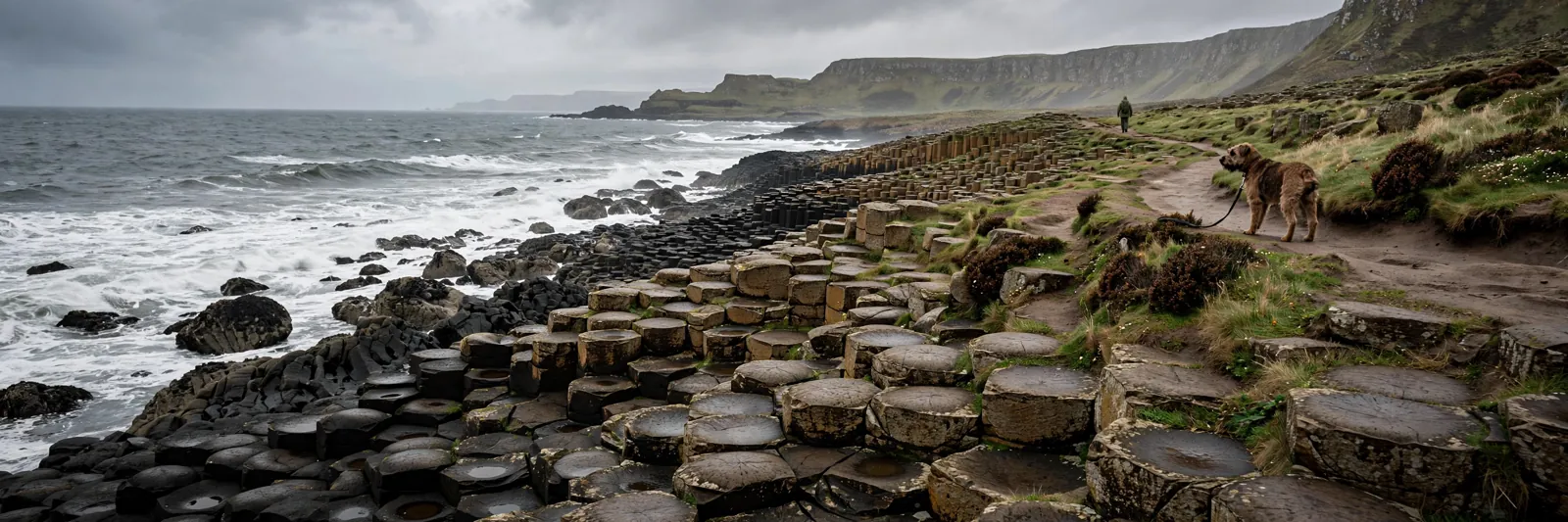
The stones themselves are the highlight and the hazard in one. Around 40,000 interlocking basalt columns, formed by volcanic activity some 60 million years ago, step down into the sea, and climbing across them is part of the fun for people. For dogs, the same surface needs managing. Dry basalt offers reasonable grip, but wet, algae-slicked or uneven columns can be treacherous for paws and for owners holding a lead. Keep your dog on the lower, flatter areas, discourage jumping between columns, and do not let them pull you across a slope — a person falling while attached to an excited dog helps neither of you. If your dog is elderly or unsteady, admiring the stones from the path edge is a perfectly good visit.
Water deserves respect here. The Atlantic arrives with real energy, waves can surge higher than expected around the Grand Causeway, and rock pools hide slippery edges. Keep dogs out of the sea at the stones themselves, watch for wet-weather spray on windy days, and never turn your back on the water while taking photographs. Further along the coast, tides can cut off shoreline sections, so any beach extension to the day needs a tide check before you commit to it.
Cliffs are the third hazard, and the quietest. Parts of the upper paths run near sheer, unfenced drops, and official trail guidance is blunt about staying on the marked route. With a dog, that means no shortcuts across grass, no letting them investigate the seaward side of a fence, and extra care at viewpoints where people bunch together. Add the standard coastal rules — sun protection and water in summer, because there is little shade; a towel and a warm layer in winter, because the wind is relentless — and the site becomes very manageable. Dogs that are comfortable on a lead in crowds, on steps and on uneven ground will cope well; dogs that are not can still enjoy the Green Trail and the Visitor Centre at quieter times.
Getting there, parking and the shuttle
The site sits on the Causeway Road near Bushmills, with the town of Bushmills, the coastal villages of Portballintrae and Portrush, and the larger town of Ballycastle all within easy driving distance. Most visitors arrive by car and use the site car parks, which are at their busiest from late morning to mid-afternoon in peak season. Arriving early does three favours at once: easier parking, quieter stones for a nervous dog, and softer light for photographs. If you are touring Northern Ireland by public transport, buses serve the coast and Belfast is the main rail gateway for onward connections — our guide to taking your dog on UK trains covers the rules for the rail leg of the journey, and you should confirm current bus timetables and dog carriage terms before relying on them.
Between the Visitor Centre and the stones, a shuttle bus operated for visitors who cannot or prefer not to walk the Blue Trail runs frequently, for a separate charge. It is a genuinely useful option for a tired dog or a tired owner at the end of the day. However, carriage terms for dogs and available space can change and can be squeezed at busy times, so confirm the current dog policy through the official visitor information or with the operator before building your plan around the bus. The safe approach is simple: walk down on the Blue Trail while everyone is fresh, enjoy the stones, and treat the shuttle as a possible bonus for the uphill return rather than a guarantee.
Whichever way you arrive, build in a toilet and water stop before you start a trail. Let your dog stretch, drink and settle after the car journey, and only then head for the stones. Five unhurried minutes at the start reliably saves a distracted, pulling first half-hour on the path.
When to go and what to pack
Timing changes this visit more than almost any other in Northern Ireland. Early mornings and late afternoons are quieter year-round, and outside the summer peak the site breathes again — you can let your dog actually look at the stones instead of weaving through a crowd. Winter brings short days, strong winds and the most dramatic seas, which suit hardy dogs and owners with proper layers; summer brings long evenings, the fullest facilities and the biggest crowds. Shoulder seasons often give the best balance for a dog day: mild weather, manageable numbers and enough daylight for a trail plus a nearby beach or village walk.
Pack for four seasons in a day, because the Antrim coast specialises in them. The essentials for the dog are a short fixed lead plus a spare, water and a portable bowl, more waste bags than you expect to use, a towel for paws and cafe respectability, and treats or a chew to reward settling indoors. For the stones and clifftops, footwear with real grip matters more than any other item you own. A light waterproof for you and, for fine-coated or elderly dogs, a simple coat in winter, turn a bracing walk into a comfortable one. If your dog wears a harness, it is a better choice than a collar alone on steps and slopes, because it spreads the load if either of you slips.
Finally, plan the food stops around the dog rather than discovering them. The Visitor Centre cafe welcomes dogs, which removes the usual problem, but village pubs and cafes along the coast vary — some welcome dogs throughout, some in the bar only, some not at all. A quick check online or a phone call before you detour saves a hungry backtrack. Browsing our destinations hub is a good way to line up a second dog-friendly stop on the coast so the Causeway becomes the centrepiece of a full day rather than a rushed single attraction.
Make a longer dog day of the coast
The Causeway rewards visitors who slow down, and the surrounding coast is full of extensions that suit dogs. The clifftop path east towards Dunseverick Castle continues the drama with far fewer people, while the villages of Portballintrae and Portrush offer harbour walks, coffee stops and sandy beaches nearby. Beach rules on this coast vary by beach and by season — some stretches ask for leads in summer or restrict dogs in the busiest bathing areas — so read the signs at the beach entrance and check restrictions before you unclip anything. The principles in our beaches rules guide apply here exactly: seasonal zones, lead areas near swimmers, and clean-up expectations everywhere.
If you are staying locally, treat the Causeway as an early-morning anchor and build the rest of the day at dog pace: a beach walk once you have checked the local rules, a village lunch where dogs are welcome, and a short evening stroll rather than a second big attraction. Dogs that have done the Red or Yellow Trail do not need another climb the same day. And if this stop is part of a wider Northern Ireland or UK touring break, the planning pattern in our weekend breaks with dogs guide — one headline activity, generous margins, a wet-weather fallback — works just as well here as anywhere on the mainland.
A simple plan for the day
Put together, a low-stress dog visit looks like this. The evening before, check the official National Trust page for opening times, booking advice and any trail closures, and check the weather and, if you plan a beach, the tides. On the day, arrive early, start with water and a settle at the Visitor Centre, and ask staff about trail conditions. Walk the Blue Trail down to the stones while it is quiet, keep the lead short and the pace unhurried on the columns, and let your dog take in the smells — for most dogs the sniffing is the attraction. Choose one extension only: the Green Trail for an easy clifftop leg-stretch, the Red Trail for fit dogs in good weather, or the Yellow Trail if you came for a proper walk. Finish back at the cafe, where your dog is welcome beside you, and leave before tiredness turns a good day scrappy.
- Before you go: Check official opening, booking and dog-policy information, plus weather and tides.
- Bring: Short fixed lead and spare, harness, water and bowl, plenty of waste bags, towel and treats.
- On the stones: Short lead, low flat columns only, no sea swimming, watch for surging waves.
- On clifftops: Marked paths only, no shortcuts, extra care in high winds and near unfenced edges.
- Pace it: One main trail plus one extension is enough — protect the cafe finish while everyone is still enjoying it.
Follow that shape and Giant's Causeway becomes what it should be: one of the most dog-welcome major attractions in the UK and Ireland, where the dog is part of the day rather than a problem to be managed around it. Check the official information before you travel, keep the lead on, and enjoy the stones together.
Keep exploring
Planning the wider coastline around the Causeway? Our Causeway Coast guide covers the strands, towns and cliff paths either side. See: Causeway Coast with a dog.
Practical questions
Before you go
Are dogs allowed at Giant's Causeway?
Yes. Dogs on leads are welcome in the outdoor areas at Giant's Causeway, throughout the Visitor Centre including the cafe, and on guided tours. The site carries the National Trust's highest three pawprint rating. Policies can change, so check the official National Trust page for the latest information before you travel.
Can dogs go inside the Visitor Centre and cafe?
Yes, dogs on leads are welcome throughout the Visitor Centre, including the cafe and exhibition areas, and water bowls are provided near the entrances. Keep your dog close to your table, out of walkways and away from other visitors' food, and check the official visitor information before you travel in case arrangements have changed.
Do dogs have to stay on a lead at Giant's Causeway?
Yes. Keep your dog on a short lead throughout the visit. The site has steep cliffs, busy paths, slippery basalt stones and other dogs in a small area, so a lead protects your dog and other visitors. Use a fixed lead rather than a long extending lead on the stones and on clifftop paths.
Which trail is best for dogs at Giant's Causeway?
For a first visit, the Blue Trail is the simplest choice because it leads directly from the Visitor Centre down to the stones. The Green Trail suits dogs and owners who need a step-free clifftop route. Choose the Red Trail only if your dog is fit and comfortable with steep steps, and treat the Yellow Trail as a longer, more challenging clifftop walk.
Can dogs ride the shuttle bus to the stones?
A shuttle bus runs between the Visitor Centre and the stones for a separate charge, but carriage terms can change and space can be limited at busy times. Confirm the current dog policy with the official visitor information or the operator before relying on the bus, and plan to walk the Blue Trail as your backup so your visit does not depend on it.