This guide is independent and contains no paid placement. If affiliate links are added later, they will be clearly marked and will not change our editorial checks.
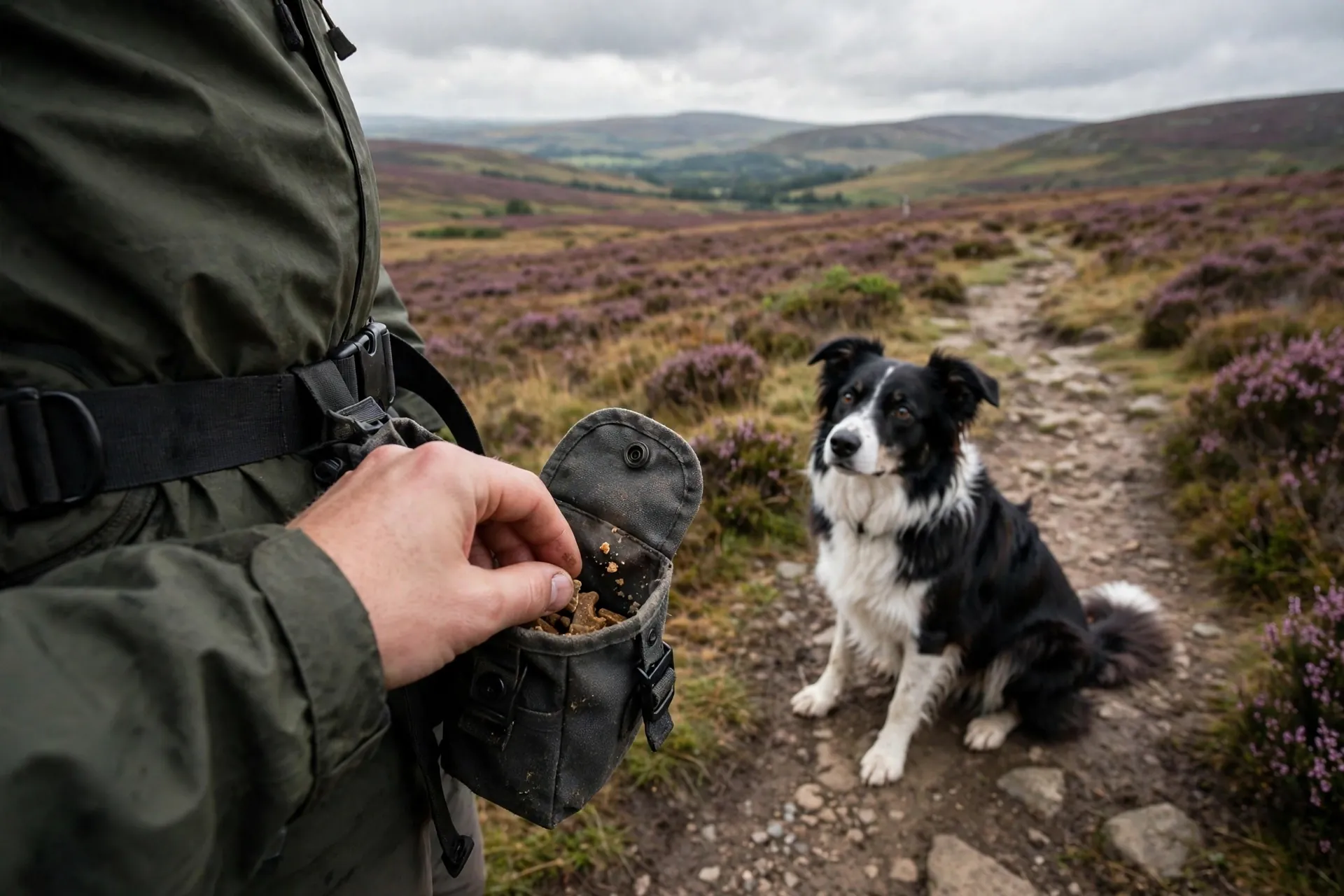
Pick a pouch that opens one-handed in under a second, survives British rain and holds 150 to 250 grams of pea-sized treats. Then use it deliberately: pay check-ins, recalls and calm behaviour near livestock, and match treat value to the difficulty of the moment. The pouch is not storage — it is your reward-delivery system.
Why recall is a safety skill on the trail
On a city pavement, a sloppy recall is an embarrassment. On open moorland it is a safety problem. British hiking country puts dogs next to sheep on unfenced fell, ground-nesting birds in the breeding season, deer in the woods, adders on warm rocky paths, cliff edges on coastal routes and farmyards with machinery — often all on the same day. A dog that returns promptly when called is the difference between a good story and a vet bill, a lost dog poster or a confrontation with a farmer who is legally entitled to protect livestock. That is why this guide starts with training, not shopping: the pouch only matters because it makes the training possible.
The science behind the pouch is timing. When you mark a behaviour with a word or a clicker, the reward that lands within one to two seconds is what the dog connects to the action. A treat fished from a zipped rucksack pocket arrives five seconds late, by which time the dog has done three other things — sniffed, turned, looked away — and the lesson is muddy. A pouch worn on your body keeps a handful of treats at your hip or chest, reachable with one hand while the other holds the lead. That single change turns a hike into hundreds of clean, well-timed repetitions: pay the check-in when the dog glances back voluntarily, pay the recall before the distraction wins, pay the calm sit while a flock of sheep drifts past 40 metres away.
Frequency matters as much as timing. A dog learning recall in easy conditions might earn a reward every few minutes; a young dog proofing that skill around livestock, joggers and picnics on a busy bank-holiday trail might need paying every 30 seconds. No coat pocket holds that many rewards comfortably, and nobody wants grease-stained trousers after one rainy walk. The pouch exists so that the rate of reinforcement can stay high without the logistics getting in the way. Think of it the way a climber thinks of a chalk bag: unglamorous, worn on the body, and quietly essential to the actual activity.
It also changes your behaviour as a handler. Owners who have to dig for treats reward less often and less precisely, and then conclude that their dog is stubborn. Owners with a pouch on the hip reward the small good choices — the voluntary check-in, the moment the dog looks at the sheep and then looks away — and are surprised how quickly the dog starts offering those choices more often. The pouch does not train the dog; it trains you to notice and pay, which trains the dog. That is the real purchase you are making.
Four pouch types compared
Treat pouches for hiking fall into four broad families. Each has a clear strength and a clear trade-off, and the right one depends on how you hike, how big your hands are and how your dog learns. Below is the honest comparison we would give a friend kitting out for a first multi-day trip.
Belt or waist pouches clip to a waistband or come on their own belt, sitting at the hip. This is the classic trainer's setup and the easiest to live with on the trail: the opening faces upward at hand height, one hand dips in without looking, and the other stays on the lead. Look for a stiffened rim that holds the mouth open while you walk, because a pouch that collapses shut every time you let go costs you seconds on every reward. The weakness is capacity — slim models top out around 150 grams — and very full ones can bounce on steep descents.
Cross-body or sling pouches hang from a shoulder strap and rest against the chest or front of the hip. They solve the rucksack problem elegantly: when a hip belt covers your waist, a sling pouch simply rides above it. They also tend to be bigger, with separate pockets for a phone, keys and poo bags. The trade-off is swing — on scrambly ground a loose sling slides around, so check that the strap adjusts short enough to sit snugly. Some hikers dislike anything across the chest with a rucksack on, so try the combination at home before a big day.
Magnetic-closure pouches are less a shape than a mechanism, and they appear in both belt and sling styles. A hidden magnet snaps the mouth shut between rewards and pops open with a one-handed push. On the trail this is the fastest system we have used: no drawstring to fumble with gloves on, no flap to lift, and nearly silent — a genuine advantage for noise-sensitive dogs, where the rip of hook-and-loop can undo a calm moment. The cautions are real too: a very cheap magnet can be too weak and spill treats on a steep slope, and dogs that mug pockets may learn to nose a magnetic pouch open, so check the strength and the rim stiffness together.
Silicone or integrated pouches include food-grade silicone bags that wipe clean and sometimes double as a collapsible water bowl, plus trainer bags with multiple compartments for treats, a clicker, a whistle and a phone. Silicone is the easiest to wash after a day of greasy salmon treats and mud — turn it inside out and rinse — and it does not absorb smells the way fabric does. Integrated bags suit handlers running proper training sessions on the trail, but they are bulkier and often overkill for a relaxed family hike where you just need treats and a poo bag.
| Type | Best for | Speed | Watch out for |
|---|---|---|---|
| Belt / waist | Everyday hikes, lead in one hand | Very fast | Capacity; bouncing on descents |
| Cross-body / sling | Rucksack hip belts, bigger loads | Fast | Swing on rough ground |
| Magnetic closure | Gloves, nervous dogs, quick reps | Fastest | Weak magnets; clever noses |
| Silicone / integrated | Greasy treats, structured sessions | Fast | Bulk; more than you need |
If you buy one thing for general British hiking, make it a belt pouch with a magnetic closure, a stiffened rim and a lined interior — the combination that handles gloves, rain and fast repetitions with the least fuss. Our detailed look at walking kit for travel covers how the pouch fits into the wider lead-and-harness setup, and it is worth reading alongside this guide if you are still choosing between a long line and a standard lead for open country.
Five things to check before you buy
Marketing copy for treat pouches is full of words like "premium" and "professional". Ignore it and check these five things instead — each one maps directly to something that goes wrong on real trails.
One-handed opening, tested with gloves. Put the pouch on, put your winter gloves on, hold a lead in one hand and try to get a treat out. If you fumble twice in the kitchen, you will fumble twenty times on a windy ridge while your dog watches the sheep. Magnetic closures and wide drawstring mouths pass this test; small zips, fiddly flaps and anything needing two hands fail it. This is the single most important feature on the whole list.
Weather resistance that matches British weather. A pouch lives outside your waterproofs, so it needs to cope with drizzle at minimum. Look for a water-resistant outer fabric, a wipeable or removable inner lining, and a closure that actually stays shut in wind — an open-topped pouch in a Peak District downpour becomes a bag of cold porridge by lunchtime. Seams and stitching matter: cheap pouches leak at the seams first. If you hike year-round, this matters more than any other feature after opening speed.
Honest capacity for your dog and your day. A 100-gram pouch suits a small dog on a short local loop; a full day on the fells with a young spaniel can need 250 grams or more of small treats. Bigger is not automatically better — an oversized pouch full of treats is heavy, swings, and tempts you to carry stale leftovers for weeks. Choose the size for your longest regular walk, and check that the pouch still closes properly when full. Some hikers carry a refill bag in the rucksack and top up at lunch, which lets the hip pouch stay slim.
Washability. Treat pouches get disgusting: meat juices, mud, rain, and the mysterious crumbs that appear in every pocket. Fabric pouches should be machine-washable or at least fully rinseable; silicone pouches should turn inside out. If the lining is not removable and the whole thing cannot go in the wash, the smell by month three will tell you about it. This is also a hygiene point: rancid fat on old crumbs is not something to feed a dog, however cheap the treats were.
Noise discipline. Crinkly linings and ripping hook-and-loop tape are surprisingly loud on a quiet moor, and for a nervous or reactive dog the sound of the pouch can become a trigger in itself — the dog hears the rip and braces before you have even delivered the reward. Magnetic and soft drawstring closures are near-silent. If your dog is sound-sensitive, this moves from nice-to-have to essential, and it is worth reading our guide to calmer holidays with a reactive dog for the wider picture of keeping arousal low on the trail.
When to reward on a real hike
Owning the pouch is step one; spending its contents well is step two. On the trail there are five moments that repay investment far beyond their cost in treats, and they are worth planning for before you set off.
The voluntary check-in. Every time your dog glances back at you unprompted on a long line or off-lead stretch, mark it and pay it. Check-ins are the raw material of recall: a dog that is in the habit of checking where you are is a dog you can call back. In the early months of training this might mean paying twenty check-ins an hour. It feels excessive. It is not — you are building the most valuable habit a hiking dog can have, and it is cheapest to build when nothing exciting is happening.
The actual recall. When you call the dog and it turns and comes, pay like it just won a prize — a jackpot of three or four treats in a row, delivered at your side or between your feet so the dog learns exactly where "here" means. Never call the dog for something unpleasant and then fail to pay: calling the dog to clip the lead on and end the fun, without a reward, teaches the dog that coming back ends good things. If you need the lead on, pay the recall first, then clip calmly, then pay once more for good measure.
Passing livestock and other triggers. Sheep, cattle, horses, deer and ground-nesting birds are the moments that define a hiking dog. The rule is distance first: move to a range where your dog can notice the animals without fixating — for many dogs that is 30 to 50 metres, for a young or highly aroused dog it can be far more. Then pay every calm behaviour you see: looking at the sheep and looking away, walking past with a loose lead, choosing to sniff the ground instead of staring. You are not bribing the dog to ignore sheep; you are paying the alternative behaviour until it becomes the default. This is where a pouch earns its keep, because you may need to deliver ten rewards in two minutes while moving. If your route planning already accounts for a reactive dog's needs, you will recognise this as the same principle applied to a specific trigger.
Uphill efforts and tricky terrain. Dogs, like people, find some stretches harder than others: a steep scree pull, a ladder stile, a wobbly footbridge, a section of sharp limestone. A well-timed reward at the top of the hard bit builds a positive association with the obstacle itself. Over a season, the dog that gets paid at every stile starts trotting toward stiles with confidence instead of balking. Keep a couple of higher-value treats back for these moments rather than spending your best currency on easy flat stretches.
Settling at rest stops. Hikes are not continuous motion, and the café terrace, the summit lunch spot and the pub garden are where manners matter most. Reward the dog for settling on its mat, lying quietly while you eat, and ignoring the other table's chips. A pouch that also holds a chew or a stuffed food toy for these stops earns its place twice over. Dogs that learn rest stops are for calm lying-down become dogs you can take anywhere — including the dog-friendly pubs that make British hiking holidays what they are.
Two mechanics underpin all of this. First, reward placement: where the treat lands teaches the dog where to be. Treats delivered at your left side build heel position; treats tossed ahead build distance; treats between your feet build a tight recall finish. Be deliberate. Second, rate of reinforcement: in new or difficult environments, pay often — every few seconds if needed — and thin out gradually as the behaviour becomes reliable. The pouch exists to make high rates cheap and easy. An empty pouch halfway through the hardest section of the walk is a planning failure, not bad luck.
Choosing and packing trail treats
Not all treats are worth pouch space, and the trail imposes its own rules. The guiding principle is a value hierarchy: ordinary, low-value treats for easy, well-known behaviours, and high-value "gold" for the hard stuff — recalls past distractions, calm passes by livestock, first attempts at scary terrain. Most pet-shop treats sit in the middle, which is exactly where they are least useful. Build your own hierarchy deliberately: dry biscuit pieces for check-ins you are confident about, soft meaty pieces for recalls, and something extraordinary — real chicken, cheese, or freeze-dried fish — for the moments that decide the walk.
Size is the next decision and it matters more than flavour. Treats should be roughly pea-sized, about 5 to 8 millimetres across: small enough to swallow in a second without chewing, large enough to find with a gloved hand. A dog that has to crunch through a biscuit for ten seconds has stopped thinking about the behaviour you just paid for, and has also stopped walking. Break or cut larger treats at home — scissors and five minutes the night before beats fumbling with a big biscuit on a windy hill. For very small dogs, go smaller still; a pea-sized treat is a meal for a Chihuahua.
Texture deserves a thought because it affects both speed and mess. Soft, slightly moist treats are eaten fastest and are easiest to break, which is why trainers favour them — but they also smear, stain and go off faster in heat. Dry, crunchy treats are clean and keep well but slow the dog down. A practical trail mix is two compartments or two pouches: soft high-value for the hard moments, dry low-value for the easy reps. If your pouch has only one compartment, put the soft stuff in a small zip bag inside it so the dry treats stay clean.
Quantity planning is simple arithmetic with a safety margin. For a three-to-four-hour hike, most handlers use 150 to 250 grams of pea-sized treats, but the real number depends on your dog's training stage. A young dog actively proofing recall might burn through 200 grams before lunch; a steady older dog on familiar paths might use 80. Pack for the dog you have on a hard day, not the dog you wish you had, and keep a refill bag in the rucksack. Puppies on their first adventures need the most generous budget of all — everything is new and everything worth paying — so if you are travelling with a young dog, our first-holiday checklist's packing section pairs well with this guide.
Calories count. Two hundred grams of training treats can easily be 600 to 800 calories, which for a medium dog is a substantial fraction of the day's food. On multi-day hiking holidays, trim the evening meal on heavy training days and watch the dog's weight across the week. This is not about being stingy — it is about keeping the dog fit for tomorrow's miles. Low-calorie options like tiny pieces of carrot or apple work for some dogs as low-value fillers, but do not expect a spaniel to recall past a rabbit for a piece of carrot. Match the currency to the job.
Finally, rotate. Dogs habituate: the treat that made eyes light up in March is boring by June if it is the only thing in the pouch. Keep two or three high-value options in rotation and introduce a new one every few weeks. Variety also protects you against the day you forget the good stuff — a dog that has learned three different jackpots is less devastated by the absence of one. Check use-by dates monthly; stale treats lose their smell, and smell is half the value.
Rain, mud and summer heat
British hiking weather is the ultimate product test, and the treat pouch sits right in the firing line. Planning for the two extremes — the sideways Pennine rain and the occasional proper heatwave — keeps the rewards working whatever the sky does.
Wet weather is the default to design around. A pouch with a water-resistant shell and a lined interior handles drizzle, but in sustained rain water finds every gap: the open mouth while you are mid-reward, the seam where the belt loop is stitched, the moment you bend to pick up after the dog. Three habits close those gaps. First, keep the pouch shut between rewards — magnetic closures make this effortless — so rain only enters during the second you are reaching in. Second, put soft treats in a small inner bag, a silicone tub or a zip-lock inside the pouch; the outer pouch then only needs to resist rain, while the inner bag handles the damp. Third, carry a sealed refill bag in your rucksack and top up under your jacket at rest stops, so the pouch never sits open and exposed while you pour.
Mud is the wet-weather companion. Pouches get dropped, leaned on, set down on boggy ground. A wipeable outer fabric and a fully rinseable lining turn a muddy pouch into a two-minute cleanup instead of a write-off. Dark colours hide the inevitable stains — this is one purchase where the attractive pale canvas is a mistake. And remember the dog's mouth: a pouch dragged through sheep pasture and then used to feed treats is a hygiene question, so a quick wipe of the rim at rest stops is worth the habit.
Summer heat brings the opposite problem. Fat-based treats soften, smear and go rancid faster; cheese sweats; anything with meat in it has a food-safety clock. On warm days, favour dry treats for the bulk of the pouch and keep the high-value soft treats in a small insulated bag with a cool block in the rucksack, decanting a few at a time. Never leave a loaded pouch in a hot car while you stop for lunch — temperatures inside a parked car can ruin treats and, far more importantly, endanger a dog left inside, so plan stops where the dog comes with you. As a rule of thumb, if you would not eat the treat yourself after a day in the pouch, do not feed it to the dog. Check the official guidance before you travel if you are unsure about safe food handling on hot days, and keep walk timings to the cooler morning and evening hours when the forecast is warm.
Seasonal planning ties it together. Spring means lambing season on many routes — more livestock, more reason for a generous treat budget and strict lead rules where farmers require them. Autumn brings pheasant shoots and deer stalking in some areas, with different distraction profiles. Winter means short days and gloves, which is when one-handed magnetic opening pays for itself daily. The pouch is a year-round tool; the treats inside it should change with the calendar.
Wearing it with a rucksack
The pouch has to coexist with the rest of your kit, and the usual friction point is the rucksack hip belt. A loaded 30-litre pack's hip belt sits exactly where a waist pouch wants to be, and the two fight for the same real estate. You have three workable answers. The simplest is to thread the pouch onto the rucksack's hip belt itself — many pouches have belt loops wide enough — so treats ride just in front of your hip bone. The second is a cross-body pouch worn above the hip belt, which keeps treats at chest height and completely clear of the pack. The third, for short walks, is to skip the big pack and use the pouch's own pockets plus a small dry bag for the essentials.
Position matters for the dog too. Most right-handed handlers wear the pouch on the right hip and reward with the right hand while the lead stays in the left — but the dog learns to watch the pouch hand, so be aware that a dog glued to your right side may be watching the treats rather than walking nicely. Occasionally rewarding from the other hand, or from a pouch worn centrally, keeps the dog guessing in a useful way. For very small dogs, a pouch worn slightly forward is easier to reach down to; for large bouncy adolescents, a pouch worn slightly behind the hip is harder for an enthusiastic nose to mug.
Two-dog households need a system. Either carry two pouches — one per hip, colour-coded if you are organised — or carry one large pouch and a clear rule about who gets paid when. What does not work is one pouch and vague intentions: the dogs will sort out the ambiguity by competing, usually at the worst moment. Pay the calmer dog first when both have done well; it is a small choice that compounds over a week of hiking. And whatever the setup, the poo-bag dispenser should live on the opposite side from the treats. Nobody wants to mix those up with gloves on.
Finally, think about the end of the day. Empty the pouch every evening: shake out the crumbs, wipe the lining, and leave it open to air overnight. Treats left in a warm, damp pouch breed exactly what you would expect. A five-minute evening routine keeps the kit fresh and means tomorrow starts with treats the dog actually wants — which is the entire point.
Three field drills that pay off
A pouch full of treats is potential; drills turn it into skill. These three can be run on any walk, need no special equipment beyond the pouch and a long line, and each targets a moment that decides real hikes.
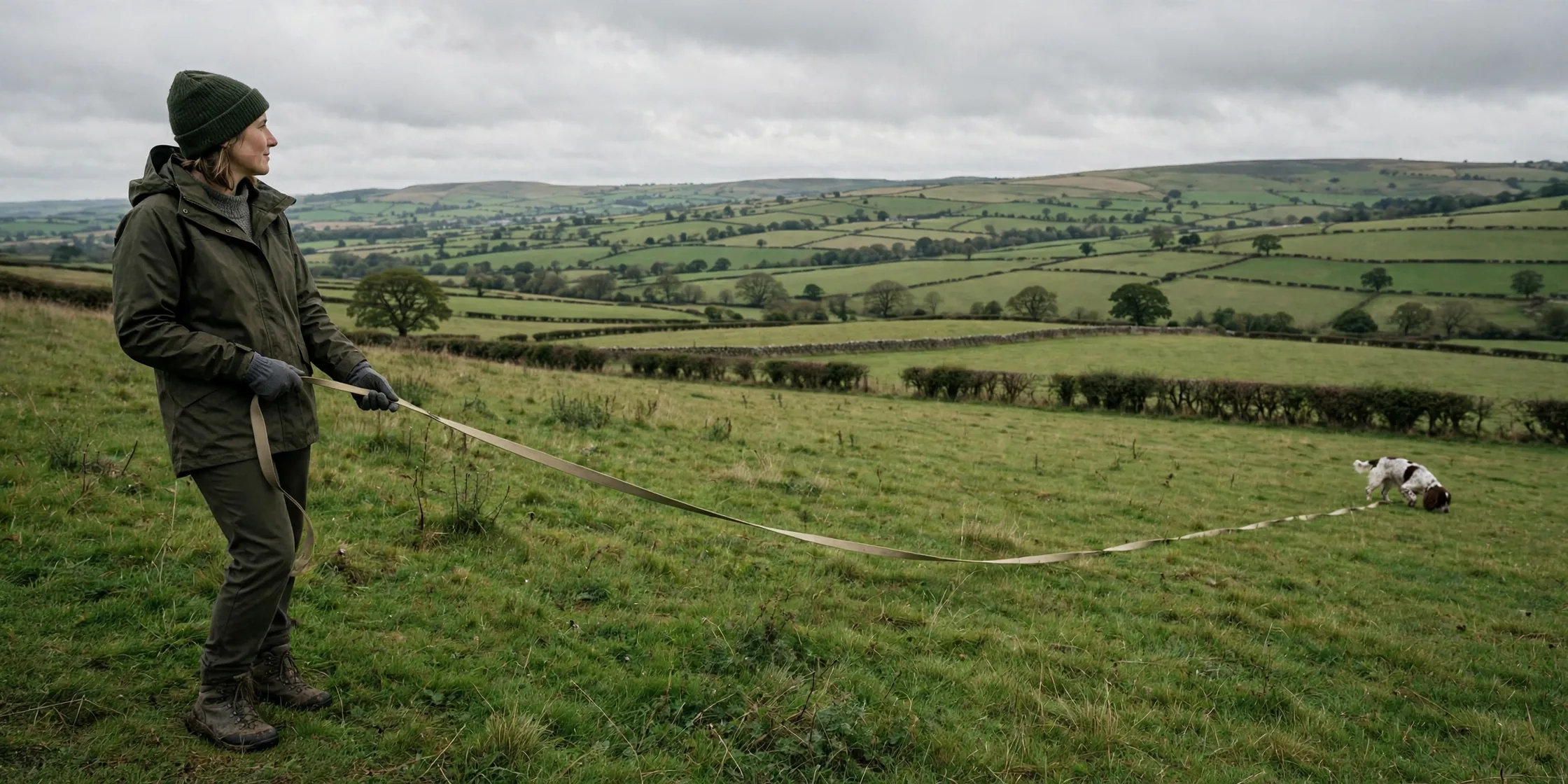
The whistle recall ladder. Pick a quiet stretch of path. Let the dog wander a few metres, blow your recall whistle (or call), mark and jackpot the return. Repeat, adding distance in small steps — five metres, ten, twenty — and only moving up when the current step is reliable. Then add difficulty instead of distance: recall past a mild distraction, recall when the dog is sniffing something interesting, recall downhill where momentum fights you. The ladder gives you a honest map of where the recall actually breaks down, which is usually much closer to home than owners expect. Run the bottom rungs every walk as maintenance; they are cheap and they keep the skill warm.
The livestock disengagement game. At a safe distance from sheep or cattle — far enough that your dog notices but can still think — wait for the dog to look at the animals, then mark and pay the instant it looks away, even for a heartbeat. You are paying disengagement, not obedience: the dog is learning that noticing livestock and choosing to look away is the most profitable thing in the field. Over sessions, the distance you need shrinks. Never lure the dog closer to "test" it; the test happens on its own when a sheep appears unexpectedly, and the game is what prepares the dog for that moment. Keep the lead or long line on wherever livestock rules or common sense require it — the drill builds the habit, the lead provides the insurance.
The emergency stop. Less glamorous than recall, and arguably more useful on narrow paths above drops or beside roads. Train a stop cue — a word, a whistle blast — that means "freeze where you are", paid generously from the pouch every time. Practice on easy ground first, then on the trail when nothing is happening, so the behaviour is fluent before you need it. A dog that stops on cue while you assess a stile, a herd crossing the path or a mountain-bike descent is a dog you can hike with anywhere. Like recall, the stop is maintained with occasional jackpots for life, not trained once and assumed.
All three drills share one rule: end on a success. If a rep fails, make the next one easier, pay it well, and move on. The pouch makes this easy because the next reward is always one hand-dip away. Training on the trail should feel like a game the dog keeps winning — that is what builds a dog that tries hard when it counts.
Common mistakes to avoid
Most treat-pouch problems are handler problems wearing a kit disguise. These five come up again and again, and each is cheap to fix once you see it.
Rewarding late. The classic: the dog recalls beautifully, you fumble with a drawstring for four seconds, and by the time the treat arrives the dog is sniffing a fascinating tuft of grass. The dog was paid for sniffing grass. If your pouch is slow, the answer is a faster pouch or pre-loading a treat in your hand before you call — not blaming the dog for a training failure that was really an equipment failure.
Only paying the big moments. Owners save treats for recalls and ignore the twenty check-ins, the calm pass by the jogger, the settle at the café. Then they wonder why the dog only offers effort in emergencies. The small behaviours are the foundation; pay them. A pouch that empties on "easy" rewards is a pouch doing its job.
Overfilling and stale leftovers. A pouch crammed to bursting spills treats on every bend, and treats that have lived in the pouch for a fortnight are scentless cardboard. Fill for the walk you are doing, empty and clean after, and refill fresh. Your dog's nose knows the difference between this morning's chicken and last Tuesday's crumbs.
Feeding chunks that stop the walk. Oversized treats turn every reward into a chewing break, killing momentum and focus. If you consistently need to wait for the dog to finish, your treats are too big. Pea-sized is the rule; break them smaller for tiny dogs and heavy repetition sessions.
Forgetting the human half of the system. The pouch on your hip does nothing if you leave it in the car, forget to refill it, or wear it but never reach for it. The most common failure mode is simply not using it: the walk happens, the good behaviours happen unrewarded, and the opportunity compounds into nothing. Make the pouch part of your leaving-the-house checklist, alongside the lead, the water and the poo bags. Consistency beats cleverness in dog training every time.
None of these mistakes is a disaster — they are all just leaks in the system. Plug them and the same dog, on the same trails, with the same pouch, starts looking like a different animal within a fortnight. That transformation is the real product review for any treat pouch, and it is the reason this unglamorous bit of kit deserves its place on every hiking checklist.
Practical questions
Before you buy
Do I really need a dedicated treat pouch for hiking, or can I use my pockets?
You can start with pockets, but a dedicated pouch is faster, cleaner and holds more. Pockets slow your reward delivery, get greasy, and empty quickly on a long hike. A belt or cross-body pouch keeps 150 to 250 grams of pea-sized treats within one hand's reach, which is what makes frequent, well-timed rewards possible on a real trail.
What size should hiking treats be?
Roughly pea-sized, about 5 to 8 millimetres. Small treats are swallowed in a second, so the dog stays focused and you can deliver fifty or more rewards without overfeeding or long chewing pauses. Break larger shop-bought treats into pieces before you leave, and carry scissors-free soft treats for the highest-value recalls.
How do I keep treats dry when it rains on the trail?
Use a pouch with a weather-resistant shell and a lined inner bag, and keep it closed between rewards. In heavy rain, carry a second sealed bag of dry treats inside your rucksack and refill the pouch under your jacket at rest stops. A small silicone inner tub or zip-lock bag inside the pouch stops damp treats from turning to mush and keeps crumbs contained.
Magnetic or drawstring closure: which is better for hiking?
For most hikers, magnetic is better. It opens and closes one-handed in a fraction of a second and makes no rustling noise, which matters for noise-sensitive dogs. Drawstrings are secure and cheap but slower and fiddly with gloves. Avoid loud hook-and-loop closures near nervous dogs; the rip can startle them at exactly the wrong moment.
How many treats should I pack for a half-day walk?
Plan for 150 to 250 grams of pea-sized treats for three to four hours, adjusted to your dog's size and how much rewarding the route will need. A young dog proofing recall near sheep needs far more than a settled older dog on a quiet lane. Budget the calories against the day's food and trim the evening meal if the pouch emptied fast.
Can a treat pouch help my dog ignore livestock on walks?
Yes, because it lets you reward the alternative behaviour at distance. When sheep appear, move to a distance your dog can cope with, mark calm looking-away or check-ins, and pay generously from the pouch. Repeated calm, well-paid moments near livestock build the habit of disengaging. The pouch does not replace distance, management and a lead where rules require one, but it makes the rewarding part fast and reliable.