This guide is independent and contains no paid placement. If affiliate links are added later, they will be clearly marked and will not change our editorial checks.
Tunbridge Wells suits a dog day out because the town is compact and the walking is close at hand. Start at the Pantiles, circle the lake in Dunorlan Park, then let the dog run on the Common. Keep the dog on a lead in the town streets, around the lake and near grazing animals, and check the official guidance before you travel for current rules, opening times and charges.
A spa town built on iron water
Royal Tunbridge Wells began with a spring. In 1606 Dudley, Lord North, noticed that the water bubbling from a spring on the heath tasted of iron and left a rust-coloured stain, and the chalybeate spring — chalybeate comes from the Greek word for iron — became the reason a town grew here at all. Within a generation the spring was drawing visitors who came to take the waters, and in 1630 Queen Henrietta Maria, wife of Charles I, arrived with her court and put the place firmly on the map. The town that followed was built for leisure: assembly rooms, a pump room, lodging houses, a colonnade and, later, the grand villas of Mount Ephraim and Mount Pleasant. Edward VII granted the "Royal" prefix in 1909, and the full name has stuck ever since.
That history matters to a dog owner because it shaped the town you walk through today. The centre is small and walkable, the interesting streets sit close together, and the two great open spaces — the Common and Dunorlan Park — lie within a short walk of the shops. There is no long trudge from a car park to the first decent walk, and no need to drive between the morning stroll and the afternoon one. The town sits on the Kent and East Sussex border, on the edge of the High Weald, and the land around it is a patchwork of heath, woodland, sandstone outcrops and small villages. A dog that is happy on heathland paths and woodland tracks will be happy here.
Geography first, so you can picture the day. Tunbridge Wells station stands at the southern end of Mount Pleasant Road, and the town centre runs uphill from there along Mount Pleasant Road towards the shops of Royal Victoria Place and the High Street. The Pantiles lies below and to the south of the station, at the bottom of the hill, roughly ten minutes on foot from the station platforms. Calverley Grounds, the town's central park, sits just north of the station. The Common spreads to the north-west of the centre, a broad sweep of heath and woodland that runs from Mount Ephraim out towards Rusthall. Dunorlan Park lies about a mile to the south-west, off Pembury Road, on the far side of the town from the Common. High Rocks, the sandstone outcrop managed by the National Trust, stands about two miles west of the town near Groombridge. Everything in this guide sits inside that small triangle, which is why a day in Tunbridge Wells works without a car once you arrive.
The practical shape of the town also decides what kind of dog will enjoy it most. This is a town walk, not a wilderness hike. Paths on the Common are uneven, gorse-lined and sometimes muddy after rain, but they are never remote; you are rarely more than a few minutes from a road or a house. Dogs that are nervous in crowds will find the Pantiles and the High Street busy on Saturdays and quiet on weekday mornings. Dogs that pull will find the downhill walk from the station to the Pantiles a test of lead manners. Dogs that are reactive to other dogs will meet plenty of company on the Common, where off-lead dogs are common, and will need the quieter woodland paths at the edges rather than the main tracks. Older dogs and small dogs do well here: the town centre is compact, the Dunorlan lake loop is flat, and there are benches everywhere.
Seasons change the town more than you might expect. Spring brings the Common alive with gorse in flower and the first leaves on the birch, and the Pantiles cafes put their tables outside. Summer is the busiest season, with the farmers' market on the Pantiles, jazz on the bandstand in Calverley Grounds, and the boating lake in Dunorlan Park at its liveliest. Autumn is arguably the best season for a dog: the beech and oak on the Common turn colour, the crowds thin, and the air is cool enough for a long walk. Winter is quiet and short-dayed, but the Pantiles colonnade gives shelter from rain and the pubs are at their most welcoming. Whenever you come, check the official guidance before you travel for market dates, event closures and seasonal opening times, because a market Saturday transforms the Pantiles from a quiet promenade into a crowded street fair.
One warning that belongs at the start rather than the end: the Chalybeate Spring water is not for dogs. The spring water is rich in iron and was drunk by visitors as a cure; it tastes strongly metallic and it is not drinking water for a dog. If you visit the spring with your dog, keep the dog on a short lead and do not let it drink from the spring or the trough. Carry your own water for the dog, as you would on any town walk, and use the water fountains and dog bowls outside cafes rather than the spring.
Getting here is straightforward. By train, Southeastern runs services from London Charing Cross and London Bridge to Tunbridge Wells, with the journey taking around 50 minutes, and on to Hastings. Up to two dogs travel free per passenger on National Rail services, which makes the train a genuinely good option for this town — the station is in the centre, and the walks start from its door. By car, the A21 runs from the M25 down to the town, the A26 comes in from Maidstone, and the A264 from East Grinstead and Crawley. Drivers should check the official guidance before you travel for roadworks on the A21, which is a regular feature of the route. The town has no park and ride, so plan to park once and walk, using the car parks listed in the town centre section below.
Before the detail, a word on how this guide is organised. The sections follow the order of a good day out: the Pantiles first, while the town is still quiet; Dunorlan Park for the middle of the day, when the lake and the lawns are at their best; the Common and High Rocks for the long afternoon walk; then the town centre for shopping and the station; and finally the pubs and places to stay. If you only have half a day, do the Pantiles and Dunorlan Park. If you have a full day, add the Common. If you are staying overnight, High Rocks and the villages beyond the town are the second day.
The Pantiles: colonnades and spring water
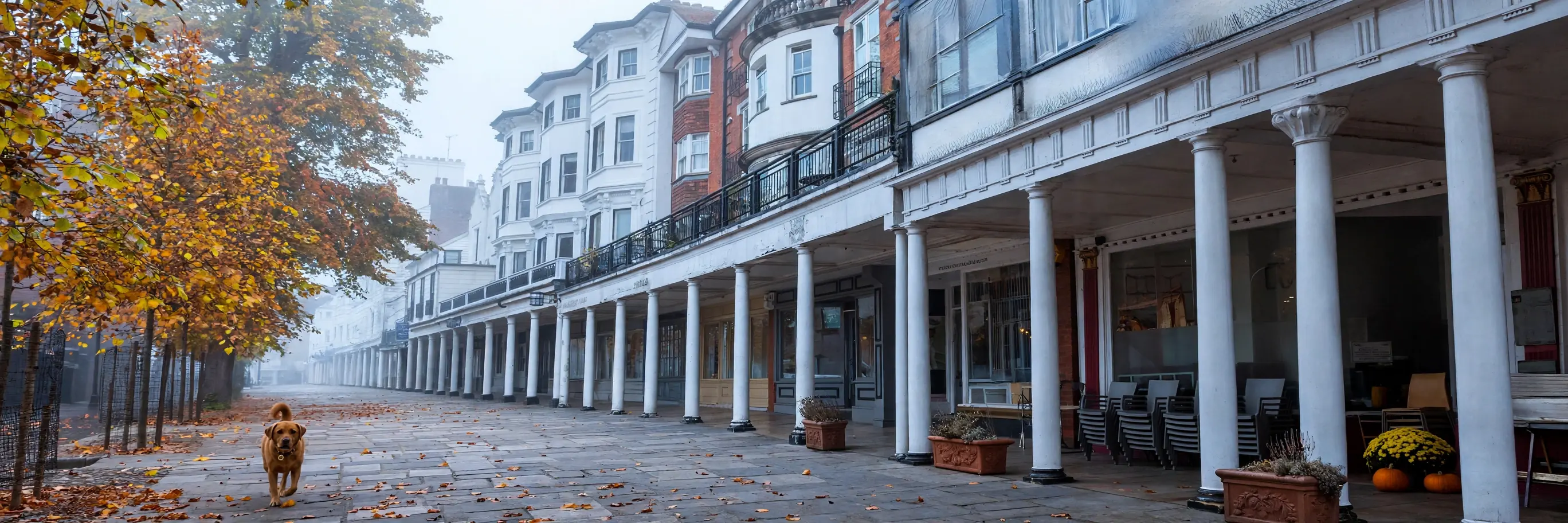
The Pantiles is the reason Tunbridge Wells exists, and it is still the best place to start a visit. The name comes from the pantiles — the curved Dutch roof tiles — that were laid over the muddy walkway beside the spring in the eighteenth century, so that visitors taking the waters could promenade without sinking into the mire. The colonnade that runs along one side was built in the 1790s, and the buildings that face it — the Assembly Rooms, the Pump Room, the Bath House and the row of bow-fronted shops — are the town's Georgian core. Walk it on a quiet weekday morning and the place feels almost unchanged: a covered walkway, a row of independent shops, the sound of the spring, and the sense that the town grew up around this one stretch of pavement.
For a dog, the Pantiles is a short-lead stroll rather than a run. The walkway is paved, level and easy underfoot, which suits older dogs and dogs that are unsteady on rough ground. The colonnade gives shelter from rain and from summer sun, and the raised walkway on the western side offers a view down the length of the Pantiles that makes a good photograph. The whole stretch is only a few hundred metres long, so the walk itself takes twenty minutes at a dog's pace — but the Pantiles rewards slow looking. The Assembly Rooms, built in the 1730s, still anchor the northern end; the Bath House marks the southern end; and between them the shopfronts change from cafes to delicatessens to galleries, many of them dog-friendly at the door.
The Chalybeate Spring itself sits at the northern end of the Pantiles, behind a small railing, and in the summer months visitors can taste the water at the spring when the attendants are present. The spring flows all year, and the water is the same iron-rich water that drew Lord North here in 1606. It is worth seeing, and worth explaining to children, but it is not a dog stop: keep the dog on a short lead, keep it away from the spring, and do not let it drink the water. The spring's opening days and tasting sessions vary by season, so check the official guidance before you travel if tasting the water is part of your plan.
The best time to walk the Pantiles with a dog is early. The cafes open their doors from around nine in the morning, the market traders arrive later, and the first hour of the day belongs to dog walkers, shopkeepers and the occasional early visitor. By late morning on a Saturday the Pantiles fills up, and on market days — the farmers' market is held on the Pantiles, traditionally on the first and third Saturdays of the month — the walkway becomes a crowded street market. A nervous dog will find market day stressful, and a friendly dog will find it a gauntlet of feet, pushchairs and food smells. If your dog is anxious in crowds, visit the Pantiles on a weekday or before ten in the morning, and save Saturday for the Common.
What can a dog actually do on the Pantiles? The honest answer is: stroll, sniff, sit outside a cafe, and watch the town wake up. The cafes and pubs along the Pantiles have outdoor seating, and several welcome dogs at the outside tables with water bowls. The shops are a mixed picture: some independent shops welcome dogs inside, others ask you to wait at the door, and the position changes from shop to shop, so ask before you step in rather than assuming. The colonnade itself is a good place to practise lead manners — narrow, with people passing on both sides — and the raised walkway gives a dog a vantage point over the street below. There are no off-lead areas on the Pantiles, and there should not be: it is a paved, busy, public promenade, and a loose dog here is a hazard to itself and to others.
Two practical details matter. First, the Pantiles is at the bottom of a hill, and the walk back up to the station and the town centre is a steady climb along Mount Pleasant Road or through the back streets. An older dog that walked happily downhill may need a slower pace on the way back, and there are benches on the way up. Second, the nearest car park is Crescent Road, a short walk from the southern end of the Pantiles, and the Great Hall car park sits nearby off Mount Pleasant Road. Both fill on market Saturdays, so an early arrival pays twice over: a quieter Pantiles and a parking space.
The Pantiles also hosts the town's outdoor events, and these change the character of the place entirely. Summer jazz evenings on the Pantiles draw crowds and music, the Christmas market brings lights and stalls, and the occasional food festival fills the walkway with smells that no dog can resist. These are good days to visit if your dog is steady in crowds and you want atmosphere; they are bad days if your dog is noise-sensitive or food-obsessed. Event dates are published on the town's visitor website, so check the official guidance before you travel and plan around them rather than being surprised by them.
If the Pantiles leaves you wanting more of the town's history, the short walk up to the top of Mount Pleasant Road takes you past the villas of Mount Ephraim and the edge of the Common, and the Amelia Scott building on the High Street — the town's museum, library and visitor centre, reopened after a major refurbishment in 2022 — holds the story of the spring and the spa town in its galleries. Dogs are not generally allowed inside museums, so treat the Amelia Scott as a human-only stop while one of you waits outside with the dog, or save it for a return visit without the dog. The building itself, and the square outside it, are worth a look even from the pavement.
Dunorlan Park: the lake and the lawns
Dunorlan Park is the town's great dog park in the practical sense: a large, green, enclosed-feeling space where a dog can walk properly without leaving the town. The park covers about 78 acres, and it began as the private grounds of Dunorlan House, built in the 1850s for the tea merchant Henry Reed, with the landscape laid out by the gardener Robert Marnock. The estate was given to the town in the 1940s, and it has been a public park ever since. The result is a Victorian landscape garden that was designed to be walked: a lake with an island, sweeping lawns, a Grecian-style temple viewpoint, mature trees, a rose garden, and paths that wind rather than march. It is the most beautiful park in the town, and the most useful one for a dog owner.
The centrepiece is the boating lake. In the summer months rowing boats are available to hire, and the lake is busy with ducks, swans, moorhens and the occasional heron. Dogs must be kept out of the water and on a lead around the lake, and this is a rule worth respecting rather than testing: the water is deep in places, the banks are steep, and the birds are protected. The lake loop is the park's main walk, a flat circuit of roughly two kilometres that takes forty minutes at a dog's pace, with benches at intervals and views across the water to the temple and the far bank. In spring the nesting season makes the lake edge a no-go area for loose dogs, and in winter the lake can freeze at the edges, which is another reason to keep a dog close.
Above the lake, the upper lawns are where dogs get their freedom. The wide grass slopes and the open ground near the top of the park are the places where dogs under close control can run, play and burn off energy, and on a sunny weekend morning the lawns fill with local dog walkers. The ground is level, the sightlines are good, and a dog that recalls reliably can be given a proper run here. The park's own rules ask for dogs to be on a lead around the lake, the cafe terrace and the children's play area, and for dogs to be under close control elsewhere — read the signs at the gates on arrival, because the council posts the current rules there and they are the ones that count.
Other features fill out the visit. The cafe by the lake serves drinks and light food, with outdoor seating where dogs are welcome, and it is the natural halfway stop on the lake loop. The play area and the tennis courts sit on the upper ground, and the rose garden and the war memorial give the park its quieter corners. The Grecian temple, a small classical structure on the hillside above the lake, is a good viewpoint and a useful landmark when you are describing the park to someone else: "meet at the temple" is a sentence local dog walkers use often. The park's trees are worth noticing in their own right — mature oaks, beeches and cedars that make the park shady in summer and golden in autumn — and the autumn colour here is among the best in the town.
Getting to Dunorlan Park is easy. From the Pantiles it is about a mile to the south-west, a walk of twenty minutes through the town streets, or a short drive via Pembury Road, where the park has its own car park. Several bus routes run along Pembury Road and stop near the park gates. The main entrance is on Pembury Road, with further entrances from the surrounding streets, and the park is open daily from early morning until dusk — check the official guidance before you travel for the current opening hours, which change with the seasons. The park is free to enter, which makes it a good option for a repeat visit during a longer stay.
The practical advice for Dunorlan Park is simple and specific. Bring water for the dog in summer, because the lake water is not drinking water and the cafe may be busy. Keep the dog on a lead until you are on the upper lawns and you can see the ground clearly. Watch for the water birds in spring and for the model boats and rowing boats in summer, both of which excite dogs that like to chase. Pick up after your dog — the park is heavily used by families and the bins are well placed, so there is no excuse. And if your dog is reactive, visit early in the morning, when the park belongs to the regulars and the paths are quiet, rather than at midday on a Sunday, when the lawns are at their busiest.
Dunorlan Park also works as a base for a longer walk. From the park's western edge, footpaths run out towards the countryside around Southborough and the villages beyond, and the High Weald landscape begins almost at the park boundary. A confident walker with a fit dog can link the park to the lanes around Bidborough and back again in a couple of hours, though the routes need a map — the paths are not waymarked as a single trail, and the lanes are narrow. For most visitors, the park itself is enough: a lake loop, a run on the lawns, a coffee at the cafe, and a slow walk back to the town.
The Common and High Rocks: heathland and sandstone
Tunbridge Wells Common is the town's wild side. About 250 acres of heathland, gorse, birch woodland and open grass, it is managed by the Conservators of Tunbridge Wells Common, and it has been common land since long before the spa town existed — the spring itself rises at the edge of the Common, and the first visitors walked across this heath to reach it. Today the Common is the place where the town's dogs go to be dogs: open ground, long sightlines, woodland paths, and the freedom to run that a town park cannot offer. It is also the place where the town's history is written into the ground, in the sandstone rocks, the old pits and the grazing land.
The walking is the point. A loop of the Common's main paths takes about an hour, and the ground is a mix of firm tracks, sandy heathland paths and woodland trails that turn muddy after rain. The heath is at its best in late summer, when the heather flowers and the gorse is in bloom, and in autumn, when the birch turns gold and the bracken turns rust. The open areas around Mount Ephraim and Major York's Road are the most popular with dog walkers, while the wooded slopes towards Rusthall are quieter and better for a dog that needs space. Wellington Rocks, a cluster of sandstone outcrops on the Common, is a landmark worth finding: the rocks rise from the heath like a small fortress, and children climb them while dogs sniff around their base. The rocks are part of the Wealden sandstone ridge, laid down around 140 million years ago, and the same stone shapes the whole landscape around the town.
Dogs and the Common go together, but the rules are the responsibility of the owner. Off-lead walking is common on the open parts of the Common, and a dog under close control can run free, but the Common is grazed land in places, and grazing animals appear on parts of the Commons through the year. A dog must be under close control near livestock, and on a lead if the animals are close — this is not a suggestion but a legal and practical requirement, and a dog that chases livestock is a danger to itself. The Common is also shared with horse riders, cyclists, runners and families, so a dog that recalls reliably is a pleasure and a dog that does not is a problem. If your dog's recall is uncertain, keep it on a long line and use the open ground to practise, rather than letting it loose and hoping.
Rusthall Common, the smaller neighbour to the west, is worth the short walk. It holds Toad Rock, the town's most famous sandstone formation, a great block of stone that really does look like a toad squatting on the heath, and it is a favourite meeting point for local walkers. The ground around Rusthall Common is open and exposed, with wide views across the Weald, and the paths link back to the main Common through the woodland. A loop that takes in the main Common, Rusthall Common and Toad Rock runs to about two hours, and it is the best single walk in the town for a fit dog.
High Rocks is a different experience and a short drive away. About two miles west of the town, near Groombridge, the High Rocks are a National Trust site: a maze of sandstone outcrops linked by wooden bridges and steps, set in eleven acres of woodland, on the site of an Iron Age hill fort. The rocks are the most dramatic sandstone in the area, with narrow passages, high viewpoints and deep clefts, and the site has a story that goes back to the Iron Age and to the Victorian tourists who first made it a visitor attraction. Dogs are welcome on leads, and the site charges admission — check the official guidance before you travel for current prices and opening times, because the site is seasonal and the hours change through the year.
High Rocks needs a clear warning. The site is not suitable for every dog. The wooden steps are steep and open, the bridges are narrow, the drops between the rocks are real, and a dog that is nervous of heights or unsteady on steps will not enjoy it. Puppies, older dogs and dogs with joint problems should skip the rock maze and use the woodland paths at the base instead. For a fit, confident dog on a short lead, the rocks are a memorable hour, but keep the lead short, keep the dog away from the edges, and do not let it jump between the rocks. The pub at the entrance, the High Rocks Inn, has a garden where dogs are welcome, and it is the natural end to the visit.
Between the Common and High Rocks, the walking country around Tunbridge Wells opens up. The High Weald Landscape Trail passes near the town, the lanes around Groombridge and Bidborough are quiet and dog-friendly, and the countryside to the south, towards the River Medway and the villages of the Weald, offers field paths and woodland walks in every direction. A car makes these easy; without one, the Common and Dunorlan Park are the walks to rely on. Whatever you choose, carry water, wear boots after rain — the clay and sandstone paths are slippery when wet — and remember that the Common has no fences: a dog that runs will run a long way before it meets a road, and the A264 and the London Road both cross the edge of the Commons.
The town centre: streets, shops and the station
Between the walks, the town centre itself is worth an hour with a dog. Mount Pleasant Road runs from the station uphill to the shops, and it is the town's main street: banks, cafes, the Opera House — the former opera house on Mount Pleasant Road, now a large pub — and the entrance to the Royal Victoria Place shopping centre. Royal Victoria Place is the town's indoor shopping centre, and dogs are not generally allowed inside shopping centres, so treat it as a human-only stop: one of you waits outside with the dog, or skip it and use the open streets instead. The High Street and Camden Road are the better dog streets. Camden Road, in particular, is the town's independent quarter: cafes, delicatessens, bookshops and small retailers along a sloping street where dogs are a common sight and several shops keep water bowls by the door.
Calverley Grounds is the town centre's park, and it is the one to use if you need a green stop between the station and the shops. The park sits just north of the station, with lawns, flower beds, a bandstand, a cafe and a play area, and it hosts summer concerts and events. Dogs are welcome on a lead, and the park is a good place for a short toilet walk and a sit on a bench before the train home. It is small — a few acres against Dunorlan's 78 — but it is central, and on a busy day it is the most practical green space in the centre. The cafe has outdoor seating where a dog can settle, and the bandstand concerts in summer are a pleasant way to spend an afternoon with a dog that is happy lying quietly in a crowd.
The Amelia Scott, on the High Street, is the town's museum, library, archive and visitor centre, reopened in 2022 after a major refurbishment that joined the museum, the library and the adult education centre into one building. It holds the town's collections, the story of the spa and the spring, and the visitor information desk where you can pick up walking maps of the Common and the town. Dogs are not generally allowed inside, so plan it as a human-only visit while someone waits outside with the dog, or go in alone while the dog rests in the car — never leave a dog in a car on a warm day, and use the shade and the water bowls outside the building instead. The square outside the Amelia Scott is a good meeting point, and the building's cafe has outdoor seating.
The station is a practical asset. Tunbridge Wells station has step-free access to the platforms, a ticket office, waiting rooms and a small cafe, and the walk from the platforms to the Pantiles takes about ten minutes downhill. Trains run to London Charing Cross, London Bridge and Cannon Street, and south to Hastings and the coast, with the London journey taking around 50 minutes. Up to two dogs travel free per passenger on National Rail services, and dogs are welcome on the trains without a ticket, though a busy commuter train is no place for a nervous dog — travel outside the rush hour if you can. If you are arriving by train, the station is the natural start and end of the day, and the walk from the station to the Pantiles is the first walk of the visit.
Parking in the town centre is straightforward but competitive. The most useful car parks for a dog visit are Crescent Road, close to the Pantiles at the southern end of the town; the Royal Victoria Place car park and the Meadow Road car park, both near the shops; and the Great Hall car park off Mount Pleasant Road. Dunorlan Park has its own car park off Pembury Road, and the Common has small car parks at Fir Tree Road and Major York's Road, which are the best starting points for a Common walk. Charges apply in the town centre car parks, and the machines take card payment — check the official guidance before you travel for current tariffs, because the council revises them. On market Saturdays and in the Christmas season, the town centre car parks fill by mid-morning, so arrive early or park at the Common and walk in.
Shopping with a dog in Tunbridge Wells is a matter of asking. The independent shops on Camden Road and the Pantiles are generally welcoming, and many will invite a dog inside, but the position varies from shop to shop and from day to day, so ask at the door rather than assuming. The larger chain stores on the High Street are less consistent, and the indoor shopping centre is a no-go for dogs. If you need dog supplies, the town has pet shops and the larger supermarkets on the edge of the centre stock the basics; for a specialist item, the pet shops in the town centre are the better bet. And if you are buying anything for the dog — a new lead, a drying coat, a treat — the Pantiles delicatessens and the Camden Road shops are the places where a dog is most likely to be offered a biscuit at the till.
One more practical matter: the nearest vet. Before you set out for the day, note the location of the nearest veterinary practice and save the number on your phone, as you would on any trip away from home. The town has several veterinary practices, and the out-of-hours emergency cover is shared between them — check the official guidance before you travel for the current emergency number. This is a five-minute job that you hope never to use, and it is worth doing before the walk rather than during a crisis.
Pubs and stays: where dogs are welcome indoors
Tunbridge Wells is a good pub town for a dog owner, and the best pubs are the ones the locals use. The Ragged Trousers on St John's Road, a short walk from the town centre, is well known for welcoming dogs, with water bowls, treats and a relaxed bar where a dog can settle under a table. The Sussex Arms, also on St John's Road, is another dog-friendly local, with a garden in summer and a fire in winter. Both are the kind of pub where a muddy dog after a Common walk is expected rather than tolerated, and both are worth knowing by name before you arrive. The Opera House on Mount Pleasant Road, a large pub in the former opera house, has outdoor seating and a grand interior, and it is a useful stop near the station — ask about the current indoor dog policy on arrival, because large pubs change their rules more often than small ones.
On the Pantiles itself, the cafes and pubs with outdoor seating are the dog-friendly option, and the colonnade gives shelter from rain while the dog settles at an outside table. The Pantiles cafes serve breakfast, coffee and lunch, and several keep water bowls outside for dogs. The pubs at the southern end of the Pantiles are the natural end to a morning walk: a drink, a snack, and a dog asleep under the table. Policies change, so check the official guidance before you travel and confirm the current rules when you arrive, and remember that a dog that is welcome outside is not automatically welcome inside.
Beyond the town, the village pubs are where a dog walk becomes a day out. The Kentish Hare at Bidborough, about two miles from the town, is a well-known dog-friendly pub with a garden and a menu that draws people from across the area — it is a good lunch stop after a walk on the lanes around Bidborough, and it is the pub to book if you are visiting at the weekend. The Compasses Inn at Green Street Green, a few miles to the north, is another dog-friendly village pub with a garden. The High Rocks Inn, at the entrance to the High Rocks site near Groombridge, has a garden where dogs are welcome and is the natural end to a visit to the rocks. All three are popular, all three are worth booking ahead at weekends, and all three are the kind of pub where a dog that has walked all morning is part of the furniture.
What makes a pub genuinely dog-friendly, rather than merely tolerant, is worth knowing before you choose. Look for water bowls without having to ask, treats at the bar, a dog that is already asleep under a table, and staff who greet the dog by name. Look for a floor that can cope with muddy paws, a quiet corner away from the kitchen door, and an outside area that is enclosed or at least away from the road. A pub that welcomes dogs will say so on its website or on a sign at the door; a pub that does not will say so too, and the sign is worth reading before you walk in with a wet spaniel. And always ask before you sit down inside: a dog that is welcome in the bar may not be welcome in the restaurant, and the distinction matters at lunchtime.
Staying overnight opens up the town properly. The Spa Hotel, on Mount Ephraim at the edge of the Common, is the town's grand old hotel, set in its own grounds with a spa, a restaurant and gardens where dogs can walk — it accepts dogs in selected rooms, and it is the hotel to choose if you want the Common on your doorstep. Hotel du Vin, also on Mount Ephraim, is a smaller boutique hotel in a Victorian building, and it welcomes dogs in selected rooms, with the town centre a short walk away. One Warwick Park Hotel, on Warwick Park near the station, is a modern boutique hotel that accepts dogs in selected rooms. All three charge a pet fee, and all three have rules about leaving dogs alone in rooms — usually, dogs should not be left unattended — so check the official guidance before you travel and get the pet fee and the rules in writing when you book.
Self-catering is the other option, and for many dog owners it is the better one. Cottages and apartments in and around Tunbridge Wells, and in the villages of the Weald, often welcome dogs with an enclosed garden, a ground-floor entrance and no stairs to negotiate — all of which matter more than a hotel's restaurant. When you book self-catering, ask the same questions you would ask a hotel: is the garden genuinely enclosed, and how high is the fence; where is the nearest toilet walk after dark; is there a charge per dog; and what happens if the dog barks. A cottage with a walled garden near the Common, and a pub within walking distance, is the best base for a dog holiday in this town.
Two practical points close the subject. First, the pet fee: ask for the all-in total per booking, including any cleaning charge, before you pay, because a nightly pet fee adds up over a week and a flat fee does not. Second, the night-time toilet walk: know where it is before dark. A hotel on Mount Ephraim has the Common outside the door; a cottage in the town centre has the streets; either way, walk the route once in daylight so that the midnight trip is familiar to both of you. And if you are staying for more than a night, use the second day for the places this guide has only mentioned in passing: Scotney Castle, about seven miles east near Lamberhurst, with gardens where dogs on leads are welcome; Groombridge Place, about four miles south-west, with formal gardens and woodland; Penshurst Place, about six miles north-west, with parkland walks; and Bewl Water, about ten miles south-east, the largest lake in the south-east, with a long circular walk that suits a fit dog. Each is a half-day trip from the town, and each is worth a guide of its own.
If the weather turns, the Pantiles colonnade is the town's covered walk, and a pub lunch is the town's indoor plan. The shops on Camden Road are browsable with a dog at the door, the cafes are warm, and the drive to Scotney Castle's gardens works in light rain. If the rain is heavy, shorten the Common walk, lengthen the pub stop, and save the rocks for a dry day — High Rocks is no place for a dog on wet wooden steps. Tunbridge Wells is a town for all weathers, but it is at its best when the dog can run on the Common and the sun is on the Pantiles, so if you have a choice of days, choose the dry one.
A final note on planning the day. The simplest good day is this: arrive by nine, park at Crescent Road, walk the Pantiles while it is quiet, take a coffee at an outside table, drive or walk to Dunorlan Park for the lake loop and a run on the lawns, lunch at a pub, and finish with an hour on the Common before the train home. The fuller day adds High Rocks in the afternoon and dinner at a village pub. The overnight stay adds Scotney Castle or Bewl Water on the second morning. However you shape it, the town rewards a slow pace: the Pantiles in the morning, the lake at midday, the Common in the afternoon, and a pub at the end. For a longer Kent trip, our guide to Canterbury with a dog covers the cathedral city to the east, and for a bigger walking challenge, the South Downs Way with a dog runs from Winchester to Eastbourne through the downland south of the Weald. Tunbridge Wells sits between them, a spa town that makes a good base for both.
Practical questions
Before you go
Can dogs go off the lead in Tunbridge Wells?
Yes, in the open parts of Tunbridge Wells Common, where a dog under close control can run free, but not everywhere. Keep the dog on a lead on the Pantiles, around the lake and cafe in Dunorlan Park, near the children's play areas, and whenever grazing animals or other dogs are close. The signs at each park gate state the local rule, so read them on arrival.
Can I take my dog into the Pantiles?
Yes, dogs on a lead are welcome on the Pantiles walkway and in the open areas around it, and many of the cafes and pubs have outdoor seating where a dog can settle. The colonnade is narrow and busy on market days, so keep the lead short and avoid the Saturday crowds if your dog dislikes close company. Do not let your dog drink from the Chalybeate Spring.
Is Dunorlan Park dog-friendly?
Yes, Dunorlan Park is one of the best dog walks in the town. Dogs are welcome throughout the park, on a lead around the boating lake, the cafe terrace and the play area, and under close control on the open lawns. Keep dogs out of the lake and away from the water birds, especially in the spring nesting season.
What is the best walk in Tunbridge Wells with a dog?
For most dogs, the loop around Tunbridge Wells Common is the best single walk, with heathland, woodland paths and the Wellington Rocks in about an hour. For a gentler day, combine the Pantiles with the lake loop in Dunorlan Park. For a bigger adventure, High Rocks near Groombridge adds sandstone outcrops and woodland, about two miles west of the town.
Where can I park in Tunbridge Wells with a dog?
The most useful car parks for a dog visit are Crescent Road, close to the Pantiles, and the Royal Victoria Place and Meadow Road car parks near the town centre. Dunorlan Park has its own car park off Pembury Road, and the Common has small car parks at Fir Tree Road and Major York's Road. Town centre car parks fill quickly on market Saturdays, so arrive early or park at the Common and walk in.
Are there dog-friendly pubs in Tunbridge Wells?
Yes. The Ragged Trousers and the Sussex Arms on St John's Road are well known for welcoming dogs, the Pantiles pubs and cafes have outdoor seating for dogs, and village pubs a short drive away such as the Kentish Hare at Bidborough are popular with dog owners. Policies change, so check the official guidance before you travel and confirm the current rules when you arrive.