Walberswick suits a dog that is happy on a short boat crossing, a long empty beach and a lead on reedbed paths. Cross the Blyth by ferry if it is running, walk south on a falling tide, keep the dog on a lead through the marshes and around the crabbing quay, arrive early for parking, and check the official guidance before you travel for ferry days, beach rules and any storm damage on the dunes.
The ferry and the estuary quay
The walk into Walberswick starts before the village does, on the water. The little ferry that crosses the River Blyth estuary between Southwold and Walberswick is a small open boat, rowed or motored across a short stretch of tidal water, and it turns an ordinary Suffolk walk into something with a clear beginning and end. For a dog, that matters: the crossing is brief, exposed to wind and spray, and there is nowhere to wander off to, which is exactly why a short lead and a calm sit are worth practising before you queue at the slipway. Dogs that charge at water, bark at moving boats or panic at a rocking deck will find this crossing harder than the beach that follows, so judge the ferry by your own dog rather than by the fact that other dogs are doing it happily.
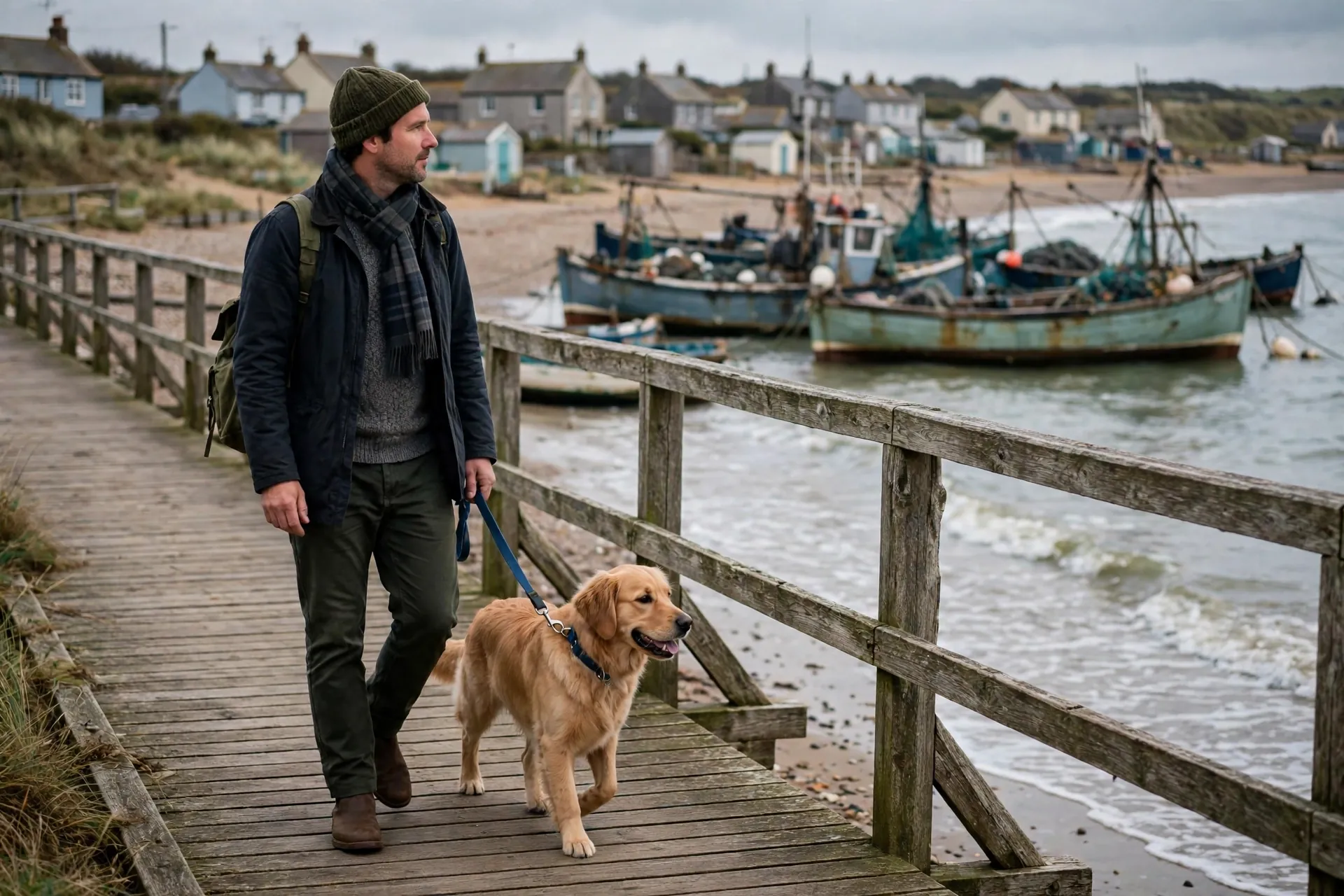
At the Walberswick end, the quay is working waterside ground rather than a tidy promenade. Boats are hauled out, mooring lines cross the path, the stone and concrete edge is wet and sometimes green with algae, and the slipway slopes down to water that deepens quickly. Keep the dog on a short lead from the moment the boat touches the slip, and do not let a wet, excited dog sprint up the slipway into the path of people carrying gear, children with buckets or a vehicle reversing toward a boat trailer. The first five minutes after landing set the tone for the whole village walk: slow, on lead, past the moored boats, and only then out toward open ground where a longer lead or a careful off-lead stretch makes sense.
Ferry running days are seasonal, and this is the one part of a Walberswick plan that genuinely cannot be guessed. The service typically runs through the warmer months and thins out or stops in winter, and bad weather, a very high tide or a low tide that strands the slip can all interrupt a day. Check the official guidance before you travel, and build a fallback into the day: if the boat is not running, the walk from Southwold becomes a much longer road route, and the honest choice is often to drive to Walberswick instead or to save the crossing for another visit. Never assume a return boat will wait for a slow walk, and leave enough daylight to walk back by the beach or to reach the quay in good time, because a missed last ferry turns a short crossing into a long detour.
The beach walk south
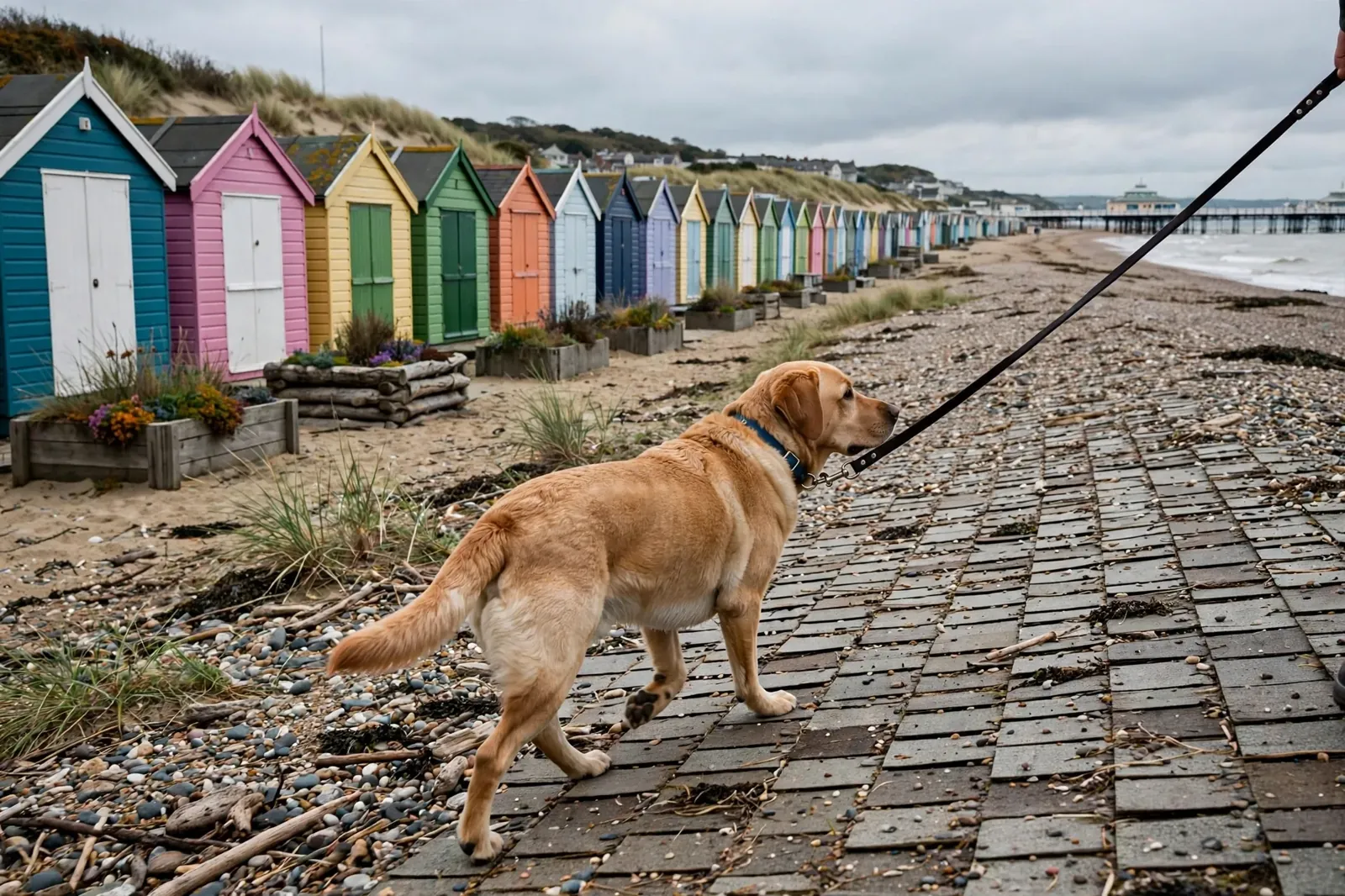
From the quay, Walberswick beach opens out as a wide, quiet sweep of sand and shingle that runs south away from the village, and it is the main reason most dogs come here. The northern end, closest to the estuary mouth, is where people gather, boats come and go and the dog traffic is thickest; the further south you walk, the thinner the crowds become, the broader the sand feels and the easier it is to give a reactive or excitable dog real space. That gradient is the practical trick of the whole beach: do not judge Walberswick by its first hundred metres. Walk ten or fifteen minutes south and the same beach becomes a different, calmer place, with room to throw a ball without it landing in someone else's picnic and room to practise recall without another dog appearing over every dune.
The surface underfoot changes as you go, and it changes what the walk costs a dog. Near the village the beach is a mix of sand and shingle, with patches of pebbles that tire small paws and older joints faster than soft sand does; further south the sand firms up and broadens, but it also collects driftwood, broken shell and the occasional sharp fragment after storms. In summer the dry sand at the top of the beach can be hot enough to make a dog hop and seek the waterline, so walk on the firm damp sand near the sea on hot days and check paws for cuts and grit at the turn-around point. Carry water and a collapsible bowl even for a short beach walk, because there is no tap on the open beach, and a dog that has been running in salt water will drink seawater if it is thirsty, which only makes the thirst and the stomach worse.
The tide, not the clock, decides how far south you can comfortably go. At high water the dry beach narrows to a thin strip and the sea pushes walkers up against the dunes and the marsh edge, while at low water the sand stretches far out and the walk south feels almost limitless. Plan the beach leg on a falling tide so the sand is widening under you rather than shrinking, and turn back well before the tide turns, because the return leg against a rising tide, with a tired dog and wet sand underfoot, is always slower than the outward leg. Keep a lead in a pocket even on the emptiest stretch: the estuary mouth at the northern end has currents, the dunes hold nesting and resting birds, and a dog that bolts toward the water at the quay end needs to be stopped before it reaches the slipway traffic.
Marsh and reedbed paths inland
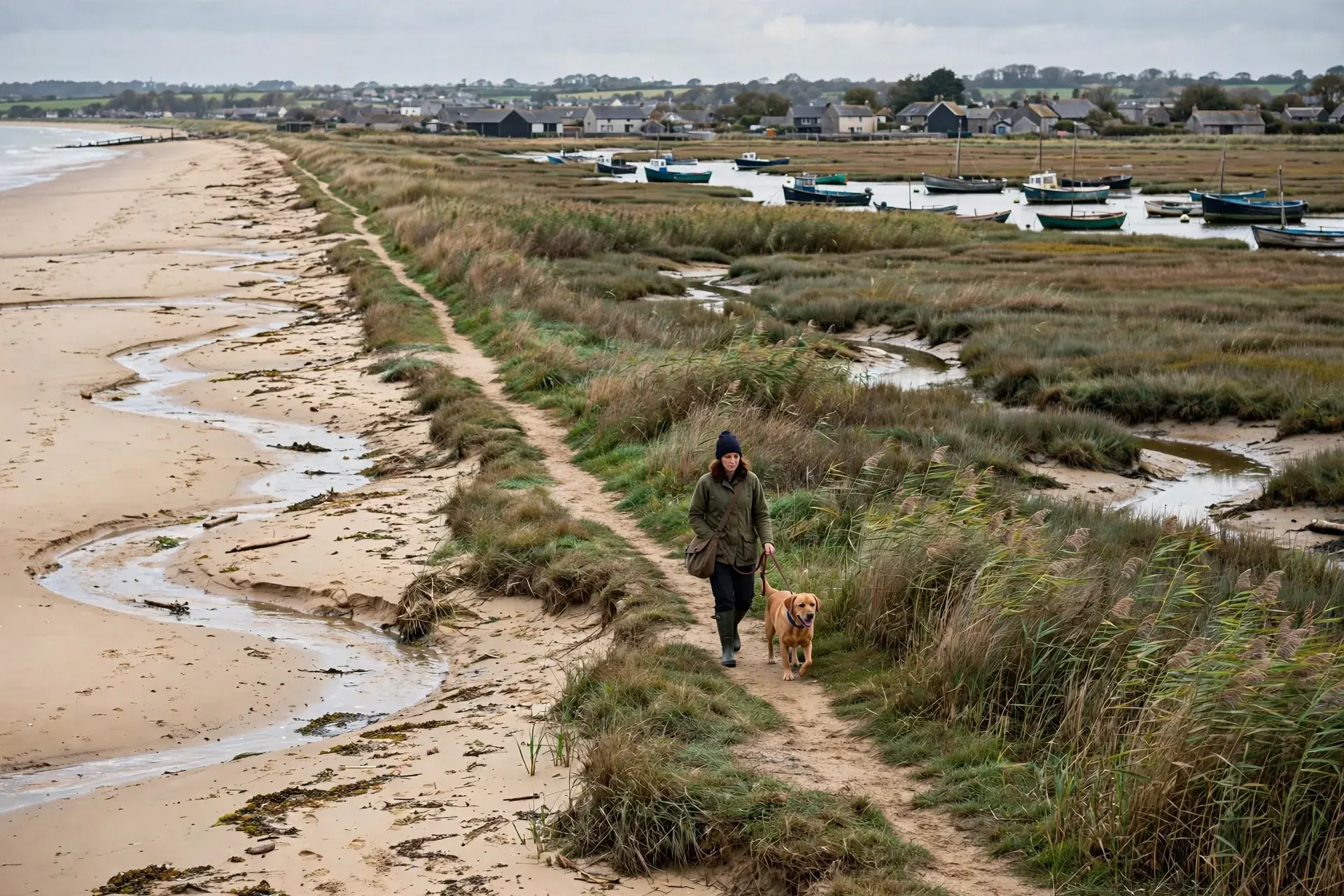
Step inland from the beach and Walberswick changes character completely. Behind the dunes lie the grazing marshes and the great reedbeds that make this corner of Suffolk feel wilder than the beach suggests, with flat open skies, drainage dykes, reed-fringed pools and paths that run straight for a long way before bending around a reed edge. For a dog, this is scent country: every dyke bank, reed stem and muddy gateway holds a smell worth investigating, which is precisely why the marsh paths need a different discipline from the beach. A dog off lead here will be in the reeds before you have finished calling, out of sight in seconds, and possibly in a dyke or a nesting area before you can reach it. The lead is not a restriction on this ground; it is what makes the walk possible at all.
The ground itself deserves respect. Marsh paths are mostly flat, which flatters older dogs and owners with stiff knees, but flat does not mean firm. After rain the tracks turn to sticky mud, dyke edges crumble under a paw, and the grass beside a path can hide a wet ditch that looks like solid ground until a dog steps into it. In summer the same paths bake hard and crack, and the reeds throw up a dry, rustling wall that hides other walkers, cyclists and grazing animals until they are close. Choose footwear with grip for yourself, and for the dog choose a harness over a collar on these paths, because a sudden lunge toward a reedbed bird is far easier to hold on a harness, and a dog that slips its collar beside a dyke is in real trouble before you can react.
Distance on the marshes is deceptive, because the landscape is so open that a walk which looks short on a map feels much longer in wind and sun. There is little shade on the marsh paths, no shelter from a Suffolk easterly, and no water point for a dog beyond what you carry, so a two-hour marsh loop needs the same water, bowl and rest stops as a hill walk of the same length. Plan marsh legs as out-and-back walks rather than ambitious circuits until you know the path network, note where you entered the reedbed track so you can find the same gap back out, and turn back at the first sign of a tired or overheated dog rather than pushing on to the next landmark. The marshes reward a slow, lead-controlled walk with herons, marsh harriers and reed warblers overhead; they punish a rushed, off-lead dash with mud, dykes and a lost dog in the reeds.
The village green and crabbing
Back in the village, Walberswick green is the social heart of a dog walk, and it behaves very differently from the beach and the marsh. The green is open, flat and easy to cross, which makes it a natural meeting point, but it is also where children play, picnics spread out, other dogs arrive on leads and the village traffic passes close by. A dog that is relaxed on an empty beach can still struggle here, because the green compresses every distraction of the day into one small space: food smells, running children, balls, other dogs and the sudden appearance of a bicycle or a car on a narrow village lane. Keep the dog on a lead on and around the green, give other dogs a wide berth rather than letting leads tangle in a greeting, and choose a quiet edge of the green for a rest stop instead of the centre where the foot traffic funnels through.
The crabbing area, down by the quay and the waterside steps, concentrates those pressures further, and it is the one spot in Walberswick where a dog owner needs to be most alert. Families lower buckets and lines into the water, bait sits in open containers at knee height, dropped hooks and tangled line end up on the ground, and a bucket left unattended at the edge of the quay is an invitation to a scavenging dog. A dog that eats bait can be sick, a dog that steps on a hook needs veterinary attention, and a dog that tangles itself in a line can panic and pull a child or a bucket toward the water. The practical answer is simple and non-negotiable: short lead, dog kept back from the water edge and from other people's gear, and no sniffing inside buckets. If your dog cannot resist bait, walk past the crabbing steps on the inland side and keep moving, rather than stopping to watch.
The physical ground at the crabbing area adds its own hazards. Quay steps are wet, worn and slippery with algae, especially at low tide when the exposed stone stays damp, and a dog scrambling down steps after a thrown stone or a crab bucket can slip and land hard on stone or in shallow water. The quay wall itself has drops that are not obvious to a dog focused on the water, and the water beside the quay is deeper and faster-moving than the beach shallows. Older dogs, puppies and dogs with poor grip on wet stone should stay well back from the edge, and every dog should be dried and checked after any slip, because a cut paw on algae-covered stone is easily missed in the excitement. Crabbing is one of the great Walberswick traditions, but for a dog it is a spectator activity from a safe distance, not a paddling spot.
Birdwatching manners and leads
Walberswick sits inside one of the most watched stretches of bird country in England, and the reedbeds and marshes around the village are not empty scenery but working habitat. Marsh harriers quarter the reeds, bitterns boom from deep cover in spring, bearded tits flick through the reed tops, and the grazing marshes hold waders and wildfowl through the winter. Birdwatchers come here precisely because the birds are close and sometimes confiding, and a single dog crashing through the reed edge can undo hours of quiet watching and, more importantly, flush birds off nests or feeding grounds at the moment they can least afford it. This is not a rule imposed for tidiness; it is the reason the marshes still hold the birds people travel to see.
The lead requirement on reedbed edges therefore needs to be treated as a standing condition of walking here, not as something to relax when no one is visibly watching. In spring and early summer, ground-nesting birds on the marsh and dune edges are at their most vulnerable, and a dog running through long grass can destroy a nest without its owner ever seeing it. In autumn and winter, feeding waders and wildfowl need to conserve energy, and repeated flushing by dogs burns the reserves they need to survive cold nights and migration. Keep the dog on a short lead on every reedbed and marsh path, stay on the marked track rather than cutting across open marsh, and never let a dog chase or flush a bird for a photograph, even a distant one, because the disturbance is real whether or not the bird is close enough to identify.
There is also a practical payoff to good birdwatching manners. A dog on a lead, walking steadily beside its owner, is far less disruptive than a dog ranging ahead, and birdwatchers who see a controlled dog are far more likely to point out a harrier or a bittern than to glare at an intrusion. Stop at a respectful distance from anyone with a telescope, keep the dog still and quiet while they watch, and move on without cutting across their line of sight to the reeds. If your dog barks at birds or at other walkers, the reedbed paths are the wrong place to train through it in peak season; choose the open beach at a quiet hour instead, and come back to the marshes when the dog can walk past a reed edge without lunging. Walberswick rewards patience, and a dog that can be patient on a lead gets to share some of the finest birdwatching walks in Suffolk.
Dunes and storm-changed ground
The dunes between Walberswick beach and the marshes are a fragile, shifting strip, and they change more after a single winter storm than most walkers expect. A dune that was a gentle grassy slope in summer can be scarped into a steep sand cliff by a storm surge, a boardwalk or gap through the dunes can be buried under wind-blown sand or washed out altogether, and the path that led neatly from the beach to the marsh in September may be a tangle of broken fencing and exposed roots by February. For a dog, the danger is not the dune itself but the changed ground: a steep sand face collapses under paws, a buried fence post or wire end can cut a paw, and a dog that scrambles up a freshly scarped dune can slide back down into the path of walkers below.
After stormy weather, treat every dune crossing as a new route rather than a remembered one. Walk the crossing yourself first where possible, look for fresh sand falls, exposed roots and broken fencing, and keep the dog on a lead through the dunes until you can see the ground on both sides. Avoid letting a dog dig into dune faces, because digging accelerates erosion on a system that is already under pressure, and keep to the marked gaps through the dunes rather than cutting new ones, since each new gap becomes a wind funnel that widens with every gale. In high winds, skip the dune tops altogether: a dog on an exposed dune crest in a Suffolk gale is buffeted, sand-blasted and deafened, and the walk is miserable for everyone.
Winter also changes the beach and marsh ground in ways that matter for paws and joints. Storm tides throw driftwood, rope, fishing debris and broken shell onto the beach, and a dog running at full speed can step on a sharp fragment or swallow a piece of rope before you can intervene. Marsh paths that were firm in summer become waterlogged, and the standing water on a marsh track can hide a deep rut or a broken drain cover. Check the official guidance before you travel after a storm, carry a small first-aid kit with a paw bandage and tweezers for splinters, and be ready to shorten the walk and spend the extra time in the village instead. A storm-changed Walberswick is still a fine dog walk, but it is a walk that needs eyes on the ground rather than a route remembered from last summer.
Places to stop for food and drink
Walberswick is a small village, so food and drink stops are few, seasonal and worth planning around rather than assuming. The village pub and the small cafe and shop near the green are the natural pauses on a dog walk, and they are used to muddy boots and wet dogs in a way that a larger resort cafe is not, but that does not mean every dog can walk straight in. Dog policies in a village pub or cafe can depend on the room, the time of day and whether food is being served, and a busy lunchtime in school holidays is very different from a quiet weekday afternoon. Check the door signs, ask before bringing a dog into a food-serving room, and always have a terrace or garden fallback in mind, because a dog that is welcome outside is still welcome even when the inside is full.
The practical details of a food stop matter more than the menu when you have a dog. A water bowl outside the door is a good sign, but bring your own bowl anyway, because bowls run out on busy days and a thirsty dog after a beach walk should not have to wait. Choose a table where the dog can lie under or beside it without blocking a walkway, keep the lead short enough that the dog cannot reach the next table's lunch, and settle the dog with a chew or a familiar mat before ordering, because a dog that is still buzzing from the beach will beg, bark and lunge at passing food. If the dog cannot settle after a few minutes, the kindest option is to take food away and eat it on the green or the beach, where the dog can relax, rather than persisting in a crowded room where every other diner becomes a training problem.
On a longer day, think of food stops as part of the route rather than as an afterthought. A stop near the quay works well at the start or the end of a beach walk, because the dog can be dried and watered before the car or the ferry; a stop on the green works well in the middle of a village-and-marsh loop, because the dog can rest in the shade while you eat. In winter, when village opening hours shorten and some places close on weekdays, carry a packed lunch and a flask as insurance, and do not plan a walk that depends on a single cafe being open. A dog that has walked the marshes in a cold wind needs food and warmth at the end of it, and the walk is only as good as the warm stop that finishes it.
Parking and getting here
Parking is the least romantic part of a Walberswick dog walk and the one most likely to spoil it, because the village is small, its lanes are narrow and its parking is limited. The car park near the village is the obvious choice, but it fills early on fine weekends, in school holidays and on any day when the ferry is running well, and once it is full there is no easy overflow. Arriving late and circling the village looking for a space does not just waste time; it puts cars and dogs into conflict on lanes with no pavements, where walkers, children and dogs are already sharing the road. Arrive early, aim for the car park rather than a lane, and treat a full car park as a signal to change the plan rather than as a challenge to solve by parking somewhere creative.
Never park on a verge, a marsh edge, a gateway or a turning area by the quay, however tempting the gap looks. Verges beside marsh lanes are soft, easily rutted and part of the habitat, and a car parked on one can block farm access, emergency access or the turning circle that boats and trailers need. A gateway that looks disused may be the only access to a grazing marsh, and a lane blocked by a parked car forces walkers and dogs onto the main road. If the village is full, the honest options are to walk in from Southwold across the ferry, to come back on a quieter weekday, or to choose a different Suffolk beach for the day. Parking badly in Walberswick is not a victimless shortcut; it is visible to the whole village and it damages the goodwill that keeps the village welcoming to dog walkers.
Getting here without a car is possible but needs the same ferry caution as the walk itself. The ferry from Southwold is the most charming approach and the most seasonal, and bus and train connections to this corner of Suffolk are thin, especially on Sundays and in winter. Check the official guidance before you travel for ferry days, parking charges and any temporary restrictions, and carry cash or a card as appropriate, because a small village car park and a small ferry do not always take the payment method you expect. Leave enough time at the end of the day for a slow walk back to the car or the quay, a drying-off stop for the dog and a check that nothing has been left on the beach, because the last part of a Walberswick day is always slower than the first.
Pairing Walberswick with Southwold
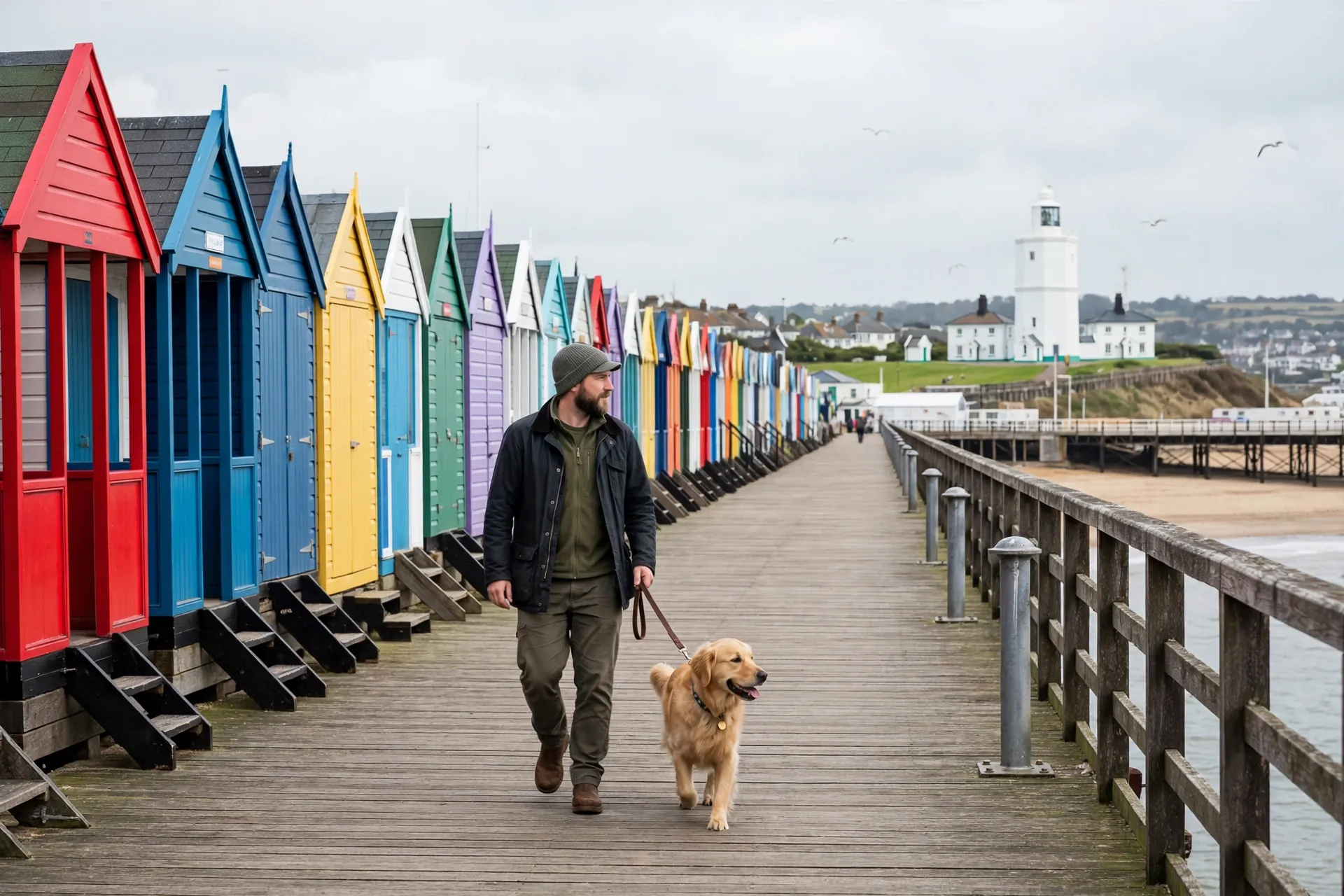
Walberswick and Southwold make a natural pair, because the ferry joins them across a few minutes of water and the two places offer opposite dog walks. Southwold is the busier, more built-up side, with a pier, a lighthouse, beach huts, a promenade and a town full of shops and cafes; Walberswick is the quieter, wilder side, with an empty beach, reedbeds and a village green. Put together, they make a day that has both energy and calm, and the ferry is the hinge between them. The classic shape of the day is to start in Southwold, cross to Walberswick in the morning, walk the beach south and the marsh paths, rest on the green, and cross back in the afternoon, so that the busier town bookends the quieter village rather than the other way round.
The pairing works best when the ferry, not the clock, sets the pace. Cross early, while the Walberswick beach is still empty and the marsh paths are quiet, and leave a generous margin for the return crossing, because a dog that is tired, wet and sandy will slow the walk back to the quay, and the last ferry will not wait for a dog that needs a drink and a shake. If the ferry is not running, the pair becomes a driving day rather than a walking day, and it is better to do one town properly than to rush both by road: choose Southwold for shops, pier and promenade, as our Southwold with a dog guide sets out, or choose Walberswick for beach and marsh, and save the other for a second visit. A rushed pair, with a dog dragged between two car parks, is worse than a single unhurried walk.
For a longer Suffolk stay, Walberswick also sits well in a chain of coastal walks that runs south toward Dunwich and north toward Southwold, and it makes a useful quiet base between busier days. A day in Walberswick can be followed by a day in Aldeburgh, where the shingle beach, promenade and fish-and-chip stops give a dog a completely different coastal experience, and the contrast is the point: Walberswick for wild beach and reeds, Aldeburgh for town beach and food. Our broader Suffolk coast guide puts those choices side by side, with the year-round and seasonal beach rules that decide which town suits which day. Used this way, Walberswick is not a half-day add-on to Southwold but the wild heart of a Suffolk dog holiday, and the ferry crossing is the moment the holiday changes gear.
Seasons and tides, in one place
Spring is Walberswick at its most delicate and its most rewarding. The reedbeds fill with birdsong, the marshes green up, and the beach is quiet before the summer crowds, but this is also the season when ground-nesting birds are most vulnerable and when the lead rule on marsh paths matters most. Keep the dog strictly on lead on reedbed and dune edges, stay on marked paths, and enjoy the birds from the path rather than pushing into the reeds for a closer look. Spring weather is changeable, with cold winds off the sea even on sunny days, so carry a drying coat for the dog and a windproof layer for yourself, and be ready for a marsh path that is still waterlogged from winter rain.
Summer brings the crowds, the ferry at its busiest and the beach at its most social, and it is the season when timing matters most. Walk the beach early or late in the day, when the sand is cooler and the crowds are thinner, and avoid the midday heat on the open beach, where there is no shade and the sand can burn paws. The quay and the green are at their busiest in summer, so keep the dog on a short lead there even if it is off lead on the empty southern beach, and carry extra water, because a dog running in and out of salt water in summer heat will dehydrate faster than you expect. Autumn, by contrast, is Walberswick at its best for many dog owners: the crowds thin, the light softens, the marshes fill with migrating birds, and the beach walks long and empty, though the ferry season shortens and storm tides begin to reshape the dunes.
Winter is the quietest and wildest season, and it suits a dog that loves wind, empty sand and cold water, provided the owner plans for it. The ferry may not be running, village opening hours shorten, and the beach and marsh paths can be waterlogged or storm-damaged, so check the official guidance before you travel and carry a towel, a drying coat and a warm layer for the dog as well as for yourself. Tides matter in every season, but they matter most in winter, when daylight is short and a rising tide on a darkening beach leaves little margin for error: walk on a falling tide, turn back early, and finish the walk with daylight to spare. Whatever the season, the same three checks close every Walberswick plan: ferry running, tide falling, and dog on lead where the reeds and the birds need it.
Practical questions
Before you go
Can I take a dog on the Walberswick ferry across the Blyth?
Dogs are generally carried on the small ferry that links Walberswick with Southwold, but it is a short open-boat crossing, not a car ferry, so a dog needs to sit still on a short lead while the boat is loaded and under way. Keep the lead short on the slipway, settle the dog low in the boat, and be ready for a wet step on and off. Ferry days and hours are seasonal, so check the official guidance before you travel rather than assuming the boat will be running.
Can dogs go on Walberswick beach all year?
Walberswick beach is a broad, quiet stretch of sand and shingle, and dogs are a familiar sight there, but the exact rules for the stretch nearest the village and any seasonal zone can change, so check the signs at the beach entrance and check the official guidance before you travel. Treat the tide as the real limit: at high water the dry beach narrows sharply, and a dog that dashes into the surf can be pulled toward the estuary mouth. Walk south on a falling tide, keep a lead handy for the quay end, and carry water, because there is no tap on the open beach.
Do dogs need to be on a lead on the Walberswick marsh and reedbed paths?
Yes, in practice you should plan to keep your dog on a lead through the marsh and reedbed edges, even where no single sign spells it out. The reedbeds and grazing marshes around Walberswick are sensitive wildlife habitat, with ground-nesting birds in spring and summer and livestock on the marshes at other times. A dog crashing through reeds flushes birds, tramples nests and can panic grazing animals, so use a short lead, stay on the marked path, and only let the dog off where the ground is clearly open beach or village green and the dog will come back at once.
Is the crabbing area at Walberswick safe for dogs?
The quay and the waterside where families crab are busy, wet and full of distractions, so they need more management than an open beach. Buckets, bait, lines and dropped hooks sit at nose height, and a dog nosing into a bucket can swallow bait or get tangled in line. Keep the dog on a short lead, away from the water edge and other people's gear, and watch the slippery steps and algae on the quay wall. If your dog is a scavenger, this is the one spot in Walberswick where a lead all the way through is the sensible choice.
Where should I park for a dog walk at Walberswick?
Walberswick is a small village with limited parking, and the spaces nearest the quay and the beach fill early on fine weekends and in school holidays. Arrive early, park only in a marked space, and never block a lane, a gateway or the turning area by the quay, because farm and emergency access must stay clear. If the village car park is full, the honest option is to walk in from Southwold across the ferry or to come back on a quieter day, rather than squeezing into a verge that damages the marsh edge.