This guide is independent and contains no paid placement. Harbour rules, gallery policies and railway dog policies can change, so check the official guidance before you travel and treat any policy quoted here as a starting point for the day, not a guarantee.
Time a Watchet dog day to the tide. Walk the harbour and marina at high water when boats float and the quayside feels complete, use low water for a slow look at the harbour walls and the town instead of the mud, keep dogs on a short lead around boats, ropes and the station, and finish with East Quay art or a short coast-path stretch rather than a long forced march.
Reading Watchet by the tide
Watchet does not keep the same hours as an inland town. The harbour runs on a tide timetable, and the whole character of a dog walk changes with it. At low water, the harbour basin empties down to wide flats of soft grey-brown mud, boats sit tilted on their moorings or rest on the harbour bed, and the working sounds of the place take over: gulls calling over the mud, ropes creaking, a distant engine, the clink of a boatyard. The quayside feels open and slightly austere, with long views across the exposed bed toward the Bristol Channel. At high water, the same basin fills, the boats lift and float level, reflections appear in the water between the hulls, and the harbour suddenly looks like the picture on a postcard. The change is not subtle, and it is the single most useful planning fact for a dog day in Watchet.
The practical consequence is simple: check the tide times for the day before setting out, and build the walk around them rather than around the clock. A high-tide arrival suits a classic harbour stroll, because the water is in, the boats are afloat, and the quayside reads as a complete scene. A low-tide arrival is not a wasted trip, but it suits a different kind of day: a slower circuit of the harbour walls, a look into the town streets, a gallery visit at East Quay, and a coffee stop while waiting for the water to return. Dogs, for their part, tend to enjoy the high-tide version more, because the interesting smells are at nose height along the quay rather than far below on an inaccessible mudflat, and because other walkers, boat owners and harbour workers are around to provide the gentle bustle that keeps a sociable dog engaged without overwhelming it.
The rhythm of harbour work follows the same timetable. Boat owners tend to appear around the top of the tide, when launching, mooring and maintenance are easiest. Early morning at low water can be quiet, with only a few workers and dog walkers about, while the middle of the day at high water brings the full mix of visitors, families, photographers and train passengers. For a nervous or reactive dog, that difference matters more than any single attraction. A quiet low-water morning circuit, with space to stop, sniff and retreat, often works better than arriving at the busiest hour and expecting the dog to cope with crowds, narrow quays and sudden train noise all at once. For a confident, people-loving dog, the reverse is true: high water and a busy quayside offer the richest outing, provided the lead stays short and the dog is kept well back from the water edge.
There is one firm rule that applies at every state of the tide: the harbour mud is not a dog playground. The exposed bed looks flat and walkable from the quay, but it is soft, sticky and uneven, with hidden channels, debris and deep patches that can trap a dog or injure a paw. Birds feeding on the mudflats are also easily disturbed, and a dog running across the flats can cause real harm to wildlife as well as to itself. The safe response is to admire the mud from the wall, keep the dog on the quayside, and save running for a proper open space. If a dog does step into mud by accident, rinse the paws with clean fresh water afterwards, check between the toes for grit and small cuts, and watch for limping over the next day. The same caution applies to slipways and boat ramps, which are working surfaces, not beaches: they are slippery when wet, busy with trolleys and trailers, and best crossed quickly on a short lead or avoided altogether.
Weather interacts with the tide in ways worth anticipating. A strong onshore wind at high water can push spray and lively wavelets over the outer harbour wall, which excites some dogs and unsettles others, while a calm summer high tide can make the quayside feel almost Mediterranean in its brightness, with stone and painted buildings reflecting heat. In winter, the same stone stays cold and damp long after rain, and shaded corners near the harbour wall can remain icy or slick when the rest of the town has dried. A dog that is happy on dry pavement may still slip on wet algae near steps down to the water, so keep to the main surfaced routes, avoid the lowest steps and algae-covered stone, and carry a towel even on a dry-looking day. The tide timetable, the wind forecast and a quick look at the sky together give a far better plan than any single one of them alone.
Finally, the tide shapes the length of the day, not just its mood. A visit planned around a single high tide can feel short if the tide turns early, while a visit that spans the change from low to high water gives two different harbours for the price of one: the working, skeletal harbour of low water, and the floating, sociable harbour of high water. Dogs that tire easily benefit from the slower version, with a long rest in the middle while the water returns. Dogs with energy to spare benefit from pairing the harbour with a coast-path stretch, so the excitement of the quayside is balanced by steady walking rather than by more stimulation. Either way, the tide is the organising principle of the day, and a visitor who reads it in advance will get more from Watchet than one who simply turns up and hopes the water is in.
Watchet Harbour Marina on foot
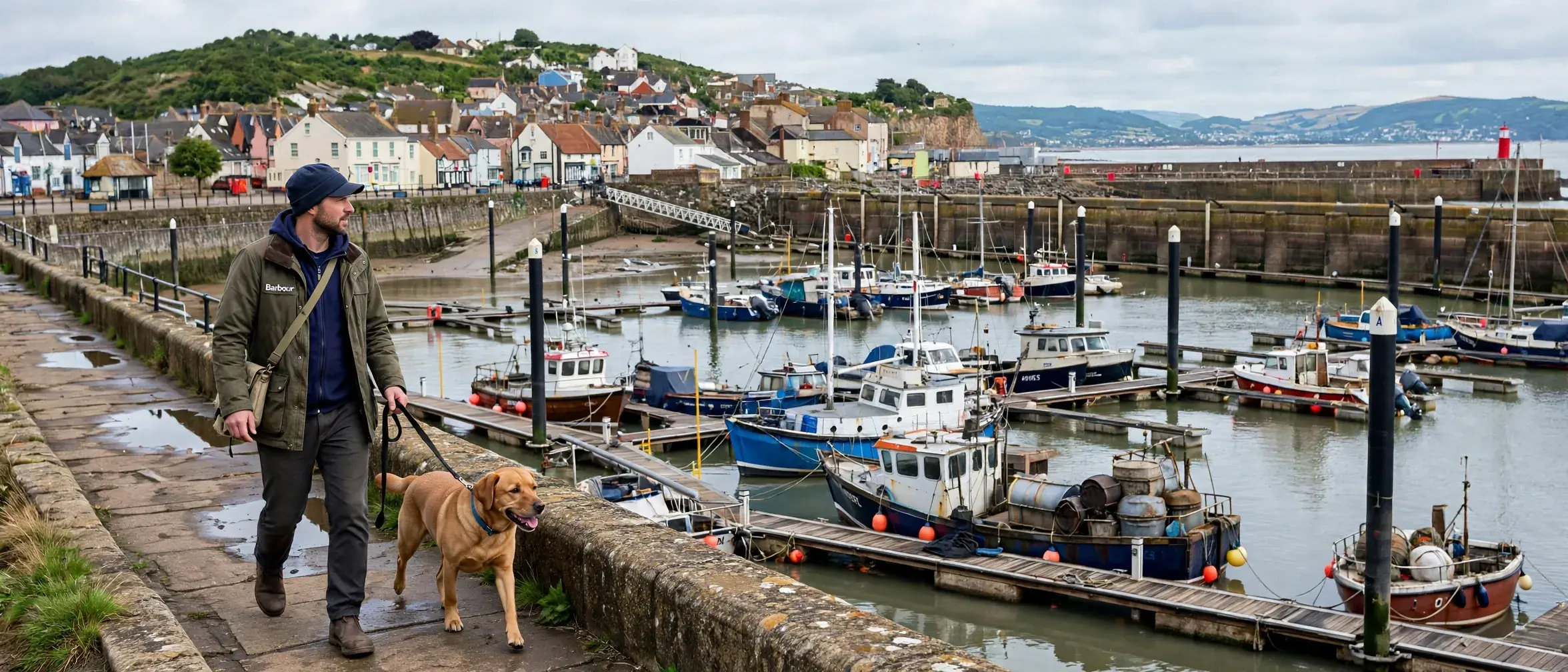
Watchet Harbour Marina sits at the heart of the town, and the most rewarding dog walk here is a slow circuit rather than a straight march from one end to the other. Start at the outer harbour wall if the tide and the wind allow, and let the dog take in the open Channel air before turning back into the more enclosed marina basin. The outer wall offers the widest views and the strongest smells of salt, seaweed and fishing gear, but it also offers the least shelter, so a small or short-coated dog may feel the cold there on a windy day. The inner quays, by contrast, are more sheltered by buildings and boats, and they provide the natural stopping points: benches, low walls, corners where a dog can sit and watch harbour life without being in the flow of foot traffic.
Underfoot, the harbour walk is mostly surfaced and level, which makes it one of the more accessible dog walks on this stretch of the Somerset coast. The main quayside paths are paved or tarmacked, with gentle gradients rather than steep climbs, and there are few steps on the principal circuit, although side steps down toward slipways and pontoons should be treated with care. That level character matters for older dogs, dogs recovering from injury, and dogs that pull, because a flat route removes one source of strain and lets the handler concentrate on lead control around the real hazards: mooring ropes at ankle height, bollards, coiled hoses, boat trolleys, and the sudden appearance of another dog around a boat shed corner. A short lead is the right tool here, not a long line, because the hazards are close, low and easy to tangle around. Keep the dog on the landward side of the handler where the path runs beside open water, so the handler, not the dog, is between the dog and the drop.
Lead points deserve deliberate planning rather than improvisation. The places to shorten the lead are predictable: anywhere the path narrows beside moored boats, anywhere a slipway crosses the route, the approaches to the station and to East Quay when crowds gather, and any stretch where children are running or where another dog is approaching head-on in a confined space. The places where a longer lead can be used safely are much rarer inside the harbour itself, and most handlers will find it simpler to keep a short lead for the whole harbour circuit and save the long line for an open coast-path field edge or a beach where the rules allow it. Dogs that are reactive to other dogs need extra space at the harbour, and the best technique is often to step into a wider bay or a side opening, let the other dog pass, and only then continue, rather than trying to squeeze past on a narrow quay with two excited dogs at close quarters.
The marina itself rewards slow looking. Fishing boats, leisure craft and working vessels lie side by side, and the variety of shapes, colours and rigging gives a dog plenty to watch without needing to approach anything closely. Boat owners are generally tolerant of dogs kept at a respectful distance, but dogs should not be allowed to jump up at hulls, nose around open hatches, drink from harbour water, or investigate fish boxes and bait stores. Harbour water is not drinking water: it can contain fuel residues, algae and bacteria, and a dog that drinks from it may become unwell. Carry fresh water and offer it regularly, especially on warm days when the stone quayside reflects heat and a dog may pant harder than expected. A collapsible bowl tucked into a pocket is enough, and offering small drinks often beats waiting until the dog is visibly thirsty.
Smells are the other harbour story. Fish, bait, rope, tar, seaweed, diesel and gull droppings all compete for a dog nose, and a dog that is usually calm on a country lane may become intensely focused around the marina. That focus is normal, but it needs management: a dog straining toward a fish box or a bait bucket is a dog that may snatch something harmful, and fish bones, hooks and discarded line are genuine hazards. A firm but calm recall, practised before the trip, is worth more than any gadget, and a treat pouch kept ready for the harbour circuit gives the handler something to trade for attention at the exact moment it is needed. If the dog is a known scavenger, a basket muzzle used kindly and introduced well in advance can turn a stressful harbour walk into a relaxed one, and there is no shame in that choice.
For visitors combining Watchet with a wider Somerset coast trip, the harbour also works as a natural rest and reset point between longer walks. A dog that has just completed a coast-path section arrives hot, thirsty and overstimulated, and a slow harbour circuit with water, shade and a sit on a bench can settle it before the drive onward. Conversely, a dog that starts the day at the harbour and then moves on to the hills behind the town will arrive at the second walk already warmed up and socially settled. Either order works, provided the harbour is treated as a place to slow down rather than as another attraction to rush through. The best harbour walks in Watchet are unhurried ones, paced by the tide and by the dog, not by a timetable.
East Quay: galleries, studios and dogs
East Quay is the part of Watchet where the harbour stops being purely working and becomes cultural. The area brings together galleries, studios, workshops and exhibition spaces in converted harbour buildings, and it gives a dog day a completely different texture from the marina circuit: quieter rooms, focused looking, the smell of paint, wood and clay, and the chance to talk to makers about their work. For a dog, East Quay is a test of calm behaviour in a new indoor environment, and it suits dogs that can settle on a mat by a door, lie quietly while their handler browses, and cope with strangers approaching to admire them. Dogs that bark at unfamiliar sounds, pull toward every new person, or struggle to settle indoors may find East Quay frustrating rather than enjoyable, and there is nothing wrong with splitting the party so one person looks around while the other walks the dog outside.
Dog policies at East Quay deserve a careful, door-by-door approach. Different studios and exhibition spaces can set different rules, and those rules can change with the season, the exhibition or the number of visitors on the day. The only reliable method is to check the official guidance before you travel, and then to ask politely at the entrance on arrival. As a working assumption, treat every gallery as a short-lead, low-noise space: keep the dog close to the handler, well away from plinths, low-hung work and open studio materials, and never let the dog wander on a long lead through a room full of ceramics, textiles or framed prints. If a space is not suitable for dogs on the day, accept that gracefully and enjoy the exterior, the harbour views and the public areas instead; a good visit does not depend on getting a dog into every room.
The physical layout of East Quay also shapes the dog experience. Harbour buildings often have thresholds, steps and changes of level that are easy for people to miss and harder for an older or small dog to negotiate. Some floors are smooth and can be slippery for dogs with weak grip, especially when paws are wet from the quayside, while studio floors may have sawdust, clay dust or paint that sticks to paws and then transfers to car seats and home floors. A quick paw wipe before entering and after leaving solves most of this, and a lightweight mat gives a dog a defined place to settle that is neither a stranger floor nor a walkway. Carrying the mat in a tote bag keeps hands free for doors, and it signals to staff that the dog is under control and expected to settle.
Timing an East Quay visit around the dog day makes the whole outing easier. The galleries work well as a middle-of-the-day activity, when the dog has already had a harbour walk and a toilet break, and when the handler can browse without a dog that is bursting for a walk. They also work well as a low-tide activity, filling the hours while the harbour basin is empty and the boats are aground. A wet-weather day, which might spoil a long coast walk, can become a successful East Quay day with a short harbour circuit on either side. Conversely, a hot day may make indoor galleries a welcome cool refuge, provided the dog is not left in a car while the handler looks around: never leave a dog in a parked car on a warm day, even for a short gallery visit, and plan the visit so the dog is either welcome inside or walked in shade by another member of the party.
Behaviour inside deserves the same attention as policy. A dog that lies quietly for twenty minutes in one gallery may still struggle in a second, busier space, and handlers should watch for the early signs of restlessness: shifting weight, yawning, lip licking, scanning the room, pulling toward the door. Those signs are a cue to step outside for a short break, offer water, and let the dog sniff harbour air for a few minutes before deciding whether to continue. Pushing a tired or overstimulated dog through one more studio rarely improves the art or the dog, and it risks a bark or a knocked object that embarrasses everyone. The best East Quay visits are short, calm and selective: one or two spaces enjoyed properly, rather than every door opened in a hurry.
East Quay also connects naturally to the wider story of Watchet as a creative town. The harbour has long attracted painters, writers and makers drawn to its light, its working character and its position between the Quantock Hills and the sea, and the contemporary studios continue that tradition rather than inventing it from nothing. For a visitor with a dog, that continuity is part of the pleasure: the same harbour light that draws an artist also makes a morning walk beautiful, and the same working waterfront that inspires a printmaker gives a dog a rich landscape of sounds and smells. Enjoying East Quay with a dog is therefore not about ticking off a cultural attraction, but about letting the artistic and the everyday sides of Watchet sit side by side for an hour, with the dog settled at the handler feet while the harbour carries on outside.
Steam trains beside the sea
One of the most distinctive moments in a Watchet dog day is the arrival of a steam train beside the harbour. The heritage railway that serves Watchet runs along the Somerset coast, and the station sits close enough to the harbour that a visitor can watch a locomotive arrive, hear the whistle and the hiss of steam, and feel the platform tremble slightly as the train draws in, all while standing a short walk from the marina. For many dogs, this is the most exciting and the most challenging part of the day in equal measure: exciting because of the movement, noise and crowds, challenging for exactly the same reasons. Preparation matters more here than anywhere else in town.
Dog policies on heritage railways vary by operator, by carriage, by season and sometimes by service, so check the official guidance before you travel rather than assuming a dog can board. Some services welcome dogs in specified carriages, some require a dog ticket or a small charge, and some restrict dogs at peak times or on special event days. The policy for riding is separate from the policy for watching: a dog that cannot ride can still enjoy watching a train arrive from the platform area or from a harbour viewpoint, provided platform rules and other passengers are respected. If riding is possible, the practical details matter: arrive early enough to board calmly rather than rushing, choose a seat where the dog can lie on the floor out of the aisle, keep the lead short and the dog off the seats, and bring water, a mat and something to occupy the dog during the journey.
Noise desensitisation should be planned in advance for dogs that have never met a steam locomotive. The whistle is loud and sudden, the brakes squeal, steam vents with a sharp hiss, and the platform fills with people moving in both directions at once. A dog that is sound-sensitive may cope far better watching from a distance first, with treats for calm looking, than being placed directly beside the locomotive on a first encounter. A dog that is confident around traffic and crowds may still startle at the first whistle, so keep the lead short and the body language calm, and avoid tightening the lead into a constant pull, which only adds tension. After the train has passed, give the dog a few quiet minutes on a harbour bench to settle before moving on; a dog that is rushed straight from a train arrival into a busy gallery or a narrow street is more likely to pull, bark or refuse to walk.
The station area itself needs the same lead discipline as the marina. Platforms, crossings and car parks bring together pedestrians, vehicles, luggage trolleys and other dogs in a confined space, and the safest approach is a short lead, a clear route planned before entering the busiest area, and a willingness to wait for a gap rather than squeezing through a crowd. Dogs should not be allowed to approach the track edge, investigate ballast, or greet every other dog on the platform, because platform greetings in a crowd often escalate quickly. If the station is busy with a train arrival, the harbour side of the station often offers a calmer viewpoint, with space to watch from a distance and an easy retreat onto the quayside if the dog becomes overwhelmed.
Combining the railway with the rest of the day works best when the train is treated as a highlight rather than as transport that must be caught at all costs. A visitor who plans the day around a single departure and then misses it will feel rushed for hours afterwards, while a visitor who treats a train arrival as a spectacle to watch, with the harbour and East Quay as the main activities, will enjoy it without pressure. If a ride is part of the plan, build in generous margins: time to walk the dog and offer a toilet break before boarding, time to settle on the platform, and time afterwards for water and a calm walk before the next activity. Dogs travel best when the journey is the calm middle of the day, not a rushed dash between two excitements.
The railway also changes the geography of a Watchet visit in a useful way. It connects the town to neighbouring coastal settlements, and it offers an alternative to driving for visitors who want to arrive or leave without a car, or who want to combine a short ride with a walk back along the coast path. Any such plan needs to be checked against the current timetable and dog policy, and it needs a fallback: if the dog cannot ride, or if the service is cancelled, the harbour walk and the town still make a complete day on their own. That fallback thinking is the hallmark of a good dog trip: the train is a bonus that makes a good day better, not a single point of failure that ruins it.
The Coleridge connection
Watchet holds a literary association that gives a dog walk a second layer of interest: Samuel Taylor Coleridge, the Romantic poet, is closely linked with this part of Somerset, and his famous poem The Rime of the Ancient Mariner is traditionally associated with Watchet harbour. The connection is not a matter of a single plaque to be photographed and forgotten; it is a way of seeing the harbour differently. The Ancient Mariner is a poem of the sea, of isolation, of a voyage that goes wrong and of a long penance that follows, and a harbour town where boats sit on mud at low tide and float free at high tide provides a vivid physical setting for thinking about that story. A dog walk that pauses to consider the poem becomes slower, more observant and more memorable, which suits most dogs very well indeed.
The historical background is worth stating carefully. Coleridge lived and walked in Somerset during the late 1790s, in the company of William Wordsworth and others, and the Quantock Hills behind Watchet formed part of the landscape of that extraordinary creative period. The precise details of where an idea for a poem began are, by their nature, difficult to prove centuries later, and visitors should treat the Watchet association as a traditional and widely repeated local link rather than as a documented fact about a single afternoon. That distinction does not diminish the walk; if anything, it improves it, because it invites visitors to enjoy the harbour as a place that inspired imagination, rather than to hunt for a definitive spot where inspiration supposedly struck. Check the official guidance before you travel for any current Coleridge trail, exhibition or waymarking, because routes and interpretation can change.
A literary dog walk in Watchet works best as a gentle harbour-and-town circuit with reading stops, rather than as a long-distance pilgrimage attempted in one go. Begin at the harbour, where the mariner theme is strongest: the water, the boats, the gulls and the sense of a small port facing a wide channel. Pause at a bench and consider how the harbour would have looked to an eighteenth-century observer, without modern pontoons, engines or crowds, and how the same tide that strands boats today would have governed sailing then. Then walk into the town streets, where the scale is human, the buildings are close together, and the dog can enjoy the ordinary pleasures of sniffing doorways, greeting shopkeepers and finding shade. The contrast between the open harbour and the enclosed streets mirrors the poem movement between the open sea and the confined ship, and it gives a walk a natural rhythm of expansion and contraction.
For dogs, the literary walk needs the same practical care as any other Watchet walk, with one addition: the handler attention is divided between the dog, the route and the story, so the walk should be kept simple. Choose a short, level circuit, keep the lead short in the town streets, and save longer reading or reflection for a bench stop where the dog can lie down. Dogs do not need to understand Coleridge to enjoy the walk, and the best literary walks are those where the dog is comfortable, watered and settled, so the handler can actually think about the poem instead of managing a pulling, thirsty or overexcited companion. A dog that is settled on a mat beside a harbour bench is participating in the literary walk in the most appropriate way possible: by being calm in a beautiful place.
The Coleridge theme also connects Watchet to the wider landscape that rewards a longer stay. The Quantock Hills rise behind the coast, and the walking country between the hills and the sea is the same country that Coleridge and Wordsworth explored on foot. Visitors who enjoy the Watchet harbour walk and want more can extend the literary theme into hill walking, but that extension needs separate planning: hill paths are steeper, more exposed and more likely to cross grazing land than harbour paths, and dogs need to be on leads around livestock, with water carried for the whole route. The Exmoor dog guide offers a useful next step for walkers who want to trade a harbour town for open moorland, ponies and red deer at a distance, while keeping the same careful approach to livestock, ticks and weather. Watchet is the gentle introduction; Exmoor is the wilder continuation, and the two pair well across a multi-day Somerset trip.
Finally, the literary association gives families and groups a way to share Watchet without forcing every member into the same activity. One person can follow the Coleridge thread, reading and reflecting, while another walks the dog along the harbour, and the group can reunite at East Quay or at a quayside bench to compare notes. Children often enjoy the mariner story more than a list of harbour facts, because it gives the gulls, the boats and the tide a narrative to hang onto, and a dog walk framed as a mariner adventure, with the dog as ship companion, tends to hold attention longer than a walk framed as exercise alone. The story, in other words, is not an optional extra; it is a practical tool for making a slow harbour walk enjoyable for everyone, including the dog, who benefits from every pause the story creates.
Three walks, graded honestly
Watchet rewards walkers who choose a route that fits the dog in front of them, not the most ambitious route on the map. The three walks below are graded by surface, gradient, length and lead demands, so a handler can match the walk to the dog energy, age and temperament on the day. Distances are given as approximate planning figures for the circuits described, not as surveyed measurements, and handlers should check the official guidance before you travel for any path closure, diversion or livestock notice that could change the route.
The first walk is the harbour and town loop, roughly one to two miles depending on the exact streets chosen, on mostly level, surfaced paths with only gentle gradients and few steps on the main circuit. This is the right choice for older dogs, puppies on a short outing, dogs that are new to Watchet, and any dog that needs a calm first walk before a longer activity. The route follows the quayside, passes the marina, touches East Quay, and returns through the town streets, with benches and shade at intervals and easy retreat points at every junction. Lead discipline is the main demand: a short lead throughout, with the dog kept on the landward side beside open water and held close at road crossings, around boats and near the station. Water should be offered at least twice on this loop in warm weather, and paws should be checked afterwards for grit from the quayside and for any mud picked up near slipways.
The second walk is a coast-path stretch out of Watchet and back by the same route, rather than a long linear walk to the next town. An out-and-back of two to three miles in total, walked at a steady pace with a turning point chosen in advance, suits fit adult dogs that need more than a harbour loop without committing the party to a long distance with no easy exit. The coast path here is more varied than the harbour: surfaced sections give way to grass, compacted earth and occasional uneven ground, gradients become noticeable on climbs away from the harbour, and cliff edges demand a short lead and close control at all times. Livestock may be present on adjoining fields, and dogs must be kept on a lead around sheep, cattle and horses, with extra care in lambing season and where young animals are present. The out-and-back format is a strength, not a limitation: it allows the handler to turn at the first sign of tiredness, heat or worsening weather, and it avoids the problem of a dog that is fresh at the start and exhausted miles from the car.
The third walk is the quiet inland option, using lanes and tracks behind the town for a gentler, less exposed outing on a windy or busy day. This route, roughly two miles on a mix of quiet lanes, tracks and field-edge paths, suits dogs that are unsettled by crowds, traffic or cliff edges, and handlers who prefer a slower walk with fewer hazards. The demands here are different: road awareness on lanes without pavements, where dogs should walk on the inside, away from traffic, and be kept on a short lead at every bend and junction; mud and standing water after rain, which can make tracks slippery and can hide uneven ground; and farm traffic, gates and stiles, which need to be negotiated calmly rather than rushed. Gates deserve special care: close every gate behind the party, keep the dog close while the gate is open, and never let a dog slip through into a field of livestock ahead of the handler.
Whichever walk is chosen, the same safety framework applies. Carry more water than the walk seems to require, because harbour stone, coastal sun and hill climbs all increase thirst, and because there is no guarantee of a dog-friendly water source on the route. Offer water little and often rather than a single large drink at the end, and watch for the early signs of overheating: heavy panting that does not settle, drooling, a reluctance to walk, or seeking shade and lying flat. In heat, shorten the walk, move to shade, wet the dog belly and paws with cool water, and seek veterinary advice promptly if the dog does not recover quickly. In cold or wet weather, the risks reverse: a small or short-coated dog can chill quickly on an exposed coast path, especially if the coat is wet and the wind is strong, so carry a drying coat and cut the walk short rather than pushing on to a planned turning point.
Paw care ties the three walks together. Harbour quays can be rough on pads after a long day, coast paths can hide sharp stones and thorns, and muddy lanes can soften pads and hide small cuts. Check paws at the end of every walk, looking between the toes and across the pads, and rinse with clean water after mud or salt exposure. Dogs that are prone to sore paws benefit from a pre-walk check as well, and from a gradual build-up of distance over a holiday rather than a sudden long walk on the first day. A dog that is limping, reluctant to bear weight, or licking a paw persistently should rest, and veterinary advice should be sought if the problem does not settle. Save the number of the nearest veterinary practice in a phone before setting out, and note that practices serving Watchet may be in neighbouring towns, so allow driving time and check the official guidance before you travel for opening arrangements and emergency cover.
Seasons, water and safety
Watchet changes with the seasons, and a dog plan that works in May may need real adjustment in August or January. Spring brings longer days, milder temperatures and a harbour that is busy but not crowded, which makes it one of the best seasons for a first visit with a nervous or older dog. The coast path greens up, the town feels awake after winter, and the dog can enjoy longer walks without the heat stress of high summer. Spring hazards are worth noting, though: adders can be present on warm, sunny banks and heathland edges, so keep dogs on paths and out of dense undergrowth on hot spring days, and seek veterinary help urgently if a bite is suspected. Ticks also become active as temperatures rise, so check the dog thoroughly after grass, bracken and woodland edges, and remove any tick promptly with a proper tick remover.
Summer is the busiest and the most demanding season. The harbour fills with visitors, the station brings train passengers in waves, and the quayside stone can become hot underfoot by midday. Dogs need shade, water and rest built into the day, not added as an afterthought, and walks should be planned for the cooler morning or evening wherever possible. Never leave a dog in a parked car, even with a window open and even for a few minutes, because a car interior can reach dangerous temperatures very quickly. On the coast path, heat and exertion combine: a dog that runs freely on a cool morning may overheat on the same route at midday, so shorten distances, slow the pace, and use shaded rest stops. Sea swimming, where it is safe and permitted, can help some dogs cool down, but it is not a substitute for shade and water, and dogs should be rinsed with fresh water afterwards to remove salt, which can irritate skin and cause stomach upset if licked in quantity.
Autumn offers some of the finest Watchet walking, with softer light, fewer crowds and a harbour that returns to a working rhythm after the summer peak. The coast path can be superb in September and October, provided the handler respects shorter days and changing weather: a walk started in sunshine can end in rain and wind, and a dog that is comfortable at the start may be cold and wet by the finish. Pack a waterproof coat for the dog as well as for the handler, carry a towel, and plan a turning point that leaves a margin for slower progress on wet ground. Autumn is also a season of falling leaves and fungi on woodland edges, some of which are toxic to dogs, so discourage foraging and keep a close watch on dogs that scavenge. Fireworks around early November can unsettle noise-sensitive dogs, so check for local displays and keep anxious dogs indoors or in a quiet place on display nights.
Winter in Watchet is quiet, atmospheric and well suited to a calm dog that enjoys empty harbours and bracing air, but it demands respect for cold, wet and short daylight. The harbour at low tide in winter can feel bleak and windswept, and a small dog may chill quickly on the outer wall, so keep winter harbour walks short, sheltered and close to warm retreats. Icy patches on shaded quayside corners and steps are a real slipping hazard for both dogs and handlers, and salt used on roads can irritate paws, so rinse paws after town walks in freezing weather. Daylight is the other constraint: a coast-path walk that is easy in June can become a race against dusk in December, so start early, carry a light, and choose a route that can be shortened without difficulty. A dog that is happy in winter is usually one whose handler has planned for the season rather than fighting it.
Water safety deserves its own paragraph, because the harbour, the Channel and the streams behind the town present different risks. Harbour water near boats and slipways should not be drunk and should not be swum in, for the reasons already given. Open sea water brings currents, waves and cold, and dogs should only enter where conditions are calm, the exit is easy, and the handler can supervise closely; a dog that is a strong swimmer in a lake may still struggle in a tidal current. Streams and rivers inland can be fast after rain, and banks can be slippery and undercut. In all cases, a dog that has been swimming should be dried, checked for cuts, and watched for vomiting or diarrhoea afterwards, which can follow ingestion of salt water or contaminated water. Blue-green algae, which can appear in still or slow-moving inland water in warm weather, is a serious hazard: if algae is suspected, keep the dog out of the water entirely and seek veterinary advice if exposure has occurred.
Emergency planning is the unglamorous part of a good trip, and it is worth doing before it is needed. Save the nearest veterinary practice number and the location of the nearest emergency vet service, carry a basic first-aid kit including a tick remover, saline for eye and wound flushing, bandage material and the dog regular medication, and know how to reach the car quickly from each walk. A dog that is injured on a coast path is much harder to carry than a dog injured on a harbour quay, so the choice of walk should always include an exit plan. Mobile signal can be patchy on coastal stretches, so download maps in advance and tell someone the planned route and return time on longer walks. These steps take ten minutes and can transform a frightening incident into a manageable one.
Practical planning and packing
A Watchet dog day works best when the practical details are settled before arrival, leaving the day itself free for harbour, art and trains. Parking should be planned around the harbour rather than assumed: harbour-side parking can fill quickly on busy days, especially around train arrivals and at high tide, so allow extra time, be prepared to walk a short distance from a car park to the harbour, and give the dog a toilet break and water before the harbour circuit rather than after it. Once parked, keep the first harbour walk short and calm, so the dog can settle after the journey before facing the busiest part of town. A dog that arrives stressed from a long drive and is immediately taken into a crowded marina is more likely to pull, bark or toilet inappropriately than a dog given ten quiet minutes first.
Toileting and waste disposal are part of harbour etiquette, not an afterthought. Carry more poo bags than seem necessary, bag waste immediately, and use the bins provided rather than leaving bags on walls, benches or beside paths. Dogs should be encouraged to toilet on grass or suitable ground before the harbour circuit, and handlers should be ready to clean up promptly on the quayside itself, where waste is both unsightly and a slipping hazard. If a dog toilets on a narrow quay or a gallery forecourt, clean it thoroughly and move on without fuss; other visitors will judge dog owners by exactly these moments. The same care applies to the coast path and to lanes: bag waste even on rural paths, and carry it to a bin rather than leaving it by a gate or a stile.
Food and drink planning matters more on a harbour day than on a country walk, because eating options and dog policies vary. Some quayside cafes and pubs welcome dogs, others welcome them only on terraces or in specified areas, and policies can change with the season, so check the official guidance before you travel and ask on arrival. As a general rule, keep the dog on a short lead under the table, bring a mat for the dog to lie on, offer water before food, and avoid feeding the dog from the table, which encourages begging and scavenging. If the party wants to eat somewhere that does not accept dogs, split the party or choose a takeaway eaten outdoors in a dog-suitable spot, rather than leaving the dog alone in a car or tied up outside. A dog tied up alone outside a cafe is stressed, vulnerable to theft, and at risk from passers-by offering food.
Packing for Watchet is a balance between harbour needs and coast-path needs, and the list below covers both without overloading the handler. A short lead for the harbour, station and town, plus a longer lead for open ground, covers lead discipline. A collapsible bowl, a water bottle reserved for the dog, poo bags, a towel and a spare lead cover the basics. A drying coat for cold or wet weather, a cooling mat or a damp towel for hot weather, and a basic first-aid kit cover the seasons. A mat for galleries and cafes, a treat pouch for harbour distractions, and a tick remover for coast and field edges cover the specific Watchet hazards. Finally, a charged phone with the vet number saved, downloaded maps and the tide times covers planning. None of this is exotic, but together it removes the small frictions that turn a good day into a stressful one.
For visitors building Watchet into a longer trip, the town pairs naturally with both inland and coastal neighbours. A harbour morning in Watchet followed by a hill walk the next day gives a dog variety without exhaustion, while a Watchet stop on a longer coastal journey gives a compact, walkable town between longer driving legs. Travellers planning that kind of journey will find the south coast road trip guide useful for the wider discipline of two-hour driving legs, beach stops, cliff walks, overnight stays and car safety, even though Watchet itself sits on the Somerset coast rather than the south coast proper. The principles transfer directly: break driving into manageable legs, give the dog a proper walk and toilet break at each stop, never leave the dog in a hot car, and plan overnight stops where the dog is genuinely welcome rather than merely tolerated.
The final piece of practical advice is the simplest: let the dog set the pace on the day. A Watchet itinerary that looks perfect on paper can still fail if the dog is tired, hot, anxious or simply uninterested in a second gallery, and the handler who adapts, shortens a walk, skips a stop or returns to a favourite bench will enjoy the town more than one who pushes on regardless. Watchet rewards slow attention: the tide turning, a boat lifting on its mooring, a train whistle across the harbour, a gull settling on a roof ridge. Dogs are naturally good at slow attention, given the chance, and a day planned around their needs will reveal more of Watchet than a day planned around a checklist. Check the official guidance before you travel, pack for the tide and the season, keep the lead short where it matters, and let the harbour do the rest.
Practical questions
Before you go
Is Watchet Harbour a good walk for a dog that pulls on the lead?
The harbour-side paths are mostly flat and surfaced, which helps, but they are also narrow in places and busy with boats, ropes, trolleys and other walkers. Use a short lead around the marina and quays, keep the dog on the landward side away from the water edge, and save any longer lead for an open stretch of coast path where sightlines are clear and no livestock is present.
Can dogs go into the East Quay galleries and studios?
Policies can differ between individual studios and exhibition spaces, and they can change between seasons, so check the official guidance before you travel and ask at the door on the day. In general, treat galleries as lead-only, low-noise spaces: keep the dog close, avoid blocking doorways, and be ready to step outside if the dog becomes restless.
Are dogs allowed on the steam railway at Watchet?
Dog policies on heritage railways vary by operator, carriage and season, so check the official guidance before you travel rather than assuming a dog can board. If dogs are welcome, book the right ticket type if one is required, keep the dog on the floor on a short lead, and bring water and a mat for the journey.
What is the mud like at Watchet at low tide, and should a dog go on it?
The exposed harbour bed at low tide is soft, sticky mud that can be deep in places and is not a safe or suitable surface for dogs. Keep dogs on the quays, promenades and marked paths, rinse paws after any accidental contact, and never let a dog chase birds across the mudflats or enter the water near moored boats and slipways.
Where is the quietest dog walk in Watchet on a busy day?
The harbour front is busiest around train arrivals and at high tide, so the quieter option is usually a short coast-path stretch away from the station and marina, walked early in the morning or later in the evening. Turn back at a clear landmark rather than pushing on to the next town, and keep the dog on a lead near cliff edges, road crossings and any grazing land.
What should I pack for a dog day out in Watchet?
Pack a short lead and a longer lead for open ground, a collapsible bowl and more water than seems necessary, poo bags, a towel for muddy paws, a drying coat in cold or wet weather, and a spare lead. Add a basic first-aid kit, the number of the nearest vet saved in a phone, and a shade plan for warm days, because harbour stone and quayside surfaces can hold heat.