This guide is independent and contains no paid placement. Beach restrictions, railway policies and venue rules change, so check the official guidance before you travel.
Walk the mile from the quay to the beach, use the dog-friendly stretches of sand outside the signed summer zone, and retreat to the pinewoods when the beach is busy or hot. Wells is a full beach day, not a quick stop.
The beach: sand, huts and seasonal zones
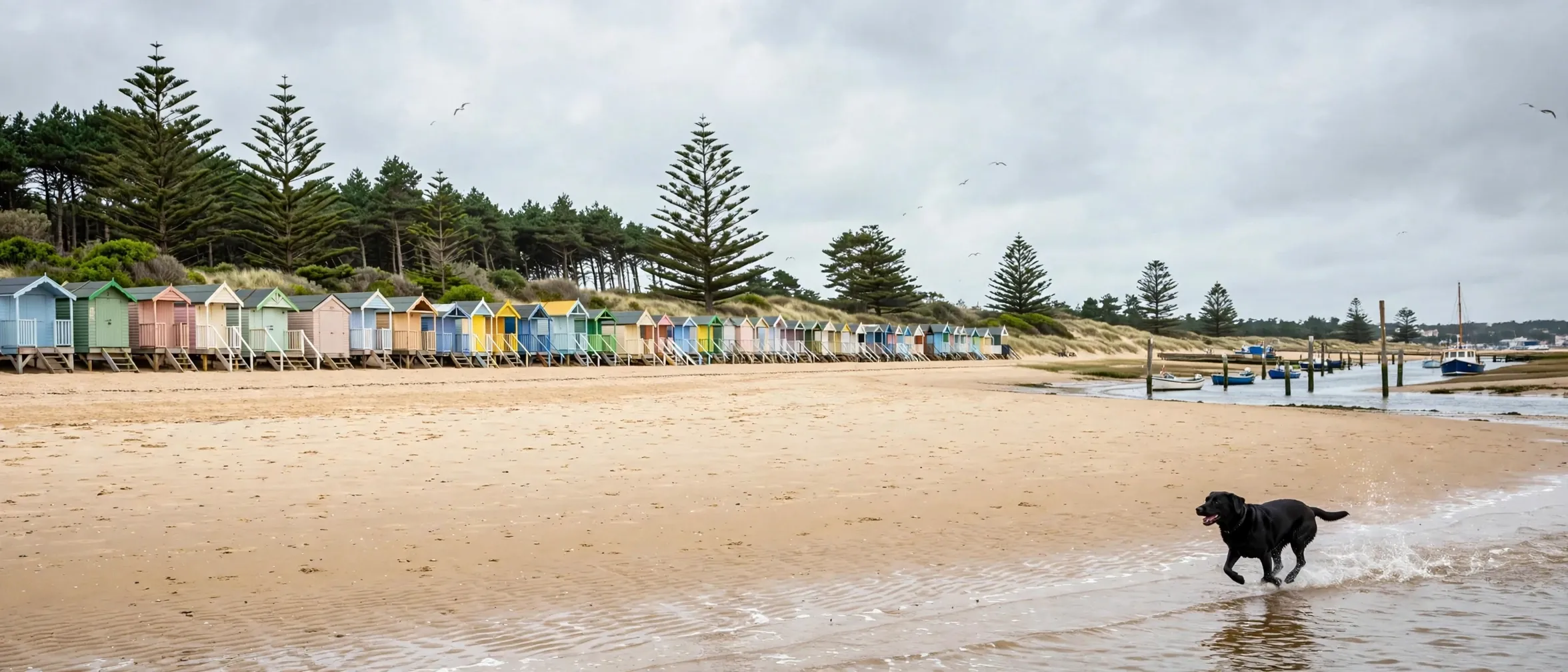
Wells beach is one of the great sandy beaches of the east coast: a vast, flat expanse of pale sand that runs for miles at low tide, backed by pinewoods and a famous row of brightly painted beach huts. At low water the sea retreats a long way, leaving shallow pools, firm sand for running, and a horizon that seems to go on forever. Dogs love it here for obvious reasons. The sand is soft underfoot, the space is enormous, and the shallow water is ideal for paddling. What makes Wells different from a simple beach day is the journey to reach it and the seasonal rules that shape where dogs can go.
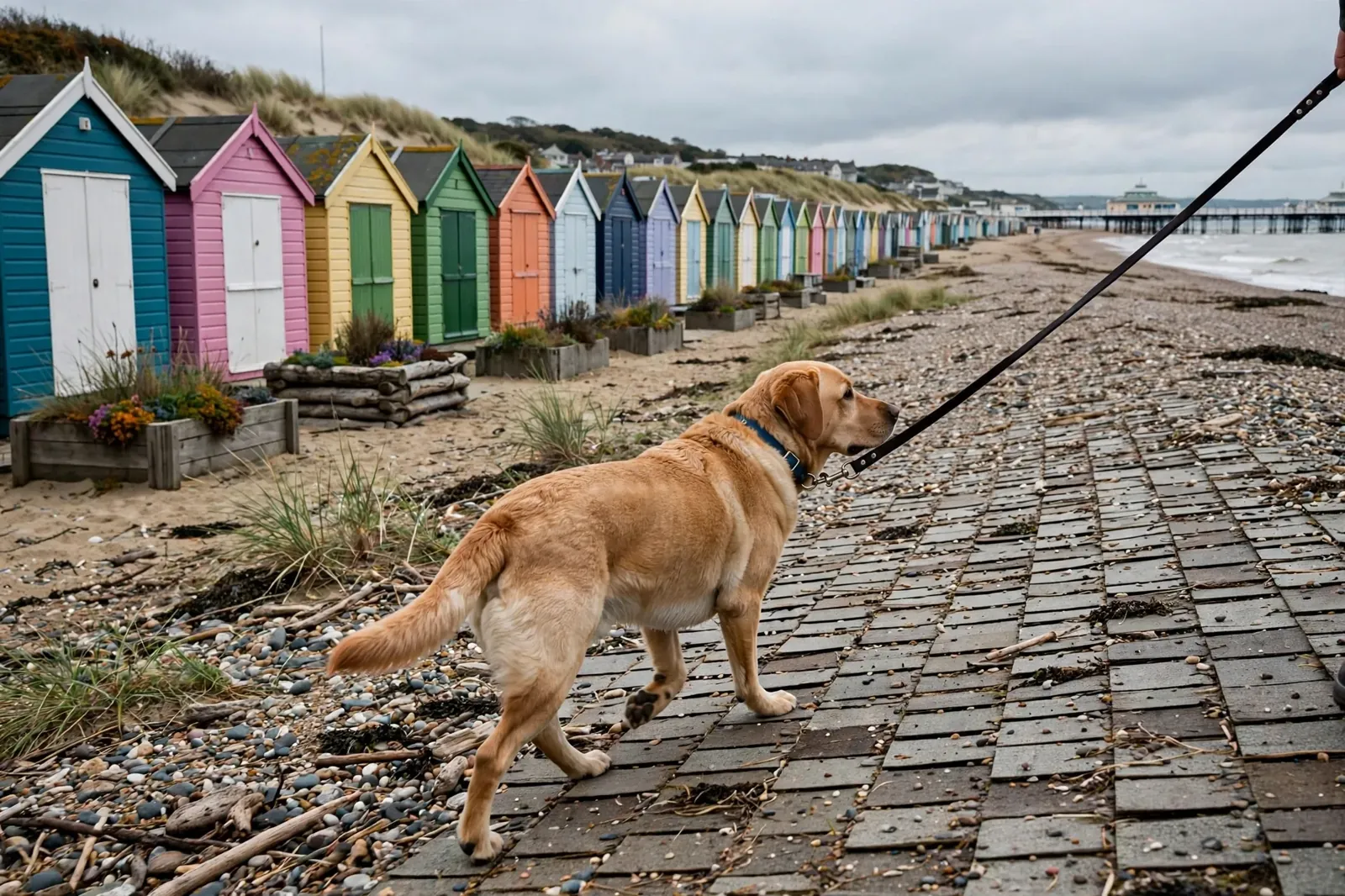
The beach huts deserve a mention because they define the Wells postcard. Around two hundred small wooden huts stand in a long line behind the beach, painted in cheerful colours, each with a tiny veranda. They are privately owned and not open to the public, but they make a wonderful backdrop for photographs and a useful landmark when arranging to meet people. Dogs are welcome to walk past the huts on a lead, and the area around them is a natural meeting point. The huts also mark the transition between the beach and the pinewoods, which matters on a hot day when shade becomes the most valuable thing on the coast.
Seasonal restrictions apply to part of Wells beach, and understanding them is essential. During the summer months, dogs are excluded from a signed section of the beach, while the rest of the beach remains open to dogs. The boundary is marked on the ground and on signs, but it is easy to miss if you arrive from an unexpected direction, so look for the signs before letting a dog off the lead. Outside the restricted period, dogs can use the whole beach. The restricted zone is not the majority of the beach, and on a quiet weekday outside school holidays you may barely notice it. On a busy August Saturday, it matters a great deal, and the dog-friendly stretches will be busier too. If you want certainty, check the official guidance before you travel, and plan to arrive early.
The beach itself changes dramatically with the tide. At high tide the sea comes right up to the sandbanks and the beach narrows; at low tide it opens into a huge playground. The best dog beach time is usually the hours around low tide, when there is maximum firm sand and shallow water. Check tide times before you go and aim for a falling or low tide if you can. Be aware that the tide returns across flat sand faster than it appears to, and channels can fill behind you, so keep an eye on the water and do not let a dog chase a ball into a deepening channel. The beach is patrolled in season, but self-reliance is still the rule.
The harbour and the channel walk
Wells harbour is a working port set a mile inland from the sea, connected to it by a long, winding channel through the marsh. The quay in the town is where fishing boats unload, where the harbour office sits, and where visitors gather to watch the boats and try crabbing. It is a lively, working place rather than a polished marina, and dogs on leads are part of the scene. The walk from the quay to the beach follows the channel, and it is one of the most enjoyable mile-long walks on this coast, provided you plan for it.
The channel walk runs along a bank beside the water, passing the harbour, the lifeboat station, the beach huts and finally the pinewoods before opening onto the beach. The surface is mostly firm and level, suitable for most dogs, though it can be muddy after rain and there is little shade for much of its length. In summer, carry water for the dog and consider walking this stretch in the cooler parts of the day. The views are superb: sailing boats on the channel, wading birds on the mud, and the pinewoods ahead. It is also a working waterway, so keep dogs on leads near the water and away from moored boats, ropes and fishing gear.
Crabbing from the quay is a Wells tradition, and dogs usually sit beside their owners watching the buckets and lines with great interest. If you join in, keep the dog on a lead and away from bait, hooks and buckets of crabs, which are a temptation and a hazard in equal measure. Crab lines and small hooks are easily swallowed, and raw bait upsets canine stomachs. The harbour office and local shops sell crabbing equipment, and the etiquette is to return crabs gently to the water after a look. A dog that can settle beside a crabbing family will have a happy hour; a dog that lunges at buckets will be happier walking the channel bank instead.
The harbour channel is tidal and the current can be strong, so swimming in it is not advisable for dogs or people. The mud beside the channel is deep, soft and genuinely dangerous, and dogs should never be allowed to wander onto it. Stick to the path, the quay and the firm sand of the beach, and treat the mud as scenery. The same warning applies to the salt marsh across the channel, which is criss-crossed by creeks that fill quickly with the tide. Wells rewards those who respect its water, and the beach is the place for swimming, not the harbour.
Pinewoods and the coast path
The pinewoods at Wells are a dense plantation of Corsican pines that runs behind the beach, and they are the secret weapon of a dog day here. On a hot or windy day, the woods offer shade, shelter and a completely different walk from the open beach. The paths through the pines are sandy and soft underfoot, and the scent of pine and the sound of wind in the canopy make a calming contrast to the brightness of the sand. Many dogs prefer the woods to the beach in high summer, and a walk that alternates between the two gives a dog variety without a long drive.
The coast path runs through the pinewoods and onwards in both directions: east towards Stiffkey and Blakeney, west towards Holkham. The stretch west to Holkham is one of the finest coastal walks in Norfolk, crossing the edge of the Holkham estate with its vast beach, dunes and pinewoods. It is a long walk, several miles each way, so treat it as a separate expedition rather than an add-on to a beach day. The shorter walk east along the coast path from Wells is gentler and makes a good second walk after a beach session. Either way, keep dogs on leads where signs require it, particularly near nesting areas in spring and summer, and be aware of horse riders and cyclists sharing the paths.
Holkham beach, just west of Wells, deserves a note because many visitors combine the two. Holkham is a huge, wild beach backed by dunes and pines, and it has its own dog rules, with a seasonal restriction on part of the beach. If you walk from Wells to Holkham, you cross from one beach's rules into another's, so check both sets of signs. Holkham's scale makes it wonderful for dogs that need space, but the walk there and back is long, and there are few facilities on the beach itself. For most dogs, Wells beach plus the pinewoods is a complete day, and Holkham is a second day's adventure.
Practical points for the pinewoods: there are no water points in the woods, so carry water. The paths are popular with families and cyclists, so keep dogs under control at junctions. Ticks are present in the woods and the long grass at their edges, so check the dog after the walk. And in autumn, the woods are full of fungi, some of which are toxic to dogs, so discourage foraging and mushroom eating. The pinewoods are a gift on a hot day, but they still need the same basic care as any other walk.
The Wells and Walsingham Light Railway
The Wells and Walsingham Light Railway is a narrow-gauge heritage line that runs from Wells to the village of Walsingham, about four miles inland. It is the longest narrow-gauge railway of its type in the world, and it is a delightful way to see the Norfolk countryside from a small open carriage. The railway is popular with families, and dogs are generally welcome, though carriages are small and the experience is quite different from a mainline train. Check the current dog policy before you travel, as it can change with the season and with special events.
The practicalities of a heritage railway with a dog are worth thinking through. Carriages are narrow, with limited floor space, and the train is open to the elements in places, so a dog needs to be comfortable sitting on the floor on a lead for around half an hour each way. Steam, whistles and the movement of the train unsettle some dogs, and a nervous dog in a confined carriage is unhappy and disruptive. If your dog is calm on trains and enjoys watching the world go by, the railway is a memorable outing. If not, the pinewoods walk is a better use of the same hour, and nobody will have missed out.
Walsingham itself is a historic pilgrimage village with an abbey, shrines and quiet streets, and it makes a pleasant destination for the railway trip. Dogs on leads are welcome around the village, though the religious sites have their own rules about where dogs can go, so check before entering. The return journey to Wells completes a half-day outing that pairs nicely with a beach morning or a harbour lunch. For visitors staying in Wells for several days, the railway is a good wet-weather or rest-day option when the dog does not need another long beach run.
Tickets, timetables and dog fares change with the season, so check the railway's own information before you travel rather than relying on a guide. The railway runs on selected days outside the main season, and special events can mean busier trains and different rules. Arrive in good time, board calmly, and bring a blanket for the dog to lie on if the carriage floor is hard or draughty. A well-planned railway trip is a highlight of a Wells stay; an unplanned one with a stressed dog is a lesson in checking first.
The town: crabbing, shops and food
Wells town is compact, attractive and very dog-friendly in the practical sense: dogs on leads are welcome on the quay, in many shops, and in several pubs and cafes. The main street runs from the quay inland, lined with fish merchants, cafes, galleries and gift shops, and the atmosphere is that of a working fishing town that also knows how to feed visitors. The fish and chip shops are deservedly popular, and a takeaway eaten on the quay with a dog at your feet is a classic Wells experience, provided you keep food away from gulls and dogs away from discarded chips.
Food choices for dog owners are good. Several pubs welcome dogs in the bar and on terraces, and cafes around the quay often provide water bowls. As ever, check the door sign and ask staff before settling in, and bring a blanket for the dog if the floor is stone. Booking ahead for lunch in peak season is wise, especially for a table where a dog can lie comfortably. Mention the dog when booking so the venue can seat you sensibly, and avoid the busiest times if your dog struggles with crowds and noise.
Shopping with a dog in Wells is straightforward. Many independent shops welcome dogs, and the fish merchants on the quay are an experience in themselves, with the day's catch on display and the smell of the sea everywhere. Keep dogs on short leads in shops, away from food displays, and be ready to wait outside if a particular shop asks it. The town also has practical supplies for dog owners: a small supermarket, a pharmacy, and outdoor shops for anything forgotten. For a longer stay, the market town of Holt, about ten miles away, has more shops and services, and our guide to Holt with a dog covers it in detail.
Evening in Wells is quieter than the daytime bustle, and the quay at dusk, with boats returning and the light fading over the marsh, is a lovely time for a final dog walk. Several pubs serve dinner, and dogs are often welcome in the bar in the evening. If you are staying locally, ask about evening dog policies at booking. A dog left alone in unfamiliar accommodation while owners eat out is a common cause of barking complaints in towns like this, so plan as if the dog comes with you.
Parking, tides and facilities
Parking at Wells is centred on a large car park near the quay and the town, with additional parking near the beach. The main car park fills early on fine days and in school holidays, so arrive before mid-morning in peak season or expect a wait. Charges apply and payment methods change, so check the signs on arrival. The beach car park is closer to the sand but further from the town, so choose based on your plan: town parking for a harbour and town day, beach parking for a pure beach day, and be prepared to walk the mile between them either way.
Tides shape a Wells beach day as much as the weather does. At high tide the beach narrows and the sea comes close to the beach huts; at low tide the sand opens into a huge expanse. Check tide times before you go and aim for low tide if you want maximum space. The harbour channel also changes with the tide, and the quay is most photogenic at high water when the boats float. A day that starts at the quay at high tide, walks to the beach as the tide falls, and returns as it rises again is a well-judged Wells day.
Facilities at the beach are reasonable but not extensive. There are toilets near the beach, a cafe in season, and the beach huts area has a small shop. There is no large indoor attraction at the beach, so wet weather means a retreat to the town, the pinewoods, or the railway. Bring everything the dog needs: water, a bowl, a shade shelter in summer, a towel for wet paws, and bags for waste. Bins are provided near the beach entrance and the car parks, but on a long beach walk you may need to carry waste for a while, so bring enough bags.
For visitors with limited mobility or older dogs, the mile walk from town to beach is the main challenge. A small land train runs between the town and the beach in season, which helps, but it does not run in all weathers or all year, so check before relying on it. Beach parking avoids the walk but still involves sand, which is tiring for arthritic dogs. Plan the day around the dog's actual ability, not its enthusiasm at the start of the walk, and remember that the return mile counts too. Our guide to UK beach rules explains the seasonal restriction system that applies at Wells and elsewhere, and the Suffolk coast guide covers the beaches further south for a second day out.
Beach rules, safety and hot sand
The seasonal dog zone at Wells is the rule that matters most, and it is easy to get right if you look for the signs. The restricted section is clearly marked on the beach during the restriction period, and the rest of the beach remains open. Outside the restriction period, the whole beach is open to dogs. The exact dates of the restriction can change, so check the official guidance before you travel rather than relying on memory or a previous visit. Fines for breaching beach restrictions exist under public space protection orders, and they apply to dog owners who ignore clear signs.
Hot sand is a real hazard in summer. Sand that feels warm to a bare foot can burn a dog's paws, and the long walk from the car park or the quay across sun-baked sand adds up. Walk in the morning or evening, stick to the waterline where the sand is cooler and wet, and check paws regularly. If the dog is lifting its paws, seeking shade or refusing to walk, the sand is too hot and it is time for the pinewoods or the car. Booties help some dogs, but many dogs hate them, so test them at home before relying on them on holiday.
Sea swimming at Wells is generally safe in the shallow water at low tide, but the usual coastal cautions apply. Watch for currents, especially near the harbour channel mouth, and do not let dogs swim after heavy rain when water quality can suffer. Rinse salt water off the dog after swimming, as dried salt irritates skin and paws, and discourage drinking sea water, which causes stomach upsets. Jellyfish occasionally wash up on this coast, so keep dogs away from stranded jellyfish and check the beach after storms.
Other beach hazards include fishing lines and hooks left on the sand, discarded food and picnic waste, and the occasional adder in the dunes and pinewood edges. Keep dogs from scavenging, check paws after the walk, and carry a basic first aid kit. Gulls are bold at Wells and will snatch food from hands and from dogs' bowls, so eat under cover where possible and keep the dog's food out of sight. A beach day that ends with a calm, rinsed, checked dog is a successful one.
A beach day plan for Wells
A good Wells day starts early. Arrive before the crowds, park, and walk the channel to the beach while the air is cool and the light is soft. Let the dog run on the firm sand at low tide, paddle in the shallows, and burn off energy before the beach fills. The morning is also the best time for photographs, with the beach huts catching the light and the pinewoods still quiet. Build in water breaks and shade from the start, rather than waiting until the dog is hot and tired.
Midday is for shade and food. Retreat to the pinewoods for a shaded walk, or return to town for lunch somewhere the dog is welcome. The hottest hours are the worst for both dogs and people on an open beach, and a long lunch in the shade is not wasted time; it is the reason the afternoon walk is enjoyable. If you have booked the light railway, midday is a good time for it, as the train offers a seated, shaded outing that rests the dog's legs.
The afternoon can be a second beach session, a harbour wander, or a crabbing hour on the quay, depending on the dog's energy. Older dogs may prefer the quay and a pub garden, while younger dogs may want another run on the sand as the tide falls again. The key is to watch the dog, not the itinerary: a dog that is flagging should not be pushed through a second long walk because the plan says so. End the day with a rinse, a check for ticks and sand irritation, and a comfortable car journey home with water available.
Wells works beautifully as part of a north Norfolk week. Combine it with the seal trips at Blakeney, the market town of Holt, and the heritage railway at Sheringham, and the coast shows its full range. Each town has a different character, and Wells' contribution is the classic beach day: sand, huts, pines and a harbour that still works for a living. Done with tides, shade and seasonal zones in mind, it is one of the most rewarding dog beaches in England.
Practical questions
Before you go
Are dogs allowed on Wells beach all year?
Dogs are welcome on much of Wells beach all year, but a seasonal restriction applies to a signed section of the beach during the summer months. The restricted area is marked on the beach, so check the signs on the day and keep dogs on a lead where the signs require it. Outside the restricted zone, dogs can run and play freely.
How far is it from Wells town to the beach?
The walk from the quay to the beach is about a mile, following the harbour channel past the beach huts and the pinewoods. It is flat and scenic, but it adds up to two miles of walking to a beach day, so plan around your dog's energy. A small land train runs between the town and the beach in season for those who prefer not to walk it.
Can dogs ride the Wells and Walsingham Light Railway?
Dogs are generally welcome on the Wells and Walsingham Light Railway, but carriages are small and the railway is popular, so check the current policy before you travel and keep dogs on a lead and on the floor. If your dog is nervous in confined spaces or around steam and whistles, walk the pinewoods instead.
Is the Wells harbour channel safe for dogs?
The channel is tidal and the current can be strong, so dogs should not swim in it and should be kept on a lead near the water's edge. The mud beside the channel is deep and sticky, so keep dogs on the path and the firm sand. The beach itself is the place for swimming and running, not the harbour channel.
Where can dogs go in Wells town?
Dogs on leads are welcome around the quay, the shopping streets and many pubs and cafes, several of which provide water bowls. Crabbing from the quay is a classic Wells activity and dogs usually watch from beside their owners. Keep dogs on a lead in town, as the quay and streets are busy with boats, cars and holidaymakers.
What is the best time of day for a dog beach trip at Wells?
Early morning and late afternoon are best: the beach is quieter, the light is softer, and in summer the sand is cooler on paws. Midday in high summer brings crowds, hot sand and little shade, so if you must visit then, bring water, a shade shelter and a plan to retreat to the pinewoods.