This guide is independent and contains no paid placement. If affiliate links are added later, they will be clearly marked and will not change our editorial checks.
Wells is a walking city: park once, then do everything on foot. Dogs on leads are welcome on the Cathedral Green and in the Bishop's Palace gardens, the market streets are easy and relaxed, and the water meadows give the dog a proper green walk at the edge of town. Check the official guidance before you travel for current access rules.
Why the smallest city suits dogs
Wells is England's smallest city, and that smallness is exactly what makes it work with a dog. The whole centre fits into a comfortable walk: the Cathedral Green, the Bishop's Palace, the Market Place and the High Street are all within a few minutes of each other, the streets are mostly flat, and there is none of the traffic, noise and crowding that makes bigger cities hard work for a dog. You can park once, walk everywhere, and still have time for a proper walk on the water meadows and a climb into the Mendips before dinner. For a dog owner, that compactness is a gift — no buses, no long trudges between sights, and no dog left waiting while you navigate a city centre.
The city is built around water, and that shapes the walking. Springs rise in the Bishop's Palace gardens and flow through the city in streams and channels, and the water meadows on the edge of town are a reminder that Wells sits at the foot of the Mendip Hills, where the limestone meets the Somerset Levels. The result is a city that feels green even in its centre: the Cathedral Green is a large open lawn, the Palace gardens are full of trees and water, and the meadows are a few minutes from the Market Place. Dogs notice the difference, and so will you — the city smells of grass and water rather than exhaust fumes, and the pace of life is slower than in a bigger city.
Wells is also a working city rather than a museum piece. The market has run here for centuries, the shops serve local people as well as visitors, and the pubs and cafes are used to dogs because the people who live here own dogs. That everyday quality matters: a city that is used to dogs is a city where a dog on a lead is unremarkable, where water bowls appear without asking, and where nobody minds a muddy spaniel in the bar. Come on a market day for the liveliest version of the city, or on a quiet weekday for the calmest, and either way the city will reward a slow walk rather than a rushed tour.
The Cathedral Green: the heart of the city
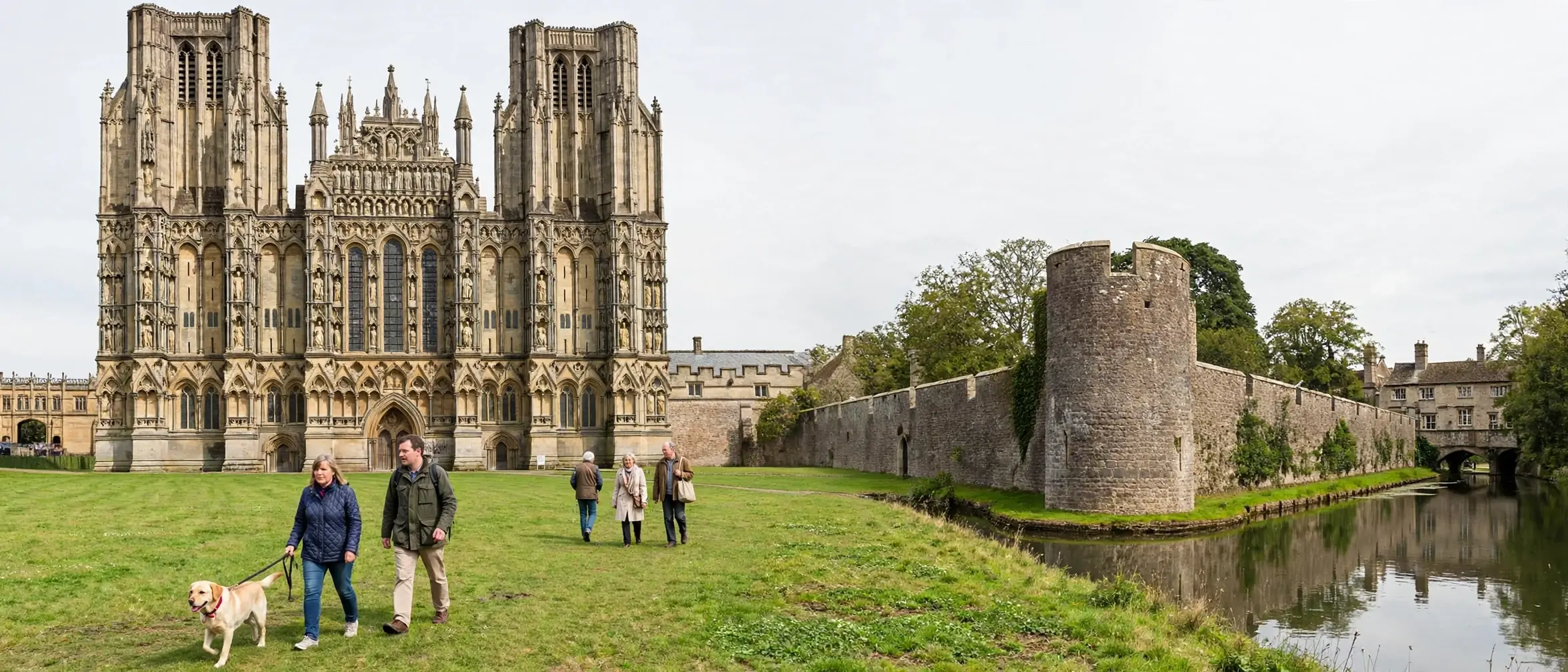
Wells Cathedral is one of the most beautiful Gothic buildings in England, and its Green is the open lawn in front of the great west front, where the city gathers. Dogs on leads are welcome on the Green, and it is the natural starting point for a visit: a wide, flat, grassy space with benches, trees and a view of the cathedral's carved facade that rewards a slow look. The Green is also a good place for the dog to settle after the journey, with room to sniff and stretch before the walking begins. The cathedral interior takes assistance dogs only, so treat the visit as an outdoor one, and look at the cathedral's own page before you travel for the current rules.
Walk around the cathedral to see the building from all sides. The west front, with its rows of medieval statues, is the famous view, but the north side, with the Chapter House and the cloisters, is quieter and more atmospheric, and the east end, with its Lady Chapel, looks out over the gardens. The Vicars' Close, a medieval street of small houses just off the Green, is one of the most photographed streets in England, and it is a short, flat walk that suits a dog on a lead. The Close is a residential street, so keep the dog close, keep the noise down, and do not block the doorways. The cathedral's bells ring regularly, and the sound can startle a noise-sensitive dog, so be ready for the first peal and give the dog a moment to get used to it.
Come back to the Green in the evening and you will see a different place: the day visitors gone, the swifts circling the tower in summer, the stone of the west front turning gold in the low light. An hour on the Green and the precinct is enough, longer if you like to sit and watch the city go by, and the cathedral shop and cafe have outdoor seating where dogs are welcome. The Green is a good picnic spot on a dry day, and in December it hosts a Christmas market, with the cathedral lit for the season — a festive evening walk with a dog that is worth timing a visit around.
The Bishop's Palace and its swans
The Bishop's Palace is the other great sight of Wells, and it is the more dog-friendly of the two. The Palace has been the home of the Bishops of Bath and Wells for over 800 years, and its gardens and grounds are open to visitors, with dogs on leads welcome in the gardens. The grounds include a moat, ramparts, a chapel, a ruined great hall and fourteen acres of gardens, with lawns, trees, a well pool and the famous swans that ring the bell at the gatehouse when they want to be fed. The gardens are the place to spend time with a dog: flat, green, peaceful and full of interest, with the moat walk and the ramparts giving views across the city and the Mendips.
The swans are the Palace's signature sight, and they are worth the visit on their own. The tradition of the swans ringing the bell for food goes back to the nineteenth century, and the birds still perform at feeding time, which is usually in the afternoon — check the Palace's times on the day of your visit. Keep the lead short by the moat: the swans guard their patch fiercely, the water is deep, and the birds should be left alone. There is a cafe in the gardens with tables outside for dogs, and the shop sells plants and local crafts. Only assistance dogs are allowed inside the Palace buildings, so plan the visit as a garden visit and check the official guidance before you travel for the latest rules.
An hour is the minimum for the Palace gardens, and two is better. The moat walk is flat and easy, which suits older dogs, and the ramparts give views across the city and the Mendips; the benches under the trees are the place to sit while the dog rests. The swans ringing the bell for food — usually in the afternoon — are the signature sight, so time your visit for feeding time if you can. Keep the dog on a short lead near the moat, because the swans are protective of their territory and the water is deep. And remember the Palace is a historic site: no climbing on the walls, no digging in the beds, and the dog stays on the paths through the planted areas.
Market Place and High Street: a proper market city
Wells Market Place is the commercial heart of the city, a broad open square with the market cross, the town hall and a ring of shops, cafes and pubs. The market has run here for centuries, and the market days — Wednesday and Saturday — are the liveliest time to visit, with stalls selling local produce, cheese, bread, flowers and crafts. Dogs on leads are welcome in the Market Place, and the town is used to dogs, so a well-behaved dog is a normal sight among the stalls. There is room to walk comfortably around the square, and the side streets give you somewhere to step aside when it gets busy.
From the Market Place the High Street runs towards the cathedral, a pleasant old-fashioned shopping street of independent shops, bookshops, cafes and a bakery. The shops are small and friendly, and several welcome dogs inside if you ask at the door. The cafes range from traditional tea rooms to modern coffee shops, most with outdoor seating as well as dog-friendly tables indoors, and the pubs around the square have beer gardens that are pleasant on a sunny afternoon. The rule can change between the bar and the dining room, so ask when you arrive rather than assuming the whole building takes dogs.
The Market Place stalls are the practical stop: picnic supplies for the water meadows, a wedge of Cheddar, bread from the bakery. The High Street bookshops are the pleasure — second-hand and new, with local history and cookery — and several welcome dogs inside if you ask at the door. Keep the lead short in the smaller shops, where the aisles are narrow, and bring a mat so the dog has somewhere of its own to lie in the cafes. On a market day the square is busy, so a nervous dog will do better on a weekday, when the same shops are open and the pavements belong to the locals again. The notice boards in the Market Place list the week's events, and a farmers' market can make a visit more interesting.
Water meadows and city walks
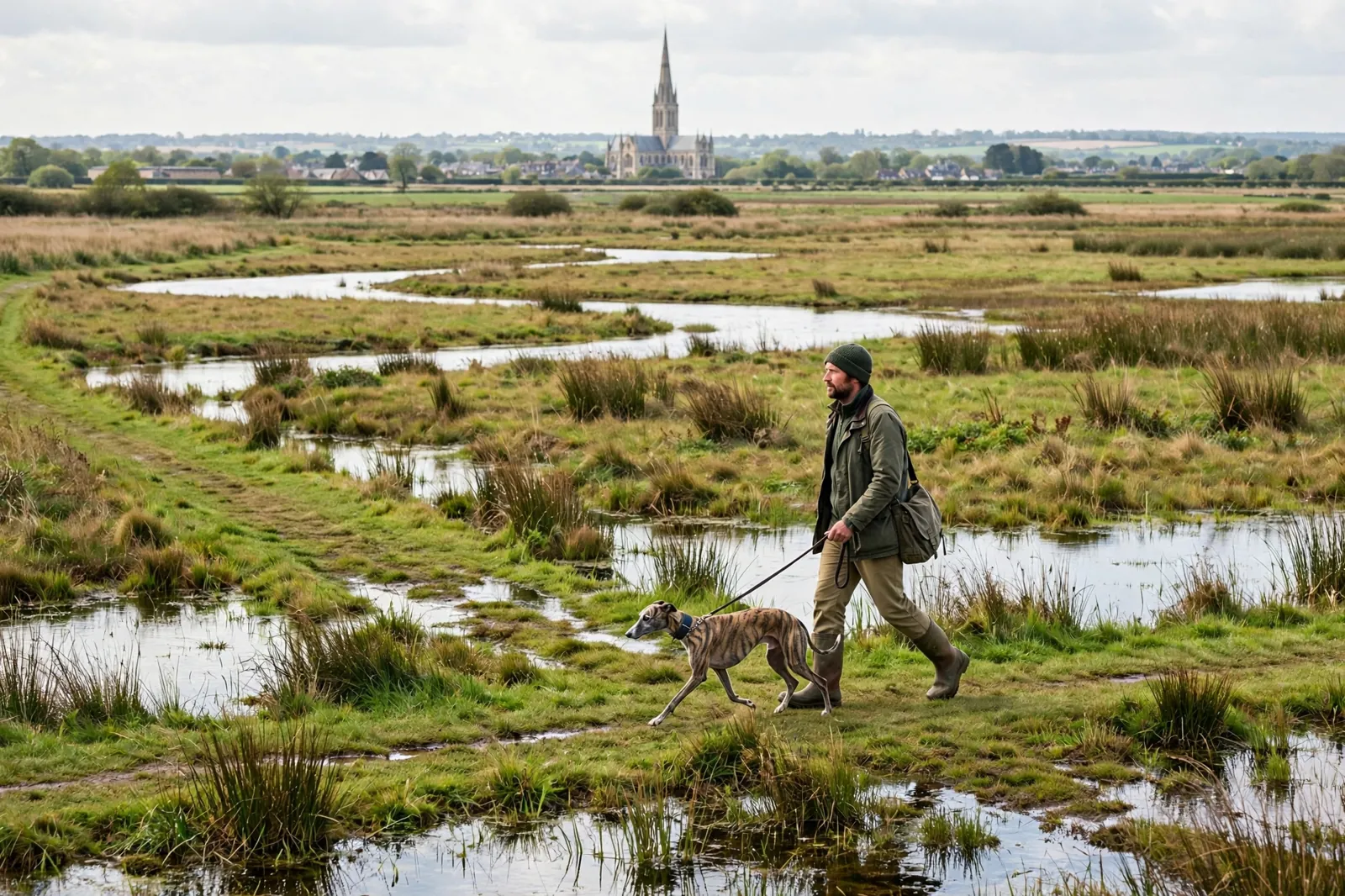
The water meadows on the edge of Wells are the city's green lung, and they are the best place for a proper dog walk without leaving town. The meadows are flat, open grassland crossed by streams and rhynes, with views back to the cathedral tower and the Mendip Hills, and they are a few minutes' walk from the Market Place. A loop of the meadows takes about forty minutes at a dog's pace, and there are several paths that link the meadows to the lanes around the city, so you can extend the walk if the dog is still fresh. Underfoot the grass is soft and easy on paws, and the streams give dogs a place to paddle on a warm day.
The meadows are farmed, so walk them like farmland. Sheep and cattle graze some of the fields, the streams run deep in places, and the ground-nesting birds in spring are easily disturbed — keep the dog on a lead or a long line until you know the field is clear of stock and the water is safe. The reward is the birdlife: ducks, waders and songbirds through the year, and the swifts and swallows circling the cathedral tower in summer. Dogs on leads are welcome on the paths, though the nature reserve areas have their own rules, so look at the signs before you go. Spring brings wildflowers to the meadows, and autumn brings the colours of the trees along the streams.
Before you set off for the meadows, a few notes: after rain the paths get muddy, especially in winter, so wear boots and keep a towel in the car; the open meadows have almost no shade, so water goes in the bag on a warm day; and the ground is low-lying, which means the low ground floods in wet winters and the paths can shut. Look at the local conditions before you leave town, and have a backup plan in the city if the meadows are under water. The meadows are also a good picnic spot, with benches and open grass, and the cathedral tower in the distance makes a fine backdrop for a rest.
Up into the Mendips: the hills above the city
The Mendips rise straight out of the north side of Wells, and they are the city's great walking asset. The climb from the city onto the plateau is steep but short, and the reward is open limestone grassland, dry stone walls and views across the Levels to the sea. The most popular route is the climb to the top of the plateau above the city, where the paths open into wide grassy tracks with views in both directions. Underfoot it is mostly short grass and limestone, firm even after rain, and the walking is easy once you are up. Keep the dog on a lead or a long line here: sheep graze the grassland for much of the year, and the ground-nesting birds in spring and summer are easily disturbed by a dog running free.
For a longer walk, the Mendip Way runs across the hills above Wells, and the route to Cheddar Gorge and the village of Cheddar is a classic half-day outing for fit dogs. Cheddar Gorge itself is a dramatic limestone gorge with cliffs, caves and a road that winds through the middle, and the village has shops, cafes and a famous cheese shop. Dogs on leads are welcome on the gorge walks, but the cliffs are steep and the road is busy, so keep the dog close and check the official guidance before you travel for the latest access rules. The caves at Cheddar are not open to dogs, so plan a split visit if you want to go inside. The walk from Wells to Cheddar takes about two hours one way, and the bus back to Wells is a practical option if the dog is tired.
- Meadows circuit: roughly forty minutes, level throughout, kind to older dogs, with the cathedral in view all the way.
- Mendip climb: ninety minutes there and back, a steep start and open grassland after; best in dry weather.
- Wells to Cheddar Gorge: two hours one way on the Mendip Way, with a bus back; a proper half-day for fit dogs.
- Wells to Glastonbury: a full day across the Levels; dry weather, water and a packed lunch.
The plateau has no drinking water and no shade, so the bottle and the bowl go in the bag before you leave the car, and the forecast gets checked before you set off — the Mendips are exposed, and a bright morning can turn wet and windy by the afternoon. Carry a map or offline maps, because the plateau is open and featureless in places, and the Mendip Way and the local footpaths are waymarked but easy to lose in mist. Close every gate behind you, stick to the waymarked paths through the crops, and bag the mess: the farmland around the city is working land, and walkers keep their welcome by behaving well.
Split visits that work for everyone
Wells is a small city, and the only places a dog truly cannot enter are the insides of the cathedral and the Palace buildings — so the split visit here is a gentle one, not a military operation. Take turns at the cathedral door: one of you goes in to see the west front from the inside and the scissor arches, while the other walks the dog around the Green and down Vicars' Close, and then swap. A proper look inside takes about an hour, which is exactly the length of a good Green-and-Close circuit with a dog, so nobody is left standing around. Travelling alone? The Green, the Close and the Palace gardens are the heart of Wells anyway, and you lose very little by staying outside — the cathedral is at its best from the lawn, with the dog beside you.
The same turn-taking works for the smaller indoor stops. The Palace gardens take the dog, the Palace buildings do not, so one of you does the house while the other does the moat walk with the dog; the little museums in the city are the same, with the waiting half wandering the Market Place or the water meadows. Cafes and pubs mostly take dogs inside in Wells, and the shops are relaxed about it, so the two of you will be together for most of the day anyway. For the odd place that is strictly indoors-only, leave the dog with a companion on the Green, or time the visit for a cool morning when the dog can rest in the shade — never in the car on a warm day, and never for long. The city is compact enough that a split visit is a five-minute separation, not a logistical exercise.
Spread the indoor stops across the trip instead of stacking them into one morning. Cathedral on the first day, Palace buildings on the second, the Mendips on the third, and the dog never waits more than an hour at a stretch. The waiting half always has somewhere good to be — the Green, the Palace gardens, the meadows — and those three places are generous enough to fill a day on their own. That is the relaxed way to do Wells: the dog has its own itinerary of green spaces, and it runs alongside yours rather than getting in its way.
Eating and drinking with a dog in Wells
Eat in Wells the way the city eats: in the Market Place, on the High Street, and in the shadow of the cathedral. The pubs around the square serve the Somerset standards — fish and chips, pies, a proper Sunday roast — and several have gardens where the dog can lie in the shade while you eat; the cafes on the High Street do breakfast and brunch with local produce, and the bakery there sells bread worth carrying home. Dogs are welcome inside many of the pubs and cafes, though the rule can change between the bar and the dining room, so ask when you arrive rather than assuming. The cafe by the Palace gardens is the quiet choice for a mid-morning stop, with outdoor tables where the dog can watch the moat.
The Green is the picnic spot to aim for on a dry day. Buy lunch from the market stalls — sandwiches, pasties, a wedge of Cheddar — and carry it to the Cathedral Green, where the dog can lie on the grass with the west front in front of you, or out to the water meadows, where the streams and the tower make the backdrop. A picnic also solves the problem of a wet dog after the meadows in winter, when nobody wants to sit in a cafe with a muddy spaniel, and it keeps the day flexible if the weather turns. If you are staying in a cottage, the city's shops stock the basics and the supermarkets on the edge of town cover a proper shop; for dinner, ring the pub ahead on market days and in summer, because the pubs fill up and a table for two plus a dog is easier to arrange by phone than by turning up.
The evening meal is the one to plan, and the morning walk is what makes it work. Eat at eight, before the Green fills, and the dog can lie in the shade of the cathedral while you eat; eat at one, and the same dog is panting on hot grass with nowhere to hide. The Green and the meadows have no drinking water for dogs, so a bottle and a bowl go in the day bag before you leave the car, and the cafes will fill a bowl if you ask. Dogs that bark at strangers are happier at a table on the edge of a garden, with their back to a wall, and a mat from home underneath them tells the dog where its place is. Aim for the meal after the walk: a tired dog sleeps under the table, and a fresh one fidgets through the whole meal.
Where to stay in and around Wells
The market-day weekends are the ones to book early for. Staying in Wells itself means the cathedral, the Palace and the Market Place are all a few minutes from your door on foot, which is the point of a city this small — and the hotels and guest houses in the centre, around the Market Place and along the streets towards the cathedral, are used to dogs. Before you book, ask for a ground-floor room if the dog is old or large, a garden or a yard for the last walk of the night, and whether the dog can come to breakfast or has to wait in the room. School holidays and bank holidays fill the best rooms months ahead, and the market-day weekends fill first.
Campsites first, cottages second — that is the order to think in for a longer stay. The campsites and caravan parks on the Mendips and the Levels suit families, with space, dog-walking fields and a relaxed attitude to a bark at breakfast. The cottages are in the villages: Priddy, with its green, and the hamlets along the plateau put the hill walks on your doorstep; Wookey, just outside Wells, has cottages with gardens backing onto the streams; Coxley and Dulcote sit in the lanes to the east with fields from the door. Ask how many dogs the cottage takes and what the charge is, how high the fence is, where the nearest field is for the morning walk, and what happens if you leave the dog alone while you eat out — the cottages that answer all four straight away are the ones to book.
Be straight about the dog from the first message: breed, size, how many, whether it sleeps in a crate. A host who knows will give you the right room and the right advice — the quiet side of the house, the lane behind for the morning walk — and you will avoid the awkward arrival where the host discovers a Great Dane at the door. Take the dog's own bed and its usual food, plus something that smells of home, and keep the first evening quiet so the new place becomes home. From Wells the whole of central Somerset is in reach — Glastonbury and the Tor one way, Cheddar Gorge the other, the Levels to the south — and our guides to Bath and Salisbury cover the neighbouring cathedral cities in the same practical detail.
Parking and getting there
Wells is reached by the A39 from Glastonbury or the A371 from Shepton Mallet, and the drive in from the Levels is one of the prettiest in Somerset, with the cathedral tower appearing over the fields long before the city does. Priory Road car park, on the south side of the centre, is the most useful for a first visit: a short flat walk from the Cathedral Green and the Market Place, and large enough to have spaces on an ordinary weekday. Tucker Street car park, closer to the Market Place, is the backup when Priory Road is full. Charges apply in most of the city car parks, so read the board and note the maximum stay — market days, Wednesday and Saturday, are the days when both fill by mid-morning, and arriving before ten is the only reliable plan.
Wells has no railway station, so the bus station in the city centre is the way in without a car, with regular services from Bristol, Bath, Glastonbury, Street and Taunton. Dogs are welcome on the buses at the driver's discretion — a quick check with the operator before you travel is worth it. Once you are here you will not need a car at all: the Green, the Palace, the Market Place and the water meadows are all walkable, and the Mendip paths start at the edge of the city. Drivers should take the approach slowly, because the roads narrow as they reach the centre and the streets around the cathedral are busy with walkers in summer.
If the dog cannot go into the cathedral with you, leave it with a companion on the Green, where there is grass, benches and shade — the car is never the answer. The city car parks have little shade, and the temperature inside a car climbs fast even on a mild day. The same applies to the shops and the Palace buildings: if the dog cannot come in, one of you stays outside with it. Electric charging exists in some of the city car parks but it is thin, so top up before you arrive. And if both central car parks are full on a market Saturday, the fallback is to park further out and walk in across the meadows, which is a better start to the day than circling the one-way system.
Seasons, weather and what changes
The city is at its best in May and September. The Cathedral Green is green, the Palace gardens are in bloom, the water meadows are full of birds, and the city is lively without being crowded — May brings wildflowers to the meadows and the Mendips, September brings warm days and quiet streets, and October brings autumn colour to the trees in the Palace gardens. A dog gets the best of the city in those months: a flat meadow walk in the morning, the Green in the middle of the day, and a Mendip climb in the evening light, all without the crowds of high summer or the mud of deep winter.
Market Saturdays set the pace of a Wells summer. The square fills, the car parks are full by mid-morning, and the Green is at its most crowded — so the quiet version of the city only exists before ten. Walk the meadows early, while the grass is still cool, and leave the Mendip climb for the evening, when the sun drops and the breeze picks up; the Green and the meadows offer little shade at midday. Check the pavement with the back of your hand before you set off at midday, carry a bottle for the dog, and if it starts panting hard or falling behind, find shade and let it cool down before you carry on.
December is the month to come for winter in Wells. The Green hosts a Christmas market, the cathedral is lit for the season, and a festive evening walk with a dog is worth timing a visit around — while the rest of winter is quiet, with the pubs warm and the water meadows full of winter birds. The price is the weather: the Mendips take the wind and rain full in the face, the meadow paths turn to mud, and the streams can flood the low ground after heavy rain. Fit the Mendip climb and the meadows walk around the short days, pack a torch for the walk back to the car, and check the forecast the night before and once more in the morning — Somerset weather can turn in an hour, so bring a waterproof for yourself and a drying coat for the dog.
A one-day plan that works with a dog
Park once and do everything on foot — that is the Wells way, and it works because the city is so small. Get in by nine, leave the car at Priory Road, and take the water meadows first, while the dog is fresh and the city is quiet; the loop takes about forty minutes and gives the dog a good run before the town wakes up. From the meadows, walk to the Cathedral Green while the morning light is on the west front, and spend an hour circling the cathedral, Vicars' Close and the Green at whatever pace the dog sets. By half past eleven the city is waking up, and a cafe on the High Street is the natural next stop. The order is the point: the dog is tired and calm by the time you sit down, and the Green is done before the midday crowds.
Lunch is best taken slowly, and the Palace gardens are the place for the afternoon. Walk the moat, watch the swans ringing the bell for food, rest on the benches under the trees — all at the slow pace a tired dog sets. The gardens are the calmest part of the city, and the perfect place for a slow afternoon. If the dog is still fresh, the climb into the Mendips above the city makes a good late-afternoon walk, with the evening light across the Levels as the reward; if it is flagging, the Market Place and the High Street, browsed slowly, fill the afternoon just as well. Either way, be back at the Market Place by early evening for dinner in a dog-friendly pub, and book the table in advance if it is a market day or a weekend, because the city pubs fill fast.
- 09:00 Park at Priory Road and walk the water meadows loop while the city is quiet.
- 10:00 Cathedral Green and Vicars' Close, circling the precinct at a slow pace.
- 11:30 Coffee on the High Street, or on the Green if the sun is out.
- 13:00 Bishop's Palace gardens, the moat walk and the swans.
- 15:30 Market Place and High Street browsing, or a Mendip climb for a fresh dog.
- 18:00 Dinner in a dog-friendly pub, table booked in advance.
Two days in Wells is barely enough: Glastonbury and the Tor fill the second, Cheddar Gorge and the Mendips the third, and the shape never changes — walks first, sights second, and food and rest fitted in between, with no long waits in cars or queues. The dog will prove it worked by settling at your feet in the pub when the day is done. For a longer stay, our guides to Bristol and Bath cover the bigger cities to the north, with split visits, parking and places to stay covered the same way.
Practical questions
Before you go
Can dogs go into Wells Cathedral?
No — the cathedral interior takes assistance dogs only. The Cathedral Green and the surrounding precinct are open to dogs on leads and are a pleasure to walk, so take turns at the door: one of you goes inside while the other walks the dog around the Green and the Bishop's Palace gardens.
Can dogs visit the Bishop's Palace in Wells?
Dogs on leads are welcome in the Bishop's Palace gardens and grounds, which include the moat, the ramparts and the famous swans that ring the bell for food. Only assistance dogs are allowed inside the Palace buildings. Check the official guidance before you travel, because the gardens sometimes close for events.
Is Wells an easy city to walk with a dog?
Yes, Wells is England's smallest city and one of the easiest to walk. The centre is compact and mostly flat, the Cathedral Green and the Market Place are within a few minutes of each other, and the water meadows on the edge of the city give dogs a proper green walk without leaving town.
Where can my dog run off the lead in Wells?
The open grassland of the Mendip plateau above the city is the place for a proper off-lead run — but keep the line on until you are past the grazing sheep and clear of the ground-nesting birds in spring and summer. The water meadows are best on a lead, because livestock grazes some of them and the streams run deep, and the Cathedral Green and the Palace gardens are lead-only. When in doubt about a field, keep the line on.
Where do I park in Wells with a dog?
Priory Road car park, on the south side of the centre, is the one to aim for: a short flat walk from the Cathedral Green and the Market Place. Tucker Street car park, closer to the square, is the backup when Priory Road is full. Market days — Wednesday and Saturday — fill both by mid-morning, so get in before ten. Never leave the dog waiting in the car; the city car parks have almost no shade.
How long do I need in Wells with a dog?
A full day covers the Cathedral Green, the Bishop's Palace gardens, the market streets and a walk on the water meadows. Two days let you add a Mendip walk and a slower look at the city, and Wells makes a good base for Glastonbury, Cheddar Gorge and the Somerset Levels, all within a short drive.