This guide is independent and contains no paid placement. If affiliate links are added later, they will be clearly marked and will not change our editorial checks.
Walk the West Highland Way in 7 to 8 days with a fit dog, booking every stay ahead. Time the trip for May or late September to dodge the worst midges, respect the Loch Lomond camping permits, and use a baggage courier so the dog's legs carry only the dog.
The 96-mile route in numbers
The West Highland Way runs 96 miles from Milngavie, on the edge of Glasgow, to Fort William at the foot of Ben Nevis. Opened in 1980, it was Scotland's first long-distance trail, and it remains the most popular, with tens of thousands of walkers completing it every year. The route follows the shores of Loch Lomond, crosses the wild expanse of Rannoch Moor, climbs the Devil's Staircase into Glencoe and finishes with a long descent into Fort William. The total ascent is around 3,500 metres, and the highest point is the top of the Devil's Staircase at about 550 metres, which is modest by mountain standards but still a serious climb after five days of walking.
Most walkers take 6 to 8 days to complete the route, averaging 12 to 16 miles a day. With a dog, 7 to 8 days is the sensible target, with a rest day built in, because the stages are long and the ground is rough. The route is usually divided into 7 or 8 stages, each arranged around a village or a hostel with somewhere to sleep. That structure is a help for dog walkers, because the overnight stops are known and the distances between them are manageable, though the stages on Rannoch Moor and into Glencoe are the hardest and the most exposed.
The West Highland Way is a very different trail from the English long-distance routes. It is shorter, but it is wilder: the moorland is bigger, the weather is more changeable, the midges are worse, and the facilities are thinner. The villages along the route are small, the shops are few, and the mobile phone signal vanishes for long stretches. A dog that has walked the Pennine Way or the Coast to Coast will find the West Highland Way familiar in spirit but different in detail, and a dog that has only ever walked in England will find Scotland's access laws, camping rules and midge season all new.
One practical point is often missed: the West Highland Way is a linear trail with a railway at both ends, which makes the logistics easier than on most long trails. Milngavie has a direct train from Glasgow, and Fort William has a train to Glasgow, which means the return journey is straightforward. Dogs travel free on most trains, though they must be kept on a lead and off the seats. That ease of transport is one of the route's great attractions, and it is worth factoring into the planning: a trail that is easy to reach and easy to leave is a trail you can walk without a car.
The stages, day by day
The first day, from Milngavie to Drymen, is a gentle introduction: 12 miles of woodland, farmland and the first views of the Campsie Fells. It is a good first day for a dog, with easy ground and plenty of places to stop, and it is the day to settle into the rhythm of the trail rather than to push the pace. The second day, from Drymen to Rowardennan on the east shore of Loch Lomond, is longer and harder, with a climb over Conic Hill and a long lochside path that can be rough underfoot. The views across the loch are superb, but the path is narrow in places and the dog should be on a lead where the ground drops to the water.
The third day, from Rowardennan to Inverarnan, is the longest lochside day, with a rough and rocky path that is hard on paws and slow going. This is the day that most walkers underestimate, because the distance looks modest on the map but the ground is slow. Allow extra time, keep the dog on a lead where the path is narrow, and do not plan a late finish. The fourth day, from Inverarnan to Tyndrum, is a gentler valley walk, and it is a good day to recover, with the village at the end offering shops, pubs and a choice of stays.
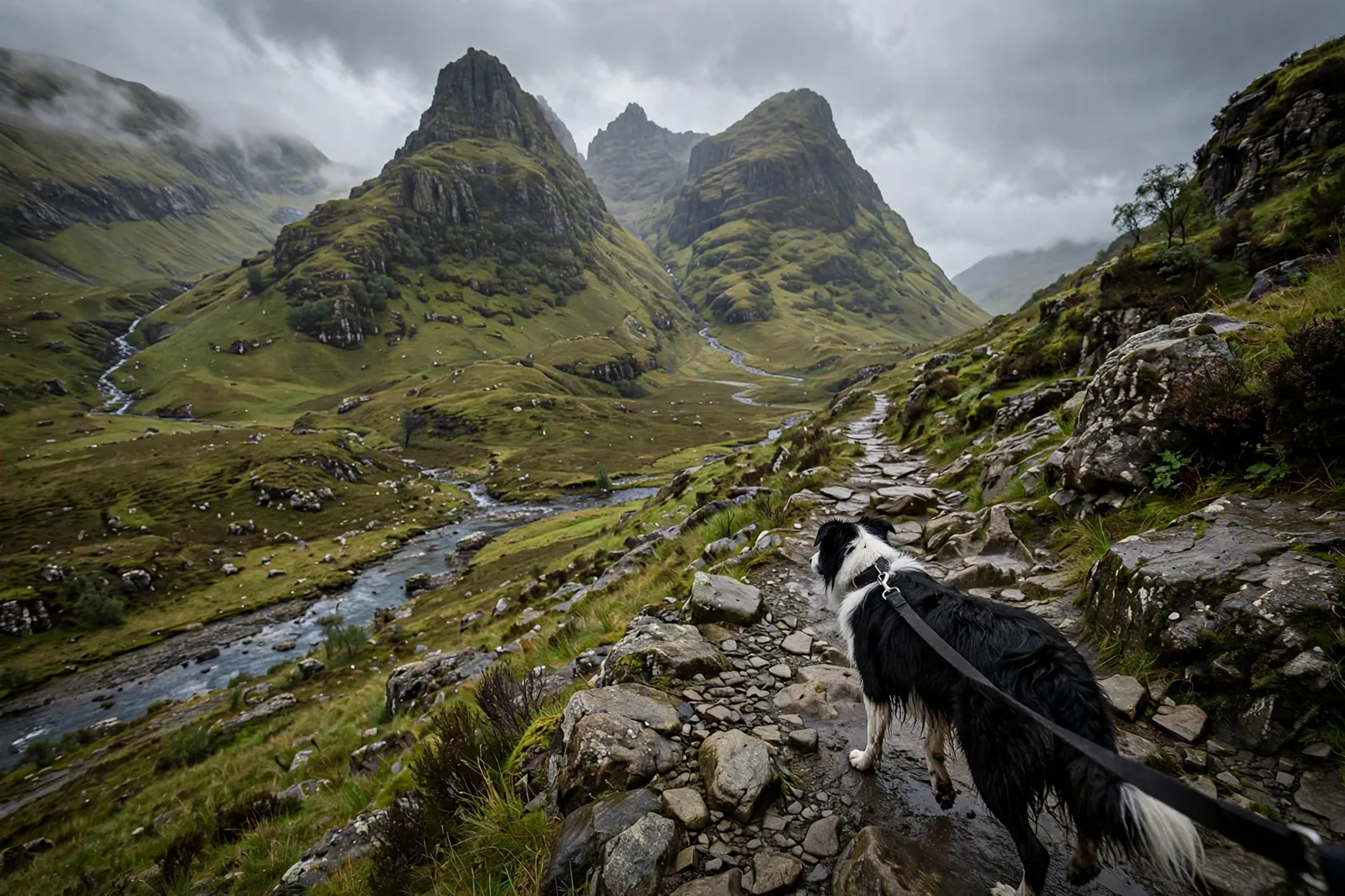
The fifth day, from Tyndrum to Bridge of Orchy and on to Kingshouse, crosses the edge of Rannoch Moor and is one of the finest days on the route, with huge open views and a real sense of wilderness. The sixth day, from Kingshouse over the Devil's Staircase to Kinlochleven, is the most dramatic, with a steep climb and a long descent into the village. The final day, from Kinlochleven to Fort William, is a long and tiring finish, with a climb over the Lairigmor and a descent into the town. Each stage has its own character, and the dog's day will be shaped by the ground, the weather and the distance in roughly that order.
There are shorter variants and rest-day options at several points along the route, and they are worth knowing about. The stage from Drymen to Balmaha can be split, the stage from Rowardennan to Inverarnan can be shortened by taking a ferry across the loch, and the final stage can be split at Kinlochleven. A walker who is flexible about the stages will have a far better trip than one who is locked into a rigid plan, and the dog will benefit most of all from that flexibility.
Midges: the season and the defence
Midges are the West Highland Way's most famous hazard, and they deserve to be taken seriously. The Highland midge is a tiny biting fly that appears in huge numbers from late May to September, especially at dawn and dusk, in calm weather, near lochs and in sheltered glens. A walker can be bitten dozens of times in a few minutes, and a dog can be bitten around the ears, the belly, the eyes and any thinly haired skin. The bites are itchy and uncomfortable, and a dog that is badly bitten can become distressed and reluctant to settle.
The defence is a combination of timing, clothing and repellent. Walking in May or late September avoids the worst of the season, and walking in a breeze or in rain is far better than walking in calm, still air. A midge head net is essential for the walker, and a long-sleeved shirt and trousers are worth wearing even on a warm day. For the dog, use a vet-approved insect repellent, and check with the vet before the trip, because not all human repellents are safe for dogs. A light dog coat can protect the belly and the back, and a dab of repellent around the ears helps, though it should never be applied near the eyes.
Behaviour matters as much as repellent. Midges are worst at dawn and dusk, so plan to be walking during the middle of the day and to be indoors or in a tent with the door closed at the worst times. Avoid stopping in sheltered, damp spots near the loch, and keep moving when the midges gather. A dog that is kept moving is bitten less than a dog that is standing still, and a walker who stops for lunch in a breezy, open spot will be far more comfortable than one who stops in a still hollow by the water. If the midges are bad, a short day is better than a long one, and a day spent in a hostel with a good book is not a wasted day.
It is worth saying plainly that the midge season is the single biggest reason to choose May or late September for this trail. The weather in May is often excellent, the days are long, and the midges have not yet arrived in force. Late September is similar, with the added advantage of autumn colours and quieter paths. June, July and August are the warmest months, but they are also the midge months, and a dog owner who walks then should be prepared for the reality of it.
Lochside campsites and hostels
Accommodation on the West Highland Way is a mix of campsites, hostels, bunkhouses, bed and breakfasts and small hotels, and the choice shapes the trip. Campsites are the cheapest option and the most flexible for a dog walker, and several along the route are well set up for walkers, with drying rooms, hot showers and a pub nearby. Dogs are usually welcome on campsites, on a lead, though some sites restrict dogs from the shower blocks and the play areas. Check the rules when you book, and book in advance in summer, because the popular sites fill up.
Hostels and bunkhouses are the next step up, and they are particularly useful on this route because they offer a bed, a drying room and a kitchen for a modest price. Several of the hostels along the West Highland Way accept dogs, though usually only in certain rooms or in a designated area, so check when you book. A hostel with a drying room is worth its weight in gold after a wet day on Rannoch Moor, and a hostel kitchen lets you cook a proper meal for yourself while the dog eats its normal food in peace.
Bed and breakfasts and small hotels are the most comfortable option, and many of them welcome dogs, though the dog-friendly rooms are limited and book up early. When you book, ask the questions that matter: is there a charge per dog, can the dog stay in the room, is there a secure place for a last outing, and is there somewhere to dry a wet dog? A host who answers clearly has thought about dogs; a host who is vague probably has not. Book the whole route before you leave, and confirm each stay in writing with the dog noted on the booking.
Wild camping is a separate subject, and it is covered in the next section, because the rules on the West Highland Way are specific and important. The short version is that wild camping is allowed in most of Scotland under the right of responsible access, but the Loch Lomond shore is a special case with permits and designated pitches. Do not assume that you can camp anywhere; check the rules for each night before you set off.
Loch Lomond and the camping rules
Loch Lomond is the most beautiful and the most regulated part of the West Highland Way. The east shore of the loch, from Drymen to Inverarnan, is a camping management zone, which means that camping is only allowed in designated pitches with a permit, and only between March and September. The permits are limited in number, they must be booked in advance, and they cost a small fee. Camping outside a designated pitch in the management zone can result in a fine, and the rangers do patrol. Check the official guidance before you travel for the current permit rules, because they are reviewed and changed.
For a dog owner, the Loch Lomond rules have practical consequences. The designated pitches are limited, and they book up quickly in summer, so a walker who plans to camp on the loch shore should book the permit as soon as the booking opens. The alternative is to stay in a hostel, a campsite or a bed and breakfast at Rowardennan or Inverarnan, which is often the simpler option. Dogs are welcome at most of the lochside stays, on a lead, though the rules vary, so check when you book.
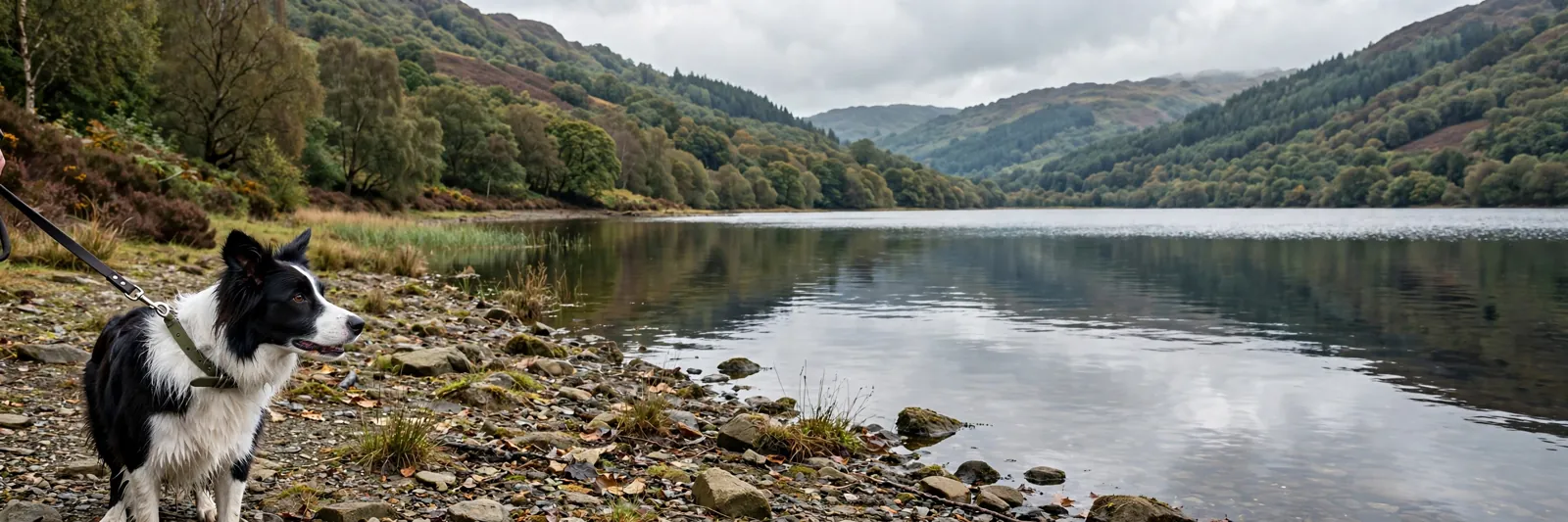
The loch itself is a delight and a hazard in equal measure. The water is cold, even in summer, and the shore is rocky in places. A dog that swims in the loch should be kept away from boats and from any area with a blue-green algae warning, and after a swim, rinse the dog with fresh water if you can. The lochside path is narrow and rough in places, and the dog should be on a lead where the ground drops to the water. The views across the loch to the mountains are superb, and the path is at its best in the early morning, before the day walkers arrive.
Our guide to Loch Lomond with a dog covers the loch's beaches, boats, walks and camping permits in more detail, and it is worth reading before you plan the lochside stages, because the rules and the facilities change with the season.
Supplies in the Highlands: shops are few and far between
The West Highland Way passes through a string of small settlements, and the shops in them are small too. Milngavie has a supermarket, Drymen has a village store, Balmaha has a shop that opens in season, Tyndrum has a couple of places to buy food, and Kinlochleven has a small supermarket, but between those points there are days with nothing to buy at all. The habit that saves a Highland walk is to shop the day before a gap, not the morning of it. Before you leave home, draw a line on the map under every shop, note the days with no shop, and carry enough for the longest gap plus a spare day. A dog that runs out of food on Rannoch Moor is a problem with no easy answer.
A walking dog eats noticeably more than it does at home, and on a cold, wet Highland day the extra can be a third or more. Divide the food into one labelled bag per day before you set off, so that a tired evening never becomes a guessing game, and stick to the food the dog already knows. A new diet on a long walk is a dependable way to upset a stomach, and an upset stomach on a trail with no vet for miles is a miserable thing. Luggage couriers will carry the bulk of the food in the transferred bag, but a full day's ration should always ride in your own pack, in case the courier is held up by weather or a closed road.
Drinking water is less of a worry here than on the English moors, because the burns run clear and cold and the lochs are never far away. Even so, carry a litre for the dog and a litre for yourself, and fill up at every pub, hostel, campsite and village tap. Burns that run fast over stones are generally fine to drink from, but still pools in warm weather can carry blue-green algae, and any water that runs through farmland should be treated with suspicion. Offer the bottle water first, and let the dog drink from a burn only when it is clear and moving. If a pool looks green or smells stale, keep the dog out of it altogether.
Keep the feeding routine steady across the whole week. A main meal an hour before the morning start, a small top-up of the usual kibble at lunchtime with water, and the evening meal an hour after the walking ends, works better than large, irregular feeds. Deep-chested dogs are at particular risk of bloat if they exercise on a full stomach, so the hour before and the hour after walking matter more than the food itself. A dog that is watered at every stop, rather than only when it looks thirsty, will keep going longer and recover faster overnight.
Reading Highland weather before it reads you
The single most useful habit on the West Highland Way is to check the Mountain Weather Information Service forecast every evening, and then to check it again in the morning. The general forecast for the nearest town tells you very little about conditions on Rannoch Moor or on the Devil's Staircase, where the wind is stronger, the rain is heavier and the temperature is several degrees lower. The mountain forecast gives wind speed at height, freezing levels and visibility, which are the numbers that decide whether a day is enjoyable or miserable. Learn to read those numbers before the trip, and the trail becomes far less surprising.
Wind is the weather that most often ruins a Highland day. On the open moor, a forecast of 40 miles an hour at height means gusts that can knock a small dog sideways and make a walker lean into every step. A dog on a lead in that wind is a sail as well as a companion, and the lead becomes a line that transmits every gust to your arm. On the worst days, the sensible choice is to drop off the high ground and walk a sheltered glen path instead, or to take a rest day in a hostel. There is no prize for walking into a gale with a frightened dog, and the moor will still be there tomorrow.
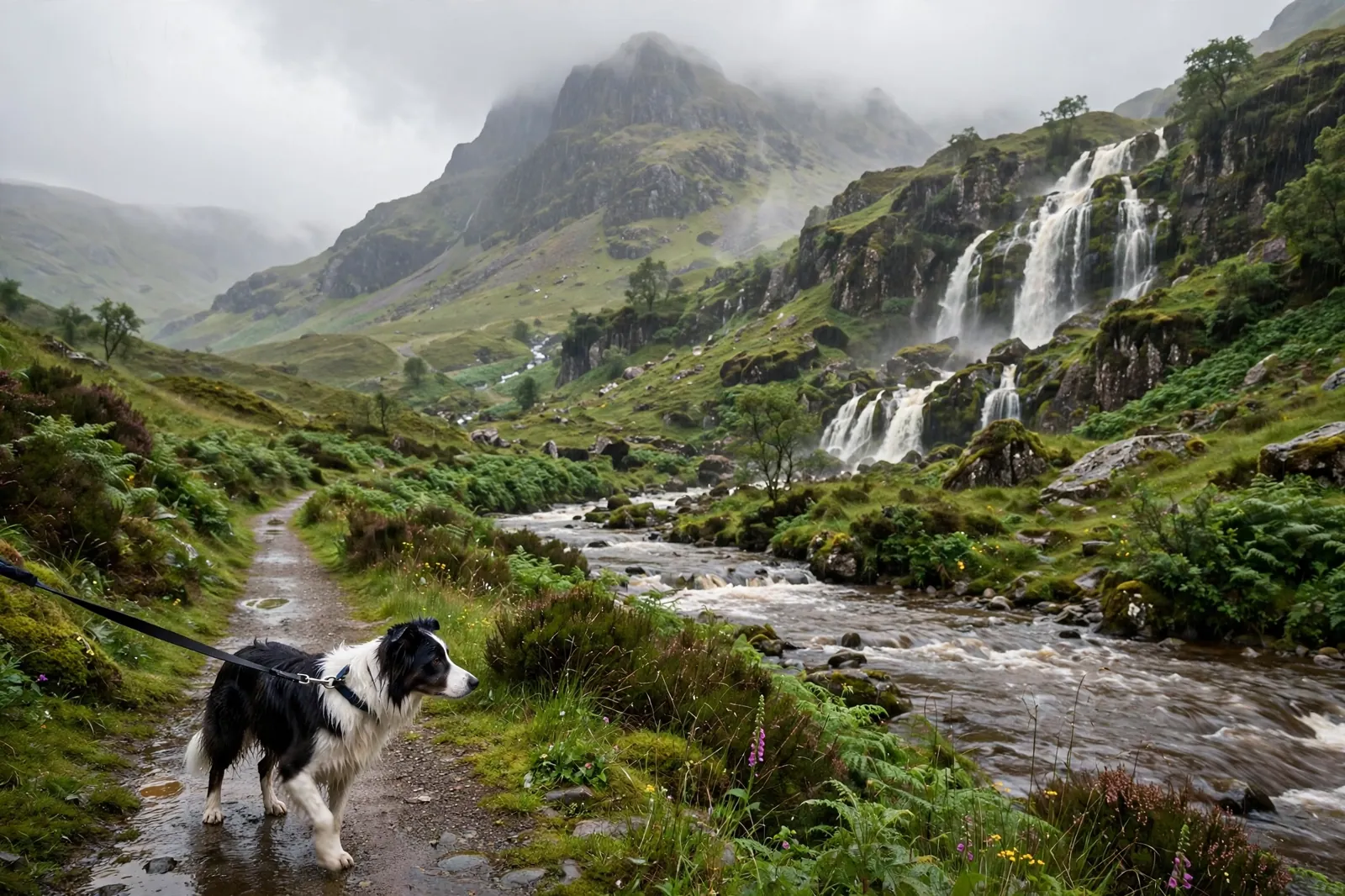
Rain in the Highlands is rarely a short shower. It arrives as weather that settles in for hours, soaking through jackets that looked waterproof in the shop and turning paths into streams. The defence is not a better jacket alone, though a good one helps; it is a system. Waterproofs over layers that stay warm when wet, a dry bag inside the pack for spare clothes and the dog's food, a towel for the dog at the end of the day, and a drying room at the night's stay. A dog that is dried properly in the evening will start the next morning willingly; a dog that sleeps wet and cold will not.
Cold is the quiet risk, because it creeps up on a wet dog that is standing still. A dog that stops for a rest on a windy moor loses heat quickly, and a small or short-coated dog can start shivering within minutes. Keep breaks short on exposed ground, keep the dog moving, and put its coat on before the stop rather than after it. Carry extra food for cold days, because a working dog burns more fuel to stay warm, and offer water even in the rain, since a panting dog still needs to drink. If the dog is shivering, get it moving or get it inside; do not wait to see if it warms up on its own.
Getting a dog ready for the Highlands
The West Highland Way asks a dog to do something it has probably never done before: walk 12 to 16 miles a day, day after day, over rough ground, in weather that changes by the hour. The preparation starts at least two months before the trip, and it starts gently. Add a mile or two a week to the longest regular walk, and add hills as soon as the distance allows, because the climbs on this route are what tire a dog, not the flat miles. A dog that has trained on hills will cope with the Devil's Staircase; a dog that has only ever walked flat park paths will find it a shock.
Rough ground is the second part of the training. The lochside path north of Rowardennan is rocky and uneven, the moor is soft and boggy, and the descents into Glencoe are steep and loose. A dog whose paws have only met pavement and short grass will be sore within a day or two. Walk the dog on rocky paths, on wet grass and on forest tracks during training, and check the paws after every walk for cracks, redness between the toes and small cuts. A paw balm at the end of the day, applied before the dog settles for the night, does more good than any bootie worn in a panic the next morning.
Rest days are not wasted days. On the trail, a short day or a full rest after every three or four walking days lets the dog's muscles recover and its paws harden, and the same is true in training. A dog that is walked hard every day for a month before the trip will arrive at Milngavie stale and tired, not fit. Watch for the signs that the dog has had enough: slow to start in the morning, lying down at every stop, a stiff walk after a night's rest. Those are signals to shorten the day, not to push through.
Manners matter as much as muscles on this trail. A dog that walks calmly on a narrow lochside path, that settles under a pub table, and that comes back when called on open moor will be welcome everywhere it goes. Practise the lead work on narrow paths, practise recall where it is safe, and practise settling in busy places, because the West Highland Way will test all three. The dog that enjoys the Highlands most is not the fittest dog on the trail; it is the one that walks steadily, rests well and is welcome at every stop.
A sample seven-day plan
A realistic seven-day plan for the West Highland Way with a dog might look like this: day one from Milngavie to Drymen, a gentle 12 miles to settle into the rhythm. Day two from Drymen to Rowardennan, over Conic Hill and along the loch shore. Day three from Rowardennan to Inverarnan, the long, rough lochside day, taken slowly. Day four from Inverarnan to Tyndrum, a gentler valley walk and a chance to resupply. Day five from Tyndrum to Kingshouse, across the edge of Rannoch Moor. Day six from Kingshouse over the Devil's Staircase to Kinlochleven. Day seven from Kinlochleven to Fort William, the long finish.
This is a demanding week, and it should be adjusted to the dog in front of you. A young, fit dog might manage it comfortably; an older dog might need an extra day, splitting the longest stages and adding a rest day at Tyndrum or Kinlochleven. The point is the shape of the week: a gentle start, a steady build, a recovery day in the middle, and a finish that leaves something in reserve. Book the stays first, then fit the walking to the stays, and leave a spare half-day at the end for transport delays or a day lost to weather.
Before you commit to any itinerary, check the official guidance before you travel for the current state of the route, the camping permits and the ferry across Loch Lomond, because the ferry timetable changes with the season and a ferry that does not run can add several miles to a day. The same applies to the pubs and cafes you plan to rely on for water and lunch: many Highland businesses close in winter or open only at weekends, so a phone call the day before is cheap insurance.
One more practical point: the West Highland Way is a popular trail, and the overnight stops can be busy in summer. A walker who books late may find that the dog-friendly rooms and the campsite pitches are gone, and that the only option is a long detour. Book early, confirm in writing, and keep the confirmations with you. A week that is booked well is a week that can be enjoyed, rather than a week spent worrying about the next bed.
Packing light for a wet Highland trail
Every gram on the West Highland Way is carried up a hill at some point, so the packing rule is to take what the weather demands and nothing else. Start with the waterproofs, because they are the one item you will use almost every day: a jacket and trousers that keep the rain out, and layers underneath that stay warm when they get damp. Wool and synthetic layers work; cotton does not, because it holds the cold once it is wet. A hat and gloves belong in the pack even in June, because the wind on Rannoch Moor is cold in any month, and a head torch belongs there too, for the short days of autumn and for any day that runs late.
The dog's kit fits in a corner of the same pack. A harness that does not rub after six hours, a lead you can hold comfortably in the rain, a spare lead in case the first one breaks, a bowl that folds flat, a litre of water, the day's food in a labelled bag, poo bags, a towel, and a coat for the cold and the wet. A paw balm for the evening, a few booties in case of a cut pad, a tick remover, and a small first-aid kit complete the list. Ticks are common in the bracken from spring to autumn, so arrange a vet-recommended treatment before you leave, and make the evening check of ears, armpits and toes a habit, not an afterthought.
Midges need their own corner of the pack. A head net for the walker is the single most valuable item in summer, worth more than any repellent, because it lets you eat lunch and walk in peace. Long sleeves and trousers help, and a repellent approved by your vet protects the dog's ears and belly, though it should never be used near the eyes. A light coat can shield the dog's back and belly, and the best defence of all is timing: be walking in the middle of the day, and be inside with the door shut at dawn and dusk, when the midges are at their worst.
Navigation kit is the last item, and it is the one that matters most when the weather closes in. A paper map and a compass, with the skill to use them, are worth more than any phone, because a phone's battery dies and its signal vanishes on the moor. Download offline maps as a backup, carry a power bank in a dry bag, and keep the phone in a waterproof case. And know where the nearest road is on every day, so that a taxi can reach you if the dog cannot walk further. A trail walked with a way out is a trail walked with confidence.
For the valley walking that follows this trail, our guide to Glencoe walks with a dog covers the valley and lochside routes around the end of the Way, with lead rules near livestock, weather checks and safer alternatives to the summits.
Practical questions
Before you go
Can dogs walk the West Highland Way?
Yes, provided the dog is a healthy adult in good condition. The trail is 96 miles of waymarked path from Milngavie to Fort William, usually walked in 6 to 8 days. A lead is needed near farm animals and along the Loch Lomond shore, where camping is restricted. Check the official guidance before you travel for the latest camping rules and any changes to the route.
How bad are midges for dogs on the West Highland Way?
From late May to September, midges can be a real torment for both ends of the lead, worst at dawn and dusk beside lochs and in sheltered glens. Dogs tend to be bitten on the ears, belly and around the eyes. Ask your vet for a suitable repellent, carry a head net for yourself, and keep walking through the worst hours rather than standing still. A trip in May or late September sidesteps the peak of the season.
Where can I camp with a dog on the West Highland Way?
Scotland's right of responsible access allows wild camping in most places, but the east shore of Loch Lomond is different: it is a camping management zone, so a permit is required and only designated pitches may be used. Campsites on the route take dogs, normally on a lead, and a number of hostels and bunkhouses do too. Reserve ahead in summer, and check the official guidance before you travel for the current permit rules.
How long does the West Highland Way take with a dog?
The usual time is 6 to 8 days, at 12 to 16 miles a day. Dogs do best with 7 to 8 days plus a rest day, since the crossing of Rannoch Moor is long and exposed and the last descent into Fort William is punishing on tired legs and paws. Plenty of dog owners divide the walk into two shorter holidays, breaking it at Tyndrum or Bridge of Orchy.
Is there a baggage transfer service on the West Highland Way?
Yes. A handful of companies move bags along the whole route, picking them up from one night's stay and dropping them at the next. Arrange the full sequence before you leave, make sure every stay is on the courier's route, and keep the dog's food and medicine in your own day pack. On this trail, where the stages are long and the ground is rough, walking light makes a real difference.
When is the best time to walk the West Highland Way with a dog?
May and late September are generally the sweet spots: long daylight, settled conditions and very few midges. The summer months are warmer but bring the worst of the midges and the busiest paths. Winter is possible yet demanding, with short days, snow on the high ground and many places shut. In any season, check the official guidance before you travel, and carry a map and a dog coat.