This guide is independent and contains no paid placement. If affiliate links are added later, they will be clearly marked and will not change our editorial checks.
West Witton is a small riverside village in Wensleydale, and the River Ure is the reason to come with a dog: a level riverside path, quiet village lanes, shallow paddling edges in settled weather, and an easy two-mile walk east to East Witton. Keep dogs on a lead near livestock and the river in spate, and treat the water with respect after rain.
Start at the river, not the green
Most Wensleydale villages are walked from the centre outwards. West Witton works better the other way round. The village sits low in the dale on the northern bank of the River Ure, and the water is the thread that ties the whole place together: the meadows, the lanes, the bridges and the paths to the neighbouring villages all make more sense once you have seen the river first. So the sensible plan for a dog visit is to head for the bank, read the water, and let the river decide what kind of day it will be.
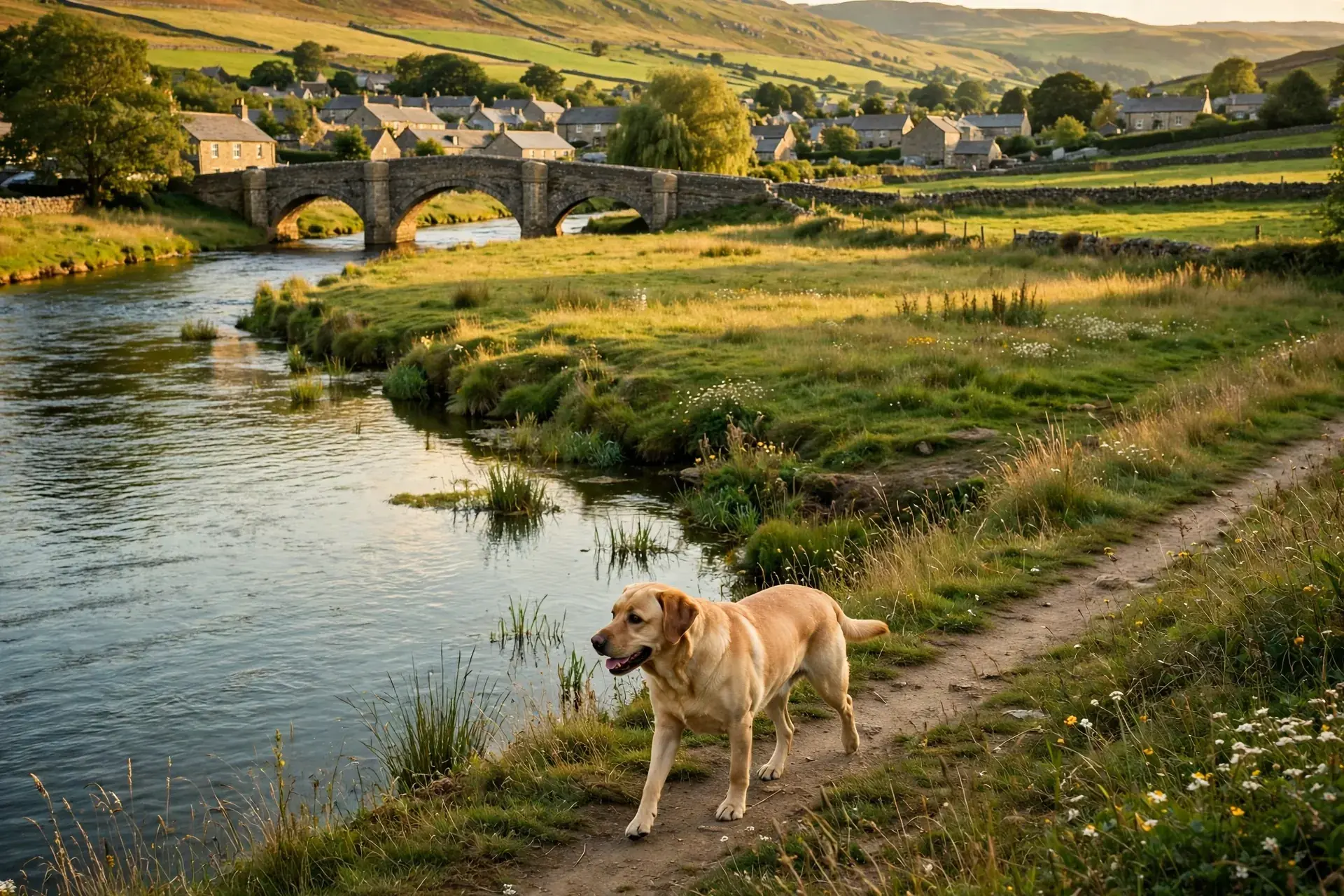
On a calm day the Ure here is a wide, unhurried river sliding between green water meadows, with gravel edges, grassy banks and the stonework of a bridge breaking the skyline. Dogs notice the difference immediately: the smells change, the ground softens underfoot, and there is open space to move in without the stop-start of a busy street. On a wet day the same river is a different animal altogether, brown and quick, pushing against its banks and covering the low paths. Both versions are part of the place, and a good visit to West Witton means planning for the river you actually find, not the one in the photograph.
That is the first practical point of this guide. Before you unclip the lead or settle into a picnic, spend five minutes looking at the river. Is the water clear or cloudy? Is it running at its usual level, or lapping high against the bank? Are the gravel edges exposed or underwater? A dog that paddles happily in a calm, shallow edge can be in real difficulty in a fast current, and the Ure is a spate river: heavy rain on the high fells can lift it noticeably within hours, even when the sky above the village looks fine. If anything about the water looks unfamiliar, keep the dog on the bank, on a lead, and enjoy the walk instead of the swim.
The second point is about pace. West Witton is not a village of attractions to tick off. There is no castle, no market square crowded with stalls, no long high street to work through. What it offers is the opposite: a quiet place where a dog can walk, sniff, paddle and rest without the pressure of a busy destination. Visitors who arrive expecting a market town will be disappointed; visitors who arrive expecting a riverside morning will find exactly what they came for. Plan the day around one good walk, one long rest and perhaps a short second outing, rather than a packed itinerary.
This guide follows that shape. It starts with the riverside path, moves through the village lanes, covers picnics and paddling safety in detail, then walks east to East Witton and looks at longer routes into the wider dale. It also covers the practical questions that matter more in a small village than in a town: where to park, where to stay, where to eat, and how the seasons change the ground under your dog's paws. Where a detail is uncertain or changes with the weather, the guide says so and asks you to check the official guidance before you travel.
The River Ure riverside path
The riverside path is the heart of a dog visit to West Witton. It is a public footpath along the valley floor, mostly level, following the river through water meadows and riverside grass. The walking is easy on the legs and easy on most dogs: there are no long climbs, no exposed edges for much of its length, and the surface is a mix of short grass, worn earth and gravel that suits a steady walking pace. The reward is the river itself, always close by, with kingfishers, herons and wagtails working the banks, and the fells of Wensleydale rising on both sides of the valley.
Start by choosing your direction. Upstream, towards the west, the river runs towards Aysgarth and its famous falls, and the path takes you through open meadows with long views back over the village rooftops. Downstream, towards the east, the river leads towards East Witton and on towards Wensley and Leyburn, with the valley gradually opening out. Neither direction is better in itself; the choice depends on the dog in front of you. A young, energetic dog may enjoy the longer pull west, while an older dog or a puppy may be happier with a short out-and-back stretch to the east, with a rest on the bank in between.
Lead discipline matters along the whole path. The riverside meadows are working farmland, and sheep and cattle graze the fields beside the river for much of the year. The rule is simple: your dog stays on a lead whenever livestock are in the same field or visible nearby, and you keep to the marked line of the footpath. A long line is a useful compromise on the open stretches: it gives a sniffy dog room to explore while keeping you in control if a sheep appears around a bend or a pheasant bursts out of the bankside cover. Close gates behind you, every time, without exception. A gate left open in a riverside meadow is a genuine problem for the farmer, and it is the single easiest way for a dog walker to cause trouble.
Stiles and bridges deserve attention too. The riverside route crosses field boundaries with stiles and small footbridges, and some of these are awkward for large, stiff or very small dogs. Lift a small dog over a stile rather than letting it scramble, and give an older dog time and a steady hand on the steps. Narrow footbridges with gaps in the planking can worry dogs that dislike seeing water below their feet; if your dog balks, do not drag them across. Walk back and find a wider crossing, or turn the walk there. A dog that is frightened on a bridge once may refuse the next one too.
The surface changes with the weather more than the distance does. After rain, the low-lying stretches beside the river hold water and turn to mud, and the grass becomes slippery on the bank slopes. Waterproof walking boots, a drying coat for the dog and a towel in the car turn a muddy walk from a chore into a normal part of the day. In dry summer weather the same path is firm and fast, but the exposed stretches offer little shade, so carry water for the dog and plan a rest in the shade of a riverside tree rather than pushing on through the hottest part of the afternoon.
Wildlife is part of the riverside experience, and it needs a little management. The Ure supports a healthy population of water birds, and a dog that chases ducks or swans can cause real distress and, in the case of a swan, a real risk to the dog. Keep the dog close where birds are feeding on the water, and be particularly careful in spring and early summer when ducklings and goslings are on the river. The same applies to the smaller life of the bank: voles, rabbits and the occasional deer move through the meadows, and a dog with a strong chase instinct should stay on a lead in the sections where the path runs close to cover.
Village lanes and the quiet core
Once you have walked the river, the village itself deserves a slow loop. West Witton is a small, stone-built settlement, and its lanes are narrow, quiet and lightly trafficked, which makes them well suited to walking a dog on a short lead. The houses are a mix of traditional Dales stone cottages and more recent buildings, with gardens, dry-stone walls and the occasional glimpse of the fells between the rooftops. It is the kind of village where the walk is the point, rather than a route between sights.
Start the loop from the riverside end of the village and work your way through the lanes at the dog's pace. Let the dog sniff the walls and gateways, pause at the field ends, and take the time to look at the village properly. The church of St Bartholomew stands in the village and is worth a slow pass, and the village hall and the green spaces between the lanes give the walk its shape. There is nothing to rush towards, and that is precisely the appeal: a dog that has spent the morning on the river can settle into a calm village loop without the stimulation of traffic, crowds or a busy high street.
Traffic is light but not absent, so keep the dog on a short lead on the lanes themselves. Farm vehicles use the village roads, and tractors, delivery vans and the occasional car can appear around bends with little warning. The lanes have limited pavements, so walk on the side facing oncoming traffic where there is no footway, and keep the dog on your inside, away from the road. At junctions and field entrances, shorten the lead and check both ways before crossing, exactly as you would in a town, because a quiet road is still a road.
Respect for residents matters in a village of this size. Keep dogs off private gardens and out of driveways, pick up after your dog everywhere, and carry bags for the whole walk rather than assuming there will be a bin at the next corner. West Witton is a working village, not a visitor attraction, and the people who live there notice the difference between walkers who treat the lanes as a shared space and those who treat them as a playground. A dog that is calm, controlled and cleaned up after is welcome anywhere; a dog that barks at garden gates or fouls a verge is remembered.
The village loop also works as a wet-weather fallback. When the riverside path is waterlogged or the river is high, the lanes stay passable long after the meadows have turned to mud. A circuit of the lanes, with a short stretch of the higher ground at the edge of the village, gives a dog a proper walk on a day when the river is out of bounds. It is worth knowing this before you arrive, so that a rainy morning does not mean a cancelled day: change the route, not the plan.
Riverside picnics and paddling safely
A riverside picnic is one of the simplest pleasures of a West Witton visit, and it suits dogs particularly well. There are grassy banks where a family can spread a blanket, a dog can settle on a mat in the shade, and everyone can watch the river go by. The key is to choose the spot with the dog in mind, not just the view: a flat, dry patch of grass a little back from the bank edge, with shade nearby and a clear line of sight to the dog at all times.
Pick a spot where the bank is gentle and the water is shallow at the edge. Avoid steep banks where a dog could slip in and struggle to climb out, and avoid places directly below a bridge or a weir, where the current can be deceptively strong. The best paddling spots are the gravel shallows where the water runs ankle-deep over stones and the dog can walk in and out under its own power. Let the dog choose whether to enter the water. A dog that walks in willingly and stands in the shallows is telling you it is comfortable; a dog that hangs back at the bank is telling you it is not, and should not be carried in or encouraged with thrown sticks.
Water safety on the Ure deserves a frank paragraph, because this is where a relaxed day can turn serious. The river is a spate river, which means its level and speed can change quickly after rain on the fells, even when the weather over West Witton looks settled. The water can also be cold, even in summer, and a dog that swims hard in cold water can tire faster than its owner expects. The bed of the river is uneven, with slippery stones, sudden drops and submerged branches. For all these reasons, the sensible rule at West Witton is paddling, not swimming: let the dog wade at the edges, keep a long line attached in all but the calmest shallows, and stay out of the main channel entirely.
Never let a dog swim below a weir, near a bridge pier, or in water that is brown, fast or rising. Do not throw sticks or balls into the current, because a dog that chases a toy into moving water will follow it further than is safe. After heavy rain, skip the water altogether and walk the bank instead. And if the dog does go in, watch for the signs of cold and tiredness: shivering, a reluctance to move, or a dog that has stopped enjoying itself. Dry the dog promptly, offer water to drink, and let it rest in the sun or under a drying coat before walking on.
There are other water hazards worth knowing about. Standing water in the meadows after rain can carry the bacteria that cause leptospirosis, and dogs that drink from stagnant pools or swim in them can be exposed, so discourage drinking from puddles and slow-moving ditches, and keep vaccinations up to date; your vet can advise on the current recommendations. Blue-green algae can appear in slow, warm water in summer, and it is toxic to dogs: if you see a blue-green scum or paint-like film on the water, keep the dog out entirely and do not let it drink. If a dog does drink or swim in water you later suspect was contaminated, contact your vet promptly and describe what happened.
For the picnic itself, pack with the dog as a member of the party. Bring the dog's own water and bowl, because river water is not a reliable drinking supply, and bring food and treats in sealed containers so the smells do not attract wasps or other dogs. A mat or blanket for the dog gives it a place to settle and a boundary to return to, which helps a restless dog relax. Bring bags for waste, and take everything away with you, including food scraps: a riverside meadow is farmland, and leftover food can attract rats and can be harmful to livestock. Leave the spot exactly as you found it, and the next walker will have the same pleasure you did.
West Witton to East Witton
The walk east to East Witton is the natural extension of a West Witton visit, and it is the link that turns a village stop into a proper half-day walk. The two villages share a name, a dale and a river, but they feel different on foot: West Witton faces the river and the open meadows, while East Witton sits a little further along the valley floor, with its own lanes, church and village character. Walking between them gives a dog a satisfying, mostly level route with a clear destination and a reason to turn around.
The route is roughly two miles each way, following the valley lanes and field paths along the floor of Wensleydale. It is mostly level, which makes it a good choice for dogs that cope well with a steady hour or two of walking but would struggle with a steep fell climb. Allow two to three hours for the round trip at a comfortable pace, including stops for sniffing, a riverside break and any stiles. Dogs that are used to a daily hour-long walk will manage it easily; dogs that normally walk for twenty minutes will need a slower pace and more rests, so build those in from the start rather than discovering the dog is tired halfway home.
Navigation is straightforward but worth preparing for. Carry a map of the area, whether on paper or on a charged phone, and check the official guidance before you travel if you plan to follow a particular path, because field paths can be diverted around farm work and stiles can be moved or repaired between seasons. Waymarks are generally clear, but the valley floor has a network of field paths and farm tracks, and it is easy to take a parallel track that leads to a farmyard rather than the next village. When in doubt, retrace your steps to the last clear marker rather than pushing on and hoping the path reappears.
The walking itself is a pleasure. The route passes through water meadows and riverside grass, with dry-stone walls, hedgerows and the river never far away. In spring the meadows fill with wildflowers, in summer the hedges are thick with birdsong, and in autumn the trees along the river turn and the valley takes on a quieter, golden character. There are places to pause and let the dog rest in the shade, and the low, level ground means you can keep a steady rhythm without the stop-start of a hilly route. For a dog that likes to walk rather than climb, this is one of the best stretches of the dale.
East Witton itself is a good turning point. It has its own village lanes to explore, a church, and a quieter, slightly more tucked-away feel than its western neighbour. There is no need to rush the return: let the dog rest, offer water, and take a different line back if the paths allow, so the return journey feels new rather than a repeat. If the dog is flagging, shorten the day by turning back at the first convenient point rather than pressing on to the village; the walk is the reward, not the destination.
One practical note: the route between the villages is rural, with limited facilities along the way. There are no shops or cafes on the path itself, and mobile signal can be patchy in the valley, so carry water, food and a basic first-aid kit for the dog, and let someone know your route if you are walking alone. The villages themselves have limited services, so stock up in Leyburn before you set out. A well-packed day bag is the difference between a comfortable walk and a walk that ends early because the dog is thirsty or the owner is hungry.
Longer Wensleydale trails from the village
West Witton makes a good base for longer walks into Wensleydale, because it sits in the middle of the dale with routes running in both directions. To the west, the river path leads towards Aysgarth and its waterfalls, roughly four miles away, and the walk there is one of the classic dog outings of the dale: a level riverside route through meadows and woodland, ending at a famous set of falls where the river drops over limestone steps. The falls themselves are a place for looking, not paddling, and dogs should be kept on a lead and well back from the water at the falls, where the current is strong and the rocks are slippery.
To the east, the valley opens towards Wensley and Leyburn, the market town that acts as the dale's centre, roughly three miles from West Witton. The walk east is gentler and more pastoral, through meadows and riverside fields, and it pairs naturally with a visit to the town: a walk in, a look around the market square and the shops, and a walk back, or a lift back if the dog has had enough. Leyburn is the place to go for supplies, a cafe stop and a wider choice of dog-friendly pubs, and our guide to Leyburn with a dog covers the town's walks, lead rules and places to stay in detail.
Further afield, Hawes, at the head of the dale, makes a good driving destination for a longer day out. The market town there offers cheese shops, waterfalls within walking distance and a network of fell and riverside paths, and the drive up the dale from West Witton is itself part of the experience, following the river through village after village. Hawes is a fuller day than a walk from West Witton, so plan it as a separate outing rather than an extension of a riverside morning, and read our guide to Hawes with a dog before you go.
For walkers who want a bigger challenge, the fells above the valley offer high routes with wide views, but these are a different kind of walk from the riverside paths, and they need a different level of preparation. Fell walking means steep climbs, exposed ground, unpredictable weather and long stretches without shelter or water, and it is only suitable for fit, experienced dogs and owners who are comfortable navigating in poor visibility. Check the official guidance before you travel, carry a map and compass as well as a phone, and be ready to turn back if the weather closes in. The valley-floor walks from West Witton are the right choice for most dogs on most days; the fells are there for the days when both dog and owner are ready for them.
Whatever the length of the walk, the same principles apply. Start early in summer to avoid the heat of the afternoon, and start late in winter so the frost has lifted and the paths are less slippery. Tell someone your route on a longer walk, carry more water than you think you need, and build in a rest at the halfway point. A dog that walks happily for two hours and then rests is a dog that will walk happily again tomorrow; a dog that is pushed to exhaustion on a single long walk may be stiff and reluctant the next day. The dale rewards patience, and the best walks are the ones that leave the dog wanting more.
Where to stay with a dog
Staying in or near West Witton with a dog means choosing between a quiet village base and a larger town with more choice. West Witton itself has a small number of holiday cottages and farm stays, and these suit visitors who want a peaceful base with a garden and a short walk to the river. Cottages in the village tend to book early for school holidays and summer weekends, so plan ahead if your dates are fixed, and always confirm the dog policy in writing: the number of dogs allowed, any size or breed conditions, whether dogs can be left alone in the property, and whether there is an enclosed garden or a charge for pets.
Leyburn, a short drive east, offers a wider range of dog-friendly accommodation, from cottages and bed and breakfasts to small hotels and self-catering apartments, and it is the practical choice for visitors who want shops, pubs and a choice of walks within easy reach. Staying in Leyburn and driving or walking to West Witton for the day gives you the best of both: a lively base and a quiet riverside village a few miles away. The same applies to the smaller villages along the dale, where farm stays and cottages often welcome dogs and give easy access to the riverside paths.
Whatever you book, ask the right questions before you pay. Is there a secure, enclosed area where the dog can be let out last thing at night? Is the garden fenced, and how high is the fence? Are dogs allowed on the furniture, or should you bring the dog's own bed? Is there a hose or an outdoor tap for washing muddy paws, and is there somewhere to dry a wet dog out of the rain? These details matter far more than the photographs, and a host who answers them clearly is usually a host who has thought about dogs properly.
For visitors who prefer a touring or camping base, the wider Wensleydale area has dog-friendly caravan and campsites, and our guide to dog-friendly holiday parks in the UK covers the questions to ask about pitches, boundaries and shared facilities. A riverside pitch with a short walk to the Ure can be a lovely base for a dog, but check the site rules on leads, noise and leaving dogs unattended, and remember that a tent or caravan offers less shelter from the weather than a cottage, so pack accordingly.
Finally, plan the dog's routine at the accommodation as carefully as the walks. Keep feeding times and the last outing close to the pattern at home, set up the dog's bed in a quiet corner on arrival, and give the dog a familiar-smelling blanket or toy to settle with. A dog that sleeps well on the first night will walk well on the second day, and a dog that is unsettled by a new place will show it on the walk. The first hour in a new place sets the tone for the whole stay, so make it calm, boring and predictable.
Eating and drinking with a dog
West Witton is a small village, and visitors should not expect a row of dog-friendly restaurants on the doorstep. The village has limited eating options, and the honest plan is to treat food as something you arrange rather than something you stumble across. Pack a picnic for the riverside, stock up on supplies in Leyburn, and treat a pub lunch as a short drive away rather than a walk from the village green. That approach sounds less convenient than a high street full of cafes, but it suits the village: the food is better when you plan it, and the dog is happier with a riverside picnic than with a long wait outside a busy pub.
Leyburn is the natural place to eat with a dog, and it is only a few miles east. The market town has several pubs and cafes that welcome dogs in at least part of the premises, usually the bar area or a garden, and some offer water bowls and dog treats without being asked. Check the official guidance before you travel, and always confirm the current dog policy before you arrive, because the rules vary between the bar, the dining room and the garden, and a pub that welcomes dogs in the bar may not allow them in the restaurant. Our guide to Leyburn with a dog covers the town's pubs, cafes and lead rules in more detail.
When you do eat out with a dog, a little preparation makes it work. Feed the dog before you go, so it is settled rather than hungry and restless, and bring a mat for the dog to lie on, a chew to keep it occupied, and water. Choose a table at the edge of the room or in the garden, where the dog is out of the way of servers and other customers, and keep the lead short and under your chair. If the dog cannot settle, take it outside for a short walk rather than waiting for it to bark. A dog that is calm in a pub is a dog that will be welcomed back; a dog that barks at every passing tray is a dog that will not.
Further afield, the wider dale has a good range of dog-friendly pubs, particularly in the market towns and larger villages, and many of them are used to walkers arriving with muddy boots and a dog on a lead. The best of them have a dog area by the fire in winter and a garden with water bowls in summer, and they treat a well-behaved dog as a normal customer rather than a problem to be managed. Ask locally for recommendations, because pub policies change, and a recommendation from a villager or a host is usually more current than a website.
Arriving, parking and getting around
West Witton sits in the middle of Wensleydale, reached by the valley road that runs along the dale from Leyburn in the east to Hawes in the west. The drive into the village is part of the visit: the road follows the river through meadows and past stone villages, with the fells rising on both sides, and it is worth allowing extra time for the journey rather than treating it as a race to the car park. In summer, the valley road can be busy with caravans, tractors and walkers, so drive patiently and expect to pull into passing places on the narrower stretches.
Parking in the village is limited, and this is the single most important practical fact for a visitor. There is no large village car park, and the lanes offer only limited on-street parking. Arrive early on fine weekends and bank holidays, park considerately, and keep farm gates, driveways, junctions and passing places clear at all times. If the village looks full, do not squeeze into a gateway or block a field entrance: drive on to Leyburn, where parking is easier, and walk or drive back when there is space. A blocked farm gate is not a minor inconvenience; it can stop a farmer reaching livestock, and it is the kind of thing that turns a village against visitors.
Public transport in the dale is limited, and visitors should plan around the car. Buses run along the valley road between the main towns, but services are infrequent, particularly on Sundays and in winter, so check the official guidance before you travel and do not rely on a bus that runs only twice a day. The nearest railway stations are on the Settle to Carlisle line and at Northallerton, both a drive away, and the Wensleydale Railway, a heritage line, runs services in the dale in season; check the official guidance before you travel for current timetables and dog policies. For most visitors, the car is the practical way to reach West Witton and to move between the villages of the dale.
Getting around with a dog is straightforward once you are there. The village is small enough to walk everywhere, the riverside path is level, and the lanes are quiet. A car is useful for reaching the wider dale, for a wet-weather drive to a covered attraction, and for carrying the kit that a dog walk needs: water, towels, a drying coat, spare leads and a first-aid kit. Keep the car tidy and the dog's kit in one bag, so you can set off without a long search for the lead. And never leave a dog alone in a parked car, especially in warm weather: a car heats up fast, even on a mild day, and a dog left inside is at real risk.
If you are visiting as part of a longer trip through the Yorkshire Dales, West Witton works well as a quiet stop between busier places. A morning on the river here, followed by an afternoon in Skipton, the gateway town at the southern edge of the Dales, gives a good balance of quiet and bustle, and our guide to Skipton with a dog covers the canal towpath, the castle and the market town's dog-friendly spots. The contrast is the point: a riverside village in the morning and a market town in the afternoon, with the dog's needs met in both.
Seasons, livestock and ground conditions
West Witton changes with the seasons more than a town does, and the dog walk changes with it. Spring brings lambs to the riverside meadows, and the rule during lambing is strict: dogs on a short lead, on the path, at all times, with no exceptions. Lambing season typically runs from late winter into spring, and farmers are within their rights to take action against a dog that worries livestock, so this is not a rule to test. Keep the dog close, keep to the path, and enjoy the lambs from a distance.
Summer is the easiest season for the riverside path, with firm ground, long evenings and the river at its most inviting, but it brings its own risks. The exposed stretches of the path offer little shade, so walk early or late in the day and carry water for the dog. Heatstroke is a real risk for dogs in warm weather, particularly for flat-faced breeds, older dogs and dogs with thick coats, so watch for heavy panting, drooling or a dog that slows down and wants to stop. Adders live on the fells and in rough grassland in the Dales, and while bites are uncommon, a dog that sniffs in long grass or under rocks can be bitten; keep dogs on paths in adder country and contact a vet immediately if you suspect a bite. Ticks are active from spring to autumn, particularly in long grass and bracken, so check the dog after every walk, remove any ticks promptly with a tick remover, and talk to your vet about prevention.
Autumn is one of the best times to visit West Witton with a dog. The crowds thin, the trees along the river turn gold, and the air is cool enough for a long walk without the heat of summer. The ground can be slippery with fallen leaves, and the river begins to rise after the first heavy rains, so watch the water level and keep the dog back from the bank when the river is running high. Pheasant shooting takes place in the dale in autumn and winter, and dogs should be kept on a lead and under close control on shoot days, when birds and guns are both active in the fields.
Winter in Wensleydale is quiet, beautiful and demanding. Frost makes the riverside path slippery, and the river can be high and fast after winter rain. Short days mean planning walks around daylight, and a head torch is worth carrying for a late afternoon return. Ice on the river edges and on puddles can cut paws, so check the dog's feet after a walk and wash off road salt if you have driven on treated roads. A drying coat, a warm bed and a hot meal at the end of the day matter more in winter than at any other time of year.
Ground conditions deserve a final word, because they shape the walk more than the distance does. The valley floor is low-lying and the riverside meadows hold water after rain, so mud is a normal part of a West Witton walk for much of the year. Waterproof boots, a towel, a drying coat and a willingness to wash the dog down after the walk are the price of a riverside village, and they are worth paying. A dog that comes home muddy and tired is a dog that has had a good day; the mud washes off, and the memory of the river stays.
Practical questions
Before you go
Can my dog swim in the River Ure at West Witton?
Short paddles at the shallow edges are usually the sensible limit. The Ure is a spate river that can run fast and rise quickly after rain, and the bed is uneven with slippery stones, so choose a calm, shallow entry, keep your dog on a long line, and stay out of the main current. Never let a dog swim below a weir or bridge pier, and skip the water entirely after heavy rain. If the river looks brown, fast or higher than usual, walk the bank instead.
Is the riverside path at West Witton suitable for a dog on a lead?
Yes, for most dogs, with care. The riverside path is a public footpath along the valley floor, mostly level and grassy, but it can be muddy after rain and narrow in places where the bank is steep. Keep your dog on a lead near livestock, gates and stiles, and use a long line on the open meadow stretches. Waterproof boots and a towel in the car make the walk far more comfortable in wet months.
How far is the walk from West Witton to East Witton?
Roughly two miles each way by the valley lanes and field paths, making a four-mile round trip at a comfortable pace with stops. The route is mostly level and follows the floor of Wensleydale, so it suits dogs that cope well with a steady hour or two of walking. Allow extra time for sniffing, a riverside break and any stiles, and check the official guidance before you travel if you plan to use a particular path, as routes can change with the seasons.
Are there dog-friendly places to eat near West Witton?
West Witton itself is a small village, so the widest choice is a short drive away in Leyburn, where several pubs and cafes welcome dogs in at least part of the premises. Check the official guidance before you travel, and always confirm the current dog policy before you arrive, because rules vary between the bar, the dining room and the garden. A riverside picnic is often the simplest option on a fine day: pack food, water and a blanket, and leave the spot exactly as you found it.
Where can I park in West Witton with a dog?
Parking in the village is limited, so arrive early on fine weekends and park considerately, keeping farm gates, driveways and passing places clear. There is no large village car park, so many visitors base themselves in nearby Leyburn, where parking is easier, and walk or drive over. Never leave a dog alone in a parked car, especially in warm weather, and keep a lead, water and a towel to hand before you set off.
When is the River Ure too high for a riverside walk with a dog?
After heavy or prolonged rain, and during winter spates, the Ure can rise fast, cover low bankside paths and turn calm-looking stretches into strong currents. If the water is brown, noisy or lapping over the usual bank edge, or if riverside grass is waterlogged, choose the higher village lanes instead and keep your dog well back from the bank. Check the official guidance before you travel, and never let a dog enter floodwater.