This guide is independent and contains no paid placement. Beach rules, lifeguard dates and venue policies are set by the council and the businesses themselves, so check the official guidance before you travel.
Westward Ho! gives dogs two miles of sand, but the rules change with the season and the tide. From 1 May to 30 September dogs stay north of the Sandymere line; the rest of the year the whole beach is open. Arrive on a falling tide, cross the pebble ridge on a marked path, and keep the dog clear of the wind-sports zone at the northern end.
Start at the pebble ridge
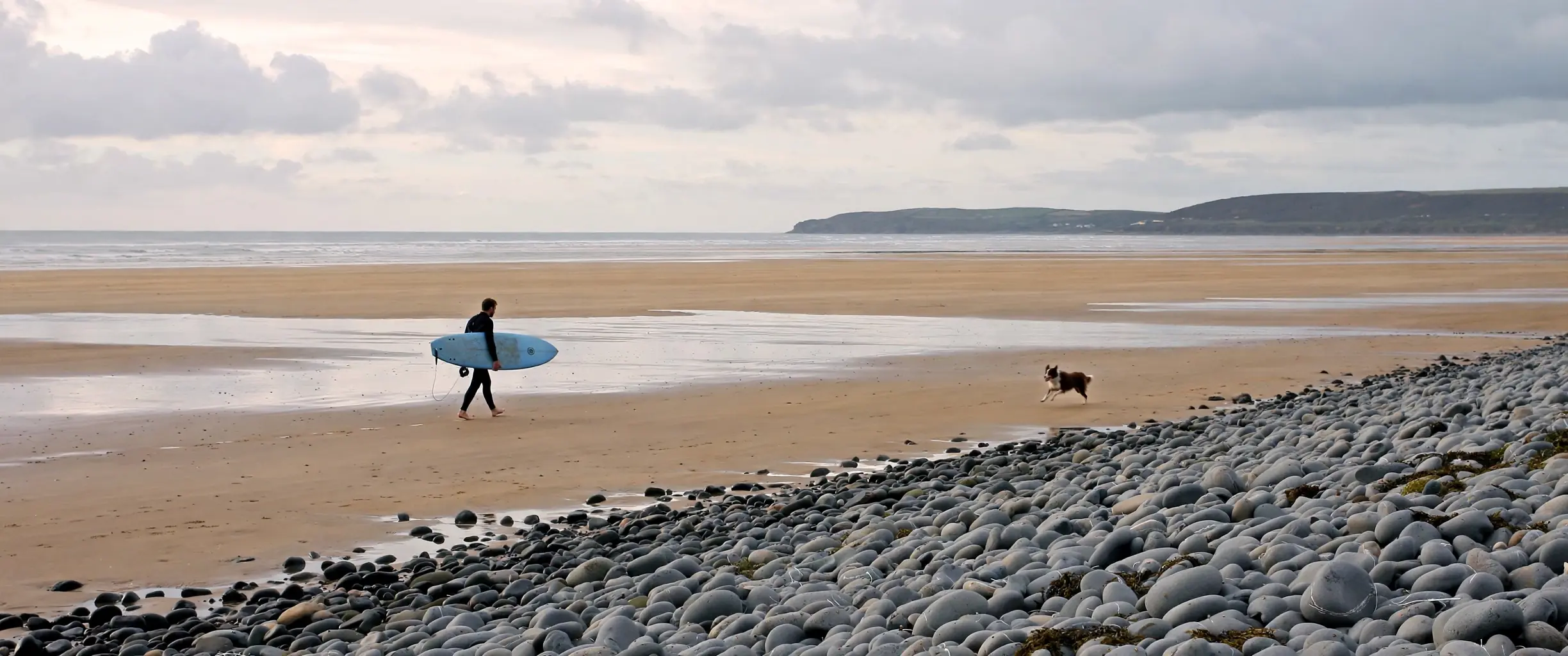
Every dog day at Westward Ho! begins with the same obstacle: a long, high bank of smooth grey pebbles that runs the full length of the beach and separates the village from the sea. Stand on it for a minute before you cross. From the top you can read the whole place at once — the sand stretching north towards the estuary, the surf breaking in lines across Bideford Bay, the flat green of Northam Burrows behind you, and on a clear day the outline of Lundy Island out to sea. It is the best orientation point in the village, and the first thing your dog needs to learn is that the ridge is not a playground.
The ridge is a natural sea defence, built over time by longshore drift: prevailing south-westerly winds and currents have carried sandstone pebbles along the coast from the Hartland direction and piled them up here at the mouth of the Taw-Torridge estuary. It is a protected feature, designated a Site of Special Scientific Interest in 1988, and it slowly migrates landwards, which is why the council asks people not to climb about on it or take pebbles away. For dogs, the practical point is simpler. The stones are large, loose and hard on paws, and a dog that scrambles up and down the slope will tire its pads quickly. Cross it once, on a proper path, and stay off it afterwards.
There are several marked crossing points along the seafront, and the most useful one for dog owners is the concrete sleeper path at Sandymere Bridge, roughly in the middle of the beach. It is also the boundary that matters for the summer dog rules, which makes it worth finding on your first visit even in winter. Other crossings sit near the village car parks and the Burrows car parks, and the level promenade along the southern part of the seafront gives step-free access to the sand for pushchairs, wheelchairs and older dogs. If your dog is unsteady on its feet, plan your route to the nearest crossing rather than the nearest stretch of sand, and carry a small dog over the worst of the stones if you have to.
Behind the ridge, the land drops away into Northam Burrows, a wide expanse of grassland, dunes and salt marsh that feels like a different landscape entirely. That contrast is what makes Westward Ho! unusual among Devon beaches: on one side of a single bank of stones you have open surf, and on the other you have flat, sheltered walking that works in almost any weather. A good day here uses both sides, and the ridge is the hinge between them.
The two halves of the beach
Westward Ho! is not one beach with one rule. Torridge District Council splits it into two sections, and the split is what decides where your dog can go in summer. The southern section is the Blue Flag beach, running from the village seafront southwards from Sandymere Bridge. The northern section runs from Sandymere Bridge to Northam Burrows and the estuary. Dogs are welcome on that northern section all year round. On the southern section, dogs are banned from 1 May to 30 September, and during those same months dogs must be kept on a lead on the promenade.
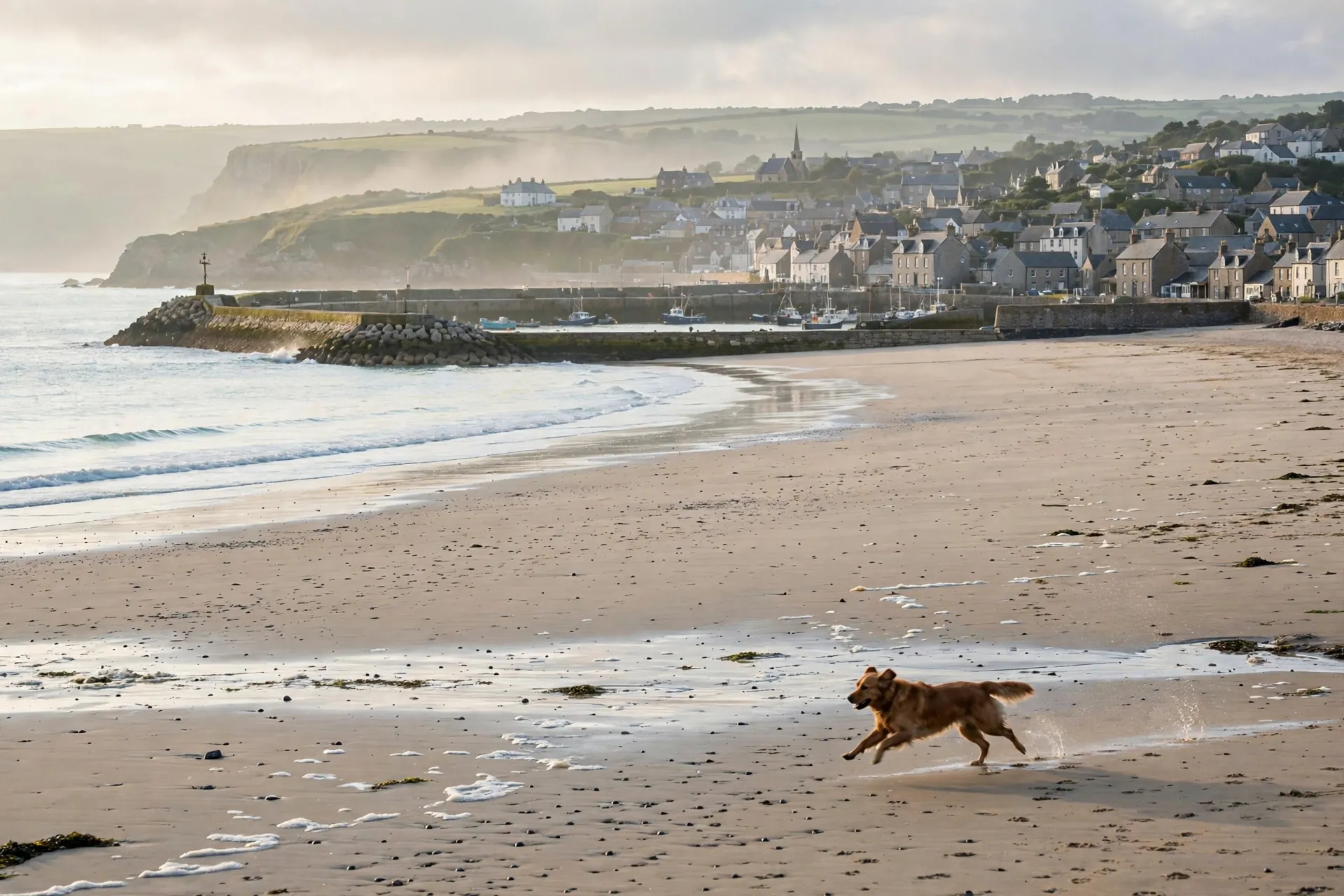
From 1 October to 30 April the whole beach opens to dogs, and that is when Westward Ho! is at its best for a proper run. Two miles of firm, flat sand at low tide gives even a fast dog room to stretch out without reaching a boundary, and the winter beach is quiet enough that a nervous dog can find empty space without much effort. In summer, the northern section still gives you a generous stretch of sand, but it is shared with the wind-sports zone, with surfers, kite surfers and horse riders, so it is not the place to let a dog run blind.
Learn to find the line before you need it. The concrete sleeper path at Sandymere Bridge is the landmark: a pale, stepped path of railway sleepers laid across the pebble ridge, with council signs beside it. Stand on it, look south towards the village, and that is the restricted side in summer. Look north towards the Burrows, and that is the year-round side. Do not rely on where other people have their dogs. On a busy August afternoon there will always be someone in the wrong half, and a fixed penalty of £100, rising to £1,000 if it goes to court, is the council's answer to that.
The signs are the final authority. Zones and dates can change, and the council's own guidance is the source to trust over any guide, including this one. Check the signs at the access point you use, and if the sign and your memory disagree, follow the sign. The same habit applies to the promenade lead rule in summer: even if your dog is walking calmly beside you, a lead on the promenade between 1 May and 30 September is the rule, and it is the rule that other beach users will expect you to follow.
Tides first, plans second
The tide at Westward Ho! is not a background detail. It is the difference between a beach two miles long and no beach at all. At low tide the sand runs out in a vast, flat sheet, and a dog can run for ten minutes in a straight line and still be on sand. At high tide the sea comes right up to the pebble ridge, the sand disappears entirely, and the only place to sit is on the stones. Visitors who arrive at high tide without checking are often surprised; visitors who arrive two hours after high water, as the tide is falling, get the whole beach opening up in front of them.
Plan around the tide table the way you would plan around a train timetable. Look up the times for the day before you leave, and aim to arrive as the tide is going out. That gives you the longest window of exposed sand, the firmest ground for running, and the best chance of a quiet stretch away from the main access points. If you arrive near high tide, use the time in the Burrows or the village instead, and walk onto the sand as it emerges. The falling tide also leaves behind shallow pools and wet sand that most dogs prefer to dry sand, and it is when the rock pools at the southern end are at their most accessible.
High water also changes the walk back. The beach is so flat that it is easy to lose track of how far out you have gone, and the tide comes in across a very wide front. Keep an eye on the waterline, and start heading back well before the sand narrows. Dogs that love the water will follow the edge of the sea as it advances, so call them back before the dry sand is gone. If you are walking north towards the Burrows, remember that the return route along the beach can be cut off by the incoming tide, and the path back over the ridge is the safe way home.
Winter tides bring their own character. The beach is emptier, the light is lower, and the sand stays firm and damp for longer, which is kinder to paws than the soft dry sand of a hot August day. Stormy weather can throw seaweed and driftwood onto the sand, which most dogs find irresistible and some will try to eat, so keep an eye on a dog that hoovers up everything it finds. After a storm, check the official guidance before you travel, because access points and lifeguard arrangements can change while the beach is being cleared.
Surf and the northern wind-sports zone
Westward Ho! is a working surf beach, not a beach where surfing happens to occur. The Atlantic swell rolls into Bideford Bay in long, orderly lines, and the gently sloping sand makes for forgiving waves that suit beginners and longboarders. Local surf schools run lessons from the beach through the summer, and on a good day you will see a spread of boards, wetsuits and learners spread across the middle of the beach. For a dog owner, the surf is both the attraction and the thing to manage: the same wide, open water that makes the beach good for surfing makes it a place where a dog can get into trouble if it chases a board or a wave.
The northern end of the beach, beyond the year-round dog section, is a designated wind-sports zone, used by kite surfers, kite buggies and land boarders. This is the part of the beach where you need your dog closest to you. Kites move fast and low, lines trail across the sand, and a dog that runs through a launch area can tangle a line or startle a rider. Keep the dog on a lead through the wind-sports zone, or give it a wide berth and stay on the wet sand near the waterline, well away from the kites. If your dog is the sort that chases anything that moves in the sky, this is not the end of the beach to use at all.
If someone in your party wants a surf lesson, the dog's day needs a plan of its own. A lesson typically lasts a couple of hours, and a dog cannot wait that long tied to a fence or left in a hot car. Take turns, so one person stays with the dog on the northern section or in the Burrows, or book a lesson early in the morning when the beach is quieter and the dog can settle on the sand nearby. Some schools are used to dogs hanging around the edges of a lesson; ask the school in advance rather than assuming, and check the official guidance before you travel if you are unsure about the current arrangements.
Dogs that swim need the same respect for the water as people do. Westward Ho! is generally a safe beach with few strong rips, but it is still open sea, and conditions change with the wind and the tide. Let a dog swim only where you can see the bottom and where you can reach it quickly, and keep it out of the water when the surf is rough or the wind is blowing offshore. A dog that swims after a ball will keep going long after it is tired, so throw parallel to the shore rather than straight out, and call the dog back before it gets too far from the beach.
Rock pools and the southern rocks
At the southern end of the beach, near the village, the sand gives way to rock. At low tide this is the best rock-pooling ground in the area: shallow pools tucked between the rocks hold crabs, small fish, anemones and limpets, and a dog that likes to sniff and poke about will be happily occupied for an hour. The rocks are also the part of the beach where a dog is most likely to cut a paw, so this is a lead-on, slow-walk sort of visit rather than a free run. Check the dog's paws when you leave the rocks, and carry fresh water to rinse off salt and sand.
Rock pooling works best on a falling tide, when the pools are freshly filled and the rocks are still wet and grippy. As the tide turns, the rocks dry out and become slippery with weed, and the pools warm up in the sun. Keep a dog out of deep pools and away from the edges of the rock platforms, where a wave can arrive without warning. Small dogs in particular can be knocked over by a wave that an adult would barely notice, so keep them close and on a lead near the water's edge.
The southern rocks are also where the summer dog ban bites hardest, because the village access points land you right on the restricted side. If you are staying in the village in summer and want rock pools with the dog, walk north first, cross into the year-round section, and enjoy the pools there instead. The northern end has its own rocky patches and pools near the Burrows, and they are quieter than the ones by the village. Either way, leave everything where you find it: turn a stone over gently if you must, put it back the way it was, and do not let the dog dig in the pools.
One more hazard sits at the southern end: the slipway. The water around it is deep, and signs warn of strong currents there. Dogs should not swim near the slipway, and children and dogs should be kept well back from the edge when boats are launching. It is a working slipway, not a paddling spot, and the safest thing to do is treat it as a no-go area for the dog and walk past it on the promenade.
Northam Burrows behind the ridge
If the beach is the headline, Northam Burrows is the reason many dog owners come back. Behind the pebble ridge lies a broad, flat country park of grassland, dunes and salt marsh, running from Westward Ho! to the edge of Appledore. It is a Site of Special Scientific Interest and part of the North Devon biosphere, and it is also one of the most forgiving dog-walking landscapes in the county: flat, open, and big enough that a dog can run properly without a road in sight.
The Burrows work in any weather. When the tide has taken the beach, the Burrows are still there. When the wind is up on the sand, the dunes and the ridge give shelter. When the summer sun is baking the beach, the grassland stays cooler underfoot. A typical circuit starts at Sandymere car park, crosses the ridge to the beach, walks north along the sand, and comes back through the middle of the Burrows past the golf course. Shorter loops are easy to improvise, because the paths are flat and the whole area is open, so you can turn back at any point and still have had a proper walk.
The Burrows are grazed, and that changes the rules. Sheep and horses roam freely, and dogs must be under close and effective control at all times — not just on a lead, but actually responsive. A dog that chases sheep is a danger to the sheep, to itself and to your walk, because worrying livestock is an offence and farmers here do not treat it lightly. From March to July, ground-nesting birds are breeding in the grassland, and dogs should be kept to the main paths. This is the one place in the area where a long line is genuinely useful: it gives a dog room to explore while keeping you in control around grazing animals.
Stay off the mudflats. Along the estuary edge of the Burrows, the receding tide exposes wide stretches of mud that look solid and are not. They can trap a dog, and they can trap a person who goes in after one. Keep to the paths and the firm grass, and keep the dog with you. The same goes for the salt marsh channels: pretty to look at, easy to get stuck in, and not worth the risk. The visitor centre at Sandymere, with the Pebble Ridge Kitchen cafe beside it, is a good place to start and finish, and the staff there can point you to the current path conditions.
Wildlife is part of the walk. In the low season, wintering birds such as Brent geese and golden plovers use the salt marshes, and the open sky over the Burrows is good for birds of prey. Keep the dog from flushing birds, and enjoy the fact that this is a working landscape rather than a manicured park. The grazing animals are what keep the grassland open and the wildflowers coming back, so the sheep are doing a job, and your dog's job is to leave them alone.
Walking on to Appledore
The South West Coast Path runs straight through Westward Ho!, and the section from here to Appledore is one of the most rewarding dog walks in North Devon. The full loop from Appledore, around Northam Burrows and back, is about 6.8 miles (10.9 km) and rated moderate, with the Burrows section flat and the Appledore end running along the estuary past mudflats and old shipbuilding quays. A shorter out-and-back from Westward Ho! to Appledore along the beach and the Burrows edge takes a little over an hour each way at a steady pace, and it is easy to cut short by turning back at the Sandymere car park.
Appledore itself is worth the walk. It is a working fishing village with narrow streets, a quay where boats still come and go, and a maritime museum that tells the story of the shipyards. The village has dog-friendly pubs, and the walk back along the estuary at low tide, with the mudflats exposed and the light coming across the water, is one of the best finishes to a walk in the area. If you are walking with a dog that is not used to villages, keep it on a lead through Appledore's narrow streets, where cars, bicycles and other dogs appear suddenly around corners.
For a longer day, the coast path continues south from Westward Ho! towards Clovelly, but that is a different kind of walk: cliff-top, steep in places, and much harder on paws and knees. Our guide to Clovelly with a dog covers that village in detail, including the car-free cobbled street and the Hobby Drive walk, and it is worth reading before you set off south. The Appledore direction is the easy one; the Clovelly direction is the ambitious one, and the two should not be confused.
Whatever direction you choose, the coast path rules are the same: keep the dog on a lead near cliff edges, near livestock and on narrow stretches, and keep it under close control everywhere else. The path is well signed, but the Burrows section can be confusing in fog or low cloud, because the flat grassland has few landmarks. Carry a charged phone, know which car park you started from, and do not rely on the dog to find the way back.
Kipling, Kingsley and a village built by a novel
Westward Ho! is the only place name in the United Kingdom that carries an exclamation mark, and it owes its existence to a book. Charles Kingsley's novel Westward Ho!, published in 1855, made the name famous, and in the 1860s a group of landowners formed a development company to build a fashionable seaside resort here that would rival Torquay and Ilfracombe. The streets they laid out, the terraces they built and the golf links they founded were all part of that Victorian ambition, and the village still follows their plan today.
The most famous resident of that early village was Rudyard Kipling. He arrived in 1878, a small, bespectacled twelve-year-old from Lahore, to attend the United Services College, a school for the sons of military officers that had opened in 1874 in a terrace of twelve houses on the hill above the beach. Kipling stayed until 1882, and the school, the coast and the boys he knew there became the material for Stalky & Co., published in 1899. The terrace where the school stood is now called Kipling Terrace, and a commemorative plaque marks the building. The hill behind the village, Kipling Tor, is owned by the National Trust and named after him.
You do not need to be a Kipling enthusiast to enjoy this history with a dog. The walk up to Kipling Tor is a short, steep climb from the village that gives a wide view over the beach, the Burrows and the estuary, and it is a good short walk when the tide has taken the sand. The terrace itself is a quiet residential street, so keep the dog on a lead, keep noise down and do not linger outside people's houses. The story is best appreciated from the pavement, looking at the building and then back out to the sea that shaped the boys who lived there.
The village's other Victorian landmark is the Royal North Devon Golf Club, founded in 1864 on the links behind the beach and often described as the oldest golf course in England. The course sits between the village and the Burrows, and its fairways are part of the landscape you walk through on the Burrows circuits. Dogs are not allowed on the course itself, and golfers' balls and dogs do not mix, so keep the dog on the paths around the edge and do not let it stray onto the fairways. The clubhouse and the course are a reminder that this corner of Devon has been a sporting landscape for a very long time, and that the beach, the Burrows and the golf links have always been shared ground.
Eating and drinking with your dog
Westward Ho! is a small village, but it eats well, and several of its pubs and cafes make a point of welcoming dogs. The Waterfront Inn, on Golf Links Road by the beach, welcomes dogs and has garden huts outside that work well for a post-walk meal with a sandy dog. The Pier House, perched above the beach on Merley Road, welcomes dogs in its Sunset Bar and on the outdoor Sun Terrace, with views across Bideford Bay towards Lundy Island, but dogs are not allowed in the Bistro, so head for the bar or the terrace. The Village Inn, on Youngaton Road, is a traditional family-run pub that describes itself as pet friendly and has its own car park.
For breakfast or a mid-walk coffee, the Rock Pool Cafe in the centre of the village, next to the Spar on Golf Links Road, is a reliable stop that welcomes dogs, with outdoor seating in good weather. The Pig on the Beach, on Bath Hotel Road, is another village pub that welcomes dogs. None of these places is a free-for-all: dogs are expected to be well behaved, to settle under a table, and to stay out of the areas where they are not allowed. Bring a mat or a blanket for the dog to lie on, ask staff where dogs are welcome before you sit down, and check the current dog policy before you travel, because policies change with the season and with management.
That last point matters more than it sounds. A pub that welcomed dogs last summer may have changed its rules, and a cafe that was happy with a dog outside may not want one inside in the rain. A quick check before you go, or a question at the door, saves an awkward moment with a tired dog and a full restaurant. The same applies to the Pebble Ridge Kitchen at the Northam Burrows visitor centre, which is a good stop after a Burrows circuit — check whether dogs are welcome inside or only outside before you settle in.
Eating out with a wet dog takes a little planning. Dry the dog off before you go in, shake the sand out of its coat outside, and keep a towel in the car for the purpose. A dog that has just come off the beach will drip on the floor, and a pub floor that is wet and sandy is a slipping hazard for everyone. If the dog is still damp, choose an outdoor table or a garden hut rather than a carpeted dining room. And if the dog is tired and restless, it may be kinder to take food away and eat it on the seafront, where the dog can lie on the grass and watch the sea.
Staying the night
Westward Ho! works as a day trip from Bideford or Barnstaple, but it is a better place to stay for a night or two, because the beach changes so much with the tide that one visit only shows you half of it. The village has hotels and guesthouses, including the Waterfront Inn, which has rooms and welcomes dogs, and there are holiday parks on the edge of the village and around Bideford Bay that accept dogs in selected units. As with any dog-friendly stay, the details matter more than the headline: which units accept dogs, how many dogs are allowed, what the pet charge is, and whether the dog can be left alone in the unit.
Ask those questions before you pay, and get the answers in writing. A park that accepts dogs in some units may have only a handful of them, and they are often the ones furthest from the beach or nearest the road. A hotel that welcomes dogs may charge per dog per night, and the total for a week can be more than the room rate suggests. If you are staying in a caravan or a lodge, check the steps, the decking and the boundary, because a dog that cannot manage the entrance steps will make every toilet trip a struggle. Our guide to Bude with a dog covers the same booking checks for another North Devon and Cornwall coast town, and the questions transfer directly.
Location matters as much as the property. A stay on the northern edge of the village puts you close to the year-round dog section of the beach and the Burrows car parks, which is the practical choice in summer. A stay in the centre of the village puts you close to the cafes and the promenade, which is better in winter, when the whole beach is open and the promenade lead rule does not apply. Either way, walk the route from your front door to the beach before you unpack, and work out where the nearest crossing over the pebble ridge is. That five-minute reconnaissance saves a lot of backtracking with a dog that needs to go out.
If you are staying longer and want to explore further, Westward Ho! makes a good base for the North Devon coast. Saunton Sands, Croyde and Woolacombe are all within a short drive, and Exmoor is an hour away. Our Exmoor dog guide covers ponies, red deer, river walks and the coast path near Lynmouth, and it is a useful companion if you are pairing a beach break with a moorland day. Plan the beach days around the tide and the moorland days around the weather, and keep one day free for the Burrows, which most visitors underestimate.
Parking, water and the kit list
Parking at Westward Ho! is straightforward if you choose the right car park for the day you have planned. The village has car parks close to the seafront and the cafes, which suit a short visit and a meal. Northam Burrows has two car parks of its own, including Sandymere car park behind the pebble ridge, and these are the better choice for a beach day or a Burrows walk, because they put you straight onto the year-round dog section and the circular routes. Charges apply in the Burrows car parks, so check the signs and the payment options when you arrive, and keep a note of which car park you used — the two Burrows car parks look similar and it is easy to walk back to the wrong one.
Arrive early in summer and on sunny weekends. The village car parks fill up by late morning, and the Burrows car parks are not far behind. If you arrive after midday on a hot day, you may find yourself parking a long way from the beach and walking a tired dog along a hot road. An early start also gives you the best of the tide and the quietest stretch of sand, so it is worth setting the alarm for. In winter, parking is rarely a problem, and the village is quiet enough that you can park near the seafront without a second thought.
Water is the thing most people forget. There is no reliable fresh water on the beach, and a dog that has been running on sand in the sun will need to drink often. Bring more water than you think you need, plus a bowl, and offer it regularly rather than waiting for the dog to look thirsty. Sea water is not a substitute: a dog that drinks a lot of it will be sick, and a dog that swallows sand with its water will have a sore stomach later. Rinse the dog's mouth with fresh water after swimming, and wash the salt off its coat before the drive home if you can.
The kit list for a Westward Ho! day is short but specific. A lead and a long line, so you can switch between the promenade, the wind-sports zone and the open sand. Two towels, one for the dog and one for the car seat. A water bottle and a bowl. Poo bags, and a spare bag for the ones you drop in the sand. A mat for the pub and a drying coat for the drive home. Sun protection for pale-nosed dogs, and a first-aid kit with tweezers for the odd thorn or fish hook on the Burrows. Check the dog's paws at the end of the day: sand, salt and pebbles are hard on pads, and a small cut picked up on the rocks can become a sore foot by the next morning.
Toilets and showers are available near the beach in the summer months, and there are refreshment facilities and shops in the village. If you are walking the Burrows, there are no facilities in the middle of the park, so use the ones at Sandymere before you set off. And remember that the beach has no shade. On a hot day, a dog needs a shady spot to rest, and the only shade on the sand is the one you bring. A lightweight windbreak or a beach shelter gives the dog somewhere cool to lie, and it gives you somewhere to sit that is not the pebble ridge.
Sea safety for dogs
Westward Ho! is a Blue Flag beach, which means the water quality is monitored and the beach is managed to a high standard, and RNLI lifeguards patrol in the summer months, roughly May to September and typically from 10am to 6pm. That is a reassuring baseline, but it does not make the sea safe by itself. The beach is open Atlantic coast, the surf can build quickly when the wind changes, and the tide can turn a calm morning into a rough afternoon. Swim between the flags when they are up, ask the lifeguards about the day's conditions before letting a dog in, and keep the dog where you can reach it.
Rip currents are the risk to understand. Westward Ho! is generally regarded as a safe beach with few strong rips, but any beach with surf can produce a current that pulls a swimmer — or a dog — away from the shore. The rule for people is to stay calm, float, and swim parallel to the shore rather than against the current, and the rule for dogs is simpler still: do not let them swim out of their depth in the first place. Throw a ball parallel to the shore, not straight out to sea, and call the dog back as soon as it is further out than you can wade to.
Other hazards are more ordinary and more likely. Jellyfish wash up on the beach after onshore winds, and a dog that noses one will get a sting. Broken glass and fish hooks turn up in the sand near the village, and driftwood after a storm can hide sharp edges. Adders are rare on the coast path but not unknown on warm, sunny banks, and a dog that snuffles in long grass on the Burrows can disturb one. None of these should stop you coming, but they are all reasons to keep the dog in sight and to check it over at the end of the day.
If something goes wrong, know where help is. The lifeguard hut is on the beach in summer, and the nearest vet is in Bideford, a few minutes' drive away — look up the number and the out-of-hours arrangements before you travel, and save them in your phone. Salt water, sand and sun are the usual culprits for a poorly dog after a beach day: vomiting after drinking sea water, a sore stomach from swallowed sand, and sunburn on a pale nose or belly. Most of these pass with fresh water, shade and rest, but if a dog is lethargic, vomiting repeatedly or unable to stand, get it to a vet rather than waiting to see if it improves.
A sample dog day at Westward Ho!
Here is a shape for a day that uses the whole place rather than just the sand. It assumes a summer visit, when the dog rules are at their strictest, and it can be stretched or shortened to fit your dog.
Start early, while the tide is falling and the beach is quiet. Park at Sandymere car park in the Burrows, cross the pebble ridge on the sleeper path, and walk north along the year-round section of the beach. Let the dog run on the wet sand near the waterline, well away from the wind-sports zone, and keep the lead handy for the moments when kites, horses or other dogs appear. An hour of this, with a paddle in the shallows, is enough for most dogs, and it is the best running they will get all day.
Come back over the ridge and walk the Burrows while the sun is still low. A circuit past the golf course and back to the visitor centre gives the dog grass under its paws and a change of smell and texture, and the flat ground is easy on tired legs. Keep the dog under close control around the grazing sheep, and stick to the paths in the breeding season. Finish at the Pebble Ridge Kitchen or back in the village for breakfast, and let the dog settle on its mat while you eat.
Use the middle of the day for the village and the history. Walk up to Kipling Tor for the view, look at Kipling Terrace from the pavement, and wander the seafront when the tide is high and the beach is gone. This is the time for a pub lunch: the Waterfront Inn or the Pier House terrace, with the dog dried off and settled under the table. If the dog is restless, take the food away and eat it on the seafront grass instead.
Finish with the coast path to Appledore in the late afternoon, when the light is low over the estuary and the tide is out. Walk as far as feels right — the Sandymere car park makes a natural turning point — and come back along the beach as the tide turns. Dry the dog, check its paws, and drive home with a tired dog and a sandy car. That is a Westward Ho! day done properly: beach, Burrows, village and estuary, with the tide doing the scheduling for you.
Practical questions
Before you go
Can my dog go on Westward Ho! beach in summer?
Yes, on the northern part of the beach. From 1 May to 30 September dogs are not allowed on the Blue Flag beach south of Sandymere Bridge, but the stretch from Sandymere Bridge north to Northam Burrows stays open to dogs all year. Dogs must be on a lead on the promenade during the same summer dates. From 1 October to 30 April the whole beach is open to dogs. Always check the signs on the day, because the council can change the zones.
Where exactly is the line between the dog area and the summer ban?
The boundary sits at Sandymere Bridge, where a path of concrete railway sleepers crosses the pebble ridge. In summer, dogs are banned south of that line on the main beach and welcome north of it. Walk to the sleeper path, look for the council signs, and treat the marked line as the rule rather than guessing from where other people are standing.
Is Westward Ho! safe for dogs to swim?
The beach slopes gently and the surf is usually moderate, which suits paddling dogs, but it is still open Atlantic water. RNLI lifeguards patrol in the summer months, roughly May to September and typically 10am to 6pm, so swim between the flags when they are up and ask the lifeguards about currents before letting a dog in. Keep dogs away from the slipway, where the water is deep, and never use inflatables in offshore winds. Check the official guidance before you travel.
Can dogs walk in Northam Burrows?
Yes. Dogs are welcome across Northam Burrows Country Park, the flat grassland and dunes behind the pebble ridge, and the circular routes make it one of the best off-lead areas in North Devon. Keep dogs under close control at all times, because sheep and horses graze freely, and stick to the main paths from March to July when ground-nesting birds are breeding. Do not let dogs onto the mudflats by the estuary, which can be dangerous.
Are dogs welcome in Westward Ho! pubs and cafes?
Several places in the village welcome dogs, including the Waterfront Inn, the Village Inn and the Rock Pool Cafe, and the Pier House welcomes dogs in its Sunset Bar and on the outdoor Sun Terrace, though not in the Bistro. Policies change, so check the current dog policy with each venue before you go, and bring a mat so your dog can settle under the table.
Where should I park with a dog at Westward Ho!?
There are car parks in the village close to the seafront and two car parks inside Northam Burrows, including Sandymere car park behind the pebble ridge. The Burrows car parks put you straight onto the year-round dog section of the beach and the circular Burrows walks, while the village car parks suit a shorter visit and the cafes. Charges apply in the Burrows car parks, so check the signs and payment options when you arrive.