This guide is independent and contains no paid placement. If affiliate links are added later, they will be clearly marked and will not change our editorial checks.
Start at Whalley Abbey and the River Calder, then loop through Spring Wood for a short walk or climb Whalley Nab for a view. Keep your dog on a lead by the river, through farmland and in the abbey grounds, check the official guidance before you travel for current access and pub rules, and finish in the village centre, where the walk, the history and the refreshments are all within a few minutes of each other.
Why Whalley works with a dog
Whalley is a village in the Ribble Valley in Lancashire, on the banks of the River Calder, and it suits a dog day out for a simple reason: almost everything worth seeing is close together. The abbey ruins, the river path, the woodland, the viaduct and the village centre sit within a short walk of each other, so a dog does not have to spend the day in the car between stops. You can park once, walk for an hour or for most of the day, and be back in the village for food and water without a second drive. That compact layout matters most for older dogs, for puppies that tire quickly, and for owners who want a proper walk rather than a series of short hops between car parks.
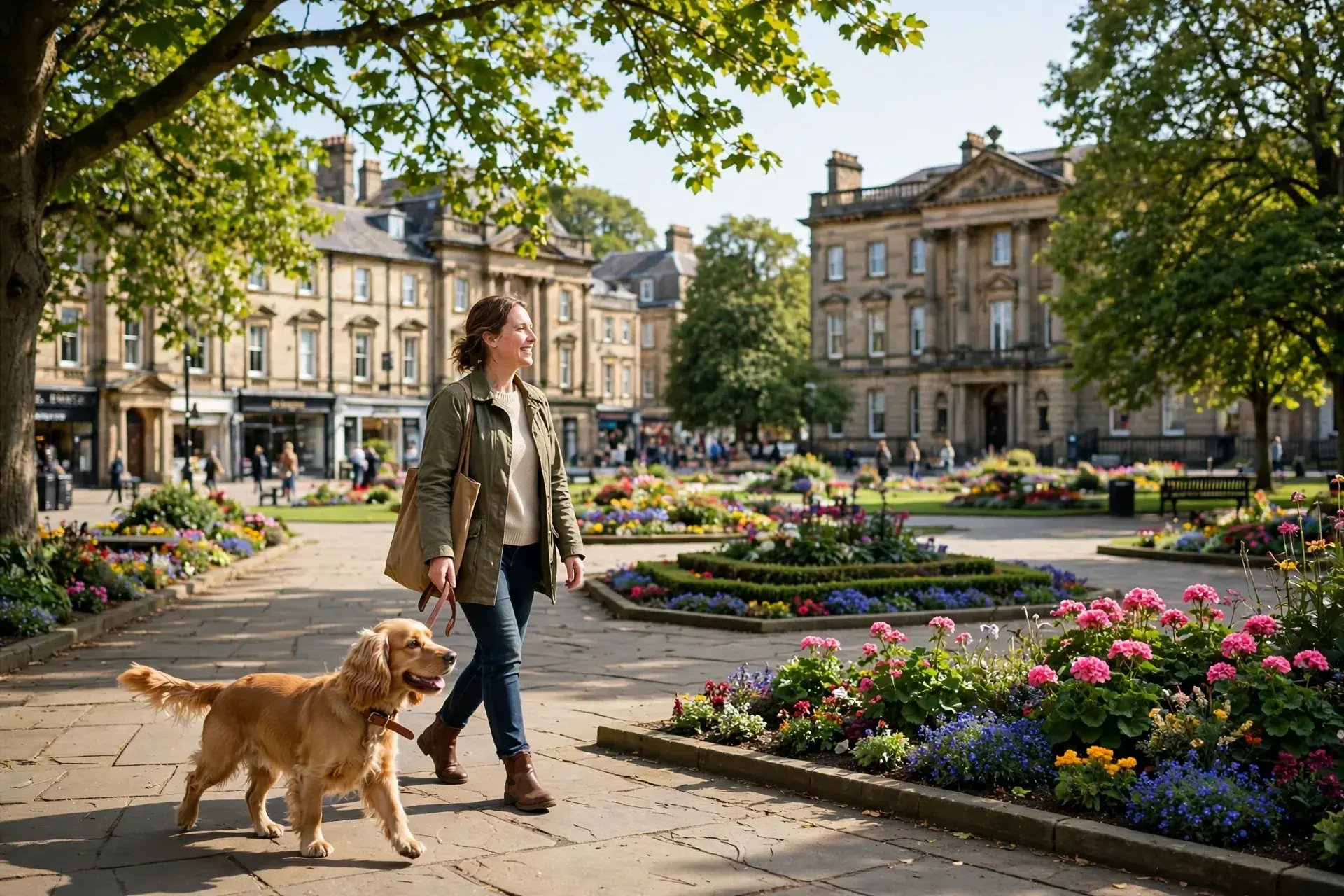
The village is also a good base for a longer Ribble Valley break. Clitheroe is a short drive or train ride to the north, the Forest of Bowland is within reach to the north-west, and Pendle Hill rises to the east, so Whalley can be a gentle first day before a bigger hill day, or a rest day between longer walks. If you are planning a wider Lancashire trip, the same pattern of short village walks and longer valley routes works in nearby towns too, and our guide to Harrogate with a dog shows how a spa town handles the same balance of gardens, riverside paths and cafes, while our guide to Leeds with a dog covers a much larger city where the walks are longer and the planning needs more care.
Whalley rewards a slow pace. The abbey grounds are green and quiet, the river moves steadily past the village, and the woodland paths above the Calder give a dog plenty of smells without demanding a long climb. A spaniel will find water, woodland and open grass in one loop. A nervous dog will find quieter corners away from the main paths. A fit dog can use Whalley as the start of a long day towards Pendle Hill or along the valley. The trick is to choose the version of Whalley that fits the dog you have brought, rather than trying to fit every walk into one visit.
That choice starts with distance and height. The abbey and river loop is mostly level and suits almost every dog. Spring Wood adds gentle climbing through trees. Whalley Nab adds a short, steep climb and a proper viewpoint, and it is the first walk in this guide where you should think seriously about your dog's fitness, joints and heat tolerance. The Wiswell and Barrow loop adds farmland, lanes and distance. Pendle Hill is a different category altogether: a long, exposed hill walk that needs water, food, weather sense and an exit plan. This guide works through those options in that order, from easiest to hardest, so you can stop at the level that suits your dog and still have a full day.
Whalley Abbey and the gatehouses
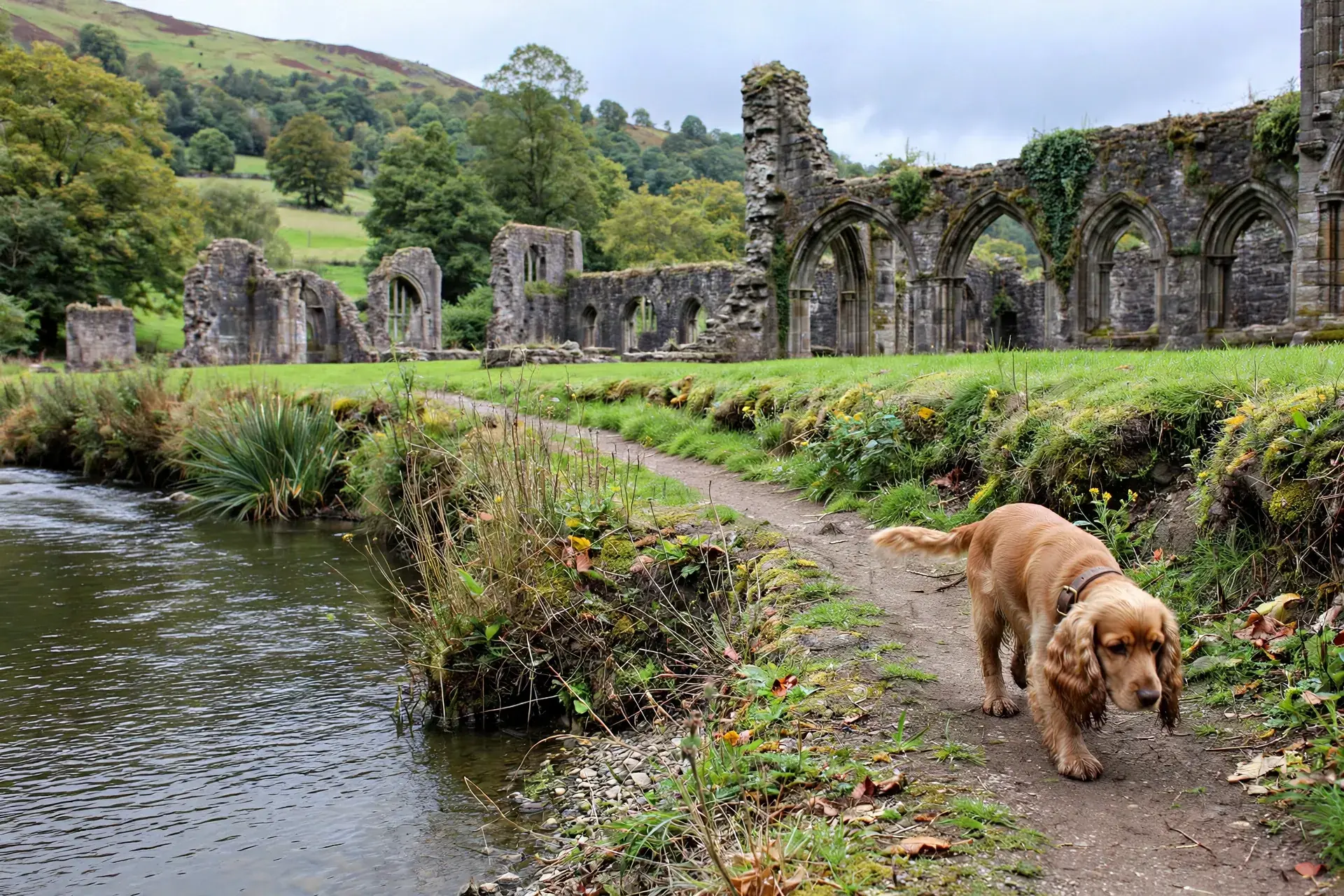
Whalley Abbey is the reason many people come to the village, and it is also the best place to start a dog walk. The abbey was a Cistercian monastery, founded when monks moved from Stanlaw Abbey in Cheshire to Whalley in 1296, after flooding made their earlier home on the River Mersey difficult to live in. The foundation stone for the new abbey church was laid in June 1296 by Henry de Lacy, and the church was finished in 1380, with the cloister, infirmary and abbot's lodging completed by the 1440s. The oldest standing structure, the north-west gatehouse, was begun around 1320. At its height the abbey was one of the wealthiest Cistercian houses in northern England, and its lands and influence spread widely across Lancashire.
The abbey's end came with the Dissolution of the Monasteries under Henry VIII in the 1530s. The last abbot, John Paslew, joined the Pilgrimage of Grace, the northern uprising against Henry's religious reforms, and was hanged at Lancaster in 1537. Most of the monastic buildings were pulled down after the suppression, and the site later passed into private hands before the Church of England bought the manor house in 1923. Today the abbey site is owned by the Diocese of Blackburn, which runs a retreat and conference centre there, while the north-west gatehouse is in the care of English Heritage as a scheduled ancient monument. That split ownership is the most important practical fact for a visitor: the ruins and the gatehouse are not one ticketed attraction with one set of rules, so check the official guidance before you travel for current access, opening times and any event closures.
For a dog owner, the abbey grounds are best treated as a quiet, lead-only walk rather than an off-lead play area. The grounds are open to visitors at reasonable times, and dogs on leads are commonly seen there, but this is a working retreat centre as well as a historic site, with guests, gardens, events and quiet areas. Keep your dog on a short lead, stay on the paths, do not let your dog climb on ruined walls or dig in planted areas, and respect any sign that marks a private or closed part of the site. The north-east gateway, completed around 1480, is the usual entrance from The Sands, off Church Lane, and a short walk further west along The Sands brings you to the north-west gatehouse. Both gatehouses photograph well, and both are worth a slow look rather than a quick pass: the stonework, the archways and the scale of the precinct give a sense of how large the monastery once was.
Allow at least thirty to forty-five minutes for the abbey alone, longer if you want to sit on the grass, read the information boards and let your dog settle. The information boards around the site explain the history of the abbey from its foundation in 1296 to its dissolution in 1537, the role of the gatehouse, and the fate of Abbot Paslew. There is no need to rush: the abbey is a place to slow down at the start of the day, not a checkpoint to tick off before the real walk begins. If you are visiting with a dog that finds new places exciting, use the abbey as a settling walk. Let the dog sniff the grass, the walls and the paths, offer water, and only move on to the river when the dog has relaxed into the day.
One warning applies here as at every historic site: do not assume that because the grounds are open, every part is open. Weddings, retreats, conferences and private events can close parts of the abbey, and the gardens may have separate hours and a small charge. Visitor reports have described a modest garden entry charge of around three pounds for adults, but prices and hours change, so check the official guidance before you travel rather than relying on an old review. If part of the site is closed, treat it as a reason to spend longer on the river path instead, not as a reason to push past a barrier or an ask to be let in.
The River Calder walk
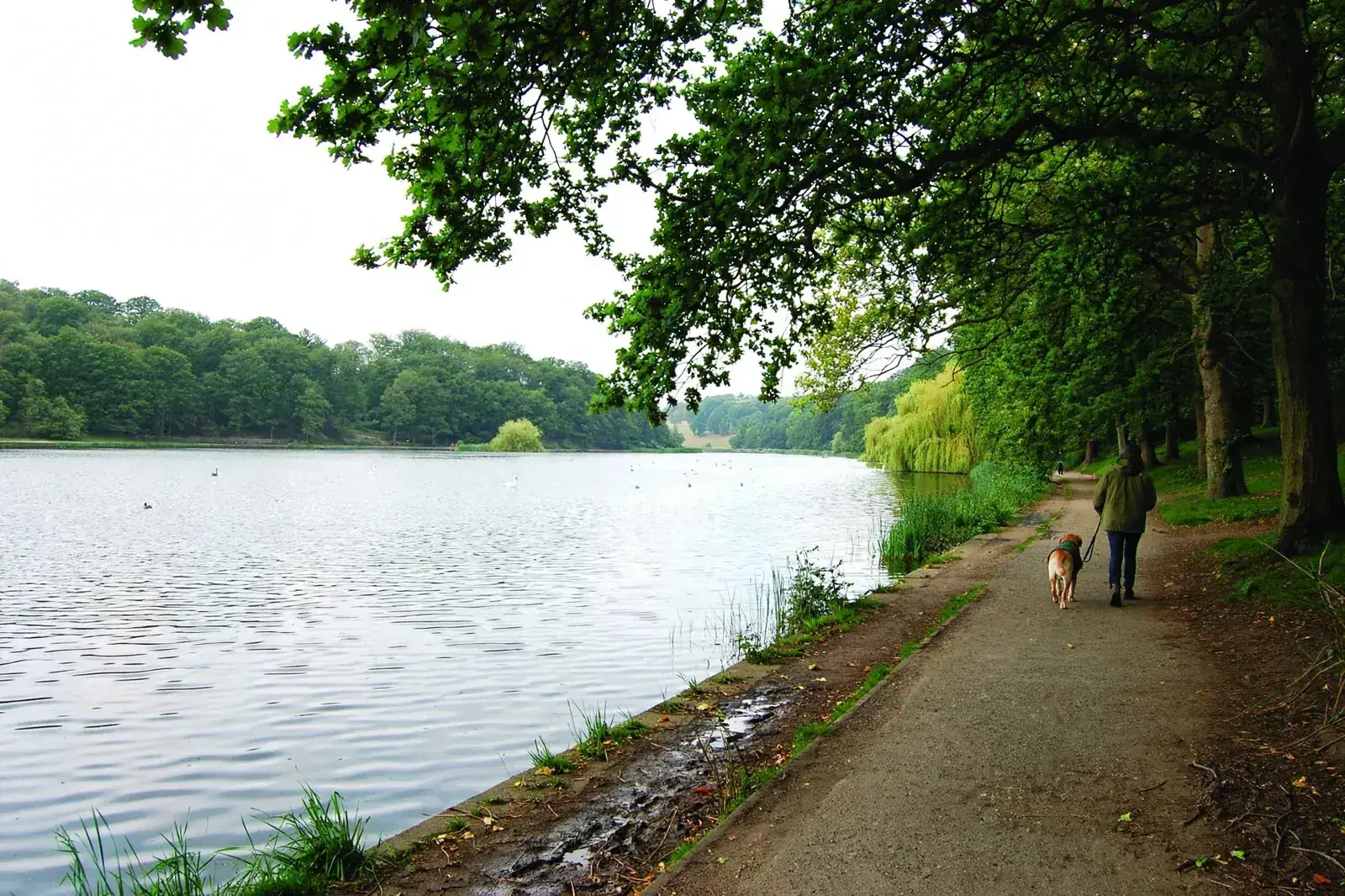
The River Calder runs past Whalley Abbey and through the village, and the riverside path is the thread that ties the village walks together. From the abbey you can follow the river towards Spring Wood, or walk in the other direction towards the viaduct and the open farmland beyond the village. The river is scenic here, with tree-lined banks, a weir, and stretches of open water that attract ducks, herons and kingfishers, and it is the part of Whalley that most dogs remember. The sound of water, the smells from the bank, and the chance to paddle at a shallow edge make it a natural focus for a dog walk, but it is also the part that needs the most care.
Keep your dog on a lead along the river unless you are certain of the ground, the current and the exit points. The Calder is a real river, not a canal, and its depth and current change with rain. After heavy rain the banks can be slippery, the water can run fast, and a dog that jumps in at a steep bank may struggle to climb out. Only let a confident dog paddle where the water is shallow and slow, where you can see the bottom, and where there is a gentle slope back to the bank. Do not let your dog drink from fast or flooded water, and do not let a dog swim after a ball or stick thrown into the current. If you are unsure, enjoy the river from the path and save the paddling for a shallow, still spot you can see clearly.
The riverside path itself is mostly level and easy to follow, but it is not a paved promenade. Expect grass, mud, tree roots and uneven ground, especially after rain, and wear shoes with grip rather than smooth trainers. In dry summer weather the path is firm and fast; in winter and after a wet week it can be soft and slippery, and the meadow sections can hold water. That is normal for a Ribble Valley riverside walk, and it is why a towel, a drying coat and a spare lead are worth packing even on a day that starts dry. If your dog is small, older, or unsteady on mud, stay on the firmer, higher parts of the path and turn back before the ground gets difficult, rather than pushing on to complete a loop.
The river walk also teaches a dog owner to read the landscape. The weir below the village is a good landmark and a good place to stop, look and listen, but keep your dog well back from the edge and on a lead. The banks near the abbey are more open and easier to manage, while the stretches towards Spring Wood are more wooded and enclosed. Livestock may graze in fields beside the river, so keep your dog on a lead whenever you pass through or beside farmland, close gates behind you, and do not let your dog chase sheep, cattle or horses. The Countryside Code applies here in full: keep dogs under control, pick up after them, and leave gates as you find them.
For most visitors, the best river walk is a simple out-and-back rather than a forced circular route. Walk from the abbey along the river for twenty or thirty minutes, let the dog sniff and settle, then turn back the same way. You will see the river from both directions, you will not have to navigate unfamiliar lanes or fields, and you can stop at the abbey or the village whenever the dog has had enough. If you want a longer day, combine the river with Spring Wood or Whalley Nab, as described below, rather than trying to extend the riverside path beyond its comfortable length.
Spring Wood and the village loop
Spring Wood is the woodland on the edge of Whalley, and it is the natural next step after the abbey and the river. The wood was once owned by the abbey monks, and today it is a much-loved local walk with easy-to-follow paths weaving through the trees. A circular walk that takes in the village, part of Spring Wood, the bank of the River Calder and the abbey grounds is one of the most popular routes in the area, and it is easy to see why: it combines woodland shade, riverside water, open grass and village history in a single loop that most dogs can manage in 45 to 90 minutes, depending on pace and stops.
The paths in Spring Wood are mostly gentle, but they are woodland paths, not surfaced park paths. Expect leaf litter, mud, roots and uneven steps, especially on the climb to the higher viewpoints. From the higher ground in the wood you can see Longridge Fell and the surrounding fells of the Forest of Bowland, and on a clear day the view gives a sense of how the Ribble Valley fits together. That climb is short, but it is steep enough to matter for an older dog or a dog with joint problems, so take it slowly, let the dog choose its pace, and do not hurry a dog that is struggling. If the climb is too much, stay on the lower paths through the wood and along the river, where the walking is level and the shade is just as welcome.
Spring Wood is also a good place to practise woodland manners. Keep your dog on a lead or under very close control, because the wood is used by families, runners, other dog walkers and wildlife, and a dog that chases squirrels or deer can quickly disappear into dense trees. Pick up after your dog even in woodland, and carry the bag out with you rather than leaving it by a tree or on a fence. In spring and summer, watch for ticks in long grass and woodland edges, and check your dog after the walk. In autumn, the wood is at its best, with colour, fallen leaves and fungi, but also with slippery leaves underfoot, so slow down on slopes and steps.
The village loop that includes Spring Wood usually starts in the village centre or at the abbey, follows the river, enters the wood, and returns to the village through quieter streets or along the river again. The exact route matters less than the rhythm: a steady walk, a pause by the river, a slow climb through the trees, a viewpoint, and a gentle descent back to the village. If you are walking with a dog that pulls, use the woodland section to practise loose-lead walking on a quieter path, and use the open riverside sections to let the dog sniff on a long line. A sniff-heavy walk tires many dogs more effectively than a fast march, and Spring Wood gives a dog plenty to sniff.
After the loop, the village is close enough to make the end of the walk easy. You do not have to drive to find water, shade or a toilet; you can walk straight into the village centre, find a bench, offer your dog water, and decide whether to eat, to drive home, or to add a second, shorter walk. That is the practical advantage of a village loop over a remote hill walk: the finish is civilised, and a tired dog can rest properly rather than being loaded straight into a hot car.
Whalley Nab: the short climb with a view
Whalley Nab is the small hill south of the village, and it is the walk to choose when you want a view without committing to a full day on Pendle Hill. The Nab rises to about 134 metres, and a circular walk from the village centre crosses the River Calder, visits Nab Wood and Whalley Banks, follows a riverside path to Cock Bridge, and returns through the village. The total ascent on the longer Nab routes is around 261 metres, which sounds modest, but the climb itself is short and steep in places, and the reward is a proper panorama up the Ribble Valley towards Pendle. For a fit dog, it is an excellent half-day walk. For an older or less fit dog, it is a walk to shorten or skip.
Start the Nab walk from the village centre, cross the river, and take the climb slowly. The path through Nab Wood is wooded and sheltered at first, then opens out to give views across the valley. Keep your dog on a lead on the climb, because the path is narrow in places, other walkers use it, and livestock may graze nearby. On the descent, watch for slippery ground after rain, and do not let a dog run down a steep slope at full speed, especially if the dog is older or has joint problems. A steady, controlled descent is kinder on joints than a fast, skidding one, and it gives you time to enjoy the view rather than watching your feet the whole way down.
The Nab is also a good test of whether your dog is ready for Pendle Hill. If the Nab climb leaves your dog panting hard, lagging, or reluctant to continue, Pendle is not the right next step. If the dog climbs steadily, recovers quickly at the top, and still wants to explore on the way down, you have a useful measure of fitness. Use that information honestly: a dog that copes well with the Nab on a cool day may still struggle on Pendle on a hot day, when heat, exposure and distance all add up. The Nab is a short climb with shade and a quick return to the village; Pendle is a long, exposed hill with few places to shelter.
From the Nab, the views are the point. Look up the Ribble Valley towards Pendle, look across to Longridge Fell, and look back down to the village, the viaduct and the river. On a clear morning the light is good for photographs, and the abbey and the viaduct sit clearly in the valley below. Take a photograph, offer your dog water, and give the dog a few minutes to rest and sniff at the top before you start down. A dog that is allowed to rest at a viewpoint is more likely to walk well on the descent than a dog that is hurried straight back down.
If you only have time for one climb in Whalley, make it the Nab rather than trying to squeeze in Pendle as well. The Nab gives you a hill, a wood, a river and a view in a single morning, and it leaves you time for lunch in the village and a gentle afternoon by the river. That is a better day for most dogs than a rushed, tiring attempt at a much bigger hill.
Longer loop: Wiswell and Barrow
For a longer day without leaving the valley, the Whalley to Wiswell loop is the classic choice. Starting in Whalley, the route heads out along the River Calder, winds through farmland and woodland to Wiswell, and returns to the start along the road via Barrow. The route passes the 13th-century Church of St Mary and All the Saints in Whalley, and it gives a good sense of the Ribble Valley as a working landscape, with fields, woods, lanes and small villages rather than a single manicured attraction. Allow at least half a day, and check a current map and the official guidance before you travel, because field paths, stiles and diversions change with the seasons and with farming.
This is a farmland walk, so the rules are different from the abbey and river paths. Keep your dog on a lead through fields, especially where sheep or cattle are grazing, and do not let your dog run through crops or chase livestock. Close every gate behind you, and use stiles carefully: lift a small dog over a stile rather than letting it jump, and check that a larger dog can cross safely before you commit. If a stile is difficult, look for a gate or a gap, and if there is no safe crossing, turn back rather than forcing a dog over a fence. Livestock, electric fences and farm machinery are all part of this landscape, and a dog on a lead is safer for everyone.
The Wiswell loop also involves road walking on the return via Barrow, so plan for lanes with no pavement. Walk on the right-hand side facing oncoming traffic where there is no pavement, keep your dog on the inside away from the road, and wear or carry something bright if the light is poor. Avoid the loop at dusk if you can, and do not assume that a quiet country lane will stay quiet: farm vehicles, delivery vans and local traffic use these roads regularly. A short lead, a calm dog and a clear plan for the road section make the difference between a pleasant return and a stressful one.
Wiswell itself is a small village worth a pause, and the Deer Park Wood section of the longer Ramblers route through Wiswell adds a climb and a view across the valley. That climb is the only significant climb on some versions of the route, and it is a good place to stop, offer water, and let the dog rest before the descent back towards Whalley. The descent picks up the River Calder again, passes a weir, and returns to the village, which makes a satisfying finish: river, wood, farmland and village in one walk.
Before you attempt the Wiswell loop, be honest about distance and time. This is a longer walk than the abbey loop or Spring Wood, and it needs water, food, a map, and a plan for what to do if the dog tires halfway round. Carry more water than you think you need, especially in warm weather, and know where the nearest road or village is at each stage of the route. If your dog is not used to walks of this length, build up to it with the shorter Whalley loops first, and save Wiswell for a second visit.
A bigger day: Pendle Hill from Whalley
Pendle Hill is the landmark that dominates the skyline east of Whalley, and it is tempting to combine the two in a single day. It can be done, but it should be treated as a serious hill walk, not as an extension of a village stroll. Pendle Hill rises to 557 metres, with a prominence of 395 metres over the surrounding ground, and the Whalley to Clitheroe route via Pendle is about 23 kilometres, or 14.3 miles, with around five and a half hours of walking time. The route starts at Whalley Station, passes through the former abbey precinct and the village centre, follows a path along the River Calder, climbs Pendle, descends to Downham Moor and Downham village, and finishes at Clitheroe Station. That is a full day, and it needs planning.
The start of the Pendle route is gentle and interesting, which can be misleading. The first section passes listed buildings in the abbey precinct and the village centre, then follows the river, before the climb begins in earnest. The climb itself is steep in places, and the summit area is exposed to wind and weather, with few places to shelter. On a clear day the views are wide, across the Ribble Valley and towards the Yorkshire Dales, but on a wet or windy day the hill can be cold, slippery and tiring. Check the weather forecast and the official guidance before you travel, and do not start the climb if the forecast is poor, if the dog is already tired, or if you do not have enough daylight left to finish comfortably.
For a dog, the Pendle day needs water, food, a lead, and a plan for the descent. Carry at least a litre of water for the dog in addition to your own, plus food and a bowl, and offer water regularly rather than waiting until the dog is panting hard. Keep the dog on a lead on the climb and descent, where the path is steep and other walkers are common, and watch for sheep on the open moor. The ground on Pendle can be boggy after rain, and the stone steps on the main path can be hard on paws, so check your dog's feet at the summit and on the way down, and carry a basic first-aid kit for cuts or sore pads.
One of the advantages of the Whalley to Clitheroe route is that it is a linear walk with public transport at both ends, so you do not have to return the same way. Whalley Station and Clitheroe Station are both on the Ribble Valley line, and buses connect Downham and Chatburn to Clitheroe if you want to shorten the walk. The option to finish in Downham, for example, cuts about 7.5 kilometres from the route, and finishing in Chatburn cuts about 5.4 kilometres. Those exit points matter for a dog owner: if the dog is tiring, if the weather turns, or if you are running out of daylight, you can leave the hill at Downham or Chatburn and catch a bus, rather than pushing on to Clitheroe. Know those options before you start, not when you need them.
Downham itself is worth a stop if you finish there. It is a small, well-preserved village with a pub, the Assheton Arms, and an ice cream shop, and it is a good place to rest a tired dog before the bus. If you continue to Clitheroe, the town has cafes, pubs and shops, and the station is a short walk from the centre. Either way, plan the end of the day as carefully as the start: a tired dog needs water, food and a calm journey home, not a rushed train change or a long wait on a cold platform. If you are unsure whether your dog is ready for Pendle, do the Nab first, then the Wiswell loop, and save Pendle for a day when you know the dog can cope with distance, height and exposure.
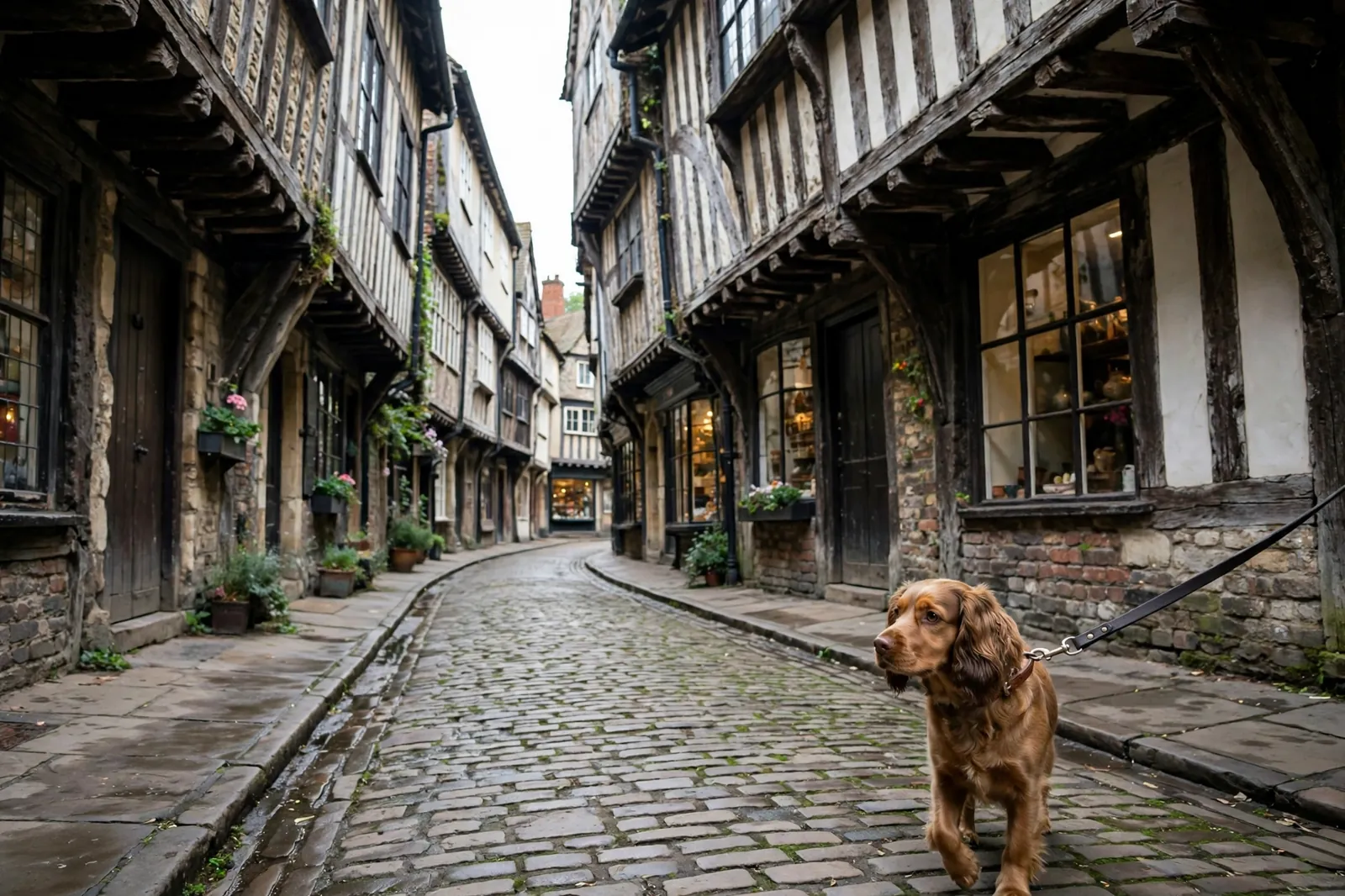
For a shorter taste of Pendle without the full day, consider a drive to a Pendle car park and a shorter climb, or a walk in the foothills around Sabden and Downham, where you can see the hill without climbing it. That is often the best choice for a first visit: you get the landscape, the village and the hill in view, without the risk of a long, exposed walk with a dog that is not yet ready for it. Our guide to York with a dog takes a different approach to a historic city, with walls, riverside walks and split visits, and it is a useful contrast: York is a city where you plan around crowds and indoor rules, while Pendle is a hill where you plan around weather, distance and exposure.
The village itself: streets, shops and the viaduct
Whalley village centre is compact, attractive and easy to explore on foot with a dog. King Street is the main street, with independent shops, cafes, pubs and restaurants, and the streets around it give glimpses of green hills between the rooftops. The village has a railway station with trains towards Blackburn and Clitheroe, and a direct connection from Manchester via Blackburn, which makes it possible to visit Whalley by train without a car. That is worth considering if you want to avoid parking on a busy weekend: the station is a short walk from the village centre, the abbey and the river, so you can arrive by train and walk everywhere.
The most striking structure in the village is Whalley Viaduct, completed in 1850 to carry the railway over the River Calder. The viaduct has 48 arches, is about 600 yards long, and is longer than the better-known Ribblehead Viaduct. It is a red-brick landmark that you will see from the river path, from the abbey grounds and from the Nab, and it is worth a slow look from below, where the scale of the arches is most impressive. Keep your dog on a lead near the viaduct and the railway, and do not let your dog wander onto railway land or climb on the structure. The best views are from the public paths below and from the river bank, not from the tracks.
The parish church of St Mary and All the Saints, dating from the 13th century, is another landmark on the edge of the village centre, and the streets around it are quieter and good for a short, level walk with a dog that finds the main street too busy. The churchyard is a place for quiet respect rather than play: keep your dog on a lead, stay on the paths, and do not let your dog disturb graves or planted areas. If you want a longer, quieter walk, the lanes towards Billington and Langho offer farmland and river views, but they also involve road walking, so keep your dog on a lead and stay alert for traffic.
Whalley has changed in recent years, with new housing developments around the village and in neighbouring Mitton, Langho, Billington and Clitheroe. Some walkers have noted that fields and countryside walks they once used are now housing, and that the remaining walks are Spring Wood, Whalley Nab, Clitheroe Castle and Whalley Abbey. That makes it even more important to use the surviving paths carefully, to respect the farmland that remains, and to support the village businesses that keep Whalley a living village rather than a dormitory. Buy a coffee, eat lunch, and use the local shops: a village that welcomes dog walkers is a village that benefits from them.
For a short village walk with a dog that does not want a long hike, try a simple loop: abbey, river, viaduct, King Street, and back to the car park. It is level, it is interesting, and it gives a dog plenty of smells and sights without tiring it out. For a dog that needs more, add Spring Wood or the Nab. For a dog that needs less, shorten the loop to the abbey and the river alone, and spend the rest of the time sitting in a pub garden or a cafe terrace, letting the dog rest while you watch the village go by.
Pubs, cafes and eating with your dog
Whalley has a reputation as a dog-friendly village, and the pub that gives the village its most dog-friendly name is The Dog Inn on King Street. The Dog Inn is widely listed as dog friendly, with visitors describing staff bringing biscuits for dogs and a warm welcome for walkers, and it serves traditional pub food, real ales and drinks in the village centre. In June 2026 a refurbishment was announced for The Dog Inn, with a planned reopening around mid-July 2026, a renovated exterior and garden, and extended food service, so the pub you find on your visit may look different from the pub in an older review. Check the official guidance before you travel for current opening hours, food times and dog policy, and do not assume that a pub that was dog friendly last year has the same policy after a refurbishment.
Beyond The Dog Inn, Whalley has a good choice of bars, pubs and restaurants, including the Whalley Wine Bar, which serves sharing boards and small plates with a selection of wines, and Vault Bar and Kitchen, which offers a range of international dishes. Dog policies vary from place to place and from season to season, and a pub that welcomes dogs in the garden may not welcome them inside, or may welcome them in the bar but not in the restaurant. The safest approach is to ask when you arrive, to look for a water bowl and a dog-friendly sign, and to have a backup plan: a garden table, a terrace, or a takeaway eaten on a bench by the river. Do not assume that a place is dog friendly because it has outdoor seating; ask first, and be ready to move on if the answer is no.
Nearby, The Lord Nelson in Langho, on Whalley Old Road, is described as a child and dog friendly pub serving food, with a garden and walks nearby, and it is a useful option if you are walking towards Langho or Billington. Pendle Village Mill, near Burnley, has a cafe tearoom with a dog-friendly indoor area and outdoor terrace, water bowls, and a dog-friendly policy that asks owners to keep dogs on a lead and in the allocated area. Those are the kinds of places that make a dog day out work: they have thought about where dogs sit, where water comes from, and how to keep dogs and non-dog owners comfortable at the same time.
Eating with a dog is easier if you plan for it. Bring a mat or blanket for your dog to lie on, a water bowl or a collapsible bowl, and a chew or a stuffed Kong to keep the dog settled while you eat. Keep your dog on a lead under the table, not stretched across a walkway, and do not let your dog beg from other tables or steal food. Order food that you can eat calmly, rather than a meal that needs both hands and constant attention, and be ready to take the dog outside for a toilet break before you sit down. If your dog is reactive, noisy or anxious in busy places, choose a quieter time, a garden table away from the main path, or a takeaway instead of a sit-down meal. A short, calm lunch is better than a long, stressful one.
Cafes in Whalley are worth checking individually, because their dog policies change more often than pub policies, and a cafe that welcomes dogs on a quiet weekday may be too busy for dogs on a Saturday. Look for cafes with outdoor seating, ask about a dog-friendly area, and be prepared to sit outside even in cooler weather. Bring a coat for the dog if you plan to sit outside for a while, and do not leave a dog tied up outside a cafe while you go inside: it is stressful for the dog, it can be unsafe, and it is not a good way to enjoy a village that is otherwise welcoming to dogs.
Where to stay with a dog
Whalley itself is a village rather than a resort, so most dog-friendly stays are in the village, in nearby Clitheroe, or in the wider Ribble Valley, rather than in a single large hotel. The abbey itself offers bed and breakfast accommodation in a setting of outstanding historical significance, through the Diocese of Blackburn's retreat and conference centre, but that is a quiet, retreat-style stay rather than a typical hotel, and it may not suit every dog or every family. Check the official guidance before you travel for current availability, dog policy and house rules, and do not assume that a retreat centre accepts dogs in the same way as a pub with rooms.
For a more typical stay, look for dog-friendly cottages, bed and breakfasts and pubs with rooms in Whalley, Clitheroe and the surrounding villages. Ask the same questions you would ask anywhere: how many dogs are allowed, is there a pet fee, are dogs allowed in the bedroom and the dining room, is there an enclosed garden or a nearby toilet walk, and what happens if the dog is left alone in the room? Get the answers in writing with your booking, and check whether the pet fee is per dog, per night or per stay. A cottage with an enclosed garden and a level walk to the river is worth more than a prettier cottage with a steep garden and a busy road outside.
If you are staying for a few days, use Whalley as a base for the Ribble Valley rather than trying to move every night. Clitheroe Castle and its grounds are a short trip away, the Forest of Bowland offers longer walks, and the villages of Downham, Chatburn and Sabden are all within a short drive. A single base means the dog can settle into a routine, with the same bed, the same feeding times and the same last walk each evening, and that routine matters more than ticking off a new village every day. If you do move, allow a settling walk at each new stay, and do not expect a dog to be calm in a new place on the first night.
When you book, be honest about your dog. Tell the host the breed, size, age and behaviour, whether the dog barks when left alone, whether it is house-trained, and whether it has any health problems. A host who knows the truth can offer a suitable room, a ground-floor room, or a room away from other guests, while a host who discovers a large, barking dog on arrival may have to refuse the stay. Bring your dog's bed, food, water bowl and a familiar blanket, and keep the feeding and walking routine as close to home as possible. A dog that sleeps in its own bed, eats at the usual time and walks the usual route is more likely to settle than a dog that is expected to adapt to a completely new routine in one night.
If you are only staying for one night, Whalley is a good choice because the walk is the attraction, not the accommodation. You do not need a large hotel with a spa and a restaurant; you need a clean, quiet room, a safe place for the dog to sleep, and a short walk to the river in the morning. Book early for weekends and school holidays, when dog-friendly rooms in the Ribble Valley sell out quickly, and check the cancellation policy before you pay, because illness, weather and a dog that is not ready for a long walk are all good reasons to change a plan.
Getting there and parking
Whalley is in the Ribble Valley, between Blackburn and Clitheroe, and it is easy to reach by car and by train. By car, the village is reached via the A59 or the A671, and the journey from Manchester, Preston or Leeds is straightforward on main roads before the final approach through the valley. By train, Whalley Station is on the Ribble Valley line between Blackburn and Clitheroe, with connections from Manchester via Blackburn, and the station is a short walk from the village centre, the abbey and the river. That makes a car-free day possible, which is worth considering on a busy weekend when parking is tight.
Parking in Whalley is in village car parks rather than on the street. The car park at the trailhead for the Spring Wood and abbey walks is pay and display, and there are other pay-and-display car parks near the village centre. Arrive early on weekends, in school holidays and on sunny days, when the village is busy and the car parks fill up. Do not park on narrow lanes, in front of gates, or on grass verges, and do not block access for farm vehicles or residents. If the main car park is full, consider arriving by train, visiting on a weekday, or choosing a quieter walk nearby rather than circling the village looking for a space.
On the train, keep your dog on a lead, keep the dog off seats, and be ready to move if the carriage is busy. Small dogs in carriers are usually the easiest to manage, while larger dogs need space by your feet and a calm temperament. Check the train operator's dog policy and the official guidance before you travel, because rules for dogs on trains can change, and peak-time trains may be crowded. If you are travelling by bus, check the bus operator's policy in advance as well, because not all buses accept dogs, and those that do may require the dog to be on a lead and under control.
For a day trip, plan your arrival time around the walk, not around lunch. Arrive in the morning, when the light is good, the paths are quieter, and the dog is fresh. Walk first, eat second, and drive home after the dog has rested. That order works better than arriving at lunchtime, eating a large meal, and then trying to walk a tired, full dog in the heat of the day. If you are staying overnight, arrive in daylight, walk the abbey and river loop to settle the dog, and save the longer walks for the next morning.
Before you set off, check the official guidance for parking charges, time limits and any changes to car parks, train times and road closures. Whalley is a small village, and a road closure, a market, a wedding at the abbey or a local event can change parking and access on the day. A quick check before you travel is faster than a frustrated search for a parking space on arrival, and it leaves more time for the walk itself.
Practical dog rules for the Ribble Valley
The Ribble Valley is a working landscape of farms, woods, rivers and villages, and the rules that keep it working also keep dogs safe. The Countryside Code is the starting point: keep dogs under control, on a lead near livestock, on a lead or under close control on open access land, pick up after your dog, and leave gates as you find them. Those rules are not suggestions; they are the difference between a welcome dog walker and a dog walker who is asked to leave. Farmers can and do take action when dogs chase livestock, and a dog that worries sheep can be shot in law, so keep your dog on a lead in fields, even if the sheep look far away.
Lead choice matters in Whalley. A short lead is best in the village, in the abbey grounds, on narrow paths and near the river. A long line is useful on open riverside grass and in woodland, where a dog can sniff and explore without running free, but a long line can tangle in trees, trip other walkers, or let a dog reach livestock or water before you can stop it. Use a long line only where you can see the ground ahead, where there is no livestock, and where you can reel the dog in quickly. A retractable lead is not a good choice on narrow paths, near roads, or in the abbey grounds, where it gives the dog too much freedom and you too little control.
Water safety deserves a separate mention. The River Calder is attractive to dogs, but it is also a river with a current, slippery banks and changing depth. Do not throw a ball or stick into the river for a dog to fetch, and do not let a dog swim in fast water, in flood, or near a weir. After rain, the river can rise quickly, and a bank that was safe in the morning can be dangerous in the afternoon. If your dog falls in or is swept downstream, do not jump in after it unless you are trained and it is safe to do so; call for help and follow the advice of the emergency services. Most river incidents are preventable by keeping the dog on a lead near the water and choosing a shallow, slow spot for paddling.
Health and hygiene are part of the practical rules too. Pick up after your dog everywhere, including woodland and farmland, and carry the bag to a bin rather than leaving it on a fence, a tree or a stile. Check your dog for ticks after woodland and long grass, especially in spring and summer, and remove any tick promptly with a tick remover. Carry water for the dog, especially on warm days and on the Nab and Pendle climbs, and do not rely on the river as a water source, because river water can carry bacteria and parasites. Know where the nearest vet is before you need one: save the number for a vet in Whalley or Clitheroe, and know the opening hours and the emergency vet for out-of-hours care.
Finally, respect other people. Not everyone loves dogs, and some people are frightened of them, allergic to them, or walking with a reactive dog of their own. Keep your dog on a lead when you pass other walkers, children or horse riders, and give other dogs space rather than assuming they want to meet. If your dog is reactive, use a yellow lead or a clear signal, walk at quieter times, and choose quieter paths. A dog owner who is considerate of other people is more likely to be welcomed back, and Whalley is a village that welcomes considerate dog owners.
Whalley through the seasons
Whalley changes with the seasons, and the best walk depends on the time of year. In spring, the abbey grounds and Spring Wood are at their freshest, with new leaves, birdsong and longer days, but the paths can be muddy after winter rain, and lambing season means extra care around livestock. Keep your dog on a lead in fields in spring, do not let your dog disturb nesting birds or lambs, and check for ticks as the weather warms up. Spring is a good time for the abbey and river loop, with the woodland coming to life and the village quieter than in summer.
In summer, Whalley is at its busiest, with warm days, full car parks and busy pubs. The river and the woodland offer shade and water, but heat is the main risk for a dog. Walk early in the morning or late in the afternoon, avoid the middle of the day, carry water, and watch for signs of heatstroke: heavy panting, drooling, lethargy, vomiting or collapse. If your dog shows those signs, move to shade, offer cool water, wet the dog's paws and belly, and seek veterinary help urgently. Do not leave a dog in a car on a warm day, even for a few minutes, and do not walk a dog on hot pavements that can burn paws. Summer is also the season for midges and flies in the valley, so bring insect repellent suitable for dogs if your vet recommends it.
Autumn is many people's favourite season in Whalley, with colour in Spring Wood, clear light on the viaduct and the abbey, and quieter paths after the summer crowds have gone. The woodland is at its best, with fallen leaves, fungi and a crisp smell in the air, but the leaves can be slippery underfoot, especially on slopes and steps, and the days get shorter quickly. Plan your walk to finish in daylight, bring a torch or a headtorch for the return to the car, and wear layers that you can add as the temperature drops. Autumn is a good time for the Nab and the Wiswell loop, when the views are clear and the ground is firm after a dry spell.
Winter in Whalley is quieter, colder and wetter, with short days and muddy paths. The abbey and river loop is still possible in winter, but the woodland and the Nab can be slippery, and the river can be high after rain. Dress for the weather, bring a drying coat for the dog, and have a towel in the car for the journey home. Check the forecast and the official guidance before you travel, and do not attempt Pendle Hill in winter unless you have experience of winter hill walking, the right clothing and equipment, and a dog that is fit and used to cold, wind and snow. For most dogs, winter is a season for short, local walks and a warm pub, rather than a long, exposed hill day.
Whatever the season, the same principle applies: check the weather, check the official guidance, and choose the walk that fits the day, not the walk you had planned a week ago. A flexible plan that changes with the weather is better than a fixed plan that ignores it, and a dog that comes home tired, dry and happy is a better result than a dog that comes home cold, wet and exhausted.
What to pack for a Whalley day
Packing for Whalley is straightforward, but a few items make the day much easier. Start with the basics: a lead, a spare lead, poo bags, water and a bowl, food and treats, and a towel. Add a drying coat or a second towel if the weather is wet, a mat for the pub, and a first-aid kit with a tick remover, antiseptic wipes and bandages. Bring a map, either on paper or downloaded to your phone, because mobile signal can be patchy in the valley and in woodland, and do not rely on a live map alone.
For the dog, pack for the walk you are actually doing, not the walk you hope to do. For the abbey and river loop, a lead, water and a towel are enough. For Spring Wood and the Nab, add grippy shoes for you, a long line for the dog, and extra water. For the Wiswell loop and Pendle Hill, add food for the dog, a bowl, a first-aid kit, a map, a headtorch, and a plan for getting home if the dog tires. For a pub lunch, add a mat, a chew, and a coat for the dog if you will be sitting outside. For a stay overnight, add the dog's bed, food, and a familiar blanket.
For you, pack layers, waterproofs and grippy shoes, even on a day that starts dry. The Ribble Valley weather can change quickly, and a shower that starts on the Nab can leave you wet and cold on the descent. Bring a hat, gloves and a warm layer in winter, and sun protection and a hat in summer. Bring cash as well as a card, because some village car parks and small businesses may not take cards, and check the official guidance before you travel for current parking payment methods.
Finally, pack patience. Whalley is a village to enjoy slowly, not a theme park to rush through. Allow time for the dog to sniff, to rest, to paddle, and to settle. Allow time for a coffee, a pub lunch, and a slow look at the abbey. If you pack patience, you will get more from Whalley than if you pack a timetable, and your dog will thank you for it.
If Whalley leaves you wanting more village walks in the north, our guide to York with a dog and our guide to Leeds with a dog both show how the same ideas, lead control near water, split visits at historic sites, and a pub at the end, work in larger places, while Harrogate offers a gentler, garden-led alternative for a dog that prefers parks to hills.
Practical questions
Before you go
Can dogs visit Whalley Abbey grounds?
Yes, in general. Dogs on leads are commonly seen in the abbey grounds and on the surrounding paths, but the site is a working retreat and conference centre as well as a historic ruin, so keep your dog on a lead, stay on paths, respect any closed or private areas, and check the official guidance before you travel for current access and any event closures.
Where is the best short dog walk in Whalley?
The abbey grounds and the River Calder path to Spring Wood make the best short loop for most dogs. It is mostly level, close to the village centre, and easy to shorten or extend. Allow 45 to 90 minutes, keep your dog on a lead near the river, livestock and other walkers, and wear grippy shoes after rain because riverside and woodland ground can be muddy and slippery.
Is the River Calder safe for dogs to paddle in?
Some dogs paddle happily at shallow edges, but the Calder is a real river with changing depth, current and slippery banks, especially after rain. Only let a confident dog paddle where the water is shallow and slow, keep the lead on or close at hand, and do not let your dog drink from or swim in fast or flooded water. Check the official guidance before you travel and skip the water entirely if you are unsure.
Are dogs welcome in Whalley pubs and cafes?
Whalley has a reputation as a dog-friendly village, and The Dog Inn in the village centre is widely listed as dog friendly, but policies change with refurbishments, seasons and management, so always check the official guidance before you travel or ask when you arrive. Bring a mat, keep your dog on a lead under the table, and have a garden or terrace plan for busy times.
Can I walk from Whalley to Pendle Hill with a dog?
Yes, as part of a long day walk, but it is a serious hill walk rather than a village stroll. Pendle Hill rises to 557 metres, and the Whalley to Clitheroe route via Pendle is about 23 kilometres and takes around five and a half hours of walking. Only attempt it with a fit dog, carry water and food, check the weather and the official guidance before you travel, and have a shorter exit route or bus option in mind.
Where should I park in Whalley with a dog?
Use the village pay-and-display car parks near the centre and the abbey rather than blocking narrow village lanes or gateways. Arrive early on weekends and in school holidays, allow time to walk to the river and abbey from the car park, and check the official guidance before you travel for current charges, time limits and any changes.