This guide is independent and contains no paid placement. If affiliate links are added later, they will be clearly marked and will not change our editorial checks.
Whitstable works for dogs because the town is flat, compact and outdoorsy: the harbour beach and West Beach suit a lead walk at any time of year, Tankerton Slopes give dogs open grass to run on, and the High Street pubs expect dogs. The one thing to check before every visit is the beach rule for the exact stretch you are standing on, because restrictions change between the harbour, West Beach and Tankerton, and between summer and winter.
An oyster town
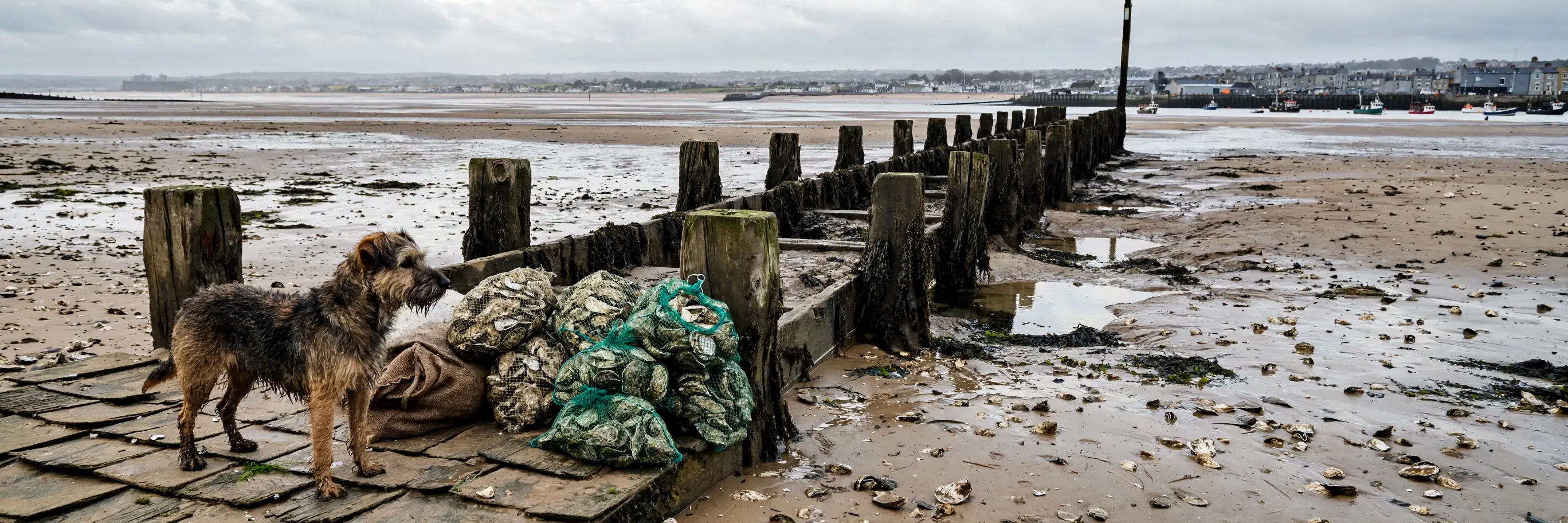
Whitstable sits on the north Kent coast where the Swale meets the Thames Estuary, about eight miles north of Canterbury and roughly sixty miles from London. The town's identity is not the beach or the brightly painted beach huts, although both are real enough; it is the oyster. Native oysters have been fished from the beds off Whitstable since Roman times, and the Whitstable Oyster Fishery Company, founded in 1793, is one of the oldest companies of its kind in Britain. When you walk the harbour with a dog, you are walking through a working fishery, not a theme park version of one: the oyster sacks stacked on the quay, the small boats hauled out for repair, the smell of the sea at low tide and the gulls arguing over the fish market are the town doing its ordinary job.
That working character shapes the dog trip more than any single rule. Whitstable is flat, which matters for older dogs and for anyone pushing a buggy alongside a lead. The centre is small enough to cross on foot in fifteen minutes, so a dog that needs a mid-morning toilet break is never far from grass or shingle. And because the town's economy runs on fishing, food and small independent shops rather than big arcades and amusement parks, there are fewer of the noisy, crowded, dog-hostile spaces that make some seaside towns hard work. The trade-off is that the harbour is genuinely busy with vehicles, forklifts and boats, and the beach is shingle rather than soft sand, so the first decision of the day is usually where to walk and where to keep the lead short.
The oyster story is worth knowing because it explains the town's calendar. The native oyster season traditionally runs from September to April, and the town's most famous event, the Whitstable Oyster Festival, takes place in July, when the harbour, the High Street and the beach fill with stalls, live music, oyster-eating competitions and a parade. The festival is fun with a steady dog and miserable with a nervous one, and the sensible plan is to arrive early, walk the quieter end of the seafront first, and leave before the afternoon crowds peak. Outside festival week, the town's rhythm is gentler: fishermen land their catch in the morning, the fish market opens, the cafes fill up, and by late afternoon the light over the Swale turns the whole place the colour of weak tea.
Getting here with a dog is straightforward. Southeastern runs trains to Whitstable from London Victoria and from London St Pancras on the high-speed line, and dogs travel free on a lead with no ticket or carrier needed. The station is about a fifteen-minute walk from the harbour, downhill most of the way, and the route takes you past the High Street, which is a useful place to stop for water and a first sniff around. Drivers should aim for the Harbour car park on Harbour Street or the Gorrell Tank car park near the station, both of which fill early on sunny weekends; the smaller car parks along the seafront at Tankerton are easier if you plan to start your walk at the slopes rather than the harbour. Check the official guidance before you travel for parking charges and any seasonal changes, because the town's car parks are managed by Canterbury City Council and the tariffs are revised from time to time.
Before the walk starts, settle the practical question of water. Whitstable's tap water is fine for dogs, and most cafes and pubs on the High Street and harbour will fill a bowl if you ask, but the seafront itself has few public taps between the harbour and Tankerton. Carry a bottle and a collapsible bowl, especially in summer, when the shingle reflects the heat and there is almost no shade on the beach. The other thing to settle early is the tide. At high tide the beach nearly disappears against the sea wall in places, and the walk along the shingle becomes a narrow strip; at low tide the beach opens into a wide flat expanse of sand and mud where dogs can run, paddle and investigate the rock pools between the groynes. Tide times are posted at the harbour and published online, and planning the walk around low tide is the single best decision you can make in Whitstable.
The harbour and the beach rules
The harbour is the heart of Whitstable and the place where the beach rules matter most. It is a working harbour run by the Whitstable Oyster Fishery Company, with fishing boats, oyster dredgers and visiting yachts sharing the water, and the quay is a place of work: lorries reverse, crates are stacked, ropes and nets lie on the ground, and the fish market sells the morning's catch from the Harbour Market building. Dogs are welcome around the harbour on a lead, and they are a familiar sight on the quay, but this is not a place to let a dog off lead. A loose dog among moored boats, moving vehicles and open water is a risk, and the harbourmaster's staff will ask you to put the lead back on. Keep the dog close, keep the lead short around the fish market, and do not let the dog drink from the harbour water or eat anything dropped on the quay.
The beach rules in Whitstable are not one rule but several, and they change with the stretch of shore and the season. The shoreline runs roughly from the harbour westwards along West Beach towards Seasalter, and eastwards past the Old Neptune pub towards Tankerton and the Swale. Some stretches welcome dogs all year, while others carry seasonal restrictions during the summer months under a Public Spaces Protection Order made by Canterbury City Council. The restrictions typically apply to the main bathing beaches in the warmer months, and the signs at each beach access point state the current position for that exact stretch. Because the boundaries are marked by groynes and signs rather than by anything visible from a distance, the only reliable approach is to read the sign where you step onto the beach, and to check the official guidance before you travel if you are planning a summer visit. Our guide to dog-friendly beaches in the UK explains how seasonal bans and PSPO fines work in general, and why the sign on the day is the rule that counts.
West Beach, immediately west of the harbour, is the stretch most visitors mean when they talk about Whitstable beach. It is a wide shingle beach with wooden groynes running down to the sea, the Old Neptune pub standing at its eastern end, and views across the estuary towards the Isle of Sheppey. At low tide the shingle gives way to sand and mud flats, and this is where dogs have the best time: they can run between the groynes, paddle in the shallows and sniff along the tide line. The shingle itself is hard on paws after a long walk, and sharp shell fragments collect near the tide line, so check your dog's paws after a beach session and rinse them in fresh water if the dog has been in the sea. The beach has no lifeguard, and the currents in the Swale and the Thames Estuary are stronger than they look from the shore, so dogs should swim only in the calm shallows near the beach, never near the harbour entrance or the Neptune's Arm breakwater.
East of the harbour, the beach continues past the Old Neptune towards Tankerton, and the character changes: the shingle is the same, but the sea wall and the beach huts begin, and the crowds thin out. This eastern stretch is a good choice for dogs that find the harbour beach too busy, because the same low-tide sand appears with fewer people, fewer picnics to steal and fewer children running. The groynes are the main hazard here as well as the main feature: at low tide they make excellent sniffing territory, but the wood can be slippery with weed and the gaps between the groynes fill with water that looks shallow and is sometimes deeper than it seems. Keep a long line on a dog that charges into the water, and call the dog back before it reaches the end of a groyne.
Two practical habits make the Whitstable beach work for dogs. The first is timing: arrive at low tide, or within an hour either side of it, when the beach is at its widest and the dogs have room. The second is cleaning up properly. Whitstable's beaches are cleaned by the council, but dog waste left on the shingle is a genuine problem in a town where people eat oysters and ice cream sitting on the same beach, and the bins along the seafront are provided for exactly that reason. Carry more bags than you think you need, use the bins at the harbour and at Tankerton, and do not bury waste in the shingle. A dog that has been in the mud flats at low tide will also need a rinse before getting into the car, and the harbour has an outdoor tap near the fish market that regulars use for exactly that purpose.
Tankerton Slopes
Tankerton Slopes are the open secret of Whitstable with a dog, and they are the reason many regulars skip the harbour beach altogether. The slopes are a long grassy bank running along the seafront east of the town, from the end of the High Street towards Swalecliffe, with the beach below and a wide promenade above. The grass is mown, the views run across the Swale to the Isle of Sheppey, and on a clear day you can see the shipping in the Thames Estuary and the low line of the Essex coast. Dogs can run on the slopes where signs allow, and the combination of grass underfoot and sea air makes this the most comfortable place in Whitstable for a dog that needs a proper run without the hard shingle.
The walk from the harbour to Tankerton is one of the easiest coastal walks in Kent. The flat seafront path takes about twenty to thirty minutes at a dog's pace, passing the Old Neptune, the beach huts and the small gardens along Marine Terrace, with benches and bins at intervals. The beach huts along this stretch are privately owned and brightly painted, and they are part of the town's scenery rather than something to visit, but they make the walk pretty and give dogs plenty to sniff at. At the Tankerton end, the slopes open out and the beach below widens, and this is where the walk turns into a proper outing: throw a ball on the grass, let the dog paddle at the water's edge at low tide, and sit on one of the benches while the dog dries in the wind.
Tankerton has its own beach, and its rules are separate from the harbour beach, so the same advice applies: read the sign at the access point you use. The beach at Tankerton is shingle at the top and sand and mud at low tide, like the rest of Whitstable, and it is quieter than West Beach on most days because the harbour crowds rarely walk this far. The slopes above the beach are the real draw, though. They are high enough to catch the breeze on a hot day, which dogs appreciate, and they have enough space for a game of fetch without the ball ending up in the sea every time. The grass is also kinder to paws than the shingle, so an older dog that struggles on the beach can still have a good walk here, and a puppy can have its first seaside run on a surface that will not cut its pads.
There are a few Tankerton details worth knowing before you go. The first is parking: the small car parks along Marine Parade and at the Tankerton end of the seafront are much easier than the harbour car parks on a sunny day, and starting the walk here means the dog gets the slopes first and the harbour second, which is a better order for a dog that gets overexcited. The second is the wind. Tankerton faces north-east across the estuary, and the wind off the sea can be sharp even on a sunny day, so a dog that has been swimming will chill quickly; bring a towel and a drying coat in the cooler months. The third is the Tankerton Bay sailing club and the small boats that launch from the beach: keep dogs away from the slipways and the boats being rigged, and do not let a dog chase the sailing dinghies as they come in.
From the slopes, the walk can continue east towards Swalecliffe and Herne Bay along the coast path, which is a longer and quieter stretch of shoreline with fewer people and more open beach. The Saxon Shore Way, the long-distance path that follows the Kent coast, passes through Whitstable and Tankerton on its way from Gravesend to Hastings, and the section east of Tankerton is a good example of it: flat, well-marked and dog-friendly, with the sea on one side and fields and houses on the other. It is a walk that rewards a slow pace, because the light on the estuary changes every few minutes and the wading birds on the mud flats — oystercatchers, curlews, redshanks and brent geese in winter — are worth stopping for. Keep dogs on a lead near the birds, especially in winter when the geese are feeding, and remember that the mud flats are dangerous at a rising tide: never walk out onto them with a dog, and never let a dog chase birds across the mud.
The High Street and the old town
Whitstable's High Street runs from the harbour inland towards the station, and it is one of the most dog-friendly shopping streets in Kent. The street is narrow, the pavements are narrow too, and the shops are mostly independent: fishmongers, bakers, delicatessens, bookshops, gift shops, galleries and cafes, with very few chain stores. That independence is part of the charm and part of the practical problem, because small shops have small doorways and not every one of them welcomes dogs inside. The rule of thumb is to ask: most shopkeepers will say yes to a well-behaved dog on a lead, and many keep a water bowl and a biscuit tin by the door, but a crowded deli with food at dog height is a place to leave the dog outside with one person while the other shops.
Harbour Street, the short street that runs from the High Street down to the harbour, is where the town's oyster trade is most visible. The fish market sits here, the oyster shacks cluster around the harbour, and the smell of the sea is strongest. It is also the busiest street in town for vehicles, because the harbour traffic uses it, so keep the lead short and the dog on the pavement side away from the road. The street is worth walking slowly, because the shopfronts are old and the details are easy to miss: the painted signs, the fishing nets draped over a doorway, the chalkboard outside a cafe announcing the day's catch. Dogs are welcome on the pavements and outside the cafes, and the outdoor seating along Harbour Street is where most dog owners end up sitting, because the dog can lie under the table while the people eat.
The pubs are the heart of Whitstable's dog-friendly reputation, and they deserve a proper look. The Old Neptune, known locally as the Neppy, stands on the beach at the end of Marine Terrace, with its terrace almost on the shingle. Dogs are welcome on the terrace and in the bar area, and the pub is famous for its position as much as its beer: on a summer evening the terrace fills with people and dogs watching the sun go down over the sea. The Ship, on the High Street near the harbour, is a smaller and older pub with a low ceiling and a dog-friendly bar, and The Smack, on Middle Wall, is a traditional fishermen's pub that welcomes dogs and serves the kind of straightforward pub food that suits a day on the beach. Pearson's Arms, on Horsebridge Road near the harbour, is another dog-friendly stop, with a garden that suits dogs in summer. Policies can change with the season and with how busy a pub is, so check the door sign or ask at the bar before settling in, and keep the dog close to your table rather than letting it wander between tables.
The old town behind the High Street is worth a wander with a dog that walks well on a lead. The streets around Harbour Street, Oxford Street and Canterbury Road hold some of the town's oldest cottages, many of them weatherboarded in the Kent style, with small front gardens and narrow lanes that are quiet compared with the High Street. Whitstable Castle, at the top of Tower Parade, is a short walk from the harbour and its grounds are open to the public: the castle itself is a nineteenth-century house rather than a medieval fortress, and the gardens are a pleasant place for a lead walk, with lawns, flower beds and views back down to the sea. Dogs are welcome in the castle grounds on a lead, and the tea room has outdoor seating where dogs can sit with their owners. Check the official guidance before you travel for opening times, because the castle grounds and the tea room have seasonal hours.
Shopping with a dog in Whitstable works best as a slow browse rather than a mission. The fishmongers on the High Street sell the day's catch, the delicatessens sell local cheese and Kentish wine, and the bookshops and galleries are the kind of places where a dog lying quietly by the door is part of the atmosphere. If the dog needs a break from the street, the churchyard of All Saints' Church, just off the High Street, is a quiet green space with benches, and the walk back to the harbour along the seafront is always there as a reset. The practical point is that Whitstable's centre is small enough that a dog never has to be left in the car, and the town's cafes and pubs are used to dogs sitting under tables, so a day here can be spent almost entirely on foot with the dog beside you.
Oyster eating with a dog
Eating oysters with a dog in Whitstable is not a problem to solve but a habit to learn, and the habit is simple: the dog sits outside or on the terrace, the oysters come to the table, and the dog gets the attention of everyone passing by. The town's oyster trade is built around the native oyster, Ostrea edulis, which is smaller, flatter and more intensely flavoured than the rock oysters farmed elsewhere, and the oyster shacks around the harbour sell them by the half-dozen, opened to order and eaten standing up with a squeeze of lemon and a dash of shallot vinegar. Dogs are not allowed inside the shacks themselves, which are small working kitchens, but the outdoor tables and the harbour seating are where the eating happens, and dogs are welcome there on a lead.
Wheelers Oyster Bar, on the High Street, is the town's most famous oyster restaurant, and it has been serving oysters since 1856. The restaurant itself is small and does not take dogs inside, so the plan for a dog owner is to order from the takeaway hatch or to eat at one of the harbour shacks instead, and to save Wheelers for a visit when the dog is not along. The harbour shacks, including the oyster stalls around the fish market and the small cafes on Harbour Street, are the practical alternative: they serve oysters, crab sandwiches, smoked fish and chips to eat outside, and the dog can lie at your feet while you eat. The Royal Native Oyster Stores, on Horsebridge Road near the harbour, has a restaurant and an oyster bar, and dogs are welcome on its outdoor terrace; check the official guidance before you travel for the current terrace policy, because it changes with the season.
There are a few things to know about feeding a dog around oysters. The first is that oysters are not dog food: raw shellfish can carry bacteria that upset a dog's stomach, and the shells are sharp enough to cut a mouth or a gut, so never give a dog an oyster or let the dog eat a discarded shell from the ground around the shacks. The harbour and the beach around the oyster stalls are littered with shells, and a dog that scavenges will find them, so keep the lead short near the stalls and watch what the dog picks up. The second is that the smell of fish will excite almost any dog, and a dog that has never been around a fish market will pull hard towards the stalls, so arrive with the dog already walked and settled, and sit down before ordering rather than standing in a queue with a pulling dog.
Beyond oysters, Whitstable's food scene suits dog owners because so much of it is eaten outdoors. The fish and chip shops on the High Street and Harbour Street are takeaway by nature, and eating chips on the harbour wall with a dog at your feet is one of the town's ordinary pleasures. The cafes along the seafront, from the harbour to Tankerton, mostly have outdoor seating where dogs are welcome, and the ice cream parlours on the High Street are happy to serve a dog a small scoop in a cup if you ask. The farmers' market, held on the High Street, is a good place to buy local cheese, bread and Kentish apples for a picnic on the slopes, and a picnic is often the best meal plan for a dog owner: the dog gets the grass, the people get the food, and nobody has to negotiate a restaurant doorway.
The practical end of the meal is the clean-up. Oyster shells, fish bones and chip paper all end up on the ground around the harbour, and dogs will find them if they are given the chance, so a short lead and a watchful eye matter as much at the table as on the walk. Bring a water bowl and a small mat for the dog to lie on, because the harbour seating is stone and concrete and a dog lying on cold stone in winter will chill quickly. And if the dog has had a long day on the beach, the kindest plan is an early dinner and an early night: Whitstable is a town that rewards an early start, and the harbour at seven in the morning, with the fishermen landing their catch and the gulls calling and almost nobody else around, is the best time of day for a dog.
Day trips: Canterbury and the coast
Whitstable is a good base for a longer stay because Canterbury is only six miles inland, and the coast in both directions is full of places that suit dogs. Canterbury, the county town, is the obvious day trip, and it is one of the most rewarding city visits you can make with a dog in Britain. The cathedral precincts themselves do not admit dogs, except for assistance dogs, but the rest of the city is very dog-friendly: the medieval lanes around the cathedral, the River Stour, the Westgate Gardens and the city walls are all walkable with a dog on a lead, and many of the city's cafes and pubs welcome dogs inside. Our guide to Canterbury with a dog covers the precinct rules, the riverside walks and the dog-friendly pubs in detail, and it is worth reading before you go, because the difference between a good day in Canterbury and a frustrating one is knowing which streets to walk and which to avoid.
The drive or train ride from Whitstable to Canterbury takes about twenty minutes, and the walk from Canterbury West station into the city centre passes the Westgate Gardens, which are a good first stop for a dog that has been travelling. The gardens run along the River Stour with lawns, trees and benches, and they are one of the few places in the city centre where a dog can have a proper sniff and a drink before the lanes and shops begin. From there, the lanes around the cathedral, the King's Mile and St Dunstan's Street offer a full day of browsing, and the riverside path along the Stour is a quieter alternative when the shopping streets get crowded. Canterbury's dog-friendly pubs, including the Parrot on Church Street and the Dolphin on St Radigunds Street, welcome dogs in the bar, and the city's cafes are used to dogs sitting under tables.
East along the coast from Whitstable, Herne Bay is about four miles away and makes an easy second day trip. Herne Bay has a pier, a long seafront and a bandstand, and its beach is shingle like Whitstable's, with seasonal dog restrictions on the main beach and quieter stretches towards Reculver where dogs have more room. The walk from Whitstable to Herne Bay along the coast path is a proper half-day outing, flat and well-marked, and it passes through Tankerton and Swalecliffe before reaching Herne Bay's seafront. Reculver, beyond Herne Bay, is worth the extra miles for its ruined Roman fort and the twin towers of the medieval church, which stand on the cliff edge and are visible for miles along the coast. The country park at Reculver has open grass, a cafe and a long stretch of beach where dogs can run, and the birdlife on the marshes behind the towers is some of the best on the Kent coast.
West along the coast, Faversham is about eight miles away and is a different kind of day trip: a market town rather than a seaside town, with a historic creek, a brewery and a market square that has been trading since the Middle Ages. Faversham's creek is a working waterway with houseboats and small boatyards, and the walk along the creek from the town centre to the marshes is a quiet and dog-friendly outing. The town's pubs, including the Sun Inn on West Street, welcome dogs, and the market on Tuesdays, Fridays and Saturdays is a good place to buy local produce. Faversham is also the home of Shepherd Neame, Britain's oldest brewer, and the brewery shop sells beer to take away, which is a better plan for a dog owner than a brewery tour.
For a longer day, Margate is about twenty miles east along the coast, and the train from Whitstable takes under half an hour. Margate's Old Town is full of independent shops and cafes, the beach is sandy rather than shingle, and the Turner Contemporary gallery stands on the seafront where the harbour used to be. Dogs are welcome on Margate's main beach outside the summer season, and the town's cafes and pubs are used to dogs, but the beach rules change in summer and the town is much busier than Whitstable, so it suits a confident dog and an early start. The coast path from Margate to Broadstairs and Ramsgate is one of the best dog walks in Kent, with chalk cliffs, sandy bays and harbour towns in a single day, and it is a walk to save for a day when the dog is fit and the weather is settled.
The practical point of all these day trips is that Whitstable's position on the north Kent coast puts a remarkable amount of dog-friendly Britain within a short drive or train ride, and the town itself is small enough to feel like home after a day or two. The best plan for a longer stay is to alternate: a beach day in Whitstable, a city day in Canterbury, a coast walk to Herne Bay or Reculver, and a quiet day on Tankerton Slopes. The dog will know the route to the harbour by the second morning, the cafes will know the dog by the third, and by the end of the week the town will feel less like a destination and more like a place you come back to.
Practical questions
Before you go
Can dogs go on Whitstable beach all year?
Parts of Whitstable's shoreline welcome dogs all year, while other stretches have seasonal restrictions in the summer months. The rules differ between the harbour beach, West Beach and Tankerton, and the signs at each access point show the current position. Check the official guidance before you travel, and keep your dog on a lead near the working harbour whatever the season.
Where can dogs swim at Whitstable?
Dogs paddle and swim most happily at low tide on the open shingle beaches west of the harbour, where the water shelves gently and the groynes break the current. Avoid the harbour entrance, the oyster beds and any area with moored boats, and never let a dog swim near the Neptune's Arm breakwater. Rinse salt and mud off afterwards, and watch for sharp shells on the shingle.
Which Whitstable pubs welcome dogs inside?
The Old Neptune on the beach is the town's best-known dog-friendly pub, with dogs welcome on the terrace and in the bar area, and several High Street pubs including The Ship and The Smack welcome well-behaved dogs inside. Policies can change with the season and with how busy a pub is, so check the door sign or ask at the bar before settling in, and keep your dog close to your table.
Can I take my dog to the Whitstable Oyster Festival?
Yes, dogs are a common sight at the Whitstable Oyster Festival, which fills the harbour and High Street with stalls, music and crowds each July. The festival is busy, loud and full of food on the ground, so a lead, a short visit and an early arrival work best. If your dog dislikes crowds, walk the quieter Tankerton end of the seafront instead and visit the harbour once the festival crowds thin out.
Is the walk from Whitstable to Tankerton dog-friendly?
Yes. The flat seafront path from the harbour to Tankerton Slopes takes about twenty to thirty minutes and is one of the easiest dog walks on the Kent coast, with benches, bins and beach access along the way. The slopes themselves are grassy and open, dogs can run off lead there where signs allow, and the views stretch across the Swale to the Isle of Sheppey.
Can dogs travel on the train to Whitstable?
Yes. Dogs travel free on Southeastern trains to Whitstable, including the high-speed services from London St Pancras, and there is no ticket or carrier requirement for a dog on a lead. Whitstable station is about a fifteen-minute walk from the harbour, mostly downhill, and the route passes the High Street, so you can break the walk with a stop for water.