This guide is independent and contains no paid placement. If affiliate links are added later, they will be clearly marked and will not change our editorial checks.
Wild camping is broadly legal in Scotland under responsible access rights, allowed in limited areas of Dartmoor under its byelaws, and otherwise not a right in England, Wales or Northern Ireland, where you need the landowner's permission. Wherever you pitch, camp late, leave early, keep the dog close, and carry all waste out.
The legal map: four nations, four answers
The single most important fact about wild camping in the UK is that there is no single rule. The United Kingdom is four legal systems wearing one name, and the answer to “can I pitch a tent here with my dog?” changes at every border. Most of the trouble people get into — being moved on at midnight, a tense conversation with a farmer, a fine they did not expect — comes from assuming the rule they learned in one nation applies in another. Learn the map before you learn the kit list, because the map decides whether the trip is lawful at all.
In England and Wales, wild camping is not a general right. Land is owned by somebody, and pitching a tent without that person's permission is trespass, which is a civil matter rather than a criminal offence in most cases, but it is still trespass. That does not mean nobody ever does it, and it does not mean every landowner objects — many walkers have camped discreetly for decades without incident — but it does mean you have no right to be there, and you can be asked to leave at any time. The dog makes the position more sensitive, not less: a landowner who might tolerate a quiet solo walker may reasonably object to a dog near livestock, ground-nesting birds or a water supply. If you want to camp in England or Wales outside a campsite, the honest route is to ask permission, use a site, or go to the one place where the rules are different.
Scotland is the exception that proves the rule, and Northern Ireland is the quietest corner of the map. Under the Land Reform (Scotland) Act 2003, Scotland has statutory access rights that include wild camping on most unenclosed land, provided you act responsibly — a subject this guide covers in its own section below. Northern Ireland has no equivalent general right of access, so the position there is closer to England and Wales: permission is needed, and the practical option for most dog owners is a campsite, a farm site, or a landowner who has said yes. Rules and local byelaws change, and protected landscapes often have their own restrictions, so check the official guidance before you travel rather than relying on a blog post, including this one, as your only source.
- England: no general right to wild camp; permission needed. Dartmoor is the notable exception, under its own byelaws.
- Wales: no general right to wild camp; permission needed. National park land is still mostly private or common land with its own rules.
- Scotland: wild camping is part of responsible access rights on most unenclosed land, with local exceptions and seasonal management zones.
- Northern Ireland: no general right of access; permission needed, and campsites are the practical default.
Two practical consequences follow from that map. First, “wild camping” is not one activity: a night on a Scottish hillside, a night on Dartmoor and a night in a Welsh valley are three different legal situations, even if the tent and the dog are identical. Second, your dog's behaviour is part of the legal picture, not an afterthought. Livestock worrying is a serious matter — a dog chasing or even worrying sheep can cause injury, abortion in pregnant ewes and real financial loss, and the law treats it seriously. Keep the dog on a lead or under genuinely close control around livestock everywhere, and remember that “he's friendly” is not a defence and not a comfort to a farmer watching a loose dog among lambs.
The Dartmoor exception, in detail
Dartmoor is the only place in England where wild camping — usually called backpack camping — is expressly allowed, and it is allowed because the national park's byelaws say so, not because of any general right. That distinction matters, because the permission is conditional and it has been tested in court in recent years. The byelaws permit camping only in certain areas, and only in the spirit of the thing: small groups travelling on foot, carrying their kit, staying a night or two and moving on. It is not a licence to drive to a car park, pitch a family tent for a week, light a fire and treat the moor as a free campsite. Anyone planning a Dartmoor trip with a dog should read the current byelaws and the national park authority's camping map before setting off, and check the official guidance before you travel, because the permitted areas and the conditions attached to them are the whole basis of the exception.
The practical rules are straightforward and worth memorising. Camp only in the areas shown as permitted on the authority's map, well away from roads, car parks, settlements, enclosed fields and reservoirs. Keep groups small — the byelaws envisage no more than six people — and stay no more than two nights in the same place. Pitch late in the day and leave early, keep the tent small and low-profile, and take everything away with you, including all litter and all dog waste. Fires are not allowed, so plan on a stove, and do not camp in the same place repeatedly or in a way that wears a visible scar into the ground. The moor's military training areas add another layer: live firing takes place on certain ranges at certain times, and you must check firing times and keep out of flagged danger areas, with your dog on a lead, before you plan a route anywhere near them.
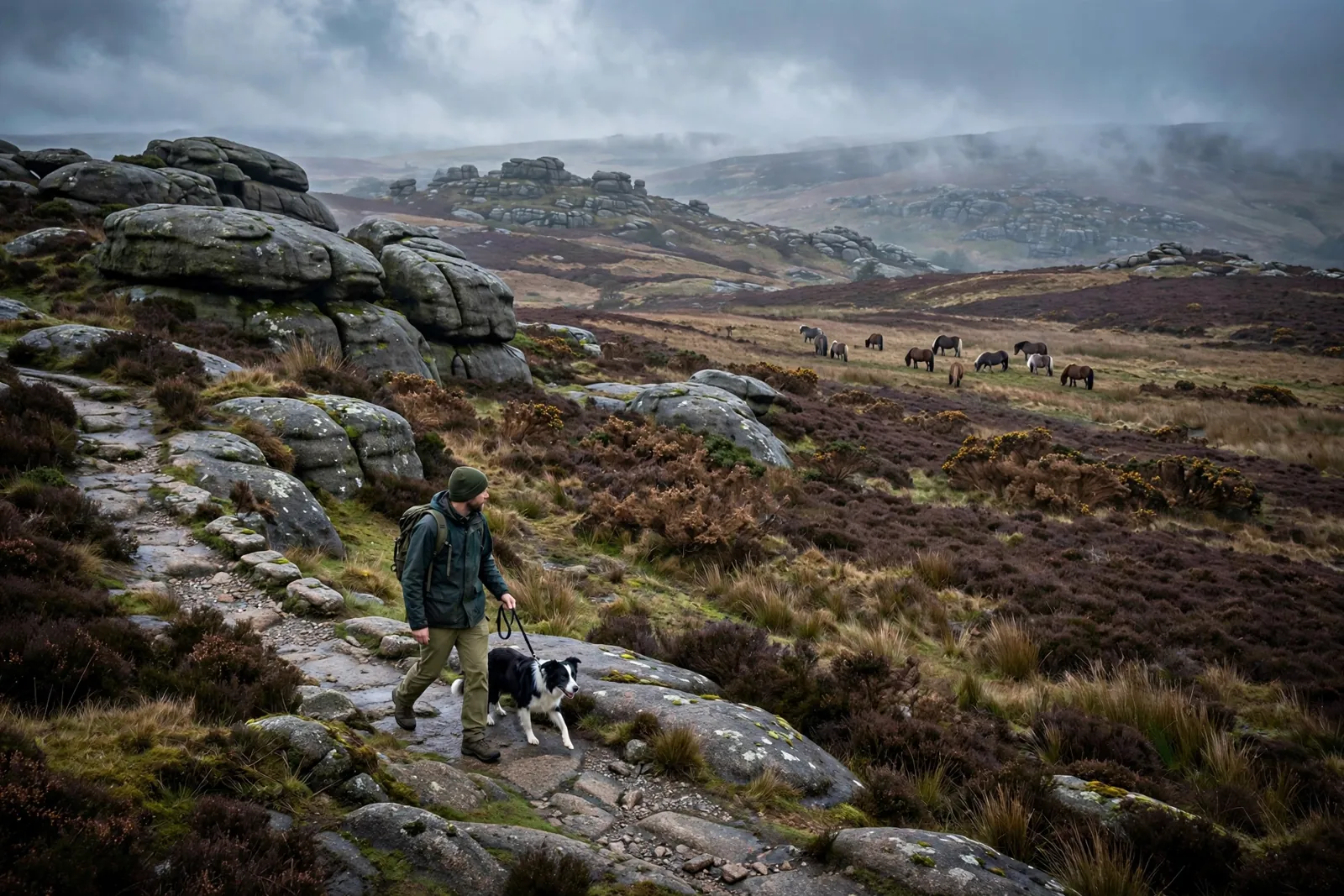
For dogs, Dartmoor adds its own hazards on top of the legal ones. The moor is grazed by free-roaming ponies, cattle and sheep, and dogs must be kept under close control at all times and on a lead near livestock — this is not a courtesy, it is a byelaw-backed expectation and a basic safety rule. Ponies can kick, cattle with calves can be defensive, and a dog that chases a pony can be injured in seconds. Adders are present in warm weather, bogs can swallow a leg, and the weather can change from sunshine to driving rain in an hour. Our Dartmoor dog walks guide covers tor routes, pony and livestock rules, firing times and river safety in more detail, and it is worth reading alongside this one before a first moorland night. A dog that is reliable off lead on a suburban path is not automatically reliable among ponies on open moor, so plan the first Dartmoor camp as a test: a short walk in, an early pitch, and a lead kept on until you know how your dog reads the place.
Scotland: access rights and responsibilities
Scotland's access rights are generous, and they are also conditional. The Land Reform (Scotland) Act 2003 gives everyone a right of responsible access to most land and inland water, and the Scottish Outdoor Access Code explains what “responsible” means in practice: respect the interests of other people, care for the environment, and take responsibility for your own actions. Wild camping is part of that access, which is why Scotland is the destination most British wild campers have in mind. But the right is not a right to camp anywhere, anyhow. It does not cover houses and gardens, school grounds, playing fields, intensively managed farmland, construction sites or land where access would cause unreasonable interference — and it comes with the expectation that you will camp away from buildings and roads, keep numbers small, stay only two or three nights in one place, and leave no trace.
The most important local exception sits in Loch Lomond and the Trossachs, where camping management zones operate during the busier months, roughly March to September. In those zones you need a permit to camp, and the number of permits is limited, so a spontaneous arrival in high summer may find no legal pitch at all. The zones exist because the loch shores were being damaged by sheer volume — fire scars, litter, human waste and trampled ground — and they are a reminder that access rights survive only if campers behave well enough to keep them. Elsewhere in Scotland the same principle applies informally: if a glen is already crowded with tents, move on rather than adding to the pressure, and if a sign asks you not to camp in a particular spot, respect it even if you think you know the law better than the sign.
Dogs fit into the Scottish picture in much the same way as people: they are welcome where access is welcome, provided they are under control. That means a lead around livestock at all times, close control near ground-nesting birds during the breeding season, and no chasing of wildlife or farm animals. The access code is explicit that dogs should not be allowed to worry livestock, and farmers have strong rights to protect their animals. In practice, the Scottish hills are often grazed by sheep even where there is no fence in sight, so the default on a wild camp should be a lead on or a dog at heel, not a dog ranging half a mile ahead. Carry water for the dog rather than assuming every burn is safe to drink from — agricultural run-off, dead animals upstream and algal blooms in still water are all real risks — and remember that midges, ticks and cold, fast rivers are part of the Scottish summer too.
Choosing a pitch with a dog
A good wild pitch is chosen twice: once on the map and once on the ground. On the map, look for unenclosed, open ground well away from houses, roads, car parks, farm buildings and enclosed fields, with a water source nearby but not so close that you are camping on a riverbank. In Scotland that means checking you are outside any camping management zone that needs a permit; on Dartmoor it means checking the permitted camping areas; everywhere else it means checking that you have permission or are on a site. Look at the contour lines, not just the path: a flat-looking spot on a map can be a bog, a frost hollow or a wind tunnel, and a dog that is cold and wet at 2am will not care how pretty the view was at sunset.
On the ground, walk the spot before you commit. Check the ground underfoot — dry, level, free of sharp stones and animal droppings, and not a hollow where cold air and water will pool. Look up for dead branches and look around for livestock, fresh dung, rabbit holes a dog could put a leg down, and ground-nesting birds that will spend the night alarming at your tent. Keep at least a sensible distance from water: close enough to fetch it, far enough that a dog cannot wander into a fast river in the dark, and far enough that you are not trampling a fragile bank. Avoid camping on a path, at a path junction, or in the middle of a view that other walkers have come to enjoy — a wild camp should be discreet, and a barking dog in the middle of a popular viewpoint is neither.
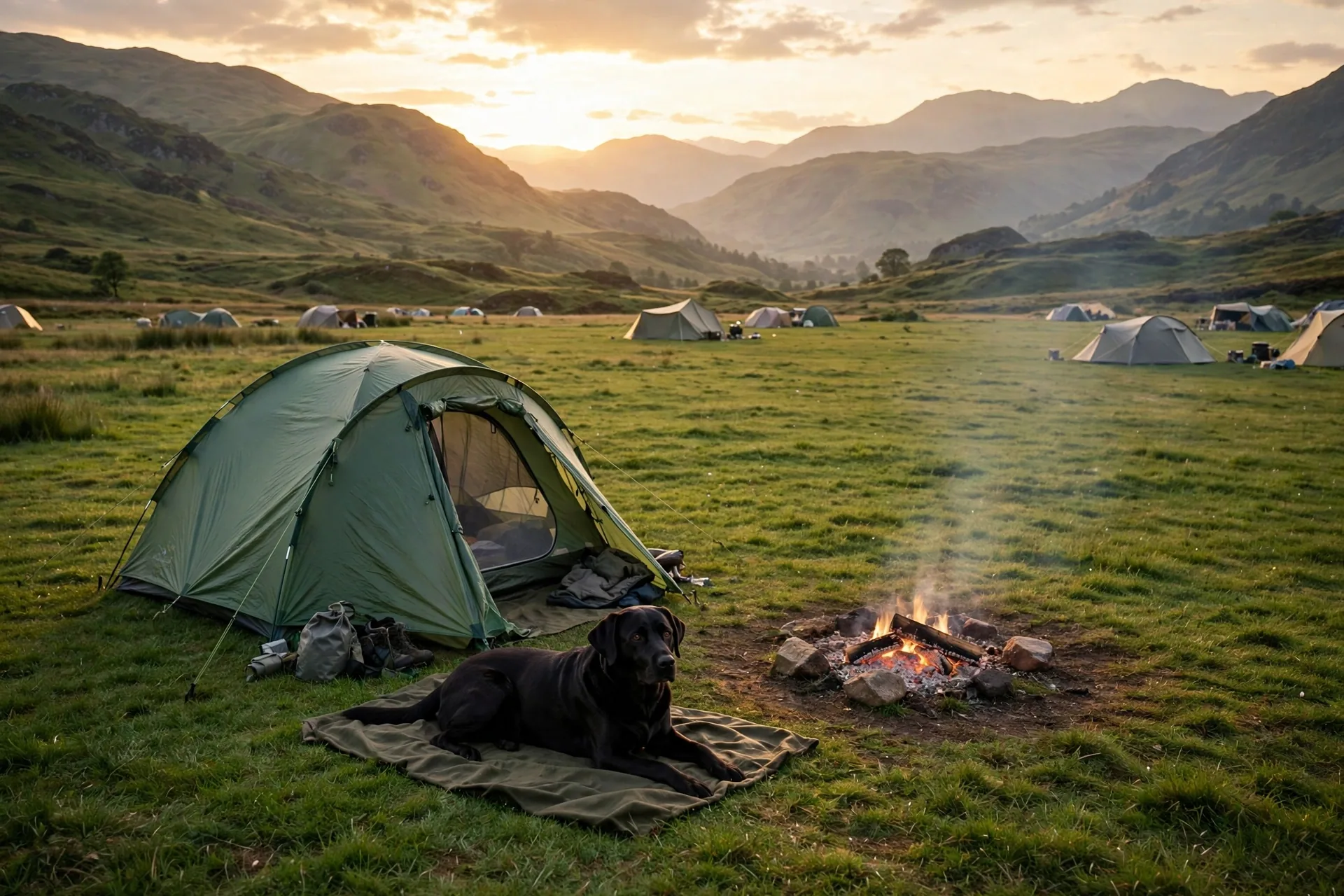
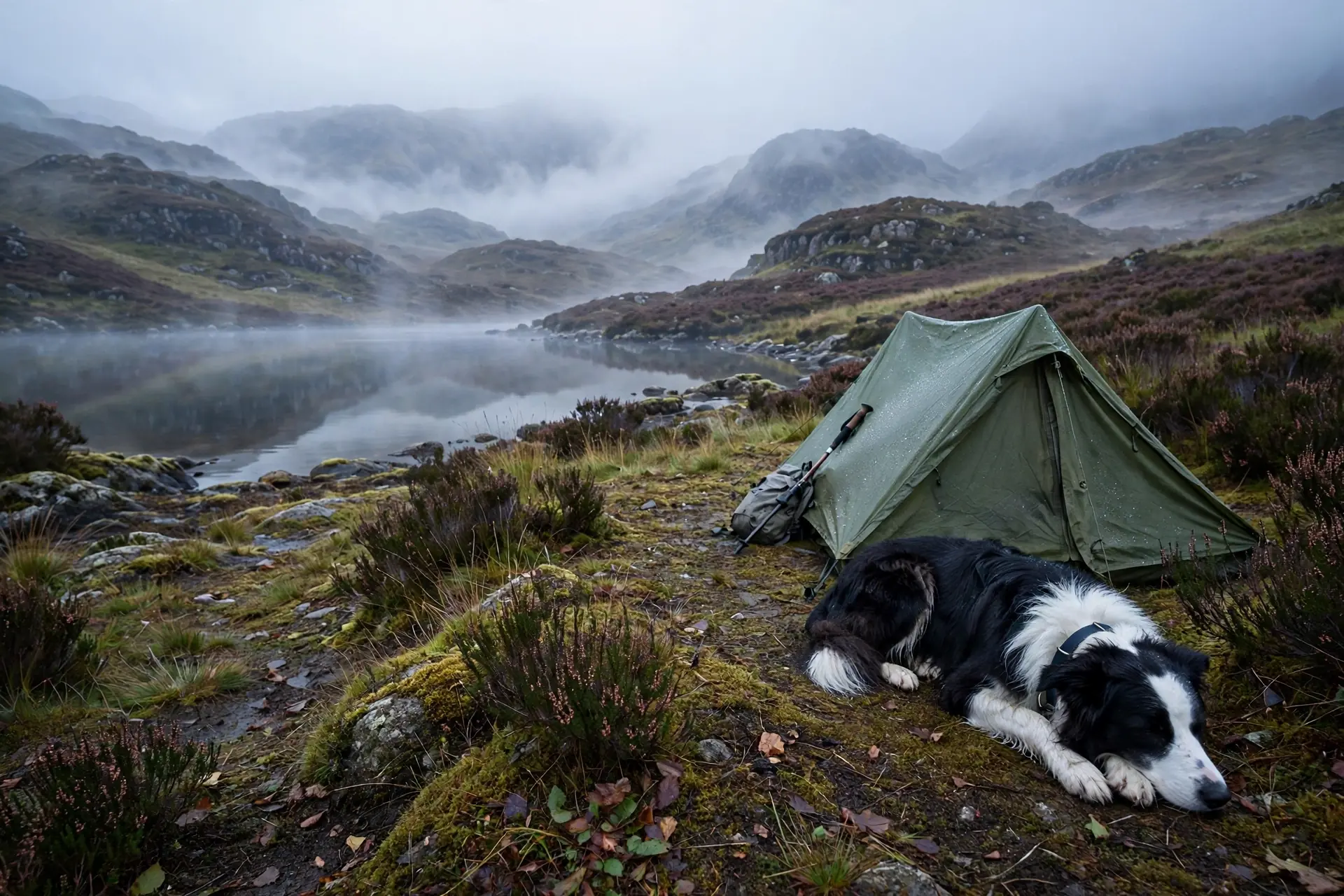
Think about the dog's night, not just your own. A dog that can see the tent door and lie on a familiar mat will settle far faster than one shut in a porch it cannot see out of. Pitch with the door facing away from the prevailing wind and away from the path, so the dog is not startled by every passer-by, and give the dog a defined sleeping spot inside the tent from the first minute — mat down, blanket on, lead clipped to a fixed point, water bowl within reach. If your dog is a barker, a nervous dog, or a dog that has never slept in a tent, choose a pitch further from other people and accept a longer walk in exchange for a quieter night. The best pitch is often the boring one: flat, sheltered, unremarkable, and a little further from the water and the path than the Instagram spot.
Leave no trace — and deal with dog waste properly
Leave No Trace is not a slogan for wild camping; it is the deal that keeps wild camping possible. Every fire scar, every buried wet wipe, every bag of dog waste hung from a branch is an argument for the next restriction, and in the most pressured places those restrictions have already arrived. The seven principles — plan ahead, travel on durable surfaces, dispose of waste properly, leave what you find, minimise campfire impact, respect wildlife and be considerate of others — apply in full, and the dog adds a layer to almost every one of them. A dog that digs, chases, barks through the night or fouls a water source is not leaving no trace, however carefully you packed your own rubbish.
Dog waste deserves its own paragraph because it is the item most often handled badly. Bag it and carry it out, every single time, in every nation, in every season. Do not bury it: dog faeces carry parasites such as Toxocara and bacteria that survive in soil, harm livestock and wildlife, and contaminate water, and burial does not neutralise them. Do not leave the bag beside the path “to collect on the way back”, because the way back rarely happens and the bag becomes litter. Do not hang it from a tree. Carry a dedicated, sealable container — a wide-mouth dry bag or a lidded tub — plus more bags than you think you need, and dispose of everything in a proper bin at the end of the trip. If your dog toilets near water, move it away and clean up thoroughly; a single fouling near a burn can affect the water for everyone downstream.
Your own waste needs the same discipline. Bury human waste at least 15 centimetres deep and well away from water, paths and camp, and carry out all toilet paper and hygiene products — wet wipes do not biodegrade on a hillside, whatever the packet says. Wash yourself and your dishes at least 30 metres from water, using as little soap as possible, and scatter the grey water widely rather than pouring it in one spot. Food scraps go in your rubbish bag, not on the ground: they attract rats, crows and foxes, and a fox visiting your pitch at 3am is a very different experience from a fox seen from a path. Before you leave, walk the pitch in a slow spiral, checking for tent pegs, guy-line fragments, food wrappers, dog waste bags and anything else small enough to miss — and check the ground where the dog slept, which is where most forgotten items turn up.
Night, weather and a dog that will not settle
Night is when a wild camp is won or lost, and dogs experience it very differently from their owners. Your dog can hear and smell far more than you can: deer moving through the bracken, sheep shifting in the next field, another camper's dog fifty metres away. Some dogs find that thrilling and settle quickly; others spend the night on high alert, whining at every sound, and keep you awake until dawn. The single best preparation is a trial run at home: pitch the tent in the garden, sleep in it with the dog, and find out whether your dog treats a tent as a den or a trap before you discover the answer on a hillside in the rain.
Weather is the other variable that turns a pleasant evening into a hard night, and British weather is famously capable of changing its mind. Check the forecast for the specific hill or glen, not just the nearest town, and plan for wind and rain even when the morning looks kind. A small tent in a 40 mph gust is a different proposition from the same tent in a sheltered valley, and a dog that is wet, cold and frightened will not be comforted by your optimism. Pack a drying coat or towel for the dog, keep a dry layer of bedding in a waterproof bag, and know where the nearest shelter and the nearest road are before dark. If the forecast turns genuinely dangerous — high winds on an exposed ridge, lightning, or a river in spate on your exit route — the right decision is to not go, or to walk out early. No night under canvas is worth a dog's safety.
If the dog will not settle, resist the urge to solve it with activity. Keep the tent dark, keep your voice low, and give the dog a long-lasting chew or a stuffed food toy to work on quietly. A lead clipped inside the tent stops a restless dog from pushing through the door at 2am, and a familiar-smelling blanket does more than any new gadget. Do not let the dog out alone at night: even a well-trained dog can chase a deer, fall into a bog or get tangled in fencing in the dark, and finding a lost dog on open moorland at night is a miserable and sometimes dangerous job. If the dog is genuinely distressed — shaking, panting, refusing to lie down for hours — take it seriously rather than waiting it out: pack up and walk out if you need to, and treat the trip as a lesson about your dog's limits rather than a failure.
Kit list: the dog
Your dog needs a kit list of their own, and it is longer than most people expect. Start with the basics that keep a dog safe and comfortable overnight: a properly fitted harness and lead, a long line for controlled freedom at camp, a familiar sleeping mat or blanket, and enough food for the trip plus one extra meal in case you are delayed. Measure food into sealed bags before you leave — guessing portions on a hillside in the rain is a good way to underfeed a dog that has walked further than usual — and carry a collapsible bowl, or two: one for food, one for water. A dog that has worked hard, climbed and carried its own excitement all day will drink more than it does at home, so do not assume a stream will cover it.
Warmth and dryness matter more than most owners plan for. Even a thick-coated dog loses heat when it lies on cold, damp ground, and a wet dog in a small tent will chill fast once it stops moving. Pack a drying towel or a lightweight drying coat, a spare blanket, and a waterproof ground layer for the dog's sleeping spot. In midge season, a light dog coat can also reduce bites, and in tick country a tick remover and a quick daily check are non-negotiable — run your hands over the ears, armpits, groin and between the toes every evening, and remove any tick promptly with the proper tool. Add a small first-aid kit for the dog: paw balm or booties for rough ground, saline wipes, a bandage, tweezers, any regular medication, and the phone number of the nearest vet, saved before you lose signal.
- Harness, lead and long line: a secure harness that cannot be slipped, a short lead for paths and livestock, and a long line for camp.
- Sleeping mat and blanket: familiar-smelling, insulated from the ground, and big enough for the dog to stretch out.
- Food and bowls: pre-measured meals plus one spare, a collapsible food bowl and a water bowl, and water carried in.
- Drying coat and towel: for rain, river crossings and cold evenings; keep one dry layer in a waterproof bag.
- Waste kit: plenty of poo bags, a sealable container, hand sanitiser and a small trowel for your own waste.
- First aid and tick kit: tick remover, paw balm, bandage, saline wipes, medication, and the nearest vet's number.
- Identification: a tag with your mobile number, a microchip that is up to date, and a recent photo of your dog on your phone.
Identification deserves emphasis because a lost dog on a wild camp is the emergency nobody plans for. A dog should be microchipped by law and wearing a tag with your phone number, and your phone should carry a recent, clear photo showing the dog's markings. If your dog is the sort that might bolt after deer, consider a GPS tracker — not as a substitute for a lead, but as a backup for the moment a lead fails. Tell someone your route and your expected return time before you go, and agree what they should do if they do not hear from you. That one message costs nothing and is the difference between a search that starts in hours and one that starts in days.
Kit list: you
Your own kit follows the same principle as the dog's: carry what keeps you warm, dry, fed and able to navigate, and leave the rest behind. A wild camp is a walk with a night in the middle, so weight matters — every extra kilogram is carried up every hill twice — but skimping on warmth or waterproofs is a false economy, especially when you are responsible for a dog as well as yourself. The non-negotiables are a tent, a sleeping bag rated for the temperatures you will actually meet, an insulated sleeping mat, a stove and fuel, water and a way to treat it, waterproofs, warm layers, a head torch, a map and compass, and a phone charged enough to call for help.
Navigation deserves a word of its own. Phone signal is unreliable on many British hills, and a phone with a dead battery is not a map. Carry a paper map of the area and a compass, and know how to use them before you need to — a compass in a bag you have never opened is decoration. Download offline maps as a backup, keep the phone in a waterproof case, and carry a small power bank if the trip is more than one night. Tell someone your plan, as above, and carry a whistle: three blasts is the recognised distress signal, it carries further than a shout, and it works when your voice gives out.
Clothing is a system, not a pile. Pack a waterproof jacket and trousers, a warm insulating layer, a hat and gloves even in summer, and spare dry socks sealed in a waterproof bag — wet feet are the fastest route to blisters and misery on a multi-day walk. Eat properly: a hot meal at the end of the day matters more than a fancy one, and a stove that works in wind is worth more than a stove that is merely light. Carry enough water for the evening and the morning, and treat water from streams and lochs before drinking it, because even clear upland water can carry bacteria from livestock upstream. If you are unsure about a source, check the official guidance before you travel, and carry more water than you think you need rather than less.
Kit list: the camp
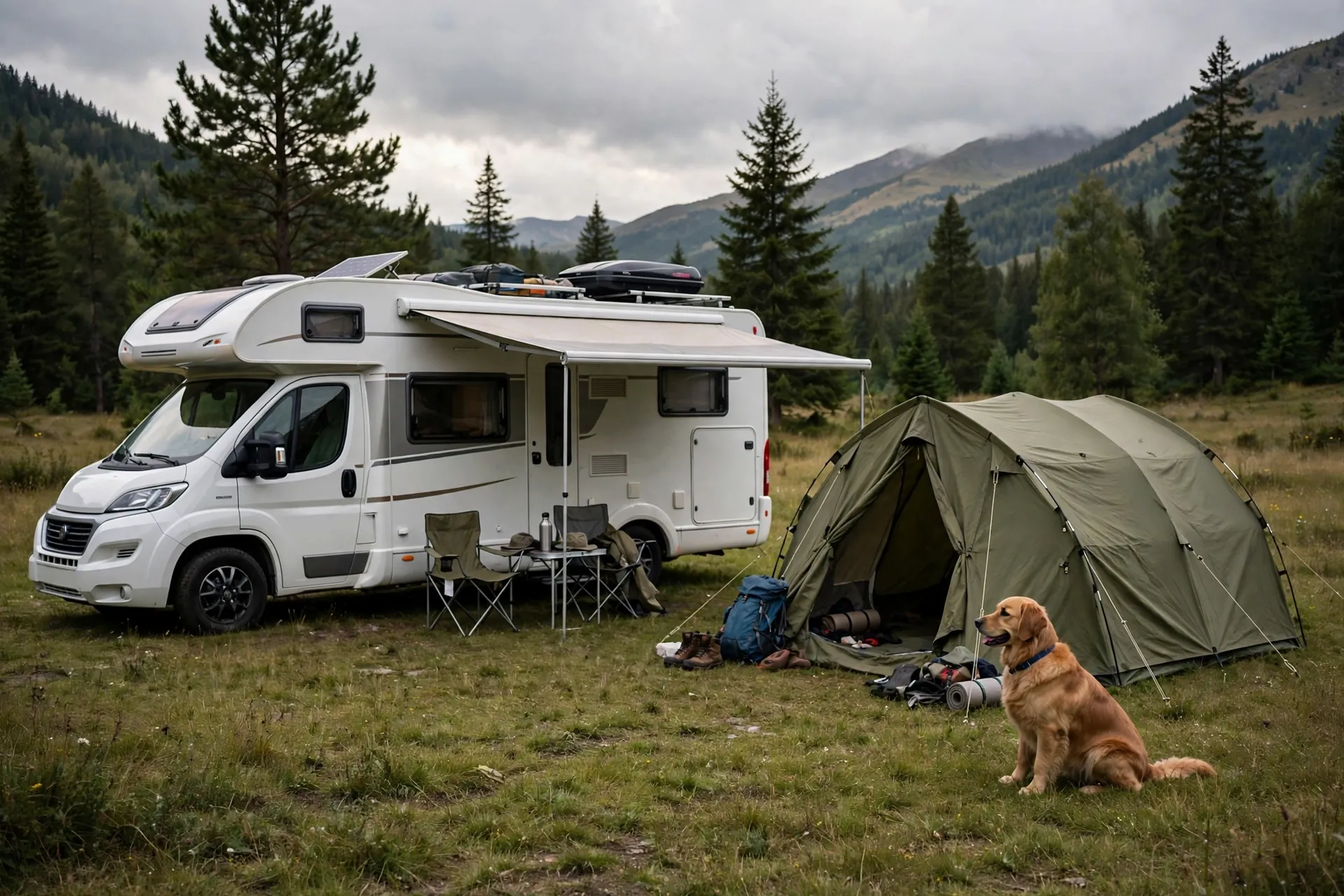
The camp itself is the third list, and it is where lightweight discipline pays off. Your tent should be big enough for you and the dog to sleep without the dog lying on your sleeping bag, and small enough to pitch discreetly — a two-person tent is usually the right size for one person and a medium dog, while a large family tent is the wrong tool for wild camping entirely. Practice pitching it at home until you can do it in the dark and in the wind, because your first attempt should not be on a hillside at dusk with a wet dog pulling at the lead. Carry spare pegs and a repair kit, and know how to guy the tent out properly: most tents that fail in wind fail because they were pitched badly, not because they were badly made.
Cooking and light are simple but worth planning. A small gas stove with a windshield, a lighter and a spare ignition source, a single pot, a mug and a spork will cover most wild-camp meals, and a head torch with a red-light mode lets you move around camp without blinding the dog or ruining your night vision. Keep food in sealed bags and store it away from the tent door at night — not because of bears, which Britain does not have, but because of foxes, rats and badgers, which are perfectly capable of investigating a food bag left in a porch. Hang nothing from trees and leave nothing out overnight; the tidy camp is the one that does not get visited.
- Tent: small, low-profile, practised at home, with spare pegs, guy lines and a repair kit.
- Sleep system: sleeping bag rated for the season, insulated mat, and a dry bag to keep it all dry.
- Stove and fuel: a wind-resistant stove, enough fuel for hot food and drinks, lighter plus a spare.
- Water: bottles or a bladder, a filter or purification tablets, and a collapsible container for camp.
- Light and navigation: head torch with spare batteries, paper map, compass, offline maps and a whistle.
- Repair and hygiene: tent repair tape, a multi-tool, sun protection, hand sanitiser and a small rubbish bag.
Weight is the honest constraint on all three lists. A common beginner error is to pack for every imaginable emergency and end up carrying a bag so heavy that the walk itself becomes the problem — and a tired owner makes worse decisions about the dog, the route and the weather. Lay everything out before you pack, weigh the bag, and remove one item you packed “just in case” for every item you are unsure about. If you are new to this, our camping with a dog guide is a gentler starting point: it covers choosing a site, tent setups, lead rules, sleeping arrangements and packing for a first trip on a proper campsite, where a mistake costs a bad night rather than a rescue.
If you are asked to leave
Being asked to leave is part of wild camping, even for careful campers. You may have misread a boundary, pitched on land whose owner you could not identify, or camped in a spot that is closed for lambing, nesting or shooting. The landowner, farmer, gamekeeper or ranger who approaches you is not your opponent; they are someone whose land, livelihood or job you have affected, and the way you respond in the first thirty seconds decides whether the conversation ends with a polite exit or a lasting complaint. Stay calm, apologise, and pack up without arguing — even if you believe you are in the right, the hillside at midnight is not the place to litigate access law.
Do not try to negotiate your way into staying the night. Thank them, ask politely which way to walk out if you are unsure of the route, and leave promptly and quietly, taking all your rubbish and dog waste with you. If the dog has been the problem — off lead near livestock, barking, fouling — say so honestly and do not make excuses. Note the location and the reason so you do not repeat the mistake, and if you were genuinely unsure of the rules, check the official guidance before you travel next time rather than assuming the encounter was a one-off. A courteous exit costs you an hour; an argument can cost the next hundred campers their welcome.
There is one exception to the “leave quietly” rule, and it matters: if you or your dog are in genuine danger — an aggressive animal, a medical emergency, weather that makes moving unsafe — say so clearly, ask for help, and stay where you are until it is safe to move. Safety overrides etiquette. In every other case, move on. If you believe you were asked to leave from land where you had a genuine right to be, note the details and raise it later through the proper channels — the access authority, the national park, or the relevant countryside body — rather than on the spot. Keep a record of where you camped, what was said, and what you did next; it protects you and it helps the next person who asks the same question.
Common mistakes to avoid
The first mistake is treating wild camping as free camping. It is not free: it is a privilege in Scotland, a conditional exception on Dartmoor, and a matter of permission everywhere else, and treating it as a right you can assert anywhere is how access gets restricted for everyone. The second is overestimating the dog. A dog that is perfect on a lead in a park, or off lead on a familiar beach, may be a different animal among sheep, ponies, deer and open water. Test the dog on short, controlled trips before committing to a remote night, and keep the lead on until the dog has proved itself in that landscape, not merely in a different one.
The third mistake is underestimating the weather and the ground. British hills are cold, wet and windy even in summer, and a tent that is fine on a sheltered campsite can be miserable on an exposed ridge. Check the forecast for the hill, not the town; check the ground for bog and drainage; and carry the layers, the drying kit and the exit plan that turn a bad night into an inconvenience rather than an emergency. The fourth is the quiet one: waste. Dog waste left behind, human waste buried too shallow or too close to water, wet wipes in a shallow scrape, food scraps scattered for the birds — each is small on its own, and together they are the reason management zones, permits and bans exist.
Finally, do not make the trip about the photograph. The prettiest pitch — the loch shore at dawn, the tor at sunset — is often the most exposed, the most visited and the most fragile, and a dog barking at every walker who comes to enjoy the same view is not a wild-camping success. Choose the boring pitch, the early night, the quiet dog and the clean getaway, and the landscape will still be there for the next trip. Wild camping with a dog works best as a low-key habit rather than a grand adventure: short distances, early pitches, small footprints, and a dog that comes home tired, dry and ready to do it again.
Practical questions
Before you go
Is wild camping with a dog legal in England?
As a general rule, no. In England wild camping is not a legal right, so you need the landowner's permission to pitch a tent. The one well-known exception is parts of Dartmoor, where backpack camping is allowed under the national park byelaws. Everywhere else, camp on a proper site or ask permission first.
Can I wild camp with my dog on Dartmoor?
Yes, in the areas where backpack camping is permitted, and only if you follow the byelaws: small groups, one or two nights in the same spot, no camping near roads, car parks, settlements or enclosed land, and no fires. Dogs must be under close control, on a lead near livestock, and you must take all dog waste away with you.
Is wild camping legal in Scotland with a dog?
Yes, in most cases. Under the Land Reform (Scotland) Act 2003 and the Scottish Outdoor Access Code, you may camp on most unenclosed land as part of responsible access, away from houses, gardens and crops. Some areas, such as parts of Loch Lomond and the Trossachs, have camping management zones with seasonal permit rules, so check the official guidance before you travel.
What should I do with my dog's waste when wild camping?
Bag it and carry it out, every time. Do not bury it, leave the bag by a path, or hang it from a tree. Dog waste carries parasites and bacteria that harm livestock, wildlife and water, and it breaks down far more slowly than most people assume. Pack spare bags, a sealed container and hand sanitiser, and dispose of the bags in a proper bin at the end of the trip.
What if a landowner asks me to move on?
Move on calmly, politely and promptly. Thank them, pack up without arguing, and do not return to the same spot. You have no right to stay on private land without permission, and a courteous exit protects access for the next camper and their dog. Note the location so you do not pitch there again, and treat the experience as a reminder to check permission next time.