This guide is independent and contains no paid placement. If affiliate links are added later, they will be clearly marked and will not change our editorial checks.
A motorhome wins on bad weather, night toilets and drying space, but costs far more and suits dogs that settle in a small, hard-floored box. A tent wins on price, space and the feeling of being outside, but every rainy night, midnight toilet trip and bark carries further. Choose by your dog's night, not by the daytime photo.
One night, two ways
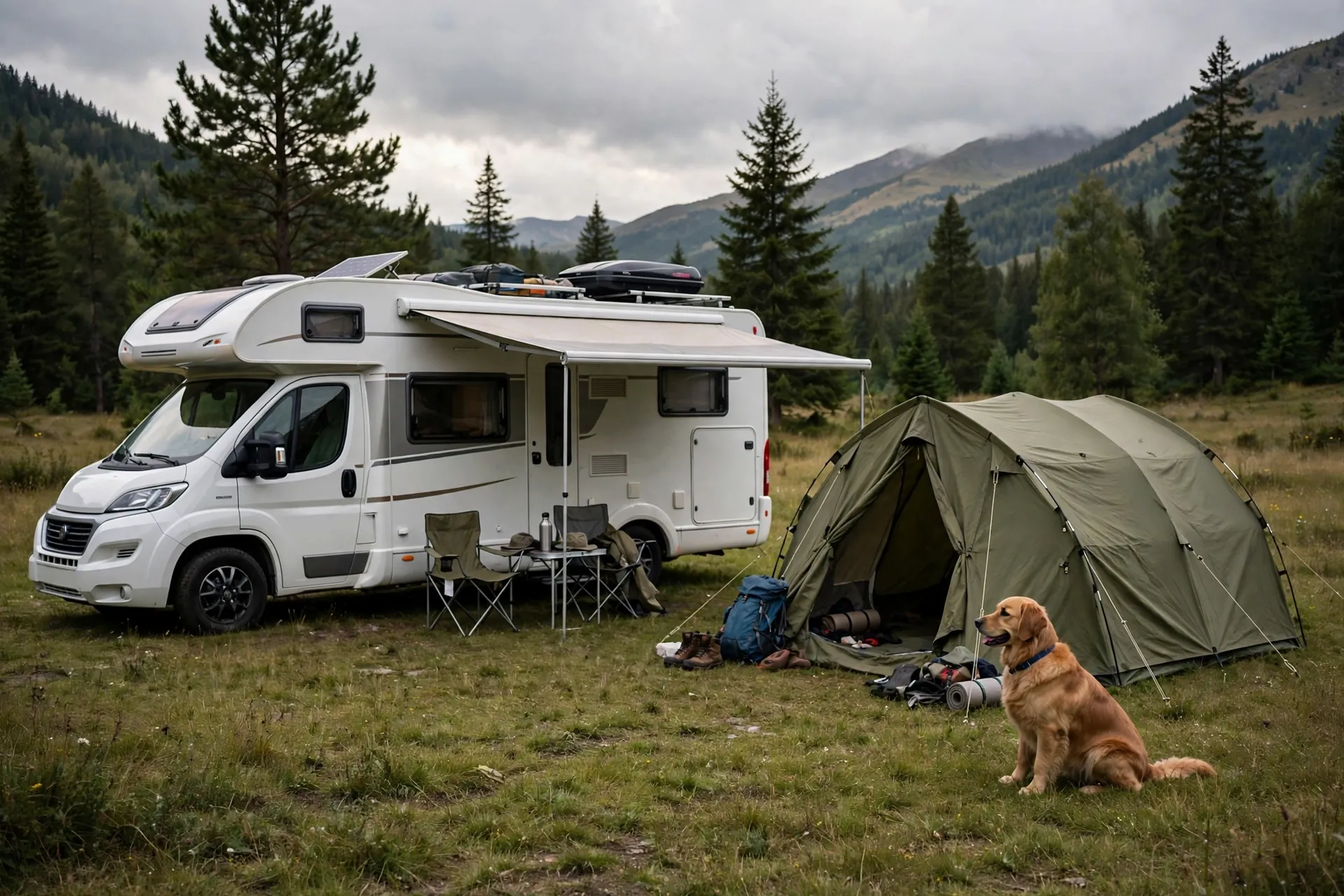
Picture the same dog, the same field and the same drizzly evening, played out twice. In the motorhome version, the evening ends indoors: the door shuts, the kettle goes on, the dog dries on a mat by the heater vent, and the bed is already made. In the tent version, the evening ends in a porch: boots off, towels out, a damp dog shaken dry in a space barely wider than a hallway, and a night spent listening to every gust, footstep and neighbouring zip. Neither version is wrong. They simply ask different things of the dog, and of the humans looking after it.
That is why this comparison is organised around a night rather than a spec sheet. Daytime camping with a dog is easy in both setups: the dog walks, sniffs, eats and naps wherever you put it. Night is when the differences show up. Temperature drops, bladders fill, noises multiply and the dog's ability to settle becomes the whole holiday. If a dog sleeps badly, the next day's walk is shorter, patience is thinner and the humans sleep badly too. A setup that looks charming at noon can be a poor choice at 2am, and that is the test worth applying before money changes hands.
The three questions that matter most are simple. First, where does the dog sleep, and does that place stay warm, dry and quiet enough for this particular dog? Second, what happens at midnight when the dog needs the toilet, and how far, how wet and how exposed is that trip for everyone involved? Third, what happens when the plan breaks — rain all day, a barking neighbour, a dog that will not settle — and does the setup give you somewhere to retreat, or does it leave you with nowhere to go? Answer those three honestly and the motorhome-versus-tent decision mostly makes itself.
Cost still matters, and it is covered properly later in this guide, but cost alone is a misleading guide. A cheap tent that leaves an anxious dog awake all night is not a bargain, and an expensive motorhome that a large dog cannot stretch out in is not a luxury. The right comparison weighs three things together: how well the dog adapts, what the whole setup truly costs, and how it copes when the weather turns. Keep those three in mind as each section below works through the night, the kit and the fallback.
Sleep: where the dog actually settles
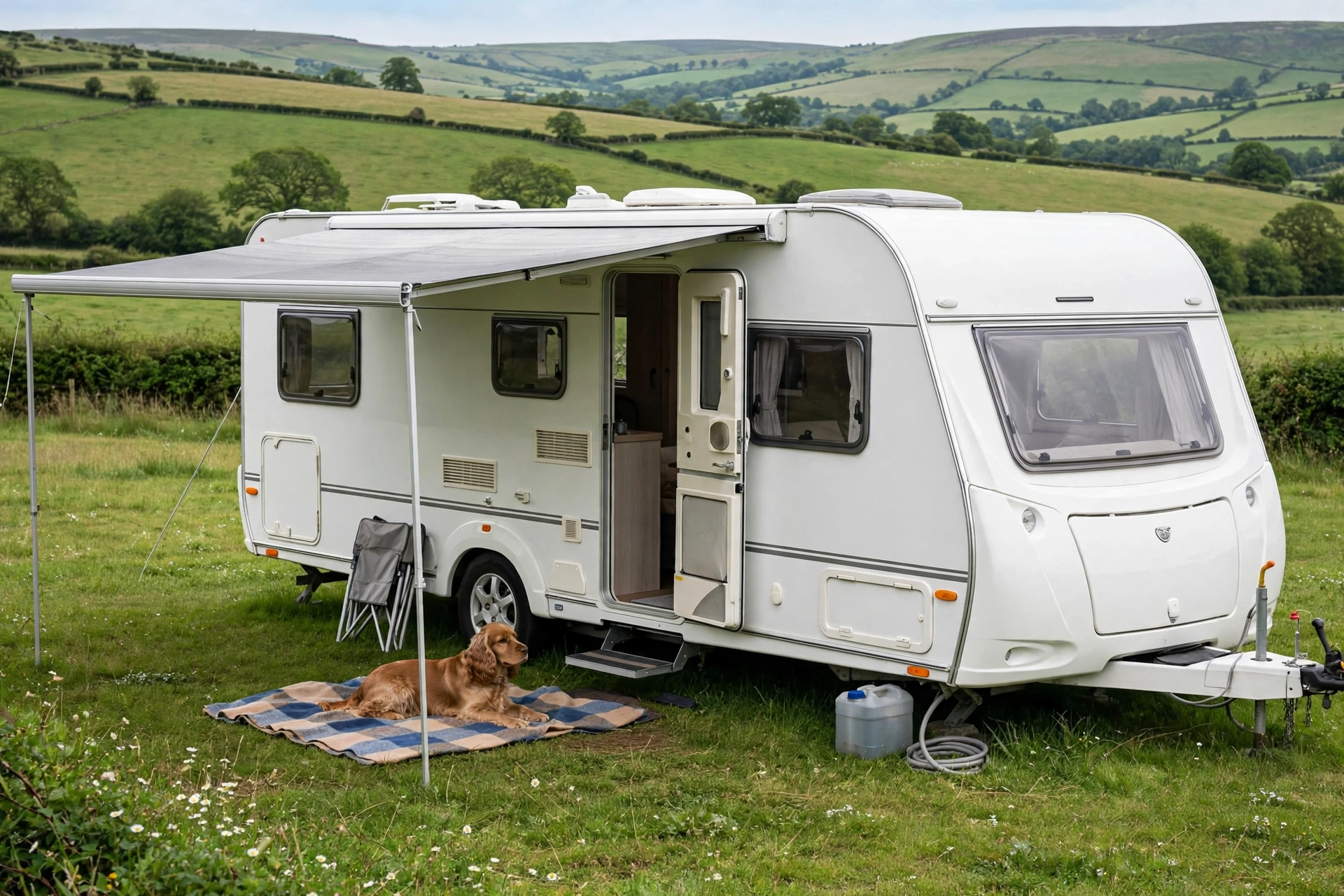
In a motorhome, the dog sleeps in a small, enclosed, hard-floored space with a solid door between it and the outside world. That enclosure is a genuine advantage for many dogs. Sound is muffled, smells are contained, the temperature is steadier, and the dog can learn one fixed sleeping spot — a bed beside the dinette, a crate secured against a wall, or a mat in the footwell — that stays the same every night of the trip. Dogs that settle by routine tend to do well here, because the motorhome itself becomes the routine: same bed, same smell, same small territory, wherever the vehicle is parked. For nervous dogs, that sameness is calming in a way that a new tent pitch every few days is not.
The limits of motorhome sleep are space and heat. A large dog may not be able to stretch fully on the floor between furniture, and a dog that likes to sprawl will end up curled against a cupboard door all night. Ventilation matters more than people expect: a sealed motorhome with a warm dog, damp coats and a gas heater can grow stuffy fast, so a cracked roof vent or a small fan is part of the sleeping setup, not an optional extra. In summer, a parked motorhome heats up quickly during the day, and although evenings cool down, the residual warmth can keep a thick-coated dog panting well past bedtime. Parking in shade, using reflective screens and opening vents early all help, but the fundamental fact remains that a motorhome is a metal box, and metal boxes hold heat.
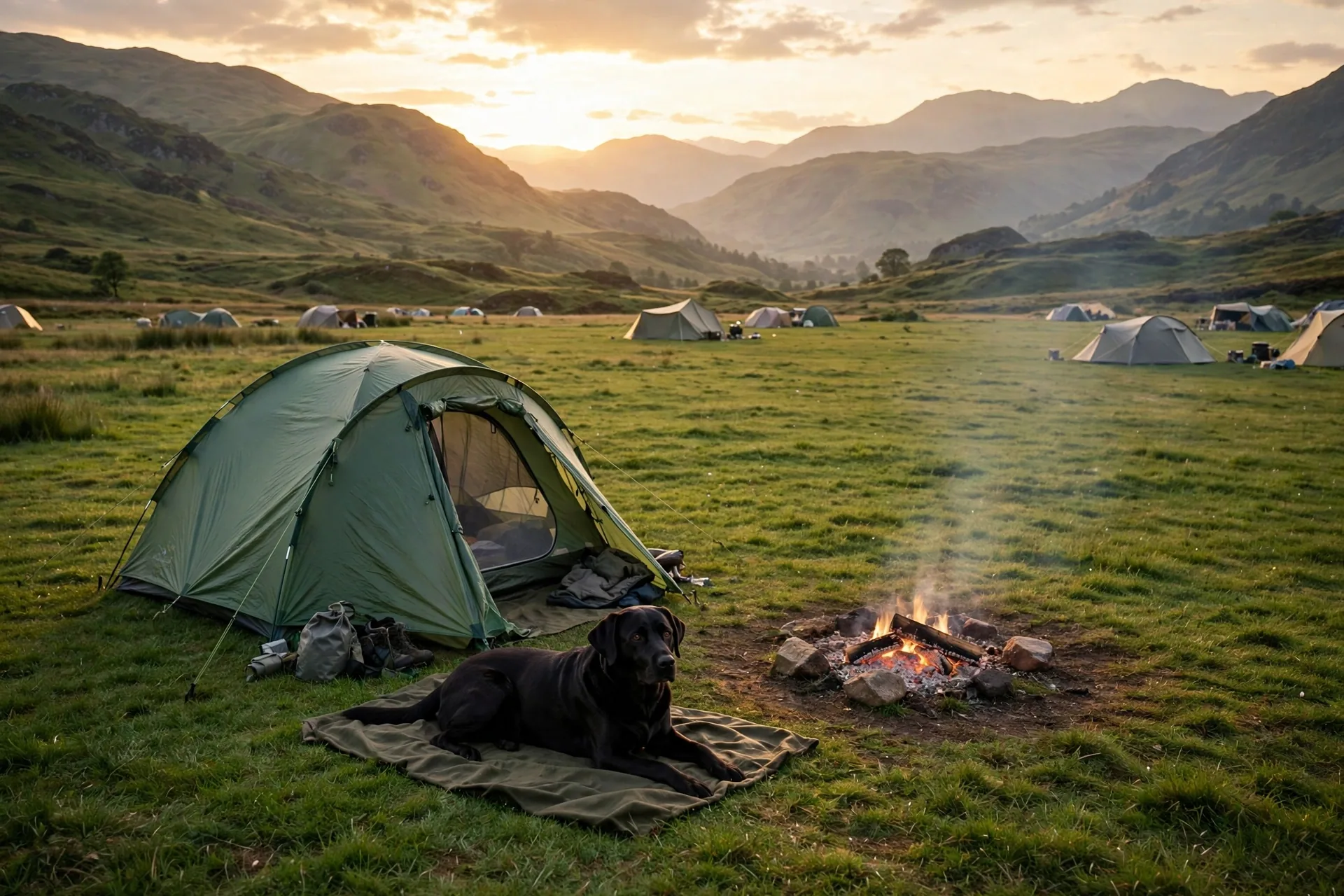
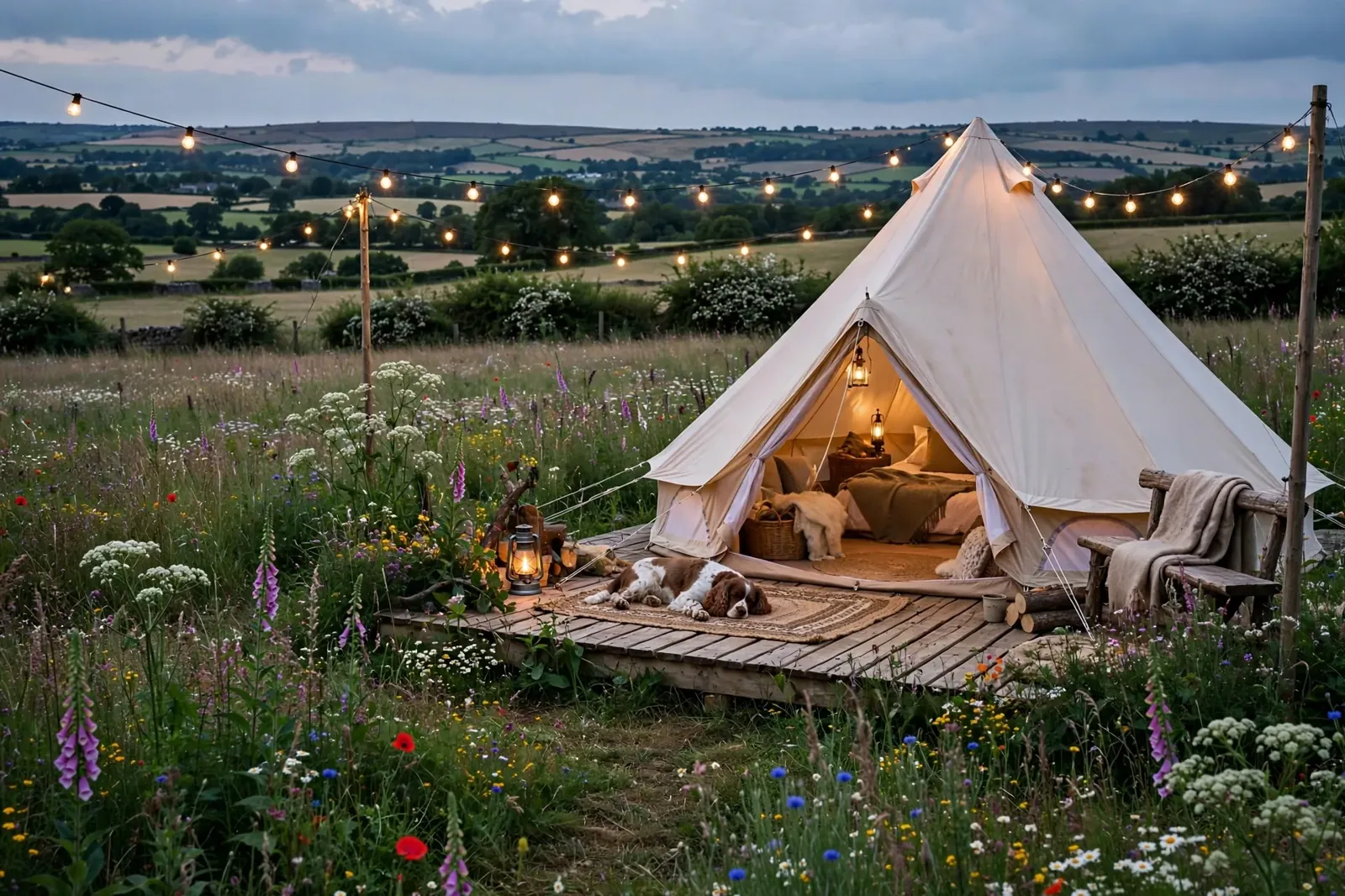
In a tent, the dog sleeps on the ground, closer to the sounds, smells and temperature of the field itself. For confident, outdoorsy dogs this is often a delight: they can hear the night, smell the grass and settle in a space that feels open rather than confined. A good tent setup gives the dog its own defined sleeping zone — an insulated mat, a familiar blanket and a bed that smells of home — inside the inner tent, away from the porch and the door. Dogs that already sleep in a crate at home often transfer well to a fabric crate inside a tent, because the crate, not the tent, is what signals bedtime to them. If your dog has a strong bed routine, bring the bed, not just a replacement, because familiarity is doing more work than the fabric.
The tent's weakness is insulation and noise. Ground cold creeps up through even a good sleeping mat, and a thin tent wall does nothing to soften the 5am chorus of birds, the neighbouring camper's alarm or a fox crossing the field. Light sleepers, young dogs and dogs that alert-bark at sounds will have a harder night in a tent than in a motorhome, and there is no door to close against the world — only a zip. Rain drumming on a flysheet is soothing to some dogs and deeply unsettling to others, and you will not know which kind yours is until the first wet night. If your dog is noise-sensitive, a practice night in the garden, with the tent pitched and the household going about its evening, is worth more than any amount of reading. For more on building that bed routine, see our guide to choosing a travel dog bed before you buy anything new.
Age and health tilt the sleep question further. Older dogs with stiff joints struggle with the step up into a motorhome and with cold ground in a tent, so a ramp for the vehicle and a thick, supportive mat for the tent are not luxuries. Puppies wake more often, chew more and need more frequent toilet trips, which makes the tent's easy exit an advantage and its thin walls a problem. Lean, short-coated breeds lose heat quickly in a tent and may need a dog sleeping bag or an insulated jacket indoors at night, while thick-coated breeds overheat faster in a motorhome. There is no universal winner here; there is only your dog's coat, age, joints and temperament, matched against two very different bedrooms.
Toilets: the midnight test
Every camping dog needs a last outing before bed and, sooner or later, a midnight one. In a motorhome, that trip means unlocking a solid door, stepping down, clipping on a lead and walking to the site's toilet area or a designated dog spot. It is quick, sheltered at the start and end, and the dog returns to a warm, dry interior. The awkward part is the middle: site toilet blocks can be a long walk across an unlit field, and some sites keep dogs out of the central facilities area, so the practical toilet spot may be a grassy edge rather than the block itself. Check the site map before booking and ask where dogs are expected to toilet after dark, because a site that is perfect by day can be a long, muddy expedition at midnight.
In a tent, the midnight toilet trip is shorter to start and harder to finish. The dog is already at ground level, the door is a zip, and the nearest grass is steps away. That sounds ideal until it rains. Then the trip means waking fully, finding a torch, pulling on waterproofs over pyjamas, unzipping a wet porch, standing in the rain while the dog sniffs for the perfect spot, and returning to a tent where everything — including the dog — is now damp. Multiply that by two trips a night for several nights and the romance of tent camping wears thin. A porch with room to towel the dog down, a dedicated toilet corner near the pitch and a head torch kept by the door turn this from a miserable expedition into a manageable routine, but they do not remove the rain.
Training and habit matter as much as geography. Dogs that toilet on command, or that will go on a short lead on a small patch of grass, cope far better in both setups than dogs that need a long, off-lead wander to get going. Before a camping trip, it is worth teaching a simple toilet cue and practising short-lead outings at home, because a campsite at midnight is the wrong place to discover that your dog will only go after twenty minutes of free running. Puppies, older dogs and dogs on medication may need more frequent trips, and for them the tent's instant access can outweigh its other disadvantages — provided the humans accept the wet-weather cost. If your dog is still learning, our beginner's camping guide covers site choice, lead rules and first-trip routines in more detail.
Hygiene and site rules complete the midnight picture. Always carry bags, even for a midnight trip, and use the site's dog waste bins rather than general litter bins where the site provides them. Some sites fine owners for fouling, and a torch makes the difference between finding the mess and missing it in the dark. In a motorhome, a small sealed bin by the door keeps bags out of the living space; in a tent, a lidded container in the porch does the same job. Neither setup excuses leaving waste on the pitch, and a site that has had fouling problems is a site that may tighten its dog rules for everyone next season. The midnight test is therefore not only about convenience; it is about whether your routine keeps the site welcoming for the next dog that visits.
Alone time: the rule nobody reads
Here is the part of the comparison that surprises most people: in both setups, leaving the dog alone is usually restricted, and in a tent it is often effectively impossible. Most UK campsites state in their terms that dogs must not be left unattended, or may be left only for a short period if they are quiet and crated. The reason is straightforward. A barking dog in a thin-walled tent carries across the whole field, and a barking dog in a motorhome, while quieter, still disturbs neighbours through open windows and vents. Sites enforce these rules because one unsettled dog can ruin a night for dozens of pitches, and repeat complaints can end a stay early. Before booking either setup, read the alone-time rule in writing, not just the marketing line that says dogs are welcome.
The practical difference is what happens when you need to leave the pitch for an hour. In a motorhome, a settled, crate-trained dog can sometimes wait comfortably: the space is secure, the temperature can be managed with ventilation or heating, and the dog has water, a bed and familiar smells. Even then, heat is the hard limit. A motorhome in summer sun can become dangerously hot within minutes, and no owner should rely on an open window or a fan to keep a dog safe. Check the official guidance before you travel on safe temperatures and unattended animals, and never leave a dog in a vehicle you cannot keep cool. In winter the risk reverses: a motorhome cools fast once heating is off, and a dog left for hours in a cold vehicle is a welfare problem as well as a comfort one.
In a tent, leaving the dog alone is a different order of risk. A tent is not secure against a determined dog, nor does it protect a dog from heat, cold or passers-by. A dog that panics can push through a zip or chew through mesh, and a tent offers no locked door between the dog and the rest of the site. Most experienced tent campers simply do not leave the dog alone in the tent at all; they plan days when the dog comes along, take turns staying on the pitch, or choose sites and activities where dogs are welcome throughout. That is a real constraint on the holiday, and it should be priced into the decision just like the cost of the tent. If your trip depends on long dog-free days out — a theme park, a city tour, a restaurant that does not take dogs — a motorhome does not magically solve that either, but it gives you a more secure base and a wider range of nearby options, such as a local dog sitter or a site with a dog-walking service. Check the official guidance before you travel on local rules and services, because these vary by site and season.
Separation anxiety deserves honest attention in both setups. A dog that howls when left alone at home will howl in a motorhome or a tent, and the thinner the walls, the more neighbours will hear it. Camping does not cure separation anxiety, and a first camping trip is the wrong time to test whether a dog can suddenly cope alone. If your dog struggles with alone time, build the trip around togetherness: choose walks, pubs and attractions that welcome dogs, split the group so someone is always with the dog, and keep absences short and practised. A dog that settles happily beside you all day will have a far better holiday in either setup than a dog left alone in a setup that was never designed for it.
The motorhome kit list
Motorhome packing for a dog is less about volume and more about fixing things down. Everything in a moving vehicle becomes a projectile or a chew toy, so the kit list starts with security: a crate or a harness anchor that keeps the dog safe while driving, a non-slip mat for the floor, and storage boxes that stop food, leads and toys sliding around corners. Dogs must travel safely and legally, and a loose dog in the cab is a danger to everyone in the vehicle as well as a distraction for the driver. Check the official guidance before you travel on restraining animals in vehicles, and fit the restraint before the first journey, not at the campsite.
Once parked, the motorhome kit is about turning a small box into a dog-friendly room. Pack the dog's own bed rather than a spare, because the familiar smell settles the dog faster than any new purchase. Add a waterproof mat under the food and water bowls to protect the floor, a lidded bin for used bags, a torch for night trips, and a drying setup by the door: a microfibre towel, a drying coat and a small mat where wet paws can be wiped before they reach the bedding. Ventilation gear belongs on the list too — a roof vent cover that allows airflow in rain, a small battery fan for warm nights, and a thermometer so you can check the interior temperature rather than guessing it. In winter, add a draft excluder for the cab and a blanket for the dog's bed; in summer, add shade screens and a cooling mat.
Food and health kit travels differently in a motorhome. A sealed, airtight container keeps kibble fresh and stops smells attracting attention, and a measured scoop avoids overfeeding on days when walks are shorter than planned. Pack the dog's regular food, not a new brand bought for the trip, and bring enough for an extra day in case the return journey is delayed. Health essentials include any regular medication with its dosage written down, a basic first-aid kit, the vet's phone number saved in two places, and proof of vaccination if the site asks for it. Water deserves a line of its own: carry a bottle and a collapsible bowl for walks, and check whether the site's water points are near your pitch, because a motorhome tank that runs dry at 10pm is an avoidable problem.
The motorhome kit also includes the things humans forget until they need them. A levelling ramp or chock for sloping pitches, a long electric hook-up cable, a freshwater hose, a waste-water container and a basic toolkit all sit alongside the dog's things, and they compete for the same storage space. That competition is part of the motorhome's hidden cost: the vehicle carries everything, but every cupboard given to dog gear is a cupboard lost to human gear. Families with a large dog and two children often discover that the motorhome that looked spacious in the showroom feels crowded once the crate, the bed, the food container and the drying station are all in place. Packing a trial load at home, before the trip, shows the real space available and avoids a miserable repack on the first night.
The tent kit list
Tent packing for a dog starts from the ground up, literally. The dog's sleeping setup is the single most important purchase: an insulated, waterproof mat that lifts the bed off cold, damp ground, a familiar blanket, and — for colder nights — a dog sleeping bag or insulated jacket. A bed that works at home on a warm floor may fail completely on cold grass, so test the setup on a cool night before relying on it. Add a groundsheet protector under the tent's own groundsheet if the pitch is stony, because a punctured groundsheet and a wet dog bed are a combination that ruins a trip quickly. For more ideas on what the dog actually sleeps on, see our guide to choosing a travel dog bed alongside this list.
The tent itself needs dog-proofing. Choose a tent with a porch large enough to hold wet gear, muddy boots and a dog-drying station, because a porch too small for both humans and dog becomes a bottleneck every time it rains. A tent with two doors helps enormously: one for humans, one that can be used for the dog's comings and goings without letting in a draught or an escaping animal. Inner-tent mesh keeps insects out but will not survive a determined scratcher, so dogs that paw at barriers need a fabric crate inside the tent as a second line of defence. Pegs and guy lines deserve attention too — a dog on a long line will tangle itself around them, so a corkscrew ground anchor or a designated tie-out point away from the guy lines keeps the pitch safer for everyone.
Weather gear for a tent dog is more extensive than for a motorhome dog, because there is no hard shell to retreat behind. Pack a drying coat, at least two towels, a waterproof mat for the porch, and a spare set of bedding sealed in a dry bag so that one wet night does not leave the dog sleeping damp for the rest of the trip. A portable dog shower or a large water container by the porch lets you wash muddy paws before they reach the inner tent, and a small brush deals with the grass seeds and burrs that collect on longer-coated dogs. Food storage matters more outdoors as well: sealed containers keep kibble dry and stop the smell drawing foxes or other dogs to the tent at night. A cool bag for wet food, if the dog eats it, prevents the porch becoming a warm, smelly larder by day two.
Finally, the tent kit list includes the human gear that makes dog care possible. A head torch with a red-light mode lets you check on the dog without waking the whole tent, a dedicated torch by the door speeds up midnight trips, and a pair of slip-on shoes by the entrance means nobody is hunting for boots in the dark. Pack a basic repair kit — tent patches, a spare peg, seam sealant — because a torn flysheet in a storm is a dog-welfare issue as much as a comfort one. And pack patience: tent camping with a dog involves more daily chores than motorhome camping, from drying the tent to managing mud, and the kit list only works if the humans using it accept that rhythm. If that rhythm sounds appealing rather than exhausting, the tent is probably the right choice.
Costs and the three-way decision
Start with the money, because it is the easiest part to measure and the easiest to get wrong. A usable family tent setup — a decent four-person tent, sleeping mats and bags, a porch mat, a dog bed and a drying kit — can often be bought for a few hundred pounds, and much of it lasts for years across many trips. Site fees for a tent pitch are typically lower than for a motorhome pitch with electric hook-up, and there is no fuel bill beyond the car journey, no vehicle insurance and no annual servicing. For a family testing whether camping suits them at all, the tent is the low-risk entry point, and borrowing or hiring a tent for a first trip lowers the risk further.
Motorhome costs run on a different scale. Hiring a motorhome for a week in peak season commonly runs into four figures before fuel, site fees, insurance excess and mileage charges are added, and buying one is a major purchase with servicing, storage, insurance and depreciation on top. That said, the comparison is not simply tent-cheap versus motorhome-expensive, because a motorhome replaces hotel or cottage accommodation as well as the tent, and for longer trips the per-night cost can narrow. The honest way to compare is to price a full trip in each setup: transport, pitch fees for the same number of nights, food, fuel, insurance and the kit you still need to buy. Price both trips for the same dates and the same site, because seasonal pitch fees change the answer more than the headline hire rate does.
Now add the second dimension: how well the dog adapts. Score it bluntly rather than hopefully. Does the dog settle in small, enclosed spaces, or does it need open air and room to move? Does it sleep through noise, or does every fox, footstep and zip wake it? Does it toilet quickly on a short lead, or does it need a long wander? A dog that ticks the motorhome column — settles in a crate, sleeps deeply, toilets on cue — will probably be happier in a motorhome even if the tent is cheaper. A dog that ticks the tent column — loves being outside, sleeps soundly in the open, sprawls across a large bed — may be miserable in a small vehicle no matter how much it cost. The dog's score is not a tiebreaker; it is the main event, because a dog that cannot settle turns every other advantage into a footnote.
The third dimension is weather resilience, and it is the one most often underestimated. A motorhome keeps cooking, eating, drying and sleeping indoors through a wet week, while a tent demands a daily routine of drying, ventilating and managing mud that some families enjoy and others resent. Think about your last wet holiday, not your last sunny one: did rain feel like an adventure or a punishment? If the answer is punishment, the motorhome's weather resilience is worth real money, and the tent's lower price is less of a saving than it looks. If rain feels like part of the fun, and the family genuinely enjoys the porch routine, the tent's weather weakness matters less and its space and price advantages matter more. Put the three dimensions side by side — dog fit, true cost, weather resilience — and choose the setup that scores acceptably on all three, rather than brilliantly on one and badly on another.
A practical shortcut helps many families decide: hire a motorhome for a long weekend before buying anything, and separately spend one wet-weather night in a tent, whether borrowed or hired, with the dog. Two short tests teach more than weeks of research, because they reveal how your dog actually sleeps, toilets and settles in each setup. If hiring is out of reach, a single night in a hired tent on a local site, followed by a night in a friend's motorhome parked on a drive with the dog settling inside, still gives useful evidence. Check the official guidance before you travel on hiring terms, insurance and site rules, because hire companies and sites set their own dog conditions and these vary widely. Our caravan holiday guide also covers pitch choice and temperature management that transfer directly to motorhome trips.
Bad weather: the fallback plan
Bad weather is not a possibility on a UK camping trip; it is a certainty that arrives on its own schedule. The motorhome fallback is straightforward: go inside, shut the door, cook, dry the dog by the heater, and wait it out in a space that stays warm and dry. The tent fallback takes planning. It starts with the pitch: choose ground that drains, avoid hollows where water collects, and pitch the tent with its back to the prevailing wind so the porch stays usable. A tarp strung over the porch extends the dry area enormously, giving the dog a place to shake off and the humans a place to cook without steam filling the inner tent. Without that extra shelter, a wet day in a tent means a wet inner tent, because every entry brings rain and mud inside.
Drying is the daily battle in a tent and a minor chore in a motorhome. In a motorhome, wet coats hang in a bathroom or by a vent, towels dry over a rail, and the dog dries on a mat while the heater runs. In a tent, everything dries slowly, condensation builds on the flysheet, and a wet dog bed that is not dried properly will smell by the second day and chill the dog by the third. The tent routine that works is disciplined: towel the dog in the porch before it enters the inner tent, hang wet gear under the tarp rather than inside, ventilate the tent even in rain by opening high vents, and keep a spare dry set of bedding sealed away from the damp. Two drying coats, rotated between dog and rail, beat a pile of towels that never dries. For drying kit specifics, see our beginner's camping guide, which covers wet-weather routines in more depth.
Wind deserves its own warning. A motorhome can be rocked by strong gusts but stays standing, and its occupants stay safe inside. A tent in high wind is a different experience: flapping fabric, straining guy lines and a dog that may be frightened by the noise and movement. Check the forecast for wind as well as rain, and know the site's exposed pitches before booking — a clifftop pitch that is glorious in sunshine can be unbearable in a gale. If high winds are forecast, the motorhome fallback is simply to stay parked and wait, while the tent fallback may mean striking camp early or moving to a sheltered pitch. Check the official guidance before you travel on severe weather warnings, and do not pitch a tent in a flood-prone hollow or under trees in a storm, however convenient the spot looks.
Finally, plan the wet-day activities for the dog, not just the humans. A dog that has been cooped up in a tent or a motorhome all day needs an outlet, and a short, muddy walk in waterproofs is better than no walk at all. Choose sites with surfaced paths, woodland trails or a nearby beach that stays usable in rain, and pack a long line so the dog can still sniff and explore without vanishing into a sodden field. A puzzle feeder, a chew and a training game all help a bored dog settle in a small space, whether that space is a tent or a motorhome. The fallback plan is therefore not only about shelter; it is about keeping the dog's day recognisably normal when the weather refuses to cooperate, because a dog whose routine survives a wet day will sleep far better that night.
Sites, driving and pitching
Site choice shapes both setups, but in different ways. Motorhome pitches need hard standing or firm ground, electric hook-up if the vehicle relies on it, and access roads wide enough for the vehicle to reach the pitch without scraping hedges or mounting kerbs. Some rural sites restrict motorhome size or ban them on grass pitches in wet weather, so check vehicle length, width and weight limits before booking, not on arrival. Tent pitches need flat, well-drained ground, space for guy lines, and a nearby water point and toilet block, because the tent carries no facilities of its own. A pitch near the facilities sounds convenient but can be noisy; a pitch at the field's edge is quieter but further from the midnight toilet trip. There is no perfect pitch, only a pitch whose compromises suit your dog.
Driving is the motorhome's hidden skill. A large vehicle handles differently from a car: longer braking distances, wider turns, vulnerability to side winds on exposed roads, and height restrictions on bridges, car parks and some campsite entrances. New hirers should practise reversing, manoeuvring and judging width on quiet roads before tackling narrow country lanes, and should plan routes that avoid low bridges and tight village centres. Dogs add another layer: a dog that travels calmly in a car may still be unsettled by the higher seating position, engine noise and movement of a motorhome, so a short practice drive before a long journey is wise. Tent campers drive a car and pitch on arrival, which is simpler, but the pitching itself is the skill: a tent pitched badly in wind or on a slope will punish its occupants all night, so practising the pitch at home, in daylight, is the tent equivalent of the motorhome practice drive.
Booking rules also differ. Motorhome sites may charge per vehicle plus per person, with extra fees for awnings, dogs and electric hook-up, while tent sites often charge per pitch plus per person with a smaller dog fee. Cancellation terms, arrival windows and quiet hours vary by site, and dog-specific rules — maximum dog numbers, lead requirements, breed conditions, beach access — are site-specific rather than national. Read the full terms before paying a deposit, and get any special arrangement, such as permission for a second dog or a specific pitch, confirmed in writing. A site that welcomes dogs in principle but restricts them in practice is a common disappointment, and it is avoidable with one careful email before booking.
Whichever setup wins, the arrival routine is the same and it matters more than the setup itself. Walk the pitch boundary first, check for gaps, litter, broken glass and neighbouring dogs, then let the dog sniff and toilet before unloading anything else. Set up the dog's bed and water in its final place before the humans settle, so the dog's territory is established first. Keep the first evening quiet, familiar and close to the home routine: same feeding time, same bed, same last outing. Dogs read consistency as safety, and a calm first evening predicts a calm first night in a motorhome just as surely as in a tent. The setup is the stage; the routine is what the dog actually experiences.
Practical questions
Before you go
Can a dog sleep loose in a motorhome overnight?
Many owners let a settled dog sleep loose on its own bed, but a crate or a secured bed is safer for dogs that pace, chew or try to reach the cab. Keep the cab separated, remove chewable cables and check ventilation before lights out.
Is a tent too cold for a dog on a UK campsite?
Not necessarily, but the margin is smaller than in a motorhome. Use an insulated mat under the dog bed, a dog sleeping bag or blanket, and a dry inner tent, and check the overnight forecast before you book. Older, very young or lean-coated dogs need extra insulation.
Can I leave my dog alone in a motorhome or a tent?
Most campsites restrict or forbid leaving a dog unattended, and a tent offers almost no sound insulation, so barking carries straight across the field. Read the site rules in writing before you book, and plan days when the dog comes with you.
What does a first tent setup really cost compared with hiring a motorhome?
A usable family tent setup can cost a few hundred pounds to buy, while motorhome hire for a week commonly runs into four figures before fuel, site fees and insurance. Hiring first is the cheaper way to test motorhome life before committing to a purchase.
What is the wet-weather fallback in each setup?
A motorhome keeps cooking, drying and settling indoors, while a tent needs a porch, a tarp and a drying routine that works in the rain. If your dog hates being wet and confined, the motorhome fallback is far stronger.