This guide is independent and contains no paid placement. If affiliate links are added later, they will be clearly marked and will not change our editorial checks.
Wimborne Minster suits dogs well: a compact, level market town where the Minster and its churchyard, the River Stour paths, independent shops and several dog-friendly pubs all sit within a short walk of each other. Hold the lead short in the centre and beside the river, get the town done early on market days, and use Wimborne as a calm base for the Dorset coast.
Why Wimborne suits a slow dog day
Wimborne Minster does not try to impress with scale. It impresses with rhythm: a market square that fills and empties, narrow streets of independent shops, a great church at the centre of it all, and a river that runs quietly past the edge of town. For a dog, that rhythm is ideal. There are no long climbs, no busy dual carriageways cutting through the centre, and no need to drive between the things you want to see. Park once, walk everywhere, and let the day unfold at the pace of the slowest member of the party.
The town rewards visitors who arrive without a rigid timetable. The Minster, formally the Minster Church of St Cuthburga, has stood at the heart of Wimborne for centuries, and its twin towers are visible from many of the surrounding lanes. The churchyard is a calm, green space where a dog on a lead can pause while you look at the stonework, the old tombs and the trees. Around the Square and the High Street, the buildings are a mix of Georgian fronts, older timber-framed shops and Victorian shopfronts, which makes even a short stroll feel like a walk through several periods of English town life at once.
Dogs fit into Wimborne because the town is built for walking. Pavements are generally wide enough for a lead, the centre is compact, and the riverside paths give every town visit a natural escape valve: when the streets feel busy, ten minutes takes you to water, grass and open sky. That matters for reactive dogs, for older dogs that need frequent rests, and for owners who would rather watch a kingfisher than queue for a table. Plan the day as a loop rather than a list — centre, river, pub, river again — and Wimborne works.
It also works as a base. Poole and Bournemouth sit a short drive away, as do the Purbeck coast and the chalk downs of Cranborne Chase. Stay here and you get the coast without seaside crowds at breakfast, and the countryside without a long drive at the end of the day. If you are planning a longer Dorset trip, our Dorset with a dog guide gives the coast-wide picture, and this guide covers the town itself.
The Minster and the town centre
Begin at the Minster. The church — formally the Minster Church of St Cuthburga — grew from Saxon and Norman foundations across many centuries, and inside it holds the chained library, the brass, and memorials that tell the town’s story. Dogs stay outside, so take it in turns: one of you goes in while the other walks the dog through the churchyard, then change places. The churchyard repays the wait, with mature trees, old gravestones and the twin towers above you from every angle, and a calm dog can rest there for a few minutes.
From the Minster, a few short streets make up the centre. The Square is the natural meeting point, with the old town pump, market stalls on market days, and cafe tables spilling onto the pavement when the weather allows. High Street and East Borough hold the independent shops that give Wimborne its character: bookshops, delicatessens, bakers, florists and gift shops, and plenty of them will welcome a calm dog through the door — ask first, all the same. Keep the lead short here, above all on market days, when the stalls narrow the pavements and food smells tug every nose a different way.
Above the shopfronts is where much of Wimborne shows itself. King Street, High Street and the lanes off the Square carry bow windows, hanging signs, date stones and the odd timber frame tucked behind a later front, leftovers from centuries as a market and coaching town. A slow loop of the centre takes roughly forty minutes on foot, which suits most dogs, and there are benches in the Square and beside the Minster for a pause. On a market day, do the centre early, before the stalls narrow the pavements and the food smells pull every nose sideways; come back for the busier streets later, once the dog has had its river walk and can take the crowds in its stride.
Along King Street and High Street, a dog-friendly shop usually gives itself away: a water bowl by the door or a sign in the window. Where there is nothing to go on, ask at the threshold rather than assuming, and be ready to wait on the pavement with the dog if the answer is no. Order matters here. A dog that has already stretched its legs beside the Stour will wait quietly by a doorway; one that has spent the morning in the car will not.
Riverside walks along the Stour
The Stour is the walk that defines a dog day in Wimborne, and it asks little of you. The river runs along the southern edge of town, its banks mostly flat, grassy and shaded in places, with views across water meadows and back to the Minster towers. A short out-and-back from the centre takes about an hour at a dog’s pace. Longer routes follow the Stour Valley Way, which runs for miles through Dorset farmland and can be sampled in short stretches instead of tackled whole.
The banks deserve respect even when the water looks lazy. Some stretches drop steeply, the current picks up after rain, and swans, ducks and moorhens nest in the reeds through spring. A long line lets a dog nose along the bank without the chance of an unplanned swim, and it keeps you in charge when another dog comes round a bend. Bring drinking water and spare bags, because the bins along these paths sit far apart, and carry the filled bags with you instead of leaving them beside a fence post.
From the town, the river invites a longer outing in either direction. East takes you towards Canford, where the Stour broadens and the path opens onto water meadows; west leads to quieter reaches beyond the last houses, best in morning light when the paths are empty and the water is low and bright. Winter turns the riverside ground soft, so a dog that loves puddles will want a towel and a drying coat before the car. In hot weather the shaded banks are a relief, but look at the water before any paddle: if a side channel looks still or green, keep the dog out of it and ask a local angler or warden what the current state of the river is.
The Stour Valley Way threads through here on its long run across Dorset, and its waymarks make the route easy to follow, but the path still leaves the town behind and crosses open fields, so carry a charged phone or a paper map. Sheep and cattle graze some of the riverside meadows: hold the dog close there, shut every gate behind you, and give livestock a wide berth. Anglers work the popular stretches, so steer a keen swimmer to a shallow, slow entry away from lines and hooks, and keep clear of weirs altogether.
Where dogs can eat and drink
Food and drink are part of the pleasure here, and several places round the Square and along High Street make room for dogs. Expect the dog to be seated in the bar, the garden or out on the terrace instead of the main eating room, and take the table you are shown rather than holding out for the one by the window. A dog settles best after exercise, so do the riverside loop first, offer water, and then sit down to eat — a tired dog under a pub table is a far easier companion than one still buzzing from the car.
A little kit makes pub meals easier. Bring a folding bowl, something to chew or a stuffed toy for settling, and the blanket your dog sleeps on at home if it has one. Stone and wooden floors, common in Wimborne’s older pubs, wipe clean after muddy paws yet give an older dog little grip, so a mat under the bed helps. Choose food you can manage with one hand free, and keep treats in a pocket instead of on the table: a dog that has once been rewarded by something dropped from a plate will spend the whole meal watching the floor.
Cafes round the Square and High Street mostly take dogs outside without fuss, and a few make room for them indoors as well, though the answer can depend on the season and who is on duty that day — ask each time rather than treating yesterday’s welcome as a promise. When a cafe is full, carry the coffee to a bench in the Square or down to the river: in Wimborne a takeaway cup and a waterside seat counts as a proper lunch. Heading south for the day, the Swanage with a dog guide covers the pubs and cafes along the coast that way.
In a pub, keep the dog’s food off the table and its lead gathered short beneath it, never trailing across the walkway where staff and other customers pass. Give the dog a toilet break outside before you order, so it can settle instead of fidgeting through the meal. The dogs that pubs love best are the unremarkable ones: quiet, tucked away, and easy to forget.
Parking and getting there
Arriving by car is the straightforward option, and the car parks sit close to everything a dog day needs. The long-stay ground off West Borough suits a full day, while the smaller car parks near the Square suit a shorter visit. On market days and summer weekends, get in before mid-morning: the central car parks fill early, and the stroll in from the outer ones feels much longer beside a dog already straining at the lead. Tariffs and time limits are revised from time to time, so confirm the current ones on the council website before you leave home.
A parked car warms up fast once the sun hits the windscreen, even on a mild spring or autumn day, so the dog should never be left sitting in one while you go into a shop. Take turns instead: one of you waits with the dog by the river or on a bench in the Square while the other goes inside. The centre is small enough that the wait is never a long one, and the dog gets a riverside sniff rather than a hot car.
Buses link Wimborne with Poole, Bournemouth and the villages round about, and the stops in the centre leave only a short walk to the Minster and the Stour. Dogs usually travel at the driver’s discretion, so keep the lead short, sit where you are pointed to, and be ready to shift if the bus fills up. The nearest trains stop at Poole and Bournemouth, with buses onward from there. Rural buses thin out on Sundays, so look at the timetable the evening before you travel rather than assuming a morning service will be there.
For drivers, the approach to Wimborne is straightforward from the A31 and the A349, but the town centre streets are narrow and one-way in places, so follow the signs to the car parks rather than trying to drive through the Square. Satnav sometimes suggests the shortest route through residential streets; the signed route is calmer and easier with a dog in the car.
Seasons, markets and events
Each season gives the town a different temper. Spring is the gentlest: the river runs high, the churchyard trees come into leaf, and the streets stay calm enough for a nervous dog to wander without pressure. The riverside ground can still be muddy in March, so pack towels and a drying coat, and give the nesting birds in the reeds a wide berth.
Summer is the busiest season. Market days draw crowds, the Square fills with stalls, and the pubs and cafes are at their liveliest. Get the walking done early, ahead of the heat and the crowds, and spend the middle of the day on the shaded riverside paths. Carry water for the dog wherever you go, look for shade whenever you stop, and remember that pavements in full sun can scorch paws — press the back of your hand to the surface before a long town walk.
Autumn is the season many regulars love most in Wimborne. The light turns low and golden, the trees along the river change colour, and the town settles back into its everyday rhythm once the summer visitors have gone. It is a good time for longer walks along the Stour Valley Way, followed by a slow pub lunch. Winter is quiet and atmospheric, with frost in the churchyard and mist over the river, but the riverside paths turn very muddy and the river runs high after rain, so look at the conditions before you set out and hold the lead short whenever you are beside the river.
Market day is worth shaping the visit around, not dodging altogether. The stalls, the food smells and the hum suit many dogs, yet the gaps between stalls are narrow and dropped food is everywhere, which tests a food-driven or crowd-shy dog. Pop in briefly, then slip away to the Stour for the quiet part of the morning; a calm, sociable dog, on the other hand, will treat the market as good practice in settling amid a crowd. Market days are not fixed forever, so confirm the current day on the town council pages before you set out.
Easy day trips from Wimborne
Wimborne’s position makes it a good base for day trips across Dorset. Poole lies a short drive south, with its vast natural harbour, the ferry to Brownsea Island and the old quay, all of which suit dogs that like water and boats. Bournemouth’s seven miles of sand run further along the coast, with cliff-top gardens as a greener alternative to the beach. Visit both early in the day, before the seafront crowds build.
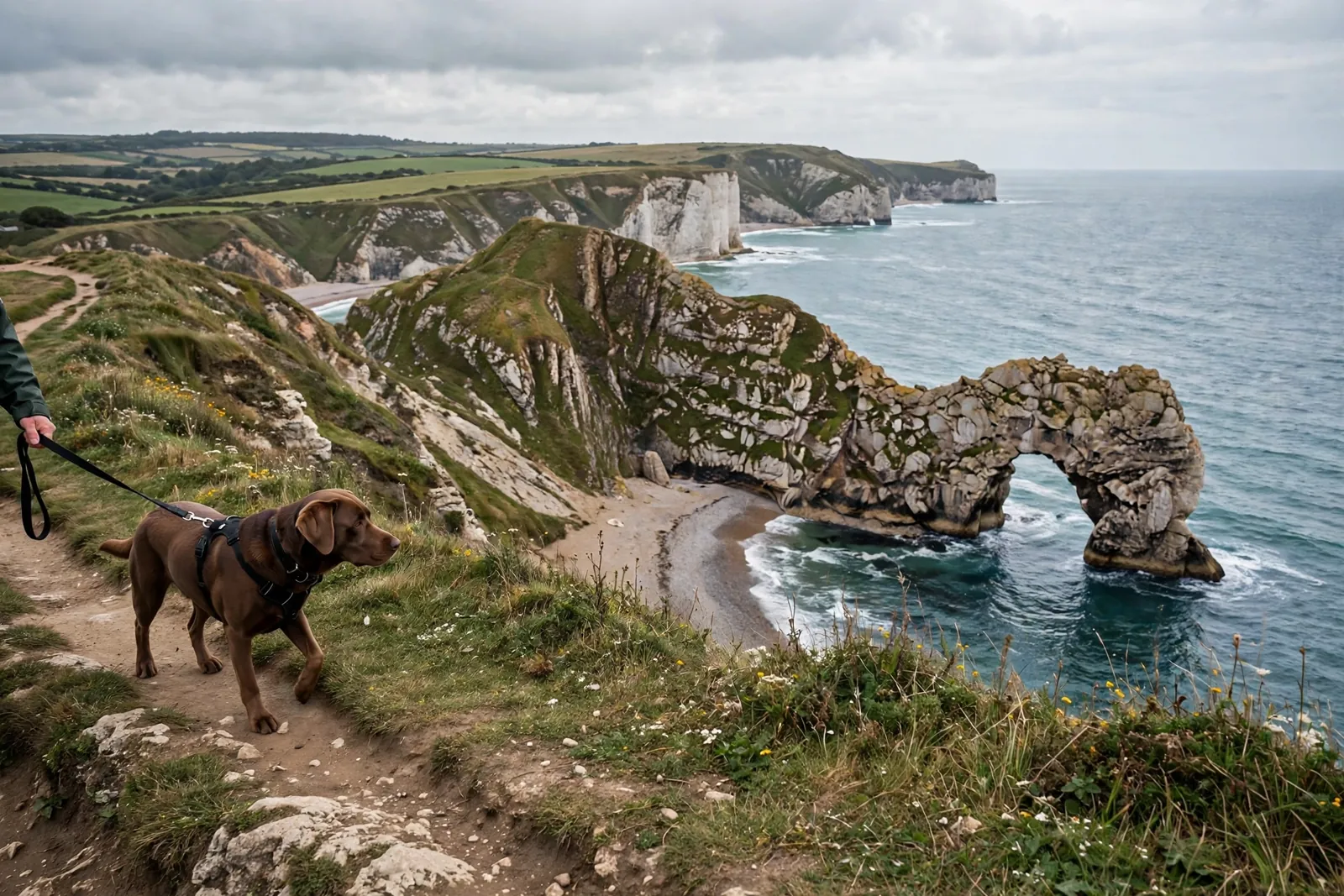
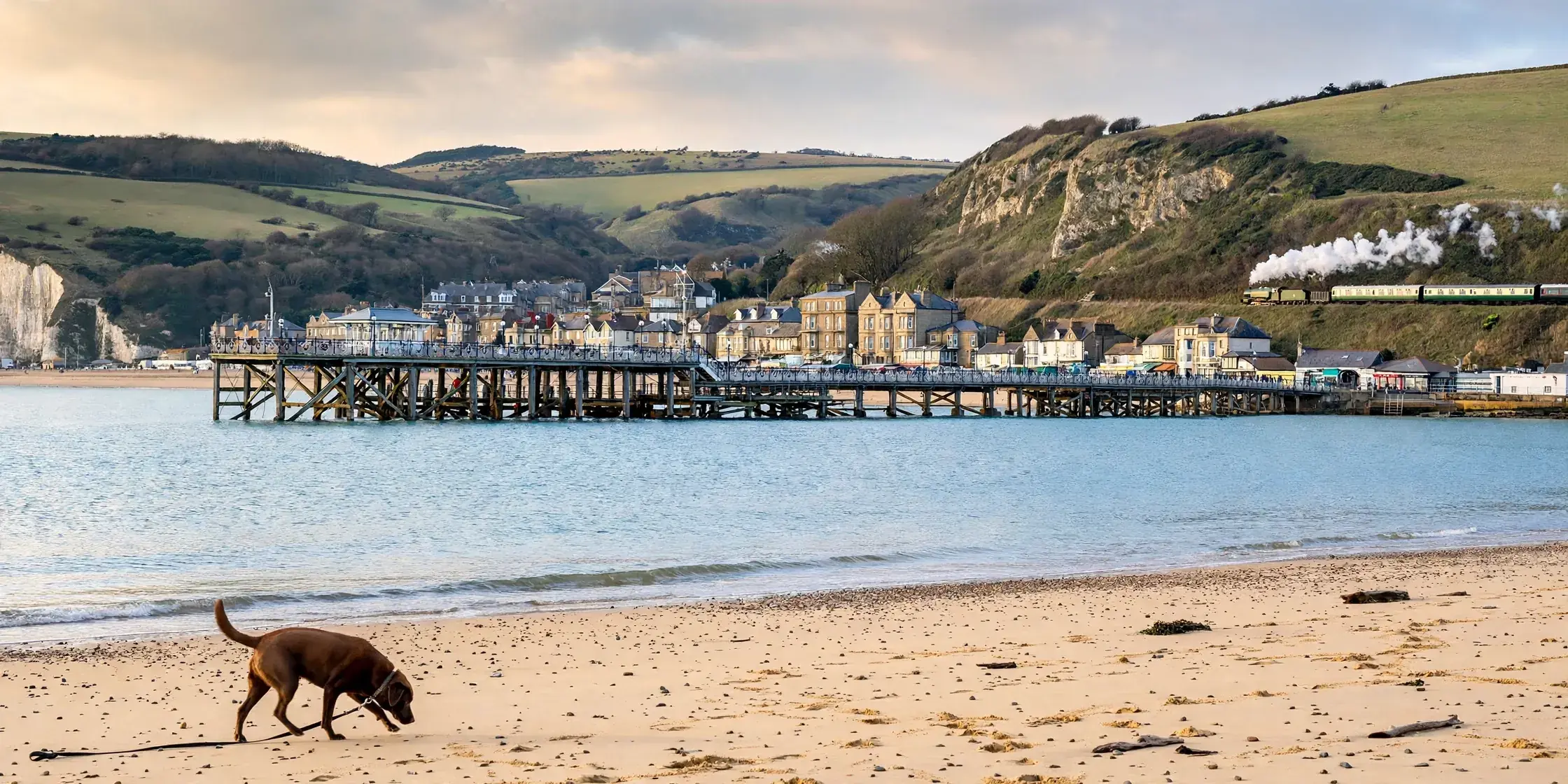
South into Purbeck the coast turns wilder: Swanage Bay, Durlston Country Park and the cliff paths towards Lulworth give bigger views and longer walks, and the steam railway between Swanage and Corfe Castle pairs a ride with a walk for visitors who like both. Dog rules on the railway and on each beach shift with the season, so look them up for the exact day you plan to go. North and west, Cranborne Chase and the chalk downs open into long, quiet footpaths and villages that suit a slower day out.
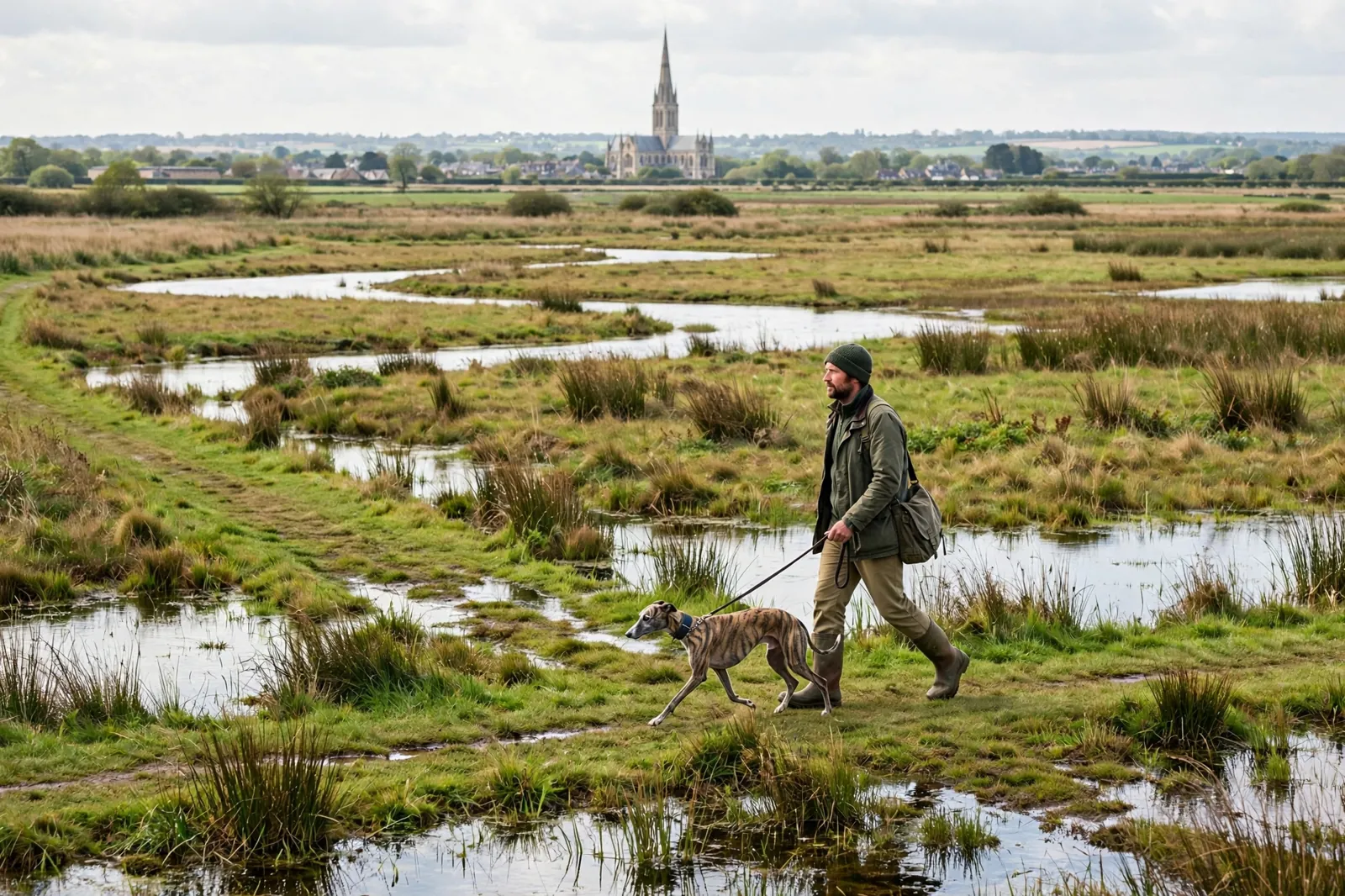
A second day could take you north-east to Salisbury, where the cathedral close, the water meadows and the walk to Old Sarum make an easy outing. Our Salisbury with a dog guide explains the cathedral rules, the water meadows and fitting Stonehenge around a dog. Closer to home, Canford village and the Stour Valley Way give you a half-day walk from Wimborne itself, with no driving at all.
Shape the day around the dog’s stamina, not the map. A single proper walk followed by one unhurried stop — a pub garden, a bench above the Stour — leaves a happier dog than three rushed destinations. A dog that has walked well in the morning will doze through the drive home. Keep a towel, drinking water and a spare lead in the car, and look up the beach and attraction rules for the day itself, since Dorset’s seasonal beach bans are real and are enforced.
Staying over with a dog
Overnight, Wimborne offers inns in the centre, cottages and bed and breakfasts towards the edge of town, with more self-catering cottages in the villages round about. Book ahead for summer weekends and school holidays, and get the dog rules in writing before you pay: how many dogs may come, whether there is a charge, whether a dog may be left alone in the room, and where the nearest late-night toilet walk runs.
On arrival, check the boundaries before the bags come out of the car. Walk the garden fence and gates, look for gaps beneath hedges where a small dog could slip through, and find the nearest lit path for the last walk of the evening. Bring the dog’s own bed and bowls and a blanket that smells of home: a dog that sleeps on its own bed settles far faster in a strange room. Ask whether the garden is private or shared, and whether other dogs use it at the same hours.
For a week or more, a self-catering cottage with its own garden and kitchen suits many dogs best: meals happen at the usual hour, and you can come and go without fitting round restaurant times. Wimborne’s shops cover the everyday basics, and the bigger supermarkets sit a short drive away. To weigh the options across the county, our Dorset with a dog guide lays out the choices along the coast, while the bigger holiday parks further afield are covered in their own guide.
Before booking, ask what the cleaning charge and the damage deposit actually cover, and be straight about your dog. A host told in advance about a large spaniel fresh from the Stour will point you to the right room and the right patch of garden; a host who only finds out at the door may not. When choosing, weigh the comments left by earlier guests who brought dogs — they tell you more than any glossy photograph.
Safety, etiquette and the river
The Stour is the safety question that matters most here. It looks gentle, yet it runs deep in places, quickens after rain, and leaves the banks slick underfoot. Keep the dog on a lead beside the water unless you know the spot well, and never let it swim below a weir or close to a bridge. After heavy rain the low stretches of path can flood, so look at the conditions before you set out and be willing to turn back.
On the town streets, the usual courtesies matter. Hold the lead short, clear up after your dog, and step aside on the narrow pavements. Wimborne’s centre draws older residents and families, so a dog that jumps up or drags towards strangers will soon wear out its welcome. A calm, well-managed dog is welcome almost everywhere; a boisterous one needs more room, more breaks and a closer eye.
Sort out the nearest vet before you need one. Wimborne has veterinary practices in and around the town, and Poole and Bournemouth have larger practices with emergency cover. Put the number in your phone before you leave the car, and carry a small first-aid kit: saline for eyes, bandages, tweezers for ticks, and your own vet’s number. Run a tick check after riverside and meadow walks, above all in spring and summer, and remove any you find promptly.
Lastly, treat the Minster and its churchyard gently. Hold the dog on a lead, steer it away from graves and flower beds, and keep barking down. The churchyard is a quiet place for many people, and a well-behaved dog belongs in that quiet rather than breaking it. The same goes for the town’s gardens and the riverside: leave the place as you found it, and the next dog owner will be welcomed too.
Practical questions
Before you go
Can I take my dog into Wimborne Minster?
No — dogs are not admitted to the inside of the Minster, apart from assistance dogs. Take it in turns at the door instead: one of you steps inside while the other stays with the dog among the churchyard trees, then swap over. The towers, the stonework and the churchyard itself are well worth the wait. Service times and special events can change the arrangement, so look at the Minster’s own notices before you set out.
Where should I walk my dog first in Wimborne Minster?
Start with the paths beside the River Stour, south of the centre: level, shaded in places, and an easy loop back to the Square. Longer stretches run east towards Canford and join the Stour Valley Way. Keep the dog on a lead by the water, at road crossings and where livestock graze, and bring drinking water and spare bags, since the bins along the river sit far apart.
Which Wimborne pubs and cafes let dogs in?
Several places round the Square and along High Street make room for dogs, most often in the bar, the garden or out on the terrace instead of the main eating room. The welcome can shift with the season and with who is on duty, so ask at the door and take the seat you are offered. A dog that has already walked beside the Stour and had a drink will settle far better under a table.
Where do I park for a dog day in Wimborne Minster?
Use the long-stay car park off West Borough for a full day, or one of the smaller car parks near the Square for a shorter visit, then walk into the centre. Get in early on market days and in summer, and allow time for the walk in from the outer car parks. A car in the sun warms up quickly, so take the dog with you rather than leaving it behind while you shop.
Does Wimborne Minster work as a base for a Dorset holiday with a dog?
Yes — it is a calm, central spot. Poole and Bournemouth sit a short drive south, the Purbeck coast lies the same way, and the Dorset countryside opens up to the north and west, while the town itself offers riverside walks, independent shops and places to eat with a dog. Reserve dog-friendly stays early for school holidays and summer weekends.
Which season suits a dog visit to Wimborne Minster best?
Spring and autumn suit most dogs: mild air, quieter streets and good walking beside the Stour, though the riverside ground can be muddy after rain. Summer brings market days and busy pavements, so walk early in the morning and use the shaded river paths at midday. Winter is quiet and atmospheric, with frost in the churchyard and mist over the water.