This guide is independent and contains no paid placement. If affiliate links are added later, they will be clearly marked and will not change our editorial checks.
Start with the town and the castle grounds, save the hill climb for a cooler part of the day, and treat Belas Knap as a separate outing rather than an add-on after a long walk. Dogs on leads are the norm around the castle, on the trail and in fields with livestock, so pack water, a long line for open ground only where it is safe, and a towel for muddy paws.
The first decision: castle, hill or town
Winchcombe presents visitors with a pleasant problem, and the order in which you solve it decides whether the dog finishes the day content or exhausted. The castle grounds sit close to the town and offer a contained, largely level outing with shade, planting and plenty of sniffing interest. The Cotswold Way climbs out of the valley onto the escarpment and rewards walkers with wide views, but it asks for stamina and sure footing. Belas Knap, the Neolithic long barrow on the hill above the town, belongs to the same high ground and is best approached as its own walk, not as a casual detour. Trying to do all three back to back, in summer heat, with a dog that has already had a long car journey, is how a promising day turns into a reluctant trudge home.
A practical rule is to match the biggest physical effort to the coolest and freshest part of your day. If you arrive early, walk uphill first while the dog is keen and the air is still cool, then drop back into town for lunch and a gentle castle-garden stroll in the afternoon. If you arrive late in the morning, reverse the plan: explore the town and the castle grounds first, eat, and then take only a short section of the high trail rather than committing to the full climb. Dogs do not care about ticking off three attractions, and a shorter walk done well beats a longer walk that ends with a dog lying flat on a pavement while its owner photographs a view.
Age and fitness should shape the choice more than ambition. A fit adult spaniel or collie may happily manage the escarpment and the barrow in one outing, with rests and water, while a puppy, a senior dog or a brachycephalic breed will enjoy the castle grounds and the town lanes far more than a steep ascent. Think about the return journey too, because downhill walking is harder on knees, hips and paws than the climb up, and a dog that bounded uphill may need a slower, shorter descent. Build in a bail-out point wherever you walk, such as a lane junction or a field gate where you can turn back without losing the thread of the day.
Sudeley Castle grounds with a dog
Sudeley Castle stands just outside the town centre, and its gardens and parkland give dog walkers a structured outing that still feels like a proper walk. The appeal for dogs is variety: mown lawns for a calm wander, planted borders full of scent, wooded corners for shade, and open grass where a lead walk can stretch out a little. The appeal for owners is that the grounds are contained and legible, so you are not constantly negotiating field gates, road crossings and uncertain rights of way. Take the visit at a dog's pace, with pauses for sniffing, rather than rushing between garden rooms as if the grounds were a checklist.
Rules matter here more than in an open field, because a historic garden is a shared and managed space. Dogs are generally welcome in the grounds on leads, while interiors and certain exhibitions may operate differently, so check the official guidance before you travel and confirm the position on the day, especially during events. Keep the lead short near flower beds, water features and other visitors, and carry bags even though bins are provided, because a busy garden day can fill a bin before the afternoon is over. If your dog is a keen digger or a determined plant-sniffer, steer toward paths and lawns and away from freshly planted borders, where a single enthusiastic excavation can do real damage.
Plan the castle visit around shade and water. On a warm day, the wooded sections and the shade of mature trees are worth seeking out, and a portable water bowl is more useful than assuming a tap will be conveniently placed. Older dogs benefit from the flatter routes through the gardens, while younger dogs may need a calming pause before entering a busy area, so let them settle by the entrance for a few minutes rather than marching straight into the thick of the crowds. If the castle itself is closed to dogs on the day, the grounds alone still make a satisfying outing, and pairing them with a town walk afterwards gives the day a natural second act without extra driving.
Photography in the grounds deserves a little thought when a dog is involved. A dog sitting politely on a path with planting behind it makes a better picture than a dog straining toward a flower bed, and it also keeps the visit calmer for everyone else. Ask another visitor to take the picture rather than tying the lead to a bench, and keep the session short so the dog does not learn that gardens mean long waits. For more ideas on pairing a historic garden with a village walk, see our Bourton-on-the-Water with a dog guide, which uses a similar rhythm of water, green space and a gentle town stroll.
The Cotswold Way above the town
The Cotswold Way is a long-distance national trail that runs along the escarpment, and the section around Winchcombe is one of its most rewarding stretches for walkers who like a climb with a payoff. From the town, paths rise through fields and woodland toward open hillside, where the view opens across the Severn Vale on a clear day. The trail is well waymarked in general, but waymarks are not a substitute for a map, especially where paths cross farmland, split at field corners or disappear briefly into woodland. Download or carry a proper map, note the names of farms and lane junctions on your route, and agree a turn-back time before you set off.
For dogs, the escarpment walk is a study in changing surfaces. Town pavements give way to field paths, then to stony tracks and finally to open grass, and each surface asks something different of paws. Stony descents can be uncomfortable for dogs with soft pads, while wet grass on a slope can be slippery for older animals. A lead is the default on farmland and near livestock, and even on open hillside it is wise to keep the dog close where the path runs near a road, a steep edge or a field boundary. A long line can be useful on safe open ground for a dog with a reliable recall, but it becomes a hazard on narrow paths, near other walkers and around livestock, so clip it short well before any of those appear.
Water and rest stops need planning on the high ground, because there is no shop on the escarpment and streams are not always accessible or suitable for drinking. Carry more water than you think you need, offer it little and often rather than waiting for the dog to ask, and use natural pauses at viewpoints and gates as rest stops. Watch for the quiet signs of tiredness that owners often miss: a dog that stops sniffing, lags behind on flat ground, pants heavily long after stopping, or starts to pick its way carefully downhill is telling you to shorten the walk. Turning back early is not a failure; it is the decision that keeps the dog keen for tomorrow's walk as well.
The Cotswold Way also connects Winchcombe to a wider network of villages and viewpoints, which is tempting for walkers who want a longer linear route. A linear walk needs transport at the far end, and that usually means a bus, a taxi that accepts dogs, or a second car, all of which should be confirmed in advance rather than assumed. For most dog walkers, an out-and-back walk from Winchcombe is simpler and kinder, because it keeps the car, the water supply and the pub lunch within reach, and it lets you retrace a path the dog already knows on the way home.
Belas Knap and the long climb
Belas Knap is a Neolithic long barrow, a grass-covered burial mound with stone chambers, set on a hillside above Winchcombe. It is an atmospheric place: a long, whale-backed mound on open ground, with views that make the climb feel worthwhile and a quietness that contrasts sharply with the busy town below. For dogs, the interest is less archaeological than sensory, because the open hillside offers wind, grass, skylarks in season and a long horizon to watch. Keep the visit respectful and simple, stay on the paths around the monument, and do not let the dog scramble on the stonework or dig at the mound.
The approach is the main challenge. The route climbs steadily from the town, and the final section crosses open hillside that can be exposed to wind and sun. In summer, start early, carry water for both of you, and wear a hat and sunscreen for yourself, because the open ground offers little shade. In winter, the same ground can be muddy, rutted and surprisingly cold when the wind comes across the escarpment, so a waterproof coat for the dog may be sensible for a short-coated or older animal. Footwear matters for owners too: walking boots with grip beat trainers on wet grass and stony tracks, and poles can help on the descent if knees are a concern.
Families sometimes ask whether Belas Knap can be combined with Sudeley Castle in a single walk, and the honest answer is that it can, but only for fit walkers with fit dogs and plenty of time. The combined route involves a climb, open ground, a descent and then a garden visit, which is a long day even before lunch and driving are counted. A better pattern for most visitors is to treat the barrow as the morning's walk and the castle grounds as the afternoon's gentle outing, or to split them across two days if you are staying locally. If you do combine them, plan a proper rest and water stop in town between the two, and do not expect a tired dog to enjoy a second attraction as much as the first.
For a wider sense of how Cotswold hill walks fit together, our Cotswolds with a dog guide explains the escarpment, commons and livestock in general terms, and it is a useful companion read before tackling any high route. The key lesson carries over: high, open ground is wonderful for dogs when the weather, the route length and the dog's fitness all line up, and it is unforgiving when any one of them does not.
Honey-stone lanes and the town centre
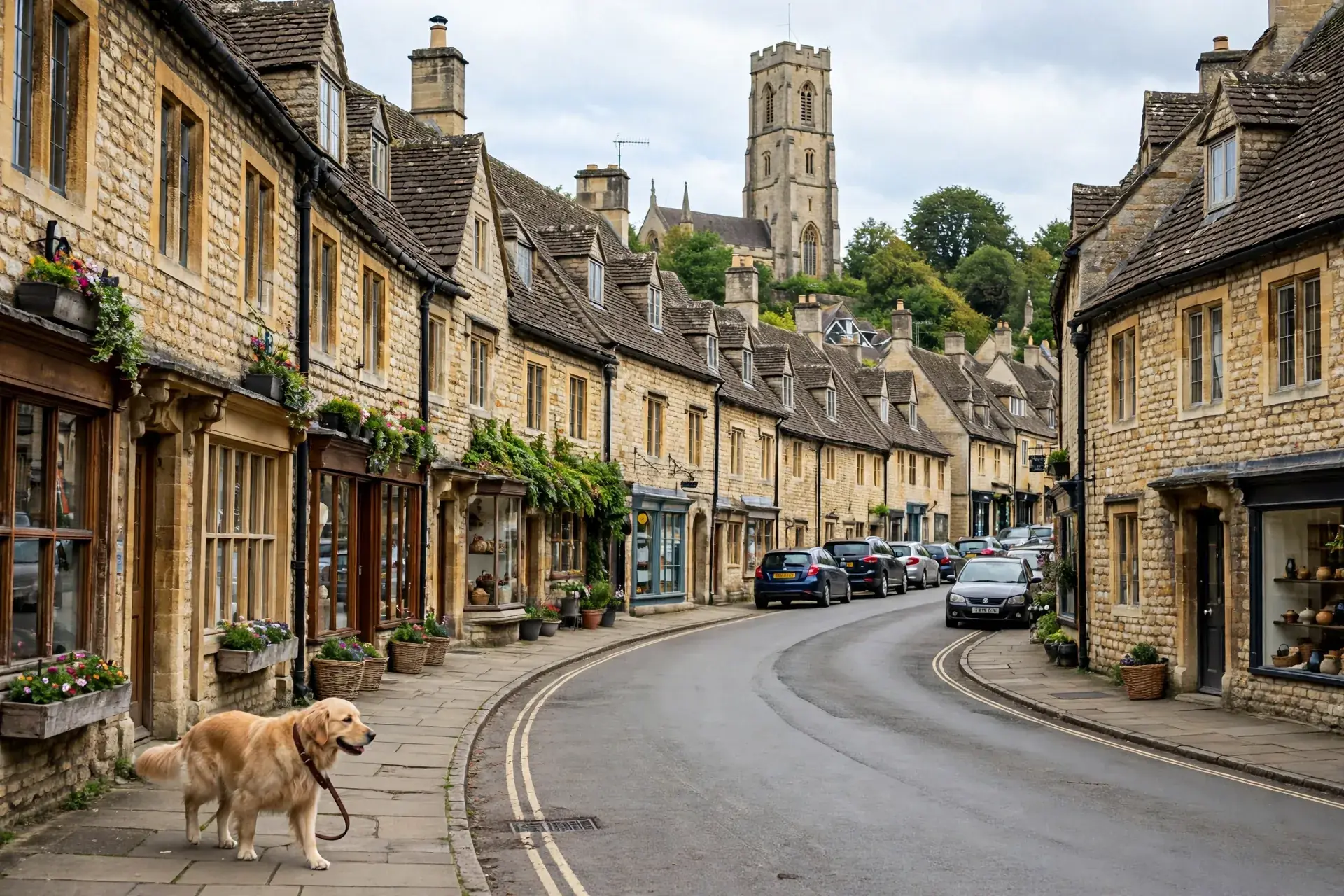
Winchcombe town centre rewards slow walking. The main street and its side lanes are lined with honey-coloured stone buildings, small shops and cafes, and the scale is comfortable for a dog on a lead: pavements are generally wide enough to pass other walkers, and there are corners and side streets where a nervous dog can step aside. Walk the town as a loop rather than a straight line, so the dog gets variety without retracing the same pavement, and use shop doorways and quiet lanes as natural pauses. A town walk also doubles as a weather gauge: if the dog is flagging on level pavements, the hill climb should wait for another day.
Shops and cafes vary in their dog policies, and the variation is part of the charm as well as part of the planning. Some welcome dogs inside, some offer a water bowl by the door, and some prefer dogs to wait outside, so look for signs, ask politely, and never assume that a friendly welcome in one shop applies to the next. A dog that can settle under a table for twenty minutes is a different proposition from a dog that barks at every passing pram, so be honest about which kind of dog you have and choose venues accordingly. If your dog needs practice at settling, a quiet cafe at a quiet hour is a better training ground than a packed lunch spot on a Saturday.
Street etiquette matters in a small town where pavements are shared with residents, pushchairs and delivery vans. Keep the lead short on narrow stretches, step to the side for oncoming walkers, and clean up promptly, because a single missed mess in a small town is noticed and remembered. Avoid letting the dog greet every other dog on the street, since not every dog wants a greeting and not every owner welcomes one, and a brief, controlled pass is kinder than a tangled lead negotiation in a doorway. The town is at its best early in the morning and late in the afternoon, when the light is warm and the pavements are quieter, and those are also the hours when dogs tend to walk most happily.
Shorter loops for small or older dogs
Not every Winchcombe visit needs a hill. A short town loop, a wander through the castle grounds and a riverside or lane stroll can fill a satisfying day for a small dog, an older dog or a dog recovering from an injury, and none of it requires a climb. The trick is to build the day from several short outings with rests in between, rather than one long outing that leaves the dog stiff the next morning. A morning loop, a midday rest in the car or accommodation, and a gentle afternoon loop will suit most older dogs better than a single heroic walk.
Choose surfaces carefully for older joints. Level pavements, mown grass and firm lanes are kinder than steep, stony descents, and a dog that copes well on flat ground may still struggle on a cambered hillside path. A ramp for the car, a supportive harness rather than a collar pull, and a familiar bed for rests all help, and a short lead gives an older dog confidence on pavements where a long line would only add confusion. Watch the weather as well: cold, damp days stiffen older dogs, while hot days tire them faster, so adjust the length of each loop to the conditions rather than to a fixed plan.
Puppies need a different kind of short loop, with frequent toilet opportunities, chances to watch the world from a safe distance, and no pressure to keep up with adult dogs on a long trail. Keep puppy walks short, let the puppy sniff and investigate, and end while the puppy is still keen rather than exhausted. Socialisation in a town like Winchcombe is valuable precisely because it is gentle: passing people, hearing traffic, seeing other dogs at a distance and settling in a cafe all build confidence without overwhelming a young dog, provided each experience is kept brief and positive.
Pubs, cafes and a tired-dog lunch
A Winchcombe lunch tastes better when the dog has a plan too. Look for pubs and cafes with a garden, a terrace or a dog-friendly bar area, and check the current policy before you sit down, because dog rules can differ between the bar, the restaurant and the garden of the same pub. A water bowl, a quiet corner and a floor that is easy to clean are the three features that matter most, and a pub that offers all three will usually be relaxed about a well-behaved dog. Bring a mat or blanket for the dog to lie on, because a familiar surface helps a dog settle in a new place and protects the pub floor at the same time.
Order with the dog's routine in mind. A dog that has just finished a long walk will be thirsty and possibly restless, so give water first, let the dog settle for a few minutes, and then order, rather than trying to settle the dog while also reading a menu. Keep treats small and quiet, avoid feeding from the table, and do not let the dog beg from neighbouring tables, since that habit is hard to break and unwelcome in a small dining room. If the dog cannot settle, a short toilet walk before lunch often solves the problem, and a pub garden is usually a better choice than a formal restaurant for a dog that is still full of walk energy.
Picnics are a good alternative when pubs are busy or the dog would prefer open air. A picnic on a grassy area near the town, with the dog on a lead and a mat to lie on, can be calmer than a crowded pub, and it lets you control the timing of the meal around the dog's needs. Pack the dog's own food and water, keep picnic rubbish contained, and choose a spot away from livestock and other picnickers' dogs. A picnic also solves the common problem of a dog that is welcome in the garden but not in the restaurant on a rainy day, because you can eat under a shelter or in the car without cutting the outing short.
Parking, arrival and the first ten minutes
Winchcombe has car parks within a short walk of the centre, and the best arrival strategy is to park once and walk everywhere. Arriving early on a weekend or a bank holiday makes a real difference, because the car parks fill, the town pavements get busier, and the castle grounds attract more visitors as the day goes on. A weekday visit is noticeably calmer, and if you can only come at a weekend, an early start gives you the town almost to yourself for the first hour. Check parking signs and charges on arrival, since arrangements can change, and keep the parking ticket or payment confirmation with you for the walk.
The first ten minutes after arrival set the tone for the dog. Let the dog toilet, drink and sniff around the car park area before heading into town, and use that time to check leads, bags, water and the route. A dog that arrives straight from a car journey and is immediately marched uphill will be unsettled, while a dog that has had a few minutes to decompress will walk more calmly and listen better. If you are using a satnav, park and then navigate on foot with a map, because driving slowly around narrow town streets looking for a closer space only adds stress for everyone.
Never leave a dog alone in a parked car on a warm day, even for a short errand, and be cautious on cold days too, when a car can chill quickly. If you need to pop into a shop that does not accept dogs, take turns with another adult, or skip the shop and enjoy the walk instead. The same principle applies to the return journey: give the dog a final toilet walk and a drink before the drive home, and keep a towel in the car for muddy paws, because Winchcombe lanes and hillside paths can be muddy even after a dry-looking day.
Livestock, gates and field manners
Fields around Winchcombe are working farmland, and livestock are part of the landscape rather than a backdrop. Sheep, cattle and horses may be in fields crossed by public paths, and the correct response is always the same: short lead, steady pace, wide berth, and no stopping for photographs beside the animals. Put the lead on well before the field, not at the gate when the dog has already seen the sheep, and keep it on until you are well clear on the other side. A dog that chases livestock can cause serious harm and can put its owner in legal difficulty, so this is not a rule to bend for a well-behaved dog that has never chased before.
Gates deserve the same care as livestock. Leave every gate as you find it, whether open or closed, and check that it is properly latched behind you, because a gate left swinging can let livestock onto a road or into a neighbouring field. If a gate is stiff, heavy or tied with rope, take your time rather than forcing it, and keep the dog close while you work it, so the dog does not slip through ahead of you. Stiles need care too: a dog that can scramble over a stile may still need lifting or guiding, and a dog that cannot manage a stile at all may need a different route, so check the route description for stile information before you commit to a path.
Field paths change with the farming year. A path that is clear in winter may run through a growing crop in summer, a field that held sheep in spring may hold cattle in autumn, and a path that was firm in May may be poached and muddy after autumn rain. Follow the waymarked line even when a shortcut looks tempting, because the waymarked line is the one the farmer expects walkers to use, and straying into crops or newly sown ground damages livelihoods. If a path is blocked, flooded or unclear, turn back or find an alternative lane route rather than forcing a way through, and check the official guidance before you travel for current access information.
Seasons, weather and ground conditions
Spring is a rewarding season in Winchcombe, with blossom in the gardens, lambs in the fields and longer days, but it is also the season when livestock are most vulnerable and when dogs must be on leads in many fields. Keep to paths, keep the dog close around lambs, and expect muddy sections on hillside paths after spring rain. Summer brings the best views from the escarpment and the busiest town pavements, so early starts, shade and water matter most, and the castle gardens are at their most colourful. Autumn offers quieter paths, rich colour in the woodland and cooler walking, but also fallen leaves that hide mud and tree roots, so watch footing on descents.
Winter in Winchcombe has its own quiet charm, with frost on the stone, clear views on cold days and empty paths, but it also brings short days, wet ground and the need for good waterproofs. Check daylight hours before a hill walk, because a walk that is comfortable at noon can become a race against dusk if you start late, and carry a torch in winter even for a walk you expect to finish in daylight. Dogs with short coats or little body fat may need a coat on cold, wet days, while all dogs benefit from a drying routine after a winter walk, with towels, a dry bed and a check for mud packed between toes.
Ground conditions deserve a specific check after rain, because Winchcombe's hillside paths include clay sections that become slippery and stony sections that stay wet. After heavy rain, choose lanes and castle gardens over the steepest hillside paths, and save the escarpment for a drier day. In hot weather, check the ground temperature with your hand before a pavement walk, since stone and tarmac can burn paws, and favour grass and shaded lanes in the middle of the day. Weather forecasts for hilltops differ from valley forecasts, so check a hill-specific forecast when planning an escarpment walk, and be ready to change the plan if the wind or rain strengthens.
A two-day Winchcombe plan
A two-day stay lets Winchcombe breathe, and it suits dogs far better than a single packed day. On day one, arrive early, walk the town loop and the castle grounds, eat a relaxed lunch, and finish with a short lane walk in the late afternoon. That pattern gives the dog exercise, novelty and rest in balance, and it leaves the evening free for a quiet pub garden or a rest at your accommodation. On day two, tackle the hill walk in the morning while the dog is fresh, whether that means Belas Knap, a section of the Cotswold Way, or a gentler hillside loop, and then return to town for lunch and a slow afternoon. Splitting the attractions across two days also means bad weather on one day does not ruin the whole visit, because the other day can absorb the hill walk.
Accommodation choice matters for a two-day stay. Look for places that genuinely welcome dogs rather than merely tolerating them, with a garden or nearby toilet walk, a floor that is easy to clean, and a clear policy on leaving a dog alone briefly. Ask about the details that affect dogs: is there a secure garden, a nearby field path for the last walk of the day, a place to dry a wet dog, and a vet nearby in case of an emergency. A stay that works for the dog will feel relaxed for the owner too, while a stay that fights the dog's routine will colour the whole trip, however pretty the room.
Packing for two days is simpler than packing for one frantic day, because you can leave spare towels, food and water in the accommodation and carry only what each walk needs. A day pack for the hill walk should contain water and a bowl, bags, a lead and a spare, a basic first-aid kit, a map and a phone charger, plus a coat for the dog if the weather demands it. A town day needs less: water, bags, a mat for cafes, and a towel for the car. The common thread is water, because dogs drink more on walks than owners expect, and a dog that is offered water little and often will walk further and recover faster than a dog that is only offered water at lunch.
Finally, leave Winchcombe with a simple test for whether the visit worked: did the dog sleep well, eat normally and greet the next morning's walk with enthusiasm. If the answer is yes, the balance was right, whatever the step count or the number of attractions visited. If the dog came home stiff, reluctant or unsettled, shorten the hill element next time and lengthen the town and garden element, because Winchcombe has plenty to offer at ground level as well as on the hilltop, and the best visit is the one the dog would happily repeat.
Practical questions
Before you go
Are dogs allowed at Sudeley Castle?
Dogs on leads are generally welcome in the castle grounds and gardens, while the castle interiors and some exhibitions may have different rules. Check the official guidance before you travel, and confirm the current policy for the day of your visit, because event days and garden areas can change the arrangement.
How long is the walk to Belas Knap from Winchcombe?
The walk from the town to Belas Knap is a steady uphill route of a few miles each way, and most walkers allow a couple of hours for the round trip with stops. The final approach crosses open hillside, so a lead, water and weather-appropriate clothing matter more than speed.
Is the Cotswold Way near Winchcombe suitable for older dogs?
Short sections near the town suit many older dogs, especially level stretches and gentle lanes, but the full escarpment route involves steep climbs and descents. Choose a short out-and-back section, watch for tiredness on the downhill return, and turn back before your dog has to cope with a long descent on tired legs.
Where can I park in Winchcombe with a dog?
The town has car parks within a short walk of the centre, and arriving early helps on busy weekends. Park with shade and ventilation in mind on warm days, leave the dog only for the briefest necessary moment if at all, and start your walk from the car park rather than driving around narrow streets looking for a closer space.
What should I do if my dog meets livestock near Winchcombe?
Put the dog on a short lead well before you reach the field, keep calm, and walk steadily past without stopping to photograph or chat beside the animals. If sheep or cattle are close to the path, give them the widest berth the field allows, and check the official guidance before you travel for current countryside access rules.