This guide is independent and contains no paid placement. If affiliate links are added later, they will be clearly marked and will not change our editorial checks.
Witney works brilliantly as a half-day dog trip: park at the Woolgate, walk the High Street to Market Square and the Butter Cross, drop down to the River Windrush at the West End, loop across Langel Common, and finish at Cogges Manor Farm or a pub garden. Dogs stay on leads in the town centre and the farm grounds, and the river walk is the part your dog will remember.
First impressions: a blanket town
Witney does not announce itself the way the honey-stone show villages of the Cotswolds do. It is a working market town in West Oxfordshire, about twelve miles west of Oxford, and its fame was built on something thoroughly practical: blankets. From the seventeenth century onwards, Witney's mills turned Cotswold wool into the heavy, warm blankets that were sold across Britain and beyond, and the river that powered those mills — the Windrush — still runs through the town's southern edge. That industrial past is the first thing worth understanding with a dog in tow, because it explains the shape of the place: a long High Street of stone-fronted shops, a market square built for trading, mill buildings by the water, and open common land where the river spreads out.
Arriving is straightforward. The A40 runs just south of the town, and the Stagecoach S1 bus links Witney with Oxford via Eynsham roughly every fifteen to twenty minutes during the day, which makes a car-free visit perfectly realistic. If you do drive, the Woolgate car park sits just off the High Street and the Woodford Mill car park sits at the West End near the river; between them they cover both ends of a visit, and choosing the right one saves a lot of backtracking with a dog that would rather be walking than circling for a space. Both are pay-and-display, so check the current charges and time limits on the boards when you arrive rather than trusting a remembered price.
The High Street itself is the town's spine, and it is a good first stretch for a dog's legs. The pavements are wide by market-town standards, the shopfronts are a mix of Georgian stone, Victorian brick and modern infill, and many of the independent shops keep a water bowl by the door in summer. Keep your dog on a short lead here: the High Street carries through-traffic, delivery vans pull across the pavement, and market-day crowds narrow the walking space considerably. The reward for that care is a street that feels lived in rather than staged — butchers, bakers, charity shops, a bookshop, cafes with pavement tables — and a dog that can sniff its way through three centuries of a wool town in a single stroll.
Look up as you walk and the blanket story starts to read itself in the buildings. Witney Blanket Hall stands on the High Street in the former blanket hall of Early and Company, the town's best-known blanket makers, and it now works as a small museum, shop and heritage centre telling the story of the trade. The big mill buildings cluster further down towards Bridge Street and the river, where the water once drove the looms and fulling stocks; their stone walls, tall windows and converted upper floors are the most photogenic part of town for anyone walking a dog along the riverside. If the blanket story catches your interest, the hall is worth a few minutes on its own, though dogs may not be able to go inside — check the official guidance before you travel and plan on taking turns if your party wants to look around the interior.
What Witney does not have is a single postcard viewpoint, and that is part of its charm for dog owners. There is no single honeypot where every visitor with a camera gathers, which means you are not fighting for pavement space with coach parties. Instead the town hands you a sequence of small, distinct places — the High Street, the square, the church green, the river, the farm — each a short walk from the last, each with its own surface underfoot and its own smells for a dog to investigate. Plan the day as a chain of these places rather than a single destination, and the town opens up.
A final note on first impressions: Witney rewards the unhurried. The town's best moments are quiet ones — a dog pausing at the mill race, the sound of the market setting up, the view across Langel Common in evening light. Arrive with a loose plan, keep the lead short in town and long by the river, and let the dog set the pace between the sights.
Market Square and the Butter Cross
Market Square is the historic heart of Witney, and it is where the town's trading past is easiest to read. The square has hosted markets since the Middle Ages, and its centrepiece is the Butter Cross, a seventeenth-century stone market cross with a steeply pitched roof, where butter, eggs and other dairy produce were once sold under cover. Stand beside it with your dog and you are standing in the exact spot where Witney's farmers and townspeople have met to trade for hundreds of years — a piece of street furniture that has outlasted the trade it was built for and now serves as the town's natural meeting point.
The Town Hall stands on the square too, a handsome stone building that anchors the northern side, and the square is ringed by shops, cafes and pubs with the kind of varied frontages that make a slow circuit interesting. On market days — Thursday and Saturday — the square fills with stalls selling fruit and vegetables, bread, flowers, plants, household goods and local produce, and the atmosphere shifts from quiet market town to busy trading floor. Dogs are welcome to walk the market on a lead, but this is the one place in Witney where timing matters most: go early, before the stalls are at their busiest, and you will have room to browse; arrive at midday on a Saturday and you will be threading a dog through shopping bags, pushchairs and stall guy-ropes.
Just south of the square, Church Green opens out around St Mary's Church, and it is the square's calmer companion. The church, with its tall tower and spacious churchyard, sits on a green that feels almost village-like after the stone of the square, and the grass gives a dog a softer surface and a moment to decompress. The lychgate, the old headstones and the mature trees make it one of the prettiest corners of town, and it is a natural pause between the market and the river. Keep your dog on a lead and on the paths here out of respect for the churchyard, and treat it as a breathing space rather than a play area.
From the square, the High Street runs in both directions, and the stretch towards the Corn Exchange is worth a look. The Corn Exchange building, a reminder of the days when Witney traded grain as well as wool, now houses a pub, and its facade is one of the more imposing pieces of Victorian commercial architecture in town. The streets around the square — Corn Street, Bridge Street, High Street — each have their own character: Corn Street for its coaching-inn history, Bridge Street for the run down to the river and the mills, High Street for the shops. A circuit of the square and its adjoining streets takes about twenty minutes at a dog's pace and gives you the whole of central Witney.
Practical points for the square: there is no shade in the middle of it, so on a hot day keep your dog to the edges where the buildings throw shadows, and carry water rather than counting on finding a bowl. The stone paving can get hot underfoot in summer and slippery in rain, so watch for a dog that starts lifting its paws or slowing down. Public toilets sit near the Woolgate, and litter bins are plentiful around the square — use them, because a market town that welcomes dogs only keeps welcoming them if owners keep it clean. If your dog is nervous around crowds, skip the Saturday market altogether and come on a weekday morning, when the square is at its most peaceful and the Butter Cross has the place almost to itself.
One last detail worth knowing: the square is also the town's noticeboard. Posters in shop windows and on the Town Hall board advertise everything from farmers' markets to charity walks, and a quick look can turn up a dog-friendly event you would otherwise miss. Witney is a town that organises itself in public, and the square is where that organisation shows.
The River Windrush walk
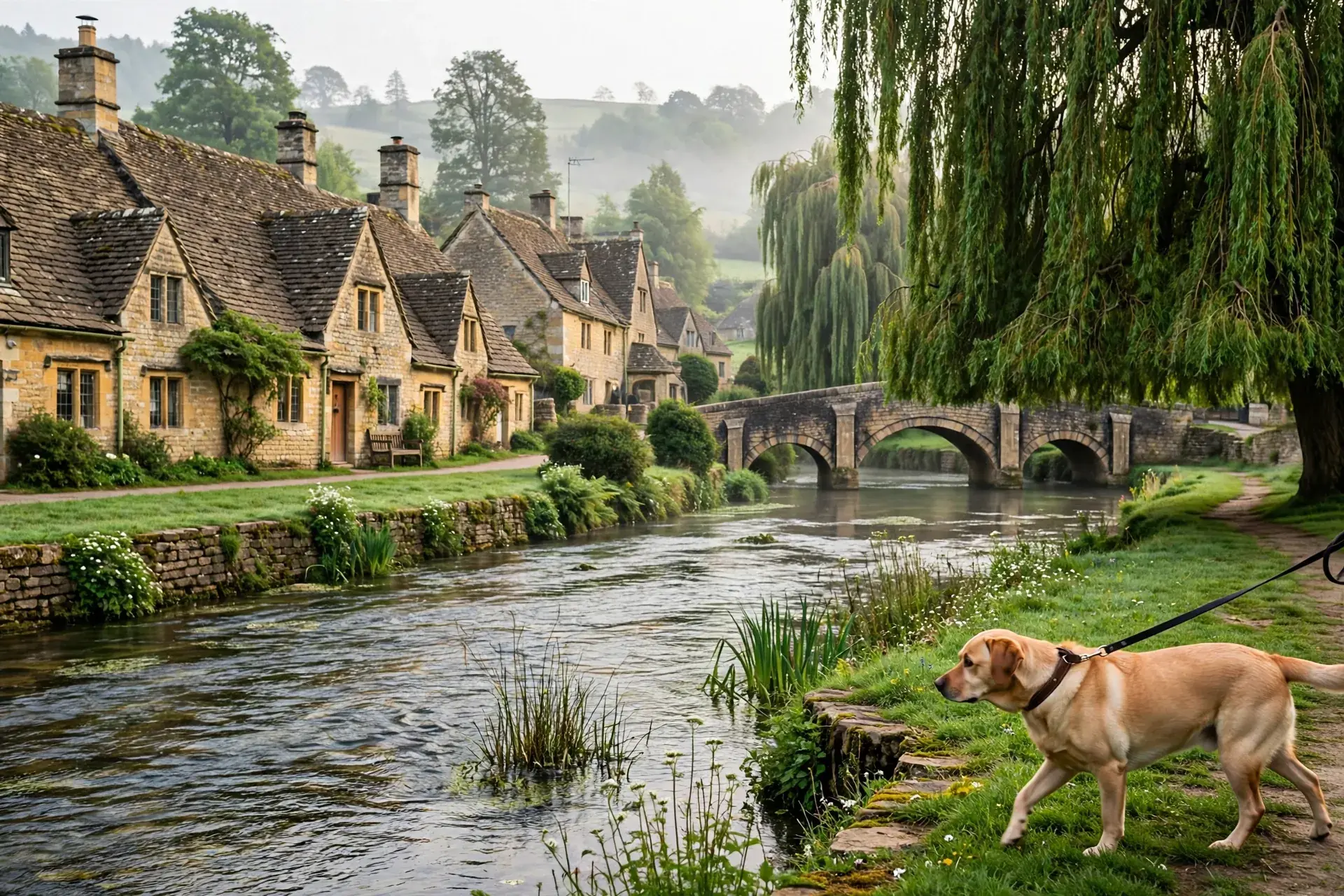
The River Windrush is the walk that makes a trip to Witney, and it is the section of the day your dog will enjoy most. The river rises in the Cotswolds near Bourton-on-the-Water — the same Windrush that runs through that village's famous low bridges — and flows south-east through Witney on its way to join the Thames at Newbridge. In Witney it is a clear, shallow, gravel-bedded river for much of its course, fringed with willows and alders, and the riverside paths give you long, flat walking without ever leaving the town behind.
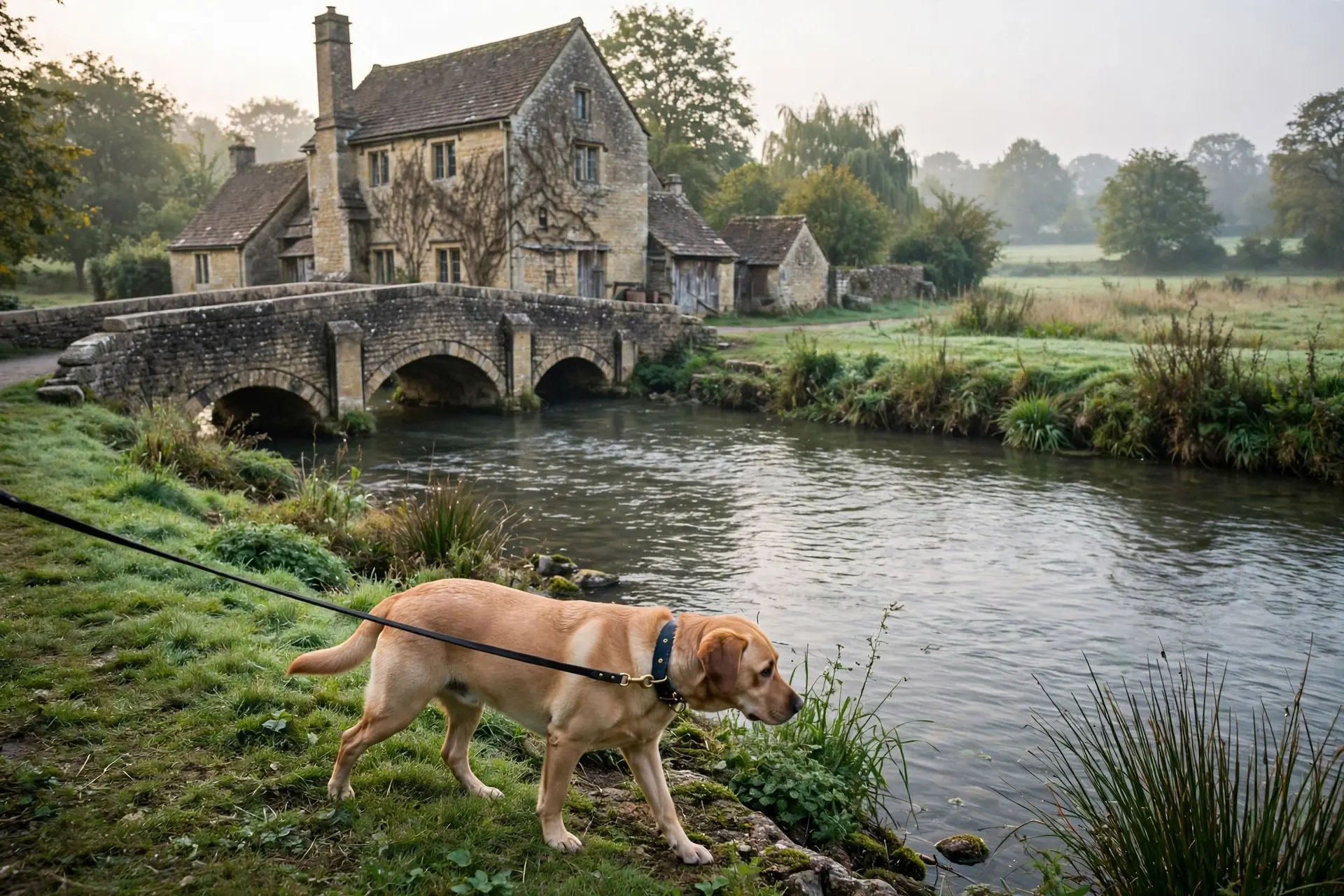
The best place to join the river is at the West End, where Bridge Street meets the water and the old mill buildings stand. From here a path follows the Windrush westwards towards Langel Common, a stretch of open common land that is one of Witney's great assets for dog walkers. Langel Common is rough grass, scattered trees and open sky, with the river along one edge and views back towards the town; it is the closest thing to countryside without leaving Witney, and it is where local dogs get their daily exercise. The paths across the common are informal — worn grass rather than tarmac — so after rain they can be muddy, and in summer the long grass hides the uneven ground beneath. Sensible shoes matter as much as a good lead.
From the common you can keep going towards Ducklington, the village a mile or so downstream, on a flat riverside path that suits an easy out-and-back of about an hour. The route passes grazing meadows and the kind of riverside scenery — kingfishers if you are lucky, herons standing motionless in the shallows, moorhens picking along the banks — that makes a slow walk feel like a proper outing. Keep your dog on a lead where the path runs beside grazing land, and be ready to shorten the lead around other walkers, cyclists and anglers, who share these paths and have as much right to them as you do.
Witney Lake and Country Park, at the eastern edge of town, offers a different kind of water walk. The lakes here are former gravel pits, now matured into a country park with surfaced paths, reed beds and a great deal of birdlife — swans, geese, ducks and grebes are all regulars. A loop of the main lake takes around forty minutes and is almost entirely flat, which suits older dogs and anyone who wants an easy circuit after the rougher ground of the common. Dogs should stay on leads around the lakes, partly for the birds and partly because the water is deeper than the river and the banks can be steep and slippery. The park has its own car park, so it also works as a standalone walk if you arrive late in the day and want one good loop before heading home.
Water safety deserves a frank paragraph, because the Windrush looks friendlier than it always is. In normal conditions it is shallow and slow, and a confident dog can paddle happily at the edges. After heavy rain it runs fast, brown and deep, and the current near weirs and old mill races is strong enough to sweep a dog off its feet. Never let a dog swim near a weir, a mill race or a bridge arch, where the water funnels and the undertow is unpredictable. In warm, still weather, check for water-quality warnings — blue-green algae can appear in slow stretches of river and lake in summer, and if you see a green scum on the surface, keep your dog out of the water entirely and check the official guidance before you travel. A dog that has been in the river should be rinsed and dried before the car journey home, and a towel and a spare lead in the boot will save your upholstery.
Season changes the river walk more than any other part of Witney. Spring brings wildflowers to the common and the first ducklings to the river; summer brings shade under the willows and the busiest paths; autumn turns the riverside trees gold and thins the crowds; winter brings floods across the low meadows, when parts of the common path can be under water and the sensible route is the higher ground towards Ducklington or the surfaced paths at the lake. Check the official guidance before you travel after a wet spell, and be ready to swap the common for the lake loop if the river has burst its banks — Witney's low-lying meadows flood most winters, and the locals take it in their stride.
For walkers who want to follow the Windrush further, the river's story continues in both directions: upstream to the village of Minster Lovell, with its ruined hall beside the water, and on to Bourton-on-the-Water, where the same river runs through the village green. Our guide to Bourton-on-the-Water with a dog covers that stretch, including the low stone bridges and the walk out to the Slaughter villages. Downstream, the Windrush meets the Thames at Newbridge, and the Thames Path offers longer, flatter walking for dogs that can manage the distance.
Cogges Manor Farm and the farmyard
Cogges Manor Farm sits at the southern edge of Witney, a short walk from Church Green down Church Lane, and it is the town's most distinctive attraction for dog owners — a working historic farmstead where the animals are the point. The manor house itself dates back to the thirteenth century, with later additions that tell the story of a farmhouse growing into a gentleman's residence, and the surrounding farm buildings, walled garden and orchard make up a compact estate that feels a world away from the High Street ten minutes' walk behind you.
The farmyard is the heart of a visit. Depending on the season you will find sheep, pigs, goats, chickens, ducks and sometimes calves, kept in pens and paddocks around the yard where visitors can watch them at close quarters. Spring is the liveliest time, with lambs in the paddocks and the farm running lambing and feeding demonstrations; summer brings the walled garden into full flower and the orchard into fruit; autumn is harvest time, with the farm's own produce and seasonal events. The animals are behind fences and in pens, so a dog on a lead can look without any risk of a chase — but keep the lead short and your dog under control, because a barking dog at a fence line stresses livestock and will draw the attention of staff for the wrong reasons.
Dogs on leads are welcome in the grounds and gardens at Cogges, which is what makes it work as a dog trip rather than a look-from-the-gate visit. The manor house itself does not admit dogs, so if your party wants to see the historic interiors, take turns — one person explores the house while the other walks the dog around the garden and the farmyard. The cafe, set in the old farm buildings, serves lunch and cake, and the outdoor seating gives you a place to sit with your dog after the farmyard circuit. Check the official guidance before you travel for current admission prices, opening days and any event-day rules, because Cogges runs a programme of seasonal events and the farm can be much busier on those days.
A visit to Cogges takes about an hour at a comfortable pace: twenty minutes in the farmyard, twenty minutes in the walled garden and orchard, and the rest on a drink or a slow look at the manor from outside. The walled garden is worth the time on its own — it is a proper working kitchen garden with vegetable beds, herb borders and fruit trees, and it gives a dog a long, scented walk on a lead between the beds. The orchard beyond it is quieter still, and on a weekday morning you may have it almost to yourself.
Getting there is part of the pleasure. The walk from Church Green down Church Lane is short, quiet and pretty, with stone cottages and garden walls on either side, and it drops you at the farm gate without touching a main road. There is also a car park at Cogges for anyone driving in, and the farm is signposted from the town centre. If you are combining Cogges with the river walk, the farm sits naturally at the end of a loop: town centre, Church Green, Cogges, then back along the river to the West End and the car. Dogs that have already had a river walk will be calmer in the farmyard, which is a good reason to do the river first and the farm second.
One practical note: Cogges charges admission, and the price covers the house, gardens and farmyard together. If you only want the farmyard and gardens with a dog, check the official guidance before you travel to see whether there is a grounds-only option on the day you visit, and whether any of the farm's events — craft fairs, seasonal trails, open days — change the usual dog rules. A quiet weekday outside the school holidays is the best time for a relaxed visit with a dog.
Pubs that welcome dogs
Witney's pubs are part of the town's fabric, and several of them make a genuine effort for dogs — which matters, because a market town visit without a pub stop feels unfinished. The key is knowing which ones to aim for and how they like dogs to behave, because a pub that welcomes a settled dog under a table is not the same as a pub that tolerates a restless one wandering the bar.
The Blue Boar on Corn Street is the best-known of Witney's dog-friendly pubs, and the one to head for first. It is a seventeenth-century coaching inn with a courtyard, low beams and a warren of small rooms, and dogs are welcome in the bar area, where the flagstone floors and the fire in winter make it a comfortable place to settle. The pub serves food through the day, and the bar staff are used to dogs — water bowls appear without asking, and a biscuit is often forthcoming. Keep your dog on a lead and under the table, and bring a mat or blanket for them to lie on, because the floors are hard and a dog that cannot settle will fidget.
The Fleece, on Church Green, is the pub for a post-river drink. It sits a few steps from St Mary's Church, with a garden that catches the afternoon sun and a bar that fills with walkers coming off the Windrush paths. Dogs are welcome in the bar and the garden, and the garden is the better bet in summer — there is room to spread out, the ground is softer, and a dog can lie down properly after a walk. The Fleece serves food, including Sunday roasts, and on a fine weekend afternoon it can get busy, so arrive early or late if your dog dislikes crowds.
The Angel, on Market Square, is the convenient option when you are in the middle of town. Its pavement tables in summer put you right on the square with the Butter Cross in view, and dogs are welcome outside and in the bar area. It is a good choice for a quick drink and a sit-down between the market and the river, rather than a long lunch — the square setting suits a pause, and the tables are close enough to the passing trade that a nervous dog may prefer the quieter pubs.
A short distance out of town, The Plough at Hailey is worth the trip for anyone with a car or the energy for a walk north from Witney. Hailey is a small village a couple of miles from the town centre, and The Plough is a classic village pub with a garden, a log fire and a reputation for food — the kind of place where a muddy dog is expected rather than tolerated. The walk from Witney to Hailey follows quiet lanes and field paths, and it makes a good extension for an energetic dog, though the lanes have no pavements in places, so keep your dog on a lead and walk facing the traffic.
A few ground rules apply in every Witney pub. Ask at the bar where dogs are welcome before you settle — the rules can differ between the bar, the restaurant area and the garden, and a quick question saves an awkward move. Keep your dog on a lead at all times, even in the garden, and under the table or beside your chair rather than stretched across a walkway. Bring water and a chew or a mat to keep them occupied, and be ready to step outside if your dog starts barking or getting restless — a short walk around the block resets most dogs. Pub policies change, so check the official guidance before you travel if a particular pub is the linchpin of your plan, and have a second option in mind. Lunchtime is generally easier than the evening, when pubs fill up and the space between tables shrinks.
For a coffee rather than a pint, several of the High Street cafes have pavement tables where a dog can sit with you, and some keep water bowls and treats by the door. These are best for a short stop — a coffee and a rest — rather than a long sit, because pavement tables leave a dog exposed to passing feet and traffic noise. The pubs above are the better choice when you want to settle for an hour.
Where to stay
Witney makes a good overnight base for exploring West Oxfordshire with a dog, and it has the advantage of being a real town rather than a resort — you can walk to shops, pubs and the river from wherever you stay, and you are a short drive from Burford, Woodstock and Blenheim Palace, and from Oxford itself. The town's accommodation is modest in scale, so book ahead in summer and on market weekends, and confirm the dog rules in writing before you pay.
The Blue Boar on Corn Street offers rooms above the pub, which is the most characterful option in town and the most convenient for anyone who wants to eat and drink without driving. The rooms are traditional coaching-inn rooms, some with low beams and uneven floors, and dogs are accepted in selected rooms — ask when you book, because not every room takes dogs and the ones that do tend to be the ground-floor or courtyard rooms. Staying above a pub means evening noise, so it suits a dog that sleeps soundly rather than one that startles at every footstep on the stairs.
Witney Lakes Resort, on the eastern edge of town beside the country park, is the larger hotel option. It has a spa, a restaurant and grounds that run down towards the lakes, and the lakeside paths give you a morning walk straight from the door. Dogs are accepted in some rooms, and the resort's layout — low-rise buildings, plenty of outdoor space, parking beside the rooms — works well for dogs that need a quick garden break. Check the official guidance before you travel for the current pet fee, the number of dogs allowed per room and whether dogs can join you in the restaurant or only on the terrace.
There is also a Premier Inn in Witney, on the Ducklington side of town, which is the reliable budget choice. Premier Inns take dogs in selected rooms for a small charge, and the formula is consistent: a clean, quiet room, parking outside, and a restaurant next door where dogs are generally not admitted indoors but can sit on the terrace in good weather. It is not the most romantic option, but for a one-night stop on a longer tour of Oxfordshire it is hard to beat for practicality, and the location puts you close to the lake paths and a short drive from the town centre.
Self-catering cottages are the best choice for a longer stay or for two dogs, and Witney and the villages around it — Ducklington, Hailey, Minster Lovell, Stanton Harcourt — have a steady supply of stone cottages listed with the usual holiday agencies. A cottage gives you a garden, a kitchen and the freedom to come and go without negotiating hotel rules, and for a dog that needs routine, that matters more than any hotel amenity. When you book, ask the specific questions that decide whether a cottage works: is the garden enclosed and how high is the fence, is there a ground-floor bedroom, where is the nearest evening toilet walk, and what is the rule about leaving the dog alone in the property. Get the answers in writing with the pet fee itemised, and check the official guidance before you travel if anything in the listing looks vague.
Whatever you book, the same checks apply. Ask for the all-in price including the pet fee, because a nightly charge of five or ten pounds adds up over a week. Ask whether dogs can be left alone in the room and for how long, and whether there is a charge for damage or extra cleaning. Ask about the floor — hard floors are easy to clean but slippery for an older dog, and a non-slip mat by the door is worth packing. And ask about breakfast: some places will let a quiet dog sit with you, others will expect the dog to stay in the room, and knowing in advance avoids a miserable first morning.
If Witney itself is full, look a few miles out. Burford, ten minutes west on the A40, has hotels and pubs with rooms that welcome dogs, and Woodstock, fifteen minutes north, sits beside Blenheim Palace and its dog-friendly parkland. Oxford is half an hour east and has a much wider range of dog-friendly stays, though at city prices and with city parking. Our guide to Oxford with a dog covers the city's dog-friendly pubs, walks and places to stay, including Port Meadow and the Thames paths, if you want to pair a Witney day with an Oxford night.
A half-day route with a dog
Here is a route that ties the whole town together in about four hours, covering roughly four miles of walking with stops built in. It is designed for a fit adult dog; shorten it by cutting the lake loop or the Cogges visit if your dog is older, smaller or less used to distance.
Start at 9:30 at the Woolgate car park. Walk the High Street west towards Market Square, taking twenty minutes to browse the shops and let your dog settle into the town. Stop at Witney Blanket Hall for a look at the building and, if the dog rules allow, a quick step inside. Carry on to Market Square and spend ten minutes at the Butter Cross and the Town Hall, then cut through to Church Green for a breather on the grass and a look at St Mary's Church.
From Church Green, walk down Church Lane to Cogges Manor Farm and spend an hour there — the farmyard first, while your dog is fresh and interested, then the walled garden and the orchard. Have a drink at the farm cafe if the weather is kind, or save your appetite for the pub. Leave Cogges by the farm gate and follow the lanes back towards the West End, where you join the River Windrush at Bridge Street.
Now the river section: walk west along the Windrush towards Langel Common, letting your dog paddle at the shallow edges where the bank is gentle. Cross the common at a leisurely pace — this is the longest open stretch of the route, about forty minutes, and the best part for a dog that likes space. If your dog still has energy, continue towards Ducklington for another twenty minutes and turn back; if not, loop back across the common to the West End, where the mill buildings and the bridge make a natural end to the walk.
Finish with lunch at The Fleece on Church Green or The Blue Boar on Corn Street, depending on which is closer to your car and which has a free table in the garden. A dog that has walked four miles will settle happily under a pub table, and you will have earned the rest. After lunch, if time allows, drive to Witney Lake and Country Park for a final forty-minute loop of the main lake — flat, easy and a good cool-down before the journey home.
For a rainy day, run the route in reverse order of exposure: start at Cogges, where the farm buildings give shelter, then do the High Street and the square under the shop awnings, and keep the river walk short, sticking to the surfaced paths near the West End rather than the open common, which turns to mud quickly. For a small dog or a puppy, cut the Ducklington extension and the lake loop, and drive between the Woolgate and Cogges rather than walking the whole chain — the town centre section alone, square to church green to farm, is about two miles and makes a complete morning. For a very energetic dog, add the walk to Hailey and The Plough, which turns the half day into a full one and gives you the village lanes as a bonus.
Before you set out, pack for the route rather than for the town: water and a bowl, a towel for the river, poo bags, a spare lead, and a mat for the pub. Check the official guidance before you travel for market days, Cogges opening times and any flood warnings on the common, and check the car park time limits at the Woolgate so a long lunch does not turn into a fine. Witney is a town that rewards a plan with room in it — follow the route loosely, let the dog's pace decide the stops, and you will see the best of the blanket town in a single morning.
Practical questions
Before you go
Can dogs go inside Witney Blanket Hall?
The hall is a small museum and shop inside a historic blanket works, so space is tight and the rules can change with exhibitions. Check the official guidance before you travel, and plan on admiring the building and the High Street frontage with your dog even if you step inside alone for a few minutes.
Is the River Windrush safe for dogs to swim in at Witney?
The Windrush through Witney is a shallow, clear river in normal conditions, but it runs faster after heavy rain and there are weirs and old mill races where the current is strong. Let your dog paddle at the shallow edges on Langel Common rather than swimming near structures, keep a lead handy, and check the official guidance before you travel if there are water-quality warnings in warm weather.
Are dogs allowed at Cogges Manor Farm?
Dogs on leads are welcome in the grounds and gardens at Cogges Manor Farm, where the farmyard animals are kept behind fences and in pens. Dogs are not admitted inside the manor house itself, so if your party wants to look around indoors, take turns. Check the official guidance before you travel, as rules for events and busy days can differ.
Where is the best place to park in Witney with a dog?
The Woolgate car park on the High Street side of town puts you straight onto the shops and a short walk from Market Square, while Woodford Mill car park sits closer to the river and the walks at the West End. Both are pay-and-display, so check the current charges and time limits on arrival, and leave the car in shade on warm days if your dog waits in it briefly while you sort tickets.
Can I take a dog on the bus from Oxford to Witney?
Yes, the regular Stagecoach S1 service runs between Oxford and Witney via Eynsham, and dogs are generally carried at the driver's discretion, usually free of charge. Keep your dog on a lead and settled at your feet, avoid the busiest commuter times if your dog is nervous, and check the official guidance before you travel, as operator rules can change.
What is the best time of day to visit Market Square with a dog?
Go early on a market day, before the Thursday or Saturday stalls get busy, or late in the afternoon when the square empties out. Midday in summer means hot stone underfoot and crowded pavements, while a weekday morning gives you space at the Butter Cross, a quiet look at the Town Hall, and an easy walk on to Church Green and the river.