This guide is independent and contains no paid placement. If affiliate links are added later, they will be clearly marked and will not change our editorial checks.
Woolacombe works brilliantly for dogs once you stop aiming for the middle of the main beach. Head south of Mill Rock for off-lead sand all year, use the dunes and the coast path for quieter miles, and treat the village end as a short, lead-only visit in summer. Arrive early, check the tide, and carry water: there is a lot of sand between you and the next tap.
Reading the bay: sand, dunes and surf
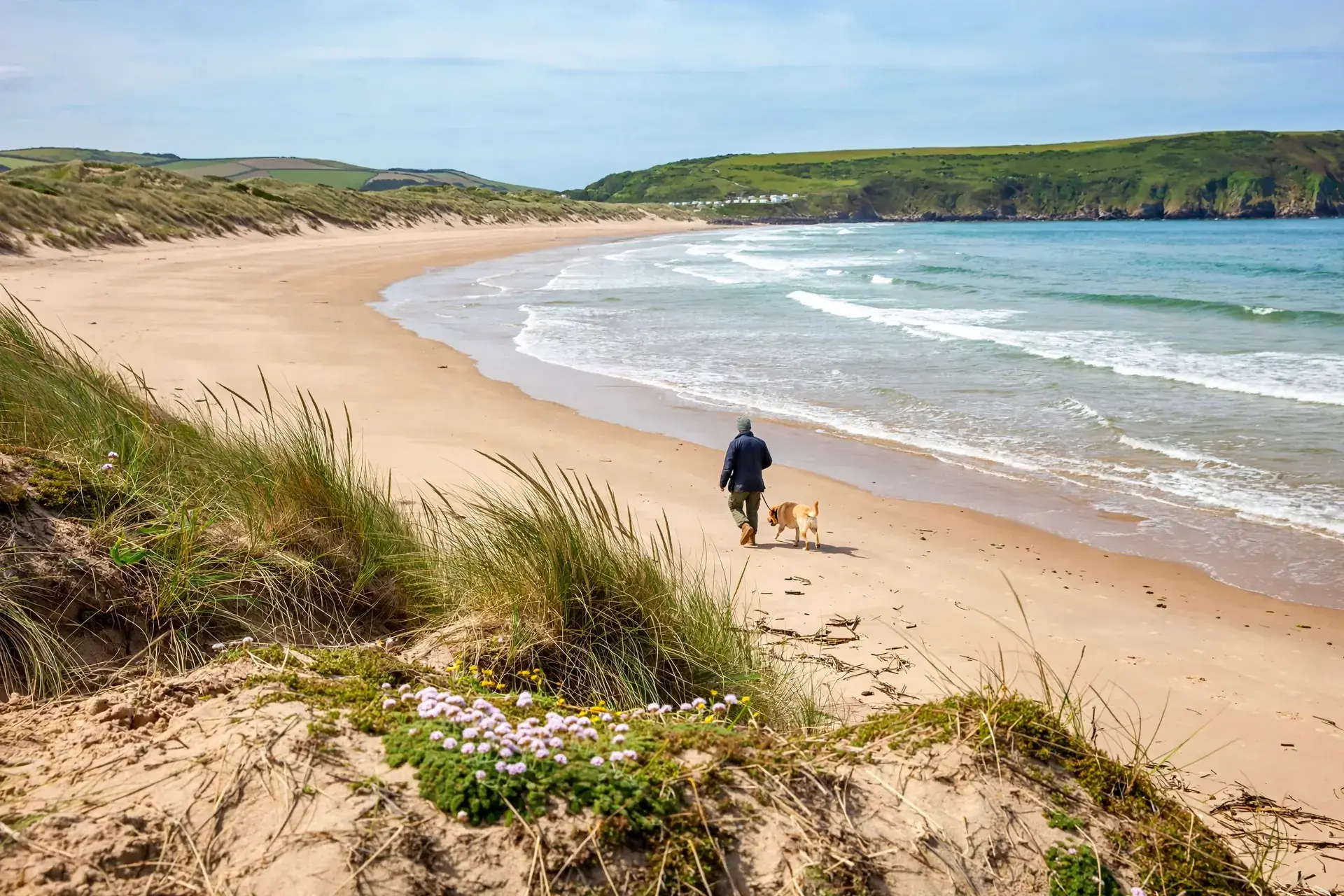
Stand at the northern end of Woolacombe Beach on a clear morning and the first thing you notice is how much room there is. The sand curves away southwards for about three miles, a wide, gently sloping arc between Morte Point at the northern end and Baggy Point far to the south, with the grassy dunes of Woolacombe Warren rising behind the middle of the bay. The village sits tucked into the northern corner, where the valley meets the sea, so the beach feels busiest exactly where you arrive — and emptier with every hundred metres you walk south.
That shape is the whole trick to a good dog trip here. Woolacombe is not a pocket beach where everyone shares one strip of sand. It is a long bay with distinct characters: the lifeguarded, surf-school stretch by the village; the broad, open middle where the dunes take over; and the quiet southern end that merges into Putsborough Sands. A dog that would be overwhelmed by boards, buckets and shouting children at the Esplanade can be perfectly happy half a mile down the beach, chasing a ball with nobody within shouting distance. Your job is not to find a different beach. It is to walk far enough along this one.
The sand itself helps. It is fine, golden and firm near the waterline at low tide, which makes it kinder on paws and joints than the shingle or coarse sand of many Devon coves. At high tide the dry sand narrows considerably, so the beach you walk at nine in the morning can feel like a different place by lunchtime. The tide goes out a long way here, exposing a huge flat expanse that is ideal for a long, straight fetch game — and also ideal for losing track of time, so check the tide times before you set out and plan your return route while you still have plenty of dry sand underfoot.
Behind the beach, the dunes are as much a part of Woolacombe as the surf. They run in a broad band along the middle and southern sections, held together by marram grass, and they are a protected, fragile habitat as well as a playground. The National Trust looks after much of this ground, and the sands themselves were given to the Trust in 1909. That history matters for dog owners in a practical way: the dunes are criss-crossed by waymarked paths, but the grassy ridges are easily damaged, so stick to the paths, keep your dog from digging into the dune faces, and treat the marked routes as the way in and out rather than an invitation to scramble everywhere.
The surf is the other defining feature, and it shapes the dog day more than most visitors expect. Woolacombe faces west-southwest into the Atlantic, so it catches swell for much of the year, and the long sandy bottom produces the gradual, forgiving waves that make it one of Britain's best beaches for learning to surf. For dogs, that means white water, moving boards, wetsuited figures appearing out of the surf, and a constant background noise of waves that some dogs love and some find unsettling. A dog that has only ever met a calm estuary will need a gentler introduction here than a dog that grew up on a surf beach. Let the first visit be short, keep the dog well back from the breaking waves, and watch how they react to the sound and the spray before you let them anywhere near the waterline.
On a clear day you can see Lundy Island on the horizon, a long dark shape out to sea that gives the bay its sense of scale. It is a useful landmark when you are walking south: if Lundy is still in front of you and the village is shrinking behind you, you are heading in the right direction for the quieter sand. The bay sits within the North Devon Coast National Landscape, and the low cliffs at either end of the beach carry maritime heathland that is rare and easily trampled, which is another reason to keep dogs on the paths on the headlands and off the cliff-top vegetation.
One more thing to understand before you plan anything else: Woolacombe is a working seaside village, not a remote wilderness beach. The car parks, surf shops, cafes and toilets are all concentrated at the northern end, and the further south you walk, the fewer facilities you will find. That is a fair trade for space and quiet, but it means the planning has to happen before you leave the village — water, shade, a lead, bags and a plan for getting back — because there is no shop halfway down the beach to fill the gaps.
Dog zones on the beach, in plain terms
Woolacombe Beach runs a zone system for dogs in the main season, and it is worth learning properly, because it is the difference between a relaxed day and an awkward conversation with a beach warden. The zones are set by the landowner, Parkin Estates, and shown on signs at the beach entrances and on a map at the beach. The rules below reflect the position at the time of writing, and you should check the official guidance before you travel, because dates and boundaries can change.
Zone A is the busy northern end, from the rocks at the north end of the beach to the stream. From Good Friday or 1 April, whichever comes first, until 30 September, dogs are not allowed in Zone A between 9am and 6pm. Outside those hours, and outside those dates, the whole beach opens up. In practice that means an early-morning or evening visit to the village end is fine all year, but a midday visit in July is not the place for a dog at all.
Zone B is the middle stretch, from the stream to Mill Rock. In the same main season, from 1 May to 30 September, dogs are allowed here between 9am and 6pm only on a lead. It is a useful transit zone: you can walk your dog through it, on a lead, on your way to the open sand further south, but it is not the place to let them off for a run in the middle of a summer day.
Zone C is the part that makes Woolacombe genuinely dog-friendly rather than merely dog-tolerant. South of Mill Rock, running down towards Putsborough Sands, there are no dog restrictions at any time of year. Dogs can be exercised here on or off the lead, all day, all summer. The red dog bin marks the boundary in practice, and once you are past it the beach opens out and the crowds thin quickly. If you remember only one thing from this guide, remember this: in summer, walk south of Mill Rock.
The zone system is enforced, and fixed penalties can apply for breaches, so do not treat the signs as a suggestion. The boundaries are not always obvious when you are standing on a featureless stretch of sand, so take a moment at the entrance to read the map, note where the stream and Mill Rock sit, and count your landmarks as you walk. Mill Rock is a useful marker in its own right: a dark outcrop on the sand that is easy to spot at low tide and much harder to find when the tide is in, so learn its position on your first walk and use the dune line and the car parks behind you as a backup.
Outside the main season, roughly October to March, the restrictions fall away and dogs are welcome on the whole beach. That is when Woolacombe is at its best for many dog owners: the surf schools have wound down, the car parks are quieter, the sand is empty, and a dog can run the full length of the bay without a zone in sight. Winter brings its own weather, of course — Atlantic wind, horizontal rain and short days — but a dog in a drying coat on an empty three-mile beach in February is a very happy animal, and the village cafes are still there for the warming-up afterwards.
Two cautions belong in this section even though they are not zone rules. First, the zones apply to the beach, not to the dunes or the coast path, which have their own expectations: dogs under close control, on a lead near livestock and cliff edges, and always under control around other walkers. Second, other beaches nearby play by different rules. Croyde, just down the coast, bans dogs from 1 May to 30 September, and Combesgate has its own seasonal ban, so do not assume that a dog-friendly morning at Woolacombe means a dog-friendly afternoon everywhere else in North Devon. Check the signs at each beach on arrival.
A beach day with a dog, hour by hour
The best Woolacombe dog days start early, and not only because the car parks fill up. Before 9am in summer, the whole beach is open to dogs, the sand is cool underfoot, the light is low and golden, and the only other people on the sand are dog walkers, runners and a few surfers carrying boards down to the water. If your dog is nervous, reactive or simply overwhelmed by crowds, this is your window. Set an alarm, bring a flask, and treat the early hour as the main event rather than a warm-up.
Arrive, read the zone signs, and make a decision before you step onto the sand. If it is a summer morning and you plan to stay past 9am, walk south. Do not settle in Zone A with a plan to move later, because moving a settled dog, a windbreak, a pile of towels and two children past a busy surf zone is exactly the sort of faff that ruins a morning. Walk first, settle second. Twenty minutes of walking south on firm sand puts you in Zone C with space to spare, and the walk itself is the dog's first exercise of the day.
Once you are settled, give the dog a job. Woolacombe's flat sand is made for fetch, but a ball thrown into surf is a ball lost, and a dog that chases every wave will be exhausted and salt-sick by lunchtime. Throw along the beach, parallel to the water, rather than into it, and use a floating toy you can see. Build in rest: a shaded spot behind a windbreak, a towel to lie on, and fresh water offered little and often. Dogs do not always stop themselves when they are having fun, and a dog that has been sprinting on hot sand for an hour will not tell you it is overheating until it is already in trouble.
Midday is the pinch point. Between late morning and mid-afternoon in summer, the sun is high, the sand is hot, and the beach is at its busiest. This is the time to get off the sand. Take the dog up into the dunes for a shaded sniff, walk the coast path for half an hour, or head back to the village for lunch in the shade. Hot sand burns paws: if you cannot comfortably hold the back of your hand on the sand for five seconds, it is too hot for bare paws, and the walk back across dry sand to the car park is the moment most dogs get sore feet. A damp towel, a shady rest and a drink do more good at midday than another game of fetch.
Swimming deserves its own paragraph, because Woolacombe's surf is not a paddling pool. The lifeguarded bathing areas, marked by red and yellow flags, are for swimmers, not dogs, and dogs should not be in the flagged zones. Outside those areas, the sea can have strong currents and a powerful undertow, especially on a big swell or a falling tide. Many dogs will happily paddle at the edge and never go further, and that is the right level of ambition for most of them. If your dog is a confident swimmer, keep them close, keep them in sight, and call them back before they get beyond the breaking waves. A dog that swims out after a ball in surf is a dog in danger, and no toy is worth a rescue.
Salt water is the other quiet hazard. Dogs that drink seawater, or swallow a lot of it while playing in the surf, can become sick, and the symptoms — vomiting, diarrhoea, lethargy — can appear hours after you have left the beach. Offer fresh water regularly so the dog is not thirsty enough to drink the sea, and watch for gulping at the waterline. Rinse the dog with fresh water when you get back to the car or the cottage, especially the paws and the belly, and dry them properly before the drive home. Sand gets everywhere: in ears, between toes, in the car, in the cottage. A quick rinse and a towel at the beach saves a much longer clean-up later.
Evenings at Woolacombe are the reward for a well-planned day. After 6pm in summer the zone restrictions lift, the day-trippers thin out, the light turns gold along the whole bay, and the beach belongs to walkers and dogs again. A sunset walk from the village end southwards, with the sun dropping into the Atlantic ahead of you, is one of the best dog walks in North Devon, and it is also the easiest: the sand is cooler, the crowds have gone, and the dog is already tired enough to walk nicely on a loose lead. If you can only manage one walk in a day, make it this one.
The dunes and Woolacombe Warren
The dunes behind Woolacombe Beach are the part of the bay that most visitors walk past without really seeing. They look like a grassy bank from the beach, but up close they are a whole landscape: rolling ridges of sand held together by marram grass, damp hollows between the ridges, sandy paths that wind through the grass, and views back over the bay that get better with every step you climb. For a dog, the dunes are a different kind of walk from the beach — slower, snuffle-ier, full of smells — and they are the best option when the beach is too hot, too busy or too windy.
The dune system, known as Woolacombe Warren, is fragile. Marram grass holds the sand together with deep roots, and once the grass is damaged the sand blows away, the ridge collapses, and the whole dune moves. That is why the waymarked paths matter. Walk on them, keep your dog on them, and resist the temptation to let the dog charge up and down every dune face. A dog digging at the base of a dune can do real damage in minutes, and the same goes for repeated scrambling on the same ridge. There is plenty of dune to enjoy without climbing the most fragile slopes.
For a practical dune walk, start from Marine Drive, the road that runs behind the middle of the beach, where the National Trust car park gives direct access to the dune paths. From there you can follow the paths south through the Warren towards Putsborough, or north towards the village, staying on the grassy ridges above the beach. The walking is gentle but uneven, with soft sand underfoot that tires dogs faster than firm beach sand, so a dune walk that looks short on the map can feel long in the legs. Short-legged and older dogs will find the soft sand hard work; let them set the pace, and build in stops on the firmer paths.
The dunes are also where Woolacombe's wildlife is most visible. Skylarks sing over the grass in spring and summer, and the dune hollows shelter butterflies, bees and small mammals that a dog will smell long before you see them. Keep dogs under close control here, not only for the wildlife but for the other users: the dune paths are shared with walkers, runners and families, and a dog racing around a blind bend in tall grass is a surprise nobody wants. A long line is a good compromise in the dunes: it gives the dog room to sniff and explore while keeping them out of the most sensitive areas and under your control.
Shade is the dunes' great gift on a hot day. The hollows between the ridges are sheltered from the wind and the sun, and a dog that has been baking on open sand will settle happily in a dune hollow with a drink and a chew. Take advantage of that: plan your midday break in the dunes rather than on the beach, and let the dog rest properly before the walk back. In winter the same hollows shelter you from the Atlantic wind, which makes the dunes a year-round option rather than just a summer fallback.
One practical note: the dunes have no water, no bins in the middle, and no shade in the sense of trees — the shade is the shape of the ground itself. Carry water, carry bags, and carry out everything you bring in. Dog waste left in the dunes is not just unpleasant; it damages the habitat and it is exactly the sort of thing that turns other walkers against dog owners. There are bins at the car parks and beach entrances, so bag it, carry it, and bin it on the way out.
Coast path in sections: Morte Point and Putsborough
The South West Coast Path runs straight through Woolacombe, and it gives you two completely different half-day walks from the same starting point: north to Morte Point and the cliffs, or south to Putsborough and Baggy Point. Neither is a casual stroll, and both are better for it. Choose by the weather, the dog and the time you have, and do not try to do both in one day with a dog that is already tired from the beach.
North first. From the village end of the beach, the coast path climbs away from the sand towards Mortehoe, a hilltop village a short distance inland, and then loops out around Morte Point. The name comes from the Latin for death, a reference to the reefs offshore that wrecked ships for centuries, and the point itself is a wild, rocky headland with jagged rocks, crashing waves and views back across the whole of Woolacombe Bay. It is a spectacular walk and a demanding one: steep climbs, uneven ground, cliff edges and, in places, livestock grazing on the headland. Keep dogs on a lead here, always, and keep them well back from the edge. The views are worth the climb, but the ground does not forgive a moment of inattention.
The Woolacombe to Mortehoe stretch is about two to three miles of coast path, and the full loop around Morte Point and back to the village is a half-day outing for most walkers — allow three to four hours with a dog, including stops, and longer if you detour into Mortehoe itself. The village has a pub and a church, and it makes a natural halfway stop, but check the opening hours and the dog policy before you count on it, because a thirsty dog and a closed pub are a poor combination. The path is well signed throughout, and the South West Coast Path Association publishes route descriptions that are worth reading before you go.
Seals are the reward on the Morte Point walk. Grey seals haul out on the rocks below the point and are often visible from the cliff path, especially at low tide, and porpoises and dolphins are sometimes seen offshore. Keep your dog close and quiet when seals are in view: a barking dog on a cliff edge above a seal colony is stressful for the seals and dangerous for the dog. Binoculars are a better idea than a closer look, and the path is set back from the edge for a reason.
South is gentler, at least at first. From the village, the coast path follows the beach and then the dunes south to Putsborough, a walk of about three miles along the sand or on the path behind it. The ground is mostly level, the views are open, and the dog can run on the beach for much of the way. At Putsborough the beach narrows, the dunes give way to the headland, and the path climbs towards Baggy Point, the southern headland of the bay. Baggy Point is a National Trust headland with a circular walk that takes in the point itself and the views back north across Woolacombe and south towards Croyde. It is a shorter, more manageable headland walk than Morte Point, and a good choice for a dog that is not ready for the northern cliffs.
The full Woolacombe to Baggy Point circuit, out along the beach and back over the headland, is a serious walk — allow most of a day, carry water and food for both of you, and do not start it late in the afternoon. A shorter version, walking the beach to Putsborough and returning the same way, gives you the best of the bay without the headland climb, and it is the version most dogs will enjoy most. The Marine Drive car park makes a good alternative start for the southern walk: park there, walk the dunes to Putsborough, and you have cut out the busiest stretch of beach entirely.
For a longer ambition, the coast path continues north from Morte Point towards Lee and Ilfracombe, a full day's walk of around seven to nine miles from Woolacombe to Ilfracombe, with steep cliff sections and few easy exits. That is a walk for a fit, experienced dog and a walker who has planned transport back, not a spontaneous add-on to a beach day. If the Ilfracombe stretch appeals, read our guide to Lynton with a dog first for a sense of how steep and exposed this stretch of the North Devon coast can be, and plan the Ilfracombe leg as its own day. The same goes for the moorland behind the coast: our Exmoor dog guide covers the ponies, deer, livestock and tick checks that matter once you leave the coast path for the high moor.
Whatever section you choose, the coast path rules are the same. Dogs on a lead near cliff edges and livestock, dogs under close control everywhere else, and no off-lead running where the path is narrow, the drop is steep, or the ground is uneven. Carry more water than you think you need, because there is no fresh water on the headlands, and check the weather before you set out: the coast path is exposed, and a sunny morning in the village can turn into a windy, wet afternoon on Morte Point. If the forecast is poor, the beach and the dunes are the better choice, and the coast path will still be there tomorrow.
Barricane and the northern coves
Just north of the village, past the rocks at the end of the main beach, sits Barricane Beach, a small cove with a completely different character from the main sands. It is a shell beach — the sand is made up of tiny broken shells, pale and crunchy underfoot — and at low tide it opens into rock pools and a wide, sheltered stretch of sand that feels a world away from the surf schools and the crowds. Dogs are welcome here all year round, on a lead in the summer months, and it is one of the best places in Woolacombe for a dog that prefers rock pools and sniffing to open-water fetch.
Barricane is tide-dependent in a way the main beach is not. At high tide the cove shrinks to almost nothing, and the walk around the rocks from the main beach is cut off. Check the tide times before you go, arrive on a falling tide, and leave with plenty of time to get back around the rocks before the tide turns. The rocks themselves are slippery with seaweed, and a dog scrambling over them can cut a paw or slip, so take the sandy route where you can and keep the dog on a lead on the rocks. The cafe at Barricane operates in the summer months, and dogs must be on a lead while it is in place; outside the summer season they can be off the lead under control.
North of Barricane, the coast path continues towards Morte Point and the small, hidden coves beyond it, including the stony beaches and rock pools that make the Mortehoe coast so appealing to walkers who like to explore. These are not beaches in the Woolacombe sense — there is no sand to speak of, no facilities, and no easy access — but they are wonderful for a dog that likes to pick its way along a rocky shore, and they are almost always quiet. Treat them as an extension of the coast path walk rather than a destination in their own right, and do not try to reach them by scrambling down cliffs: use the signed path and the steps, and turn back if the ground looks too steep for the dog.
Combesgate, the next beach south of Putsborough, is a useful contrast. It is a small, sheltered cove with its own seasonal dog ban, and it is a reminder that the Woolacombe zone system is specific to Woolacombe. Each beach on this coast has its own landowner, its own signs and its own dates, and the only reliable rule is to read the sign at the beach you are actually standing on. If you are walking south from Woolacombe to Putsborough and on to Combesgate, check the signs at each new beach before you let the dog off the lead.
Village logistics: parking, water and shade
Woolacombe village is small, and that is part of its charm — everything you need is within a few minutes' walk of the beach — but it also means the logistics are concentrated, and on a sunny summer weekend the whole system is under pressure. The main car parks are the Esplanade car park, right by the beach at the northern end, and Sandy Burrows, a short walk back from the seafront. Both are run by Parkin Estates, both are paid, and both fill early: on a fine Saturday in August, arriving after 10am can mean queuing, and arriving after 11am can mean not parking at all. The advice is simple and it is worth following: arrive before 9.30am, or come after 4pm when the day-trippers are leaving.
Marine Drive car park, run by the National Trust, is the better choice for many dog owners. It sits behind the middle of the beach, gives direct access to the dunes and the coast path, and puts you straight onto the quieter stretch of sand without walking through the village end. National Trust members park free. Putsborough car park, also National Trust, is the quietest start of all: a small car park at the end of a lane, a short walk to the southern end of the beach, and immediate access to the dog-friendly sand. If your whole plan is a long, quiet beach walk, Putsborough is where to start.
Mortehoe village, up the hill from Woolacombe, has some free parking and makes a good start for the coast path walk to Morte Point, with a twenty-five minute walk down to the beach. It is a useful option if the Woolacombe car parks are full, but do not park inconsiderately in a small village: use the marked spaces, do not block driveways or passing places, and remember that the people who live there have to get in and out all day.
Once you are parked, the practical questions are water, toilets and shade. Public toilets are at the main car park and on the seafront, open year-round, including accessible toilets, and there are toilets at Marine Drive as well. There is no fresh water on the beach itself, so fill your bottles and the dog's bowl before you leave the car park, and carry more than you think you need: a dog that has been running on sand in the sun will drink far more than you expect, and the nearest tap is a long walk back. The beach has an outdoor shower at Marine Drive and at the main car park area, which is useful for rinsing sand off paws and legs before the drive home.
Shade is scarce on the beach, and there are no trees on the sand. Bring your own: a windbreak, a beach tent or a large umbrella, and a towel or mat for the dog to lie on out of the sun. A dog that has nowhere to get out of the sun will overheat, and a dog that is overheating will not enjoy the beach, however much it loves the sea. If you have forgotten shade, the dunes are the fallback — the hollows between the ridges are the only natural shade on the bay, and they are worth the walk.
Getting there without a car is possible but needs planning. The bus service runs from the village to Barnstaple, Ilfracombe, Combe Martin and Mortehoe, and it is the practical way to do a one-way coast path walk: bus to Ilfracombe or Mortehoe, walk back to Woolacombe along the coast. Check the timetable before you travel, because services are infrequent, and check the bus operator's dog policy as well — dogs are generally carried at the driver's discretion, and a wet, sandy dog after a beach day is a different proposition from a dry dog on the way out. If you are staying in the village, walking everywhere is easy: the village is compact, the beach is at the bottom of the hill, and the coast path is signposted from the seafront.
One last piece of village logistics: the beach is cleaned daily in season, and there are dog waste bins at the beach entrances and car parks. Use them. Woolacombe's dog-friendly reputation depends on dog owners behaving well, and the zone system only survives if the beaches stay clean. Bag it, bin it, and if the nearest bin is full, carry it to the next one rather than leaving it beside an overflowing bin.
Family trips: children, surf lessons and dogs
Woolacombe is a family beach first and a dog beach second, and the best family trips are the ones that plan for both at the same time rather than treating the dog as an afterthought. The village end of the beach is where the surf schools, the bodyboard hire, the ice cream and the lifeguards are, and it is also where the dog zones are tightest. That is not a contradiction; it is a timetable. Use the early morning and the evening for the dog, the middle of the day for the children, and the dunes and the southern beach for the hours when everyone wants to be together.
Surf lessons are the obvious family activity, and Woolacombe is one of the best places in Britain to learn. The long, sandy bottom and the gradual waves suit beginners, and the village has several established surf schools offering group and private lessons for children and adults. A dog does not belong in a surf lesson. Plan for one adult to stay with the dog — on the southern beach, in the dunes, or back at the cottage — while the other takes the children to the lesson, and swap over afterwards. A dog tied to a windbreak while its family plays in the surf is a stressed dog, and a stressed dog on a busy beach is a problem waiting to happen.
Bodyboarding is the easier family compromise. The lifeguarded bathing areas have a marked bodyboarding zone, the waves are gentle enough for children, and a dog can watch from the sand at a distance without being in the water. Keep the dog on a lead near the waterline, well away from the flagged bathing area, and give the dog its own activity — a chew, a shaded spot, a ball game on dry sand — so it is not simply waiting for the family to come back.
Rock pooling is the activity that genuinely suits dogs and children together. At low tide, the rocks at the northern end of the beach and at Barricane expose pools full of crabs, anemones, small fish and limpets, and a dog on a lead can sniff around the edges while the children explore. The rules are the same as everywhere on this coast: watch the tide, wear sensible shoes, do not turn over rocks and leave them overturned, and do not let the dog drink from the pools. The best rock pooling is on a falling tide, an hour or two after high water, when the pools are freshly filled and the sea is still a safe distance away.
Children and dogs on a hot beach need the same things: shade, water, sun protection and rest. A dog cannot tell you it has sunburn on its nose and ears, and a pale-nosed dog will burn in the same sun that burns a child. Pet-safe sun cream on exposed noses and ears, a shaded rest spot, and regular drinks are not optional extras; they are the difference between a good day and a vet visit. If the dog is panting heavily, seeking shade and refusing to play, it is telling you it has had enough. Listen to it, and head for the dunes or the village.
Evenings are the family reward. After the surf schools pack up and the day-trippers leave, the beach is quiet enough for a family walk with the dog off the lead in the right zone, and the village pubs and cafes are still open for an early supper. Eat early, walk late, and let the dog sleep properly afterwards: a dog that has had a full beach day, a coast path walk and a family supper needs a proper night's sleep, not another hour of excitement.
Eating and staying with a dog in the village
Woolacombe village has the full range of seaside eating: cafes on the seafront, fish and chips, ice cream parlours, pubs and restaurants, and a handful of beach shacks serving hot food in season. What it does not have is a single, settled rule about dogs indoors. Policies vary from place to place, change with the season, and often depend on whether you are sitting inside, on a terrace, or taking food away. The only reliable approach is to ask before you sit down, and to have a takeaway plan if the answer is no.
Terraces and outdoor seating are your best bet. Many of the village cafes and pubs welcome dogs on their outdoor seating, especially outside the busiest hours, and a dog that can settle under a table with a bowl of water is a dog that can join the family for lunch. Arrive early or late, choose a quiet corner, bring the dog's mat so it has a defined place to lie, and order at the counter if that is how the place works rather than expecting table service for a dog that is still settling. A dog that has just come off the beach, sandy and wet, is not a good candidate for any indoor space: rinse and dry the dog first, or eat outside.
Takeaway food is the unsung hero of a Woolacombe dog holiday. Fish and chips eaten on a bench above the beach, with the dog on a lead beside you, is a better meal than a stressful hour in a restaurant with a dog that will not settle. The village shops sell sandwiches, pasties and picnic supplies, and a picnic in the dunes — shade, space, no other tables to disturb — is often the most relaxing lunch of the whole trip. Pack a cool bag, buy food in the village, and eat where the dog is comfortable rather than where the menu looks best.
Staying in Woolacombe with a dog needs the same careful approach as eating. The village and the surrounding area have holiday cottages, bed and breakfasts, campsites and holiday parks, and many of them welcome dogs, but the details matter: how many dogs, what size, whether dogs can be left alone in the accommodation, whether there is an enclosed garden, and what the pet charge is. Ask all of it in writing before you book, and do not assume that a listing that says dog-friendly means your dog, in your numbers, on your dates. A cottage with a walled garden a short walk from the southern beach is a different holiday from a flat above a shop with no outside space and a two-mile walk to the dog-friendly sand.
Self-catering is usually the easiest option for a dog holiday here. A cottage with a garden, a hard floor for sandy paws, and a washing machine for sandy towels takes most of the friction out of a beach holiday, and it means the dog can settle into a routine — same bed, same feeding time, same last walk — that a hotel room cannot offer. If you are staying in a caravan or a holiday park, check the site rules about dogs on leads, the location of the nearest toilet walk after dark, and whether there is somewhere to rinse a sandy dog. The same questions apply here as on any park stay: boundaries, noise, and the practicalities of a wet dog in a small space.
Wherever you stay, build the dog's routine around the beach zones. A cottage near the village end means a short walk to the busy beach and a longer walk to the dog-friendly sand; a cottage near Putsborough means the opposite. Neither is wrong, but they are different holidays, and the right choice depends on whether your dog wants a quick morning paddle or a long afternoon run. If you are choosing between two places, pick the one that puts the dog-friendly sand within an easy walk, because you will make that walk twice a day, every day, in all weathers.
Seasons, tides and surf safety
Woolacombe changes with the seasons more than most British beaches, because the difference between a quiet winter beach and a crowded August beach is not just the number of people — it is which parts of the beach your dog can use, which facilities are open, and what the sea is doing. Plan by season, not just by date.
Spring, from Easter to May, is the hinge. The surf schools reopen, the lifeguards return, the cafes open up, and the dog zones come into force. The beach is still quiet on weekdays, the dunes are full of skylarks, and the light is at its best. It is an excellent time for a dog holiday, provided you have learned the zone dates: Zone A closes to dogs from Good Friday or 1 April, and Zone B goes lead-only from 1 May. A spring visit rewards an early start and a walk south, and it punishes anyone who assumes the winter rules still apply.
Summer is the high season in every sense. The beach is busy, the car parks fill by mid-morning, the surf schools are in full swing, and the dog zones are at their strictest. It is also the season when Woolacombe is at its most joyful: warm sand, gentle surf, ice cream, and a beach full of families. Dogs can still have a wonderful summer here, but only if the humans plan around the dog rather than around the beach. That means early mornings, evenings, the southern beach, the dunes at midday, and a willingness to leave the village end to the surf schools. If your dog is nervous, reactive or heat-sensitive, summer at Woolacombe is a harder holiday than spring or autumn, and you should think carefully before booking a peak-season week.
Autumn, from late September into November, is the sweet spot for many dog owners. The zones lift at the end of September, the crowds thin, the sea is at its warmest, and the light turns gold. The surf is often at its best in autumn, with clean Atlantic swell and offshore winds, and the beach is empty enough for a proper run. The cafes and surf schools wind down through October, so check what is open before you travel, but the beach itself is open all year, and an October dog walk on an empty Woolacombe is hard to beat.
Winter is the quiet season, and it suits a particular kind of dog holiday: long walks, empty sand, bracing wind, and a cottage with a fire to come back to. The beach is fully open to dogs, the car parks are quiet, and the village is calm. The trade-off is weather. Atlantic storms bring high winds, heavy rain and big seas, and the coast path can be dangerous in a gale. Check the forecast, check the tide, and do not walk the cliff paths in high wind. A winter beach day is a shorter, sharper affair than a summer one: an hour on the sand, a warm-up in the village, and a proper rest afterwards.
Tides deserve a section of their own, because they shape every Woolacombe walk. The tide goes out a long way, the beach is flat, and it is easy to walk a long way south on the firm sand and then find the tide has turned and the way back is narrower, wetter and harder than the way out. Check the tide times for Woolacombe before you set out, note the time of high water, and plan to be back at your starting point well before it. The coves north of the village and at Barricane are cut off at high tide, and the rocks between them and the main beach should not be attempted when the tide is in. If you are unsure, ask at the tourist information centre or check the official guidance before you travel.
Surf safety is the last piece. The RNLI lifeguards patrol the main beach in the main season, typically from late May to mid-September and over Easter and the school holidays, from 10am to 6pm, and the bathing areas are marked by red and yellow flags. Swim between the flags, keep dogs out of the flagged areas, and respect the surf zones: the beach is divided into bathing and surfing areas for a reason, and a dog in the surf zone is a hazard to surfers and to itself. Rip currents can occur, especially on a falling tide and a big swell, and the sea here is powerful even when it looks calm. If in doubt, stay out of the water, keep the dog on a lead at the waterline, and enjoy the beach from the sand.
What to pack for a Woolacombe dog day
A Woolacombe dog day is a long day on open sand with no shops halfway along, so the packing list is really a plan for self-sufficiency. Start with water: a large bottle for the dog, a collapsible bowl, and more than you think you need. Add a lead and a long line, because the beach zones, the coast path and the dunes all need different levels of control, and a dog that is off the lead on the southern beach still needs a lead for the walk through the village and the middle zones.
Shade and rest come next. A windbreak or beach tent, a towel or mat for the dog to lie on, and a drying coat for after a swim or a paddle. The drying coat does double duty: it keeps a wet dog warm on the walk back to the car, and it keeps the car seats dry. Bring two towels if you can: one for the dog, one for the humans, because a single towel will be sandy within minutes. A spare lead, a spare bag of treats, and a chew for the midday rest will all earn their place in the bag.
For the dog's feet, think about the surfaces. Hot sand in summer, sharp shells at Barricane, slippery rocks on the coast path, and soft dune sand that tires small legs — all of them are easier with a quick paw check at each stop. Look between the toes for sand and small stones, rinse with fresh water, and dry properly. If your dog has sensitive paws, consider booties for the hottest part of the day, but try them at home first: a dog that has never worn booties will spend the first hour trying to take them off rather than enjoying the beach.
Health and safety items belong in the bag too. Pet-safe sun cream for pale noses and ears, a basic first-aid kit with saline for rinsing eyes and a tick remover, and the number of the nearest vet saved in your phone before you need it. Ticks are a real consideration on the coast path and in the dunes, especially in spring and summer, so check the dog after every walk, particularly around the ears, the armpits and the groin. Our Minehead with a dog guide covers the same South West Coast Path tick and livestock checks from the Somerset end of the path, and the advice applies just as well here.
Finally, pack for the car. A waterproof seat cover or a crate, old towels for the boot, and a bag for sandy leads and wet coats will save the drive home. A dog that has had a full day on Woolacombe Beach will be tired, sandy and probably asleep within minutes of leaving the car park, and a comfortable, dry place to sleep in the car is the last kindness of the day. Keep a bottle of fresh water in the car for the journey home, and offer the dog a drink before you set off.
If you are staying for a week, the packing list grows: a washing line or an airer for drying coats and towels, a spare set of bedding for the cottage, a familiar bed or blanket so the dog settles in a new place, and the dog's usual food, measured out for the week, so a change of diet does not add an upset stomach to a beach holiday. Woolacombe village has shops for the things you forget, but a dog's food, medication and familiar bed are not things to leave to chance.
Practical questions
Before you go
Can dogs go on Woolacombe Beach in summer?
Yes, but only in the right part of the beach. In the main season the busy northern end is closed to dogs between 9am and 6pm, the middle stretch from the stream to Mill Rock is lead-only in those hours, and the sand south of Mill Rock towards Putsborough stays open to dogs all year. Check the signs at the beach entrance on the day, because the exact dates can change.
Where can my dog run off the lead at Woolacombe?
The most reliable off-lead sand is south of Mill Rock, running down towards Putsborough Sands, where there are no dog restrictions at any time of year. The dunes behind the beach and the quieter stretches of the South West Coast Path also suit a dog under close control, but keep a lead handy for livestock, other walkers and cliff edges.
How long is the walk from Woolacombe to Putsborough with a dog?
The beach walk from the village end to Putsborough is about three miles one way, so allow at least an hour each way at a dog-walking pace, longer if your dog stops to paddle and sniff. The firm sand near the waterline is the easiest surface, and the walk is much easier at low or falling tide. Carry water, because there is no fresh water on the sand itself.
Is Barricane Beach dog friendly?
Yes, dogs are welcome at Barricane Beach, the small shell-covered cove just north of the village, all year round. In the summer months dogs must be kept on a lead there. Check the tide before you go, because the cove is cut off at high tide and the walk back needs to be timed carefully.
Where should I park for a dog walk at Woolacombe?
For the village end and the main beach, use the Esplanade or Sandy Burrows car parks. For a quieter start and direct access to the dog-friendly southern sand, use the National Trust car park at Putsborough, which is free for National Trust members. Marine Drive car park suits dune and coast path walks. All of them fill early on sunny summer weekends, so arrive before 9.30am or after 4pm.
Can dogs walk the South West Coast Path from Woolacombe to Morte Point?
Yes. The coast path leaves the northern end of the beach, climbs past Mortehoe and loops around Morte Point, with wide views back across Woolacombe Bay and out to Lundy Island on a clear day. Keep dogs on a lead near cliff edges and livestock, carry water, and allow extra time for the climbs. The full loop back to the village is a half-day walk for most dogs.