This guide is independent and contains no paid placement. If affiliate links are added later, they will be clearly marked and will not change our editorial checks.
Wrexham works brilliantly as a dog day out: Erddig's gardens and parkland welcome dogs on leads, the compact city centre is made for slow market wandering, Bellevue and Acton parks give you green space within minutes, and the Clywedog Valley Trail is a proper riverside walk a short drive away. Avoid the stadium area on match days, keep the lead on in gardens and near livestock, and check the official guidance before you travel for opening times and prices.
A new city with a very old football story
Start with the thing that makes Wrexham different from every other town of its size: it is a city now, and it became one in the most Wrexham way possible. Wrexham was granted city status in 2022 as part of the late Queen Elizabeth II's Platinum Jubilee celebrations, one of eight places across the UK to receive the honour that year. For a place that had campaigned for city status for decades, the announcement landed as vindication — and it changed how the town talks about itself. You will notice it in the small things: the way the centre presents itself, the pride in the signage, the sense that this is a place that has arrived rather than one still waiting. For a visitor with a dog, that matters in a practical way too. A city that is busy reimagining itself tends to be a city that is investing in its streets, its markets and its public spaces, and Wrexham's centre is compact enough that you can feel that energy on a single slow walk.
The second half of the story is the one the whole world has heard. Wrexham AFC, founded in 1864, is one of the oldest professional football clubs in the world, and its home, the Racecourse Ground, is widely described as the oldest international football stadium still in use, having hosted its first home international match in 1877. The club's purchase by actors Ryan Reynolds and Rob McElhenney in 2021, and the documentary series that followed, turned a proud local institution into a global talking point. The result is a city where football is not a weekend hobby but a shared language. On a match day the streets fill with red shirts, the pubs spill out onto the pavements and the air around the ground hums hours before kick-off. That atmosphere is wonderful for a football fan and, frankly, a lot for most dogs. The honest advice in this guide is to enjoy the football story on a non-match day, when you can walk the ground's perimeter, read the history in the streets around it and take photographs without crowds, and to keep the dog well away on match days themselves.
What does all of this mean for a dog walk? More than you might think. Wrexham's identity is built on two things that shape the streets you will walk: industry and community. This was a coal, steel and brewing town, and the centre still carries that history in its brickwork, its market halls and its pub frontages. It is also a Welsh border city, sitting close to the English border, with Chester a short drive away and the hills of north-east Wales rising to the west. That border position gives Wrexham a particular character: Welsh-language signage and a strong Welsh identity alongside a steady flow of visitors from across the border in England. For a dog owner, the practical upshot is a city that is used to walkers. The centre is flat, the distances are short, the pavements are wide on the main streets, and you are rarely more than ten minutes from a patch of green. The walk from the station to the market, from the market to Bellevue Park, from the park to the Racecourse Ground — these are all short, level, ordinary urban strolls, the kind that suits an older dog or a puppy that is still building stamina just as well as they suit a fit spaniel.
Before you set off, it helps to think about what kind of day you want, because Wrexham rewards a plan more than a wander. A good shape for a first visit is to start at Erddig in the morning, when the gardens are quiet and the light is kind, then drive into the centre for the markets and a late lunch, and finish with a park or riverside walk in the afternoon when the dog has had a rest. That order works because Erddig is at its best early, the markets are liveliest late morning, and the valley walks are best when you have a couple of unhurried hours rather than a squeezed half-hour. If you are staying overnight, the city makes a practical base for a longer north-east Wales trip: Llangollen and the Dee Valley are a short drive west, Chester is a short drive east, and the walks in this guide are a useful warm-up before bigger hill days. Keep the first day gentle, let the dog learn the new smells and sounds, and save the longer trails for day two when you both know the rhythm of the place.
Erddig Hall and gardens with a dog
Erddig is the reason many dog owners come to Wrexham in the first place, and it deserves a slow half-day rather than a rushed hour. The estate is a National Trust property, a Grade I listed country house with gardens and parkland that have been cared for by the same family for generations, and it sits about two miles south-west of the city centre — close enough that it feels part of Wrexham, far enough that the countryside arrives properly. The house itself is an eighteenth-century Georgian mansion, famous for its unusually complete record of the servants who kept it running, and the gardens are the part your dog will love: formal lawns, clipped hedges, long borders and wide paths that invite a steady, sniffing pace. The estate grounds stretch well beyond the formal garden into parkland and woodland, where the walks open out and the dog can settle into a proper stride. It is the single best dog walk in Wrexham, and planning your day around it is the right call.
The dog rules at Erddig follow National Trust policy, which is worth understanding before you arrive so there are no surprises at the gate. Dogs are welcome in the gardens and parkland on a lead, and the estate walks are genuinely dog-friendly — this is not a grudging tolerance but a place where dog walkers are a normal part of the daily picture. Only assistance dogs are allowed inside the house itself, so if part of your party wants to tour the interiors, plan for one person to stay outside with the dog or take turns. That is the standard arrangement at most National Trust houses, and our guide to National Trust places with dogs explains how the pawprint ratings work and what to expect from property to property. Water bowls are usually available near the visitor facilities, and the estate has dog waste bins along the main routes, but bring your own bags and a spare — the parkland is big and the bins are not on every path. Check the official guidance before you travel for current opening times, admission prices and any seasonal restrictions, because garden access, event days and house opening hours can all change the rules on a given day.
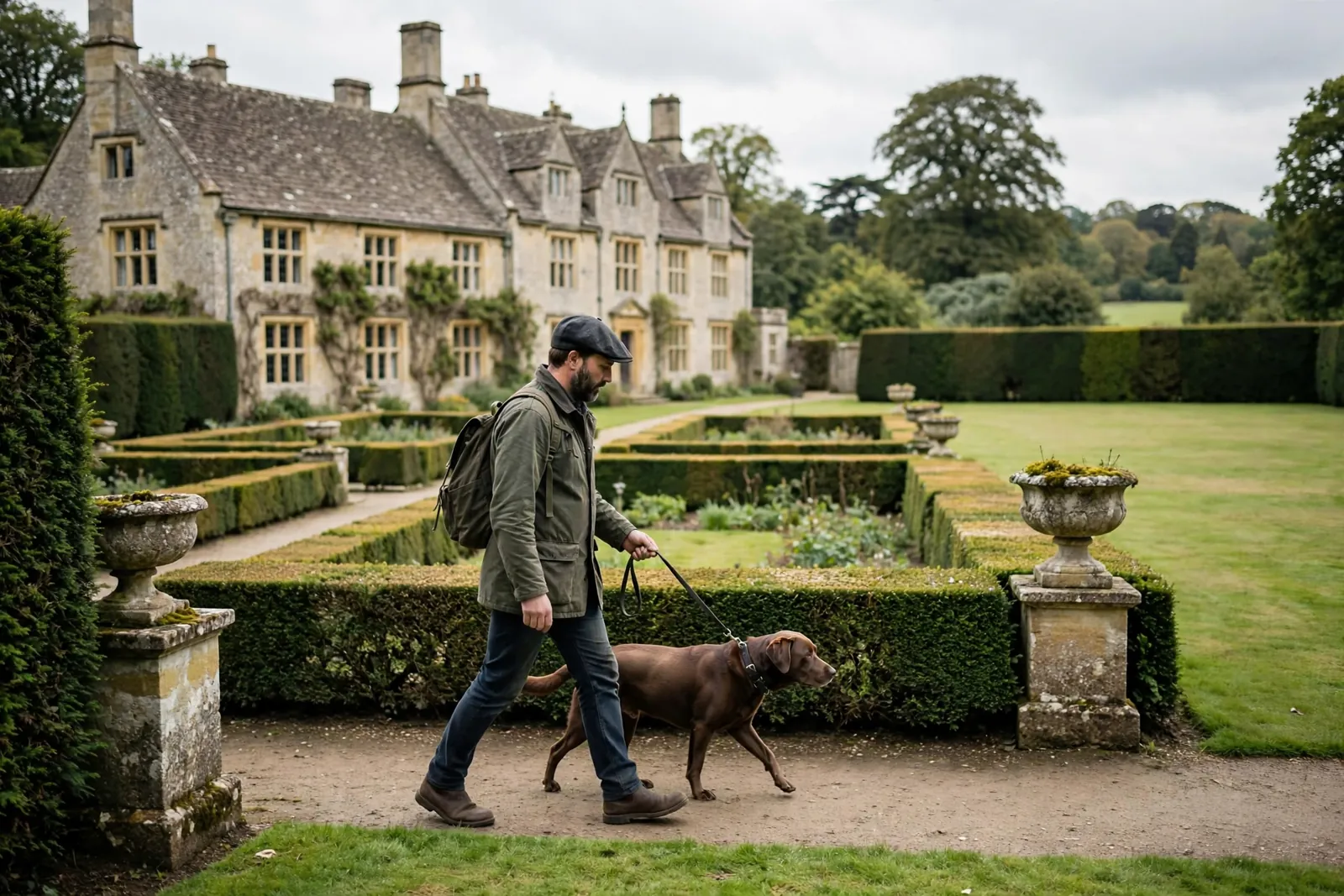
The walk itself is best approached as a loop rather than a straight line. From the car park, the path leads you towards the house and the formal garden, where the clipped yew hedges and the long borders frame the Georgian facade in a way that photographs beautifully in afternoon light. Keep the dog on a short lead here: the garden paths are shared with other visitors, the borders are planted close to the path edge, and a dog that lunges at a squirrel across a flower bed will not be popular. Beyond the formal garden, the paths open into the parkland, where there is more room to let the dog move at its own pace on a long lead. The parkland has mature trees, open grass and views back towards the house, and in autumn the colour is superb. The wooded sections are cooler in summer and sheltered in a shower, which makes the estate a reliable choice in weather that would spoil a more exposed walk. Allow at least an hour and a half for a proper circuit, and two hours if you stop at the cafe, because the estate rewards slowness and the dog will tell you when it has had enough.
A few practical details make the visit smoother. Arrive early if you can, especially at weekends and in school holidays, because the car park fills and the garden paths get busy by late morning. The estate is busiest on event days and during the summer holidays, when the formal garden can feel crowded for a nervous dog; a weekday morning is a different, calmer place. Wear proper walking shoes rather than smart trainers: the parkland paths are surfaced in places but turn muddy after rain, and the wooded sections hold puddles longer than you would expect. Bring water for the dog even though bowls are provided, because the parkland loop is long and there is no tap halfway round. If your dog is reactive, keep to the wider parkland paths rather than the narrow garden walks, and be ready for other dogs, children and the occasional horse rider on the estate's outer paths. Finally, remember that Erddig is a working historic estate, not a dog park: the lead stays on, the dog stays out of the planting, and the pleasure comes from sharing a beautiful place properly rather than treating it as an exercise field.
Markets and independent shops in the centre
After Erddig, the city centre is the natural second act, and Wrexham's markets are the best place to start. The city has a long market tradition, and the market halls and open-air stalls in the centre still form the commercial heart of the place. On market days the streets around the centre fill with stalls selling fruit and vegetables, bread, flowers, household goods and local produce, and the atmosphere is closer to a working Welsh market town than to a polished shopping centre. Dogs are welcome in the open-air streets, squares and market areas on a lead, and a calm dog on a short lead fits in naturally among the stalls. The key skill is positioning: walk the dog on the side away from the stalls, keep the lead short where the crowds thicken, and step aside into a doorway or a quieter side street if the dog starts to find the noise and the smells overwhelming. Market dogs do best when they have already had a proper walk — a dog that has burned off its energy at Erddig will settle happily beside a stall while you browse, while a dog that has been in the car all morning will find the same crowd unbearable.
The independent shops are where Wrexham's centre earns its character. Away from the main shopping streets, the centre has a growing number of independent retailers: butchers, bakers, bookshops, gift shops, cafes and specialist stores that give the city a personality no chain store can match. Many of these shops are happy to have a well-behaved dog inside, but the rule is always to ask first. Look for a sign in the window — some shops advertise themselves as dog-friendly — and if there is no sign, a quick question at the door is all it takes. Shopkeepers who welcome dogs usually mean it genuinely, and a dog that is invited in is a dog that behaves better, because the invitation sets the tone. Keep the dog close, watch the tail near low displays and fragile stock, and be ready to step outside if the shop is small or crowded. The High Street, Hope Street and the streets around the market are the best hunting ground for independents, and a slow loop through them, with pauses at the windows that catch your eye, is a pleasant hour for both of you.
Cafes and pubs deserve a plan of their own. Wrexham has a good spread of cafes and traditional pubs, and many have outdoor seating where a dog is welcome without any question. Indoors, the rules vary: some pubs welcome dogs throughout, some restrict them to a particular room or the bar area, and some keep dogs outside only. The practical approach is to choose your stop before you need it. When you pass a place that looks promising, pop your head in and ask — most staff will tell you straight away, and many will offer the dog a biscuit or a bowl of water without being asked. Lunchtime is the busiest period, so if your dog is nervous in crowds, aim for an early or late lunch, or pick a place with a quiet corner rather than the main dining room. The city centre also has chain coffee shops and fast-food outlets where the dog policy is usually stricter, so the independents are generally the better bet for a relaxed stop. Bring a small mat or blanket for the dog to lie on in a pub or cafe: it gives the dog a defined place to settle, keeps it off cold floors, and signals to other customers that this is a dog that knows how to behave in public.
The centre is also worth exploring for its architecture and its street-level details, which are easy to miss if you rush. St Giles' Church, with its tall tower, dominates the skyline and is one of the finest parish churches in Wales — a good landmark for orienting yourself and a handsome backdrop for a photograph. The streets around it hold a mix of Victorian and Georgian frontages, old pub signs and the occasional reminder of the city's industrial past. Queens Square, the main civic space, is a useful meeting point and a place to sit for a few minutes with the dog while you work out your next move. The whole centre is flat and compact, so a full loop from the market to the church, down to the station and back takes well under an hour at a dog's pace. If you are pushing a buggy or managing a dog that tires easily, that flatness is a genuine blessing: there are no steep hills in the centre, and the pavements on the main streets are wide enough for a dog and a pedestrian to pass comfortably.
The Racecourse Ground and the city parks
The Racecourse Ground sits just north of the city centre, and on a non-match day it is a fascinating place to walk past with a dog. The stadium is the home of Wrexham AFC and one of the oldest football grounds in the world, and the streets around it — Mold Road, Crispin Lane and the roads that run down towards the centre — carry the history of the club in their names, their pubs and their murals. Walk the perimeter on a quiet weekday and you will see the ground in its calm state: the stands, the turnstiles, the club shop, and the small details that supporters notice and visitors walk straight past. It is a good walk for a football fan with a dog, because it lets you take in the place at your own pace, read the information boards, and take photographs without a crowd pressing in. The ground itself is not open to casual visitors on non-match days, and you should not expect to walk onto the pitch or into the stands — but the streets around it are public, pleasant and flat, and they make a satisfying half-hour loop from the centre.
On match days, the advice changes completely. The streets around the ground fill with supporters hours before kick-off, the pubs spill out onto the pavements, and the noise — singing, shouting, the roar from inside the ground — is intense even from outside. Most dogs find that stressful, and even a confident dog can be startled by a sudden cheer or a flare of crowd noise. The pavements become crowded enough that a dog on a lead is an obstacle rather than a companion, and the post-match crowds are worse, because thousands of people leave at once. If you are in Wrexham on a match day with a dog, the sensible plan is to enjoy the football from a distance: walk the parks and the valley in the morning, keep the dog well away from the ground from a couple of hours before kick-off until the crowds have dispersed, and let the supporters have their streets. Check the fixture list before your trip so you know which days to avoid, and if your visit happens to coincide with a big match, treat it as a reason to spend the day at Erddig or in the Clywedog Valley instead. Check the official guidance before you travel for current fixture information, because kick-off times and dates can change.
Bellevue Park is the city's most useful green space for a dog owner, and it sits a short walk from the centre. This is a Victorian park with paths, lawns, mature trees and a bandstand, laid out in the formal style of its era but used today as a thoroughly practical neighbourhood park. The paths are surfaced and level, which makes it a good choice for older dogs, puppies and anyone who wants a gentle walk rather than a hike. The lawns give a dog room to sniff and stretch on a long lead, and the trees provide shade in summer and shelter in a shower. Keep the dog on a lead — this is a shared public park with children, joggers and other dogs, not an off-lead exercise field — and be ready for squirrels, which the park has in abundance. Bellevue works best as a morning or evening walk, when the light is soft and the park is quieter, and it pairs naturally with a loop past the Racecourse Ground or a wander through the centre. It is the kind of park that locals use every day, and that familiarity is part of its charm: you will see the same dog walkers, the same routines, and the same unhurried pace.
Acton Park, on the north side of the city, is the larger and wilder of the two main city parks, and it suits a longer walk. It has open grassland, wooded paths and a lake, and the scale of it means you can walk for an hour without retracing your steps. The wooded sections are good in hot weather and in rain, and the open areas give a dog space to move on a long lead. The lake attracts ducks and other water birds, so keep the dog close near the water and do not let it chase or disturb the wildlife. Acton Park is also a good place to practise recall and lead manners in a semi-rural setting without leaving the city: the paths are wide enough to pass other walkers comfortably, but there are enough distractions — other dogs, joggers, cyclists, children — to make it a genuine training ground. As with Bellevue, the lead stays on unless you are in a clearly designated off-lead area, and you should always have bags with you. Between the two parks, the centre and the Racecourse perimeter, you can build a full day of city walking without ever getting in the car, which is exactly what a good city break with a dog should offer.
Countryside walks: Offa's Dyke and the Clywedog Valley
Leave the city behind for an afternoon and Wrexham's position on the edge of north-east Wales starts to pay off. The best of the nearby countryside walks is the Clywedog Valley Trail, a riverside route that follows the River Clywedog through woodland and meadows to the south-west of the city. The trail is well marked, largely level, and long enough to feel like a proper walk rather than a park loop. The river is the constant companion: you hear it before you see it, and the path follows it through stretches of mature woodland where the light filters down in shafts and the ground smells of leaf mould and damp earth. Dogs love this kind of walk — the smells change every few metres, the ground is soft underfoot, and there is always something to investigate around the next bend. Keep the dog on a lead near the water, on narrow sections and wherever livestock graze nearby, and be ready for muddy stretches after rain. The trail is at its best in spring, when the woodland floor is covered in wild garlic and bluebells, and in autumn, when the trees turn and the river runs high after rain.
Nant Mill Country Park is the practical gateway to the Clywedog Valley, and it is worth treating as a destination in its own right. The park has parking, a visitor centre, picnic areas and the remains of an old mill, and it sits at a point where several paths meet, so you can choose a short loop or a longer out-and-back depending on how much time and energy you have. A short loop from the visitor centre, down to the river and back through the woods, takes about an hour at a dog's pace and is a good introduction to the valley. A longer walk along the trail takes two to three hours and rewards you with quieter stretches where you may not meet another walker for twenty minutes. The visitor centre is a useful source of local information: ask about current path conditions, fallen trees after a storm, or which sections are muddiest, because the staff know the trail in a way no guidebook can match. The picnic areas are a good place for a packed lunch with the dog, and the open grass near the car park is useful for a last toilet stop before the drive home. Check the official guidance before you travel for current opening times and facilities, because the visitor centre hours vary by season.
Alyn Waters Country Park, to the north-east of the city near Gwersyllt, offers a different kind of countryside walk: a former industrial landscape that has been reclaimed as parkland, with the River Alyn running through it and a network of paths that link woodland, meadow and riverside. The park is bigger and more open than the Clywedog Valley, and it suits a dog that likes space and a long, steady walk. The paths are surfaced in places and grass in others, so the ground can be muddy after wet weather, and the river sections need a lead. The park has several car parks, which makes it easy to choose a starting point that suits the length of walk you want, and the paths connect well enough that you can build a loop of almost any length. It is also a good birdwatching spot, so keep the dog close near the water and the reed beds. For a visitor staying in Wrexham for a few days, Alyn Waters and the Clywedog Valley make a natural pair: one day in the valley, one day by the Alyn, each giving the dog a different landscape and a different set of smells.
For walkers with more time, the Offa's Dyke direction opens up the bigger hill country to the west. The Offa's Dyke Path, the long-distance trail that follows the ancient earthwork along the Welsh border, passes through the hills west of Wrexham on its way towards Llangollen, and the sections around the Dee Valley offer some of the finest walking in north-east Wales. These are proper hill walks rather than park strolls: the ground is rougher, the climbs are steeper, and the weather changes faster. A day walk from Llangollen up onto the hills above the Dee, with views across the valley and the dog on a lead near the sheep, is a superb outing for a fit dog and a fit owner. But it needs planning: check the route in advance, carry water and a lead, dress for the weather, and be honest about your dog's fitness. A dog that has happily walked the Clywedog Valley may still struggle with a steep, exposed hill path in wind and rain. If you are unsure, the valley trails are the safer choice, and the Offa's Dyke sections are a reason to come back rather than a box to tick on a first visit. For more ideas on long-distance walking with a dog, our guides to the region's other towns — including Bangor further along the north Wales coast — cover the practicalities of combining a city stay with bigger hill days.
Staying, parking and practical details
Choosing where to stay with a dog in Wrexham is straightforward if you ask the right questions before you book. The city has a mix of city-centre hotels, guesthouses, bed and breakfasts and self-catering accommodation in the surrounding villages, and the dog policies vary more than the room descriptions suggest. The single most important step is to get the dog policy in writing before you pay: how many dogs are allowed, whether there is a pet fee and how much it is, whether dogs can be left alone in the room, and whether there are designated dog-friendly rooms or floors. A property that says it is dog-friendly but only allows one small dog in a single room type is not the same as a property that welcomes two large dogs in every room. Self-catering stays are often the easiest option for dog owners, because they give you a kitchen, a door you can open for a late-night toilet trip, and usually a garden or yard. Hotels work well too if the dog is used to settling in a new room, but check whether there is a charge for the dog and whether the hotel has a sensible place for the dog to relieve itself nearby. Whatever you choose, bring the dog's own bed and a familiar blanket: a new room smells strange to a dog, and a bed that smells of home is the fastest way to settle it.
Parking in the city centre is practical rather than difficult, but it helps to know the layout before you arrive. The city has several signed car parks in and around the centre, including multi-storey and surface car parks within a short walk of the markets, and the charges are modest by city standards. Check the official guidance before you travel for current charges and any height or overnight restrictions, because the rules differ between car parks and the charges change from time to time. If you are staying overnight, ask your accommodation about parking: some hotels have their own car park, others use a nearby public car park, and a few have no parking at all. For a day visit, the sensible approach is to park once, walk the centre, and drive to Erddig or the valley walks separately — the estate and the country parks each have their own car parks, so there is no need to drive in and out of the centre repeatedly. Never leave a dog in a parked car, even for a few minutes: a car heats up fast in sun and cools fast in cold weather, and a dog left alone in a car is a dog in danger. If you need to pop into a shop that does not allow dogs, take turns with your companion or leave the dog at your accommodation.
A few practical details are worth sorting before you travel. Find the nearest vet to your accommodation and save the number in your phone, along with the number of an out-of-hours emergency vet — rural and small-city practices can be a twenty-minute drive away, and they close early. Pack the dog's usual food, because a change of diet on a travel day is a reliable recipe for an upset stomach, and bring more water than you think you need, plus a collapsible bowl. The weather in north-east Wales changes quickly, so pack a drying coat or towels for the dog and a waterproof for yourself, even if the forecast looks kind. If your dog is on medication, bring a spare day's supply in case your return is delayed. And if you are travelling by train, check the train operator's dog policy in advance: Wrexham has two stations, Wrexham General and Wrexham Central, with services to Chester, Shrewsbury and beyond, and dogs are generally welcome on trains on a lead, but the rules and the practicalities — busy carriages, stairs, platform gaps — are worth knowing before you arrive at the station with a nervous dog.
Finally, think about the dog you actually have, not the dog you wish you had. Wrexham is a forgiving city for a well-prepared dog owner: the walks are varied, the distances are short, the parks are good and the countryside is close. But it is still a city, with traffic, crowds, market noise and match-day excitement, and a dog that is reactive, nervous or unwell will find some parts of it hard. The best days here are the ones where you match the plan to the dog: a quiet morning at Erddig for a nervous dog, a market wander for a confident one, a valley walk for a dog that needs space, and a park loop for a dog that needs routine. Build in rest time, keep the lead on where it matters, and be ready to change the plan if the dog tells you it has had enough. A dog that has a good day in Wrexham is a dog that will happily come back, and this is a city that rewards a second visit: the hills to the west, the coast to the north and the border country all around are waiting, and Wrexham makes a better base for them than most people realise.
A sample day in Wrexham with a dog
Pulling the pieces of this guide together into a single day helps, because Wrexham is at its best when the order of events matches the dog's energy. The shape below works for a first visit in spring or autumn, when the light is kind and the crowds are manageable, and it can be stretched into a weekend by swapping the afternoon walk for one of the longer routes described above. The timings are deliberately loose: a good dog day runs on the dog's clock, not a timetable, and the best moments in Wrexham — a quiet stretch of riverside path, a sunny corner in a pub garden, a market stallholder offering your dog a treat — do not keep to a schedule. Treat the times as a rhythm rather than a plan, and be ready to cut a section short if the dog tells you it has had enough.
Start at Erddig, and start early. Aim to arrive as the estate opens, when the car park is quiet and the garden paths belong to the dog walkers and the gardeners. Spend the first hour in the formal garden and the parkland, walking the loop described earlier at a slow, sniffing pace, and let the dog set the speed. This is the best part of the day for photographs, because the morning light falls across the house and the hedges, and the garden is at its most peaceful. By late morning, when the paths begin to fill, head for the cafe or the picnic areas for a rest and a drink. A dog that has had a proper morning walk will settle happily under a cafe table or on a picnic rug, and that rest is what makes the afternoon work. Do not rush the estate: two hours here, with a break in the middle, is a better investment than an hour spent hurrying between the house and the car park.
Drive into the city centre for the middle of the day, and make the markets your first stop. Late morning is when the market streets are at their liveliest, and a dog that has already walked and rested will cope with the crowds far better than a dog that has been cooped up in the car. Wander the stalls without a fixed route, stopping where something catches your eye, and keep the lead short and the dog on the side away from the displays. Allow an hour for the markets and the independent shops, and build in a pause in Queens Square or beside St Giles' Church, where you can sit for ten minutes and let the dog watch the world go by. Sitting still in a busy place is a skill, and a dog that can settle on a pavement in a city centre is a dog that has learned something useful. If the dog starts to flag, cut the shopping short and head for lunch — the city has plenty of dog-friendly pubs and cafes, and a quiet corner with a bowl of water and a mat to lie on will revive most dogs within half an hour.
Spend the afternoon in the green space that suits your dog best. For a dog that is still full of energy, the Clywedog Valley Trail from Nant Mill is the right choice: a proper riverside walk through woodland, long enough to feel like an adventure and quiet enough to let the dog relax. For a dog that is tiring, Bellevue Park is the gentler option: a level loop on surfaced paths, with lawns for sniffing and trees for shade, and the centre close by if you need to cut the walk short. Either way, keep the afternoon walk to an hour or ninety minutes, and finish with a calm drive home rather than another busy stop. The dog will sleep well after a day like this, and so will you. If you are staying overnight, the evening is for a short toilet walk near your accommodation and an early night — the second day, with the Dee Valley and Llangollen to the west, will be the bigger adventure, and the dog will need its rest.
A few variations are worth knowing about. In summer, start even earlier at Erddig and move the valley walk to the late afternoon, when the woodland is cooler and the river is at its most inviting. In winter, swap the valley for Acton Park, where the paths are firmer and the open ground dries faster, and plan a longer pub stop in the middle of the day. If the weather turns, the city centre and Erddig's sheltered garden paths are the wet-weather fallback: the estate's wooded sections hold up well in rain, and the centre's covered market areas and cafes give you somewhere dry to wait out a shower. And if your visit falls on a Wrexham AFC home match day, rearrange the day so that the afternoon walk is in the valley rather than anywhere near the ground — the football is part of the city's story, but it is a story best enjoyed from a distance when you have a dog with you.
If you have a second day, Wrexham makes an excellent base for a wider north-east Wales loop, and the dog will be better prepared for it after a gentle first day in the city. Llangollen and the Dee Valley, a short drive to the west, offer riverside walks, canal towpaths and the climb up to the hills above the town, and the Llangollen Railway and the Pontcysyllte Aqueduct are worth seeing even from the towpath with a dog on a lead. To the east, Chester is a natural partner city, with its walls, its Rows and the River Dee meadows, and a day split between the two cities gives you a proper sense of this border country. To the north, the coast and the Clwydian Range offer bigger hill days for a fit dog. The trick is to keep the second day's ambition in proportion to the first: a dog that has walked Erddig and the valley on day one will be ready for a longer hill walk on day two, but a dog that was rushed, tired or stressed on day one will not. Build the trip as a progression — city first, countryside second, hills third — and let each day earn the next one.
Practical questions
Before you go
Can dogs visit Erddig Hall and gardens?
Yes, dogs are welcome in the gardens and parkland at Erddig on a lead, and the wider estate walks are a highlight for dog owners. Only assistance dogs are allowed inside the house itself, which follows National Trust policy at most properties. Check the official guidance before you travel for current opening times, admission prices and any seasonal restrictions, because garden access and events can change the rules on a given day.
Are dogs allowed in Wrexham city centre and the markets?
Dogs are welcome in the open-air streets, squares and markets of the city centre on a lead, and many independent shops are happy to have a well-behaved dog inside if you ask first. Individual shops set their own rules, so look for a sign in the window or ask at the door rather than assuming. Indoor shopping centres and food halls have their own policies, and assistance dogs are admitted everywhere by law.
Where can I walk my dog near the Racecourse Ground?
The streets around the Racecourse Ground are pleasant for a short on-lead stroll, especially on non-match days, and Bellevue Park is a short walk away with paths, lawns and trees. For a longer walk, Acton Park on the north side of the city has open space and wooded paths, while the Clywedog Valley Trail and Nant Mill Country Park a short drive away offer riverside routes. Avoid the immediate stadium area on match days, when crowds and noise make it a poor choice for most dogs.
Is the Clywedog Valley Trail suitable for dogs?
Yes, the Clywedog Valley Trail is a popular dog walk, following the river through woodland and meadows with a largely level, well-marked path. Keep your dog on a lead near the water, on narrow sections and wherever livestock graze nearby, and be ready for muddy stretches after rain. Nant Mill Country Park at one end of the trail has parking, a visitor centre and picnic areas, which makes it a practical start and finish point.
Where should we stay and park in Wrexham with a dog?
Look for accommodation that states its dog policy in writing before you book, including any pet fee, the number of dogs allowed and whether dogs can be left alone in the room. City-centre hotels, guesthouses and self-catering stays around Wrexham all vary, so confirm the details rather than relying on a generic dog-friendly label. For parking, use the signed city-centre car parks and check the official guidance before you travel for current charges and any height or overnight restrictions.