This guide is independent and contains no paid placement. If affiliate links are added later, they will be clearly marked and will not change our editorial checks.
Begin with Wymondham Abbey's exterior and churchyard, where dogs on leads can take in the stonework without any indoor-policy gamble. Then walk the market-town streets slowly, and save the open country for a Tiffey valley field path, keeping dogs on leads near livestock and on marked paths through crops. Check the official guidance before you travel for indoor access, path diversions and seasonal livestock notices.
Start at the abbey, from the outside
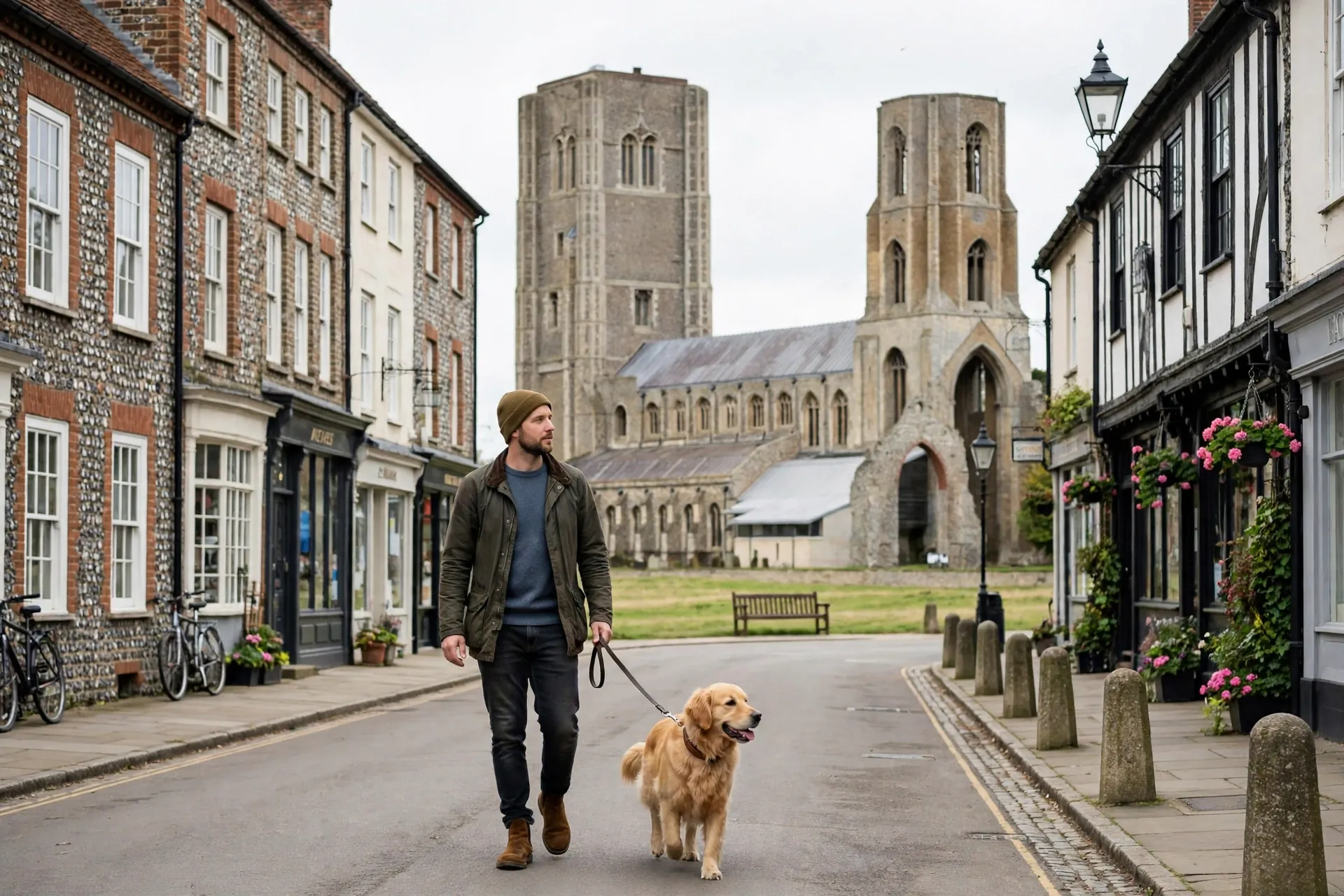
Most guides to a historic town begin by sending you through a door. In Wymondham, with a dog, it is better to begin by not going through one at all. Wymondham Abbey dominates the town from the outside: a great medieval church whose towers, flint and stonework, long roofs and churchyard setting can be read, photographed and enjoyed entirely from the open air. Starting here has a practical advantage as well as an aesthetic one. You do not need to gamble the first hour of your visit on an indoor dog policy, a queue, or a dog that is suddenly asked to be quiet in an echoing stone interior. You begin with the thing that is most certain, most spacious and most dog-friendly: the building seen from its grounds, at walking pace, with room for the dog to sniff, settle and look up at you for direction.
Walk the outside slowly, in a full circuit if the grounds allow, rather than stopping only at the front. The character of a building like this changes with every angle. From one side you see height and mass; from another, the pattern of flint flushwork, the shape of the windows, the way later additions sit against older stone, and the relationship between the church and the town that grew up around it. Dogs are excellent companions for this kind of looking, because they enforce a slower rhythm. A dog stops to investigate a scent, and in that pause you notice a carved detail, a change in stone colour, or a view down a side street that a brisk visitor would walk straight past. Let the dog set the tempo for the first half hour, and the abbey stops being a backdrop and becomes the subject of the visit.
Use the exterior walk to orient yourself for the rest of the day. The abbey sits at the historic heart of Wymondham, and the streets that lead away from it are the streets you will walk next. Notice which way the ground falls, where the shade lies on a warm day, where the quieter lanes branch off, and where the busier roads run. If you are travelling with children or with a second adult, this is also the moment to agree a simple plan: one person can check the current indoor notice while the other waits outside with the dog, so nobody has to improvise later. Indoor dog policies for historic churches can change with services, events, conservation work or staffing, so check the official guidance before you travel, and treat anything you read online as a starting point rather than a promise. The exterior-first approach means that even if the interior is closed to dogs on the day, or closed altogether, the visit has already succeeded.
Photography works best from the outside too. A dog on a lead in the foreground, with the tower behind, tells the story of the day far better than a hurried interior snapshot. Keep the dog on a short lead for photographs near paths and other visitors, and avoid posing the dog on memorials, low walls or planting. If your dog is nervous around crowds, choose a quieter corner of the grounds and a longer lens distance rather than placing them in the middle of the main approach. The aim is a calm dog and a clear view, in that order. A settled dog photographs well; a stressed dog, however picturesque the tower, does not.
One more reason to begin outside: it teaches you the town's scale. Wymondham is a market town, not a city, and its pleasures are close together. The abbey, the streets and the field paths beyond them all lie within a walk that a reasonably fit dog can manage without a car. Beginning at the abbey gives you a landmark to return to, a mental map of the centre, and a sense of how much further you want to go. If the dog is already tired, you can shorten the day to the abbey and the streets. If the dog is fresh, the Tiffey valley paths are waiting. Either way, the day has a centre, and that centre is the building you have already seen properly, from the outside, at a dog's pace.
Churchyard etiquette for dogs
A churchyard is not a park, and treating it like one is the fastest way to spoil a visit for everyone, including your dog. It is a place of burial, remembrance and quiet visiting, and it is also, on many days, a working churchyard with visitors, gardeners and services. The rules below are not restrictive for their own sake; they are what allow dogs to keep being welcome in such places. Keep your dog on a lead throughout the churchyard, even if your dog is normally reliable off lead. A churchyard is full of low stonework, uneven ground, small memorials and other people's moments of grief, and a lead is the simplest way to show respect for all of them.
Keep to the paths where paths exist, and keep the dog off graves, memorial stones and planted areas. Dogs do not understand the difference between a grass path and a grave, so the lead and your attention have to supply that understanding. Do not let the dog drink from fonts or flower vases, chew plants, or dig at edges and banks. Carry bags and use them, and take the bag with you rather than leaving it by a wall or in a hedge; churchyards rarely have the bins that a country park provides, so plan to carry waste until you reach a proper bin in the town. A small, sealable pouch for used bags is one of the most useful items in a dog owner's pocket, and it costs nothing to carry.
Be alert to services and private moments. If a funeral, wedding or service is taking place, or if someone is standing quietly at a grave, give them a wide berth and keep your dog close and quiet. If the church is in use, do not try to peer through doors or walk the dog around the building's entrance while people are arriving. Step aside, wait, or move on to the streets and return later. The same courtesy applies to other dogs: not every dog in a churchyard wants to meet yours, and a narrow path between memorials is a poor place for an introduction. Cross to a wider stretch, shorten the lead, and keep moving if the other owner does the same.
Watch the ground as well as the manners. Churchyards combine old, uneven surfaces: worn stone, tree roots, grass that is slippery after rain, and steps that may be shallow or irregular. Small dogs, older dogs and dogs with joint problems will feel these surfaces more than you do. Walk slowly, let the dog choose footing where it is safe to do so, and avoid dragging a reluctant dog across wet stone. In hot weather, remember that stone and gravel hold heat; in cold weather, they hold ice. Shade and water matter here as much as on a country walk, and a collapsible bowl and a bottle of water should be in your bag before you leave the car or the station.
Finally, read the notices. A churchyard noticeboard is the most reliable local source for current rules: whether dogs are welcome inside the church, whether any part of the grounds is closed for maintenance or conservation, and whether there are seasonal requests, such as keeping dogs away from nesting areas or newly planted ground. Noticeboards change faster than guidebooks, and they are written by the people who look after the place. Checking them takes a minute and prevents the kind of misunderstanding that makes a dog owner feel unwelcome. If a notice asks for something you had not expected, follow it cheerfully; the town has plenty of other ground for your dog, and the churchyard will still be there, quiet and impressive, for your next visit.
The market-town streets, at a dog's pace
From the abbey, Wymondham's streets invite a different kind of walking: slower, more stop-start, full of shopfronts, side lanes, crossing points and smells. A market town street is a social space as much as a route, and a dog experiences it as a sequence of encounters: other dogs, children, pushchairs, delivery vans, cyclists, market stalls on market days, and the scent trails left by every dog that passed before. Your job is to set a rhythm that keeps the dog under threshold rather than over it. Walk on the inside of the pavement where you can, keep the lead short but not tight, and pause deliberately at corners, crossings and busy shopfronts so the dog can look, sniff and settle before you ask them to move on.
Market days deserve a particular approach. A market street on a market day is louder, narrower and more crowded than the same street on an ordinary weekday, and the stalls themselves add low tables, food smells, dropped food and feet at dog-head height. Some dogs love this; many do not, and even a sociable dog can become over-aroused by the combination of food, crowds and other dogs in a confined space. If you visit on a market day, go early if you can, keep the dog close, and be ready to step into a side street for a breather. Do not let the dog eat dropped food, approach food stalls closely, or greet every other dog. A market visit with a dog works best as a short loop with an easy exit, not as a long, determined browse through every stall.
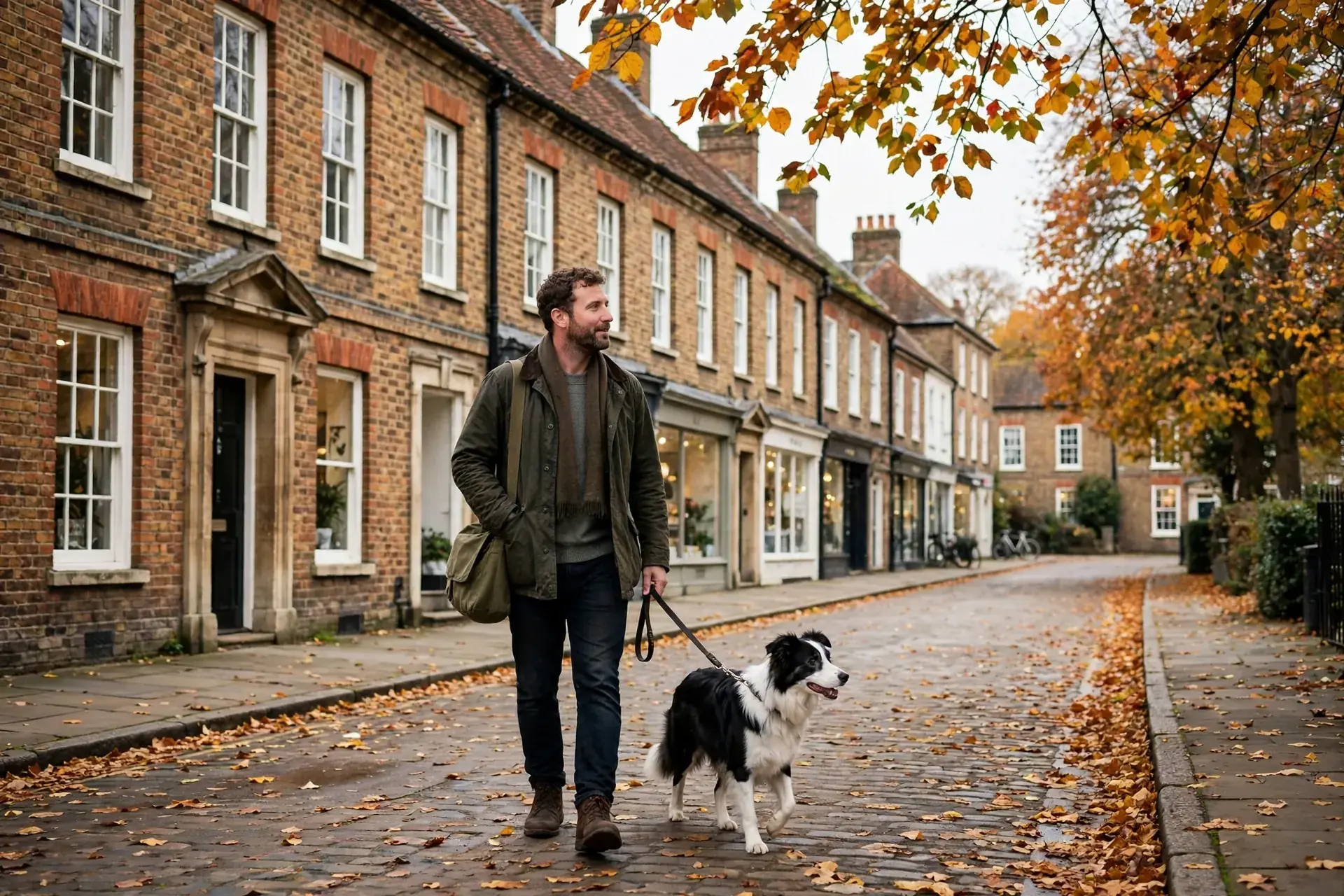
Shopfronts and historic buildings reward the same slow looking you practised at the abbey. Wymondham's streets carry a mix of timber-framed, brick and rendered buildings, and their interest lies in the details: overhanging upper floors, old doorways, painted signs, narrow passages and the way the street bends and opens. You do not need to know the date of every building to enjoy this; you need only to look up occasionally, which a dog's pauses will remind you to do. If you want to go inside a shop, check the policy first rather than assuming. Some shops welcome dogs warmly, some prefer dogs to wait outside, and some change their policy with the season or the day's trade. A quick question at the door, with the dog held close, is polite and fast, and it avoids the awkward moment of being asked to leave a shop you have only just entered.
Pavement cafes and places to eat follow the same principle, with one addition: settle the dog before you settle yourself. Choose a table with space for the dog to lie out of the main walkway, put a mat or blanket down if your dog has one, offer water, and give the dog something to do, such as a chew that is safe to use in public, while you order. Dogs that are asked to lie quietly for an hour without preparation will struggle; dogs that have had a walk, a drink and a chance to sniff the surroundings first will usually manage. If your dog cannot settle, shorten the stop rather than forcing it. A short, successful cafe stop is worth more than a long, stressful one, and the town's streets are pleasant enough that a takeaway eaten on a bench, with the dog beside you, can be the better plan.
Practical street sense matters too. Keep the dog on the side away from traffic at crossings, and do not let a long lead trail across a pavement where cyclists and pushchairs pass. Watch for parked cars pulling out, for bins on collection days, and for the sudden noises of a working town: shutters, reversing vehicles, church bells, and market-day announcements. None of these are reasons to avoid a market town with a dog; they are the normal texture of the place, and a dog that is walked through them steadily, with praise and space, will grow more confident with each visit. The rhythm to aim for is unhurried but purposeful: walk, pause, look, move on, and let the town reveal itself in the gaps between the dog's sniffs.
Tiffey valley field paths
Beyond the streets, the land around Wymondham opens into the Tiffey valley: a shallow, green valley of fields, hedgerows, small watercourses and the kind of arable countryside that defines much of south Norfolk. The field paths here are the natural second half of a Wymondham day, and they offer a completely different experience from the town: open sky, longer sightlines, birdsong, and the chance for a dog to stretch its legs on a longer line or, where allowed and safe, off lead. But field paths also carry responsibilities that town streets do not. They cross working farmland, and the rules that protect crops, livestock and wildlife are not optional extras; they are the conditions on which public access depends.
Start by understanding what kind of path you are on. Public rights of way in England are marked on maps and usually waymarked on the ground, and they follow defined lines across fields, not the most convenient shortcut. Keep to the marked line, especially where crops are growing. Walking across a growing crop, even for a few metres, damages a farmer's livelihood and can close a path to future walkers if it becomes a habit. Where the path runs along a field edge, use the edge; where it crosses a field, follow the waymarks and the worn line rather than striking out diagonally. If you are unsure of the line, stop and look for the next marker before continuing, and check the official guidance before you travel for any published diversions or closures.
Livestock is the most important field-path consideration for dog owners. Sheep, cattle and horses may be grazing in fields that a path crosses, and a dog's instinct to chase, herd or simply run towards them can cause real harm, even if the dog only means to play. Keep your dog on a lead in any field with livestock, and put the lead on before you enter the field, not after you have spotted the animals. Keep the dog close, move steadily along the path, and do not let the dog bark at, approach or circle the animals. In spring, during lambing, take extra care: ewes with young lambs are easily stressed, and many farmers and access codes ask walkers to keep dogs on leads on all farmland at that time of year. If animals are crowding the path, or if your dog is visibly distressed, turn back or use a signed alternative. No walk is worth a livestock incident.
Gates, stiles and fences deserve the same care. Close every gate behind you, even if you found it open, unless a sign clearly says otherwise; an open gate can let livestock stray onto a road. Help your dog over stiles calmly rather than lifting them awkwardly in a hurry, and check that fences and gates are secure after you pass. If a dog is small enough to slip through a gap in a hedge or fence, keep them on a lead near boundaries and roads. These small habits are what farmers notice, and they are what keep paths open for the next dog walker.
Water is a quieter hazard in a valley landscape. Small streams, ditches and wet field corners can look inviting to a dog on a warm day, but they may be deep, muddy, fast after rain, or lined with steep banks that are hard to climb out of. Do not let your dog enter water you cannot see into, and be cautious after heavy rain when levels rise quickly. The same caution applies to blue-green algae in still water in warm weather: if water looks discoloured or scummy, keep the dog out and do not let them drink from it. A bottle of clean water and a collapsible bowl are more reliable than any stream, and they weigh almost nothing.
Arriving by rail, and by car
Wymondham is an easy town to reach without a car, and that matters for dog owners, because a car-free day removes parking, traffic and the question of leaving a dog in a vehicle. The town has a railway station, and the walk from the station into the centre is short enough to be part of the visit rather than a chore. If you travel by train, check the timetable and the train operator's dog guidance before you travel, because rules and services vary by operator and by time of day. Keep your dog on a lead on platforms and in station buildings, allow extra time for boarding if your dog is new to trains, and choose a quieter carriage area where the dog can lie under a seat or at your feet without blocking the aisle.
Train travel with a dog rewards preparation. Feed and walk the dog before the journey so that the train is a rest, not a test of bladder and energy. Bring water, a bowl, a familiar blanket, and something to settle the dog during the ride. If your dog is nervous about train noises, start with a short journey elsewhere before attempting a longer Norfolk trip, and sit where the dog can see you and feel your hand nearby. Other passengers will generally be kind about a calm dog, and a calm dog is usually the result of a tired body, a full bladder emptied before boarding, and an owner who is not anxiously hovering. Sit down, settle yourself, and the dog will often follow.
Arriving by car is equally straightforward, but it needs a different kind of planning. Use signed parking in the town rather than blocking lanes or field entrances, and check signs for time limits and charges before you leave the car; do not rely on memory or on another website's summary, because parking arrangements change. Never leave a dog in a parked car in warm weather, even for a short stop, and in cold weather remember that a car cools quickly and a dog left alone in an unfamiliar place will bark, stress and attract attention. The better plan, in a town as compact as Wymondham, is to park once, walk everywhere, and return to the car only at the end of the day.
Whichever way you arrive, build a margin into the start of the day. Dogs that are rushed from a train or a car straight into a busy street, without a toilet stop and a sniffing walk, start the day over-aroused. Give the dog ten unhurried minutes on arrival: a quiet corner, a drink, a chance to relieve itself in a suitable place, and a few minutes of simply standing and watching the town go by. That small investment pays for itself in every later part of the day, because a dog that has arrived properly is a dog that can walk, wait and settle. Visitors who skip it often spend the rest of the day managing a dog that never quite caught up with the plan.
A half-day route that works
Put the pieces together and a Wymondham half day falls into a natural order: abbey exterior first, streets second, field path third. Begin at the abbey grounds, walk the outside of the building slowly, read the noticeboard, and let the dog settle into the town's pace. Then move into the market-town streets, looping at a dog's rhythm, pausing at shopfronts and corners, and stopping for a drink and a rest when the dog tells you it is time. Finish with a field path in the Tiffey valley direction, where the dog can stretch out after the town's stop-start walking, before returning to the centre or the station by the same or a parallel route.
The order matters. Abbey first gives the day a landmark and a sense of history before the bustle of the streets. Streets second give the dog social interest while it is still fresh and curious. Field path last gives the dog open space when it has already had its fill of people, and gives you a quieter end to the day, with birdsong and hedgerows instead of traffic. Reversing the order can work, especially if you arrive by train and want to walk off the journey first, but the abbey-first order is the one that best matches the town's character: history at the centre, daily life around it, countryside beyond it.
Allow roughly half a day for this loop without hurrying, and longer if you stop for a meal, a second circuit of the abbey grounds, or a longer field walk. The exact time depends on your dog's pace, the weather, and how often you stop, and that is the point: a dog day should not be timed like a train timetable. Build in two or three rest points where the dog can lie down, drink and watch the world, and treat those rests as part of the route, not as delays. A bench with shade, a quiet stretch of churchyard path, and a field gate with a view are all rest points if you choose to use them that way.
If the weather turns, shorten the field-path section first and keep the abbey and streets. The town parts of the route are usable in rain, with shelter in doorways and cafes, while a field path in heavy rain becomes a mud bath for the dog and a slog for you. Conversely, on a hot day, shorten the town section at midday, seek shade and water, and save the field path for the cooler part of the day, or skip it altogether and return to the abbey grounds in the evening light. A flexible route that you are willing to cut is worth more than an ambitious route that exhausts the dog.
End the day the way you began it: calmly. Return to the abbey area or a quiet street for a final sniffing walk, offer water, and let the dog settle before the train or car journey home. Dogs remember the last part of a day as strongly as the first, and a calm ending makes the next visit easier. If you are staying in Norfolk for longer, note what worked: which streets your dog liked, where the quiet corners were, and how far the field path felt. Those notes, kept for your own next trip, are more useful than any guide's general advice, because they are written about your dog.
Pairing Wymondham with Diss or Fakenham
Wymondham sits in a county full of market towns, and visitors often ask whether to combine it with Diss or Fakenham. The honest answer is that each of these towns deserves its own day, and combining two in one day usually means rushing both and tiring the dog. If you have two days, the pairing works beautifully; if you have one, choose the town that matches the kind of day you want, and leave the other for a return visit. The towns differ in character and setting, and understanding those differences helps you choose rather than simply ticking boxes.
Diss, to the south of Wymondham, is a mere-side town: its centre of gravity is water, with a mere and its surrounding paths giving the town a lakeside rhythm quite unlike Wymondham's abbey-centred one. A Diss day leans towards waterside walking, ducks and open water views, and the dog's experience is shaped by water, banks and the birds that gather there. Wymondham, by contrast, leans towards stone, streets and arable valley paths. The two towns complement each other across a weekend precisely because they are different: one day of water and mere-side paths, one day of abbey stone and Tiffey valley fields, with a night in between for the dog to rest. For a fuller Diss plan, check whether a dedicated Diss guide is published before you travel, and verify its details against current local notices. If you prefer to keep the whole weekend in one area, our weekend in Norfolk with a dog itinerary shows how a single base can cover coast, Broads and market towns without daily packing.
Fakenham, to the north-west, offers a third flavour: a north Norfolk market town whose hinterland leans towards the coast and the big skies of the north Norfolk countryside. A Fakenham day tends to be paired with coast or countryside beyond the town, and the dog's day there is shaped by longer, more open landscapes. Wymondham's hinterland, by contrast, is the gentler, enclosed valley landscape of the Tiffey. The practical difference for a dog owner is one of scale and driving: Fakenham pairs naturally with a north coast day, while Wymondham pairs naturally with a Norwich-direction day or with the Broads to the east. Trying to do Wymondham and Fakenham in a single day means spending the middle of the day in a car, which is the least rewarding part of any dog trip.
The better way to think about it is by base, not by list. Choose Wymondham as a base for a south Norfolk day, with the abbey, the streets and the Tiffey valley as the core, and add Norwich or the Broads as a second day if you have one. Choose Diss as a base for a mere-side day. Choose Fakenham as a base for a north Norfolk day. If you are staying for a weekend, pick one base and one second town, and let the dog have a proper day in each rather than a hurried hour in three. Dogs do not collect towns; they collect walks, smells, rests and calm evenings, and those come from unhurried days, not from ambitious itineraries.
For wider Norfolk planning, the geographically closest companions to Wymondham are the Broads and the north Norfolk coast towns, and our Norfolk Broads with a dog guide and our Holt, Norfolk with a dog guide cover those landscapes in detail. Holt, in particular, makes a useful comparison: another Norfolk market town, but Georgian in character and oriented towards the north coast, where Wymondham is medieval in character and oriented towards its abbey and valley. Reading the two together gives a good sense of how varied Norfolk's market towns are, and why a single template never fits them all.
Seasons, ground and livestock
Norfolk's seasons change a Wymondham walk more than its street map suggests, and the biggest variable is the ground under the dog's feet. In spring, field paths are soft, hedgerows are loud with birdsong, and lambing means dogs must be on leads on farmland without exception. Spring is a lovely time for the abbey grounds and the streets, when the town is green and the light is kind, but it is also the time when a dog's freedom on field paths is most restricted, and rightly so. Respect the restriction and enjoy the town parts of the day; the open fields will still be there in summer.
Summer brings firm ground, long evenings and heat. Firm ground is kind to paws and to pushchairs, and long evenings mean an abbey walk in golden light after the day's heat has passed. But heat itself needs management: carry water, seek shade, walk the town streets in the morning and the field path in the cooler hours, and watch for hot pavements. Dogs cool themselves far less efficiently than people, and a dog that is panting heavily, slowing down or seeking shade is telling you to stop, not to push on. Never leave a dog in a car in summer, even briefly, and remember that a stone churchyard can be a heat trap at midday, with reflected warmth from walls and gravel.
Autumn is, for many dog owners, the best Wymondham season. The ground is still firm early in the season, the light is beautiful on stone, the crowds thin, and the field paths are at their most atmospheric, with hedgerow berries, turning leaves and the smell of harvest. Later in autumn, rain returns and the ground softens, and by late autumn the field edges can be muddy enough to change your route choice. Autumn also brings fireworks season around early November, which can unsettle noise-sensitive dogs; if your dog is sound-sensitive, check whether local events are planned and plan a quieter evening indoors. The town itself, with its solid buildings and sheltered streets, is a good autumn base precisely because it offers a rewarding day even when the fields are too wet.
Winter in Wymondham is quiet, short-dayed and often muddy underfoot, but it has its own rewards: empty streets, clear light on the abbey tower, and the pleasure of a warm stop after a cold walk. Short days mean planning around daylight, especially for field paths, where an unsurfaced track that is pleasant at noon can be treacherous in dusk. Carry a light if you may be out late, keep the dog visible with a reflective lead or coat, and accept that winter field walks will be shorter and muddier. A drying coat, a towel and a boot mat for the car turn a muddy winter walk from a chore into a pleasure, and a dog that is dried and warmed quickly after a walk will sleep soundly for the rest of the evening.
Across all seasons, the rule for ground is the same: look before you commit the dog. A path that looks firm from the gate may be waterlogged fifty metres on; a field that looks empty may hold livestock around a bend; a verge that looks dry may hide a ditch. Walk the first stretch yourself, with the dog on a lead, and decide whether the route suits the dog you have today, not the dog you had on a perfect summer day. Checking the official guidance before you travel for path closures, diversions and livestock notices is part of this habit, and it takes less time than turning back halfway down a flooded track with a muddy, miserable dog.
Practical kit and older dogs
A Wymondham day does not need specialist equipment, but a small, well-chosen kit makes the difference between a smooth day and a day of improvisation. Start with the lead: a standard lead for streets and churchyards, and a long line for field paths where off-lead walking is not appropriate or safe. A long line gives a dog freedom to sniff and range without the risk of a chase across a field, and it is the single most useful item for a Norfolk field walk. Add a harness that fits well and does not rub, especially for dogs that pull, and a collar with an identification tag, which is a legal requirement in England for dogs in public places.
Water, waste and drying come next. A bottle of water and a collapsible bowl, waste bags and a sealable pouch for used bags, a towel, and, in wet or cold weather, a drying coat. These five items fit in a small bag and cover the most common needs of a town-and-field day. In summer, add a shade plan: a light-coloured mat for the dog to lie on, and a willingness to cut a walk short. In winter, add a torch, a reflective item for the dog, and a spare towel, because one towel is rarely enough for a muddy Norfolk dog.
Older dogs and small dogs need a few extra considerations, and Wymondham suits them well if the day is planned around their limits. Older dogs benefit from a shorter field path, a slower street pace, and more rest points; they also feel uneven churchyard ground and steps more keenly, so choose the smoothest line through the grounds and avoid hurrying them over stone. Small dogs, meanwhile, are closer to puddles, mud and the feet of passers-by, and they tire faster on a long field path than their enthusiasm suggests. Carry a small dog for short stretches if they ask to be carried, without embarrassment; a carried dog over a difficult stile or a flooded stretch is a sensible dog, not a spoiled one.
Health preparation is quiet but important. Save the details of a veterinary practice near Wymondham before you travel, so that you are not searching for one in an emergency. If your dog takes medication, carry a day's supply plus a spare dose, and keep it in a labelled container. If your dog has a condition that affects walking, heat tolerance or stress, tell your travelling companions before the day begins, so that nobody is surprised when you shorten a walk or skip a field path. Dogs with anxiety around crowds, other dogs or traffic will do better with the abbey-first, side-street route described here than with a market-day crowd, and there is no shame in choosing the quieter version of a town.
Finally, pack patience. A dog day in a market town is a succession of small negotiations: a dog that wants to greet another dog, a street that is busier than expected, a field path that is muddier than hoped, a churchyard notice that changes the plan. Each negotiation is easier if you have allowed time for it. The visitors who enjoy Wymondham most with a dog are not the ones who cover the most ground; they are the ones who walk slowly, stop often, and let the town and the valley set the pace. The abbey has stood for centuries. It will still be there if you take an extra half hour to let your dog sniff a hedgerow.
Practical questions
Before you go
Are dogs allowed inside Wymondham Abbey?
The indoor policy can change, so check the official guidance before you travel. This guide is built around the exterior and the churchyard, which give you the abbey's scale, stonework and atmosphere without depending on an indoor rule. If you do want to go inside, check the current notice before you set out, and have a plan for one person waiting outside with the dog if dogs are not admitted that day.
Do dogs need to be on a lead around Wymondham?
Keep your dog on a lead in the churchyard, on town streets, near livestock and wherever a sign asks for it. A lead is also the kind choice in busy stretches, around other dogs and near roads. Off-lead time belongs in places where it is clearly allowed and where you have reliable recall, not in a churchyard full of visitors or a field with grazing animals.
Is Wymondham a good base for a Norfolk dog weekend?
Yes, for a slower kind of weekend. Wymondham suits visitors who want one handsome market town, a churchyard walk and a field path, with rail links for wider Norfolk days. If your weekend is really about boats or beaches, pair it with a Broads or coast day rather than trying to force everything into Wymondham itself.
What should I do if livestock is in a field on a Tiffey valley path?
Put your dog on a short lead before you reach the field, keep to the marked path, and move steadily without letting the dog approach, chase or bark at the animals. If the animals are crowding the path or your dog is clearly distressed, turn back or take a signed alternative route rather than pushing through. Check the official guidance before you travel for any seasonal livestock notices.
Can I visit Wymondham with a dog without a car?
Yes. Wymondham has a railway station, and the walk from the station into the town centre is part of the pleasure of the visit. Check the timetable and the train operator's dog guidance before you travel, keep your dog on a lead on platforms, and allow extra time at the station if your dog is new to trains.
When are field paths near Wymondham muddiest?
After sustained rain, especially in autumn and winter, when arable field edges and unsurfaced tracks hold water and turn to deep mud. Choose a shorter, firmer route in those conditions, carry a towel and a drying coat, and check the official guidance before you travel if a path has been diverted or closed for field work.