This guide is independent and contains no paid placement. If affiliate links are added later, they will be clearly marked and will not change our editorial checks.
Dogs are not allowed inside York Minster, except registered assistance dogs, and emotional support animals are not allowed inside. Dogs on leads are welcome in the open spaces around the Minster — Minster Yard, Dean's Park and the Museum Gardens — and on York's riverside paths. Dogs are not permitted on the city walls. Check the official guidance before you travel, because opening times and prices change.
Inside versus outside: the policy in one minute
York Minster is the largest Gothic cathedral in northern Europe, and it is the building that dominates York. It is also a working church, a concert venue and a museum, with a sightseeing ticket, guided tours and a tower climb. That mix is why the dog policy is split in two: inside the Minster, the answer is no, except for assistance dogs; outside, in the square and the parks around the cathedral, dogs on leads are welcome. Understanding that split is the whole of this guide, because it decides how you plan the day.
Inside, York Minster states that no animals may be brought into the Minster, except for service animals, and that emotional support animals are not allowed inside. That rule covers the nave, the transepts, the quire, the Undercroft Museum and the Central Tower. It applies to sightseeing visitors, to people attending a service and to people on a guided tour. It applies whether the dog is small enough to carry, well-behaved or in a carrier — the rule is about animals in the building, not about size or behaviour. The only exception is a registered assistance dog working with its handler.
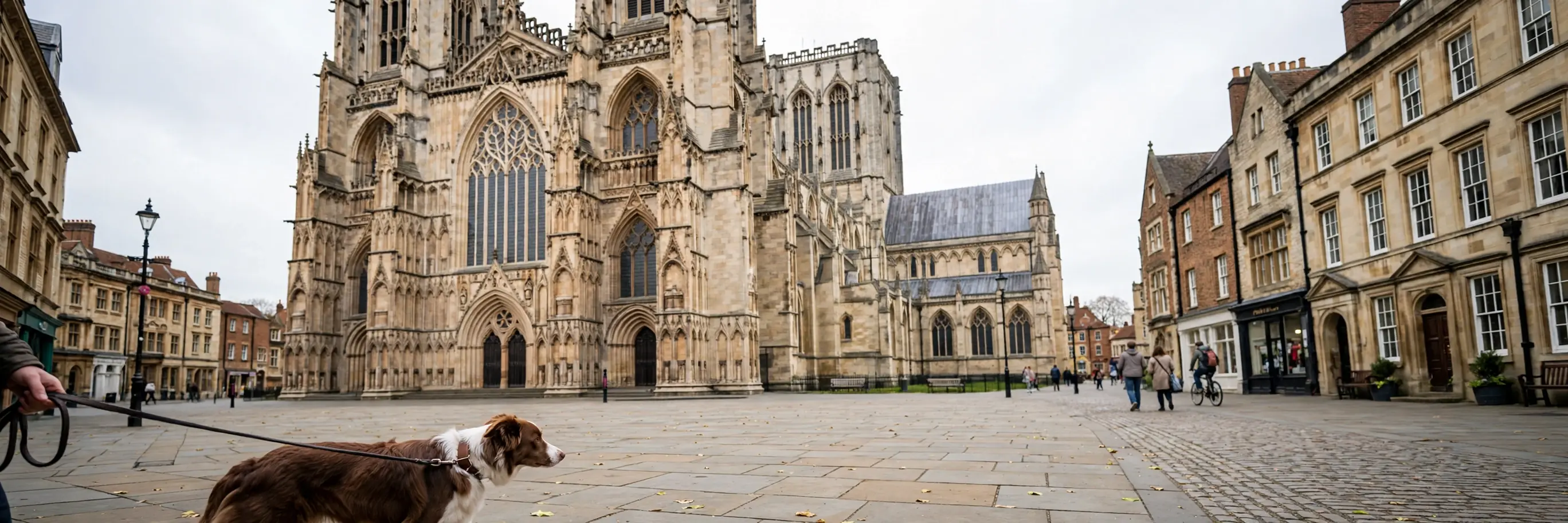
Outside, the picture is different. Minster Yard, the paved square in front of the cathedral, is a public open space, and dogs on leads are welcome there. Dean's Park, the grassy park behind the Minster, is a good place for a dog to have a break, with benches, trees and views of the cathedral. The Museum Gardens, a short walk away, allow dogs on leads, and the Refectory, the Minster's restaurant, welcomes well-behaved dogs in its outside garden area. The streets around the Minster — the Shambles, Stonegate and Petergate — are public streets, and dogs on leads are welcome there, although they are busy and narrow.
That split means a dog trip to York Minster is not a wasted journey, but it is a different kind of day from a visit to a dog-friendly cathedral. Some English cathedrals allow pet dogs inside, but York Minster is not one of them, and it is better to know that before you arrive than to discover it at the door. Plan the day so that one person visits the inside while the other stays outside with the dog, and then swap — or plan the day around the outside, the parks and the riverside, and save the inside for a visit without the dog. Check the official guidance before you travel, because the rules, the opening times and the prices can change.
Inside the Minster: what the rules say
The rule inside York Minster is clear and consistent across the Minster's own pages: no animals may be brought into the Minster, except for assistance dogs, and emotional support animals are not allowed inside. That wording matters, because it draws a line between a registered service animal and an emotional support animal, which is not the same thing in law. A pet dog, however well-behaved, is not a service animal, and it will not be allowed in, even if it is small, quiet or in a carrier.
The rule covers every part of the interior. The nave, with its great west window and its stone vault, the transepts, the quire, the Chapter House, the Undercroft Museum and the Treasury are all inside the building, and dogs are not allowed in any of them. The Central Tower, which visitors climb by 275 stone steps for a view across York, is also inside, and it is not a place for a dog in any case — the steps are narrow, steep and crowded, and there is no room for a dog on the stairs or at the top. If you want to climb the Tower, plan to do it while someone else stays with the dog outside.
Services are a separate case, and they follow the same rule. York Minster is a working cathedral, with daily services, and visitors are welcome to attend a service without a sightseeing ticket. Dogs are not allowed at a service, except assistance dogs, and a dog should not be brought into the building for a service, a concert or a special event. If you want to attend a service, arrange for the dog to be looked after elsewhere — at your accommodation, with a sitter or with another member of your party outside.
Do not argue with staff at the door. The Minster's staff apply the rule every day, and they will not make an exception for a well-behaved pet, a small dog or a dog that has been allowed into another cathedral. That is not rudeness — it is consistency, and it protects the building, the visitors and the dogs. If you arrive with a dog and you have not planned for the split, the staff will usually suggest that one person stays outside with the dog while the other visits, and that is the sensible solution. Plan for it in advance, and the day will go smoothly.
Assistance dogs: the exception
Inside the building, the exception is a working partnership. A registered assistance dog is allowed in the Minster and welcome in all its public areas — the nave, the transepts, the Undercroft Museum and the guided tours among them. The Minster's accessibility pages say service animals are welcome, and accompanying carers are not charged for entry. The dog has to be a registered assistance dog at work with its handler: guide, hearing and medical alert dogs, and other similarly trained assistance dogs. Emotional support animals, therapy dogs and pets are not covered.
The admission desk is where the paperwork matters most. Minster staff see assistance dogs regularly and will usually welcome the dog without fuss, but keep the identification to hand when you arrive. The dog should be on a lead or harness, under the handler's control, and wearing its working jacket if it has one. The ground floor — the nave, the transepts and the east end — is fully accessible, with ramped and stepped access, and the Undercroft Museum is reached by steps or a lift.
Carers go free, with a ticket booked through the bookings team, and specially trained guides can be arranged if you ask in advance. For access questions, the Minster's bookings team is the place to ask ahead of the visit — route, timing and any help on the day. The Minster's library and archives, in the Old Palace behind the Minster, also welcome registered assistance dogs in all public areas, although you will need to register as a reader to see special collections.
A vest ordered online, a borrowed harness and a confident claim at the door do not turn a pet into an assistance dog. Do not describe a pet as one, do not buy a jacket on the internet and present the dog as a working dog, and do not argue with staff if they ask for identification. It makes life harder for genuine assistance-dog handlers, and it can end with a dog being refused entry. Travelling with a pet, plan the visit around the rules for pets, and use the square, the parks and the riverside walks in this guide.
Tickets, opening times and the Tower
There is a charge to enter York Minster for sightseeing, with concessions for students and seniors, and free entry for York residents and students with proof of address. Accompanying carers are not charged for entry, and a free carers ticket can be booked through the bookings team. The sightseeing ticket includes the Undercroft Museum, the Crypt, changing exhibitions and free guided tours, and tickets are valid for a calendar year. Prices change, so check the official guidance before you travel and book a ticket in advance if you can, especially in summer and during school holidays.
Opening times also change with the season and with services. As a guide, the Minster opens for sightseeing from Monday to Saturday in the morning and closes in the afternoon, with restricted Sunday opening around services — but the exact times vary, and the Minster is sometimes open for services only, with no sightseeing. Check the official guidance before you travel, because a visit planned around a Sunday afternoon may find the Minster closed for sightseeing, and a visit during a special event or a concert may have different hours. Book a timed ticket if the Minster offers one, and arrive at the time on your ticket.
The Central Tower is the highest point in York, and the climb is 275 stone steps, with no lift and no wheelchair access. The view from the top is worth the climb on a clear day, with the city, the rivers and the countryside spread out below, but it is not a place for a dog, a small child or anyone who is nervous of heights. The steps are narrow and steep, and the top is exposed to the wind. If you want to climb the Tower, plan to do it while someone else stays with the dog outside, and allow at least an hour for the climb and the view.
Guided tours run regularly through the day, and they are free with a sightseeing ticket. The tours cover the history of the Minster, the stained glass and the stonework, and they last about an hour. Dogs are not allowed on a guided tour, except assistance dogs, so plan to take it in turns if you want to join a tour. The Minster also has a stained glass tour, a family trail and a tactile model for visitors who are blind or partially sighted. If you are visiting with children, the family trail is a good way to keep them engaged, and the Undercroft Museum has interactive displays that children enjoy.
The square, Dean's Park and the Refectory garden
Minster Yard, the paved square in front of York Minster, is the best place to start a dog visit to York. It is a large, open space, with benches, trees and a view of the west front of the cathedral, and dogs on leads are welcome there. It is busy in summer, with visitors, street performers and tour groups, so keep the dog on a short lead and give them time to settle. The square is a good place for photographs, with the Minster rising behind the dog, and it is a good place to meet up if one person has been inside the Minster while the other has stayed outside with the dog.
Dean's Park, behind the Minster, is quieter than the square, and it is the best place for a dog to have a break. It is a grassy park with trees, benches and views of the Minster's east end, and it is popular with local dog owners, students and families. Dogs on leads are welcome, and the park is a good place to sit, give the dog water and let them rest after a walk around the city. The park is also the route to the Minster Library and Archives, in the Old Palace, and to the King's Manor, a historic building that is now part of the university.
The Refectory, the Minster's restaurant, welcomes well-behaved dogs in its outside garden area, although dogs are not allowed inside the restaurant itself. Water can be provided, and owners are expected to clean up after their dogs and dispose of waste appropriately. The garden is a pleasant place for lunch, with a view of the Minster, and it is a good option if you want to eat near the cathedral without leaving the dog outside. Check the arrangement on the day, because the garden may be closed in bad weather or during a special event.
College Green, the small green in front of the Minster's south side, is another quiet spot, with benches and a view of the cathedral. It is a good place to sit and watch the city go by, and it is less busy than the main square. The streets around the Minster — Precentor's Court, Minster Court and Chapter House Street — are narrow, historic streets, and they are worth a walk with a dog on a lead, although they are busy in summer and the pavements are narrow. Keep the dog close, and do not let them block the pavement for other pedestrians.
The city walls: dogs stay at street level
York's city walls are one of the most popular walks in the city, and they are also one of the places where dogs are not allowed. Pet dogs are not permitted on York's city walls, except assistance dogs, and walkers with dogs should stay at street level and rejoin the route near Monk Bar or Bootham Bar. The walls are narrow, with steep steps, no railings in places, and a drop on one side, so they are not a safe place for a dog, and the rule exists for the dog's safety as well as for other walkers.
The walls are free to walk, and they run for about two miles around the city centre, with views across the rooftops, the Minster and the rivers. Sections may be closed during strong winds, frost, ice, flooding or conservation work, so check the City of York Council's current information before relying on this part of a route. If you are walking with a dog, the street-level alternative is to follow the streets below the walls, from Bootham Bar to Monk Bar, and then rejoin the walls route at street level. That walk is flat, surfaced and suitable for a dog, and it passes the same historic gates and towers, seen from below.
The gates, known as Bars, are worth seeing from street level. Bootham Bar, at the northern end of the city, Monk Bar, at the eastern end, Walmgate Bar, at the southern end, and Micklegate Bar, at the western end, are all medieval gatehouses, and they are impressive from the street. Dogs on leads are welcome on the streets around the Bars, and the pavements are wide enough for a dog to walk comfortably. The walls themselves are a good walk for the human members of the party, if you take it in turns to stay with the dog at street level.
Do not try to carry a dog onto the walls, and do not argue with staff or other walkers if they point out the rule. The walls are a historic monument, and the rule is applied consistently. If you want a high view of York with a dog, the best alternative is the view from the Knavesmire, the open grassland south of the city, or from the riverside paths, where the Minster rises above the rooftops. Our guide to Richmond in Yorkshire with a dog covers another historic Yorkshire town, with castle access, river walks and market square lead rules, if you are planning a longer Yorkshire trip.
Dog walks around York city centre
The riverside paths are the best dog walks in York city centre. The River Ouse runs through the city, with a path along both banks, and the River Foss joins it near the city centre, with a quieter path along its banks. The Ouse path is flat, surfaced and suitable for a dog of any age, and it offers views of the Minster, the bridges and the riverside pubs. The path can flood after heavy rain, so check the river level before you set off, and do not let a dog swim in the Ouse, because the current is strong and the water is deep.
The Museum Gardens, near the Minster, are a good short walk with a dog on a lead. The gardens contain the ruins of St Mary's Abbey, the Yorkshire Museum and a observatory, and they are a peaceful, green space in the middle of the city. Dogs are permitted in the Museum Gardens, but they must be kept on a lead at all times, and owners are expected to clean up after their dogs. The gardens are a good place for a picnic, with benches and lawns, and they are a short walk from the Minster square.
The Shambles, York's most famous street, is a narrow, medieval street with overhanging timber-framed buildings, shops and cafes. Dogs on leads are welcome on the Shambles, but the street is very busy in summer, with crowds, pushchairs and shoppers, and a nervous dog will find it stressful. Visit the Shambles early in the morning or in the evening, when the crowds have gone, and keep the dog on a short lead. The street is short, so a visit takes only a few minutes, and it is worth it for the atmosphere, even if the dog would rather be on the riverside.
Stonegate and Petergate, the historic streets near the Minster, are quieter than the Shambles, with independent shops, cafes and pubs that welcome dogs. Many of the pubs in York welcome dogs, and some have a dog menu or a bowl of water by the door. Ask before you sit down, because some pubs allow dogs only in a specific area, and some are busier than others. The streets are mostly flat, with wide pavements, and they are a good walk for an older dog or a dog that struggles with steps. For a longer walk, our guide to the Coast to Coast walk with a dog covers a 192-mile route through three national parks, including the Yorkshire Dales, if you are planning a longer walking holiday.
Cafes, pubs and practicalities
York is one of the most dog-friendly cities in England for cafes and pubs, and many of them welcome dogs inside as well as on the terrace. That matters, because a dog that cannot go inside the Minster will need somewhere to sit while the human members of the party take it in turns to visit. Ask before you sit down, because the policy varies by venue, and some cafes allow dogs only in a specific area. The dog-friendly pubs around the Minster, the Shambles and the riverside are a good place to start, and the staff will usually bring a bowl of water for the dog.
Parking in York city centre is limited and expensive, so use the park and ride if you are driving. The park and ride sites are on the edge of the city, with a bus into the centre, and dogs are usually allowed on the bus, although you should check with the operator before you travel. The city centre car parks are small and fill up early, especially on summer weekends, and the charges are high. If you are staying in York, choose accommodation with parking, or use the train — York station is a short walk from the city centre, and it is well connected to London, Edinburgh and Leeds.
Toilets, water and shade are the practicalities to plan for. The city centre has public toilets, but they are not always close to the Minster, so plan a route that passes a cafe or a pub where you can use the facilities. Fresh water is essential in summer: bring a bottle and a bowl, and offer water often, because a dog walking on hot pavements will lose water fast. Shade is rare in the Minster square, so bring a parasol or a light blanket for the dog to lie on, and never leave a dog in a hot car, even with the windows open.
Crowds are the challenge in York, not the distance. A dog that is nervous in crowds will find the city centre stressful in summer, so visit early in the morning or in the evening, once the day-trippers have gone, and keep the dog on a short lead in the narrow streets. If the dog is overwhelmed, head for the riverside paths or Dean's Park, where it is quieter, and give it time to settle. A calm, well-planned visit beats a rushed one, and York rewards a slow pace, with time to sit in a park, watch the river and enjoy the city.
Alternatives and day trips from York
If you want to visit a historic building with a dog inside, York Minster is not the place, but there are alternatives nearby. Castle Howard, about 15 miles north-east of York, is a stately home with gardens, parkland and woodland walks where dogs on leads are welcome in the outdoor areas. The house itself does not allow dogs, except assistance dogs, but the gardens and the parkland offer a full day out with a dog. The National Trust properties around York, including Beningbrough Hall and Treasurer's House, have gardens and parkland where dogs are welcome, although the houses themselves have different rules.
Richmond, in North Yorkshire, is a good day trip from York, with a castle, a river and a market square that welcome dogs. Our guide to Richmond in Yorkshire with a dog covers castle access, River Swale walks, Easby Abbey and the market square, and it is a good companion to this guide if you are planning a Yorkshire trip. The Yorkshire Dales, the North York Moors and the Yorkshire Wolds are all within an hour's drive of York, and they offer long, open walks for a fit dog, with villages, pubs and cafes that welcome dogs.
The Yorkshire coast is another option, with beaches at Whitby, Scarborough and Filey that welcome dogs out of season, and quieter beaches at Runswick Bay and Fraisthorpe that welcome dogs all year. The drive from York to the coast takes about an hour and a half, which is a long way for a day trip, but it is worth it for a beach day, especially out of season when the beaches are quiet. Our guide to dog friendly beaches in Scotland is useful if your trip takes you further north, because the rules and the tides change once you leave England.
For a longer walking holiday, the Coast to Coast walk runs through the Yorkshire Dales and the North York Moors, and it is one of the best long-distance walks in England for a dog. The route is 192 miles, from the Irish Sea to the North Sea, and it can be walked in sections, with baggage transfer and dog-friendly accommodation. Our guide to the Coast to Coast walk with a dog covers the route, the lead rules, the stays and a realistic ten-day plan, and it is a good place to start if you are planning a longer trip after York.
Planning a York day with a dog
Start the day early, with a walk on the riverside paths before the city gets busy. The Ouse path is quiet in the morning, the light is good for photographs, and the dog will have a proper walk before the day begins. Then head to the Minster square, for a look at the cathedral from outside, a sit in Dean's Park and a coffee in the Refectory garden. If one person wants to visit the inside, take it in turns, and allow at least an hour for the inside visit, including the Undercroft Museum and a guided tour.
After the Minster, walk through the Shambles and Stonegate, with a stop for lunch in a dog-friendly pub, and then head to the Museum Gardens for a quiet break. In the afternoon, walk along the riverside to the Knavesmire, the open grassland south of the city, where the dog can have a longer run off the lead if the area allows it — check the signs, because the Knavesmire is common land with grazing cattle, and dogs must be kept on a lead near livestock. End the day with a riverside walk back to the city centre, and a drink in a pub that welcomes dogs.
Pack for a city walk, not a countryside walk. Bring fresh water and a bowl, a lead, poo bags, a towel and a snack for the dog, and a bag to carry the dog's things. The pavements in York are hard on paws, especially in summer when they heat up, so check the pavement with your bare hand before letting a dog walk on it — if it is too hot for you, it is too hot for the dog, and you should walk on the grass or in the shade. Check the dog's paws after a city walk, because the pavements can be rough and the streets can have broken glass.
Pick somewhere the dog can actually stay, not just somewhere photogenic. A hotel or cottage with a garden, a short walk to the city centre and a place to rinse paws will make the stay much easier than a beautiful hotel with no outdoor space. When you book, confirm the pet fee, the number of dogs allowed and the rules on leaving a dog alone, in writing. And remember: the best York day with a dog is not the one that tries to do everything, it is the one that gives the dog time to walk, rest and enjoy the city at its own pace.
Practical questions
Before you go
Are dogs allowed inside York Minster?
No, pet dogs are not allowed inside York Minster. York Minster states that no animals may be brought into the Minster, except for service animals, and emotional support animals are not allowed inside. Check the official guidance before you travel, because the rules can change.
Are assistance dogs allowed in York Minster?
Yes, registered assistance dogs are allowed inside York Minster. The Minster welcomes service animals in all public areas, and accompanying carers are not charged for entry. Emotional support animals are not allowed, so the distinction is between a registered service animal and a pet or support animal.
Can I walk my dog around York Minster outside?
Yes, dogs on leads are welcome in the open spaces around the Minster, including Minster Yard, the square in front of the cathedral, and Dean's Park behind it. The Refectory garden welcomes well-behaved dogs, and the Museum Gardens nearby allow dogs on leads. Keep dogs on a short lead in the square, because it is busy with visitors.
Are dogs allowed on the York city walls?
No, pet dogs are not permitted on York's city walls, except assistance dogs. Walkers with dogs should stay at street level and rejoin the route near Monk Bar or Bootham Bar, using the streets below the walls. The walls are narrow, with steep steps and no railings in places, so they are not a safe place for a dog.
How much does it cost to visit York Minster?
There is a charge to enter York Minster for sightseeing, with concessions for students and seniors, and free entry for York residents and students with proof of address. Accompanying carers are not charged. Prices and opening times change, so check the official guidance before you travel and book a ticket in advance if you can.
Where can I walk my dog in York after visiting the Minster?
Good options include the riverside paths along the River Ouse and the River Foss, the Museum Gardens, Dean's Park and the streets around the Shambles. For a longer walk, head out to the Knavesmire, the open grassland south of the city, or take a short drive to the Yorkshire Wolds or the North York Moors for a proper countryside walk.