This guide is independent and contains no paid placement. If affiliate links are added later, they will be clearly marked and will not change our editorial checks.
The Yorkshire Wolds Way is a 79-mile National Trail from Hessle, on the Humber estuary, to Filey on the North Sea coast. It is widely described as the quietest of Britain's National Trails: rolling chalk hills, dry valleys, village pubs and very few other walkers. It suits dogs that like steady, gentle walking and owners who like space, but it has long gaps between villages, so carry water and plan your stops.
The quietest National Trail: what that means for a dog
The Yorkshire Wolds Way is often called the quietest National Trail in England, and the description is not an exaggeration. On a weekday in spring or autumn, you can walk for hours and meet nobody. There are no honeypot towns, no famous viewpoints with car parks full of coaches, and no long queues on the path. For a dog, that quiet is the whole point. A nervous or reactive dog that struggles on a busy coastal path can walk the Wolds in peace, with space to sniff, space to settle and nobody to worry about. A young dog that is still learning recall can practise on open ground without the constant distraction of other walkers. And an older dog that likes a steady, unhurried pace will find the gentle hills and the soft grass exactly right.
The quiet has a practical side, too. The trail is well waymarked, but the lack of other walkers means there is nobody to ask the way if you lose the path, and the lack of villages means there is nobody to help if your dog goes lame or you run out of water. The Wolds are a place to be self-sufficient, not a place to improvise. Carry a map, carry water, carry a phone with offline maps, and know where the nearest village or road is at every point. The quiet is a gift, but it is a gift that asks for preparation.
The landscape itself is gentle and rolling, a series of chalk hills cut by dry valleys, with farmland, woodland and the occasional village. The walking is easy by National Trail standards: no steep climbs, no exposed ridges, no cliff edges. The highest point on the trail is only a little over 200 metres, and the hills are the kind that rise gradually and fall gradually, with long views across the Wolds from the top. It is a walk that suits almost any fit dog, and it is a good first National Trail for a dog that has never done a multi-day walk before. Before you set out, check the official guidance before you travel, because the trail crosses farmland and diversions are possible.
Dry valleys and chalk hills: the Wolds landscape
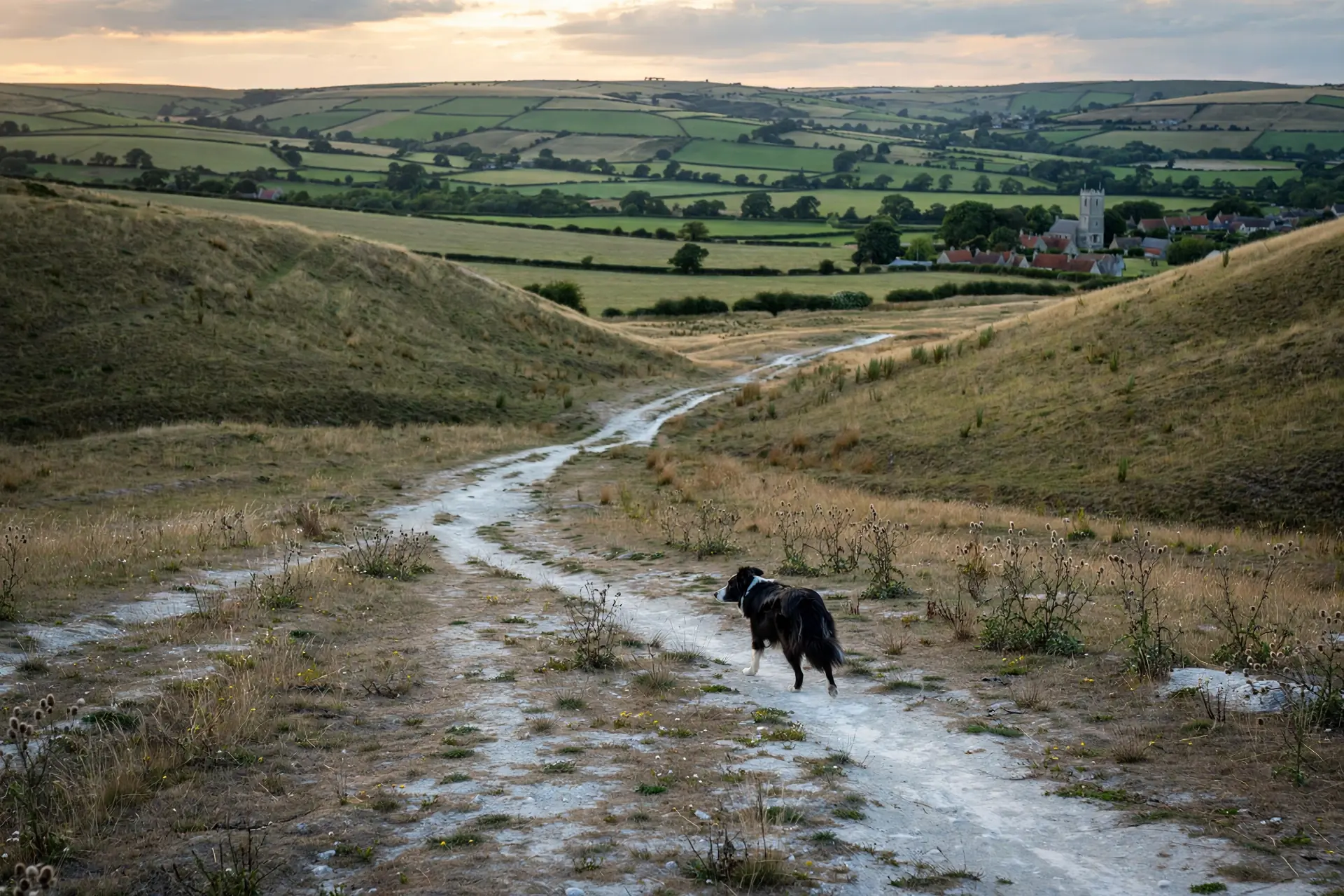
The Yorkshire Wolds are a chalk landscape, and the dry valleys are its most distinctive feature. These are valleys with no stream in them, carved by meltwater at the end of the last Ice Age and now dry for most of the year. Walking through a dry valley with a dog is a strange and pleasant experience: the ground is soft grass, the sides rise gently on either side, and the valley floor is a natural corridor that invites a steady, unhurried pace. The valleys are also where the wildlife is, because the sheltered ground holds the warmth and the insects, and a dog that is allowed to sniff its way along a dry valley will be a happy dog.
The chalk hills themselves are the other half of the landscape. The trail climbs onto the high Wolds for long stretches, with views across the farmland and, on a clear day, to the North Sea. The chalk is free-draining, which means the path dries out quickly after rain, and the surface is generally good: grass, chalk and the occasional flinty stretch. The flint can be hard on a dog's paws over a long day, so check pads at lunchtime and carry paw balm. The hills are not high, but they are constant, and the cumulative climbing over a day adds up. A dog that is used to flat walking will feel the hills by the end of the day, so build up distance gradually and do not plan your longest day first.
The farmland between the hills and valleys is a working landscape, and the trail crosses it on field paths and farm tracks. The fields are arable for much of the year, which means the path can be a narrow strip between crops in summer, and the farm tracks can be muddy after rain. Keep to the marked path, close gates behind you, and keep your dog on a lead through every field with livestock. The Wolds are not a wild landscape; they are a farmed one, and the trail works because walkers and farmers respect each other.
Village pubs and places to stop: the Wolds at walking pace
The villages of the Wolds are small, quiet and widely spaced, and they are the reason the trail feels so peaceful. Places like Millington, Thixendale, Wharram Percy, Wintringham and Muston are not towns; they are a church, a handful of houses and, if you are lucky, a pub. The pubs are the heart of the trail, and they are worth planning your day around. A pub that welcomes dogs, serves food and has a garden is the perfect end to a day on the Wolds, and the villages that have one are the natural overnight stops.
Thixendale is a good example. It is a tiny village in a dry valley, with a pub that has long been a favourite with Wolds Way walkers. It is the kind of place where the dog is welcomed, the food is simple and good, and the walkers' book in the corner tells the story of the trail. Millington is another, with a pub and a village green that make a natural lunch stop. Wharram Percy is different: it is a deserted medieval village, a scheduled monument with the ruins of a church and the outlines of houses in the turf. Dogs are welcome on a lead, and the place is worth the detour, but it is archaeology, not a pub, so plan your food and water accordingly.
The Wolds villages are spaced for walkers who plan ahead, not for walkers who hope. Millington, Thixendale, Wharram Percy, Wintringham and Muston are a church, a few houses and — on a good day — a pub, and the pub is often the reason a day ends where it does. A dog-friendly pub with food and a garden makes the perfect finish, so build the day around the villages that have one rather than the miles on the map. The catch is that opening hours are unreliable and shops are rarer still, so carry lunch and the dog's food regardless, and carry water too: a closed pub is a disappointment, but an empty bottle is a problem. Rooms work the same way — the villages hold only a handful of bed and breakfasts and farm stays, they fill early, and a written confirmation of the dog arrangement is worth getting before you set out.
Farmland etiquette: crossing fields with a dog
The Yorkshire Wolds Way crosses farmland for most of its length, and farmland etiquette is the skill that makes the trail work. The rules are simple, but they need to be followed every time. Keep to the marked path, even when the field looks empty and the direct line looks tempting. Close every gate behind you, even if it was open when you arrived. Keep your dog on a lead through every field with livestock, and keep it close when you pass through a gate or past a farmyard. And take all waste with you, including dog waste, because there are long stretches with no bins.
Sheep are the reason the lead stays on across the Wolds. They graze the open grassland and the valley fields, cattle stand in the lower ground, and a dog that runs at them can be shot by the farmer — the law allows it, and it happens to dogs whose owners thought theirs would never chase. The danger is easy to underestimate here because the ground is so open: the animals look far away until the dog is already among them, so clip the lead on before the field, not after the dog has gone, and hold the dog close at every gate. Arable ground needs the same respect for a different reason: a dog loose in a crop can flatten a season's work in a few minutes, and a dog that eats something sprayed or treated in a field can come home seriously ill.
The skylarks are the Wolds' other seasonal claim on your dog's freedom. They nest in the grass from spring into midsummer, and a nest is no more than a scrape in the turf — a running dog can wreck one in a single stride. While the birds are breeding, keep the dog on the marked path and on a lead wherever the signs ask for it, and treat the restriction as part of the walk rather than an interruption to it: a few months of care is what keeps the song overhead for the next walker. Where the rules for a particular stretch are unclear, check the official guidance before you travel.
From Hessle to Filey: the route in stages
The Yorkshire Wolds Way runs from Hessle, on the north bank of the Humber estuary, to Filey on the North Sea coast, a distance of 79 miles. The start is dramatic: the trail begins beside the Humber Bridge, one of the great crossings in Britain, and the first miles follow the estuary with views across the water to Lincolnshire. It is a good place to start a walk, because the bridge and the estuary give the trail a sense of occasion, and the path is easy and flat. From Hessle, the trail climbs onto the Wolds and heads north through the villages and dry valleys towards the coast.
The middle of the trail, from Millington through Thixendale and Wharram Percy to Wintringham, is the quietest and most characteristic stretch. The villages are small, the valleys are dry, and the walking is gentle. This is the part of the trail where the quiet is most complete, and it is the part that most walkers remember. The final stretch, from Wintringham to Filey, descends to the coast, and the finish is a proper seaside ending: the trail comes down to Filey Bay, with its long beach, its cliffs and its fishing boats. It is a fitting end to a quiet walk, and a good place for a dog to have a paddle, subject to the local beach rules.
Five to six days at 13 to 16 miles a day covers the 79 miles, and the gentle ground makes that an honest pace for a fit dog — the miles are easy, but they still add up, so do not put your longest day first. A first taste works well as a long weekend on the middle ground, Millington to Wintringham, where the dry valleys and the quiet are at their best and the logistics stay simple. The acorn waymarks are easy to follow in clear weather, but the open Wolds turn blank in fog, with few landmarks to steer by, so a paper map and the ability to use it belong in the pack even on a short day.
Water, food and the long gaps between villages
Water is the thing to solve first on this trail, because the Wolds hide it. The chalk swallows rain almost as fast as it falls, the dry valleys hold no stream, and the villages can sit eight or ten miles apart with nothing to drink between them. That means loading for the longest waterless stretch on each day, not for the average one, and knowing before you start where the next tap is — a pub, a village hall, a churchyard tap. Our guide to dog hydration on long walks works out how much a dog needs by weight and temperature, and the Wolds are the place where those figures become a packing list rather than a theory.
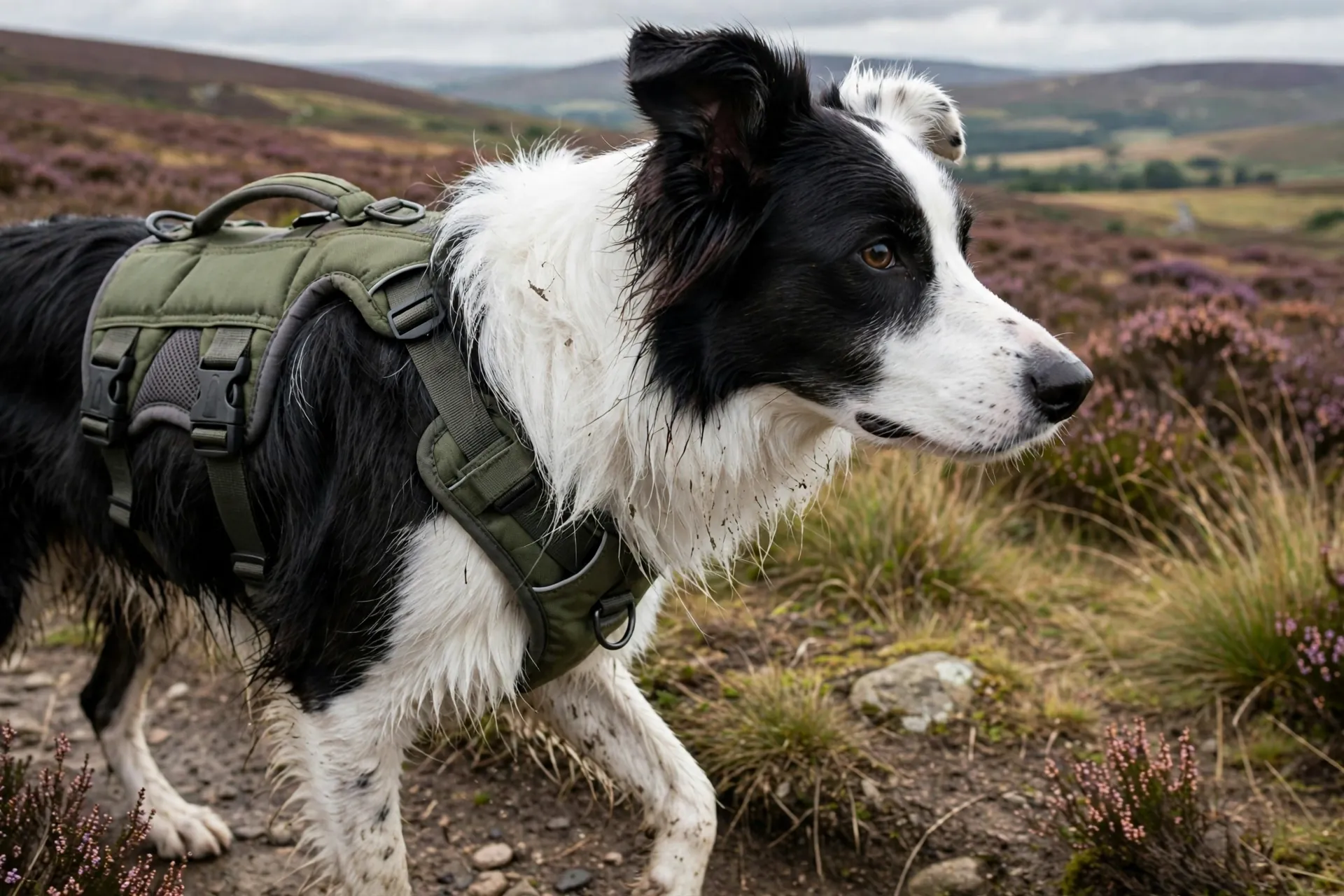
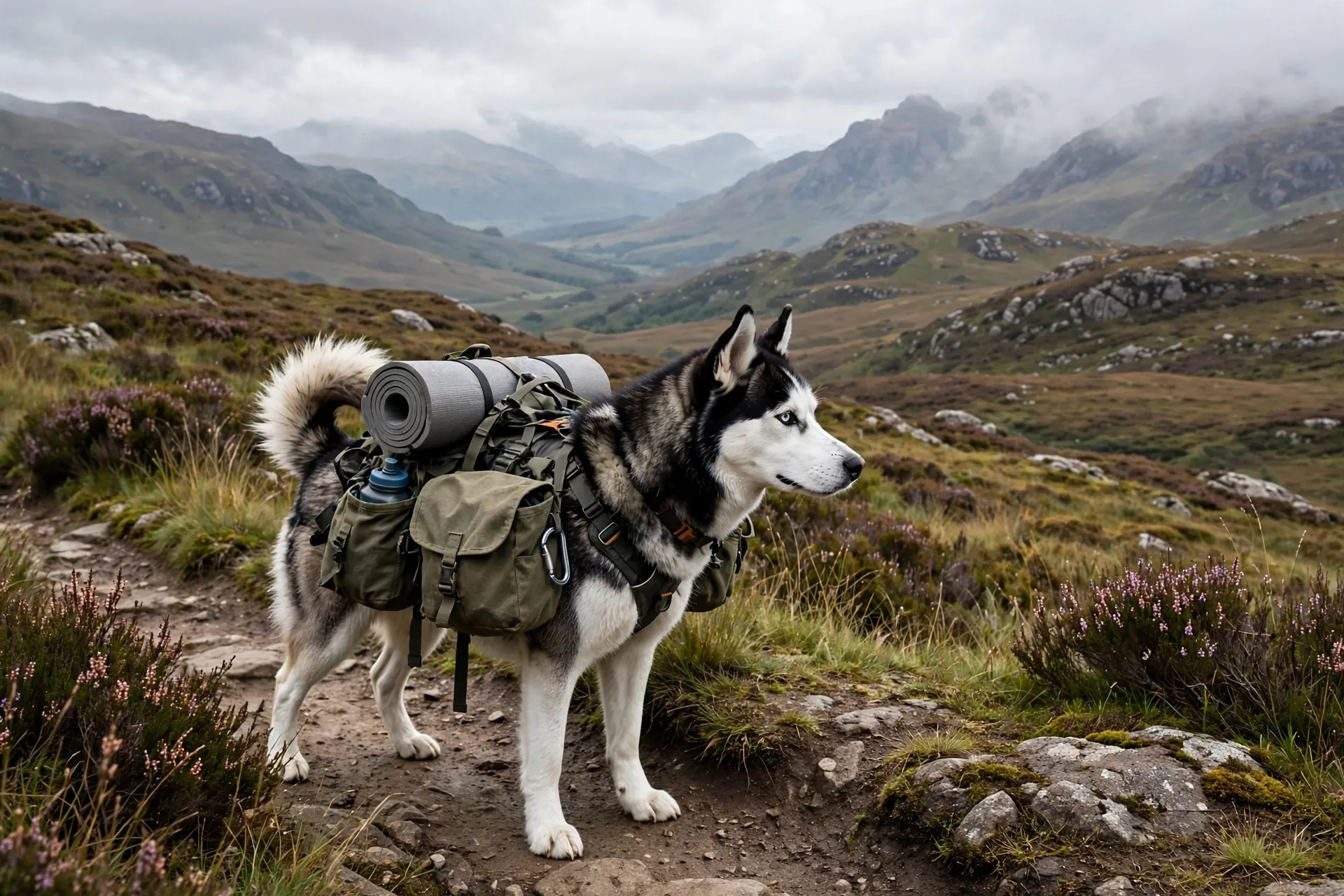
Food follows the same logic: carry it, because the villages are too small and too far apart to feed a walking party on demand. A pub may be shut, a shop may not exist, and the next village may be two hours away, so the day's sandwiches and the dog's normal ration go in the pack in the morning, in the usual quantities and at the usual hour — fifteen miles of chalk is no place to test a new diet, and a shared sandwich is not a dog's dinner. A comfortable harness earns its keep on these long, steady days, since the lead is on for much of the walk; our harness guide covers fitting, and our dog backpack guide covers safe loads and a training plan if the dog carries a share of its own kit.
The routine is simple once it becomes a habit: mark the taps on the map the night before, fill up at every chance, and give the dog a mouthful at every halt, whether it asks or not. A collapsible bowl turns any bottle into a proper drink, and a dog that sips all day holds its pace all day. The opposite — a dog that reaches a village dry — takes hours to recover, drinks too fast, and starts the next morning behind, which is how a good week turns into a hard one.
Planning the Wolds Way with a dog: days, stays and transport
The full 79 miles takes most walkers five to six days, and the middle section from Millington to Wintringham makes the best long weekend for a first trip — the quietest ground, the finest dry valleys, and none of the week's logistics. Trains serve both ends of the trail, at Hessle and at Filey, and buses reach some of the villages, though they run rarely enough that a timetable is worth reading before you leave rather than at the stop. For each day, settle on a way out before you start — a station, a bus stop, a road where a taxi can reach you — and keep it in mind all day, because the Wolds are not a place to improvise if the dog goes lame.
Rooms are the tightest part of the plan. The villages are small and the places that take dogs — pubs with rooms, bed and breakfasts, farm stays — are few, and they sit in the villages rather than on the trail, so the day usually ends with a short walk off the route to reach the bed. Book early, and get the dog terms confirmed by email: the charge, how many dogs, and whether the dog is welcome in the bar or only in the bedroom. Baggage transfer runs on the Wolds Way, and it changes the walk more than any other single purchase — a dog that carries nothing and a walker with a light day pack will cover the chalk far more happily than a pair loaded for a week. The same multi-day habits apply on harder ground too: our guide to the Coast to Coast walk with a dog covers short first days, booked beds and a known way out at every stage, and all three transfer directly to the Wolds.
Do not lean on the buses. The villages are small, the services are few, and a missed bus in the Wolds can mean a long wait in an empty lane or a long walk to the next village. Read the timetables before you leave, and keep the number of a taxi in the nearest town saved in your phone. Keep the phone charged, maps saved offline, and a small first-aid kit to hand — those are the things that turn a bad moment, a lame dog or a sudden change in the weather, into a short walk to help instead of a long one.
Seasons on the Wolds Way: when to walk it
The walking is at its best from May into June and again in September and October. Late spring brings flowering chalk grassland, skylarks overhead and mild air for long days; early autumn brings cooler walking, colour in the trees and the driest ground of the year. The months between them are hot, exposed and thirsty work, and the months after them are cold, windy and dark early — the Wolds are a fair-weather trail at heart, and the calendar should be read that way.
Summer on the high Wolds is a test of water discipline. Shade is thin, the chalk throws the sun back, and the villages with taps are far apart, so the sensible summer day starts at dawn, carries more water than the distance seems to need, and ends early without apology — the long evenings are the reward, and the views in clear air are the best of the year. Winter flips the problem: wind and frost take over, frozen chalk turns slick underfoot, and fifteen miles has to fit into short daylight. A crisp, still winter day is beautiful up here, but it is a day for a fit dog and a walker who has read the forecast for the Wolds themselves and packed for the cold.
Whatever the month, read the forecast for the Wolds rather than for the nearest big town — the high ground runs colder and windier than the valleys, and a mild day in Hull can be a raw one on the hills. A map, a forecast and a look at the water bottles the night before: that is the whole of the preparation, and on this trail it is enough.
If you only walk one section: the best day walks
Millington to Thixendale is the day to start with: about eight miles of chalk hill and dry valley, a pub at each end, and the quiet the trail is known for, all in one walk. Set out from Millington, follow the valley down to Thixendale, and either retrace your steps or arrange a lift — the dog gets a proper taste of the Wolds without a full day's mileage, and you get the best of the trail before lunch.
The Wharram Percy circuit is a different kind of day, about seven miles around the deserted medieval village and its dry valley, with the ruined church and the house outlines in the turf to give the walk its shape — a good choice for a dog that is happy with a steady climb and a lead walk through archaeology. For a coastal finish, the last stretch from Muston down to Filey Bay trades the hills for a long beach and a paddle, and suits dogs that like to end a walk in the sea; check the local beach rules first, because seasonal restrictions can apply.
Walk slowly and the Wolds give up what they have: the quiet, the valleys, the skylarks, the pubs at the end of the day. Keep the lead handy near stock and farmland, keep water in the pack, and let the dog set the pace — the trail's greatest gift is the space to do exactly that.
Practical questions
Before you go
Can dogs walk the whole Yorkshire Wolds Way?
Yes — the whole 79-mile National Trail from Hessle to Filey welcomes dogs, and most walkers finish it in five to six days at 13 to 16 miles a day. The lead stays on around livestock and through farmland, and water matters more than anything else here: the gaps between villages are long and dry.
Is the Yorkshire Wolds Way really the quietest National Trail?
It is, on a weekday outside the school holidays, and the experience usually bears the description out. Hours can pass without meeting another walker, there are no busy honeypot towns, and the path stays quiet. That stillness suits nervous and reactive dogs — and it also means carrying your own water, maps and first aid, because help is a long way off.
How much water should I carry for my dog on the Wolds Way?
More than the distance suggests. The chalk holds no drinking water and villages can sit eight or ten miles apart, so fill for the longest waterless stretch on the day, carry a collapsible bowl, and give the dog a drink at every stop. The latest water point information is in the official guidance — check it before you travel.
Are dogs allowed at Wharram Percy?
Yes, on a lead. Wharram Percy is a deserted medieval village and a scheduled monument, and dogs may visit on leads. Stay on the paths, keep the dog off the ruins, do not let it dig, and take all waste away with you — the site is fragile, and a little care keeps it standing.
Do dogs have to be on a lead on the Yorkshire Wolds Way?
No — only where it counts. Leads are needed around livestock, through farmland, near ground-nesting birds in the breeding season and at every road crossing. Quiet open stretches allow off-lead walking for a dog with a recall you trust, provided it stays on the path.
What is the best time of year to walk the Yorkshire Wolds Way with a dog?
The best months are May and June, or September and October. Late spring gives you flowers, skylarks and mild air for long days; early autumn gives you cooler walking and dry ground. Summer is hot and thirsty on the high Wolds, winter brings wind, frost and short daylight.