This guide is independent and contains no paid placement. If affiliate links are added later, they will be clearly marked and will not change our editorial checks.
An Australian Shepherd holiday succeeds or fails on three things: keeping the dog away from livestock it will want to herd, giving its brain a daily job, and tiring it with a mix of running, training and sniffing rather than one exhausting walk. Get those right and the breed's loyalty, stamina and enthusiasm make it one of the best companions for Britain's hills, moors and coast paths.
Start with the herding brain
Everything distinctive about travelling with an Australian Shepherd flows from one fact: this is a dog bred to watch movement, anticipate it and control it. On a walk, that instinct shows up as circling runners, staring at cyclists, nipping at the heels of children playing football, and barking at a flock of birds that has dared to move. None of this is disobedience in the ordinary sense; it is the dog doing the job it was selected for, in a place where that job is not wanted. Owners who understand this before the trip plan differently from owners who expect a generic friendly dog. They train a settle and a recall with movement as the distraction, they keep a lead in hand around anything that moves quickly, and they never assume that a dog which is calm at home will be calm when a group of joggers appears on a narrow path.
The herding brain also explains why an Australian Shepherd can be simultaneously brilliant and exhausting on holiday. These dogs learn fast, read their owners' body language with uncanny accuracy, and throw themselves into any game that involves rules and movement. That makes them wonderful partners for structured activities: scent games, trick training, agility-style play in a secure field, and fetch with rules about waiting and returning. It also means they notice everything, including the things you would rather they ignored, and they will practise herding on whatever moves if you give them nothing better to do. A bored Australian Shepherd is not a quiet dog. It is a dog that rearranges the furniture, herds the children, barks at the postman through the cottage window and digs a hole in the garden, all before lunch. The holiday plan has to include occupation, not just exercise.
Sheep country: the non-negotiable rule
Britain's hills and moors are working farmland, and sheep are present in places that look like open wilderness to a visitor. For an Australian Shepherd, a flock of sheep is not scenery: it is an invitation that the breed's instincts make almost impossible to refuse. A dog that chases sheep can cause ewes to miscarry, lambs to be separated and animals to be injured on fences, and the consequences for the farmer, and for the dog owner, are severe. In England and Wales, a farmer may in certain circumstances shoot a dog that is worrying livestock, and dog owners can face criminal liability and civil claims. The law and the access codes differ across the UK nations, so check the official guidance before you travel to a new area, and treat local signs as instructions rather than suggestions.
The practical rule is simple and absolute: if sheep, cattle or other livestock could be present, the dog stays on a lead, and if you cannot be certain, assume they are present. This applies on open moorland, on farmland footpaths, on coastal headlands grazed by sheep and even on some nature reserves where grazing animals are part of the management. A long line is a useful compromise on open ground where the dog can run without being free, but it must be managed carefully around livestock, because a long line that tangles or a dog that lunges at the end of it is still a risk. Teach a rock-solid recall long before you travel, but never test it on livestock: recall is a safety net for the day the lead slips, not a licence to let a herding dog loose among sheep. When in doubt, choose a different route. Britain has plenty of livestock-free walking, including forestry tracks, enclosed dog fields and beaches outside lambing season, and using them is not a compromise: it is responsible ownership.
Giving the dog a job on holiday
The most effective way to tire an Australian Shepherd is not to run it further but to give it problems to solve. A twenty-minute scent game, in which the dog searches for hidden treats or a favourite toy in a field, can settle a dog more reliably than an extra hour of walking, because it engages the same focus and decision-making that herding requires. Build a small repertoire of games before the trip: hide-and-seek with a person, find-the-treat trails, a reliable fetch with a wait and a return, and a few tricks that can be practised anywhere. On holiday, rotate these games so the dog never knows exactly what comes next, and keep sessions short and successful rather than long and frustrating. A dog that has worked its brain is a dog that will sleep in the car and settle in the cottage.
Structured activities on the trip itself are worth seeking out. Secure dog fields, which can be hired by the hour across much of the UK, give an Australian Shepherd a safe place to run, play and practise recall without livestock or other dogs to herd. Some rural attractions and activity centres offer herding taster sessions with ducks or sheep under supervision, which can be a fascinating outlet for the instinct in a controlled setting, though they are not suitable for every dog and should be booked with a reputable provider. Even without special activities, you can build jobs into ordinary walks: ask the dog to wait at every gate, to find a hidden toy at a path junction, to practise heelwork for short stretches, and to settle on a mat at a cafe stop. The dog does not need a formal job title. It needs a reason to pay attention to you rather than to everything that moves.
The exercise arithmetic that actually works
Most healthy adult Australian Shepherds need at least two hours of active exercise a day, but the arithmetic matters more than the total. One two-hour forced march tends to produce a fitter, more restless dog, because stamina builds quickly and the dog simply learns to expect more. A better pattern is a mix spread across the day: a morning run or hike, a midday training session or scent game, an afternoon sniff-heavy walk on a long line, and short toilet outings in the evening. Sniffing deserves emphasis, because a dog that is allowed to stop, investigate and process scent is doing real mental work, and a slow, sniffy walk can be more tiring than a fast one. Puppies and adolescents need a different calculation: growing joints should not be hammered with repetitive long-distance running, so build distance gradually and favour varied terrain over pounding pavements.
Rest is part of the arithmetic, not a reward for finishing it. Australian Shepherds are famously bad at switching off, especially in a new place, and a dog that is exercised all day without enforced rest will become overtired, hyperactive and harder to manage, not calmer. Build rest into the day deliberately: a crate or a quiet room with a chew after the morning outing, a settle on a mat during lunch, and a wind-down walk rather than a high-energy game in the evening. Watch for the signs of a dog that has had enough, including loss of focus, mouthing, inability to settle and frantic behaviour, and treat those as signals to rest rather than to exercise more. The goal is a dog that is pleasantly tired at bedtime, not a dog that has been run into the ground, and the owners who achieve that are usually the ones who planned rest as carefully as they planned walks.
Recall, herding and other dogs
Recall is the single most valuable skill for an Australian Shepherd on holiday, and it needs to be proofed against movement before it can be trusted anywhere. Practise recall with runners, cyclists, other dogs and wildlife as distractions, starting at a distance where the dog can succeed and only gradually closing the gap. A whistle is a powerful tool for this breed, because it carries further than a voice on a windy moor and becomes a clear, consistent cue that is not confused with everyday talking. Train the whistle at home first, pairing it with high-value rewards, and carry it on every walk. Even with a strong recall, keep the dog on a lead in places where a failure would be dangerous, including near roads, cliffs, livestock and ground-nesting birds in spring, because no recall is perfect and the consequences of a failure in those places are too serious to gamble on.
Meetings with other dogs need the same careful management. Many Australian Shepherds are sociable with dogs they know but controlling with dogs they do not, and herding behaviour towards another dog, circling, staring, barking and nipping, is often misread by the other owner as aggression. Keep greetings short, on a lead and in open ground where either dog can move away, and call your dog away at the first sign of intense staring or circling rather than waiting to see what happens. If your dog has a history of herding other dogs, avoid busy dog parks and off-lead beaches at peak times, and use secure fields for free running instead. The same caution applies to children: a dog that herds running children is not being naughty, but a child that is knocked over or nipped will not see it that way, so keep the dog on a lead around play areas and teach children to stand still and be boring if the dog starts to circle.
The double coat, mud and shedding
The Australian Shepherd's medium-length double coat is beautiful and, on a British holiday, a magnet for mud, water and burrs. The coat sheds moderately all year and heavily during seasonal moults, when a daily brush becomes essential rather than optional. Pack a slicker brush and an undercoat rake, and brush thoroughly every few days, checking behind the ears, in the feathering on the legs and tail, and in the armpits, where mats form first. After wet walks, towel the dog down and use a drying coat if you have one, because a wet double coat takes a long time to dry naturally and a damp dog in a car or a cottage quickly becomes a cold, smelly dog. Never clip the coat short for summer in the belief that it will keep the dog cooler: the double coat insulates against heat as well as cold, and clipping can damage its texture and its ability to regulate temperature.
Mud management is a daily routine on a British trip, not an occasional chore. A portable paw washer, a stack of microfibre towels and a washable throw for the car boot will save more time than any other kit you pack. Brush the coat out once it is dry rather than while it is wet, when the hair is more likely to break, and check paws for mud packed between the toes, which can cause soreness on long walks. If you are staying in a rental, protect the furniture with throws and keep the dog's bedding washable, because a shedding Australian Shepherd will leave hair on everything it touches. The coat is not a reason to avoid wet-weather walking: it is a reason to plan the drying routine as part of the walk, so that the dog comes home, gets dried and brushed, and settles, rather than wandering wet through a rental leaving a trail of mud behind it.
Settling in hotels, cottages and campsites
An Australian Shepherd that has been properly tired, in body and brain, will settle well in most accommodation, but the choice of place still matters. A cottage with a secure garden is ideal, because the dog can toilet and potter safely without a lead walk at midnight, and a ground-floor hotel room near an exit is far better than a top-floor room reached by a long corridor full of triggers. When booking, ask about the garden fencing, the nearest toilet area after dark, and whether dogs are welcome in communal areas or only in the room, because a dog that must be left alone at breakfast will not settle. Confirm the pet fee and any conditions in writing, and be honest about the breed: a hotel that welcomes a calm older dog may have different rules for a large, energetic herder, and discovering that on arrival helps nobody.
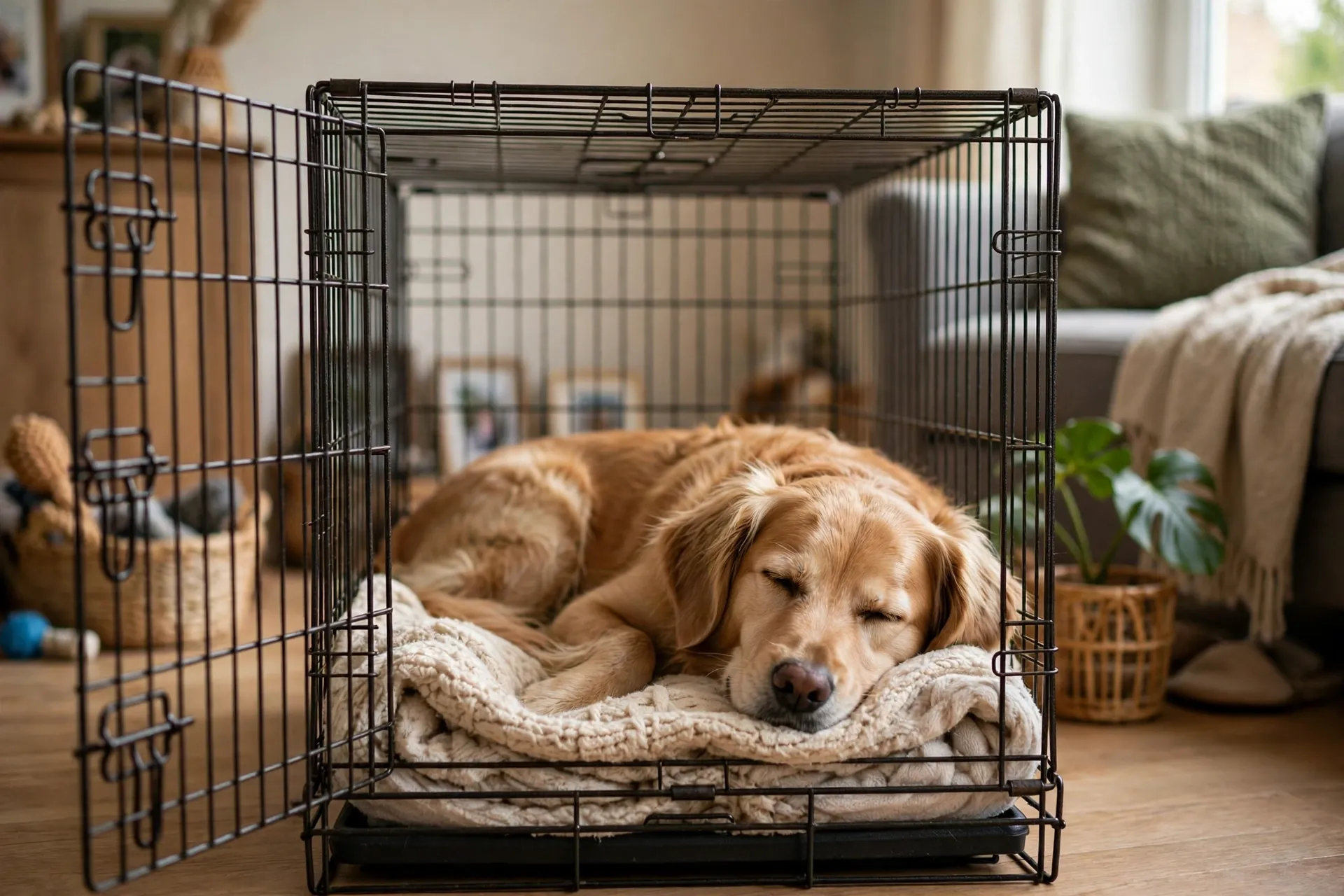
Inside the accommodation, recreate the dog's routine as closely as possible. Set up the bed, the water bowl and the chew in the same arrangement as at home, keep feeding times consistent, and use a crate if the dog is crate-trained, because a crate gives a restless dog a clear signal that it is time to switch off. Protect the rental by keeping muddy paws off bedding and sofas until the dog is clean and dry, and never leave an untried dog alone in a new place for a long period on the first day: build absences up gradually, starting with a few minutes while you fetch something from the car. Our guide to crate training a dog for travel covers the four-week plan that makes a crate a calming tool rather than a source of stress. A dog that settles in its accommodation is a dog that can be taken to breakfast, left for a short shopping trip and welcomed back the next year, which is worth more than any single walk.
Car journeys with a restless herder
Car travel with an Australian Shepherd is usually straightforward once the dog understands that the car is a resting place, not a herding arena. The challenge is the dog that barks at every passing cyclist, lunges at the window when another dog appears, or paces and whines for the entire journey. The answer is the same as for every other herding problem: tire the dog before the journey, give it a clear job in the car, and make the car boring. A secured crate in the boot is often the best solution, because it removes the visual triggers and gives the dog a den to sleep in, but a crash-tested harness on the back seat works well if the dog is trained to lie down and stay there. Never allow a dog to travel loose, and never allow it to ride with its head out of the window, which is dangerous for the eyes and the ears as well as a distraction.
Break long journeys every couple of hours for toilet, water and a short walk, and use those stops for a brief training game rather than a free-for-all in a service area, where other dogs and traffic create exactly the triggers you are trying to avoid. Keep the car cool and ventilated, and never leave the dog in a parked car on a warm day, when the temperature inside rises far faster than people expect. If the dog is a nervous traveller, practise short journeys first, building up to longer ones, and consider whether a familiar blanket and a chew help or whether they become objects to guard. Our dog car safety guide compares harnesses and crates and explains fitting for medium-sized dogs, which is the size range most Australian Shepherds fall into.
Heat, cold and a thick coat
The double coat that protects an Australian Shepherd in cold weather can become a liability in summer heat, and British summers, though mild by international standards, regularly produce days that are too hot for a thick-coated herding dog to exercise hard. On warm days, walk early in the morning and late in the evening, choose shaded woodland and riverside routes over exposed moorland, and carry water for the dog as well as for yourself. Watch for heavy panting that does not ease with rest, drooling, wobbling or reluctance to move, and stop immediately, cool the dog with water on the belly and paws, and seek shade. Never exercise a thick-coated dog hard in the middle of a hot day, and never leave it in a car, a conservatory or a south-facing room without ventilation.
In cold weather, the coat is an asset, but it is not invincible. Wet snow and ice ball up in the feathering and between the toes, causing discomfort and sometimes lameness, so check paws after winter walks and trim the hair between the toes if it collects ice. Older dogs and dogs with joint problems feel the cold more, so a waterproof coat for wet winter walks and a warm, draught-free bed at night make a real difference. After swimming in cold water, dry the dog thoroughly and keep it moving until it is warm, because a wet, thick-coated dog loses heat quickly once it stops moving. The general rule is to treat the coat as insulation that needs managing, not as a guarantee: it keeps the dog warm when dry and still, and it keeps the dog hot when wet and exercising hard, and the owner's job is to adjust the walk, the water and the drying routine to match the day.
Choosing ground that suits an Aussie
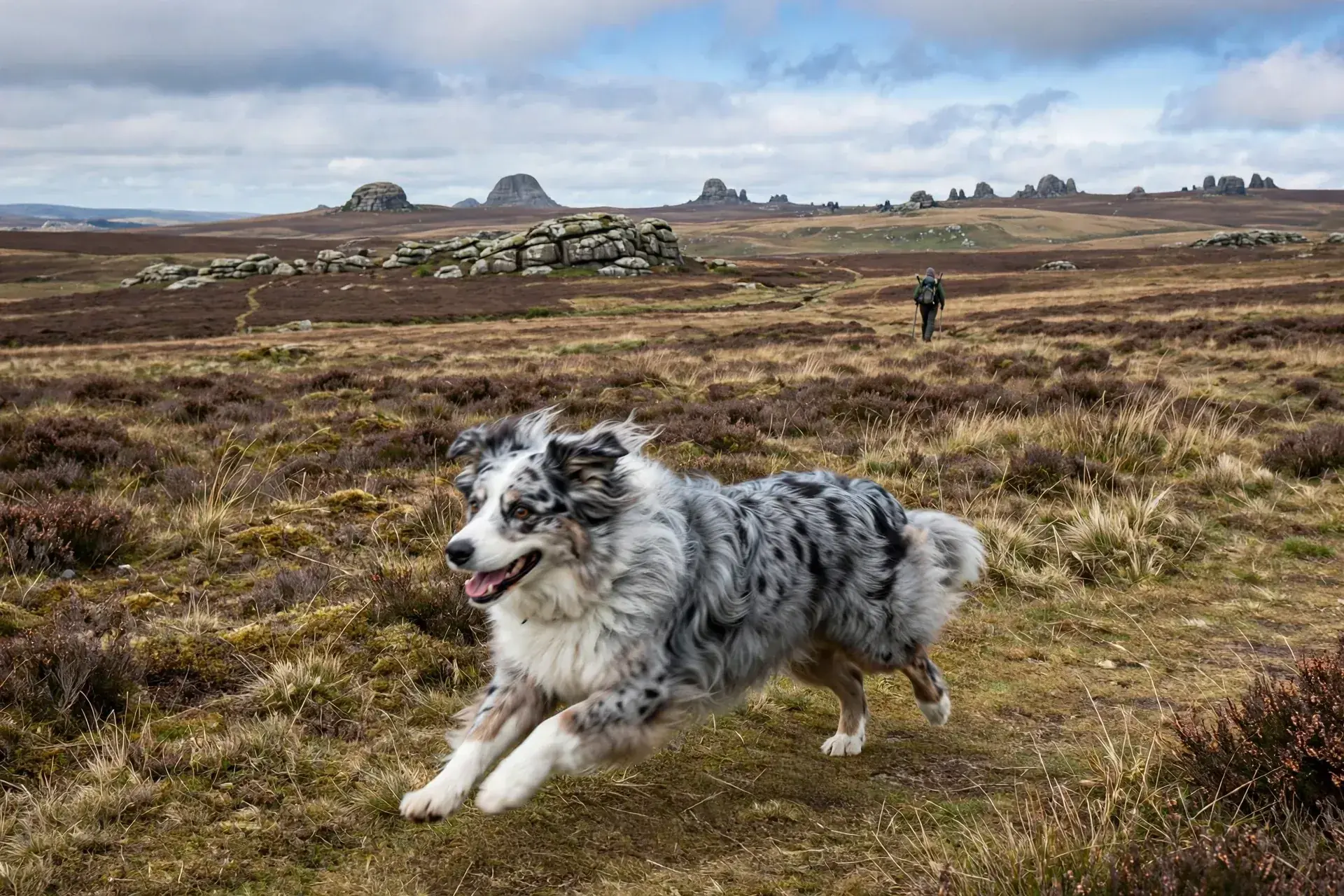
The best Australian Shepherd walking in Britain is open, varied and livestock-free, with room to run and things to investigate. Dartmoor and the Yorkshire Dales offer superb moorland, but they demand careful route choice to avoid sheep, so use enclosed dog fields and forestry tracks as your default and treat open moorland as a special occasion with a lead in hand. Coastal paths, especially the flatter stretches of the South West Coast Path and the Norfolk coast, give long, interesting walks with sea air and plenty of sniffing, though cliffs and livestock on headlands need the same caution as moorland. Woodland, such as the New Forest, though ponies and cattle roam there, and the forests of Northumberland, offers shade, scent and varied terrain, and is often the best choice on a hot day.
When you choose a base, look for the practical details that make an Aussie trip work: a secure field or garden, a choice of walks from the door so the dog does not need a car journey for every outing, and a nearby vet in case of an injury on a long walk. A base with a mix of open ground, woodland and water gives the dog variety across a week, which matters for a breed that gets bored by repetition. End each day with a wind-down: a short, sniffy walk, a training game and a chew, rather than a final burst of high-energy play that leaves the dog wired at bedtime. Done this way, an Australian Shepherd holiday in Britain is not a compromise between the dog's needs and the owner's plans. It is a week in which the dog's energy, intelligence and loyalty are given exactly the outlet they were bred for, on ground that suits them, with the livestock and the other walkers kept safe. Our guide to finding an emergency vet on holiday is worth reading before you travel to a remote area, where the nearest practice may be a long drive away.
Practical questions
Before you go
Can an Australian Shepherd be let off the lead near sheep?
Only where you are certain no livestock is present and the dog has a reliable recall. In sheep country, keep the dog on a lead, because a herding dog that chases sheep can cause serious harm and the farmer has legal powers in some circumstances. Check the official guidance before you travel if you are unsure about local access rules.
How much exercise does an Australian Shepherd need on holiday?
Most adults need at least two hours of active exercise a day, plus training and problem-solving, to stay settled. A single long walk is less effective than a mix of running, training games and sniffing time, spread across the day with rest in between.
Do Australian Shepherds herd children and other dogs on trips?
Many do, especially when excited: circling, nipping at heels and barking at runners are classic herding behaviours. Train a strong settle and a recall before the trip, keep the dog on a lead around children and joggers, and redirect the instinct into games rather than letting it become a habit.
How do I manage an Australian Shepherd coat while travelling?
Brush thoroughly every few days with a slicker brush and an undercoat rake, and daily during seasonal shedding. Pack a drying coat and towels, because the double coat holds water and mud, and check behind the ears and in the feathering for mats after wet walks.
Are Australian Shepherds good in hotels and cottages?
Yes, if the dog is tired in both body and brain before arrival. Choose accommodation with a secure garden or a nearby field, tire the dog with training as well as walking, and bring a familiar bed and chews. A bored Australian Shepherd in a small room will invent its own entertainment, usually at the furniture's expense.