This guide is independent and contains no paid placement. If affiliate links are added later, they will be clearly marked and will not change our editorial checks.
Belfast suits dogs best as a walking city in layers: the Titanic Quarter waterfront and the River Lagan towpath for flat, scenic miles, Ormeau Park and Botanic Gardens for green pauses, and Cave Hill for one bigger hill day. Treat the Titanic Belfast museum itself as an exterior visit with a dog, base yourself somewhere with a hard floor and a nearby last walk, and book the dog onto the ferry in advance — then check the latest official guidance before you travel for any policy that may have changed. Official source: Belfast City Council: Ormeau Park (checked October 2026).
Walk Belfast in layers, not in a landmark checklist
Do Belfast in this order and the city makes sense with a dog: start at the water, follow the river, rest in the parks, and only then climb a hill. Too many city breaks with dogs fail because the day is built around indoor attractions the dog cannot enter, joined up by hot pavements and long waits outside doorways. Belfast rewards the opposite approach. Its best dog experiences are outdoors and free — a regenerated docklands waterfront, a river corridor that runs like a green spine through the city, Victorian parks with real space, and hills that rise directly behind the suburbs. Plan those as the main events, and let museums, shops and galleries become short, optional extras for the humans rather than the structure of the day.
Geography helps. The Titanic Quarter sits east of the River Lagan, a short walk across the Lagan Weir footbridge from the city centre. The river towpath then leads south past Ormeau Park towards the leafier suburbs, while Botanic Gardens and the Queen's University quarter sit a comfortable walk west of the towpath. Cave Hill stands to the north, above Belfast Castle, close enough to reach by bus, taxi or car without turning it into an expedition. A dog owner can therefore build each day around one anchor walk and one gentle extra, instead of criss-crossing the city and tiring the dog out on transport and pavements before the proper walk even begins.
Set expectations about rules early, because Northern Ireland has its own dog control framework and Belfast City Council enforces local orders in parks and public spaces. Leads are required in many formal areas, dogs are excluded from some play areas and sports facilities, and fouling rules are actively enforced with fines. None of this is unusual, but it does mean the relaxed assumption that a well-behaved dog can go anywhere does not apply. Read signs at each park entrance, keep a lead in your hand rather than buried in a bag, and treat every new space as lead-only until you can see that other arrangements are clearly permitted. Where this guide describes a venue or operator policy, check the latest official guidance before you travel, because dog policies in cities change faster than almost anything else.
Titanic Quarter on foot: the exterior route that works
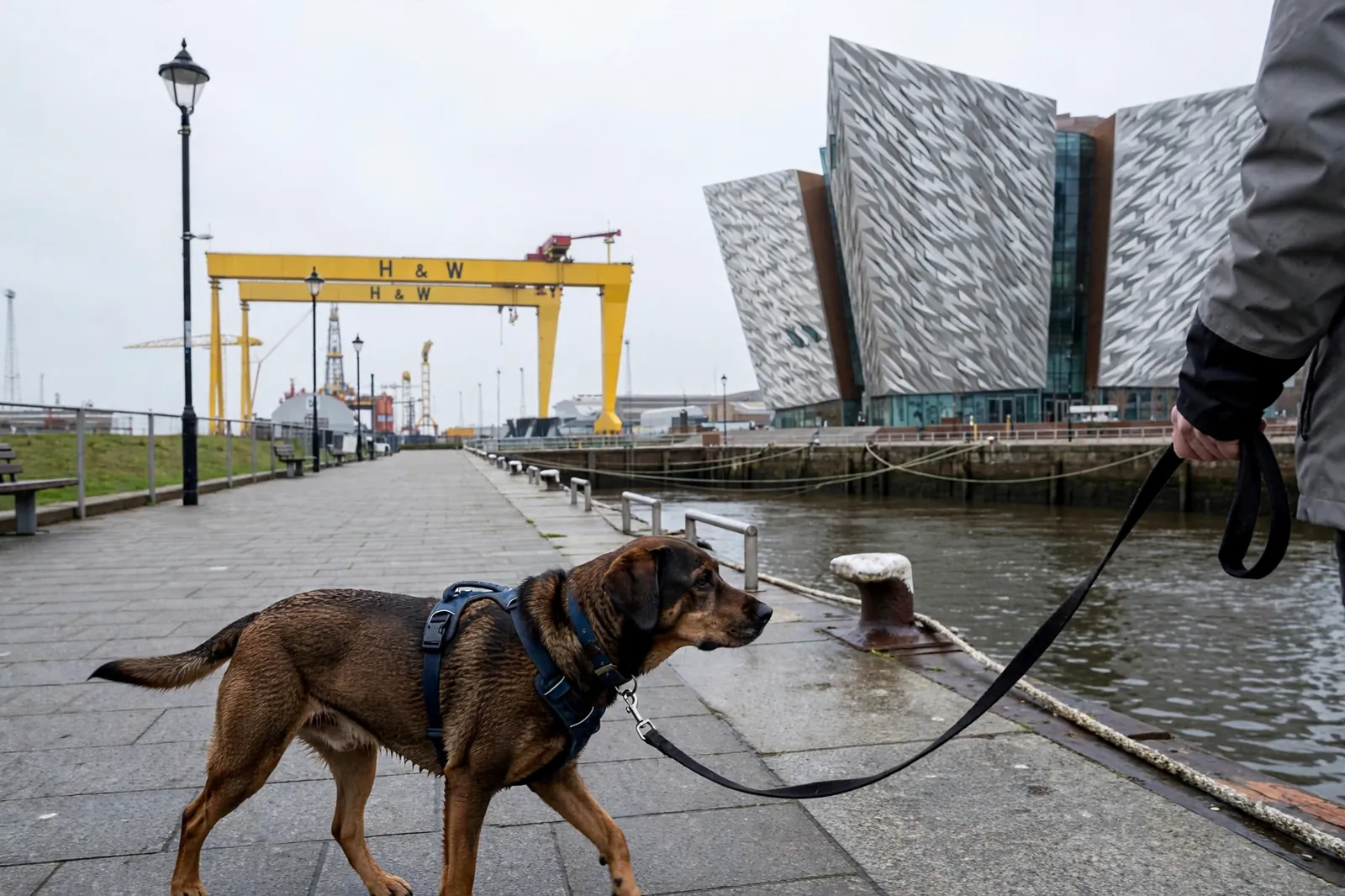
The Titanic Quarter is the natural first walk of a Belfast trip, and not only for the photographs. The waterfront promenades are wide, flat and paved, with room for a dog to walk at your side without weaving through crowds, long sightlines that help nervous dogs, and a constant supply of new smells from the water, the docks and the working harbour beyond. Begin around the Titanic Belfast building and follow the water past the historic slipways where the great liners were built, out towards the marina and the open views down Belfast Lough. The yellow gantry cranes of the shipyard dominate the skyline for the whole walk, which makes navigation reassuringly simple: keep the cranes and the water in view and you cannot get properly lost.
Be clear-eyed about the museum itself. Titanic Belfast is an indoor visitor attraction, and the honest plan with a pet dog is to enjoy the building, the slipways and the surrounding maritime trail from the outside rather than expecting to tour the galleries together. Assistance dogs are a separate matter and are accommodated under their own arrangements, but a pet dog should not be left tied up outside the entrance or waiting in a hot car while the rest of the group goes inside. If the humans in your party want the full museum experience, split the visit: one person walks the dog along the waterfront and around the docklands while the other tours inside, then swap at a cafe afterwards. Handled that way, nobody misses out and the dog gets one of the best flat walks in the city instead of a stressful wait. Museum dog policy can change, so check the latest official guidance before you travel rather than relying on any guide, including this one.
Practical details make or break this walk. The Quarter is exposed to wind off the lough, so a layer you would not need in the sheltered city centre can matter here, and in summer the pale paving reflects heat with very little shade — walk early or late on hot days and carry water, because a waterfront can look refreshing while offering a dog nothing safe to drink. Surfaces are mostly smooth and step-free, which suits older dogs, pushchairs and anyone with limited mobility, but watch for cyclists and runners sharing the promenades, keep the lead short near the water's edge, and be careful around bollards, mooring hardware and the occasional uneven dock surface. Events in the Quarter, from concerts to maritime festivals, can transform a calm promenade into a crowded and noisy space, so check what is on during your dates and choose a quieter morning if your dog dislikes crowds.
Extend the walk if energy allows. The maritime trail links the Quarter to the city centre across the river, and from there the Lagan towpath described next continues the same waterside story southwards. Joining the two gives a fit dog a genuinely satisfying half-day of flat walking without a car, broken up by coffee stops and park detours. Keep the return journey in mind, though: out-and-back waterfront routes feel easy on the way out with a fresh dog and a tailwind, and noticeably longer on the way back into the wind with tired legs — human and canine alike.
River Lagan and Ormeau Park: the city's everyday dog walk
If the Titanic Quarter is Belfast's showcase, the River Lagan towpath is its working dog walk — the route local owners use daily, in all weathers, because it delivers distance, greenery and variety without leaving the city. From the centre, the towpath follows the river south through a changing sequence of bridges, meadows, woodland edges and playing fields, with the Lagan Valley opening out ahead. The surface is generally good for paws and for wheels, gradients are gentle, and the river provides a constant orientation point. Swans, herons and rowing crews share the corridor, so keep dogs out of the water at busy stretches, on a lead near wildlife and anglers, and close at blind bends where cyclists approach quickly and quietly.
Ormeau Park, one of Belfast's oldest public parks, sits directly beside this corridor and pairs with the towpath so naturally that most good Belfast dog days use both. Inside the park you will find broad open grass, mature trees, formal paths and sports facilities, which means you need to read the space as you enter it. Open grass away from pitches is where dogs get their freer exercise, while play areas, courts and marked pitches are for keeping out of or walking around on a lead. Football training, parkruns, festivals and funfairs periodically take over large parts of the park, changing where a dog can relax and how busy the paths become. On an ordinary weekday morning, though, this is one of the most pleasant urban dog walks in Ireland: long loops under trees, squirrels to watch rather than chase, and enough other dogs around for social animals to feel at home — with enough space to give reactive dogs room if you choose your timing carefully.
Use the combination intelligently across a stay. A towpath-and-Ormeau circuit works as the early-morning toilet-and-energy walk before a city day, as a full morning walk in its own right with a picnic or a nearby cafe, or as a decompression stroll on arrival day after a ferry crossing, when a dog needs to move and sniff without new rules every five minutes. It is also the most forgiving walk in this guide for mixed-ability groups, because anyone who has had enough can peel off at a bridge or park gate while fitter walkers and dogs continue. In wet weather the towpath mostly holds up better than grass, but riverside sections can flood or turn slick after heavy rain, and the river itself runs high and fast — keep dogs on leads near swollen water and never let a dog swim in a strong current, however keen it looks.
South of Ormeau, the corridor continues towards the Lagan Valley Regional Park, where the walking becomes steadily more rural and a determined walker with a fit dog can keep going for miles through meadows and woodland. You do not need to complete anything for the walk to be worthwhile. Turnaround points are everywhere, buses and taxis can rescue tired legs from several points along the valley, and the dog will judge the outing by the sniffing quality rather than the mileage. What matters is pacing: build in water stops, let the dog investigate at its own speed on quieter stretches, and leave enough in reserve for the walk back to your base or the next bus stop.
Botanic Gardens and the Queen's Quarter: a calm lead walk
Botanic Gardens offers a different register of Belfast walking: slower, shadier and more formal, tucked beside Queen's University in the south of the city. For dogs, this is a lead walk in the best sense — winding paths under mature trees, lawns and planting to look at rather than run across, and a steady, unhurried atmosphere that suits older dogs, dogs recovering from busy days, and owners who want an hour of green without committing to a full park circuit. The Palm House and Tropical Ravine are the famous glasshouse landmarks of the gardens; admire them from outside with the dog and apply the same split-visit logic as at the Titanic Quarter if anyone wants to step inside an indoor attraction, checking the latest official guidance before you travel for current arrangements.
The surrounding Queen's Quarter extends the pleasure. University streets, the Ulster Museum's exterior setting at the edge of the gardens, independent cafes and bookshops, and some of Belfast's most handsome Victorian and Edwardian terraces make this the natural neighbourhood for a slow morning: gardens first, coffee second, a gentle street wander third. Dogs are a common sight at outdoor cafe tables here, but individual businesses set their own rules and busy indoor spaces may be human-only, so ask at the door, choose outdoor seating where possible, and settle the dog on a mat under the table rather than letting it sprawl across a walkway. The museum, galleries and university buildings themselves should be assumed to be assistance-dogs-only indoors unless you have verified otherwise on the day.
Link Botanic Gardens into the wider network instead of treating it as an isolated stop. It sits a short walk from the Lagan towpath and Ormeau Park, so a loop of gardens, river and park fills a morning elegantly and gives a dog three distinct environments — formal planting, open water corridor and broad urban grass — in a single outing. It also works as the gentle second walk of a day that began with Cave Hill, or as the main walk on a departure day when you need the dog exercised and settled but cannot risk muddy paws and a long drive to a hill. In autumn the gardens are particularly fine, with leaf colour and conkers to dodge; in spring, bedding displays mean extra gardeners, extra visitors and extra reason to keep leads short and dogs off the beds.
Cave Hill Country Park: Belfast's big-view hill day
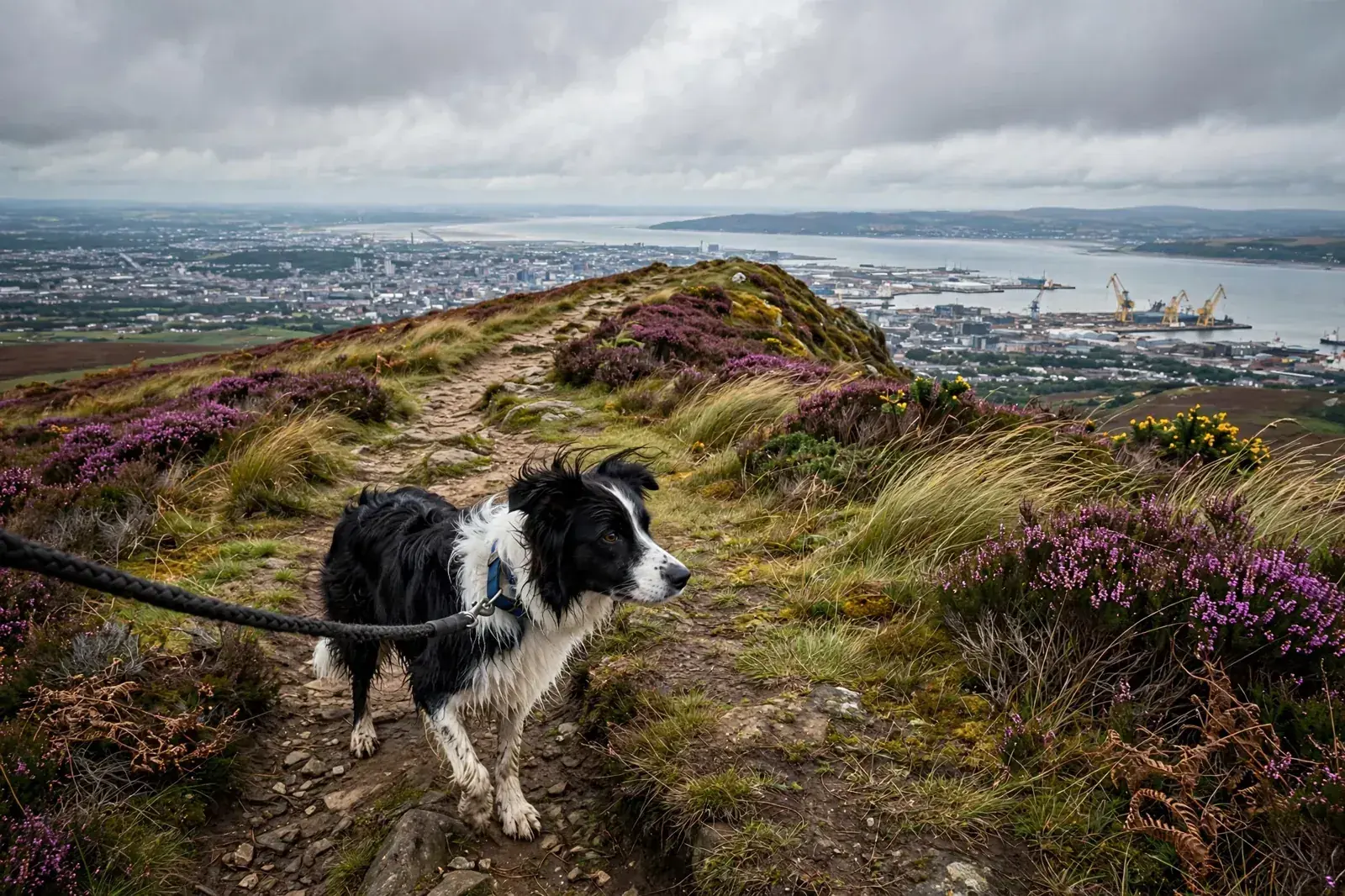
Every Belfast dog trip deserves one proper hill, and Cave Hill is the city's own. Rising to the north of Belfast above Belfast Castle, its profile — often compared to a sleeping giant — is visible from across the city, and the walk up repays the effort with some of the finest views in Northern Ireland: the whole of Belfast spread below, the lough stretching away, and on clear days a horizon that reaches far beyond the city. Cave Hill Country Park protects the hill and its woodland, heath and archaeological features, and the marked trails let you build anything from a short castle-grounds outing to a full summit circuit. This is a hill walk, not a park stroll, and it should be planned with the same care as any exposed upland route: footwear with grip, a layer for the top, water for the dog, and a turnaround decision made before tiredness makes it for you.
Start from the Belfast Castle side if you want the most forgiving introduction. The castle grounds, woodland paths and lower trails give dogs a rewarding outing without the summit commitment, and the estate setting — gardens, trees and views already opening up — makes a satisfying destination in itself for older dogs, younger households and anyone short on time. Dogs belong outdoors here: treat the castle interior, its visitor facilities and any cafe or restaurant spaces according to the rules you find on the day, assume indoor areas may not accept pet dogs, and check the latest official guidance before you travel if an indoor visit matters to your plan. From the grounds, the hill paths climb steadily, and the character changes as you gain height: shelter gives way to open, windswept ground, paths narrow, and the city noise fades into wind and birdsong.
The summit area, around McArt's Fort, is the highlight and the hazard in one. The views are exceptional, but the ground is exposed, edges demand respect, and a dog pulling suddenly towards a scent or another walker needs a short lead and a secure hold from you, especially in gusts. Keep dogs well back from steep drops, do not let them range freely near the fort or on archaeological features, and be ready to cut the visit short if cloud, wind or rain arrives — the hill creates its own weather and conditions at the top routinely differ from the castle car park below. After wet weather, chalky and earth paths can be slippery on descent, which is when most human slips and most canine shoulder strains happen. Descend slowly, zigzag where the path allows, and stop for water and a paw check rather than pushing tired legs downhill in one go.
Choose who this walk is for honestly. A fit adult dog with sound joints, decent lead manners and no obsession with chasing birds will usually relish Cave Hill on a calm day. Puppies should not be doing sustained climbs or long descents while they are still growing, senior dogs are often happier with the castle grounds and lower woodland than with the summit, and dogs that pull hard, lunge at passers-by or panic in open, windy places will find the narrow upper paths stressful for everyone. Go early on a clear weekday for the quietest experience, tell someone your plan, carry a charged phone without relying on it entirely, and pack out all waste — bins cluster near the main access points, not on the summit. A Cave Hill morning followed by a lazy afternoon is the right rhythm; a Cave Hill morning followed by three hours of city pavement is too much for most dogs.
Divis, the Black Mountain and bigger days beyond the city
Cave Hill has a western counterpart that completes Belfast's hill picture. Across the city, Divis and the Black Mountain form a larger, wilder-feeling upland area managed for conservation, farming and public access, with summit and ridge trails that look back at Belfast from the opposite side. Where Cave Hill is a single distinctive peak tied to a castle estate, Divis feels like open hill country that happens to sit beside a city — grazed, exposed and properly spacious. The two hills bookend a Belfast stay beautifully: Cave Hill for the castle-and-summit day, Divis for the longer, quieter ridge walk. Because the routes, livestock rules and weather exposure deserve detailed treatment in their own right, this guide does not repeat them here; instead, read the dedicated walk guide to Divis and the Black Mountain with a dog for route choices, lead rules around grazing animals and advice on judging the ridge in poor weather.
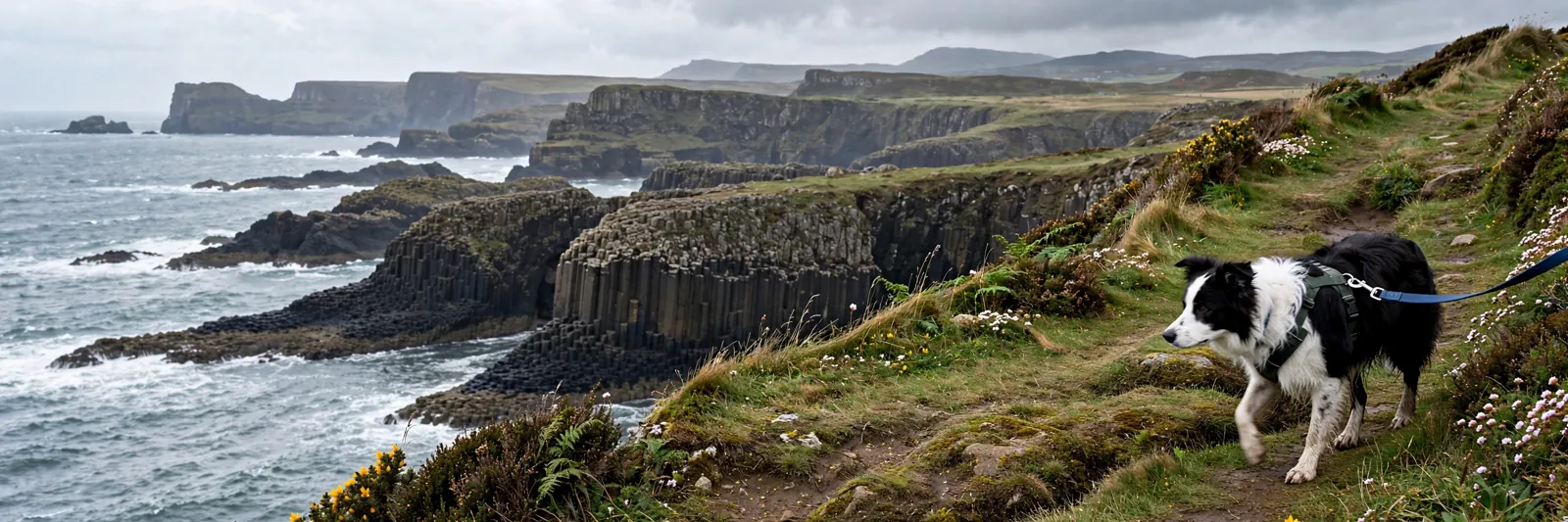
Belfast also works as a base rather than just a destination, and a dog trip can radiate outwards without changing accommodation every night. North and east along the shore, the coast towards the glens and the famous basalt columns makes a natural extension: our guide to the Causeway Coast with a dog covers the beaches, cliff paths and town stops of that coastline in detail. South of the city, the Mourne Mountains offer Northern Ireland's most serious hill walking, a clear step up from both Cave Hill and Divis in height, rockiness and commitment. Use Belfast's hills as honest preparation: a dog that is calm on leads around livestock, steady on descents and settled after a Cave Hill day is building exactly the skills the Mournes demand, while a dog that found Cave Hill overwhelming needs gentler progression, not a bigger mountain.
Resist the temptation to stack all of this into one short break. Belfast's gift to dog owners is density: two serious hills, a river valley, a docklands waterfront and several substantial parks inside or beside one compact city. Two or three well-chosen walks, done slowly with rest built in, will leave a dog happier — and owners with better memories — than a frantic circuit of every trail in this guide. Pick one hill, one waterfront or river day, and one gentle park day as your core, and hold the rest as options for the return visit that Belfast tends to inspire.
Where to stay with a dog in Belfast
Choose your Belfast base by the first and last walks of the day, not by the photograph of the bedroom. A dog-friendly stay earns the label in practical ways: a ground-floor or lift-served room so an older dog never faces stairs at midnight, a hard floor or washable surface near the door for wet paws, enough space for the dog's own bed without blocking the bathroom route, and a host or hotel team that states its dog rules clearly — how many dogs, what size, which areas are open to them, whether dogs may be left alone in the room, and what the charge is. Get those answers in writing before you book, because city hotels in particular range from genuinely dog-welcoming, with bowls, treats and dog towels provided, to technically dog-accepting in a handful of rooms at a steep nightly fee.
Neighbourhood choice shapes the whole trip. Staying near the Queen's Quarter or the Ormeau Road puts Botanic Gardens, the towpath and Ormeau Park on your doorstep, which makes morning and late-evening walks effortless and gives you the widest choice of cafes. The city centre and Titanic Quarter suit travellers arriving by ferry or train who want the waterfront and central sights on foot, but check the immediate surroundings for a practical last walk that is not just a busy pavement — a dog that needs grass at 11pm will not thank you for a fashionable address. Self-catering apartments and houses in residential streets often work best of all for reactive or noisy dogs, provided you verify that any garden is genuinely enclosed, ask about neighbouring dogs and bin-store arrangements, and confirm that the dog is allowed on furniture or bring covers if it is not.
Whatever the property type, run the same arrival routine. Walk the dog before you go inside, check doors, gates and low windows, set up bed, water and a familiar blanket in a quiet corner, and keep the first evening deliberately dull. City stays concentrate novelty — lifts, corridors, other guests, traffic noise, seagulls on the roof — and a dog that has travelled by ferry and walked a new waterfront in one day has already had a large day. Feed at the usual time, take a short familiar-smelling last walk, and let the dog sleep. Ask reception or your host, on arrival rather than in a crisis, for the nearest vet and the nearest emergency out-of-hours service, and save both numbers in your phone alongside your own vet's details and your pet insurance information.
Eating and drinking with a dog in Belfast
Belfast eats well, and a dog no longer has to mean a sandwich on a bench — as long as you plan around the distinction between dog-welcoming and dog-tolerant. Pubs are generally the most relaxed option, with many Belfast locals happy to welcome a settled dog in the bar area, sometimes with water bowls and treats behind the counter. Cafes cluster around the Queen's Quarter, the Ormeau Road, the city centre and the Titanic Quarter, and outdoor tables widen your choices considerably in fair weather. Restaurants are the most variable category: some accept dogs in specific areas or at specific times, others are assistance-dogs-only indoors, and small dining rooms may reasonably say no. The reliable method never changes — check the venue's own listing, then phone or message to confirm for your date, your dog's size and the area you will be seated in, because a policy copied from an old review is not a booking.
Market and street-food settings deserve a special note. Covered markets and food halls can be wonderful for owners and overwhelming for dogs: dense crowds, dropped food at nose height, loud music and little room to create space. Some venues welcome dogs on leads, others restrict them, and even where dogs are allowed, a nervous, very large or food-obsessed dog may have a miserable time. Go at opening time or on a quieter day, keep the visit short, position the dog under or beside your seat away from the main flow, and leave if the dog is panting, fixating or unable to settle. A dog asleep at home or settled in the car for a short, safe period in cool weather — where that is appropriate and lawful — can be the kinder option for a long, crowded food session, but never leave a dog in a warm vehicle, and never tie a dog up outside an unfamiliar venue in a busy city street.
Set the dog up to succeed wherever you eat together. Arrive with a dog that has already been walked, toileted and given water, bring a portable mat so the dog has a defined place to lie, and order a long-lasting chew only if the venue is relaxed about it and neighbouring tables are comfortable. Keep leads short and out of walkways, keep the dog off seats unless explicitly invited, and be ready to finish drinks outside if the dog cannot settle — other diners did not choose your dog as company. Handled this way, Belfast's food scene becomes one of the pleasures of the trip rather than a daily negotiation, and staff in genuinely dog-friendly places tend to remember, and reward, the owners who make it easy.
Arriving by ferry at Belfast port with a dog
For many visitors, Belfast begins at the ferry port, and arriving by sea is one of the most dog-friendly ways to reach Northern Ireland — no flying, no cargo holds, and your own car, bedding and familiar smells travelling with you. Routes into Belfast serve ports including Cairnryan in Scotland and Liverpool in England, with operators offering a mix of arrangements for dogs: travelling in your vehicle for the crossing, onboard kennels, and on some ships and routes, pet-friendly cabins or designated pet lounges. What is available depends entirely on the operator, the ship and the sailing, and popular pet options sell out, so book the dog at the same time as the humans, not as an afterthought. Our detailed guide to dogs on UK ferries compares operator approaches, costs and cabin and kennel arrangements across routes, and is worth reading alongside the operator's own current conditions before you commit.
Prepare the crossing itself as carefully as the booking. Exercise and toilet the dog thoroughly before check-in, feed a lighter meal in good time rather than a full meal at the port, and set up the vehicle or kennel space with familiar bedding, water and a safe chew. Follow the operator's rules exactly on leads, muzzles where required, designated exercise areas and the times at which you may visit the dog, and never assume you can return to the car deck during a sailing — on most crossings, access to vehicles is restricted once the ship is under way. Keep the dog's documentation, your booking confirmation and any required paperwork together and accessible, and check the latest official guidance before you travel, because pet travel rules between Great Britain and Northern Ireland have their own specific requirements and these have been subject to change and review.
The port arrival is a transition, not a finish line. A dog stepping out of a vehicle or kennel after hours at sea needs, in this order: a calm toilet opportunity in the designated area, water, a short leg-stretch on a lead, and only then the onward journey. Do not drive straight into central Belfast traffic and expect the dog to wait another hour. The port area connects to the city by main roads and the Titanic Quarter is one of the closest substantial walks to the terminal side of the city, which makes the waterfront an ideal first Belfast walk after disembarking — flat, spacious and forgiving for a dog regaining its land legs. If you are travelling without a car, confirm in advance how you will leave the port with a dog: which taxi firms accept dogs, what public transport allows, and how far you would have to walk with luggage and a dog if a connection fails. That single piece of planning removes most of the stress from ferry arrival day.
Build the return crossing into your last day with the same care. A long, satisfying morning walk — the towpath and Ormeau Park are ideal — then rest, an early light meal and a calm drive to the port beats a frantic final hill and a rushed check-in. Keep one full set of dog supplies in the cabin bag rather than the hold or the bottom of the car: lead and spare lead, waste bags, water and a bowl, food for a delayed sailing, any medication, and a towel for wet paws. Ferries are weather-dependent in a way trains are not, and the dog that copes best with a delay is the one whose routine, food and comforts are all within reach.
A two-day Belfast plan that leaves the dog rested
Here is how the pieces fit together across a short break, offered as a rhythm to adapt rather than a timetable to obey. Day one, arrival day: come in by ferry or road late morning, settle the dog at your accommodation with the quiet routine described above, then take the Titanic Quarter waterfront as the main walk — flat, spacious and spectacular without being tiring. Eat early somewhere dog-welcoming near your base, finish with a short, unexciting last walk, and protect the first night's sleep. A dog that sleeps well on night one is a different, easier companion for the whole trip.
Day two is the choice day, and the choice depends on the dog in front of you. Fit adult dogs get the hill: Cave Hill in the morning while legs and weather are fresh, back down for a long rest, then Botanic Gardens or a Queen's Quarter cafe wander as the gentle second act. Dogs that are older, younger, recovering or simply not hill dogs get the river day instead: the Lagan towpath and Ormeau Park in the morning, a proper midday rest, and the Botanic Gardens lead walk later. Either version ends better than any version that tries to do both. If you have a third day, swap in whichever option you skipped, or use Divis for a second, contrasting hill — and if you are extending the trip beyond the city, the Mourne Mountains with a dog guide will help you judge whether your dog is ready for that step up.
Whatever the day, carry the same small kit and the same habits. Water and a collapsible bowl, waste bags in more than one pocket, a charged phone, the dog's usual treats or a portion of food if you will be out over a mealtime, a towel in the car or bag, and a spare lead. Check paws after docklands grit, towpath gravel and hill paths alike, rinse salt and city grime off legs in winter, and keep up tick checks after park, woodland and hill days. Belfast will do most of the work for you — few cities offer this much walking, water and green space in so compact an area — provided you respect the few firm boundaries: museums are exterior visits, leads rule in formal spaces, hills demand weather respect, and the ferry dog is booked, exercised and rested like the full member of the trip it is.
Practical questions
Before you go
Can dogs go inside Titanic Belfast?
Plan on enjoying Titanic Belfast from the outside with your dog. The visitor attraction is an indoor museum experience, and pet dogs are not normally part of that indoor offer, while assistance dogs are handled separately. The surrounding Titanic Quarter is the dog-friendly part of the visit: the waterfront promenades, slipways and outdoor maritime trail can all be explored on a lead. Policies can change, so check the latest official guidance before you travel and never leave a dog unattended outside the entrance.
Are dogs allowed in Botanic Gardens in Belfast?
Yes, dogs are a familiar sight on the paths of Botanic Gardens beside Queen's University, and the gardens work well as a calm lead walk between the city centre and longer river routes. Keep your dog on a lead, stay off planted beds and lawns where signs ask you to, and carry waste bags because bins can be busy at lunchtimes. The glasshouses are an indoor attraction with their own rules, so plan those for a moment when someone else can stay outside with the dog, and check the latest official guidance before you travel.
Can I walk my dog off lead in Ormeau Park?
Ormeau Park has open grass where many owners exercise dogs, but off-lead walking still depends on reliable recall, current park signage and courtesy to other users. Sports pitches, play areas, busy events and the riverbank all call for a lead or very close control, and some areas or times may be restricted. If your dog chases runners, bikes or other dogs, use a long line on the quieter grass instead. Always check signs on the day and check the latest official guidance before you travel.
How do dogs travel on the ferry to Belfast?
On ferry routes into Belfast, including sailings from Cairnryan and Liverpool, dogs usually travel in a vehicle, in onboard kennels or in a limited number of pet-friendly cabins or lounges, depending on the operator and route. You must book the dog in advance, follow the operator's rules on leads, muzzles and exercise areas, and allow extra time at check-in. Rules differ between operators and can change, so read the booking conditions carefully and check the latest official guidance before you travel.
Is Cave Hill suitable for older dogs and puppies?
Only in its gentlest form. The lower paths around Belfast Castle and the woodland edges can suit a steady older dog for a short outing, but the climb to the summit, the exposed top and the steep descents are too much for most puppies, dogs recovering from injury and many senior dogs. Choose a short lower loop, go on a dry and calm day, turn back at the first sign of tiredness, and save the full Cave Hill circuit for a fit adult dog.
Where exactly can my dog run off lead in Ormeau Park?
Inside the park’s fenced dog enclosure only. Belfast City Council requires dogs to stay on a lead until they are inside the off-lead area and when entering and exiting, and off lead only once inside with the gates securely closed. Only two dogs per person at a time, only during daylight hours, and you must use the dog waste bins provided or risk an £80 fixed penalty notice. See the council’s official park page: Belfast City Council: Ormeau Park (checked October 2026).
Which Belfast ferry should I choose for my dog: Cairnryan or Liverpool (Birkenhead)?
Choose by crossing length. The Stena Line Cairnryan route is a short crossing of about 2 hours 15 minutes, with a dedicated pet lounge that must be booked in advance and where your dog must stay in a ventilated pet carrier throughout, while kennels are free. The Stena Line Liverpool (Birkenhead) route is an overnight crossing of about 8 hours, with pet-friendly cabins, and kennels charged per crossing that you can visit during the sailing and where you can walk your dog under controlled conditions. On both routes, leaving your pet in your car is free, but on the long route the operator recommends booking a cabin or kennel. Travelling from Great Britain to Northern Ireland requires a Northern Ireland Pet Travel Document and your dog must be microchipped; with that document, rabies vaccination and tapeworm treatment are not required. The Isle of Man Steam Packet Douglas-Belfast route is seasonal, with few sailings, so check the Steam Packet timetable before booking. See Stena Line pets for current pet rules, and for beach days after arrival, see dog-friendly beaches in Northern Ireland.