This guide is independent and contains no paid placement. If affiliate links are added later, they will be clearly marked and will not change our editorial checks.
Divis and the Black Mountain give dogs a genuine summit and ridge walk directly above Belfast — but treat it as exposed upland, not a city park. Keep dogs on a short lead around livestock, carry water, pick a route with a bail-out point, and check the latest official guidance before you travel.
A city on one side, open hill on the other
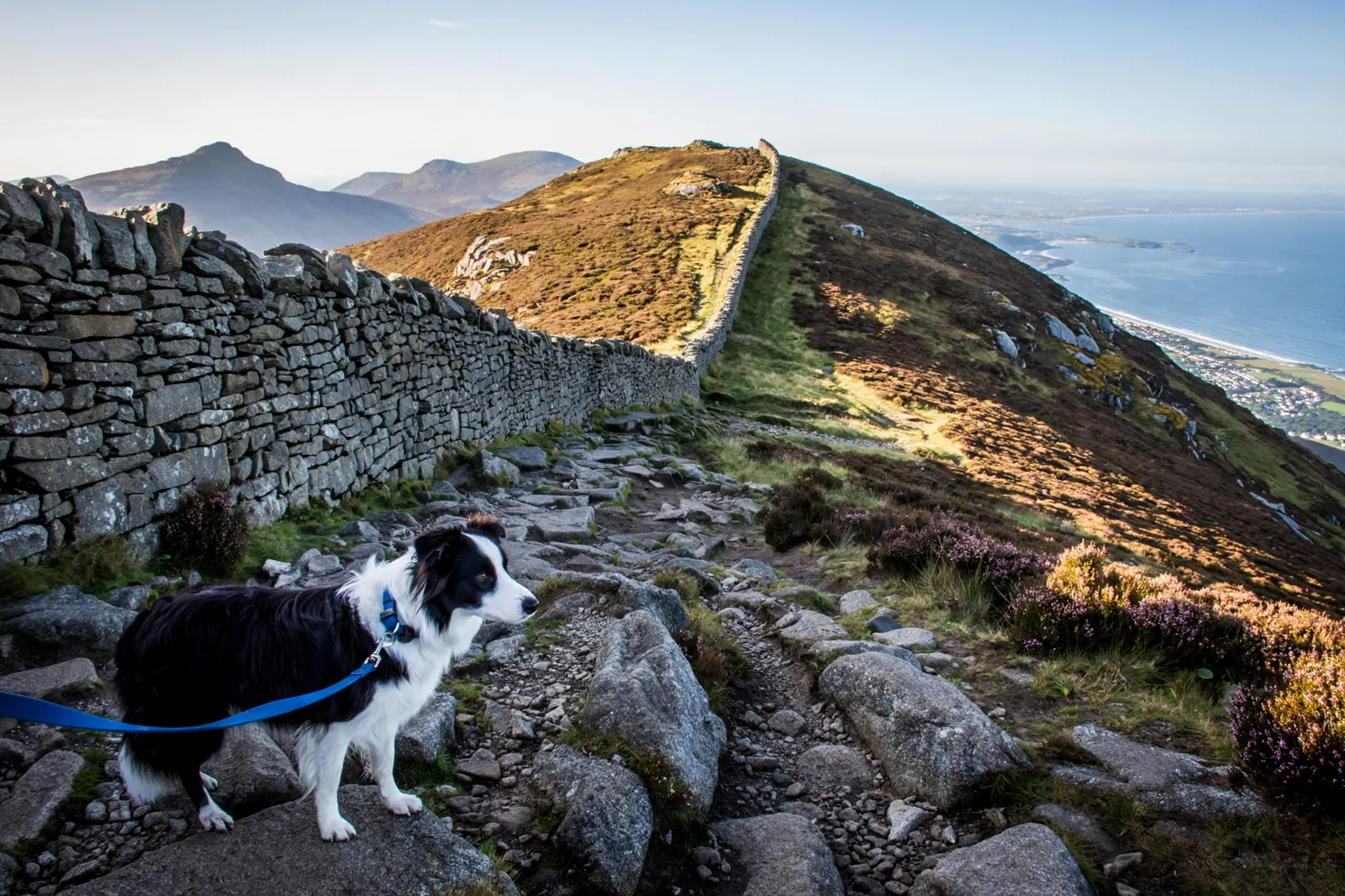
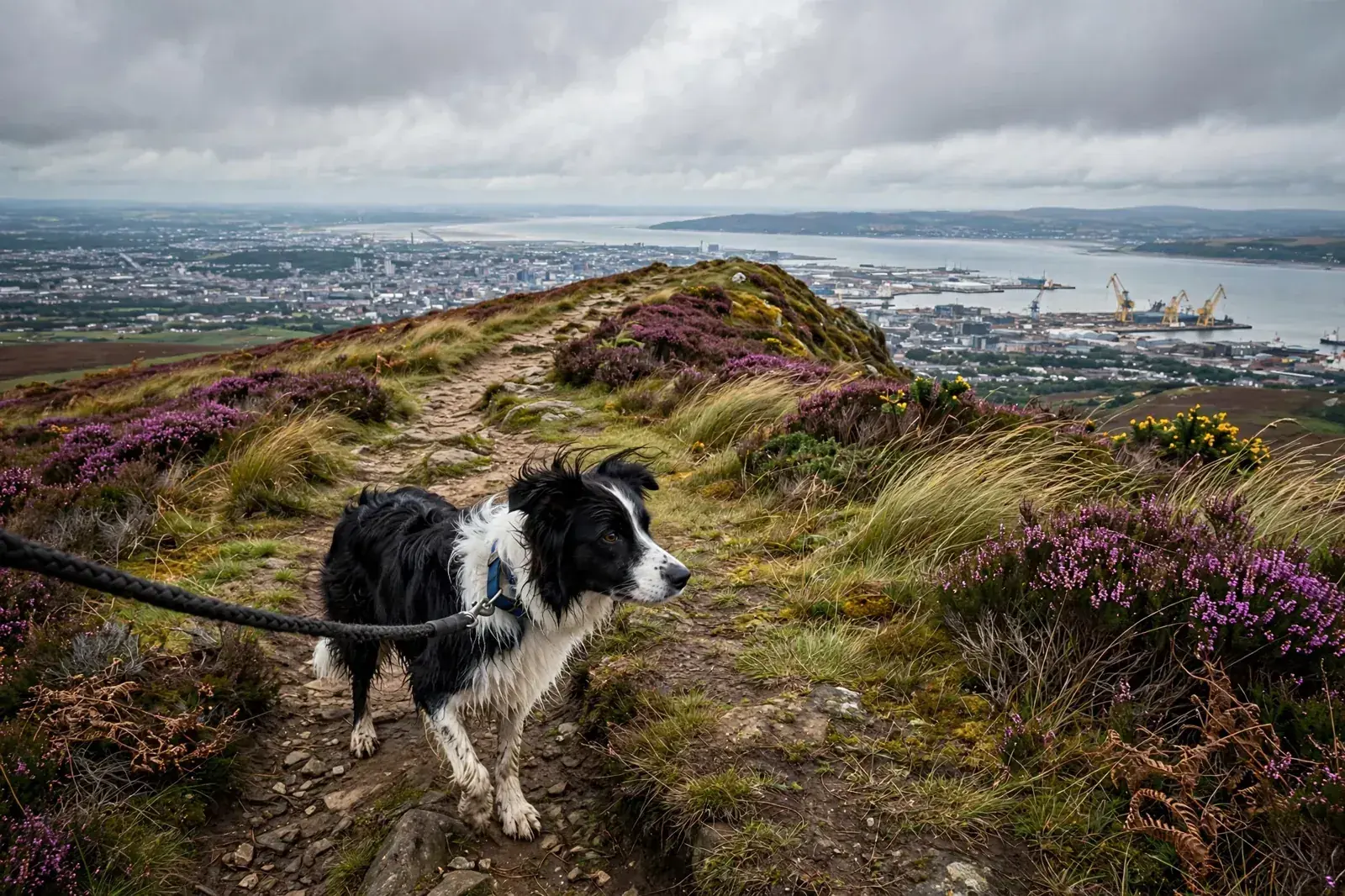
Most hill walks ask you to drive deep into the countryside before the climbing starts. Divis and the Black Mountain reverse that logic. You leave Belfast streets, climb for a short distance by road, and step out into open upland where the city suddenly looks small: Belfast Lough stretching away, rooftops and cranes laid out below, and heather and grass taking over in every other direction. For a dog owner staying in or near Belfast, that contrast is the whole appeal. You can give a dog a proper hill walk in the morning and still be back in the city for lunch, without a long rural drive at either end.
That convenience comes with a warning that shapes this entire guide. Divis is a real hill, not a city park on a slope. At around 478 metres, Divis is the highest point in the Belfast Hills, and the ridge towards Black Mountain is exposed to weather coming straight off the Atlantic and the lough. On a still, clear morning it feels generous and easy. In wind, low cloud or driving rain the same paths feel remote, cold and disorientating, and a dog that was happily trotting ahead an hour earlier can be shivering, pulling towards shelter or struggling on wet ground. Treat the walk with the same respect you would give any upland route in Northern Ireland, and check the latest official guidance before you travel.
The land is cared for by the National Trust and forms part of a wider landscape of farmland, habitat restoration and public access. That mix matters for dogs. This is not empty moor where anything goes. Sheep and cattle graze here, rare plants and ground-nesting birds depend on undisturbed ground, and other walkers, runners and families share the same network of trails. A well-managed dog on a lead fits into that picture perfectly well. A loose dog chasing stock or flushing birds does not, and it puts future access at risk for everyone.
Choosing a route: summit, ridge and gentler loops
Think about Divis in three layers rather than as a single walk. The first layer is the summit approach: the clearest, most direct way up Divis itself, rewarding you quickly with panoramic views and a trig point that makes a satisfying turnaround for dogs that are fit but not seasoned hill dogs. The second layer is the ridge: the longer, more exposed line linking Divis with Black Mountain, with sustained views and sustained wind, best saved for a settled forecast and a dog that is comfortable at height with nowhere to shelter. The third layer is the lower network: shorter loops and linking paths across the lower slopes and around the access areas, which give younger, older or recovering dogs a taste of the hill without the full climb.
For a first visit, resist the urge to link everything together. A common mistake is to look at a map, see that the distances are not huge by Lake District or Mourne standards, and assume a full summit-plus-ridge circuit will be straightforward. Distance is only part of the effort here. Exposure, underfoot conditions and how much your dog pulls on a lead on open ground all add up. A spaniel that walks six miles on flat towpaths may be tired after half that distance climbing into a headwind on Divis, and a nervous dog may find the wide open sky and distant traffic noise unsettling in a way that only shows after an hour.
Build a route with an honest bail-out point. Decide in advance where you will turn if the cloud drops, if your dog starts lagging, or if livestock are spread across the path ahead. On the summit approach, turning around is simple at almost any point. On the ridge, options narrow, so set your turnaround time before you set off and stick to it even if the summit photos look tempting. Walkers who enjoy Divis most tend to return several times, trying the ridge in perfect weather after they already know the lower ground in ordinary weather. If you are planning bigger Northern Ireland hill days, our guide to the Mourne Mountains with a dog shows how to step up gradually from hills like Divis to higher, rockier terrain.
Surfaces vary more than first-time visitors expect. Some sections are firm, well-made paths that stay passable after rain. Others cross grass, heather and peaty ground that holds water, hides shallow ruts and turns slick on descents. After wet weather, allow extra time, choose footwear with real grip, and shorten the route for small dogs whose bellies sit close to cold, wet vegetation. In dry summer weather the opposite problem appears: hard ground, strong sun with almost no shade, and a real risk of overheating on the climb if you set off at midday with no water.
Livestock, leads and the rules that actually matter
If you remember only one section of this guide, make it this one. Divis and the Black Mountain are grazed, and you should expect to meet sheep and, in places, cattle at any time of year. Keep your dog on a short lead whenever livestock are visible, whenever you approach a blind rise or gateway where stock might be just out of sight, and whenever signs on the ground ask you to. Close control is not a vague suggestion here. A dog worrying sheep can cause injury, miscarriage in pregnant ewes and huge distress to farmers, and landowners have legal protections in these situations. Our plain-English explainer on livestock worrying law and what it means for dog walkers is worth reading before any upland walk in the UK, not just this one.
Practise the practical details, not just the principle. Use a short, fixed lead rather than an extending lead on the hill: extending lines tangle in heather, wrap around other walkers' legs at passing places and give you too little control if a sheep bolts across the path. Hold the lead securely with both hands free enough to use a gate or steady yourself on a descent. Walk calmly and widely around stock rather than threading through the middle of a flock or herd, and never let your dog stare down, stalk or approach cattle with calves, which can be protective even when they look placid from a distance. If cattle move towards you and you feel genuinely unsafe, the standard countryside advice is to let go of the lead so you and the dog can separate and move away — but the better strategy is avoidance: give herds a very wide berth in the first place.
Ground-nesting birds add a seasonal reason for the same behaviour. In spring and early summer, birds nest in the heather and grass where a loose dog would love to quarter the ground. Keeping to paths and keeping dogs close protects nests you will never see. Heather and upland habitat restoration areas deserve the same care: stay on established trails across fragile ground, do not let dogs dig in restored peat or planted areas, and take every scrap of litter and dog waste away with you. Waste left in bags beside a path is still litter, and in grazing land it is a hazard as well as an eyesore.
Other users are part of the rulebook too. You will share trails with runners who appear quickly from behind, mountain bikers on permitted sections, families with small children, and other dogs, some of which will be reactive or in training. Shorten the lead and step aside early when passing, ask before letting dogs greet, and recall or reel your dog in at car parks, road crossings and the busiest access points even if you have been walking quietly for an hour without seeing anyone. Good hill manners are mostly about making your dog predictable to strangers.
Weather exposure: why Belfast below can mislead you
Check two forecasts, not one: the city forecast for Belfast and a mountain or upland forecast for the time you will actually be on the ridge. It is entirely normal for the streets below to be mild and merely breezy while the summit is in cloud with a wind strong enough to push a medium-sized dog sideways and make conversation difficult. Cloud base is the detail that changes the experience most. Divis in clear air gives you one of the finest viewpoints in Northern Ireland. Divis in mist gives you a grey path, a wet dog and no view at all, plus a genuine navigation test if you stray from the clearest lines.
Pack for the hill you might get, not the hill in the photograph. That means a waterproof layer for you, a drying or waterproof coat for a short-coated, older or very small dog, and spare warmth for stops: dogs cool quickly when they stop moving at a windy summit after generating heat on the climb. In winter, daylight is short and the temperature drop after sunset is sharp, so set a latest turnaround time and carry a headtorch even on a walk you expect to finish in daylight. In summer, carry more water than feels necessary, walk early or late to avoid the hottest part of the day, and watch for the early signs of overheating — heavy panting that does not settle, lagging, seeking shade that does not exist on open ridge ground. If your dog shows those signs, stop, offer water, cool gradually and abandon the summit plan.
Underfoot weather matters as well as air weather. After heavy rain, peaty sections stay sodden, stream crossings run higher, and descents on grass and mud become the most likely place for a human slip while holding a lead — a fall that can injure the dog as well as the walker. After frost, made paths can carry invisible ice on shaded dips. In high wind, avoid lingering near edges, old structures or anywhere the ridge narrows, and keep dogs close so a sudden gust does not catch a loose lead or spook them into bolting. None of this should put you off; it should simply move Divis out of the casual category in your mind and into the proper hill walk category, where a little preparation pays off every time.
Getting there, parking and starting well
Divis and the Black Mountain sit on the western edge of Belfast, reached by road from the city and from the Hannahstown and Divis Road side. The main access area provides the most straightforward starting point for first-time visitors, with parking, information and the clearest onward paths. Spaces can fill on sunny weekends, bank holidays and clear winter mornings when half of Belfast seems to have had the same idea, so arrive early, park considerately without blocking gates or farm access, and have a lower-key backup walk in mind if the car park is full rather than parking dangerously on verges. Charges, opening arrangements and any temporary closures can change, so check the latest official guidance before you travel rather than relying on an old blog post or a saved social media reel.
Public transport and taxi options can get you close to the hill from Belfast, but the final approach, the lack of shelter while waiting, and travelling home with a wet, muddy dog all need thinking through in advance. If you are visiting without a car, agree a pickup point with clear signal coverage, carry a towel and a spare bag for muddy gear, and shorten the walk so you are not relying on a tight connection after a slow descent. Cyclists and walkers arriving from different access points should take extra care at shared entrances where dogs, children and vehicles mix.
Start the walk deliberately. Give your dog a toilet opportunity near the access area, bag and bin the waste where facilities are provided, check the lead, collar or harness fit before the first climb rather than on it, and take a photograph of any route information board in case your phone later becomes your only map in mist. Tell someone where you are going and when you expect to be back, even on this close-to-city hill — proximity to Belfast does not guarantee a phone signal in every dip, and a twisted ankle on an empty weekday path is still an emergency. Carry a small kit as standard: water and a bowl, waste bags, a charged phone, a basic first aid kit for humans and dogs, treats or food if you will be out over a normal mealtime, and a spare lead in case one breaks or is dropped in mud.
Combining Divis with a Belfast day
One of the pleasures of this walk is how neatly it pairs with the rest of a Belfast day, provided you plan in the right order. Hill first, city second almost always works better than the reverse. A dog that has climbed, sniffed and settled on Divis will rest far more contentedly while you browse, eat or visit an indoor attraction that does not allow dogs inside, whereas a dog that has spent the morning waiting in a car or trailing around pavements will arrive at the hill already frustrated and overstimulated. After the walk, dry and settle the dog properly before heading into the city: a full water drink, a towelling down, a chance to rest on a familiar blanket, and a check of paws for grit, cuts or thorns picked up on the paths.
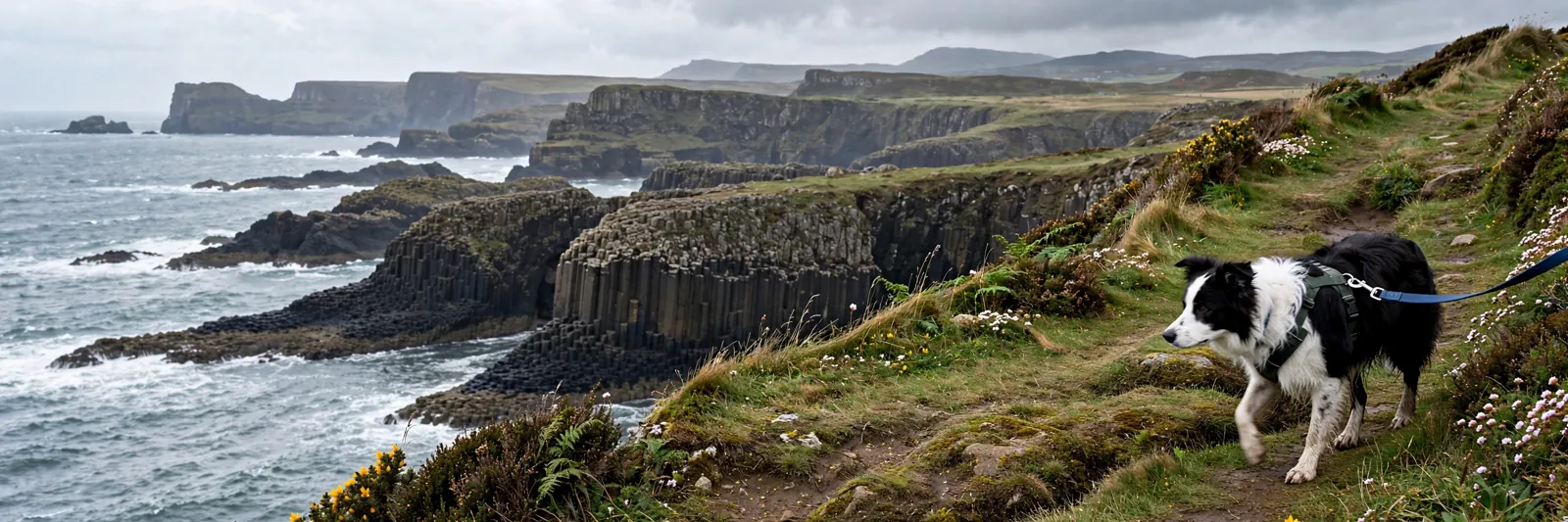
Belfast offers plenty of dog-welcoming pubs, cafes with outdoor seating and green spaces for a gentler second walk if your dog still has energy, but verify individual venues on the day because dog policies change and busy city-centre spots may only accept dogs outside or at certain hours. For wider planning, our guide to dog-friendly National Trust places explains how membership, paw ratings and local rules vary across sites, which helps if Divis is one stop on a longer Northern Ireland trip that also takes in the Causeway Coast with a dog or other Trust properties. Keep the total day honest: a full ridge walk plus hours of city pavement is too much for most dogs, however fit they seem at lunchtime. Build in a proper rest, shorten one half of the day, and remember that a dog asleep under a cafe table is enjoying Belfast exactly as much as it needs to.
If you are staying overnight, choose accommodation that solves the muddy-dog problem rather than creating it: a hard floor near the entrance, space for a crate or bed away from radiators, and a host or hotel that genuinely expects hill-walked dogs rather than merely tolerating clean ones. Ask about secure outdoor space, late check-in after a long day out, and where you can rinse paws without flooding a smart bathroom. Belfast makes a strong base for a Northern Ireland dog trip precisely because days like this — a summit in the morning, a city in the afternoon — are possible without changing beds every night.
Which dogs suit Divis — and which should wait
Fit adult dogs with sound joints, decent lead manners and no strong chase drive will usually love Divis on a kind day. The gradients are honest rather than extreme, the paths reward steady pacing, and the sniffing opportunities in heather, grass and stone walls provide mental work as well as physical exercise. Herding breeds often settle beautifully here because the walk has a clear job-like rhythm: climb, traverse, descend, rest. Gundogs and scent hounds need firmer lead management around birds and livestock scents, and their enthusiasm on the way up should not trick you into forgetting that they still have to walk down on tired legs.
Be more cautious with puppies, whose growth plates are still developing and who should not do sustained climbing or long descents; with senior dogs, who may manage the lower loops happily but struggle with cold wind at the summit; with brachycephalic breeds, whose breathing makes exposed climbs in warm weather a poor idea; and with dogs recovering from injury or surgery, who need veterinary clearance and flat, predictable ground first. Reactive dogs present a mixed picture: the open views mean you can see other dogs coming from far away, which helps, but the narrow summit and ridge sections offer few escape routes when paths converge, and a busy sunny Sunday can undo a lot of careful training. Choose a quiet weekday, go early, and treat a calm lower loop as a success rather than a failed summit attempt.
Whatever your dog's age or breed, watch the descent. Dogs tire visibly on the way down, placing extra strain on shoulders and wrists, and excitement about being nearly back can make them pull hardest exactly when the ground is steepest and your own knees are tired. Slow down, take breaks that are not only for humans, and do a final paw, pad and tick check at the car. Ticks are a feature of upland and bracken country across the UK in warmer months, so check armpits, ears, collar lines and bellies the same evening, and remove any ticks with a proper tick tool rather than improvised methods.
Practical questions
Before you go
Are dogs allowed on Divis and the Black Mountain?
Yes, dogs are welcome across most of the open Divis and Black Mountain trails, but they must stay under close control and on a short lead around livestock, near roads and car parks, and wherever signs ask for it. This is working farmland as well as protected habitat, so a lead is the default rather than the exception. Always check the latest official guidance before you travel, as grazing patterns and temporary restrictions change.
Which Divis route is best for a first visit with a dog?
For a first visit, choose a clear-weather morning and link the lower summit approach with part of the ridge trail, turning back before your dog is tired rather than completing a full circuit. That gives you the Belfast and lough views without committing to the most exposed ground. Build distance gradually on later visits, and in wind, rain or low cloud stay on lower, waymarked paths instead.
Do I need to keep my dog on a lead the whole time?
Plan to keep your dog on a lead for most of this walk. Sheep and cattle graze the hill, ground-nesting birds use the heather in season, and a dog that chases livestock can be a serious legal and welfare problem. Even a dog with excellent recall off lead at home can react differently to sheep, hares or a sudden gust carrying new scents. A short fixed lead, not a long extending line, is safest on narrow and exposed sections.
What should I do if the weather turns bad on the ridge?
Turn back early and descend by the clearest route you already know. Mist can close in quickly above Belfast, wind is stronger on the ridge than in the city below, and wet paths become slippery. Do not rely solely on a phone signal or a fading battery for navigation. If you lose the path, stop, keep your dog close, reassess with a map or compass if you carry one, and retrace your steps rather than pushing on hoping the view will clear.
Is there water for dogs on Divis and the Black Mountain?
Do not count on clean drinking water for your dog on the hill itself. Carry water for both of you from the start, plus a collapsible bowl, and offer drinks little and often, especially on the climb. Natural water on upland grazing land can be contaminated and may not be safe, and in dry weather sources can disappear entirely. Pack out everything, including dog waste, as bins are concentrated near access points.