This guide is independent and contains no paid placement. If affiliate links are added later, they will be clearly marked and will not change our editorial checks.
Stay a night. Bridgend is not a destination that shouts, and that is exactly why it works as a dog base: a main-line station, the M4, riverside walks in town, and Gower one way and Cardiff the other. Pick your base first, then run one day west, one day east, and keep the town itself for the tired hours.
Stay a night, or just pass through?
Every dog trip through South Wales asks the same question somewhere around the M4, and Bridgend is where it is usually asked. You are driving west towards Gower or east towards Cardiff, the dog is asleep in the back, and the town slides past the junction. Do you stop, or do you keep going? The honest answer depends on what the rest of your trip looks like, and it is worth deciding before you reach the junction rather than in the middle of it, with a tired dog and a full bladder to manage.
Drive straight through if your trip is really a city trip. If every night is booked in Cardiff or Swansea, if your dog is happiest with one settled base and short familiar walks, or if you are on a tight schedule with a long drive still ahead, Bridgend adds a stop you do not need. A stop only helps when it replaces something harder: a late arrival in a busy city, a long drive with no proper break, or a night in accommodation that costs twice as much for half the space. Passing through is not a failure. It is the right call when the town would only be a car park and a rushed toilet break.
Stay a night, though, if any of these sound familiar. You want Gower beaches but not Gower prices, and you would rather drive twenty to forty minutes to the sand than pay a premium to sleep beside it. You want Cardiff for a day — the parks, the bay, the riverside — without parking a car in the city centre or paying city-centre rates for a dog-friendly room. You are breaking a long journey along the M4 and your dog needs a real walk, a real meal and a quiet night, not a service station loop on a lead. Or you simply like the idea of a base that is calm after 6pm, when the day-trippers have gone home and the riverside paths belong to dog walkers again.
One night is usually enough to test the idea. It gives you an evening walk along the River Ogmore, a morning walk before the traffic builds, and a full day in one direction. Two nights is the sweet spot for most people: one day west to Gower, one day east to Cardiff, and the town itself filling the gaps. Three nights starts to make sense if you want a slow pace, a wet-weather day built in, or a second Gower beach without rushing the first. Longer than that, and you should be honest about whether Bridgend is still a base or has quietly become the holiday — which is fine too, as long as the dog has enough variety and you have not run out of walks you actually enjoy.
Think of the decision in dog terms rather than tourist terms. A good base town does three things: it lets the dog settle fast, it puts the first walk of the day within a few minutes of the front door, and it makes the drive to the big day out short enough that the dog is not already tired when you arrive. Bridgend does all three for a particular kind of trip — the split trip, half coast and half city — and that is the trip this guide is built around. If your trip is only coast or only city, a base closer to the action may serve you better. If it is both, Bridgend earns its night.
Arriving and settling in
Bridgend sits on the M4 between Cardiff and Swansea, roughly twenty miles west of Cardiff and twenty miles east of Swansea, and on the South Wales main railway line that connects the two cities. That position is the whole point of the town as a base, and it shapes how you should arrive. Drivers get the M4 junctions at either end of the town; rail passengers get a station in the town centre with regular trains in both directions. Neither route is complicated, but each has a dog detail worth sorting before you set off.
By car, plan the last part of the journey, not just the motorway. The M4 is straightforward, but the town centre has one-way streets, bus lanes and short-stay car parks that are much easier to navigate when you already know which one you are heading for. Pick your parking before you leave home: a car park near your accommodation, or a longer-stay car park if you are arriving early and checking in later. Note the payment method and the maximum stay, because a ticket that runs out mid-walk is a needless worry. If your dog travels in a crate or behind a guard, keep the car cool and shaded while you unload, and give the dog water before you start carrying bags. A dog that has just done a three-hour motorway stretch needs a toilet break and a sniff around the block before it needs anything else.
By train, Bridgend station is served by regular services west to Swansea and east to Cardiff, Newport and London, as well as local services into the valleys. Dogs travel free on most UK trains when kept on a lead or in a carrier and kept off the seats, but the practical details matter more than the fare. Check the platform and step-free access before you travel if your dog is large, older, nervous in crowds, or unhappy on stairs. Arrive with time to spare rather than sprinting across a footbridge with a pulling dog, and carry water and a chew for the wait. If you are changing trains, a longer connection at a quiet station beats a tight one at a busy interchange, especially with a dog that needs a toilet break between legs.
The first hour after arrival sets the tone for the whole stay, and the rule is to make it boring on purpose. Walk the dog first, on a short familiar loop, before you unpack anything. Find the nearest patch of grass for the evening toilet walk and the nearest bin, and walk the route once in daylight so you are not discovering it at 11pm in the rain. Let the dog sniff the hallway, the garden or the parking area, and give them their own bed or blanket in a quiet corner straight away. Food and water go down in the same place they will be all stay. Then, and only then, unpack the bags.
If you are arriving late, keep the evening even simpler. A short riverside loop, a quick meal, and an early night beat a heroic attempt to see the town in the dark. Your dog will not remember the sights you skipped, but they will remember whether the first night felt safe. The same applies to early arrivals: if your room is not ready, ask where you can leave bags, take the dog for a proper walk, and come back when the place is ready rather than waiting in a car park with a restless animal.
Choosing a base that suits your dog
The best base in Bridgend is rarely the prettiest listing. It is the one where the practical details line up with your dog, and those details are worth checking before you pay. Start with the walk out of the front door. Is there a pavement, a patch of grass or a quiet street within a minute or two, or does every toilet trip begin with a car journey or a busy road crossing? A base that needs the car for the first walk of the day is a base that will wear you down by day three, however nice the room is.
Ask about the dog rules in writing, and be specific. How many dogs are allowed, and is there a pet fee per night or per stay? Are dogs allowed in all rooms of that type or only in selected ones? Can the dog be left alone in the room, and if so for how long and under what conditions? Is there a garden, a yard or an enclosed area, and how high is the boundary? A low fence that a terrier can clear is not a secure garden, however the listing describes it. If the accommodation is a flat or a house with shared access, ask about stairs, other dogs in the building, and where the dog can be dried after a wet walk.
Location inside the town matters too. A base near the river or the town centre puts the evening walk on your doorstep, but it can also mean more traffic noise, more passers-by and more fireworks around early November. A base on a quieter residential street or on the edge of town may be calmer at night, at the cost of a longer walk to the shops or the station. Neither is right for every dog. A noise-sensitive rescue will thank you for the quiet street; a sociable spaniel that loves watching the world go by may be perfectly happy in the centre. Match the location to the dog you actually have, not the dog in the brochure photograph.
Think about the car as part of the base as well. Is parking on site, on the street, or in a public car park, and how far is it from the front door? Loading a nervous dog across a busy road at dusk is a poor end to a good day. If you are staying without a car, check the walk to the station and the nearest shops, and whether a taxi that accepts dogs is realistically available in the evening. Some towns have plenty of dog-friendly taxis in the daytime and very few after 9pm, which matters if your plans run late.
Finally, check the wet-day fallback before you need it. A base with hard floors, a boot room or a porch where a wet dog can be towelled down is worth more than a stylish carpeted lounge. Pack two towels and a drying coat even if the forecast looks kind, because South Wales weather changes fast and a wet dog in a small room is a smell that stays with you. If you are comparing a hotel, a guesthouse and a self-catering cottage, our guide to dog-friendly holiday parks in Wales covers the same booking questions — boundaries, fees, alone-time rules and drying space — in a form you can reuse for any stay, including a Bridgend base.
West: a day on Gower
The day west is the reason most people choose Bridgend as a base. Gower, the peninsula beyond Swansea, holds some of the best-known beaches in Wales — wide sands, dunes, rock pools and headland walks — and Bridgend puts you within a comfortable drive of the eastern edge of the peninsula without asking you to sleep on it. The drive to Swansea takes around half an hour in normal traffic, and the Gower beaches beyond it add another twenty to forty minutes depending on which one you pick. That is a real day out, not a quick pop, so treat it as one: leave after the morning walk, not before it, and plan to be back in Bridgend for a calm evening.
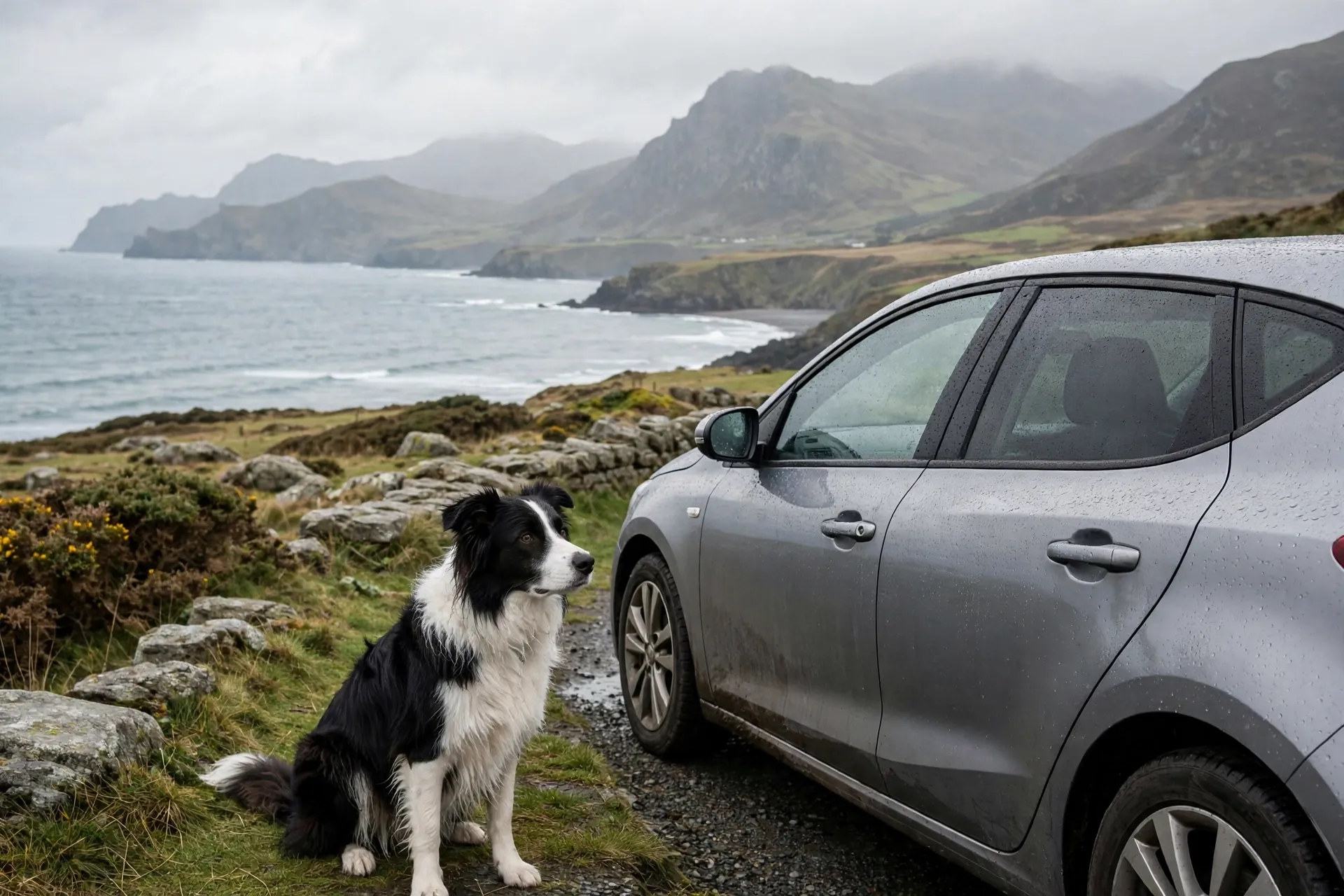
Choose one beach, not three. Gower rewards depth: a long walk on one big beach, lunch, and a slow drive home beats a frantic tour of three car parks with a dog that never gets properly off the lead. Rhossili Bay is the famous choice, a vast sweep of sand with the tidal island of Worm's Head at its far end, and it suits confident walkers and dogs that love open space — but it is also exposed, the walk down from the car park is steep, and the tides around Worm's Head are genuinely dangerous, so check the official guidance before you travel and never attempt the causeway without checking tide times. Three Cliffs Bay is quieter and wilder, reached by a walk through dunes and woodland, and better suited to dogs that enjoy a proper hike in. For a gentler day, the Swansea and Mumbles end of the peninsula offers promenades, gardens and cafes, and our guide to Swansea with a dog covers the bay, the seasonal beach rules by section, and the Gower day trips in detail.
Plan the beach day around the rules, not around the photograph. Many Gower beaches have seasonal dog restrictions on their main bathing areas in summer, and the dates and boundaries vary from beach to beach, so check the official guidance before you travel and read the signs at the entrance when you arrive. Off-season, from roughly October to April, most beaches are far more relaxed, but that is a broad pattern rather than a promise, and a local restriction can still apply. Keep the dog on a lead near car parks, cliff edges, livestock and other beach users, and only let them off where it is clearly allowed and safe. A long line is a good compromise on a busy beach: it gives a young or unreliable dog room to run without giving you a chase across a mile of sand.
Pack for the beach as if the weather will change, because on Gower it often does. Bring drinking water and a bowl — seawater is not a substitute and dogs that drink it can become ill — plus a towel, a drying coat, poo bags, a lead and a spare lead. Check the dog for sand between the toes and salt in the coat at the end of the day, and rinse paws if you can before the drive home. A car seat cover or an old blanket saves the upholstery and keeps the dog comfortable on the way back to Bridgend. If the wind picks up or the rain sets in, cut the beach walk short and head for the sheltered side of the peninsula or back towards Swansea for a cafe stop rather than pushing a wet, cold dog through another hour of exposure.
Driving back deserves the same care as driving out. A tired dog that has run on sand for two hours will sleep most of the way home, which is exactly what you want, but make sure the car is ventilated and the dog has water before you set off. Stop once on the way back if the journey is longer than an hour, even if the dog seems settled, and give them a short toilet break at a services or a lay-by with a grass verge. Arriving back in Bridgend, keep the evening short: a gentle riverside loop, dinner, and an early night. The Gower day is a big day. Let it be the only big thing that day.
East: a day in Cardiff
The day east is the other half of the Bridgend base, and it is a different kind of day altogether. Cardiff is a compact capital city, and its best dog days are green ones: the long riverside trails of Bute Park, the open spaces of Roath Park, the barrage walk at Cardiff Bay, and the cafes and pubs that welcome dogs on their terraces. From Bridgend, the train is often the better choice than the car. It takes roughly half an hour, drops you in the city centre, and spares you the search for city parking with a dog in tow. Driving is perfectly possible, but check parking charges and maximum stays before you set off, and remember that a car parked in the city all day is a car you cannot easily return to for a midday break.
Start the Cardiff day with the river, not the shops. Bute Park and the River Taff trails give a long, mostly flat walk that suits most dogs, with shade in summer and plenty of space to step aside when the path gets busy. Roath Park offers a lake, gardens and a longer loop for a second walk, and Cardiff Bay gives a wide, open waterside stroll with a very different feel. Our guide to Cardiff with a dog covers the park routes, the castle rules, the bay walk and the dog-friendly cafes in detail, and it is worth reading before you go so you can pick one route and stick to it rather than improvising in the city centre with a tired dog.
City days need a different rhythm from beach days. Keep the walking in two blocks — morning and late afternoon — with a long, calm middle section where the dog can rest. A dog that has walked for two hours, had lunch, and then been dragged around shops for another three hours is a dog that will be miserable by 4pm, and a miserable dog in a busy city is no fun for anyone. Find a dog-friendly cafe or pub early, settle in with water for the dog and a proper break for you, and let the dog sleep under the table. If your dog is nervous in crowds, avoid the busiest shopping streets at midday and stick to the parks and the bay, where there is room to move away from other people and dogs.
Check the rules before you assume anything. Cardiff Castle has its own conditions for dogs, and many indoor attractions do not admit them at all, so plan the day around outdoor spaces and dog-friendly stops rather than hoping to take the dog inside somewhere. Dogs are welcome in many cafes and pubs, but usually on the terrace or in a designated area, and it is always worth checking before you sit down. Keep the dog on a lead throughout the city, carry poo bags, and remember that city pavements in summer can get hot enough to hurt paws — if you would not walk barefoot on it, do not ask your dog to.
Coming home by train is part of the pleasure of the Cardiff day, provided you plan it. Aim for a train that is not the last one, so a delay does not become a crisis, and give the dog a toilet break and water before you board. A tired dog will usually settle quickly on a quieter evening train; a dog that is still wired from a busy day may need a chew or a calm word to settle. Back in Bridgend, the evening walk can be the shortest of the trip — a loop around the block, a drink, and bed. The city day has done its work. Let the town be quiet.
Staying in town: Bridgend itself
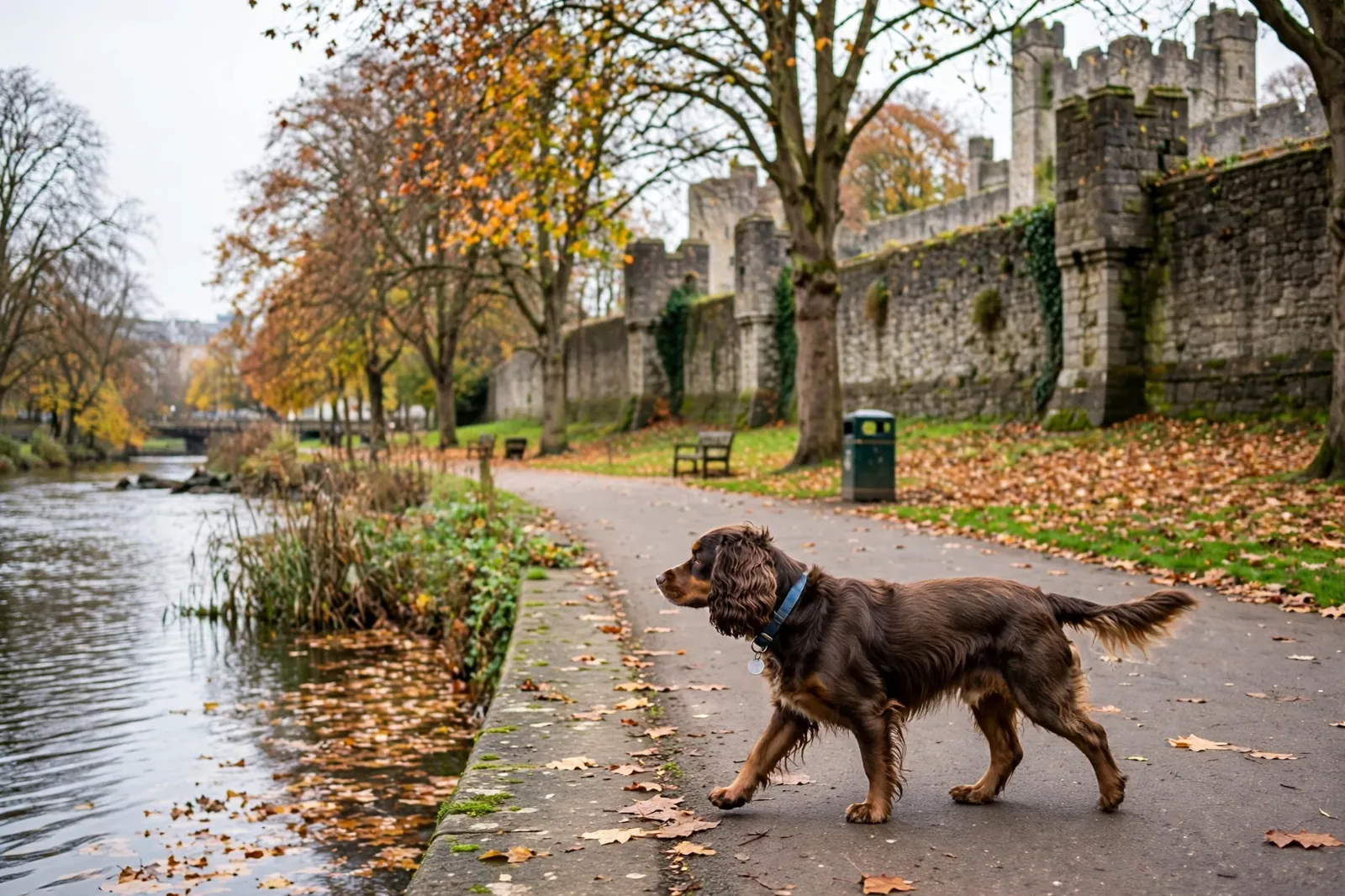
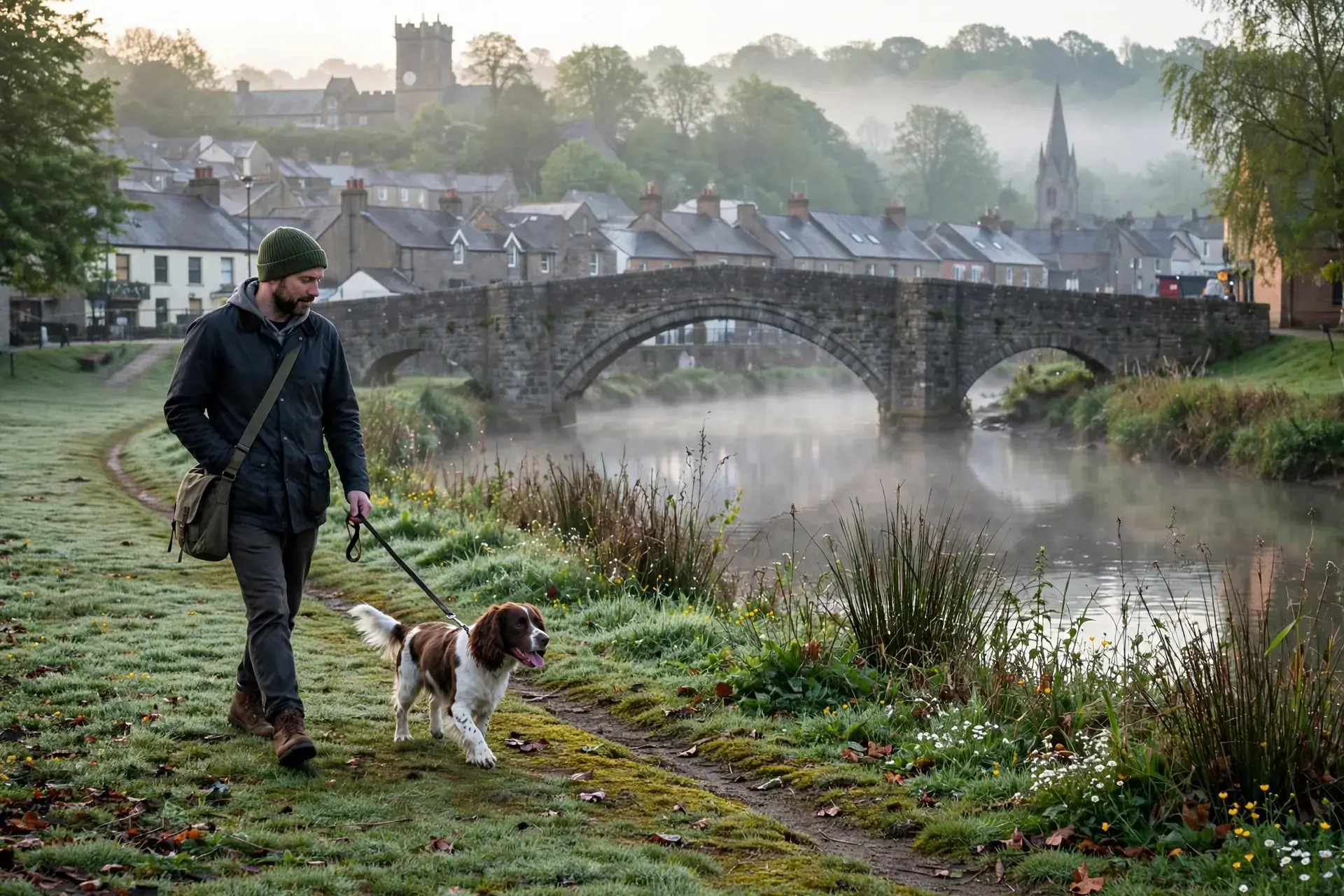
Not every day needs a big drive, and the days you stay in Bridgend are what turn a base into a break rather than a car park with a bed. The town's best dog walk is also its simplest: the River Ogmore runs through the centre, and the riverside paths around the Old Bridge give a short, level loop that works for a morning stretch, an evening wind-down, or a rainy-day walk when you do not want to drive anywhere. The Old Bridge itself is a medieval stone bridge, a reminder that this market town has been a crossing point for centuries, and the paths beside the river are at their best early in the morning, when the dog walkers are out and the town is still quiet.
For a longer town walk, head for Newbridge Fields, the parkland and playing fields beside the river, which offers open grass, trees and a longer loop without leaving the town. It is the kind of place that suits a ball, a long line and a dog that wants to run, though you should keep the dog under control near sports pitches and other users, and pick up after them. The woodland paths on the edge of town give shade in summer and shelter in light rain, and they are worth exploring on foot before you decide whether your dog prefers open grass or tree cover. Either way, the rule is the same: the first walk of the day should be easy, close and familiar, and Bridgend's riverside paths are exactly that.
The town centre itself is a practical base rather than a sightseeing stop, and that is a strength. There are supermarkets and pet shops for supplies, cafes for a mid-morning break, and a high street that is easy to walk with a dog on a lead. Keep the dog close on busy pavements, step aside for pushchairs and other dogs, and do not expect every shop to welcome dogs inside — ask before you enter, and be ready to take turns waiting outside if you are travelling as a pair. A market town rewards a slow pace: a coffee, a wander, a sit by the river, and back to base for a rest. Trying to turn Bridgend into a full day of sightseeing will disappoint you; using it as a calm hub will not.
Just outside the town, Newcastle — the old village area around the castle ruins — gives a short, characterful walk with views back over the town and the river valley. The castle itself is a ruin on a hill, and the paths around it are steep in places, so it suits a fit dog and a dry day better than a wet one or an older animal. Check the official guidance before you travel for access and any seasonal conditions. For a longer half-day without driving far, the lanes and footpaths south towards the coast offer a gentle introduction to the Vale of Glamorgan countryside, but keep dogs on a lead near livestock and on narrow lanes with no pavement, and carry a map or a charged phone, because rural footpaths are not always well signed.
The point of the in-town day is recovery. After a Gower beach day or a Cardiff city day, your dog needs a day with less driving, less novelty and more rest, and Bridgend is good at providing it. A riverside walk in the morning, a long sleep in the afternoon, a second short walk in the evening, and a quiet night is a proper holiday for most dogs, even if it does not look like much on a map. Build at least one such day into any stay of three nights or more, and do not feel guilty about it. The dog will thank you by being cheerful on the next big day out, which is worth far more than another attraction ticked off a list.
Beaches near Bridgend
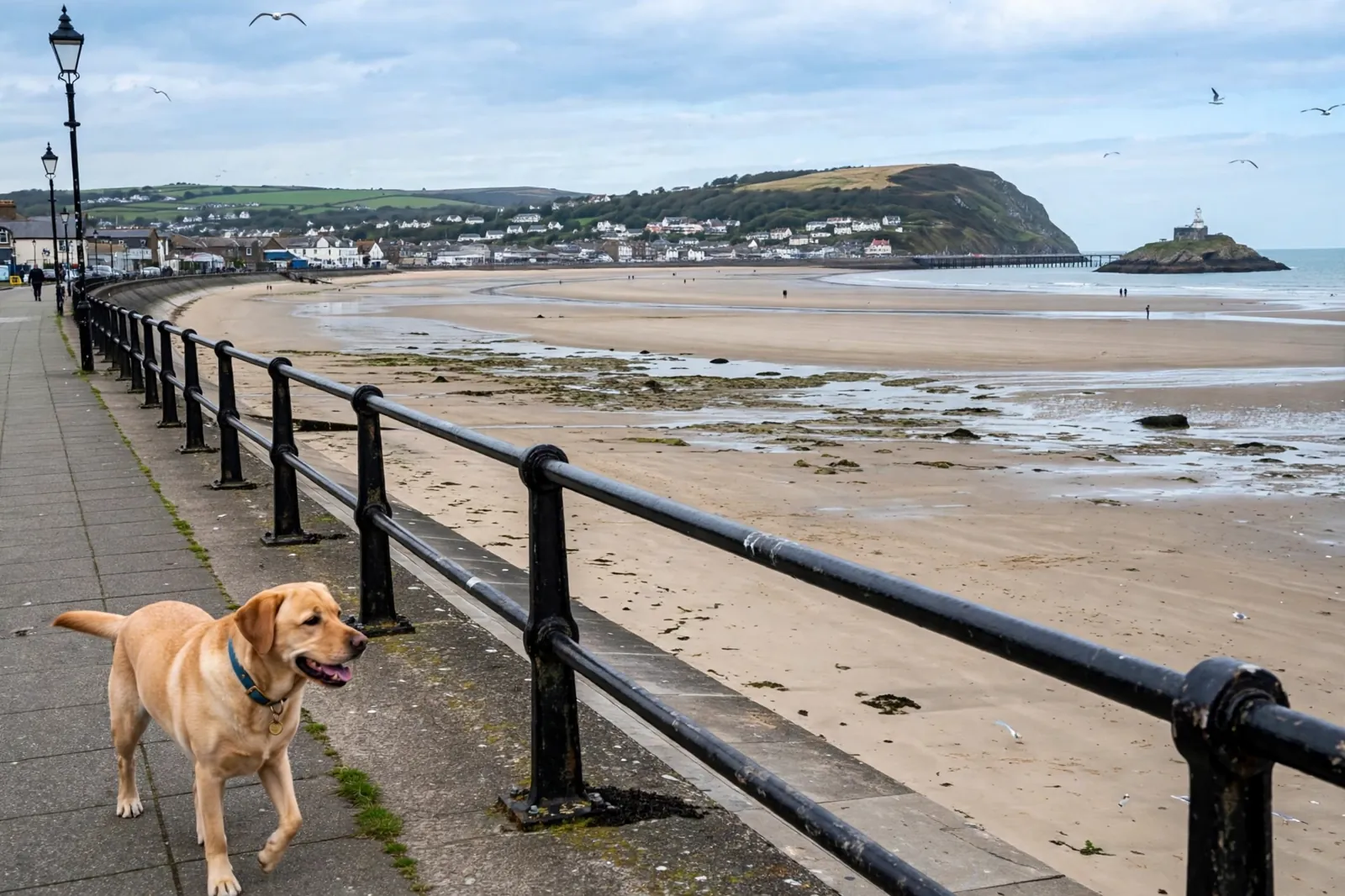
You do not need to drive to Gower for sand. The coast south of Bridgend holds several beaches that are close enough for a half-day trip, and they are one of the best reasons to base yourself here rather than further inland. Porthcawl, about seven miles south, is the nearest seaside town, with a harbour, a promenade and several beaches in a small area. Rest Bay, at the western end of Porthcawl, is the best known for dog walkers, with a wide sweep of sand and dunes behind it, while the town beaches closer to the harbour have their own character and their own rules. Ogmore-by-Sea, a few miles west of Porthcawl, offers a quieter, more rugged stretch of coast with rock pools and a river mouth, and Southerndown, further west still, is a dramatic, cliff-backed beach that suits a proper walk rather than a quick paddle.
Seasonal restrictions are the detail that catches people out, so treat them as the first thing to check, not an afterthought. Many beaches in this area restrict dogs on their main bathing areas during the summer months, typically from around May to September, while other stretches of the same beach stay open to dogs all year. The boundaries are marked on signs at the beach entrances, and they can change from year to year, so check the official guidance before you travel and read the signs when you arrive. Off-season, most of these beaches are far more relaxed, which is one reason autumn and spring are such good times to base yourself in Bridgend. A November beach with a dog running free on an empty sweep of sand is a very different experience from the same beach in August, and for many dogs it is a better one.
Each beach has its own character and its own hazards. Rest Bay is exposed to the Atlantic swell and popular with surfers, so keep dogs on a lead near the water's edge if they are inclined to chase waves, and watch for strong currents and rip tides. Ogmore-by-Sea has a river mouth and rock pools that are wonderful for sniffing and exploring, but the rocks are slippery and the tide comes in fast, so check tide times before you travel and never let the dog wander out of sight around the headland. Southerndown is beautiful and wild, with a steep walk down to the sand, and it suits a fit dog on a dry day; after heavy rain the paths can be muddy and the beach can be cut off by the tide. Merthyr Mawr, just inland from Ogmore, holds one of the largest sand dune systems in Europe, and the dunes are a superb walk for a dog that loves to run — but keep dogs under control near the dune paths, carry water, and be aware that the dunes are hot in summer and exposed in winter.
Pack for a local beach day in the same way as a Gower day, just with a shorter drive. Water and a bowl, a towel, poo bags, a lead and a spare lead, and something to shade the dog in the car on the way home. Check the dog for sand, salt and any cuts from shells or rocks when you get back, and rinse paws if the sand is gritty. If you are visiting in summer, go early or late in the day, when the sand is cooler and the beach is quieter, and remember that dogs can overheat quickly on a hot beach — shade, water and rest are not optional extras. If the beach you wanted is restricted or too busy, the next one along the coast is rarely more than fifteen minutes away, and a flexible plan beats a fixed one every time.
Eating out with your dog
Eating out with a dog in a market town is usually easier than in a big city, and Bridgend is no exception — but it still rewards a little planning. Many cafes and pubs welcome dogs, most often on a terrace, in a garden, or in a designated area inside, and the pattern varies from place to place. Check before you sit down, either by looking for a sign, asking at the door, or checking the venue's own information before you travel. A place that welcomed dogs last year may have changed its policy, and a place that welcomes dogs on a quiet weekday may be too full to manage them on a busy Saturday.
Choose your spot with the dog in mind. A table at the edge of a terrace, away from the main walkway, gives a nervous dog room to settle and a sociable dog fewer people to greet. A table near the door is useful if the dog needs a quick toilet break mid-meal. Bring a blanket or a mat for the dog to lie on, and water if the venue does not provide it — a dog that has somewhere comfortable to settle is a dog that will let you eat in peace. Order food that is easy to manage with one hand on a lead, and keep the dog's lead short enough that it cannot reach other tables or trip a passing member of staff.
Think about timing as well as location. A late lunch after the beach, when the dog is tired and ready to sleep, is usually a calmer meal than a busy Saturday brunch with a wired dog that has not yet been walked. If you are eating in Porthcawl or on the Gower coast after a beach walk, look for places with outdoor seating and a view of the car park or the beach, so the dog can dry off and settle in the open air. In Cardiff, the dog-friendly cafes tend to cluster around the parks and the bay, which makes it easy to combine a walk with a meal — but the same rule applies: walk first, eat second, and let the dog rest while you do.
If your dog cannot settle in a cafe, do not force it. Some dogs are simply happier with a takeaway eaten on a bench by the river or on a beach, and there is no shame in that. Bridgend's riverside paths and Porthcawl's promenade both have benches where a takeaway lunch tastes perfectly good, and the dog can watch the world go by without the pressure of a busy room. The goal is a calm meal for everyone, not a test of the dog's patience. And if you are staying in self-catering accommodation, remember that a cooked meal at base, with the dog asleep on their own bed, is often the most relaxing option of all after a long day out.
A calm two-day plan
A plan is useful only if it survives contact with a real dog, so here is a two-day version built around rest as much as sightseeing. It assumes you arrive the evening before, and it keeps each day to one big outing with a quiet base at either end. Adjust the order to suit the weather: put the beach day on the better day and the city day on the cloudier one, and do not be afraid to swap them at the last minute.
Day one goes west. Start with a short riverside loop in Bridgend, then drive to the coast — Porthcawl and Rest Bay for a half-day, or on to Gower for a full day if the dog is fit and the weather is kind. Walk the beach, have lunch, and drive back to Bridgend in the afternoon. Keep the evening short: a gentle loop by the river, dinner, and an early night. The dog will be tired from sand and sea air, and that tiredness is the point. Do not add a second outing, a late meal or a long drive. Let the beach day be the day.
Day two goes east. Take the train to Cardiff after a morning walk in Bridgend, spend the late morning in Bute Park and along the River Taff, have a long lunch at a dog-friendly cafe, and take a second, shorter walk at the bay or in Roath Park in the afternoon. Catch a train home that is not the last one, and finish with the shortest evening walk of the trip. If the dog is tired from day one, shorten the Cardiff day without guilt — an hour in Bute Park and a cafe lunch is still a good day out, and a dog that is allowed to rest is a dog that will enjoy the next trip.
If you have a third day, stay in Bridgend. Walk the river in the morning, explore Newbridge Fields or the lanes towards the coast in the afternoon, and eat at base or at a quiet local pub in the evening. This is the day that turns two busy days into a holiday, and it is the day most people skip and later regret skipping. A third day also gives you a buffer for bad weather: if day one or day two is rained off, you can move the beach or the city to day three instead of losing it altogether. Build the buffer in from the start, and the whole trip feels calmer.
Practical details: vets, weather and packing
Before you travel, save the details you hope never to need. Find the nearest veterinary practice to your Bridgend base and save its number and opening hours, and note the nearest out-of-hours or emergency vet as well, because rural and coastal practices can be some distance away and may close early. Carry your dog's vaccination record and any medication, and keep a note of any allergies or conditions on your phone. If your dog is on regular medication, pack a day's extra supply in case your return is delayed. None of this is dramatic; it is simply the difference between a small problem and a crisis.
South Wales weather deserves respect, and Bridgend sits where coastal weather meets inland weather, which means it can change quickly. A sunny morning in town can turn into a windy afternoon on the coast, and a dry forecast can still produce a sharp shower over the dunes. Check the forecast the night before and again in the morning, and pack a waterproof for yourself and a drying coat for the dog even when the forecast looks kind. In summer, watch for heat: do not leave a dog in a parked car, even for a few minutes, and check pavement and sand temperatures before a long walk. In winter, watch for mud, wind and short daylight — a beach walk that is delightful at noon can be a cold, dark slog by 4pm, so plan your return time before you set out.
Packing for a base-town break is a matter of one good bag rather than three. The essentials are a short lead and a long lead, poo bags, a towel and a drying coat, drinking water and a bowl, the dog's usual food measured for the trip plus a little extra, any medication, a blanket or bed, and a chew or a toy that helps the dog settle in a new place. Add a torch for evening walks in winter, a car seat cover or an old blanket for sandy returns, and a basic first-aid kit with tick remover and saline for rinsing paws. If your dog wears a coat, bring it; if they do not, do not buy one for this trip. The dog that is comfortable at home is the dog that will be comfortable in Bridgend.
Finally, remember the small courtesies that keep a base town welcoming to dogs. Pick up after your dog everywhere, including on beaches and in dunes, and use the bins provided. Keep dogs on a lead near livestock, on narrow lanes, in car parks and around other dogs unless you are sure of a friendly greeting. Respect seasonal beach restrictions and the signs at each beach entrance, and check the official guidance before you travel for any rule that might have changed. A market town that welcomes dogs is a market town that has learned to trust dog owners, and that trust is earned one picked-up bag and one short lead at a time.
Practical questions
Before you go
Is Bridgend worth staying in with a dog, or should we just drive through?
Stay at least one night if Gower or the Vale of Glamorgan coast is on your list. Bridgend sits between Cardiff and Swansea on the main rail line and the M4, so it works as a cheaper, calmer base than either city, with riverside walks in town and beaches at Porthcawl and Ogmore-by-Sea a short drive away. Drive straight through only if your whole trip is in Cardiff or Swansea itself.
Can I get to Gower beaches from Bridgend without a car?
It is awkward without a car. Trains run from Bridgend to Swansea, and buses then serve Mumbles and parts of Gower, but services to the more remote beaches are infrequent and timetables change seasonally, so check the official guidance before you travel. With a car, the drive to the Gower edge takes roughly half an hour in normal traffic.
Are dogs allowed on the beaches near Bridgend?
It depends on the beach and the season. Several beaches near Bridgend, including parts of Porthcawl and Ogmore-by-Sea, have seasonal dog restrictions on their main bathing areas in summer, while other stretches stay open to dogs all year. Always read the signs at the beach entrance and check the official guidance before you travel, because boundaries and dates can change.
Where can I walk my dog in Bridgend town itself?
The River Ogmore runs through the town, and the riverside paths around the Old Bridge and the town centre give a short, level loop that suits a morning or evening walk. For a longer outing, head to the woodland and parkland at Newbridge Fields, or drive a few minutes to the coast at Ogmore-by-Sea or the dunes at Merthyr Mawr. Keep dogs on a lead near roads, livestock and busy paths.
Is Bridgend station easy with a dog?
Bridgend station is on the South Wales main line, with regular trains west to Swansea and east to Cardiff, Newport and beyond. Dogs travel free on most UK trains when kept on a lead or in a carrier and kept off seats. Check step-free access and platform arrangements before you travel if your dog is large, nervous or struggles with stairs.
What should I pack for a Bridgend base-town break with a dog?
Pack for coast, river and town in one bag: a long lead, a short lead, poo bags, a towel and a drying coat for wet sand and river mud, drinking water and a bowl, and a blanket or bed so the dog settles in accommodation. South Wales weather changes fast, so add a waterproof for yourself and check the official guidance before you travel for any beach or attraction rules.