This guide is independent and contains no paid placement. If affiliate links are added later, they will be clearly marked and will not change our editorial checks.
Book in writing, name the breed plainly, and plan the day around short bursts of hard play, rest, and calm introductions. A Bull Terrier rarely fails a holiday through lack of energy; the trip fails when a host, a crowded beach, or an over-long walk was never checked in advance.
First, deal with the misreading
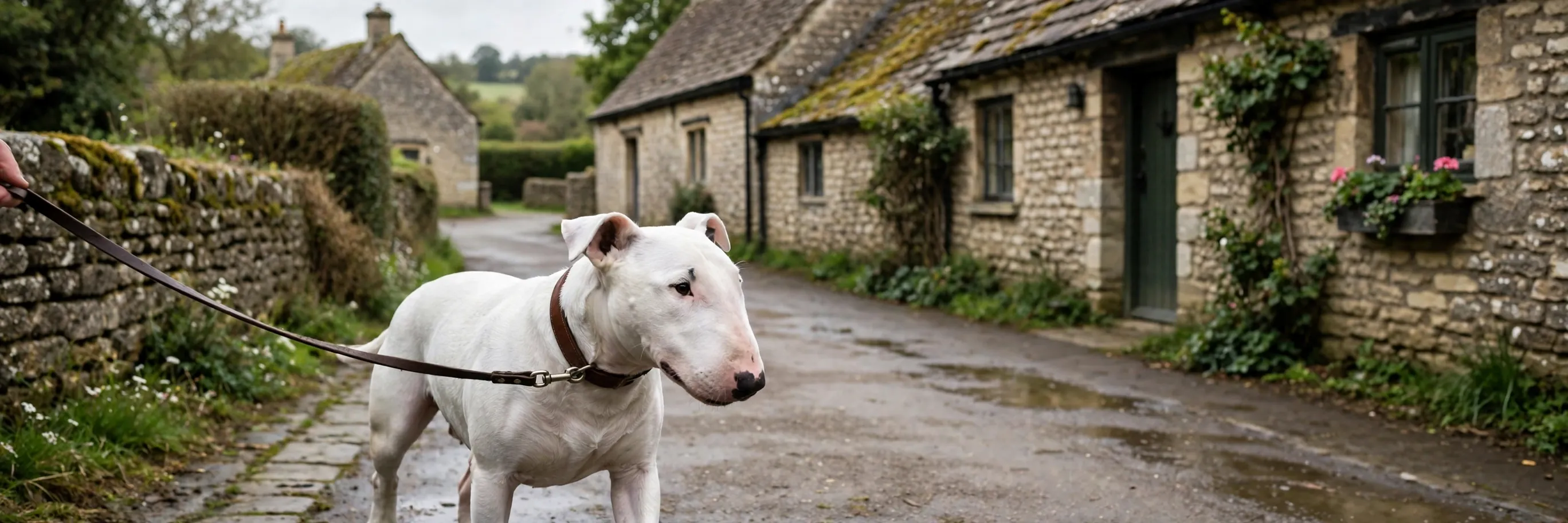
The single most useful thing to understand before travelling with a Bull Terrier is that many strangers will not see the dog you live with. They will see a shape: a broad, egg-shaped head, a deep chest, a muscular neck, and a name that sounds, to an untrained ear, like a banned type. That first impression can decide whether a cottage host replies warmly, whether a pub landlord waves you to the far corner, and whether another walker tightens their grip on their own lead long before your dog has done anything at all. None of this is fair to the individual dog, and none of it is solved by arguing about fairness at the gate. It is solved by preparation, by plain language, and by choosing places that have already said yes in writing.
Start with the legal picture, and keep it separate from the social picture. A Bull Terrier is a distinct, recognised breed. It is not itself one of the dog types listed under the Dangerous Dogs Act 1991, and the types that are listed are described in specific legal terms that do not simply mean any strong, short-coated dog. That said, identification arguments in real life are rarely settled by quoting a breed standard at a reception desk, and the consequences of a misunderstanding can be serious. If there is any chance that a venue, a council officer, or another member of the public could question identification, check the official guidance before you travel, carry the paperwork described later in this guide, and do not rely on a single web page or a forum post as your authority. The law also covers any dog that is dangerously out of control, whatever its breed, so a well-managed Bull Terrier is not only a pleasanter companion but also the legally safer one.
The social picture needs a different toolkit. When you first contact a host, say the breed name in the first message, not in a footnote after the deposit. A message that reads "one adult Bull Terrier, neutered, house-trained, travels with a crate, happy on a lead around other dogs, no history of biting" gives a host something concrete to say yes to. A message that says only "one medium dog" and leaves the reveal for arrival day gives the same host a reason to feel misled, even if the dog behaves perfectly. Photographs help for the same reason: a clear, ordinary photograph of the dog lying on a rug, walking on a lead, or waiting calmly at a cafe table does more work than any adjective. Owners who send a photograph and a short, honest behaviour note usually find that the hosts who reply are the hosts who genuinely do not mind, and that filter is worth more than any number of tentative maybes.
Think about the words other people use, because you will hear them on holiday. Some people will call any Bull Terrier a "pit bull", some will ask whether the dog is dangerous, and some children will simply stare. A short, rehearsed answer keeps these moments small: the breed name, a calm statement that the dog is friendly but strong and therefore stays on a lead in busy places, and a change of subject back to the walk. There is no obligation to deliver a lecture on breed history in a pub garden, and a long defence often makes a nervous stranger more nervous, not less. The dog's behaviour in the next thirty seconds matters more than the speech: a dog that sits, waits, and watches its owner while a stranger passes is a better argument than any pedigree paper.
One more distinction matters, and it is worth getting right before you travel. The Bull Terrier described here is the standard-sized breed, not the smaller Miniature Bull Terrier, and not the Staffordshire Bull Terrier, which is a different breed with its own shape and history. Hosts, insurers, and vets sometimes blur these names in their forms, so check which name is written on your booking, your insurance policy, and your vet record, and correct it where it is wrong. A form that says "Bull Terrier cross" when the dog is a pedigree Bull Terrier, or that says "Staffordshire" when the dog is not one, can cause exactly the kind of confusion at check-in that this guide is trying to avoid. If your dog is a cross, say so plainly and describe the dog's size, coat, and behaviour rather than guessing at a label that sounds more acceptable.
Plan play bursts, not long marches
A Bull Terrier's engine does not run like a spaniel's or a collie's. Many Bull Terriers explode into play, race in tight circles, spin, bounce, and wrestle with a toy as if the game were the whole point of the day, and then flop flat, snoring, twenty minutes later. That rhythm is a gift on holiday if the day is built around it, and a problem if the day is built around a single six-mile walk with no outlet for the explosion. The dog that has spent its energy in a good game is the dog that settles in a cottage in the afternoon; the dog that has only walked steadily on a lead for three hours, without ever being allowed to play properly, is the dog that starts bouncing off the furniture at tea time.
A practical holiday day therefore has a shape with peaks and troughs. Start with a morning toilet walk and a short sniffing circuit, then give the dog a real play session in a safe, enclosed space: a secure garden, an enclosed field hired by the hour, or a quiet stretch of beach where the dog can sprint, tug, and retrieve without meeting a stream of strangers. Follow that with breakfast, a rest, and a calmer midday outing, such as a village walk or a slow wander around a garden centre, where the dog practises being calm in public rather than burning energy. In the afternoon, repeat the pattern on a smaller scale: another play burst, another rest, and an evening walk that ends with a toilet stop and a wind-down at the cottage. Two or three genuine play sessions beat one heroic hike, and they leave the dog tired in the right way, which is to say sleepy rather than wired.
Watch the dog, not the clock, during play. Bull Terriers are famously determined and famously bad at telling their owners when they have had enough, which means overheating, a pulled muscle, or sore paws can arrive without much warning. On warm days, play in shade, offer water often, and stop while the dog still wants more; that is the moment to stop, not the moment to add one more throw. On rough ground, check paws after play, because a dog that charges across shingle, gravel, or broken stone will not always limp immediately. In water, remember that a muscular, deep-chested dog is not automatically a natural swimmer, and a life jacket is a sensible purchase for a dog that loves to launch itself into a river without checking the depth or the current first.
Toys deserve a paragraph of their own, because a Bull Terrier's play is physical in a way that surprises people used to softer-mouthed breeds. Tug toys, sturdy rubber toys, and flirt poles all work well, but they work best as owner-led games with clear starts and stops, rather than as toys left lying around for the dog to destroy unsupervised. Teach, or refresh before the holiday, a reliable trade: the dog drops the toy in exchange for a treat or another toy, and the game restarts. That single skill keeps tug games safe, keeps walks pleasant when the dog picks up a stick or a piece of rubbish, and gives you a way to end a game without a wrestling match. Bring spares, because a favourite toy left on a beach is a small tragedy, and a holiday cottage is a poor place to discover that the only tug toy has been chewed through on the first morning.
Finally, do not mistake a Bull Terrier's clowning for a need for constant entertainment. Spinning, chasing its own tail, zooming around a garden, and offering a toy with enormous ceremony are all normal Bull Terrier behaviours, and they are fun to watch, but a dog that is spinning for minutes at a time, fixating on shadows, or unable to settle at all may be over-tired, over-stimulated, or simply in need of a boring hour in a crate with a chew. Holidays are stimulating by nature: new smells, new rooms, new people, and new routines all stack up. Protect the rest periods as carefully as the play periods, keep feeding and sleeping times close to the home routine, and the clown will still be there in the morning, ready for the next burst.
Work with the stubborn streak
Every Bull Terrier owner knows the look: the dog hears the recall, understands the recall perfectly well, and decides, after a visible moment of thought, that the interesting smell, the other dog, or the muddy puddle is a better idea. This is often called stubbornness, and on holiday it can feel like a training failure. It is more useful to think of it as a breed trait with a logic of its own. Bull Terriers were developed to be tenacious, to keep going when a task got difficult, and to make their own decisions in the moment. That tenacity is the same quality that makes them comically determined to carry a stick through a narrow gate, and it is also the quality that makes a battle of wills over a recall a battle you will usually lose if you fight it head-on.
The holiday solution is to stop fighting head-on and to design training around short, rewarding exchanges. Keep sessions to two or three minutes, several times a day, rather than one long drilling session that bores both of you. Reward generously and variably: a piece of chicken for a recall on a quiet lane, a game of tug for a recall away from a distraction, and a simple "good" and a pat for an easy recall at home base. Practise the skills that holiday life actually needs, in the places where they will be needed: waiting at a cottage gate before going out, walking past a cafe table without investigating every plate, settling on a mat while the owner orders food, and walking on a loose lead past a barking dog behind a fence. A recall practised only in a garden is a garden recall; a recall practised on a quiet lane, then a busier lane, then a beach car park, is a holiday recall.
Lead handling matters more than lead length for this breed. A strong dog that has learned to pull towards everything interesting will pull its owner into a ditch, a road, or another dog's space on holiday, and no amount of good intentions fixes that on the first day of the trip. A well-fitted harness with a front attachment, a double-ended lead, or a head collar introduced gradually at home can all help, but the equipment is secondary to the habit: reward the dog for checking in, for walking beside you, and for turning away from a distraction before the lead goes tight. If the dog does lunge, the calmest response is to move away, create distance, and try again from further back, rather than holding a contest of strength in the middle of the path. Distance is your friend on holiday; it is always easier to succeed from twenty metres away than to fail from two.
There is also a gentler side to the stubborn streak that owners sometimes miss. A Bull Terrier that plants its feet and refuses to walk any further is not always being defiant. The dog may be tired, hot, sore, frightened by something the owner has not noticed, or simply overwhelmed by a new environment. Before assuming disobedience, check the basics: paws, temperature, water, and the surroundings. A dog that refuses to enter a particular cottage room may have slipped on its floor before; a dog that refuses to walk down a particular lane may have been startled there the day before. Patience, a treat trail, a different route, or simply a rest usually solve the problem faster than pressure, and they preserve the trust that makes the rest of the holiday work.
Children and other family members need the same briefing, because a Bull Terrier will quickly learn which person enforces the rules and which person can be charmed out of them. Agree before the trip who gives the recall cue, what the release word is, whether the dog is allowed on furniture in the cottage, and who is responsible for the dog at meal times. A dog that is told "off" by one person and "oh, go on then" by another is not being naughty; it is being given contradictory information by the people it trusts most. Consistency across the family is not strictness for its own sake. It is the kindness of making the holiday rules predictable, so that the dog can relax into them instead of testing them all week.
Ears, skin and the white coat
If there is one part of Bull Terrier care that repays attention on holiday, it is the ears and the skin, and the reason is written into the breed's shape. Those upright, pointed ears are open to wind, water, seeds, and mud in a way that floppy ears are not, and they show dirt and irritation quickly. A daily check takes less than a minute: lift each ear, look for redness, swelling, a strong smell, or dark discharge, and wipe the outer ear gently with a soft cloth or a vet-approved cleaner if the dog has been swimming or rolling in mud. Do not push cotton buds deep into the ear canal, and do not start a new ear product on holiday unless your vet has already approved it, because an irritated ear on day two of a cottage stay is a poor time to discover a sensitivity.
Deafness deserves an honest mention, because it affects this breed more than most. White-coated Bull Terriers in particular have a higher reported risk of congenital deafness, in one or both ears, and a deaf or partially deaf dog on holiday needs a different plan: a long line rather than off-lead freedom in open country, a vibrating collar only if the dog has been trained with one at home and the owner understands its use, and visual cues such as a hand signal for recall and a torch flash at night. If you have never had your dog's hearing tested, ask your vet about it before a big trip, and check the official guidance before you travel if you are unsure how deafness affects insurance or local rules. A dog that cannot hear a recall, a car, or another dog's warning growl is not a badly behaved dog; it is a dog that needs its owner to manage distance and visibility more carefully.
Skin is the other holiday watchpoint. Bull Terriers are prone to skin allergies and irritations, and a change of environment can trigger them: new grass pollens, a different laundry detergent on cottage bedding, a flea bite in long grass, or a long swim in a river that leaves the coat damp for hours. Pack any prescribed treatment, plus a note of the dose and the vet's phone number, and keep the dog's own bedding and blanket for the cottage bed rather than relying on whatever the host provides. After swimming, rinse the dog with clean water where possible and dry the coat thoroughly, paying attention to the groin, the armpits, and any skin folds, because damp skin in warm weather is where irritation starts. If redness, itching, or a rash appears, photograph it, note when it started, and call your vet or a local vet early rather than waiting to see whether it settles on its own.
The white coat brings a specific seasonal problem: sunburn. A white or largely white Bull Terrier has pink skin on the ears, the nose, and the belly, and those areas can burn on a bright summer day, especially on a beach where reflected light doubles the exposure. Keep the dog in shade during the middle of the day, use a vet-approved sunscreen on the ears and nose if your vet recommends one, and never use a human sunscreen without checking, because some human products contain ingredients that are harmful if licked. A light, breathable sun shirt can help for a dog that loves to lie in the sun, although many Bull Terriers will treat a shirt as a new game and try to remove it, so introduce it at home first. On the other side of the year, the same short, single coat offers little insulation, so a warm, waterproof coat is not a fashion accessory for a Bull Terrier in a cold wind; it is the difference between a dog that enjoys a winter walk and a dog that shivers through one.
Feet, nails, and teeth complete the daily check, and they are worth building into the evening routine at the cottage. Check between the toes for grass seeds, mud, and small cuts, especially after walks through long grass or cornfields, because a grass seed working its way into a paw can become a vet visit within days. Keep nails trimmed before the trip, since long nails change the way a strong dog moves and can catch on cottage rugs and decking. Dental care is easy to forget on holiday, but a sturdy chew or a daily dental stick, given under supervision, keeps the mouth busy in the evening when the dog might otherwise be looking for something else to chew. None of this is glamorous, and all of it is the difference between a holiday that runs smoothly and a holiday interrupted by a vet appointment in an unfamiliar town.
The mouth, the jaw and the kit
A Bull Terrier's jaw is a piece of engineering, and holiday kit needs to be chosen with that in mind. Leads, harnesses, crates, and toys that survive a softer breed may not survive a Bull Terrier that decides to test them, and a failure at the wrong moment, such as a lead clip opening on a busy road, is not a minor inconvenience. Before the trip, inspect every clip, stitch, and buckle, replace anything frayed, and choose a lead with a robust, locking clip and a harness with strong, well-stitched attachment points. A second lead in the car boot costs little and saves the holiday if the first one is chewed through during a moment of boredom at a service station.
Chewing is not a behaviour problem to be cured on holiday; it is a normal Bull Terrier activity that needs a safe outlet. Bring sturdy chews that are sized for a strong jaw, supervise chewing, and remove a chew once it starts to break into small pieces. At the cottage, give the dog its own chews and toys from the start, and move the host's tempting items out of reach: remote controls, shoes by the door, children's toys left on the floor, and anything made of soft plastic. If the dog does chew something it should not have, stay calm, trade for something better, and move on; a dramatic reaction teaches the dog that chewing forbidden objects gets a lot of attention, which is the opposite of the lesson intended.
The crate deserves a defence, because it is sometimes misunderstood as a punishment. For a Bull Terrier, a crate that has been introduced positively at home is a familiar den on holiday: a safe place to rest, a way to keep the dog secure when the cottage door is open for luggage, and a practical answer to the host who asks whether the dog can be left alone for an hour. Bring the dog's own crate, or a sturdy travel crate, with its usual blanket and a safe chew, and set it up in the cottage in the same way as at home. A dog that sleeps in a crate at home and is suddenly expected to sleep loose in a strange room will often patrol, worry, and bark; a dog that has its den will usually settle faster, which is better for the dog, the neighbours, and the holiday.
Muzzles also deserve a calm, practical mention. A muzzle is not an admission that a dog is dangerous, and for a Bull Terrier it can be a genuinely useful holiday tool: for a vet visit in a strange town, for a crowded market where the dog is over-excited, or for a dog that scavenges everything on a beach walk. A basket muzzle that allows panting and drinking, introduced gradually at home with treats and short, happy sessions, is a kindness, not a punishment. A muzzle introduced for the first time on holiday, in a stressful situation, will feel like one. If there is any chance you might need one, train it before the trip, pack it, and treat it as normal kit, like a lead or a coat.
Finally, think about the car boot as part of the kit. A Bull Terrier that travels well is usually a Bull Terrier that has a secure, comfortable space: a crash-tested crate or a harness attached to a seatbelt point, a non-slip mat, water for rest stops, and a barrier or guard if the dog travels in the boot of an estate car. Loose dogs in cars are a safety risk for everyone, and a dog that can climb into the driver's footwell at a roundabout is a holiday-ending risk. Practise the car routine at home, including getting in and out calmly, waiting before jumping out, and settling for the duration of the journey, so that the first long drive of the holiday is not also the first time the dog has ever been asked to settle in the car.
Meeting other dogs without drama
Bull Terriers and other dogs have a complicated relationship, and honesty about it makes holidays easier. Many Bull Terriers love other dogs, play with enormous enthusiasm, and make loyal friends. Many are also selective, preferring a small number of known dogs to a crowd of strangers, and some show tension around dogs of the same sex, around intact males, or around dogs that rush in face-first. None of this makes a dog a bad dog, but it does mean that the classic holiday scene, a free-for-all dog beach or a crowded pub garden full of off-lead dogs, is not automatically a good idea for every Bull Terrier. The plan should be built around the individual dog's history, not around the idea that all dogs should love all other dogs.
On-lead greetings are the safest default on holiday, and they have a technique worth practising. Approach on a wide arc rather than head-on, keep the lead loose, watch both dogs' body language, and allow a brief sniff of three to five seconds before calling the dog away with a treat and moving on. A greeting that goes on until one dog stiffens, stares, or starts mounting is a greeting that has gone on too long. If either dog shows hard staring, raised hackles, a high stiff tail, or a sudden freeze, create distance calmly and do not force the interaction to a friendly conclusion. A short, boring greeting that ends well is worth far more than a long, exciting greeting that ends in a scuffle, and other owners will usually be grateful for the brevity once they see how calmly it was handled.
Off-lead play needs even more care, and the best holiday choice is often an enclosed field with one or two known dogs, rather than a public dog park full of strangers. In an enclosed field, the owner controls who comes in, how long play lasts, and when to call a break. Watch for the signs that Bull Terrier play is tipping from fun into over-arousal: play that gets faster and louder rather than settling, body slams that stop being reciprocal, one dog that cannot disengage, or a dog that starts to guard a toy, a stick, or a patch of ground. Call a break before that point, give both dogs water and a few minutes apart, and restart only if both dogs re-engage calmly. Ending play while it is still going well is not spoiling the fun; it is the skill that lets the same dogs play happily again tomorrow. For a fuller approach to quiet, low-pressure holidays, see our guide to reactive dog holidays in the UK, which covers enclosed gardens, off-peak timing, and crowd-free routes in detail.
Beaches, in particular, need a Bull Terrier-specific reading. A beach that looks ideal on a map, wide, sandy, and dog-friendly, can become difficult when it is full of off-lead dogs racing in every direction, children with buckets and spades, and picnics at dog height. Visit at quiet times, choose the quieter end of the beach, keep the dog on a long line until you have read the scene, and have a clear recall or a long-line plan for the moment another dog races over. If your dog is selective, a beach walk on a lead, with a swim at the quiet end and a game in an empty stretch, is a better holiday memory than a beach free-for-all that ends with an argument. Our guide to dog-friendly beaches in the UK explains seasonal bans, fines, and how to check a beach before you go.
What happens after a scuffle matters as much as preventing one. If two dogs do clash, the priority is to separate them safely, check both dogs for injuries, including small punctures hidden in thick neck skin, and exchange details calmly with the other owner. Photograph any injuries, note the time and place, and seek vet advice promptly, because puncture wounds can look minor on the surface and become infected underneath. Do not let embarrassment turn into a decision to walk away without checking the other dog, and do not let one bad incident rewrite the whole holiday: return to quiet walks, rebuild confidence with known dogs in controlled settings, and keep the next few days calm. For the legal side of incidents, including what the law means by a dog being dangerously out of control, see our guide to dog bite law in the UK.
Ask hosts the question that matters
The question that matters is not "are you dog-friendly?" It is "are you happy with a Bull Terrier, specifically, in this property, on these dates, with these arrangements?" The first question gets a yes that may not survive the breed name. The second question gets a real answer, and a real answer, even when it is no, is more useful than a vague yes that collapses on arrival. Ask it early, ask it in writing, and keep the reply with your booking confirmation, because a written yes is the document that settles a dispute at check-in if a different member of staff is on duty.
A good booking message has five parts, and it takes two minutes to write. First, the breed, size, age, and sex of the dog, stated plainly. Second, the behaviour facts that matter to a host: house-trained, crate-trained, travels with a crate and its own bedding, good with people, and an honest note about other dogs, such as "best kept on a lead around unfamiliar dogs" or "happy with calm dogs, selective with boisterous ones". Third, the practical arrangements: the dog will not be left alone in the property, or will be left only in a crate for a short, stated period, and the owner will clean up and cover any damage. Fourth, a question about the property itself: is the garden enclosed, how high is the fence, is there a gate that latches, and are there livestock nearby? Fifth, a request for confirmation: please confirm in writing that a Bull Terrier is welcome in this specific unit, and please itemise any pet fee. A host who answers all five points clearly is a host worth booking with.
Read the host's answer for what it does not say, as well as what it does. "We love dogs" without any mention of the breed, the garden, or the fee is not yet an answer. "Dogs welcome, maximum two, £30 per stay, enclosed garden with a 1.2-metre fence, dogs not allowed on beds or in the hot tub" is an answer, and it tells you exactly what to pack and what to plan around. If the answer mentions a breed restriction, ask politely whether it is a property policy, an insurance condition, or a misunderstanding of the breed name, and offer the breed paperwork and a photograph. Some restrictions will not move, and that is useful information too: better to find out by email than by driving three hours to a locked door.
Pet fees and damage deposits deserve the same clarity. Ask for the all-in figure per booking, not per night, and ask what it covers: cleaning, a damage deposit, or both. A refundable deposit is normal and fair; a vague "cleaning charge to be decided after checkout" is not. Photograph the property on arrival, especially floors, doors, and garden gates, and photograph it again on departure, so that any dispute about damage has evidence rather than memory. Leave the property as you found it, or better, because Bull Terrier owners as a group benefit when every individual owner leaves a host thinking that Bull Terriers are easy guests.
Finally, think about the neighbours, because a cottage holiday is a shared experience even when the cottage is detached. Introduce the dog calmly if you meet neighbours, keep barking to a minimum, especially in the morning and late evening, and do not leave the dog barking in a garden while the owner goes out. A Bull Terrier's bark is deep and carries, and a single noisy evening can undo a week's good impression. If the dog does bark, the fastest remedy is usually more play, more rest, and less stimulation, rather than more scolding, and a tired, settled Bull Terrier is a quiet neighbour.
Car and train days
Most Bull Terrier holidays in Britain start with a car journey, and the car journey sets the tone for the whole trip. A dog that arrives stressed, car-sick, or over-excited is harder to settle in a new cottage than a dog that arrives calm, and the difference is usually made by preparation rather than luck. Build up journey length gradually before the holiday if the dog is not a regular traveller, feed a light meal a few hours before departure rather than a full meal immediately before, and plan rest stops every two hours for water, a toilet break, and a short walk. Never leave a dog alone in a parked car on a warm day, even for a few minutes, and check the official guidance before you travel if you are unsure about the current rules on dogs in vehicles.
On the road, keep the dog secure and the car cool. A crash-tested crate, a harness clipped to a seatbelt point, or a boot guard in an estate car all work, provided the dog has been introduced to the setup at home and the setup is checked before departure. Keep water within reach at rest stops, not sloshing around in the car, and bring a familiar blanket so that the dog's space smells like home. If the dog pants heavily, drools, or vomits in the car, talk to your vet before the holiday about motion sickness and about whether a short trial journey with a vet-approved remedy helps. A dog that associates the car with nausea will dread every holiday, and that association is much easier to prevent than to undo.
Trains are a different challenge, and a Bull Terrier on a train needs to be a calm, compact traveller for the duration of the journey. Most UK train operators allow up to two dogs per passenger free of charge, provided the dog does not occupy a seat and does not cause a nuisance, but individual operators have their own conditions, and busy services, station rules, and the behaviour of other passengers all affect the reality. Check the official guidance before you travel, book a quieter service if possible, choose a seat near the door with floor space for the dog, and bring a mat, a chew, and water for the journey. A muzzle in the bag, even if it is never used, is sensible insurance for a crowded train, and a dog that has practised settling on a mat at home will settle on a train far faster than a dog meeting a mat for the first time. Our guide to taking a dog on UK trains covers operator differences, tickets, and step-by-step planning for quieter journeys.
Service stations and motorway stops deserve a plan of their own. Many service stations have dog exercise areas, but they are often small, unfenced, or next to a busy car park, and a strong dog on a lead in a crowded forecourt needs an owner who is paying attention. Keep the dog on a short lead, avoid the busiest dog area if it is full of off-lead dogs, and use the quieter grass at the edge of the site for a toilet break and a stretch. Clean up carefully, carry spare bags, and keep the stop short: a service station is a toilet stop and a drink, not a play session, and the dog will settle better in the car if the stop has been calm rather than exciting.
Arrival day is the last part of the journey, and it deserves the same calm approach. Arrive in daylight if possible, walk the dog around the cottage garden and the immediate area before unloading the car, check gates and fences, and let the dog sniff the new space at its own pace. Set up the crate, the bed, the water bowl, and the food bowl in their usual arrangement, and keep the first evening close to the home routine: same feeding time, same last walk, same bedtime. A boring arrival is a successful arrival, and a dog that sleeps well on the first night is a dog that will enjoy the holiday far more than a dog that has been taken on a tour of every attraction on the first afternoon.
Villages, pubs and beaches
A village is the Bull Terrier's natural holiday habitat, provided the owner reads it correctly. Village lanes are narrow, with blind corners, farm gates, and cats sitting on walls, and a strong dog on a lead needs an owner who walks on the inside of the lane, keeps the lead short at corners, and gives way to tractors, cyclists, and horse riders. Teach the dog to wait at gates and stiles, to walk past livestock without lunging at a fence, and to ignore the free-range chickens that are a feature of many villages. A dog that can walk calmly past a flock of sheep behind a fence is a dog that can be taken anywhere in the countryside, and that skill is worth practising in quiet lanes before trying it on a busy bridleway.
Pubs are a particular pleasure and a particular test. A dog-friendly pub is not automatically a Bull Terrier-friendly pub, and the difference is usually about space, other dogs, and food at dog height. Choose a pub with a garden or a quiet corner, arrive at a quiet time for the first visit, and settle the dog on its mat with a chew before ordering food. Keep the dog on a lead, even if other dogs are loose, and watch for the moments that cause trouble: food dropped on the floor, children running between tables, and another dog approaching head-on in a narrow gap between tables. If the dog is settled, the visit will be a pleasure; if the dog is over-excited, a short visit that ends well is better than a long visit that ends with a scuffle or a complaint. Ask the staff where dogs are welcome, whether water is provided, and whether there is a quieter area, because staff know the layout and the regular dogs far better than any listing.
Cafes and tea rooms follow the same logic on a smaller scale. A small, busy cafe with tables close together and cakes at dog-nose height is a harder environment than a spacious garden centre cafe with room to settle. Bring a mat, practise settling under a table at home, and reward the dog for lying quietly while the owner eats. If the dog cannot settle, take the food away or eat outside; a dog that is practising calm behaviour in short, successful sessions will learn faster than a dog that is expected to lie still for an hour on the first attempt. Other customers are usually delighted by a calm Bull Terrier, and a calm Bull Terrier in a cafe does more for the breed's reputation than any amount of online advocacy.
Beaches have already been mentioned, but they deserve a fuller holiday plan. Check the seasonal rules for the specific beach, because many popular beaches restrict dogs during the summer months, and the restriction may apply to part of the beach, to certain hours, or to the whole beach. Arrive early or late, when the beach is quieter and the sand is cooler, and bring shade, water, and a long line for a dog whose recall is not yet reliable in an exciting environment. Rinse the dog after swimming in the sea, check paws for cuts from shells and sharp stones, and watch for the dog drinking sea water, which can cause stomach upset. A beach day that ends with a tired, rinsed, and settled dog is a successful beach day, even if the dog spent most of it on a long line rather than running free.
Attractions, gardens, and historic houses vary enormously, and the only reliable approach is to check each one individually before the visit. Some National Trust properties welcome dogs in gardens but not in houses, some welcome dogs on leads throughout, and some restrict dogs to certain routes. Check the property's own page, call ahead if the Bull Terrier question matters, and have a backup plan for the visit if dogs are not allowed inside. A day that includes a garden visit for the dog and a house visit for the humans, with the dog resting in a shaded car only if it is safe and legal to do so, needs careful planning and is often better split into two shorter visits. Never leave a dog in a car on a warm day as a solution to an attraction's dog policy; change the plan instead.
The one-folder paperwork habit
A single folder, physical or digital, solves most of the problems that Bull Terrier owners face on holiday, because most of those problems are really paperwork problems in disguise. The folder should contain the dog's microchip number, vaccination record, insurance policy number and the insurer's emergency phone number, the vet's phone number and the address of a vet near the holiday cottage, a clear photograph of the dog, and a short behaviour note: breed, age, sex, neutered status, good with people, and an honest line about other dogs. Add a copy of any breed registration or pedigree if the dog has one, not because a host will ask for a pedigree, but because it settles the breed question instantly if anyone asks.
Insurance deserves a careful check before the trip, not after an incident. Read the policy for breed conditions, for third-party liability cover, and for any exclusions that apply to the dog's breed or to the activities planned on holiday. Some policies exclude certain breeds, some require the dog to be kept on a lead in public, and some have conditions about dogs that have previously been involved in an incident. If the policy has a breed condition, understand it before the holiday, and if the policy does not cover the dog at all, arrange cover that does. Third-party liability cover is not only a financial protection; it is also a practical answer to the host who asks, reasonably, what happens if the dog causes damage or injury.
Microchipping is a legal requirement in England, Scotland, and Wales for dogs over eight weeks old, and the details on the chip database must be kept up to date, including a holiday phone number if the owner will be away from the usual number. Check the database entry before the trip, not during it, and carry the chip number in the folder. A dog that slips a lead on a beach walk is far more likely to be reunited quickly if the chip details are current and the owner can be contacted immediately. The same folder should carry a note of any medication, its dose, and the time it is given, so that another family member or a vet can take over care without guessing.
Vet planning is the part of the folder that owners most often skip, and the part they most often regret skipping. Before the trip, find the nearest vet practice to the cottage, note its opening hours and its out-of-hours emergency number, and save both in a phone. Rural practices may close early, may be twenty minutes away, and may operate an emergency rota with a different practice at night, so a quick check before the holiday saves a frantic search during an emergency. If the dog has a chronic condition, a skin problem, or a medication that might need refilling, ask the home vet for a short summary note and a copy of any recent test results, and carry them in the folder. A vet in an unfamiliar town can help far faster with a summary than with a vague description.
Finally, keep a simple holiday log in the same folder: where the dog stayed, which beaches and pubs welcomed the dog, which walks worked well, and which hosts were genuinely happy with a Bull Terrier. That log becomes the starting point for the next holiday, and it is worth more than any list of dog-friendly places found online, because it is based on the actual dog, the actual behaviour, and the actual places that said yes. Over time, the log builds into a personal guide to travelling with the breed, and it is the kind of guide that no generic listing can replace.
Seasons, sun and cold snaps
Spring is a kind Bull Terrier season, with a warning attached. Mild weather, quieter beaches before the summer restrictions begin, and gardens coming into flower all suit a short-coated dog that loves to be outside. The warning is about grass seeds, pollen, and the first warm days that catch a dog unprepared. Check paws and ears after walks through long grass, watch for itchy skin or watery eyes if pollen is high, and introduce longer walks gradually after a quiet winter, because a dog that has been resting all winter will not be fit for a long hike on the first spring weekend. Spring lambs also mean livestock rules matter more: keep the dog on a lead near sheep, even if the dog has never shown interest, because a single chase can have serious consequences for the farmer, the dog, and the owner.
Summer is the season that needs the most management, and the management is mostly about heat and sun. A Bull Terrier's short coat offers little protection from the sun and little insulation against heat loss, which sounds contradictory until it is lived with: the same dog can sunburn on its ears and overheat on a walk in the same afternoon. Walk early in the morning and late in the evening, rest in shade during the middle of the day, offer water frequently, and learn the signs of overheating: heavy panting that does not settle, drooling, a glazed expression, and reluctance to move. If overheating is suspected, move the dog to shade, offer small amounts of cool water, wet the coat with cool water, and seek vet advice promptly. Never leave a dog in a parked car in summer, and never rely on a cracked window as ventilation, because a car interior heats to dangerous levels far faster than most people expect.
Autumn is many Bull Terrier owners' favourite season, and for good reason. Cooler weather suits a muscular dog, beaches reopen as summer restrictions lift, and the countryside is quieter after the school holidays. The cautions are about mud, darkness, and fireworks. Shorter days mean more walks in low light, so a reflective harness or collar, a light on the harness, and a lead that is visible in the dark are sensible purchases. Fireworks season, around early November, unsettles many dogs, so check whether the cottage area, a nearby venue, or a local event will host displays, and plan a calm evening indoors with the dog's crate, a chew, and background noise if the dog is noise-sensitive. Autumn leaves and fallen fruit also hide hazards: conkers, acorns, and mouldy fruit can all cause stomach upset if eaten, so watch a scavenging dog closely on autumn walks.
Winter brings cold, wet, and short days, and a Bull Terrier needs more protection than its confident appearance suggests. A short, single coat does not keep a dog warm in a cold wind, on wet ground, or after a swim, so a warm, waterproof coat is essential for winter walks, and a drying coat after a wet walk is equally important. Dry the dog thoroughly after every wet walk, check paws for ice, grit, and salt on treated paths, and wash paws after walks on gritted roads, because grit and de-icing salt irritate paws and are harmful if licked. Keep walks shorter and more frequent in very cold weather, and watch for shivering, lifting paws, or reluctance to continue, which are signs that the dog has had enough. A winter cottage with a warm floor, a draft-free sleeping area, and a drying routine is a winter cottage that a Bull Terrier will enjoy.
Across all seasons, the same principle applies: plan for the dog's body, not for the calendar. A Bull Terrier that is fit, rested, and comfortable will enjoy a holiday in any season, and a Bull Terrier that is hot, cold, wet, or exhausted will not enjoy a holiday in any season, however beautiful the location. The owner's job is to read the weather, read the dog, and adjust the plan accordingly, even if that means cutting a walk short, skipping a beach, or spending an afternoon indoors with a chew. Holidays are not about completing an itinerary; they are about coming home with a dog that is happy, healthy, and ready to go again.
A Bull Terrier packing list
Packing for a Bull Terrier is mostly about packing for strength, for skin, and for play, and the list below is a starting point to adapt to the individual dog. Start with the essentials that no holiday should be without: food for the whole trip plus two extra days, measured in advance, the dog's usual bowl or a collapsible bowl, water and a portable water bottle, a lead and a spare lead, a harness, a collar with an identification tag, poo bags, and any medication with a note of the dose. Add the dog's own bed or blanket, a crate if the dog uses one, and a familiar toy or chew, because familiar smells settle a dog in a strange room faster than any amount of reassurance.
Next, pack for the breed's specific needs. A sturdy tug toy and a flirt pole or a ball on a rope give the dog its play outlet; a long line gives the owner control on a beach or in an open field while the dog still gets freedom; a basket muzzle, trained at home, gives the owner an option for crowded places or vet visits; a drying coat and a warm, waterproof coat cover the weather; a vet-approved ear cleaner, soft cloths, and any prescribed skin treatment cover the ears and skin; and a vet-approved sunscreen, if the vet recommends one, covers a pale or white coat in summer. A first-aid kit for the dog, including a tick remover, saline for flushing eyes or wounds, bandaging material, and the vet's phone number, completes the practical kit.
Pack for the journey as well as the destination. A non-slip mat for the car, a water bowl that does not spill, a towel for muddy paws, a spare lead in the car boot, and a bag for rubbish and used poo bags all make the journey smoother. For a train journey, add a mat for the dog to settle on, a chew for the journey, and a small bag with water, a bowl, and treats, so that everything the dog needs is within reach without blocking the aisle. For a cottage stay, add a stair gate or a portable barrier if the cottage has rooms the dog should not enter, a washable throw for furniture if the host allows the dog on a sofa, and a lidded box for muddy leads and wet towels by the door.
Finally, pack for the unexpected, because holidays with a strong, playful dog always include something unexpected. A spare collar, a spare harness clip, a roll of vet wrap, a torch for night-time toilet walks, and a phone charger for the phone that holds the vet's number and the booking confirmations are all small items that prevent large problems. Keep the paperwork folder, physical or digital, in the same bag as the dog's food and lead, so that it is never left behind in a car or a cottage when it is needed. A well-packed bag does not guarantee a perfect holiday, but it does guarantee that the owner can deal with the imperfect moments calmly, and calm owners make calm dogs.
If you are turned away
Being turned away is unpleasant, and it happens to Bull Terrier owners more often than to owners of other breeds, even when the dog has behaved perfectly. The best response is prepared in advance, because a calm, practised response on the doorstep is far more effective than an improvised argument. Keep a shortlist of alternative places for every part of the trip: an alternative cottage or hotel, an alternative pub, an alternative beach, and an alternative walk, each with a phone number and a note of whether the place has confirmed that a Bull Terrier is welcome. A shortlist turns a refusal from a crisis into an inconvenience, and it lets the owner leave gracefully rather than arguing.
On the doorstep, ask politely for the exact rule: is it a property policy, an insurance condition, a council order, or a misunderstanding about the breed? Write down the answer, the name of the person who gave it, and the time, and ask for the decision in writing if a booking or a payment is involved. Do not raise your voice, do not let the dog off the lead to prove how friendly it is, and do not argue the law on the doorstep, because none of those actions help the dog, the owner, or the next Bull Terrier owner who visits that place. A calm departure, followed by a polite written follow-up, is both more dignified and more effective, and it preserves the owner's position if a refund or a complaint is later needed.
Afterwards, follow up in writing, calmly and factually. State what was booked, what was said, what was paid, and what remedy is sought: a refund, a date change, or a clarification of the policy for future guests. Keep copies of the booking confirmation, the breed information sent before the booking, and any written reply from the host. If a payment is disputed, contact the booking platform or the card provider promptly, and keep the correspondence factual rather than emotional. A well-documented complaint helps not only the individual owner but also the next Bull Terrier owner who books with the same host, because hosts change policies when they see a pattern of polite, well-documented feedback.
Most importantly, do not let a refusal define the holiday or the dog. A refusal says something about a particular place, a particular policy, or a particular person's understanding of a breed name; it does not say anything about the dog that was turned away. Move to the alternative on the shortlist, enjoy the rest of the day, and note the refusal in the holiday log so that the next trip can avoid the same place. Bull Terrier owners who travel widely, document their experiences, and share them with other owners do more for the breed's reputation than any single argument on a doorstep ever could, because they build a real, tested list of places that genuinely welcome the breed.
Practical questions
Before you go
Is a Bull Terrier a banned breed in the UK?
A Bull Terrier is a distinct recognised breed and is not itself one of the dog types listed under the Dangerous Dogs Act 1991. Confusion happens because the name sounds close to the banned pit bull terrier type, so carry breed paperwork and check the official guidance before you travel if identification could be questioned.
Why do some hosts and venues hesitate over a Bull Terrier?
Hesitation usually comes from the muscular build, the strong jaw and the breed name rather than from anything the individual dog has done. A calm introduction, a short lead, a clear answer about behaviour around other dogs, and written confirmation at booking remove most of the guesswork for a host.
How much exercise does a Bull Terrier need on holiday?
Most adult Bull Terriers do better on several short, intense play bursts with rest in between than on one very long hike. Plan two or three play sessions, sniffing walks and a long midday rest, and watch for tiredness, overheating and sore paws rather than chasing a mileage target.
What should I pack for a Bull Terrier's ears and skin?
Pack a vet-approved ear cleaner, soft cloths, any prescribed skin treatment, sun protection advice from your vet for a pale or white coat, and a familiar drying coat. Check ears after swimming and muddy walks, dry skin folds gently, and seek vet advice promptly for redness, smell or persistent scratching.
Can a Bull Terrier meet other dogs off the lead on holiday?
It depends entirely on the individual dog. Many Bull Terriers play hard, body-slam and mouth during play, and some are selective about other dogs, especially dogs of the same sex. Keep first meetings on a lead, choose wide open ground, and end play while it is still going well rather than waiting for it to tip over.
What do I do if a venue turns my Bull Terrier away on arrival?
Stay calm, ask politely for the exact written rule, and do not argue the dog's case on the doorstep. Keep a shortlist of alternatives with phone numbers, move to a place that has confirmed the booking in writing, and ask the original venue for its decision in writing so you can follow up about any refund.