This guide explains general law for information and is not legal advice. If you are involved in an incident or an investigation, speak to a solicitor promptly. Rules differ between UK nations and change over time, so check the latest official guidance before you travel.
A dog is dangerously out of control if it injures a person or an assistance dog, or gives reasonable grounds for fearing it will injure someone. The offence applies in public and, in England and Wales, in private places too. Penalties can include prison, and courts can impose control conditions, disqualification and, in serious cases, destruction of the dog.
What dangerously out of control means
The phrase comes from the Dangerous Dogs Act 1991, which remains the central statute in England, Wales and Scotland, with related legislation in Northern Ireland. Its core offence is committed by the owner — and, importantly, also by any person in charge of the dog at the time — if the dog is dangerously out of control. The Act explains that a dog is regarded as dangerously out of control on any occasion when it injures any person or an assistance dog, or when there are grounds for reasonable apprehension that it will do so. Two ideas in that sentence do most of the work: injury is not required, and the test involves reasonable fear, not mere dislike or alarm at a dog being boisterous.
Reasonable apprehension is judged on the facts. A large dog sprinting uncontrolled at a stranger, ignoring recall and making contact, presents a very different picture from a dog barking behind a secure fence. Courts and prosecutors look at the whole incident: the dog’s behaviour, the setting, what the person in charge did or failed to do, and whether anyone was actually at risk of injury. Owners sometimes protest that their dog “was only playing”, and sometimes that is even true — but if the person on the receiving end reasonably feared injury and the dog was beyond the handler’s control, playfulness is not a complete answer.
Responsibility follows whoever is in charge, which is why lending a powerful dog to a teenager, a dog walker or a house-sitter is a legal decision as well as a favour. If that person cannot physically control the dog or does not know its triggers, the risk has been created by the arrangement, not just by the incident. Our guide on when leads are legally required covers the everyday control rules that sit beneath this offence and prevent most situations from ever approaching it.
Where the law applies — including at home
For many years the main offence was associated with public places, and owners assumed the home was legally separate. That assumption is now dangerous. In England and Wales the offence was extended in 2014 to cover all places, including private property. A dog that injures a lawful visitor in your hallway, a carer in your kitchen or a delivery driver at your door can therefore fall within the same framework as an incident in the park. There is a limited defence connected to trespassers within the home itself, but it is narrow, fact-specific and entirely irrelevant to the ordinary visitors most incidents involve.
Gardens sit in a revealing middle ground. A dog loose in an insecure garden that reaches a passer-by, a neighbour or a child who has come to retrieve a ball creates risk the law takes seriously, and insecure boundaries are a recurring feature in reported cases. Treat the garden as a place the law can see: fences at a height and strength matched to the dog, gates that close and latch by themselves, and a routine that the dog is never in the front garden unsupervised where callers arrive. Holiday accommodation deserves the same audit on arrival — strange fences, low walls and gates opening straight onto lanes are standard features of rural cottages and standard ingredients in holiday incidents.
Scotland and Northern Ireland operate related but distinct provisions, and the detail of private-place liability and procedure varies. The safe working rule for travel anywhere in the UK is to hold yourself to the strictest version: your dog should be incapable of reaching, rushing or injuring any lawful visitor in any place you occupy, home or holiday let, and check the latest official guidance before you travel if you need the nation-specific position.
Injury, fear of injury and assistance dogs
Where a dog injures a person, the offence is aggravated and sentencing reflects the harm, with the gravest cases — a death, or injury to an assistance dog — attracting the highest maximum penalties. Attacks on assistance dogs are treated with particular seriousness because they strike twice: the dog is injured, and its owner loses the independence the dog provides, sometimes permanently if the dog cannot work again. A dog that lunges at, chases or attacks a working assistance dog in the street is therefore in territory far beyond a “dog on dog scuffle”, a distinction owners of reactive dogs must understand clearly.
Ordinary dog-on-dog incidents occupy a more complicated space. An attack on a pet dog does not automatically equal the dangerously out of control offence unless a person is injured — for example while intervening — or reasonably fears injury themselves, but it can still bring other consequences: local authority action, civil claims for vet bills, community protection measures, and it becomes powerful evidence if any later incident occurs. The pattern matters. Authorities respond to trajectories, and a first incident handled responsibly, recorded honestly and followed by visible behaviour change is treated very differently from a third incident with the same explanation.
Fear-based cases deserve a word of balance, because owners sometimes feel them to be unfair. The law does not punish barking, size or breed reputation in the abstract; it asks whether, on that occasion, there were reasonable grounds to fear injury. A small dog yapping on a lead gives no such grounds. A powerful dog that has broken free and is circling a child while its owner calls ineffectually very likely does. Understanding that distinction honestly — from the other person’s viewpoint — is the single best predictor of whether an owner stays out of trouble.
Banned types and the XL bully rules
Separate from behaviour, the Act prohibits certain types of dog bred for fighting: the pit bull terrier, Japanese tosa, dogo Argentino and fila Brasileiro are the long-standing prohibited types, assessed by physical characteristics as a “type” rather than by pedigree papers. Owning a prohibited type without exemption is an offence even if the dog is gentle, and courts decide type on measurements and appearance with expert evidence — a process owners consistently underestimate until they are inside it. If you are ever told your dog may be a prohibited type, take specialist legal advice immediately and do not sign anything about the dog without it.
The XL bully became a prohibited type in England and Wales under rules brought in during 2023 and 2024, with an exemption scheme requiring registration, third-party insurance, neutering and permanent conditions including keeping the dog muzzled and on a lead in public. Scotland introduced its own XL bully safeguard regime with exemption requirements, and Northern Ireland has moved on its own timetable. Because dates, definitions and conditions differ by nation and have been amended repeatedly, any owner of a large bull breed should verify their exact position against current official guidance rather than relying on summaries — including this one — and check the latest official guidance before you travel.
Travelling with an exempted dog adds practical duties: exemption paperwork and insurance evidence should travel with you, muzzle training must be thorough enough that the dog can wear one calmly for whole walks, and accommodation providers need honest disclosure before booking. Our guide to travelling with a large dog covers disclosure conversations and space planning that apply with extra force here.
Penalties, orders and what courts can do
Sentencing scales with harm. At the top end, offences where a person dies carry maximum prison terms well into double figures, injury offences carry terms measured in years, and injury to an assistance dog is treated at a similarly serious level. Even where custody is avoided, courts can impose unlimited fines, order compensation to victims, disqualify a person from owning or keeping dogs, and decide the fate of the dog itself. These are maxima and serious-case outcomes, not predictions for every incident — but any owner who reads them as remote has misunderstood how quickly an ordinary walk can enter this territory.
For the dog, courts have a spectrum. A contingent destruction order — destruction suspended on conditions such as muzzling, leads, secure containment, neutering or training — allows a dog to live under strict terms, and breaching those terms revives the order. In cases where the court finds the dog would pose a danger to public safety, or where the owner is not considered a fit and proper person to keep it, destruction can follow. Separate civil powers also let courts and, in some situations, local authorities impose control conditions without a full dangerous-dog prosecution, and community protection notices can restrict how and where a problem dog is kept.
Alongside the criminal route runs the civil one. An injured person can claim compensation for injuries, lost earnings, damaged property and the cost of treating an injured dog, and third-party liability insurance — included in many pet policies and memberships — exists precisely for this exposure. Owners without cover face claims personally. Reviewing whether your insurance includes third-party liability, and at what level, is a ten-minute task that belongs on every owner’s annual list; our explainer on dog travel insurance sets out what that cover does and does not include.
Investigation: seizure, assessment and court
After a reported incident, police may seize a dog suspected of being dangerously out of control or of a prohibited type, and the dog can be held in kennels while the case proceeds. This is often the most distressing stage for owners and the stage where early legal advice matters most, because timelines, assessment access and the evidence gathered about the dog’s temperament all influence outcomes. Dog legislation officers assess seized dogs, witnesses give statements, and medical or veterinary evidence documents injuries. Cases can take months, during which the dog remains kennelled unless a court orders interim release under an exemption-type scheme.
Owners under investigation should expect their history to be examined: previous complaints, warnings, training efforts, insurance, containment at home and honesty after the incident. This cuts both ways. A documented pattern of responsible action — behaviourist involvement after a first scare, muzzle training, secure fencing fitted promptly — is genuinely influential with prosecutors and courts deciding between control conditions and harsher outcomes. A pattern of ignored warnings is equally influential in the other direction.
If you receive a summons or a notice about your dog, treat deadlines as absolute, keep every letter, and write your own contemporaneous account before memories soften. Do not attempt to contact witnesses to “explain”, do not post about the case on social media, and do not rehome or disguise the dog — each of these reliably makes a bad position worse. Calm, advised, documented cooperation is not weakness; it is the strategy that gives courts room to choose control over destruction.
The first hours after an incident
If your dog bites or injures someone, the first minutes set the tone for everything that follows. Get the dog secured — lead on, distance created, car or room if available — before anything else, because a second incident during the confusion is catastrophic. Then attend to the person: first aid, an ambulance if the injury is anything more than trivial, and honest exchange of names and contact details. Bites that break skin warrant medical assessment even when they look minor, because infection risk is real and a medical record protects everyone’s clarity later.
Resist the two natural instincts to argue fault at the scene or to minimise what happened. Shock makes witnesses and owners alike unreliable narrators in the moment; your job is safety and facts. As soon as practical — the same day — write down times, place, who was present, what preceded the incident, what your dog did, what you did, and any injuries or damage, and photograph relevant locations, gates, signage or injuries to property where appropriate. Notify your insurer promptly if you carry third-party cover; delayed notification can complicate claims.
Then look after the longer arc. Expect that the incident may be reported to police or the council dog warden, and cooperate factually if contacted. Book a veterinary check for your own dog — pain and undiagnosed illness sit behind a share of sudden aggression — and, once immediate matters settle, a qualified behaviourist assessment. These steps are not admissions; they are what responsible ownership looks like after a failure, and every professional who later reviews the case will look for exactly them.
Prevention as a daily system
Almost every serious incident reads, in retrospect, as a chain of small ordinary decisions: the gate that had not latched properly all month, the extending lead at full stretch near the road, the warning growl that was scolded instead of understood, the visitor told “he’s friendly” as the dog stiffened. Prevention is therefore not a product but a system of habits matched to the dog you actually own. Know your dog’s triggers precisely — resource guarding, frustration at barriers, pain, fear of children’s speed and noise, predatory chase — and manage the environment so triggers are rarely met at full strength.
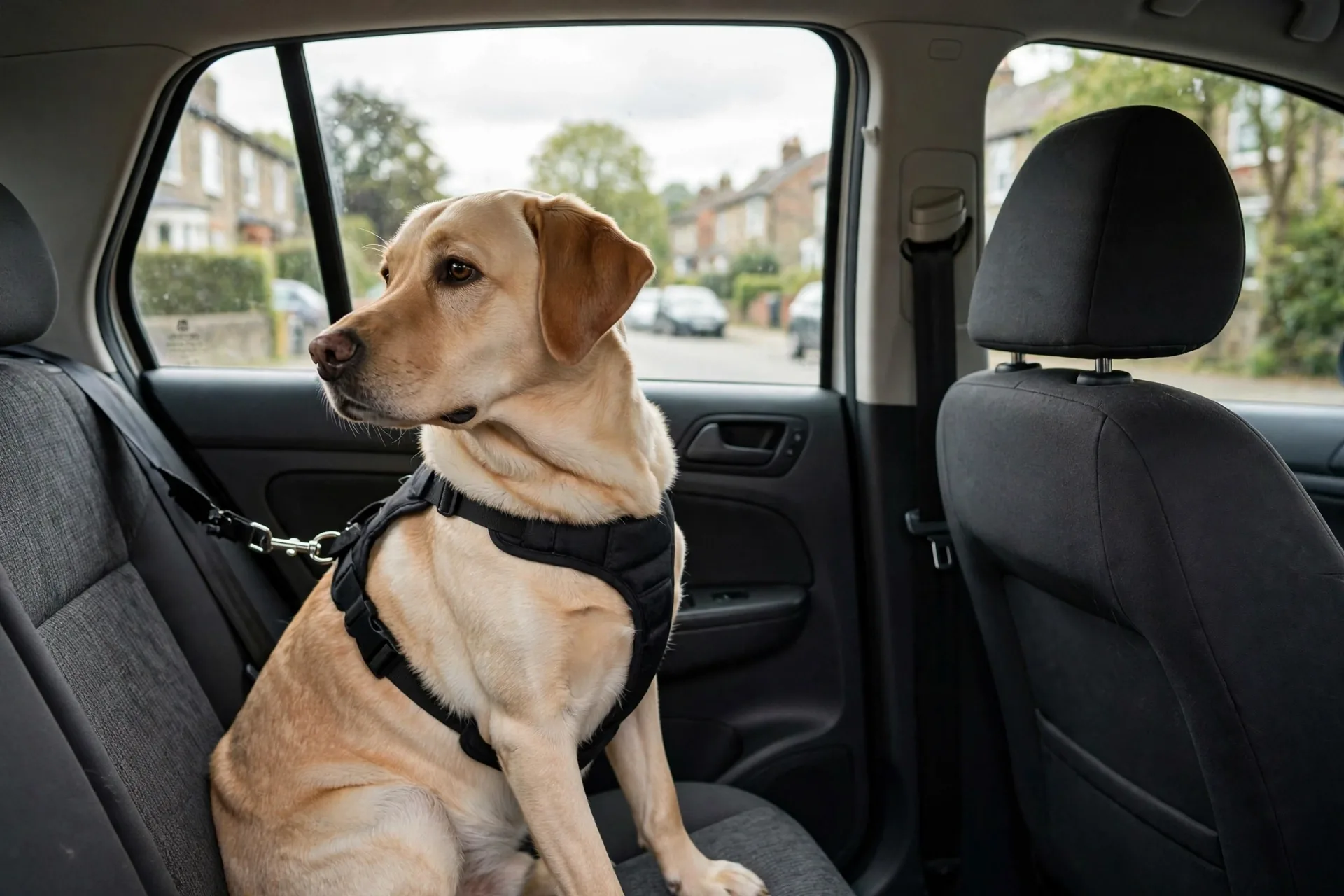
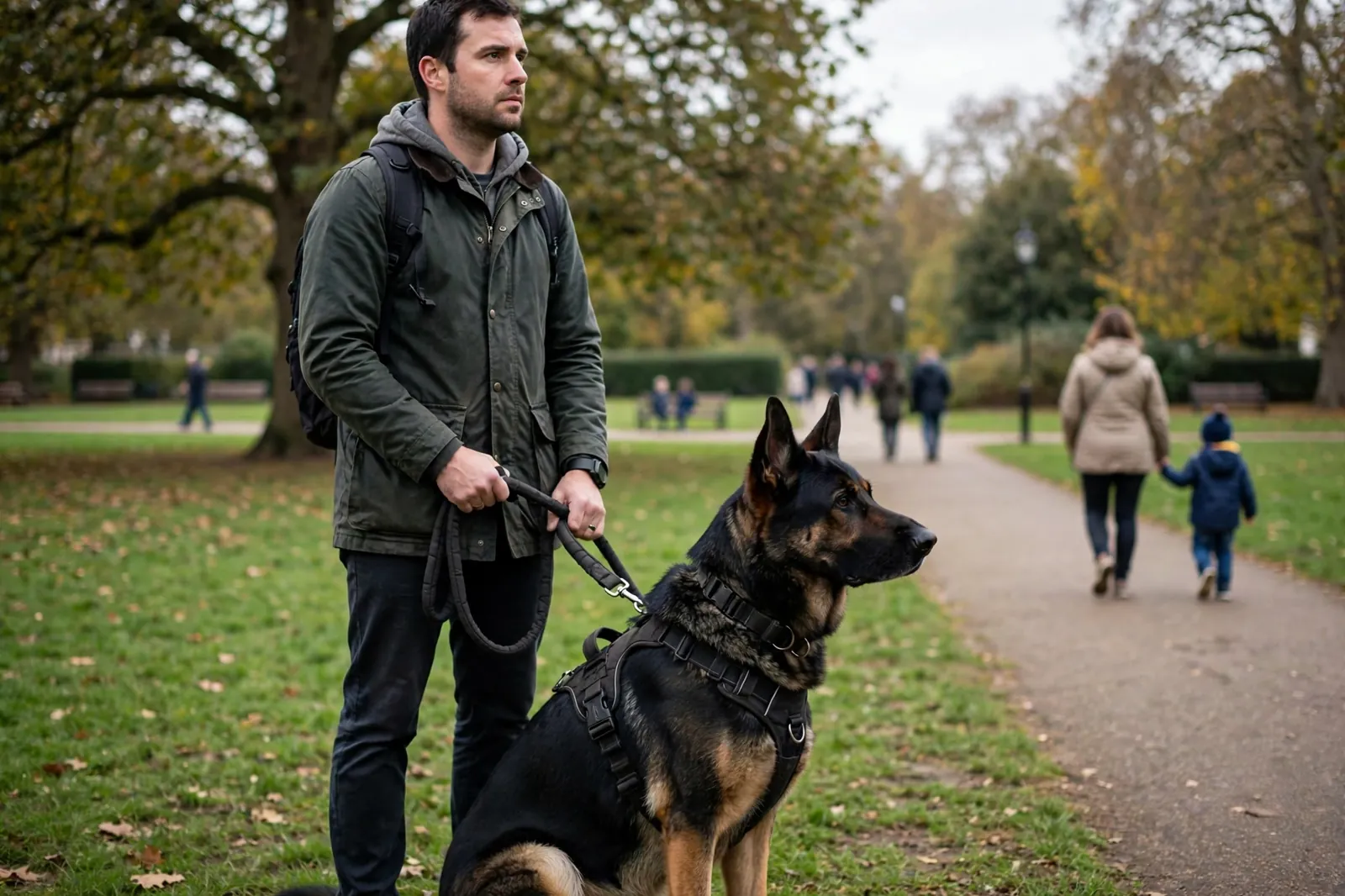
Equipment plays its part when chosen honestly. A well-fitted harness or collar you can hold, a lead of sensible length, and a muzzle that has been introduced gradually with food rewards so the dog wears it relaxed rather than distressed: these are the tools that turn a risky dog into a manageable one. Muzzle training deserves its reputation as a kindness, not a stigma — a dog comfortable in a muzzle can keep its walks, its holidays and its social life while everyone around it stays safe. Owners of reactive dogs will find our guide to reactive dog holidays useful for applying the same system away from home.
Training underpins the equipment, with realistic aims. You do not need obedience-championship polish; you need a recall or an emergency stop that works under distraction, a dog that can be redirected before it fixates, and the judgement to increase distance early. Group classes, one-to-one trainers and clinical behaviourists each have their place, and escalating to proper help after the first sign of aggression is a strength that courts, insurers and neighbours all recognise. The owners who get into the deepest trouble are almost never those who asked for help too early.
Visitors, post and the front door problem
Statistically, the home front door deserves as much planning as any park. Dogs that guard territory meet their highest-risk moments when the doorbell rings: arousal spikes, a stranger appears at the boundary, and a narrow hallway removes everyone’s escape routes. Incidents involving delivery drivers, postal workers and tradespeople are a persistent feature of the case law and of union safety campaigns for exactly this reason. Build a door routine that does not depend on holding a collar with one hand while signing for a parcel with the other.
A robust setup layers barriers. A stair gate, porch gate or closed inner door between dog and entrance; a letterbox cage or external box so fingers never enter the dog’s space; a lead or house line for controlled greetings where greetings happen at all; and a settled place the dog is sent to when the bell rings, trained in calm moments until it is boring. For holiday stays, recreate the essentials in the first hour: decide which door the dog never attends, where the dog goes when visitors arrive, and how post and deliveries work in that property. Two minutes of planning on arrival outperforms any amount of mid-incident improvisation.
Children visiting deserve the household’s clearest rules, because excitement, squealing and face-level hugs are a combination many dogs tolerate at home until the day they do not. Supervise actively rather than from the next room, give the dog a genuine retreat that children are taught is out of bounds, and end interactions while they are still going well. None of this requires living in fear of your own dog; it requires respecting that the law, fairly or not, will judge the outcome of the one interaction that goes wrong, and arranging life so that interaction is structurally unlikely.
Practical questions
Before you go
Can my dog be classed as dangerously out of control without biting anyone?
Yes. The offence can be made out where a dog injures someone or an assistance dog, but also where there are reasonable grounds for fear that it will injure someone, whether or not it actually does. Barking alone is not the test; behaviour that gives genuine grounds for fear of injury is what matters, judged on the facts of the incident.
What are the maximum penalties if a dog injures someone?
Penalties are severe and rise with the harm caused. Injury offences can bring prison sentences measured in years, with the highest maximums where a person dies or an assistance dog is injured. Courts can also impose fines, compensation, disqualification from keeping dogs and control or destruction orders for the dog. Check the latest official guidance before you travel, as sentencing detail changes.
Does the law apply inside my own home and garden?
In England and Wales the dangerously out of control offence was extended to cover all places, including private property, with a limited household defence where the victim is a trespasser in or entering the home. Visitors, delivery workers and guests are not trespassers, so normal duties apply to them in your home and garden.
What should I do immediately after my dog has bitten someone?
Secure the dog, help the injured person and call emergency services if needed. Exchange details honestly, do not argue about fault at the scene, and seek first aid or medical advice for the injured person. Then notify your insurer if you have third-party cover, write down exactly what happened while it is fresh, and get legal advice promptly if police become involved.
Are XL bullies and other banned types covered by different rules?
Yes. Certain types are prohibited under the Dangerous Dogs Act framework, and XL bully rules in England and Wales require exemption, registration, insurance, neutering and keeping the dog muzzled and on a lead in public, with separate arrangements in Scotland. Rules differ by nation and change over time, so check the latest official guidance before you travel.