This guide is independent and contains no paid placement. If affiliate links are added later, they will be clearly marked and will not change our editorial checks.
Callander is one of the easiest Trossachs bases for a dog trip: flat riverside paths start in the town centre, the Bracklinn Falls trail and the lochs are a short drive away, and most cafes and pubs on Main Street welcome dogs. Walk the Teith in the morning, eat together at lunchtime, and drive out to a loch or a forest trail in the afternoon.
Why Callander suits dogs
Callander sits where the River Teith leaves the Highlands and the road into the Trossachs begins. It is a small town, not a resort, and that is exactly what makes it work for a dog trip. Everything a dog owner needs is within a short walk: the river, the Meadows, the shops on Main Street, the car parks and the start of several waymarked trails. You can base yourself here for three or four days and walk a different route every morning without moving the car.
The town calls itself the gateway to the Trossachs, and the geography backs the claim. To the west lie Loch Venachar, Loch Achray and Loch Katrine; to the north rise Ben Ledi and Ben Vorlich; to the south the road runs down to Stirling and the flat farmland of the Forth valley. That means a single base gives you riverside strolls, forest tracks, lochside paths and, for fit dogs and owners, a proper hill walk. Few Scottish towns of this size offer that range within a twenty-minute drive.
Callander is also genuinely used to dogs. The town has been a walking and touring base for well over a century, and the current mix of visitors is heavy on walkers, cyclists and families with dogs. You will see dogs in the cafes, on the riverside benches and on almost every trail out of town. That does not mean rules are relaxed: livestock grazes on the fields around the town, the river is fast after rain, and the popular paths are shared with cyclists and children. But it does mean you are unlikely to be the only person working out where the dog can go, and staff in most places will have an answer ready.
One more practical point in the town's favour is scale. Main Street is short enough to walk end to end in ten minutes, yet it holds a supermarket, an outdoor shop, several cafes, pubs and takeaways, and a visitor information point. If you forget a lead, run out of treats or need a towel after a wet walk, you can sort it without a drive. For a dog trip, that small-town completeness matters more than any single attraction.
Getting there and parking
Callander lies on the A84 between Stirling and the Trossachs, about 16 miles north-west of Stirling and roughly an hour's drive from Glasgow and Edinburgh. The drive from Stirling is straightforward and scenic: the road follows the Teith valley, passes Doune, and climbs gently into the town. From Glasgow, the usual route is the M80 and the A84 via Stirling. Allow extra time on summer weekends and bank holidays, when the single carriageway through the town can queue, especially around the Main Street junction.
There is no railway station in Callander today. The old Callander and Oban line closed in 1965, and the nearest stations are at Stirling and Dunblane, both served by regular trains from Glasgow and Edinburgh. From Stirling, buses run to Callander several times a day, and dogs are generally welcome on the bus at the driver's discretion, usually on a lead and on the floor rather than on a seat. If you are travelling by public transport, check the official guidance before you travel, because timetables and dog rules change, and a missed connection in the evening can leave you with a long wait.
Driving is the easiest option for most dog owners, and parking is the first decision of the day. The main public car parks are on Station Road, close to the old station site and the start of the cycle path, and by the Meadows at the eastern end of town. Both are a short walk from Main Street and from the riverside paths, and both are more convenient than trying to park on Main Street itself, where spaces are limited and turn over quickly. On summer weekends, school holidays and bright autumn days, the car parks can fill by late morning, so an early start is worth it. Check the official guidance before you travel for current charges, time limits and payment methods, as these are reviewed from time to time.
When you arrive, settle the dog before you do anything else. A short lead walk along the Meadows or the first stretch of the riverside path lets a dog stretch its legs after the car journey and take in the new smells before the day begins. Keep the first outing short and calm, offer water, and only then think about the longer walk. Dogs that arrive wound up from a long drive are far more likely to pull, bark and chase on the first trail, and a ten-minute settle walk is the cheapest insurance against that.
River Teith riverside walks
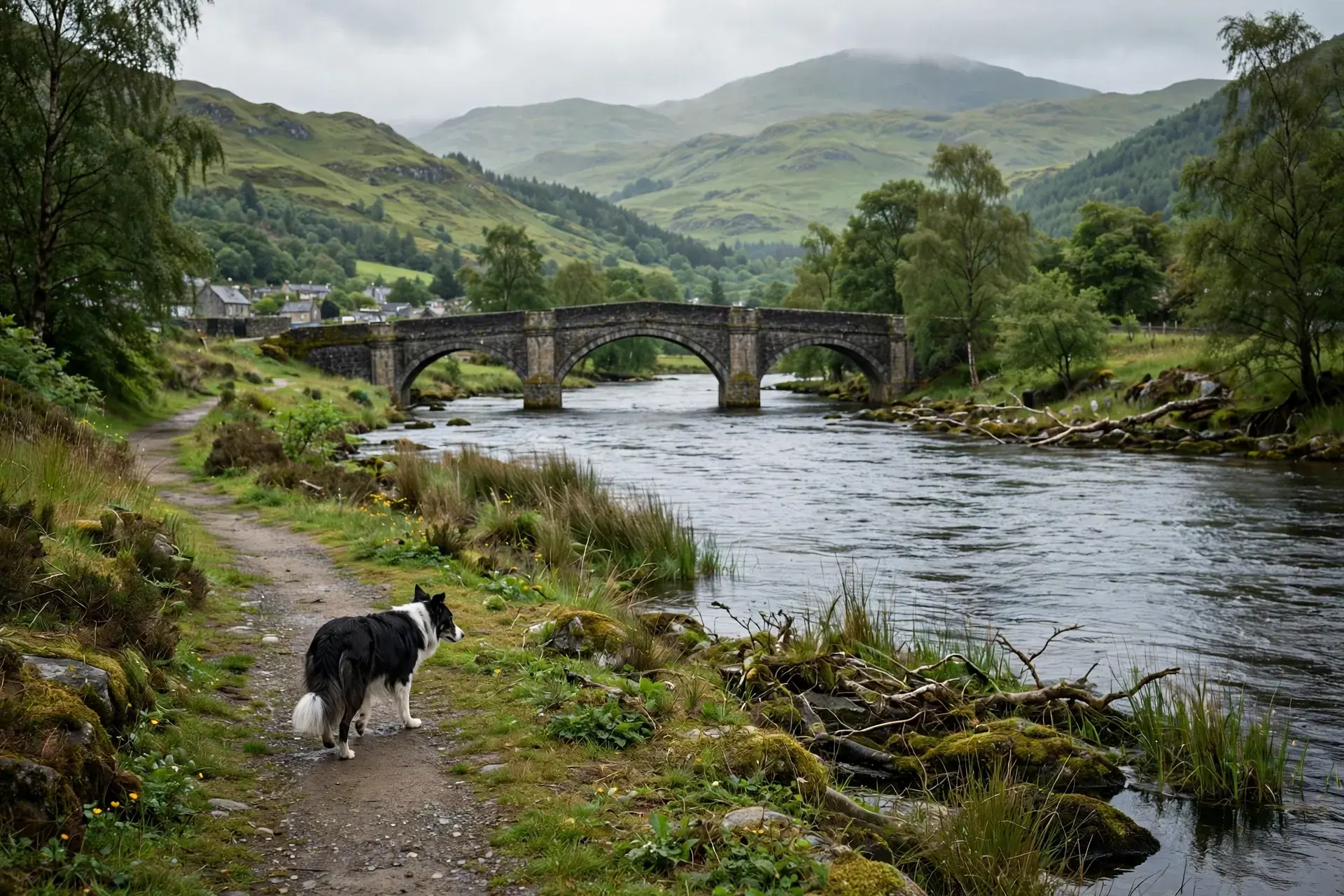
The River Teith runs through Callander from west to east, and the riverside paths are the town's easiest dog walks. The river starts as the outflow of Loch Lubnaig, gathers water from the Trossachs burns, and flows past the town towards Doune and Stirling, where it joins the Forth. In the town centre it runs broad and clear over gravel, with grassy banks, mature trees and benches where you can sit and watch the water. The walking is mostly flat, the surfaces are good, and you can build a walk of almost any length by turning back at any point.
The classic short loop starts at Callander Meadows, the open grassland at the eastern end of Main Street. Cross the Meadows towards the river, follow the path along the bank, and loop back through the town. The whole circuit takes about 30 to 45 minutes at a dog's pace, with plenty of sniffing stops, and it works well as a first walk of the day or a last outing before dinner. The Meadows themselves are popular with local dog walkers, so your dog will usually meet others here; keep greetings short and on a lead until you know how the other dog reacts.
For a longer riverside walk, follow the Teith west out of town towards the old railway line and the cycle path. This stretch is quieter, with farmland on one side and the river on the other, and it gives a good sense of the valley without any climbing. In spring the banks are thick with wildflowers, in autumn the trees turn, and in winter the low sun lights up the water. The path can be muddy after rain, and after heavy rain the river rises fast and the lower sections can flood, so check conditions before you set off and keep your dog on a lead near the water when the river is high.
Swimming needs care on the Teith. The river looks inviting on a warm day, but the current is stronger than it appears, the water stays cold even in summer, and the bed is uneven with sudden deep spots. Shallow, slow edges near the Meadows can suit a confident swimmer on a calm day, but never let a dog swim near the weir, the bridge piers or any fast water, and never throw a stick into moving water where the dog has to chase it downstream. After heavy rain, skip swimming altogether. Watch for blue-green algae in warm, still spells, and if the water looks discoloured or smells unusual, keep the dog out and check the official guidance before you travel.
Lead rules on the river are a matter of judgement rather than a single rule. On open, quiet stretches with good sightlines, many owners let a well-trained dog off the lead, but the path is shared with cyclists, runners, children and other dogs, and livestock grazes in the fields beside it. The safe approach is to keep the dog on a lead on the busy town sections, near roads and bridges, and wherever sheep or cattle are visible, and only let the dog off where you have a clear view and a reliable recall. A long line is a good compromise on the wider stretches: the dog gets room to explore while you keep control.
Gateway walks into the Trossachs
Callander's real advantage is what lies beyond the town. The Trossachs, the wooded hills and lochs between Callander and Aberfoyle, are part of Loch Lomond and The Trossachs National Park, and several of the area's best dog walks start within a short drive of Main Street. The three below cover the range: a short woodland waterfall walk, a lochside stroll and a hill for fit dogs.
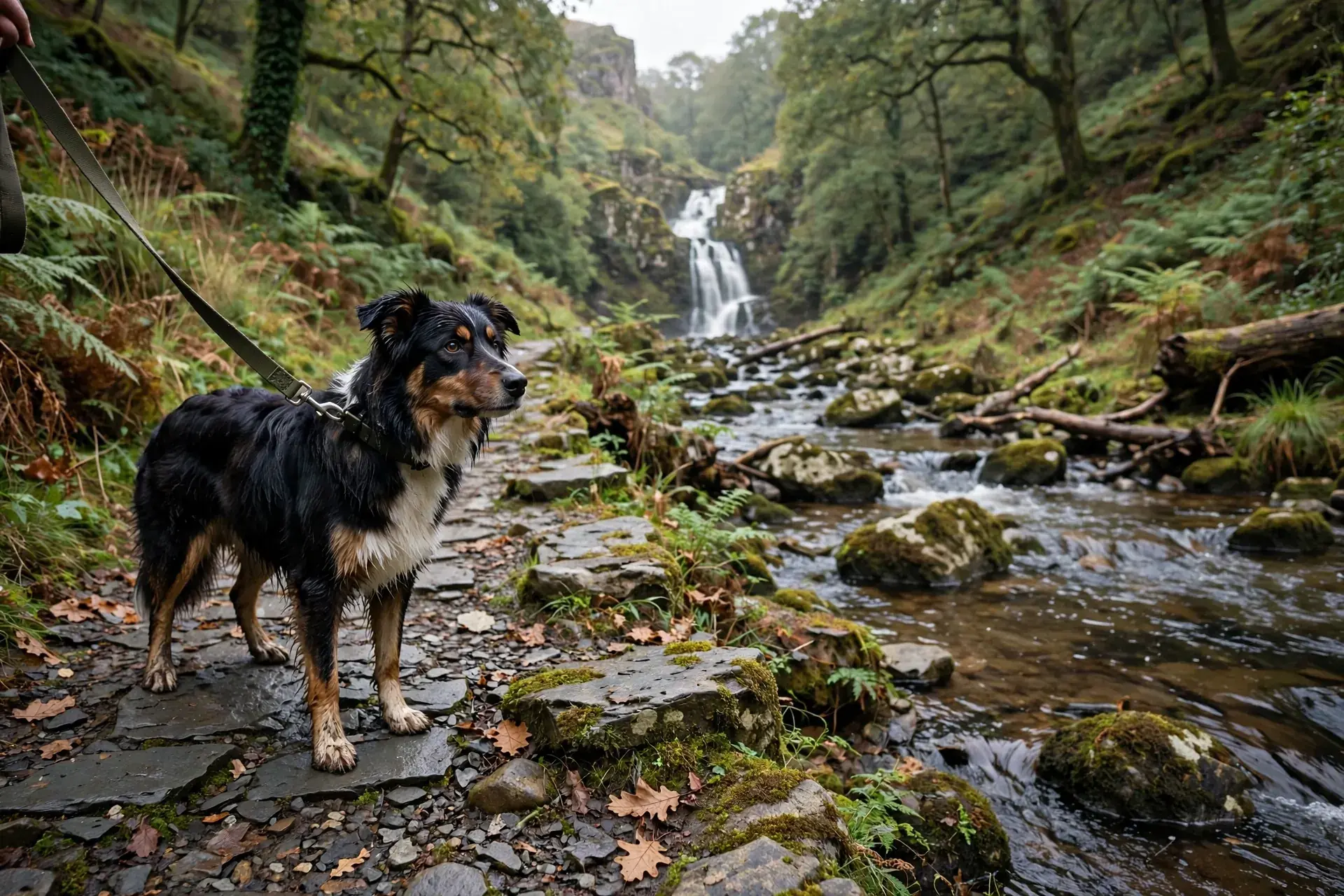
Bracklinn Falls is the nearest classic walk, and the one most visitors do first. The trail starts at the car park at the end of Bracklinn Road, on the northern edge of town, and climbs gently through woodland to the falls on the Keltie Water. The walk to the viewpoint and back takes about an hour, and the falls themselves are a series of drops over dark rock, best after rain. Dogs are welcome, but this is a lead walk: the gorge section is narrow, the drops are steep, and the wooden steps and bridges are slippery when wet. Keep your dog close through the gorge, use the fenced viewing area for photographs, and do not let the dog scramble down to the water at the falls. The return path can be busy on summer weekends, so an early start gives you the quietest walk.
For something flatter, drive west to Loch Venachar, about three miles from Callander. The loch's southern shore has level tracks and quiet lanes, with views across the water to Ben Ledi, and there are places where a dog can paddle at the edge on a calm day. The sailing club and the lochside picnic spots are popular on summer weekends, so keep the dog on a lead around the car parks and picnic areas. A gentler alternative is Loch Lubnaig, a few miles north on the A84 towards Lochearnhead. The loch runs alongside the road, and the old railway line beside it gives a flat, traffic-free walk with water views the whole way. Both lochs are good choices for older dogs or for a second, easier walk after a morning on the hills.
Ben Ledi is the serious walk, and it should only be attempted with a fit, experienced dog. The hill rises to 879 metres directly north-west of the town, and the usual route starts from the car park on the A84 at the foot of the hill. The path climbs steadily through forest, then open moorland, to a broad summit with views across the Trossachs and the Forth valley. Allow four to five hours for the round trip, carry water for the dog as well as for yourself, and be ready for the weather to change on the open top. Keep the dog on a lead where sheep graze on the lower slopes and on the summit ridge in poor visibility, and do not attempt the hill in high wind, ice or thick mist. For a shorter hill option, Ben A'an, above Loch Katrine, is a much shorter climb with a big view for the effort, but its path is steep and rocky, and small or older dogs may struggle on the rough steps near the top.
Whichever trail you choose, the Trossachs rules are the same: keep dogs under close control near livestock at all times, follow the Scottish Outdoor Access Code, and take all litter and dog waste home or use the bins provided. Sheep and lambs graze on many of the hillsides around Callander, and a dog chasing livestock can be shot by a farmer under the law, so this is not a minor point. If you see sheep ahead, put the dog on a lead well before you reach them, and keep it there until you are well past.
A town-centre walk with your dog
Not every outing needs to be a trail. Callander's town centre makes a pleasant short walk on its own, and it is the best way to combine a leg-stretch with the practical jobs of a dog trip. Start at the Meadows, walk along the river for ten minutes, then cut up to Main Street and wander west past the shops. The pavements are wide enough for a dog on a short lead, and there are benches and water bowls outside several businesses. Allow about 45 minutes including a coffee stop, and keep the dog on a short lead throughout, as the pavements are busy with shoppers, pushchairs and other dogs.
The town's history is visible on this short walk if you know where to look. Callander grew as a market town and a staging post on the road to the Highlands, and its wide Main Street and stone buildings reflect that past. The old station site, now the car park on Station Road, is a reminder of the railway that once carried visitors to the Trossachs and on to Oban. The Rob Roy Way, the long-distance route that follows the footsteps of the folk hero Rob Roy MacGregor, passes through the town, and the National Cycle Network Route 7 runs along the old railway line, so you may meet long-distance walkers and cyclists passing through. None of this needs a detour: it is simply there, on the street and on the path, while you walk the dog.
For a longer town-based loop, follow the cycle path east from the old station site towards Doune. The path is flat, surfaced and traffic-free, and it runs through farmland with the Teith never far away. You can walk as far as you like and turn back, or arrange a lift back from Doune, where the castle is a well-known landmark from the television series Outlander and the town has its own cafes and pubs. The cycle path is shared with cyclists, who can approach quickly and quietly, so keep the dog on a lead or a short line and stay to one side. This is a good wet-weather option too, because the surfaced path stays walkable when the riverside and hill paths turn to mud.
Shopping with a dog in Callander is mostly a matter of taking turns. The supermarket and the outdoor shop are useful for supplies, but dogs are not usually allowed inside food shops, so one person waits outside with the dog while the other shops. Some of the gift shops and outdoor retailers welcome dogs inside, so look for the sign on the door or ask. If you are travelling alone, do the shopping first, drop the bags at the car or the accommodation, and then take the dog for its walk, rather than trying to combine the two. A dog tied up outside a shop is a poor idea in a busy town, and most owners in Callander will tell you the same.
Dog-friendly cafes and pubs
Eating and drinking with your dog is one of the pleasures of Callander, and the town is well set up for it. Several cafes and pubs on Main Street and around the town welcome dogs, usually inside as well as on outdoor seating, and many keep a water bowl and a jar of biscuits by the door. The habit is so normal here that staff will often greet the dog before they greet you, and a dog settling under the table is an everyday sight rather than an exception. Even so, policies vary between the bar and the dining room, and between summer and winter, so always check the sign at the door or ask a member of staff before you settle in.
For a coffee stop, the cafes on Main Street are the obvious choice. Most have a mix of indoor tables and pavement seating, and the outdoor tables are the easiest option on a busy day, since the dog can sit beside you without navigating a crowded room. Bring a small mat or blanket for the dog to lie on, especially in cold weather, and keep the lead short so the dog is not stretched across the walkway. A chew or a stuffed Kong can keep a restless dog occupied while you eat, and it is worth ordering food that you can eat one-handed if the dog needs attention. If your dog is reactive to other dogs, choose a table at the edge of the room or outside, away from the main route to the counter.
Pubs are often the best option for an evening meal with the dog. The pubs in and around Callander, including the well-known Lade Inn at Kilmahog just west of the town, have long welcomed walkers and their dogs, and the bar area is usually the dog-friendly space, with the restaurant sometimes restricted. Order at the bar, find a corner table, and settle the dog with water and something to chew. Evening is when tired dogs are at their best: a dog that has walked all day will usually sleep under the table, while a dog that has been in the car all afternoon may be restless, so time the pub visit after the day's main walk rather than before it.
Good pub manners make the next visit easier for everyone. Keep the dog on a lead at all times indoors, keep it off the furniture unless the pub explicitly invites dogs onto the seats, and do not let it approach other tables or other dogs without asking. Clean up any mess immediately and tell staff if anything is spilled. If your dog barks at strangers or at other dogs, the honest choice is a takeaway eaten on a bench by the river rather than a long sit in a crowded bar. The town's takeaways are a good fallback on a wet evening, and the Meadows and the riverside benches make an easy outdoor dining room in dry weather.
Where to stay with a dog
Callander has a good range of dog-friendly places to stay, from hotels and bed and breakfasts on Main Street to self-catering cottages and lodges on the edge of town and in the surrounding glens. The right choice depends on your dog. A hotel room suits a calm dog that settles quickly and is happy to be left for short periods; a self-catering cottage suits a dog that needs a garden, a dog that barks, or a household with two or more dogs. Work out what your dog needs before you browse, and use that as your filter rather than the photographs.
When you enquire, ask the specific questions that matter. How many dogs are allowed, and is there a charge per dog or per stay? Are dogs allowed in all rooms or only in designated dog-friendly rooms, and are those rooms on the ground floor with easy access to outside? Is there an enclosed garden or a safe area for a last outing at night? Are dogs allowed in the bar or dining room, or only in the bedroom? What happens if the dog barks and another guest complains? Get the answers in writing with your booking, and confirm the total price including any pet charge, because a small nightly fee adds up over a week. Our guide to dog-friendly holiday parks in the UK covers the same questions in more detail, and the checklist works just as well for a hotel or a cottage.
Location matters as much as the property. A place on the edge of town, near the Meadows or the Bracklinn Falls road, gives you a walk from the door without a drive, while a place on Main Street gives you cafes and shops on foot but more noise and more passers-by. If your dog is noise-sensitive, ask for a room away from the road and away from the bar. If your dog needs a late-night toilet trip, check that the route outside is lit and safe, and that you can get in and out without waking the whole building. A ground-floor room with a door to the outside is worth paying extra for with an older dog or a puppy.
Book early for the busy periods. Summer weekends, school holidays and the autumn colours season fill the dog-friendly rooms first, and the best cottages with enclosed gardens are often booked months ahead. If you are flexible, the shoulder seasons of May and September offer the best combination of availability, price and quiet paths. Whatever the season, arrive in daylight if you can: walking the boundaries, finding the water bowl and settling the dog before dark makes the first night far easier than arriving after a long drive in the dark with a dog that has never seen the place before.
Practical kit, vets and weather
Packing for Callander is packing for Scottish weather: assume rain, wind and a change of plan, and you will rarely be disappointed. The essentials for the dog are a lead and a long line, a harness that fits well when wet, towels and a drying coat, a water bottle and a collapsible bowl, poo bags, and a first-aid kit with tick removers, antiseptic and any regular medication. A spare lead and a spare towel live in the car, not in the accommodation, so they are there when you need them on the trail. In summer, add sun protection for thin-coated and pale dogs, and in winter, add a warm coat for short-coated, older or very small dogs.
Ticks are the main health risk on the Trossachs walks. The area has sheep, deer and long grass, and ticks are active from spring through autumn, with a peak in late spring and early summer. Check the dog after every walk, paying attention to the ears, the armpits, the groin and between the toes, and remove any tick promptly with a tick remover, twisting rather than pulling. A vet-approved tick treatment before the trip is the simplest protection. Adder bites are rare but possible on sunny, rocky slopes in the warmer months, so keep the dog on the path and away from dry stone walls and sunny rock piles, and know the signs: sudden swelling, pain and lethargy after a walk in adder country mean a vet visit, not a wait and see.
Know where the nearest vet is before you need one. Callander has a veterinary practice in the town, and there are further practices in Stirling and Dunblane. Save the number in your phone on arrival, and note the opening hours, because rural practices may close early and run reduced hours at weekends. For an emergency out of hours, the nearest emergency vet may be in Stirling or Glasgow, so check the arrangements in advance rather than searching in a crisis. If your dog has a long-term condition, bring enough medication for the whole trip plus a day or two extra, and carry a copy of the prescription or the vet's notes.
Weather in the Trossachs changes fast, and the forecast for Stirling is not the forecast for the hills above Callander. Check a mountain forecast as well as a town forecast before a hill walk, and be ready to swap a hill day for a lochside or forest walk if the wind rises or the cloud comes down. Midges are the summer nuisance: they are worst from June to August, at dawn and dusk, near still water and in sheltered woodland, and they bother people far more than dogs, though dogs with thin coats can be bitten. A breeze, a hilltop and the middle of the day are your friends. In winter, daylight is short, so start walks early, carry a torch for the return, and put a light or a reflective coat on the dog on the road sections.
Day trips from Callander
Callander works as a base because the day trips are short. Stirling, about 40 minutes away, is the easiest city day out, with its castle, the old town and the Wallace Monument, and the town is well used to visitors with dogs. The castle itself has restrictions on dogs inside, so plan Stirling as a walk-and-cafe day rather than a castle-interior day, and check the current rules before you go. Our Stirling dog guide covers the castle area, the town walks and where dogs are welcome, and it is worth reading before you drive down.
To the west, Loch Lomond is the big day out. The eastern shore of the loch, around Balmaha and Rowardennan, is about 45 minutes from Callander, and the lochside paths and the lower slopes of Ben Lomond give a very different landscape from the Trossachs: bigger water, bigger hills, and a busier shoreline. Keep the dog on a lead around the car parks and picnic areas, which are crowded in summer, and take the quieter paths once you are away from the honeypot sites. Our guide to Loch Lomond with a dog covers the best lochside walks and the practical details, including parking and the seasonal rules.
Aberfoyle, about 20 minutes south-west, is the other Trossachs village worth a visit. It sits at the edge of the Queen Elizabeth Forest Park, where the forest trails and the viewpoints give easy walking for dogs of all ages. The village has cafes and a visitor centre, and the forest drive and the walking trails can fill a whole day. Doune, about 20 minutes south on the A84, is smaller but worth an hour: the castle is a well-known filming location, the village has a good pub, and the cycle path from Callander makes it a pleasant destination for a longer walk or a cycle ride.
For a longer day, the road north over the hills to Lochearnhead and on to Killin, at the western end of Loch Tay, is one of the most scenic drives in the area. Killin has the Falls of Dochart, a short riverside walk and several dog-friendly cafes, and it makes a good lunch stop on a circular drive back through the Trossachs. Allow a full day for the loop, and remember that the roads are single carriageway and slow in summer. Whatever you choose, build the day around the dog's limits rather than the map: one good walk and a relaxed lunch beats three rushed stops and a tired, stressed dog.
Before you set off on any day trip, run through the same short checklist. Water and a bowl, food and treats, poo bags, a towel, the lead and the long line, and the vet's number saved in your phone. Check the weather for the destination, not just for Callander, and check the official guidance before you travel if anything about access, parking or dog rules is unclear. A five-minute check at the car saves an hour of frustration at the other end, and it is the habit that separates an easy dog trip from a difficult one.
Practical questions
Before you go
Can dogs go off the lead in Callander?
In some places, yes, but not everywhere. Dogs can usually run off the lead on open ground away from livestock and roads, but they must be under close control near sheep, on the town streets and on busy paths. Around the River Teith, the Meadows and the Bracklinn Falls path, keep your dog on a lead where other walkers, cyclists or livestock are close by, and always be ready to clip the lead back on.
Is the River Teith safe for dogs to swim in?
The Teith is a fast, cold river and conditions change quickly after rain. Shallow, slow edges near Callander Meadows can suit a confident swimmer on a calm day, but the current strengthens fast after heavy rain and the water stays cold even in summer. Never let a dog swim near the weir or the bridge piers, watch for blue-green algae in warm spells, and check the official guidance before you travel.
Are dogs allowed on the Bracklinn Falls walk?
Yes, dogs are welcome on the Bracklinn Falls trail, and the short woodland walk from the car park is one of the most popular dog walks around Callander. Keep your dog on a lead on the gorge section, where the path is narrow and the drops are steep, and take extra care on wet wooden steps and bridges. The waterfall viewpoint is best enjoyed from the fenced viewing area.
Where can I park in Callander with a dog?
The main public car parks are on Station Road and by the Meadows, both a short walk from Main Street and the riverside paths. Arrive early on summer weekends and school holidays, when both fill up by late morning. Never leave a dog in a parked car on a warm day, even with the windows open, and check the official guidance before you travel for current charges and time limits.
Can I take my dog into cafes and pubs in Callander?
Many cafes and pubs on Main Street and around the town welcome dogs, usually inside as well as on outdoor seating, and several keep water bowls and dog biscuits by the door. Policies can change with the season and between the bar and the dining room, so check the sign at the door or ask staff before you settle in, and keep your dog on a lead and out of the walkway.
What is the best time of year to visit Callander with a dog?
Late spring and early autumn are usually the easiest: paths are drier, the town is calmer than in the summer holidays, and the midges that trouble parts of the Trossachs from June to August are less of a problem. Winter brings short days and muddy trails but very quiet walks. Summer is the busiest season, so start walks early and book dog-friendly accommodation well ahead.