This guide is independent and contains no paid placement. Attraction dog rules change, sometimes at short notice for events, filming or conservation work. Where this guide flags a rule to verify, check the latest official guidance before you travel.
Stirling rewards dog owners who split the day by height. Do the hills early — Abbey Craig woodland for the Wallace Monument and the castle rock from outside — walk the flat River Forth loops when legs tire, and keep the castle interior as a humans-only swap. Base yourself where the first and last walks need no car, and the city becomes an easy, compact two-day break.
Two hills, one small city: how Stirling works with a dog
Most British city breaks force a choice between sightseeing and dog walking. Stirling largely avoids that choice because its two landmarks are hills, and hills come with paths, trees and viewpoints as standard. At the western end of the Old Town, the castle sits on its volcanic rock above the carse, the flat floodplain of the River Forth. To the north-east, across the river in Causewayhead, Abbey Craig rises to the National Wallace Monument. Between and below them lie the streets, parks and riverside meadows where daily dog life actually happens. Once that map is clear in your head, planning stops being a list of attractions and becomes a simple question of altitude, energy and weather.
Start by matching the hills to the right part of the day. Both climbs are short by hillwalking standards but steep enough to matter for older dogs, very young puppies and anyone visiting in summer heat. A fit adult dog will usually manage Abbey Craig comfortably with water stops, while a senior dog may be happier on the lower woodland circuits rather than the final pull to the monument terrace. The castle approach, by contrast, is mostly on paved streets and esplanade surfaces: less of a workout, more of a crowd and lead-management exercise. Neither hill is a full-day expedition on its own, which is precisely the point. Stirling works best as a layered day — a hill in the morning, a flat river loop in the afternoon, and a short Old Town wander in the evening — rather than as a single heroic walk.
Scale also helps nervous and reactive dogs more than brochures suggest. Stirling is a small city, so distances between green spaces are short and retreat is always possible. If the Old Town streets feel busy, you can be on a quiet riverside path in minutes; if a riverside field turns out to hold livestock, a park or woodland alternative is rarely far away. That density of alternatives is the real luxury here. You are not committing to one remote trailhead with no plan B. You are working a compact network, and you can re-route around school groups, roadworks, flooded sections or a dog that has simply had enough, without losing the day.
One caution belongs at the front of any Stirling plan: the Forth is a working, tidal-influenced lowland river in its lower reaches and a fast-rising one after heavy rain upstream. Flat does not mean risk-free. Riverside paths can flood, banks can be soft and undercut, and fields that were dry in the morning can hold standing water by afternoon in a wet week. Check river conditions locally after prolonged rain, keep dogs out of fast or discoloured water, and treat any closed or taped-off section as closed, however inconvenient the detour. The hills, helpfully, are your wet-weather pressure valve: woodland on Abbey Craig and paved Old Town routes stay usable on many days when the lowest meadows do not.
Stirling Castle with a dog: what is realistic, what is not
Let us deal with the headline question plainly, because it shapes the whole itinerary. Pet dogs cannot go inside Stirling Castle. The castle is one of Scotland's most significant historic sites, managed as a ticketed attraction with interiors, exhibitions and enclosed areas where the standard position is assistance dogs only. That means a dog holiday in Stirling is not a castle holiday in the sense of wandering the Great Hall together. It is a castle-view holiday: the rock, the esplanade, the surrounding streets and the panoramas are shared; the palace interiors are not. Planning around that fact from the start prevents the most common disappointment, which is arriving at the gate with a dog, a timed ticket and no fallback.
The workable pattern for couples and groups is a split visit. One person goes inside for the palace, the exhibitions and the views from the walls, while the other takes the dog on the outer circuit — the esplanade area where access for people not entering may vary, the streets below the rock, and the paths around the castle hill, including the routes towards the old town cemetery and the lower town. Then you swap, ideally with the second person knowing exactly which rooms are worth their time. Solo travellers with a dog need a different decision: either skip the interior on this trip and enjoy Stirling as an outdoor city, or arrange proper care for the dog for a few hours rather than leaving a dog unattended in a car or accommodation that forbids it. Never leave a dog in a car near the castle in warm weather, and never tie a dog up outside an attraction entrance.
Grounds rules around major historic sites do change. Events, filming, maintenance and conservation work can alter which outer areas are open, whether lead-only zones extend further than usual, and where assistance dog relief arrangements apply. For that reason this guide deliberately does not promise a fixed line on a map for the castle surroundings. The stable facts are the interior rule — assistance dogs only inside, pet dogs outside — and the need to check the latest official guidance before you travel, especially before buying non-refundable tickets for a specific time slot. If you are also visiting other heritage properties on the same trip, compare the approach in our guide to dogs at English Heritage sites, and note that Scotland has its own managers and its own rules: do not assume a policy you met in England applies unchanged at a Scottish castle.
None of this makes the castle a waste of time for dog owners. The walk up through the Old Town to the castle rock is one of the best short urban walks in central Scotland: cobbled streets, old walls, sudden views across the carse to the Ochils and the Highlands beyond, and plenty of sniff interest at a dog's pace. Photograph the castle from outside, walk the hill, and let the interior be a bonus for whoever draws the inside shift. Dogs do not measure a day by ticketed interiors. They measure it by miles, smells and company, and on those measures the castle hill delivers fully without crossing the gate.
Abbey Craig and the Wallace Monument: the woodland half of the trip
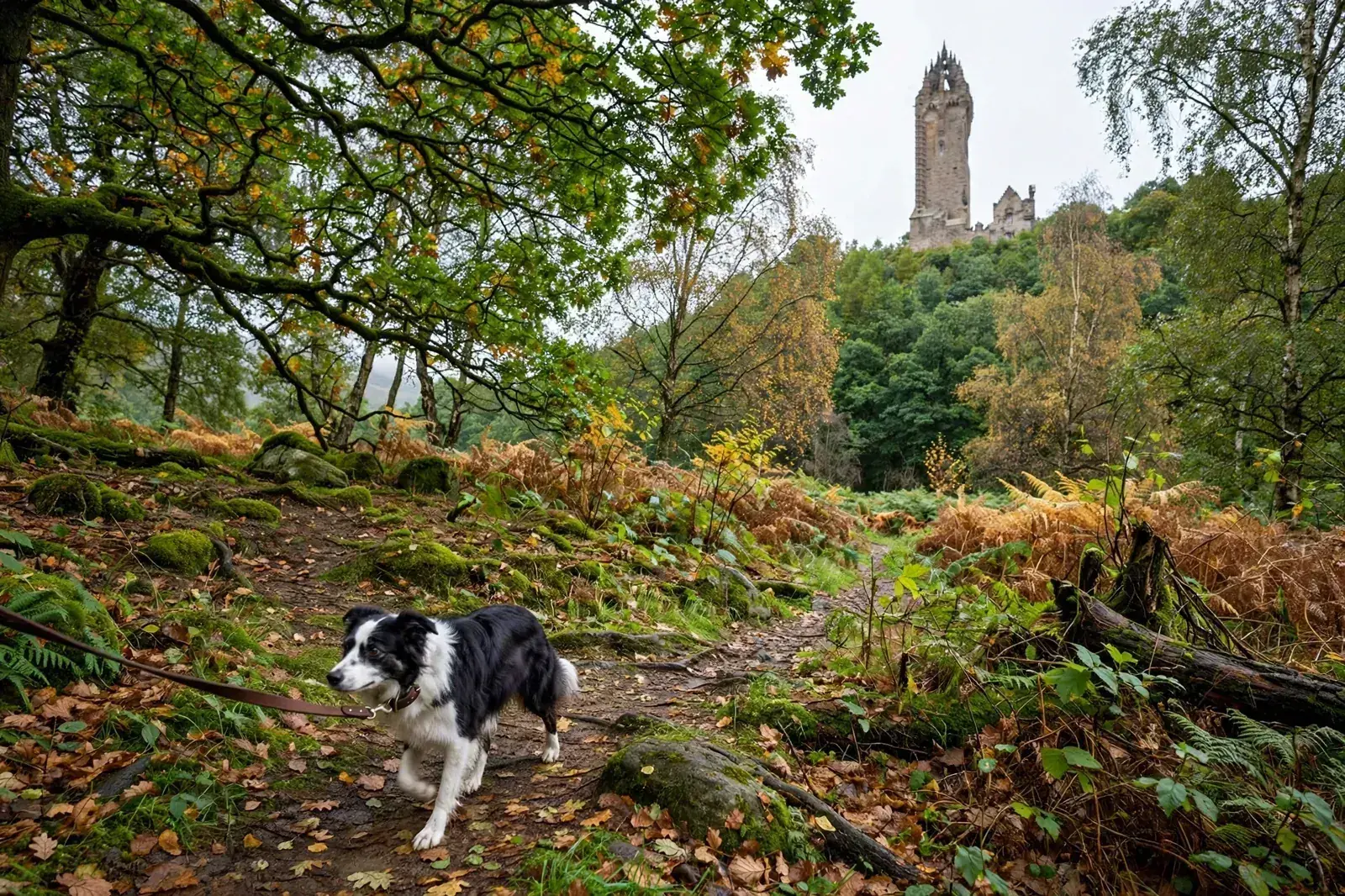
If the castle is the attraction you walk around, the Wallace Monument is the attraction you walk towards. The tower stands on Abbey Craig, a wooded crag north-east of the city centre, across the Forth near Causewayhead and Bridge of Allan. The monument commemorates William Wallace, and its terrace views take in the castle, the winding Forth and the battlefield landscapes below. For dog owners, however, the headline is not the tower. It is the hill itself: a network of woodland paths climbing through mature trees, with shorter lower loops for tired legs and a steeper main route to the top for dogs and people who want the full climb. Check the latest official guidance before you travel for monument opening arrangements, and treat the tower interior as a separate question from the hill: pet dogs belong on the outdoor paths, and entry inside the tower for pet dogs should not be assumed.
Plan the ascent like a short hill walk, not a park stroll. Surfaces mix surfaced path, woodland trail and steps, and after rain the steeper sections can be muddy and slippery under leaf litter. Wear footwear with grip, keep the lead short on steps and blind corners where other dogs and families appear suddenly, and carry water: there is climbing involved even though the hill is modest, and dogs work harder than the distance suggests because woodland encourages constant pulling towards new smells. At the top, expect wind even on a calm day in the city. The terrace and summit area are exposed, busy at peak times and paved in places, so give nervous dogs space at the edges rather than pushing into the crowd at the best-known viewpoint. The view rewards patience; the second-best viewpoint, thirty seconds further on, is often empty.
Timing transforms this walk. Early morning and late afternoon bring softer light across the carse, cooler temperatures for the climb and far fewer people on the narrow upper paths. Midday in summer holidays is the hardest combination: heat on the climb, queues and crowds at the top, and a tired dog being asked to be polite in a confined space. If you only have a midday slot, use the lower woodland instead and save the summit for another trip. Dogs that struggle with heights, open steps or close crowds will also be happier on the lower circuits, which still give you the essential Abbey Craig experience — big trees, birdsong, dappled paths and glimpsed views — without the exposed top. There is no failure in turning around at the point that suits your dog. The monument will still be there, and a relaxed lower walk beats a stressed summit every time.
Build in the practicalities before you set off. Parking and visitor facilities cluster at the foot of the hill, and the area can be busy at weekends, so arrive with a lead, poo bags and water already in hand rather than rummaging in the car while a dog winds itself around a signpost. Follow any local signage about keeping dogs on leads in specific zones, particularly near facilities, play areas and any grazing. As elsewhere in Scotland, outdoor access comes with responsibilities: dogs must be under proper control, out of fields with young farm animals, and away from ground-nesting birds in season. Abbey Craig is a popular, shared hill. The dog owners who are welcomed back warmly are the ones whose dogs are visibly under control on the narrow bits, not just the empty bits.
River Forth loops: the flat miles that make the trip work
Every good dog city needs a reliable flat walk for first mornings, last evenings and the day after a hill. In Stirling that role belongs to the River Forth. The river loops extravagantly across the carse below the castle — the famous Links of Forth meanders — and paths along its banks and across the surrounding meadows give you long, level walking with huge skies and constant castle and monument views. These are not wilderness trails and should not be sold as such. They are shared, lived-in lowland paths: anglers, cyclists, runners, families and other dogs all use them, and fields beside them may hold cattle or sheep. That shared character is what makes them useful. You can walk for an hour or cut back early at several points, and you are rarely far from a bridge, a road or a recognisable landmark if the weather turns.
Choose your loop by conditions rather than by a fixed route name, because the lowest ground is the first to suffer in a wet week. After dry weather, longer meadow circuits are a joy: firm grass, open sightlines and room for a long line where livestock allows and recall is still being trained. After heavy rain, favour surfaced sections, higher bank paths and shorter out-and-back walks, and accept mud as a certainty rather than a surprise. Riverside dogs need a rinse plan in winter: the Forth carries silt, field run-off and everything a floodplain collects, so a towelling-down at the car or door, a paw check for grit and cuts, and a full dry before settling are part of the walk, not an optional extra. Keep dogs out of the water where banks are steep, currents are strong or anglers are fishing, and never let a dog chase birds along the water's edge in breeding season.
Lead decisions on the Forth deserve more thought than a blanket rule in either direction. Scottish access responsibilities require proper control, and proper control on a shared riverside path usually means a lead or long line near cyclists, livestock, fishing pegs, bridges and other dogs, with any off-lead time reserved for empty fields with clear sightlines, no livestock and a recall you would bet the day on. If your dog is still learning, the Forth is actually an excellent training walk precisely because distractions arrive gradually — a jogger, then a bike, then another dog at a distance — rather than all at once outside a station. For wider context on how lead rules and responsibilities work across the UK, see our explainer on dogs on leads and the law, and apply its principles with Scottish access law in mind.
One Forth walk deserves a special mention because it links the river to history without needing a ticket. Cambuskenneth, the village and abbey site on the far bank east of the centre, can be reached on foot and combines quiet lanes, riverside ground and the remains of Cambuskenneth Abbey, where the bell tower is the standout survivor. It feels surprisingly rural for somewhere so close to a city centre, and dogs tend to love the change of pace: slower paths, river smells and village streets after the busier centre. As with the castle, treat the abbey grounds as a verify-before-you-go visit — opening arrangements and any dog restrictions for the site itself should be checked against the latest official guidance before you travel — and keep dogs on leads, calm and out of any enclosed or signed areas in the meantime. Even if you only walk the village and riverbank and view the tower from outside, the outing earns its place.
Cambuskenneth, the Old Town and Kings Park: short walks with long payoffs
Between the two big hill walks, Stirling offers a set of shorter walks that together can fill a day without ever feeling like filler. The Old Town climb from the city centre to the castle is the obvious one, but slow it down and it becomes a dog walk in its own right. The steep historic streets — with the tolbooth, old kirkyards, the town wall line and grand houses along the way — reward a lead-short, nose-down amble. Kirkyards and cemeteries divide dog owners, and rules vary: some historic burial grounds welcome dogs on leads, others ask that dogs stay out. Read the signs at each gate, follow them without argument, and never let a dog off lead among gravestones. Elsewhere in the Old Town, expect cobbles and setts that are charming at noon and treacherous when wet or icy, especially for older dogs and anyone in smooth-soled shoes.
South of the centre, King's Park — styled as the Kings Park, with the apostrophe used inconsistently locally — gives Stirling its classic town park: open grass, mature trees, paths suitable for a steady circuit, and the everyday dog-walking community you would hope to meet in any friendly Scottish city. Town parks are where travelling dogs learn a place. Do a circuit here on your first evening and you will know by morning where local dogs gather, which corners stay quiet for a nervous dog's toilet walk, and how far the park really is from your accommodation in dog minutes rather than map minutes. Respect the usual park choreography: leads on near sports pitches, play areas and cafes, poo picked up even at dusk, and no assumption that every other dog wants to say hello, however sociable yours is.
Add one more short option for balance: the streets and green edges around Bridge of Allan, the Victorian spa town just north of the city towards Dunblane. Allan Water runs through it, woodland rises behind it, and its main street has the kind of independent shops and cafes that make a wet afternoon salvageable. It pairs naturally with Abbey Craig — monument woods in the morning, Bridge of Allan for lunch and a gentler afternoon — and many dog owners end up preferring to stay there and visit Stirling, rather than the other way round. Neither base is wrong. The centre suits rail travellers and short stays; Bridge of Allan suits drivers, quieter evenings and dogs that settle better away from city-centre noise. Choose by your dog's sleeping habits, not by a league table.
Where to stay with a dog in and around Stirling
Stirling accommodation falls into three practical zones, and the right zone matters more than any individual property's marketing. Zone one is the Old Town and city centre: hotels and guest houses within walking distance of the station, the castle climb and the main eating streets. The advantage is a car-free break — arrive by train, walk everywhere, and let the Forth and King's Park cover daily exercise. The compromises are green space at the door, city noise for light-sleeping dogs, and parking if you do bring a car. Zone two is Bridge of Allan and the Dunblane direction: quieter, leafier and often better for a morning woodland walk before breakfast, at the cost of a short drive or train hop into Stirling itself. Zone three is self-catering and holiday lets on the city's edge and in the surrounding villages towards the Trossachs: the easiest option for multiple dogs, muddy gear and early toilet walks, and the weakest for eating out together on foot.
Whichever zone you favour, interrogate the dog policy with the same questions you would ask anywhere in Britain, because Stirling's popularity means the best dog rooms go first in summer. How many dogs are allowed, and is there a size, breed or age condition? What is the charge — per dog, per night or per stay — and does it include anything beyond permission, such as bedding, bowls or a welcome pack? Which spaces can the dog actually use: breakfast room, bar, garden, or only the bedroom? Can the dog be left alone in the room at all, and if so under what conditions? Where is the nearest practical toilet walk after dark, and is it lit? Our broader guide to dog-friendly hotels in the UK works through these questions in full; use it as a checklist here and get the answers for your specific booking in writing, because a hotel that takes dogs in the shoulder season may run a different policy in peak weeks or for events.
Self-catering deserves one Stirling-specific warning: check the garden claim properly. Edge-of-city and village lets advertise enclosed gardens that turn out to be shared, low-fenced or bounded by a livestock field — all manageable, none of them the off-lead private space the listing implied. Ask for the fence height, whether the garden is exclusively yours, and what is on the other side of it. In return, self-catering gives you the drying space this city's walks demand. Forth mud and Abbey Craig leaf litter will test any accommodation's floors, so a porch, utility area or hard-floored entrance is worth more than a prettier lounge. Pack a drying coat, an old towel you do not mind sacrificing, and a mat for bowls, and even a wet October week stays civilised.
Eating and drinking with your dog in Stirling
Stirling is well supplied with pubs, cafes and restaurants for a city of its size, fed by its students, its visitors and its role as a central Scotland meeting point. A good number welcome dogs in bar areas, snugs or terraces, and the pattern here matches the rest of Scotland: the more traditional the pub and the more distinct its bar from its dining room, the better your chances; the more formal the restaurant, the more likely dogs are terrace-only or not accommodated. Policies change with refurbishments and new management often enough that naming a fixed list here would mislead within a season. Instead, use a reliable method. Shortlist places near your evening walk — King's Park, the Old Town or Bridge of Allan — check each venue's own website or social pages for its current dog policy, and phone ahead for Friday and Saturday evenings, when dog-friendly tables are the first to go.
Make the meal easy for the staff and the dog alike. Walk first, eat second: a dog that has done the Forth loop or a King's Park circuit will settle under a table in a way that a dog walked only from the car park will not. Bring a settle mat or familiar blanket, choose a corner table where leads and tails are out of the walkway, and keep the dog out of service routes to the kitchen and bar. Water bowls are commonly offered, but carry your own collapsible bowl and water in summer so you are not dependent on it. If your dog is reactive, large or simply young and fidgety, aim for early sittings, garden tables in fair weather, and cafes after a walk rather than pubs at peak time — and have a takeaway plan B. Stirling's centre is compact enough that a good takeaway eaten back at your accommodation, after a proper evening walk, is a perfectly successful end to the day, not a defeat.
Daytime eating pairs neatly with the walks in this guide. Bridge of Allan after Abbey Craig, the city centre after the castle climb, and a cafe stop built into a King's Park morning all follow the same principle: food follows exercise, and nobody — dog or human — is asked to sit still on an empty stomach and a full bladder. In summer, add shade and heat to the calculation. Pavements in the centre can be hot at midday, enclosed pub gardens can become sun traps, and the walk back uphill to Old Town accommodation after lunch is harder than it looked on the way down. Eat in the shade, walk in the cool ends of the day, and the city's small scale works for you again: nothing is far, so nothing has to be endured.
Getting there, getting around and wet-weather plans
Stirling's transport is a genuine strength for a dog break. The railway station sits in the city centre with direct trains from Glasgow and Edinburgh and connections north towards Perth, Dundee and Inverness, putting a car-free trip well within reach for most central belt visitors and many from further south. Dogs travel on UK trains under the usual national conditions — generally free, on a lead, and kept off seats — but conditions and busy-service advice change, so read our guide to taking your dog on UK trains before you travel and avoid the busiest commuter peaks with a large or nervous dog. By road, Stirling sits at the junction of motorway and trunk routes from Glasgow, Edinburgh and Perth, which is why it works so well as a touring base: Loch Lomond with a dog is an easy day trip west, while St Andrews with a dog and the Fife coast lie east, and Inverness with a dog anchors a longer Highland extension north. Keep day trips honest, though. A base should reduce driving, not licence a different two-hour drive every day with a dog wilting in the back.
Within the city, walking is the default and driving is the exception. Distances between the station, King's Park, the Old Town and the castle are all dog-walkable, and Abbey Craig is the only main sight where many visitors will choose to drive to the foot of the hill or take a bus or taxi towards Causewayhead rather than adding the road walk out of the centre. If you use taxis or buses with a dog, expect driver discretion and local-operator rules to apply: phone ahead, state the dog's size, bring a blanket for seats where required, and never argue at the kerb. Parking near the castle and in the centre is in demand in season, so accommodation with parking included is worth real money if you are driving — confirm it is included, rather than merely nearby, when you book.
Finally, plan for the Stirling that the postcards skip: horizontal rain, a Forth running high and brown, and woodland paths running with water. A wet-weather day here is not a lost day if you build it correctly. Shorten Abbey Craig to its lower woods or drop it entirely, switch the Forth to surfaced and higher sections, lean on the Old Town's paved climb and the city's cafes, and use King's Park for brisk, purposeful circuits between showers. Dry the dog thoroughly after every outing — a wet dog in a small hotel room or holiday let makes its presence felt for hours — and rotate drying coats and towels so something dry is always available. In winter, add daylight to the plan: central Scotland's short days mean hill walks should start early, reflective gear earns its place on evening walks, and the last toilet walk is better done on lit, familiar ground near your base than on a strange riverside path in the dark.
A realistic two-day plan, plus a packing checklist
Day one belongs to the castle side of the city. Arrive, settle the dog with a King's Park circuit so the new place smells familiar, then walk the Old Town climb to the castle rock in the late morning. Split the castle visit if you have a second person, or enjoy the hill and the views as an outdoor visit if you do not, and keep the ticketed interior for whoever most wants it rather than trying to rush both halves. Lunch in the centre follows the walk, not the other way round. In the afternoon, when sightseeing legs and paws both flag, take a flat Forth loop at a sniffing pace, and finish with a short evening wander near your accommodation so the last walk of the day is calm and local. Dogs remember the last walk when they settle at night; make it boring in the best way.
Day two belongs to Abbey Craig. Start early, walk the woodland with water and time in hand, and take the summit only if your dog, the weather and the crowds all agree. Come down to Bridge of Allan for food and a gentler Allan Water stroll, then use the afternoon flexibly: Cambuskenneth and the river if energy remains, a return to a favourite park if it does not, or the start of an onward day trip if Stirling is your hub rather than your destination. Build departure around a proper final walk, not a rushed pavement toilet stop beside a packed car — a dog that leaves Stirling tired, dry and watered travels measurably better than one bundled straight from a hotel room into a car or train.
Pack for hills, rivers and cobbles in the same bag. Bring a lead plus a long line for controlled freedom on open ground, a harness if your dog pulls on steep descents, poo bags in every pocket rather than one roll in the car, water and a collapsible bowl for Abbey Craig, a drying coat and towels for the Forth, paw balm or booties if your dog is sensitive to grit and wet cobbles, and reflective gear in winter. Add the health basics: any medication, a note of your own vet's number plus a plan to find emergency cover locally, and up-to-date microchip and tag details in case a gate, a firework or a deer turns a good day into a search. None of this is Stirling-specific in principle, but Stirling concentrates the need for all of it — hill, river, city and countryside within a single weekend — into one small, walkable place. That concentration, handled with the rules above, is exactly why it deserves a place on any dog owner's map of Scotland.
Practical questions
Before you go
Can dogs go inside Stirling Castle?
Pet dogs cannot go inside the castle buildings or the enclosed interior areas. The usual position for historic castles of this type is that only assistance dogs are welcomed inside, while pet dogs stay outside with another member of the group. Treat the castle as a split visit: one person explores inside while the other walks the dog around the outer areas where dogs on leads may be permitted, then swap. Rules can change for events and filming, so check the latest official guidance before you travel and before you buy tickets.
Can I walk my dog around the Wallace Monument?
Yes, the woodland paths on Abbey Craig around the monument are the dog part of the visit. Dogs on leads are generally welcome on the outdoor paths and in the grounds, while entry inside the tower itself is a separate matter and pet dogs should not be assumed to be allowed inside. Keep leads short near the car park, the visitor facilities and any livestock, carry water for the climb, and check the latest official guidance before you travel for opening times, path closures and any seasonal restrictions.
Are dogs allowed off lead along the River Forth?
In places, but not everywhere and not by default. Riverside meadows, shared paths with cyclists, angling spots and fields with livestock all call for a lead or a long line, and Scottish outdoor access responsibilities require dogs to be under proper control near farm animals, ground-nesting birds and other people. Use off-lead time only where you have clear sightlines, a reliable recall and no livestock in the field, and put the lead back on well before bridges, roads and busy junctions.
Where can I stay in Stirling with a dog?
Look in three zones and compare them by walk access, not just price. Old Town and city-centre hotels suit short stays and eating out together but may have limited green space at the door. Bridge of Allan and the roads towards Dunblane offer quieter streets and quicker access to woodland. Self-catering and holiday lets on the edge of the city usually give the easiest early and late toilet walks and space for wet gear. Wherever you choose, confirm the dog fee, the maximum number and size of dogs, and which rooms and dining areas dogs may use, in writing before you book.
Is Stirling a good base for a dog holiday in central Scotland?
Yes, because it combines a compact, walkable centre with fast onward options. You can fill two full days in the city itself with Abbey Craig, the Forth loops, Cambuskenneth and Kings Park, then use Stirling as a hub for Loch Lomond, the Trossachs and the Fife coast on longer stays. Rail and road links are strong for central Scotland, so day trips do not have to mean long drives every day. The trade-off is that the best-known sights are popular in summer, so start hill and monument walks early and keep a wet-weather plan.