No placement has been paid for in this independent guide. Cavaliers differ in stamina and health, and the notes here are general information, not veterinary advice for your dog. Raise specifics with your vet, and check official guidance before you travel.
A Cavalier King Charles Spaniel holiday in the UK works best at a gentle pace: short, frequent walks rather than one long hike, calm accommodation where your dog can stay close, shade and rest in warm weather, and a vet conversation before you travel about exercise tolerance and general health. Choose ground-floor or lift-served stays for older dogs, keep alone-time very short, and build the day around companionship — that, more than any attraction, is what this breed is travelling for.
Start with tempo, not distance
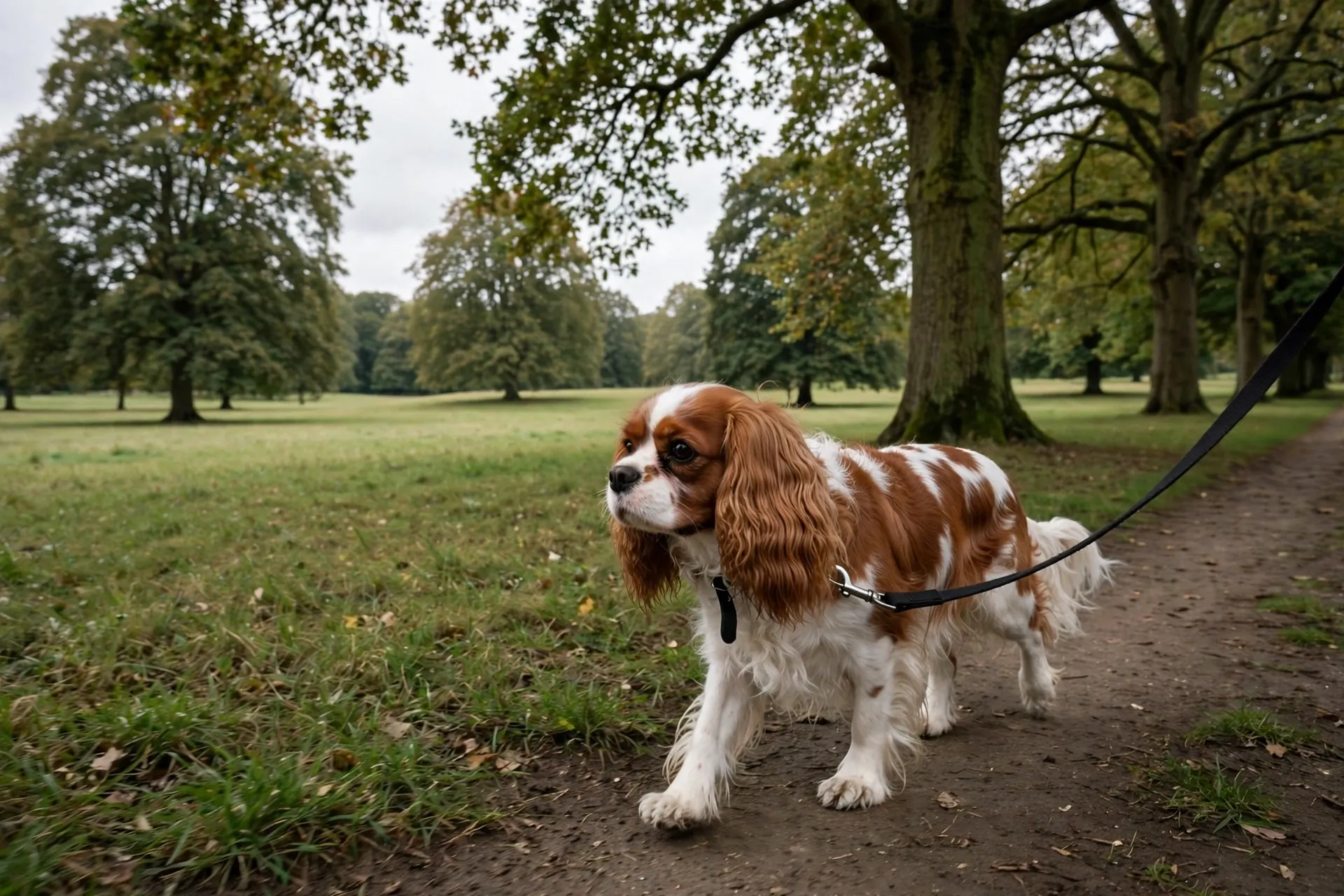
Every breed guide should begin with the dog's natural rhythm, and with a Cavalier that rhythm is unmistakably gentle. This is a small companion spaniel, typically weighing roughly five to eight kilograms, bred for centuries to be near people rather than to range across fields. On holiday that heritage shows up as a dog who trots happily beside you for a modest walk, settles readily in a cafe corner, and then expects — reasonably, by Cavalier standards — to spend the next hour asleep against somebody's leg. Planning a Cavalier King Charles Spaniel holiday in the UK therefore starts with tempo rather than mileage: several short outings spread through the day will suit most Cavaliers far better than a single heroic walk followed by collapse.
That gentle framing is not a limitation to work around; it is the design brief for the whole trip. Choose a base where good things are close — a village with a green, a short riverside path, a pub garden within an easy stroll — so that nobody has to drive forty minutes to find the day's only walk. Build in proper pauses between outings, because a Cavalier who has rested well will enjoy the next short walk far more than a tired one dragged out again too soon. And keep the group's expectations aligned before you book: if your travelling companions want ten-mile ridge walks, either split the party for those days or choose a different break, rather than quietly hoping a small spaniel will rise to an itinerary that was never shaped for her.
Individual variation matters here as much as breed generalities. A fit young Cavalier may cheerfully manage more than an elderly one with stiff joints, while a dog who is carrying extra weight will tire sooner and overheat faster. Watch the dog in front of you on your normal walks at home in the weeks before the trip: how far does she walk before her pace drops, how long does she sleep afterwards, and which surfaces does she prefer? Those honest home observations are a better planning tool than any generic distance figure, and they will help you choose walks, stays and travel days that feel generous rather than demanding.
Health awareness, handled calmly and led by your vet
Cavaliers are a breed where general health awareness genuinely matters, and a holiday guide would be doing owners a disservice by pretending otherwise. The breed is known in veterinary literature for a higher prevalence of certain conditions, including heart valve disease that becomes more common with age, and responsible breed advice has long encouraged regular veterinary checks. Nothing in this guide can or should diagnose anything about your individual dog. What it can do is point you to the only conversation that counts: a pre-trip chat with your own vet, who knows your dog's history, can listen to her heart, review any medication, and advise honestly on how much exercise and travel is sensible for her at this stage of her life.
Treat that vet visit as part of the holiday budget and timetable, ideally a few weeks before you go rather than the day before. Ask about exercise tolerance in plain terms — how long a walk, how often, and what signs should make you stop and rest. Ask whether any medication needs to travel with you in hand luggage rather than a packed bag, how it should be stored in a hot car or a warm cottage, and what you should do if a dose is missed or a repeat prescription runs out while you are away. If your dog has any known condition, ask for a brief written summary you can carry, so that an unfamiliar vet at your destination is not starting from nothing if you need help.
On the trip itself, calm observation beats anxious monitoring. Learn your dog's normal resting breathing and usual energy pattern at home, so that a change on holiday — unusual tiredness, reluctance to walk, coughing, or breathing that seems laboured at rest — stands out to you as a change rather than blending into holiday strangeness. If you notice something that worries you, the right move is always the same: rest, keep her cool and comfortable, and contact a vet — your own practice by phone for advice, or the local practice where you are staying. Our guide to senior dog travel covers travelling with older and less robust dogs in more depth, and much of it applies to any Cavalier whose vet has advised a quieter life.
Walks that fit a small spaniel
The ideal Cavalier walk in Britain is short, interesting and full of sniffing: a parkland circuit, a canal towpath stretch between two bridges, a village loop that passes a bakery, or a woodland ride where the surface is soft and the gradient is kind. Sniffing is not wasted time for this breed — it is the main event, providing mental engagement without physical strain — so choose routes where lingering is pleasant rather than routes where the only reward is reaching the far end. Two or three outings of twenty to forty minutes, adjusted to your vet's advice and your dog's own signals, will leave most Cavaliers contentedly tired in the best way.
Surfaces and gradients deserve more attention than owners of bigger dogs usually give them. Steep, stepped paths that a Labrador takes in stride can be a genuine workout for short legs, and long descents are hard on joints. Shingle beaches are similarly deceptive: charming for ten minutes, exhausting for forty. Grass, firm earth paths and quiet lanes are the kind surfaces; wet cobbles and polished stone floors in historic towns are slippery ones worth crossing slowly. If a famous walk is on your list, research its profile honestly and consider doing the flat first section and turning back — a Cavalier will not feel cheated, because she never knew the summit existed.
Carry water even on short walks, and plan a rest stop into any outing over half an hour — a bench, a wall, a cafe with outdoor seating. In warm weather, shorten further and walk early or late; the heat section below explains why this breed needs that caution. And keep the lead arrangements simple and kind: a well-fitted harness is often more comfortable than a collar for a small dog who pulls towards interesting smells, and a standard-length lead gives enough freedom to sniff without tangling around other walkers on a narrow towpath.
Warm weather: shade, water and low expectations
British summers rarely trouble the record books, yet a handful of genuinely hot days each year are exactly when small companion dogs struggle, and Cavaliers — with their enthusiasm for being close to warm humans and their modest exercise tolerance — should be treated as a heat-cautious breed. The rules are simple and worth stating plainly: walk in the cool of early morning and evening, rest in shade or indoors through the middle of the day, offer water frequently, and never expect a hot dog to keep up with a human itinerary. Pavements that feel merely warm to your palm can be uncomfortable for small paws, and a dog walking close to hot tarmac is breathing the hottest air on the street.
Choose accommodation with heat in mind, not just charm. A ground-floor room with a door onto a shaded garden beats a top-floor conversion under a slate roof; a cottage where you can create a through-draught beats one sealed against the sun. Take a familiar lightweight blanket rather than a thick padded bed in summer, position the bed out of direct sun, and keep a spare bottle of water specifically for the dog in your day bag. Our wider guide to travelling with a dog in hot weather covers warning signs of overheating and what to do — read it before a summer trip, because heatstroke is an emergency where minutes and correct first steps matter.
Finally, the car rule that runs through every guide on this site applies without exception: never leave a Cavalier alone in a parked car in warm weather, and plan shopping and attraction stops so that a person is always with the dog. A small dog in a carrier is still a dog in a hot car. If an attraction cannot accommodate the dog and nobody can stay with her, that attraction moves to a different day or a different holiday — the breed's whole appeal is companionship, and a trip designed around her should honour it in the logistics as well as the photographs.
Choosing a calm stay where your dog can stay close
Accommodation for a Cavalier should be judged on calm and closeness rather than on facilities for dogs in general. A quiet cottage on a village edge, a small inn where dogs are welcome in the bar, or a ground-floor apartment with its own door will usually beat a large, busy hotel with long echoing corridors, slamming doors and a lift that becomes a social event every time it opens. Ask hosts specific questions before booking: which room or unit would you be in, how many stairs are involved, how close is the nearest patch of grass for a last evening toilet trip, and are dogs welcome in the spaces where you will actually spend time, or confined to the bedroom?
Stairs deserve a special mention because they interact with both age and health. A young, fit Cavalier manages ordinary stairs without drama, but an older dog — or one whose vet has advised limiting exertion — may find a third-floor flat genuinely difficult several times a day. Ground-floor stays, or buildings with a reliable lift, remove that daily strain entirely, and booking them is one of the kindest upgrades you can give an older companion dog. While you are checking, also look at flooring: polished wood and tile throughout can be slippery for a small dog with feathered paws, so take a washable rug or two to create confident footing between bed, door and bowl.
Evenings are when this breed's preferences become non-negotiable: your Cavalier expects to be where you are. Choose stays where that is easy — a sitting room she can share, a pub downstairs that welcomes dogs, a garden she can potter in while you read. A stay that technically accepts dogs but expects them to sleep alone in a utility room will produce a miserable dog and, quite possibly, a miserable night for the whole property. If a host's rules are ambiguous on this point, ask directly before paying a deposit; clarity now is kinder than negotiation on arrival.
Travelling with an older Cavalier
Many Cavaliers in Britain are cherished older dogs, and holidays with them can be some of the most rewarding trips an owner takes — provided the trip is designed around comfort rather than sightseeing ambition. Start with the journey itself: an older dog benefits from a familiar, supportive bed on the back seat or in a secured crate, frequent stops on long drives for water, a stretch and a toilet break, and a step or portable ramp if jumping in and out of the car has become a strain. Our guide to dog car safety explains restraint choices and journey planning in detail, and it is worth reading with older joints specifically in mind.
At the destination, routine is the older dog's anchor. Keep feeding times, medication times and bedtime close to the pattern from home, set up her bed in a quiet corner on arrival before you unpack anything else, and let the first evening be deliberately boring. Older dogs often sleep more deeply and startle more easily, so position the bed away from doors and passing feet, and make sure grandchildren and visiting dogs understand that a sleeping Cavalier is to be left in peace. If your dog takes regular medication, pack more than the trip requires, split it between two bags, and keep your vet's summary and your home practice number in your phone.
Build the itinerary with honest margins. One modest outing and a long afternoon of companionship will usually make an older Cavalier's day complete; a second short potter before dinner is a bonus, not an obligation. Watch for the quiet signals that she has had enough — seeking her bed, turning away from fuss, lagging on a familiar route — and treat retreating early as good ownership rather than a spoiled plan. The trips owners remember fondly with old dogs are rarely the ones with the longest attraction lists; they are the ones where the dog was comfortable, included and unhurried from start to finish.
Company, separation and the dog who follows you to the bathroom
If there is one trait that defines travelling with this breed, it is devotion that shades into dependence. Cavaliers were shaped over centuries as lap companions, and many genuinely struggle with being left alone, even for periods that other breeds take in their stride. On holiday this has a practical consequence that should shape your booking from the start: plan on taking your Cavalier almost everywhere, and treat any activity that excludes dogs as an activity that also excludes you, unless another trusted person from your party is staying behind with her by choice rather than by rota resentment.
Test alone-time honestly at home before assuming a holiday version will work. A dog who cannot settle alone in her own kitchen will not settle better in a strange cottage with unfamiliar sounds through the walls; she will likely do worse, and barking or distress in a holiday let risks both her welfare and your deposit. If your dog does cope with short, practised absences, keep holiday absences shorter still, leave her with a familiar blanket and a safe chew in the room she knows best on the trip, and return without drama. If she does not cope, that is not a training failure to fix in a week — it is information to design around, as our guide to calming anxious dog travel explores for unsettled travellers generally.
The upside of this dependence is considerable: a Cavalier is one of the easiest breeds in Britain to include. Small, polite, quiet by spaniel standards and generally delighted by cafes, pubs, gardens and gentle attractions, she fits the rhythm of a companionable holiday better than almost any other dog. Choose destinations that reward that inclusion — market towns, garden visits with dog access, short heritage railway rides where dogs are carried, and stays where the dog's presence at breakfast is normal — and the supposed limitation becomes the entire point of the trip.
A Cavalier packing list and final checks
Pack for comfort, familiarity and small contingencies. The essentials: food measured out plus a spare day or two, any medication with the vet summary, a harness and lead plus a spare lead, water and a light travel bowl, poo bags, a familiar blanket that smells of home, a supportive travel bed, a washable rug for slippery floors, towels for wet paws and feathering, and a lightweight drying coat if you are travelling in the cooler months — those long ears and leg feathers collect mud and water with impressive efficiency. Grooming kit matters more for this breed than most: a brush and comb for ears and feathering every day or two stops holiday tangles becoming a grooming emergency on your return.
Add a small set of just-in-case items: your home vet's number and the number of a practice near your destination saved in your phone, a recent clear photograph of your dog in case she is ever separated from you, a tag with your mobile number on her collar, and a note of her microchip details. Check before you leave that her microchip registration holds your current phone number — it is a two-minute online task that owners often discover is years out of date. In the car, keep her kit in one grab-bag rather than distributed through the luggage, so that a motorway stop does not require unpacking half the boot to find a water bowl.
In the final week, do three calm things: have the vet conversation described earlier if you have not already, walk a typical holiday-length route at home to confirm your pacing assumptions, and do a trial settle in a new place if your dog is inexperienced — an afternoon at a friend's house or a single night away nearby teaches you both more than any amount of reading. Then go, and let the trip be what this breed asks for: unhurried, companionable and close. A Cavalier King Charles Spaniel holiday done at the right tempo is not a reduced version of a dog holiday. It is a reminder of what dog holidays were always supposed to feel like.
Practical questions
Before you go
How far can a Cavalier King Charles Spaniel walk on holiday?
Most Cavaliers do best with several short walks rather than one long one — many are content with two or three outings of around twenty to forty minutes, but the right amount depends on your dog's age, weight, fitness and health. Ask your vet for individual guidance before you travel, build up gradually, and let your dog's pace and enthusiasm on the day set the limit rather than a fixed distance.
Are Cavaliers prone to heart problems I should know about before travelling?
The breed is known to have a higher prevalence of heart valve disease, particularly with age, which is one reason regular veterinary checks are widely recommended for Cavaliers. This guide cannot assess your dog; only your vet, who can examine her and knows her history, can advise on her health and on sensible exercise and travel. Book that conversation before any trip, and carry any medication and notes your vet advises.
Can a Cavalier be left alone in a holiday cottage?
Many Cavaliers find being left alone difficult, even in familiar surroundings, and a strange property usually makes settling harder rather than easier. If your dog has been gradually trained to cope with short absences at home, keep holiday absences shorter still; if she has not, plan the trip so she is not left. Check the property's rules too, as many lets prohibit leaving dogs unattended regardless of breed.
How do I keep a Cavalier cool in a British summer?
Walk early and late, rest in shade or indoors through the hottest part of the day, offer water frequently, choose ground-floor accommodation that stays cool, and never leave your dog in a parked car. Shorten walks on hot days and watch for signs of overheating such as heavy panting or unusual tiredness; if you are worried, cool her, rest her and contact a vet promptly, as heatstroke is an emergency.
Is a Cavalier a good choice for a first dog-friendly holiday?
A Cavalier is often an excellent first holiday dog: small, generally sociable, quiet by spaniel standards and easy to include in cafes, pubs and gentle attractions. The trade-offs are the need for near-constant company, modest exercise limits and the importance of vet-led health awareness. If your ideal break is gentle and companionable rather than adventurous, few breeds fit it better.