This guide is independent and contains no paid placement. If affiliate links are added later, they will be clearly marked and will not change our editorial checks.
Check the breed rule in writing before you book, walk early or late in shade, keep the car and the room cool, and give an independent Chow Chow a quiet retreat from strangers. If any one of those four is missing, change the plan rather than hoping the dog will adapt.
Ask permission before you fall for a place
Most dog-holiday advice starts with the destination. Chow Chow advice should start with permission. A Chow is a medium-to-large, heavily coated, independent dog, and that combination is exactly what makes some hosts, insurers and transport operators pause. Nothing about that pause is personal, and none of it is worth arguing about after you have paid a deposit. The efficient order is therefore reversed: confirm that this particular dog is welcome in this particular room, on this particular route, and in the shared areas you will actually use, and only then get excited about the view.
The reason permission matters so much is that dog-friendly is not one rule. It is a stack of separate decisions made by different people. A hotel may welcome dogs in principle but restrict them to certain floors. A cottage owner may allow one dog but not a second. A ferry operator may carry dogs in vehicles but not in cabins. A beach may allow dogs all year on one stretch and ban them in summer on the next. Each decision can be reasonable on its own and still add up to a trip that does not work for your dog. Checking the headline is not checking the trip.
Start with a single honest message, sent before booking, and keep the reply. Name the breed, the age, the approximate weight and the number of dogs. Say whether the dog is comfortable with strangers, children and other dogs, or whether it prefers space. Mention anything that affects the property, such as heavy seasonal shedding or a need for a ground-floor room away from a busy corridor. Then ask three direct questions: is this breed accepted for this booking, are there any size, room or shared-area limits, and does the answer change if you add a second guest, a second dog or a different arrival date? A host who answers all three clearly is a host you can plan around. A host who answers only with a slogan has not answered at all.
Written confirmation protects both sides. If a problem arises on arrival, a saved email saying that a Chow Chow is accepted in a named room is far more useful than a memory of a friendly phone call. The same applies to deposits and cleaning charges. Ask for the total dog-related cost in writing, including any per-night fee, deep-clean charge or refundable deposit, and ask what behaviour or damage would trigger an extra charge. Owners who declare a thick-coated dog honestly are rarely surprised by a cleaning fee; owners who hope nobody notices the shedding usually are.
Permission is also a transport question, not only a bedroom question. Before a long journey, check the rules of every leg: the car is yours, but trains, buses, ferries and taxis each have their own conditions, and some require a carrier, a muzzle or a specific ticket type. If a leg does not work, change the leg early, while alternatives are still available, rather than discovering the problem at a station barrier with a tired dog and a full car. Where a rule is unclear or has recently changed, check the official guidance before you travel rather than relying on a forum post from last year.
Build the trip around shade, not sights
A Chow Chow carries a thick double coat designed for cold weather, and that coat changes what a British summer means. A day that feels pleasantly warm to a person in a T-shirt can be hard work for a dog wearing the equivalent of a winter coat that cannot be taken off. The coat insulates, so it slows heat gain as well as heat loss, but it also traps the heat the dog generates by walking, panting and simply being active. The practical result is simple: heat management is not one item on a Chow trip checklist, it is the timetable itself.
Think of each day as having a heat budget. The budget is largest before about ten in the morning and after about six in the evening, smaller in dappled woodland, and smallest of all on exposed tarmac, sand or a sun-baked patio at midday. Spend the budget on the walk that matters most, then protect the rest of the day. A short, shaded morning walk, a long indoor or garden rest through the middle of the day, and a second gentle outing in the evening will suit most Chows far better than a heroic midday hike followed by a panting dog in a hot car. Sightseeing can fill the middle of the day, provided the dog is resting somewhere genuinely cool and not waiting in a vehicle.
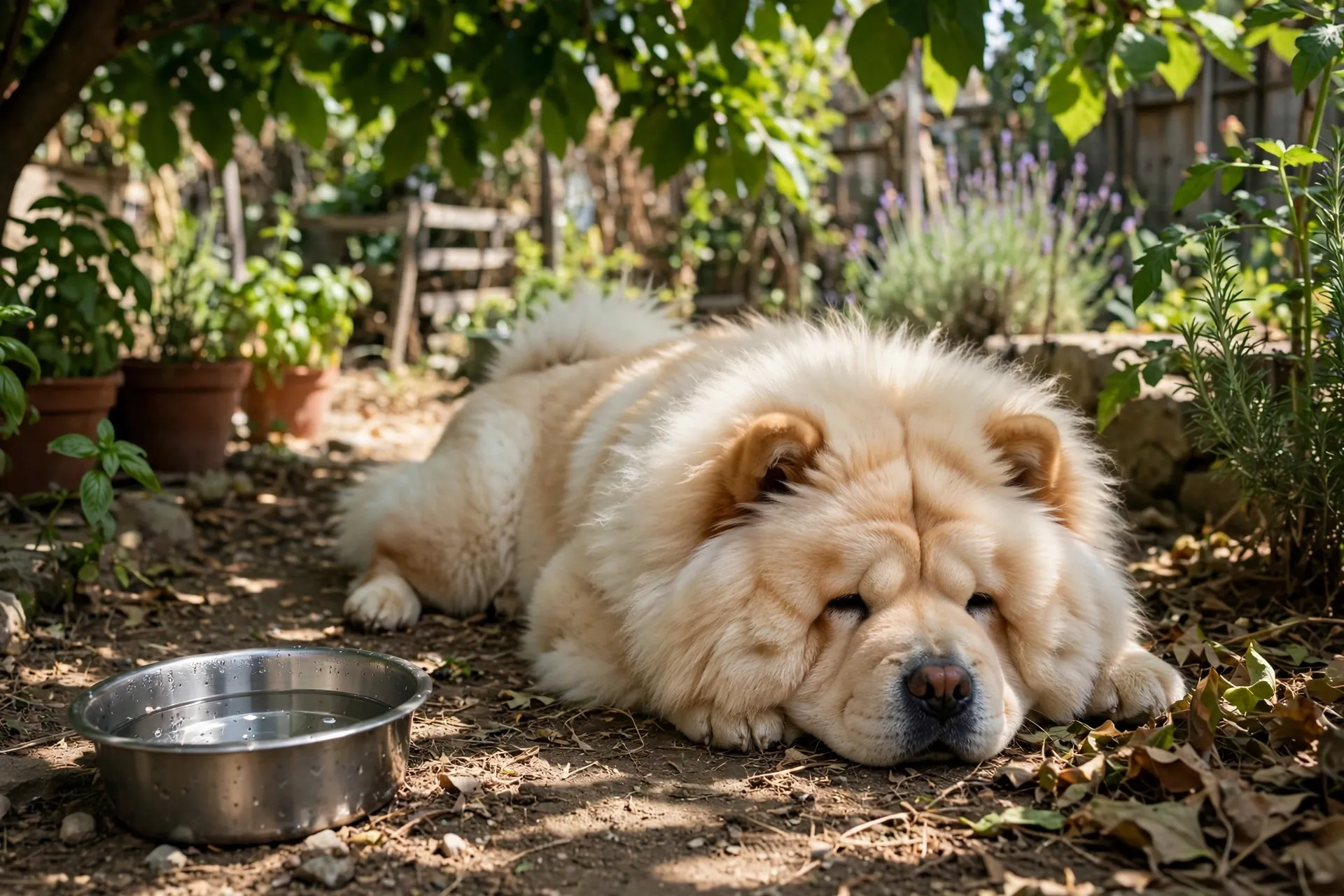
Shade is not all equal, and this is where route reading matters. A thin line of trees beside a road gives less protection than a woodland path with a closed canopy. A breezy coastal path helps more than a still, humid valley, even at the same air temperature. South-facing patios, conservatories and cars parked in sun all warm up far faster than the forecast suggests. When you arrive somewhere new, check the shaded resting spot before you check the view: is there a cool floor, moving air, water within reach, and a place where the dog can lie flat and stretch out? If the only shade is a narrow strip that will move by noon, the plan needs adjusting.
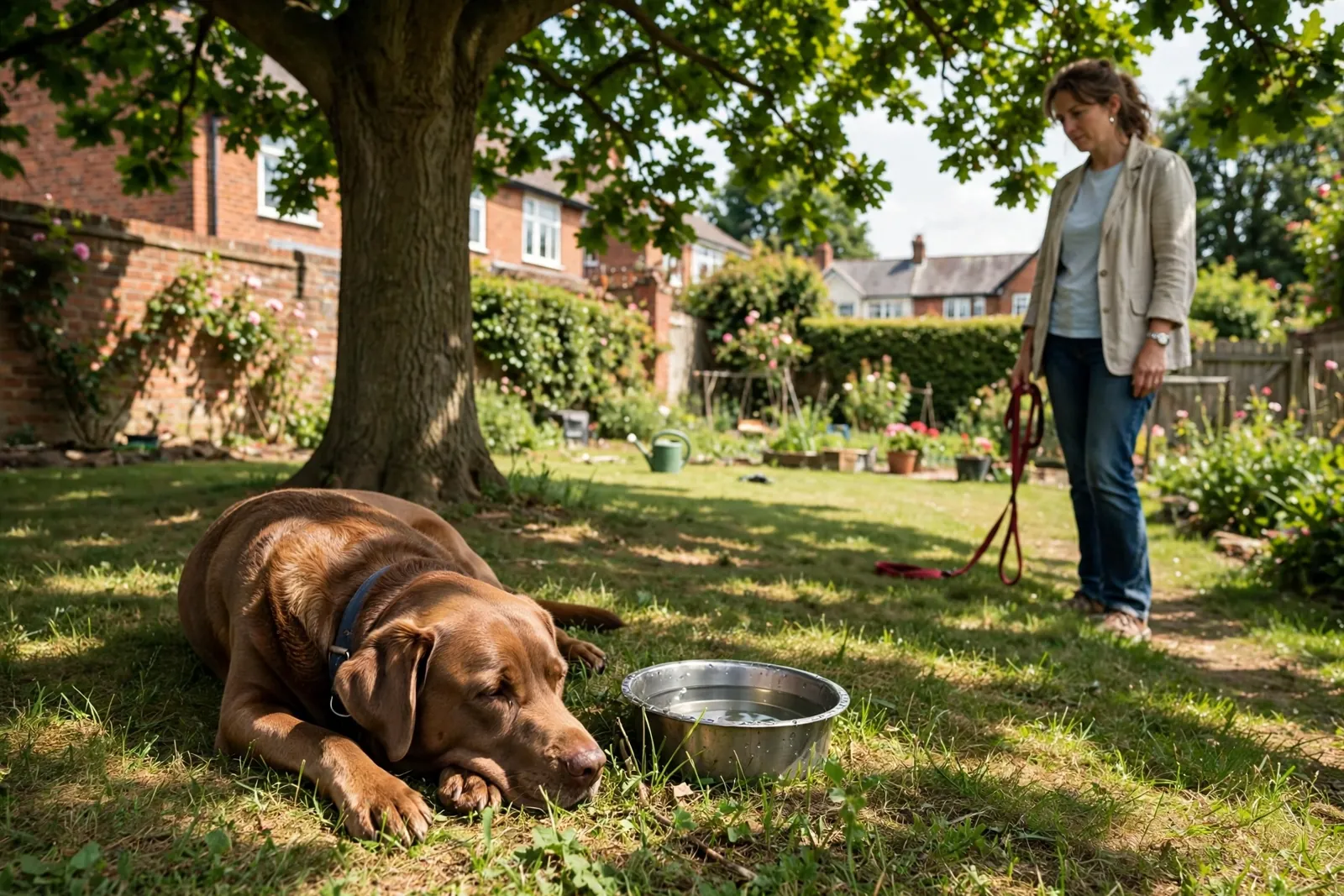
Water is part of the same system, not an afterthought. Carry more than you think you need, offer it often, and do not wait for the dog to ask. A collapsible bowl, a bottle for the dog alone, and a spare bottle in the car cover most days. Wetting the paws and belly can help a hot dog cool down, but do not plunge an overheated dog into cold water or cover it with ice, and seek veterinary advice promptly if panting does not settle, the dog becomes unsteady, vomits, or seems confused. Heat illness can develop quickly in a heavily coated dog, and the correct response is to stop, cool gradually, and call a vet, not to push on to the next viewpoint.
Finally, treat the forecast as a range, not a promise. A forecast of twenty-two degrees with high humidity, strong sun and no wind is a different day from twenty-two degrees with cloud and a breeze. Check the forecast for the place you will actually walk, not only the town where you sleep, because a sheltered inland valley and an exposed hilltop a few miles apart can feel like different seasons. If the day turns hotter than expected, the honest move is to shorten the plan. A missed attraction costs nothing; a dog pushed past its limit costs a vet visit and a ruined holiday.
A dog that chooses its people
Many Chows are loyal, dignified and deeply attached to their own household, and noticeably less enthusiastic about strangers. That is not a flaw to be trained out of a dog on holiday, and it is certainly not a reason to force introductions in a busy pub garden. It is a planning fact, like the coat. A trip that gives an independent dog control over distance from strangers will be calmer than a trip that treats every new person as a friend the dog has not met yet.
The difference shows up in small moments. A Chow that is happy to watch the world from a quiet corner may stiffen when a stranger leans over to stroke its head. A dog that walks beautifully on an empty lane may become watchful in a crowded market street where hands reach out from every direction. A dog that settles well in a cottage may guard a doorway when cleaners, delivery drivers or neighbouring guests pass through. None of this means the dog cannot travel. It means the itinerary should favour places where the dog can observe without being touched, approached or cornered, and where you can step aside easily when the crowd thickens.
Practical choices follow from that. Choose a table at the edge of a pub garden rather than one in the middle of the foot traffic. Choose a cottage with a private garden over a hotel corridor where every guest passes the bedroom door. On walks, choose wider paths where you can create distance, and use a short lead in busy stretches rather than a long line that lets strangers close in before you can react. Teach visitors, kindly and firmly, that this dog is admired from a distance: a simple sentence, delivered with a smile, prevents most unwanted handling. Children in particular should be told not to run up to a Chow, not to hug it, and not to put a face near its face, however fluffy and inviting it looks.
Grooming and handling on the road deserve the same care. A Chow that tolerates brushing at home may object to a stranger doing the same work in an unfamiliar salon, especially if the coat is matted or the dog is tired after travel. If grooming is needed during a longer trip, book ahead, explain the dog's handling preferences in advance, and stay nearby if the groomer allows it. The same applies to vets: take the dog's usual muzzle training, lead handling and settling routine with you, and tell the practice in advance if the dog is wary of strangers, so the appointment can be planned with fewer surprises.
None of this requires keeping a Chow hidden away. It requires giving the dog a job that suits it: walking, sniffing, watching, resting in a chosen spot, and returning to familiar people. Dogs that are allowed to choose distance usually choose to relax. Dogs that are repeatedly put in situations where strangers decide the distance usually choose to warn. Plan for the first outcome, and the second becomes much less likely.
Keep the car as cool as the walk
For most UK trips, the car is the most dangerous heat trap in the whole itinerary, and also the easiest to control. A parked car warms up with frightening speed, even on a day that does not feel extreme, and even with a window left ajar. The rule is absolute and needs no qualification: never leave a dog alone in a parked car on a warm day, for any length of time, for any errand. If the plan requires leaving the dog in the car while you visit an attraction, a shop or a restaurant, the plan is wrong and must be changed before departure.
A moving car needs its own preparation. Before a long drive, check that the air conditioning works properly, that air reaches the back of the vehicle where the dog travels, and that sun shades or tinted windows reduce direct sun on the dog's space. A Chow travelling in a boot with no airflow will overheat even with the front of the car feeling comfortable, so test the airflow from the dog's position, not the driver's seat. Stop regularly on long journeys, not only for toilet breaks but for water, shade and a chance for the dog to cool down and stretch. A dog that arrives panting and restless has not had a rest stop; it has had a delay.
Restraint matters too, and it should be settled before the trip, not improvised on the motorway. Whether you use a crash-tested harness, a secured crate or a boot guard with a divider, the dog should be familiar with the setup from short local journeys, and the setup should leave room for the dog to lie flat, turn, and pant with its mouth open. A harness that is too tight across the chest, a crate with no ventilation on one side, or a boot packed so tightly that air cannot circulate all turn a safe journey into a hot one. Our guide to dog car safety compares harnesses and crates in detail, including fitting and boot layouts.
Trains, buses and ferries bring a different version of the same problem: heat and crowding without your control. A summer train carriage with no air conditioning, a crowded bus on a warm afternoon, or a ferry lounge full of people can all push a coated dog past comfort. Where a choice exists, travel at cooler times, choose a quieter carriage or deck, and carry water and a cooling mat. If a service is cancelled or delayed on a hot day, have a fallback that does not involve waiting on a sun-baked platform with no shade. A little pessimism in planning prevents a great deal of improvisation in heat.
Finally, think about what happens when you arrive. A dog that has travelled well still needs a cool-down period before a walk, a meal or a greeting from strangers. Let the dog drink, lie on a cool floor, and settle in the shade for twenty minutes before asking anything else of it. The arrival routine sets the tone for the whole stay, and a calm arrival is worth far more than arriving half an hour earlier.
The coat travels too: grooming, mud and shedding
A Chow coat is not decoration. It is a thick double coat with a dense undercoat, and it will shed, mat, collect mud and fill a holiday home with fluff in a way that surprises first-time owners. Planning for the coat is therefore planning for the accommodation, the car and the host relationship all at once. A host who has been warned about shedding and shown that you have brought your own covers and brushes will be far more relaxed than a host who discovers a drift of undercoat on a dark sofa on the last day.
Before departure, groom thoroughly and check for mats behind the ears, under the collar, in the armpits and around the back of the legs, where mats form first and tighten fastest. A mat that is merely uncomfortable at home becomes painful when a harness rubs it for hours on a walk, and wet mats after swimming or rain dry slowly and can irritate the skin underneath. Pack the brush the dog is used to, a comb for checking, and a towel for drying, and groom little and often during the trip rather than saving it all for one long session at the end. If you are unsure whether a particular area is matted or sore, check the official guidance before you travel or ask your vet or groomer for advice in advance, rather than guessing on the road.
Mud is the coat's other travelling companion. A Chow that has paddled through a stream or crossed a muddy field will carry a remarkable amount of the countryside back to the accommodation, and a thick coat holds mud far longer than a short coat does. Pack a drying coat or several large towels, a portable shower or a large water bottle for rinsing paws and belly, and a washable mat for the doorway. Ask the property where muddy dogs should be dried and whether there is an outdoor tap or a utility area. Drying the dog properly before it reaches carpets and bedding protects the deposit, the dog's skin, and your evening.
Shedding deserves a frank conversation with any host. Chows shed heavily at seasonal changes, and a holiday that coincides with a coat blow will produce enough fur to fill a carrier bag. Bring washable throws for sofas and beds, a lint roller, and a car cover that can be shaken out, and offer to run a quick vacuum before departure if the property provides one. Most hosts accept shedding gracefully when it is declared and managed. Almost none enjoy discovering it. The same honesty helps with insurance and cleaning terms: ask what is covered, what counts as damage rather than normal shedding, and whether a professional clean is expected after a stay with a heavy shedder.
One persistent question is whether to clip a Chow for summer. The short answer is to ask a professional who knows your dog, and to be wary of any simple yes. A double coat insulates in both directions, clipping can alter regrowth and expose skin to sunburn, and a clipped dog still needs shade, water and sensible timing. For most holiday purposes, a well-groomed, mat-free coat, a shade-based timetable and cool resting places will do far more than a drastic cut. If a vet or groomer does recommend trimming for a medical reason, get the advice in writing and follow it, but do not treat clipping as a substitute for heat planning.
Read the small print like a breed owner
Breed restrictions in the UK are rarely a single national list that applies everywhere. They are a patchwork of different rules made by different organisations for different reasons, and that patchwork is exactly why a Chow owner needs to read carefully. A holiday park, a hotel chain, a rental agency, an insurer and a transport operator may each use different wording, different lists and different exceptions. The question is never simply whether Chows are allowed in Britain. It is whether this Chow is allowed by this organisation, for this booking, under these conditions.
Start with the wording. Some policies name specific breeds. Others set a weight or height limit that excludes larger dogs without naming them. Others say that acceptance is at the manager's discretion, which means the answer can change with the person on duty. Others exclude dogs described as aggressive, dangerous or of a fighting type, a phrase that can be applied very differently depending on who is judging. If a policy uses any of these phrases, ask for a direct answer about your dog by name, in writing, before you pay. A vague policy plus a specific written confirmation is workable. A vague policy plus silence is not.
Insurance is the quiet part of the small print that owners often miss. Pet insurance, travel insurance and third-party liability cover can all contain breed conditions, exclusions or higher excesses, and the terms that matter are the ones that apply on the day of an incident, not the ones that applied when the policy was bought. Read the breed section of your policy before a trip, and if the wording is unclear, ask the insurer directly and keep the answer. Where a host, a venue or a transport operator asks for proof of insurance, have the documents ready in the form they accept, whether that is a printed summary or a digital copy on your phone.
Tenancy and short-let rules add another layer. A cottage booked through an agency may be subject to the owner's own rules as well as the agency's, and the stricter of the two will apply in practice. A hotel that accepts dogs may still restrict them from restaurants, pools, gyms and gardens, which matters if you planned to eat together or exercise together on site. Ask for the full set of dog rules, not only the booking page headline, and check whether the rules change at weekends, in school holidays or during events when a property is busier and stricter.
Finally, keep a paper trail that would convince a stranger. Save booking confirmations that name the breed, emails that confirm acceptance, insurance summaries, vaccination records and any vet letter that explains the dog's temperament or handling needs. Keep them in one folder, physical or digital, that travels with you. If a question arises at check-in, producing a clear document in thirty seconds resolves most disputes. If a question arises and you have only a vague memory, the dispute usually resolves in favour of the property, and your dog is the one who loses the room.
Design walks a thick coat can enjoy
A good Chow walk is designed backwards from the coat, the heat and the dog's love of space. Start with shade and water, then add distance, then add interest, in that order. A walk that is long, exposed and impressive on a map is a poor walk for a heavily coated dog on a warm day. A walk that is shorter, shaded, near water and free of crowds is a walk the dog will actually enjoy, and will still leave you feeling that you have seen something worthwhile.
Woodland paths are the Chow walker's best friend, provided they are genuinely shaded and not just fringed with trees. Look for a closed canopy, a path that stays out of direct sun for most of its length, and a stream or pond where a dog can paddle, where paddling is allowed and the water is safe. Riverside paths offer similar benefits, but check the ground: a riverside meadow in full sun is hotter than a woodland path, and a towpath shared with cyclists needs a short lead and good control. Coastal paths can be wonderful in a breeze and miserable in still heat, and sand reflects heat and can burn paws, so test the surface with your hand and keep beach walks for cooler hours.
Hills deserve honesty. A Chow can enjoy a steady climb in cool weather, but a steep hill in heat is a different proposition, and the descent matters as much as the ascent, because a tired, hot dog is less steady on its feet. Choose routes with a clear turnaround point that you are genuinely willing to use. The turnaround is not a failure. It is the plan working: you set a point, you watched the dog, and you turned back while the dog was still happy. Dogs do not keep score of miles. They remember whether the walk felt good.
Water on a walk is both a pleasure and a risk. Many Chows enjoy paddling, but a thick coat takes a long time to dry, and a dog that swims in cold water and then sits in a draughty car can chill quickly. Check whether swimming is allowed, whether the water is affected by blue-green algae or strong currents, and whether there is a safe, shallow entry point. Our guide to dog water safety covers algae, tides, cold water and life jackets in full. After any swim, dry the dog as well as you can, check for mats forming in the wet coat, and give the dog time to warm up before the next activity.
Crowds, livestock and other dogs are the other design constraints. A path that runs through a sheep field, a busy dog exercise area or a narrow lane with no passing places will demand more control than a wide forest track. Where livestock is present, keep the dog on a lead, even if it usually ignores sheep, because the law and the farmer's patience both run out quickly after a single chase. Where other dogs are off lead and boisterous, create distance early rather than hoping for a calm greeting. A Chow that is given space on a walk will usually give you a calm walk in return.
Choose the quiet room, not the pretty room
When you compare stays, it is tempting to choose the room with the best photograph. For a Chow, choose the room with the best quiet. A ground-floor room away from the main corridor, a cottage at the edge of a site rather than beside the play area, or a hotel room facing a garden rather than a car park will all do more for the dog's sleep than a larger bed or a better view. Noise, foot traffic and unexpected visitors are the things that keep an independent dog alert, and an alert dog does not rest well.
Ask specific questions about the room, not the property in general. Is the room on the ground floor, and are there steps? Does the corridor outside the door carry guests all evening, or is it quiet after a certain hour? Is there a garden, terrace or quiet outdoor space where the dog can toilet last thing at night without a long walk through busy areas? Can the dog be with you in the restaurant, the bar or the breakfast room, or will you be eating separately for the whole stay? Each answer changes the trip, and each answer is specific to a room, not to a brand.
Inside the room, recreate the dog's home base as closely as you can. Bring its own bed, its usual blanket, its food and water bowls, and anything it settles with at home. Place the bed in a corner where the dog can see the door but is not in the thoroughfare, and keep the routine familiar: same feeding times, same last walk, same settling cue. A dog that knows where its place is in a new room will use it. A dog that is expected to improvise on a strange bed in a strange corner will pace instead.
Alone time needs the same honesty as everything else in this guide. Many properties forbid leaving a dog unattended, and many dogs, Chow or otherwise, do not settle well alone in a strange room in any case. If your dog does settle alone at home, test the same routine in a new place in short stages, and never assume a long absence will work just because a short one did. If your dog does not settle alone, plan the trip so the dog comes with you, or choose a stay where that is genuinely possible. A holiday built around leaving the dog behind is a holiday that will be spent worrying about the dog.
Neighbours are the final consideration, and a little courtesy goes a long way. Tell neighbouring guests, where appropriate, that you have a dog, and ask the property whether there is a quieter location if your dog is watchful at night. Keep the dog's barking in mind when choosing a room: a dog that alerts at every corridor noise will be happier, and will make happier neighbours, in a room with less corridor noise. Our guide to dog friendly hotels in the UK explains room types, pet fees and dining rules in detail, and it is worth reading alongside the specific questions in this section.
A month-by-month sense of the year
Britain does not have a single Chow season. It has a year of changing trade-offs, and the best month depends on what you value most: cool weather, quiet paths, open beaches, or a particular event. The notes below are a starting point for planning, not a forecast. Local weather, a dog's age and fitness, and the specific property will always matter more than a calendar, and where a rule or a seasonal restriction is uncertain, check the official guidance before you travel.
Winter, from December to February, is often the Chow's easiest season for temperature, because a thick coat is finally an advantage. Walks are cooler, the dog is more comfortable, and many inland paths are quiet. The trade-offs are mud, short daylight, wet coats that need thorough drying, and the risk of ice on paths and roads. Fireworks around the New Year can unsettle some dogs, so check local displays and plan a quiet room if your dog is noise-sensitive. A winter cottage with a drying area and a warm, draughty-free room is worth more than a winter cottage with a view.
Spring, from March to May, is often the sweet spot. Temperatures are moderate, woodland paths are shaded but not yet humid, and many beaches are still open to dogs before summer restrictions begin. Lambing season, however, brings strict livestock rules and some paths may be closed or require dogs on leads, so check local notices and keep the dog under close control near sheep. Spring also brings ticks in grassland and woodland, so check the dog after walks, especially around the ears, armpits and groin, and ask your vet about prevention before the trip.
Summer, from June to August, is the season that needs the most discipline. Beach bans apply on many popular stretches, midday heat makes long walks unwise, and busy resorts add crowds, noise and queues. That does not mean summer is impossible. It means summer trips should be built around early mornings, shaded woodland, cooler coastal breezes, and accommodation with a genuinely cool resting place. If summer is the only option, choose the north, the coast or higher ground where possible, and be ready to change the day's plan when the heat rises. Our guide to travelling with a dog in hot weather covers heatstroke signs, car rules and cool stays in detail.
Autumn, from September to November, is often underrated for Chows. The heat eases, many beach restrictions lift, woodland is at its best, and paths quieten after the school holidays. The trade-offs are mud returning, shorter days, and fireworks season in early November, which needs the same quiet-room planning as the New Year. Autumn storms can also affect coastal paths and ferry services, so check conditions before a long walk or a crossing, and have a wet-weather alternative that does not depend on the dog waiting in a car.
Across all seasons, two habits matter more than the month. First, check the specific rules for the specific place and date, because beach bans, livestock restrictions and property policies all change with the season. Second, watch the dog, not the calendar. A cool but humid day in May can be harder than a bright, breezy day in July, and a fit young Chow will cope differently from an older dog with a heavier coat. The calendar helps you choose; the dog tells you whether the choice was right.
The booking script and packing list
Pulling the whole guide together into a single pre-trip routine makes it far easier to act on. Use the script below as a starting point, adapt it to your dog, and send it before you pay. A few minutes of writing before booking saves hours of negotiation after arrival, and it signals to a host that you are a careful owner, which is exactly the impression a Chow owner wants to make.
Start with the facts, then the questions. Write: the breed, age and weight of the dog, the number of dogs travelling, whether the dog is comfortable with strangers, children and other dogs, and any practical needs such as a ground-floor room, a quiet location, or a private garden. Then ask: is this breed accepted for this booking and this room, what are the dog-related charges in total, are dogs allowed in the restaurant, bar, garden and other shared areas, what is the rule on leaving a dog unattended, and what happens if the dog barks or a neighbour complains? If any answer is vague, ask again, politely, for the specific answer. Vagueness before payment becomes a dispute after arrival.
The packing list follows the same logic as the rest of this guide: shade, water, cool transport, coat care and a quiet base. Pack a collapsible bowl and spare water, a cooling mat, a sun shade for the car, and a lead that gives you control in crowds. Pack the dog's usual brush and comb, several large towels or a drying coat, a washable throw for furniture, and a lint roller for the inevitable shedding. Pack the dog's own bed and blanket, its usual food measured for the trip plus a spare day's supply, any medication in its original packaging, and a folder with booking confirmations, insurance details, vaccination records and the number of a vet near your destination. Add a first-aid kit that includes a thermometer if your vet has shown you how to use one, and know the signs that mean stop, cool gradually and call a vet.
On arrival, run a short routine before anything else. Check the room for hazards, including cleaning products, electrical cables, open windows and gaps in fencing. Find the shaded resting spot, the water point, the toilet area and the nearest vet, and save the vet's number in your phone. Walk the boundary of a garden or terrace before letting the dog off lead, and check gates, decking gaps and low windows. Give the dog water, its own bed and twenty quiet minutes before introducing it to new people, new rooms or a new walk. A boring first hour, as with so many dog holidays, is the fastest route to a relaxed first evening.
Finally, keep a trip note for next time. Record which properties welcomed the dog clearly, which walks had real shade, which rooms were quiet, and what you would change about timing or packing. Chow trips improve quickly with experience, because the variables are few and consistent: permission, heat, space and coat. Once you have found a property, a route and a routine that suit your dog, returning to them is not a lack of imagination. It is good planning, and it is how a dog that values familiarity gets a holiday that feels like a holiday.
Practical questions
Before you go
Do some UK stays and transport operators restrict Chow Chows?
Some do, and the wording varies. A policy may name breeds, set a size limit, or leave the decision to the individual property. Always declare the breed in writing before you pay, ask whether the answer covers the room, the grounds and any shared areas, and keep the reply with your booking.
How hot is too hot for a Chow Chow walk?
There is no single safe number, because humidity, sunshine, coat condition and fitness all matter. Walk early or late, choose shade, test the ground with your hand, carry water, and cut the walk short at the first sign of heavy panting or slowing down. On a warm day, a short shaded outing beats a long exposed one.
Should a Chow Chow be clipped for a summer holiday?
Do not assume clipping helps. A double coat insulates against heat as well as cold, and clipping can change how the coat grows back and how easily the skin sunburns. Ask your vet or groomer about your own dog before the trip, and plan around shade, water and timing instead of a drastic cut.
Can a Chow Chow be left alone in a holiday room?
Only if the property expressly allows it and your dog genuinely settles alone. Many stays prohibit unattended dogs or allow it only for a short, quiet period. Plan as if the answer is no, choose places where the dog can join you for meals or walks, and never leave a dog in a parked car.
What should I tell a host about a Chow Chow before booking?
State the breed, age, weight and whether the dog is used to strangers, children and other dogs. Add the practical details: coat shedding, grooming needs, any need for a quiet room away from foot traffic, and whether the dog will be crated or on a lead in shared areas. A short, honest message prevents most arrival-day disputes.
What goes wrong most often on a Chow Chow trip?
Three avoidable problems dominate: a midday walk on a warm day, a booking made before the breed rule was checked, and a stranger-heavy stay that gives an independent dog no quiet retreat. Fix those three in advance and most Chow trips become straightforward, if slower than planned.