Written independently, with no sponsored mentions. Cockapoos vary in size, coat and energy because they are a cross, so treat health points as background and ask your vet about your own dog. Confirm rules from official sources before you set off.
A Cockapoo holiday in the UK suits new owners well if you plan for three things: a lively, clever dog who needs real exercise and something to think about; a coat that mats quickly when it gets wet and muddy, so grooming kit and drying space matter; and a sociable temperament that loves inclusion but still needs training support in exciting new places. Pick a stay with a washable floor and an enclosed garden, pack brushes as seriously as boots, and keep routines — feeding, walking, settling — as predictable as you can.
Why so many Cockapoo owners are first-timers
Start with a fact that shapes this entire guide: a strikingly large share of Cockapoo owners are first-time dog owners. The cross between a Cocker Spaniel and a Poodle became one of Britain's most popular family dogs during the last decade, bought by many households who had never lived with a dog before. That is nothing to be sheepish about — enthusiasm and research count for a lot — but it does mean a Cockapoo holiday guide should not assume knowledge that other breed guides take for granted. So this one spells out the basics plainly: how much exercise is actually involved, what that famous coat really needs after a wet walk, and why a dog who is angelic at home can be noticeably less polished in a holiday cottage.
It also means planning your first trip at the right scale. Choose a short break — two or three nights — within a couple of hours of home for the first attempt, rather than debuting with a ten-day tour of three regions. A small first trip teaches you your dog's travel personality cheaply: whether she settles in the car, sleeps in a strange room, and copes with a pub garden, all with an easy drive home if it is not working. Owners who learn those lessons on a miniature trip plan their second, bigger one with confidence instead of hope, and their dogs arrive experienced rather than overwhelmed.
Finally, a word on expectations set by the internet. Cockapoos are marketed with a great deal of cheerful simplification — non-shedding, easy-going, ideal for everyone. The real dog is usually delightful but more specific: energetic from the spaniel side, bright and sometimes wilful from both sides, and carrying a coat that needs considerably more maintenance than the adverts suggest. A holiday planned for the real dog — exercised, brushed, trained and included — goes well. A holiday planned for the advert tends to unravel by the second rainy walk.
Energy: the spaniel engine under the teddy-bear coat
New owners are often surprised, a few months in, by how much dog lives inside a Cockapoo. The Cocker Spaniel parent is a working gundog bred to quarter fields all day, and many Cockapoos inherit a generous share of that drive: a typical adult needs around an hour or more of proper exercise daily, split across walks, plus play and mental work, with younger and fitter dogs wanting more. On holiday this is good news if you let it structure the day — a proper morning walk, a midday potter, an evening run-around — and a problem if you imagined a handbag dog who would mostly sit in cafes while you toured stately homes.
Mental exercise tires a Cockapoo as usefully as physical exercise, and holidays are full of cheap opportunities: scatter-feeding breakfast on a lawn where rules allow, a snuffle mat in the cottage while you cook, short training games in the garden, and new routes where the sniffing is rich. Build at least one such activity into each day, particularly on wet days when walks get shortened; a bright dog confined to a cottage with nothing to do will invent occupations, and you will not approve of her choices. Puzzle feeders and long-lasting chews bought in advance travel well and buy you a peaceful shower or an unhurried packing session.
Watch for the opposite failure too: overdoing it. Young Cockapoos under about a year are still growing, and their joints should not be hammered with adult distances or endless stair-climbing; ask your vet about sensible exercise for your dog's age if you are unsure. Even for adults, a holiday temptation to do a huge walk every day because the scenery is there can produce a stiff, overtired dog by midweek. Alternate bigger days with gentler ones, keep one afternoon deliberately lazy, and remember that for the dog, being with you in a new garden is already a rich experience — she does not need a summit.
The coat problem: water, mud and the matting clock
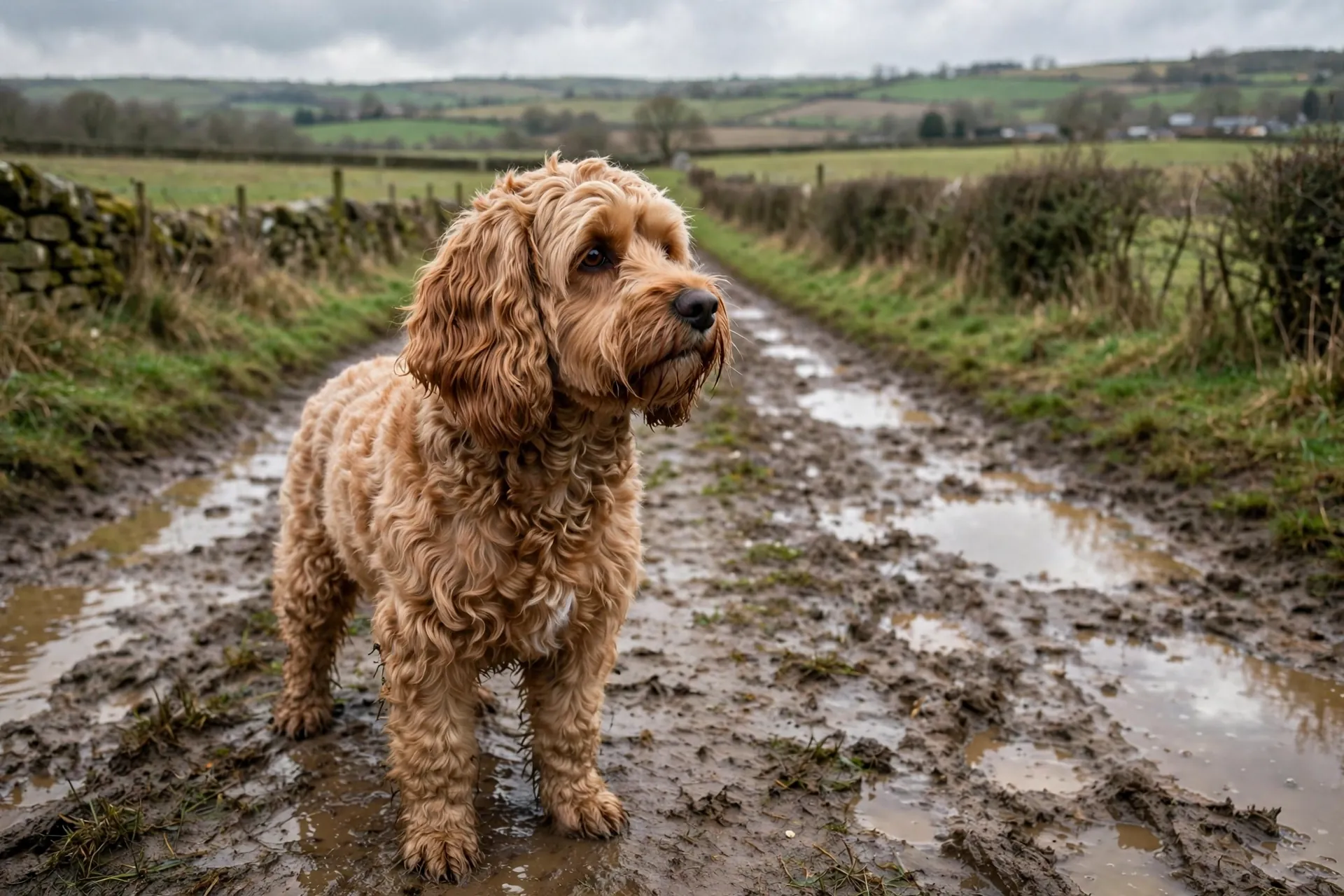
Here is the warning experienced owners give every Cockapoo newcomer, usually while holding a brush: that soft, wavy coat mats. The combination of spaniel and poodle hair tangles readily, tightens when wet, and tightens further as it dries, so a dog who swims, crashes through wet bracken or simply walks a muddy farm track can develop felted knots behind the ears, in the armpits, around the collar and between the toes within a remarkably short time. On a British holiday — where wet walks are not a risk but a schedule — coat care is not grooming vanity. Left mats pull on skin, hide burrs and thorns, and eventually need clipping out, which is nobody's idea of a souvenir.
Prevention is mostly rhythm. Brush and comb your dog thoroughly before the trip, ideally after a groom, so you start from a knot-free baseline; then brush little and often during it — five minutes each evening, working through ears, chest, legs and tail with a slicker brush followed by a metal comb to check you have reached the skin. The comb test is the honest one: if the comb will not pass, a mat is forming, whatever the surface looks like. After wet walks, rinse mud off with plain water where you can, pat rather than rub dry — rubbing works tangles deeper — and brush again once the coat is dry. Our list in the rainy-day dog gear checklist covers drying coats and towels that make this routine far easier.
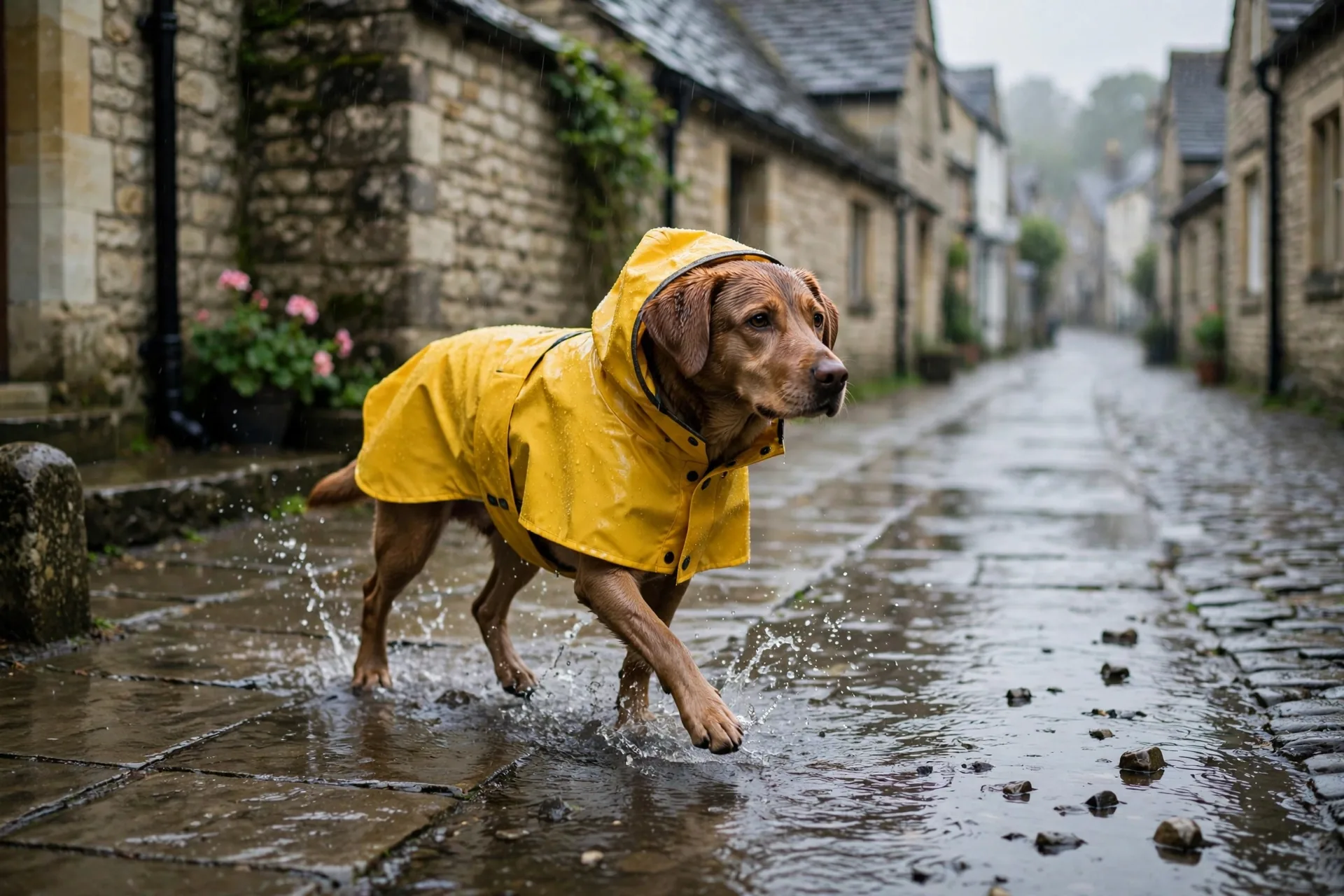
Choose your stay and your walks with the coat in mind. A cottage with a utility area, a hose or at least a deep sink, and hard floors near the door will save your deposit and your evenings; a cream-carpeted barn conversion will not. On walks, a well-fitted dog coat or waterproof can keep the worst of the mud off the body coat on the wettest days, though legs and ears will still need attention. And book a groom for shortly after you return home: even diligent holiday brushing rarely matches a professional reset, and arriving home to a booked appointment beats joining a three-week waiting list with a felted dog.
Grooming and drying kit that earns its luggage space
New owners tend to pack for a dog the way they pack for a toddler — everything, except the two things that matter. For a Cockapoo trip, the grooming bag is not optional luggage; it ranks with food and medication. Pack a slicker brush, a steel comb, a detangling spray if you use one, blunt-ended scissors for freeing a burr (never for cutting close to skin against a mat — that is how skin gets nicked; tight mats are a job for a groomer with clippers), dog shampoo for the inevitable full wash, and more towels than feels reasonable: one for the car, one by the cottage door, one for the dog's bed area.
Add a drying coat or towelling robe if you have one — put it on after a wet walk and it wicks a surprising amount of moisture while you drive or make tea, reducing both the damp-dog smell in the cottage and the shake-off radius. Microfibre towels outperform cotton ones for this coat type and dry quickly overnight, which matters in a property with no tumble dryer. A portable mud-washer — essentially a lidded cup with silicone bristles for dipping paws — is the single gadget most Cockapoo owners end up recommending, because farm tracks and clean cottage floors meet at the front door several times a day.
While packing, also think about ears and eyes, gently and generally. Those long, hairy ears trap moisture after swimming or rain, so dry them carefully with a soft cloth after wet outings, and check daily for burrs, grass seeds and redness; if your dog is shaking her head, scratching persistently or an ear looks sore, that is a job for a vet, including a local one while you are away — do not wait out a holiday with an uncomfortable dog. Similarly, check between toes after field walks for seeds and small stones. None of this takes long once it is a routine, and building it into the trip from day one is exactly what separates a relaxed Cockapoo holiday from a matted, itchy aftermath.
Sociability: blessing, and occasionally a project
Most Cockapoos are enthusiastically social — with people, with other dogs, with the waiter, with the person three tables away who has not yet been greeted and clearly should be. On holiday this friendliness is mostly a joy: your dog will be welcomed, fussed over and photographed, and her confidence makes cafes, pubs and markets easy in a way that owners of warier dogs envy. It is also, unmanaged, the source of the breed's classic holiday behaviours — pulling towards every passer-by, barking with excitement in a quiet beer garden, and treating every off-lead dog on the beach as the start of a party she is hosting.
The management is basic training, practised kindly and rewarded generously, and a holiday is a surprisingly good place to consolidate it because you have time and repetitions. Work on three things in the weeks before you go: a reliable settle on a mat or blanket, which converts pub gardens from theatre into relaxation; polite lead walking past people and dogs without launching at them; and a recall you have tested in boring places before trusting in interesting ones. Keep her on a lead in busy areas regardless — friendliness is not consent from the other dog, and some dogs on holiday are nervous or recovering from injury — and ask before allowing greetings, every time.
If your Cockapoo's sociability tips into frustration barking or frantic pulling, do not read it as naughtiness; she is over threshold, and the fix is distance and calm, not correction. Move away, let her watch from a range where she can still think, reward quiet attention, and shorten the exposure. Owners of more reactive travellers will recognise the approach from our guide to reactive dog holidays, and the same principles, applied lightly, suit an over-friendly young crossbreed just as well. A holiday where you practise a little each day usually ends with a noticeably steadier dog than the one you set out with.
Training on trips: routines that travel
Training on holiday works when it looks like routine rather than school. Dogs learn contexts, not abstractions, so the settle that works in your kitchen may evaporate in a cottage — until you have practised it there a few times with the same mat, the same cue and the same rewards. On arrival, before exploring, run the greatest hits in the new space: a few sits, a down on the mat, a wander around the garden on a lead to learn its boundaries together. Ten unhurried minutes of this on day one pays you back at every mealtime of the trip.
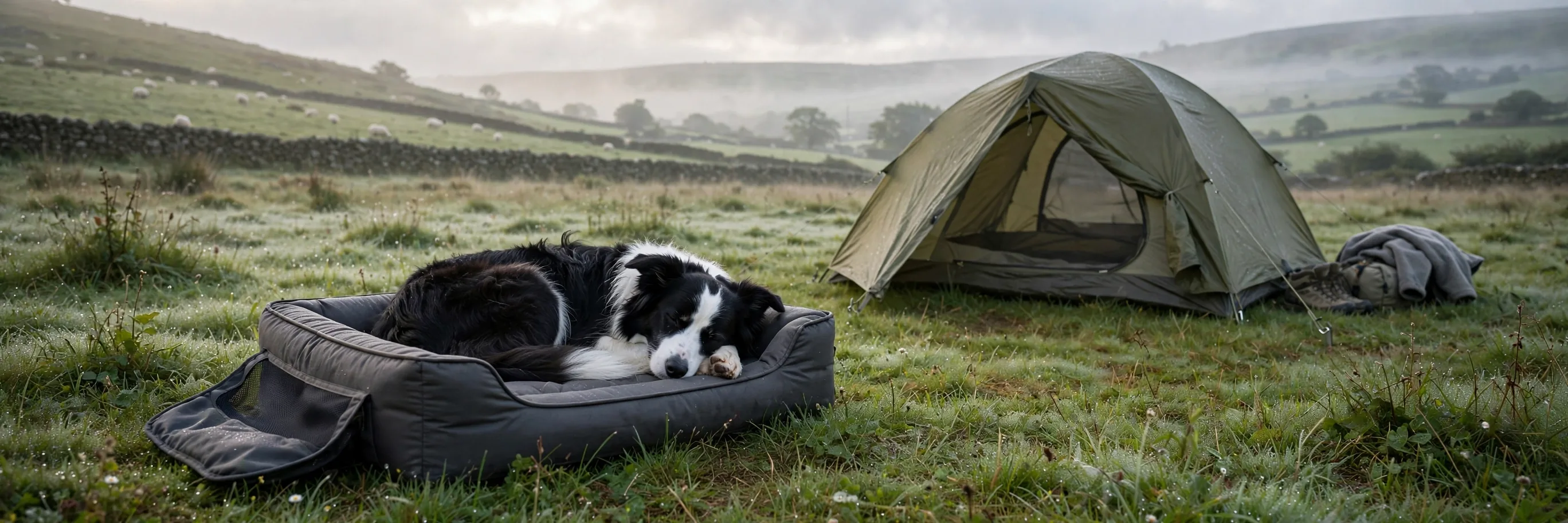
Keep the daily skeleton familiar even when the scenery changes. Feed at roughly home times, walk before breakfast if that is the home pattern, and protect a proper evening settle — bright young dogs who miss their usual wind-down become wired, mouthy and wakeful in strange bedrooms. Take the actual bed from home if space allows, or at least the blanket that smells of it; our guide to choosing a travel dog bed explains why familiarity settles dogs faster than novelty. And carry training treats as seriously as you carry the lead: high-value, small, and in a pocket rather than buried in a rucksack, because the moment you need one is never the moment to unpack.
Setbacks are normal and not a verdict. A first holiday often includes one chaotic pub visit, one garden escape attempt, one night of restless whining. Respond by simplifying — quieter venues, shorter exposures, more exercise and more sleep — rather than by escalating. If your dog is young, remember that adolescence commonly arrives somewhere in the second half of the first year and can temporarily undo previously reliable behaviours; a holiday during that phase should be planned with extra patience and lower ambitions. You are not failing the trip. You are doing the entirely ordinary work of a newer owner learning a real dog, which is precisely the experience this holiday is for.
Choosing a stay that suits a bouncy crossbreed
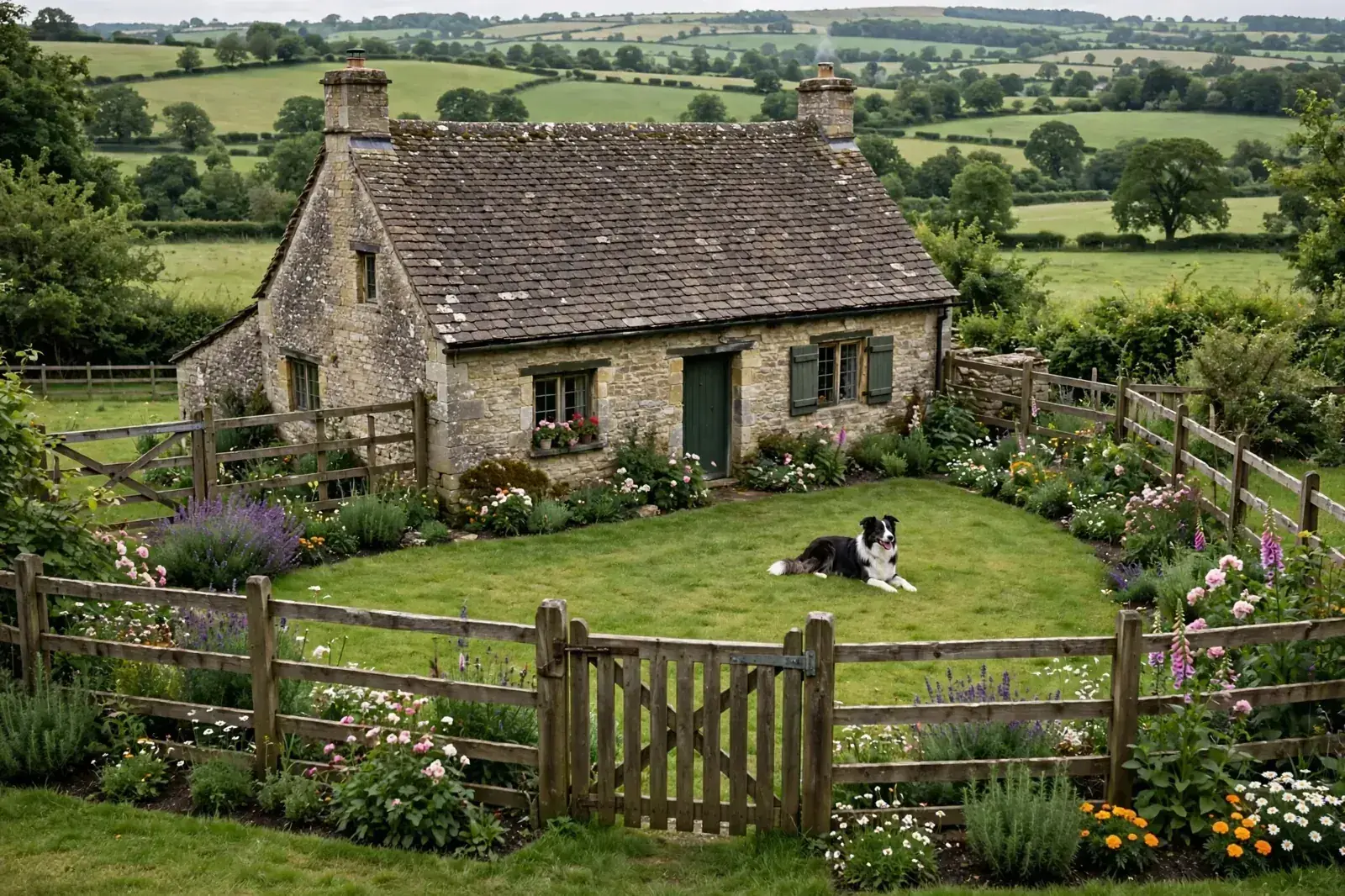
The right first property forgives a young, muddy, enthusiastic dog. Prioritise, in this order: an enclosed garden with a fence your dog cannot slip under or through — check what enclosed actually means in the listing, and ask for the fence's height and type if photos are ambiguous; hard flooring at least in the entrance and living area; a utility space, porch or sheltered outdoor tap for the daily de-mudding operation; and permission for the dog in the main living space, where she will want to be, rather than a kitchen-only rule that guarantees friction. Our guide to cottages with secure gardens walks through the questions that reveal whether a garden is genuinely secure.
Hotels and B&Bs can work well for calmer, older Cockapoos, but for a first trip self-catering usually wins: your own front door avoids corridor encounters, breakfast happens on your schedule after a walk rather than in a formal dining room, and a garden replaces the lead-clip expedition every time your dog needs the toilet at eleven at night. Whatever you choose, tell the host honestly that you are bringing a young crossbreed and ask about extra charges, dog limits in eating areas and any request to keep dogs off furniture, then bring throws to make compliance easy — a host who feels respected is a host who welcomes the next dog owner too.
Location completes the picture. For a first trip, a village base with a shop, a pub and two or three walks from the door beats a remote showpiece cottage up a track that floods — remoteness amplifies every beginner problem, from forgotten food to a dog who needs a vet. Check where the nearest veterinary practice is before you book, save its number, and confirm your dog's microchip details and insurance paperwork are current. None of this is pessimism; it is the quiet infrastructure that lets a new owner relax, and a relaxed owner is, as every dog knows, the whole point of going away.
Putting the first trip together
A workable first Cockapoo holiday has a simple shape. Day one: a moderate drive with a proper walk stop halfway, arrival in daylight, garden exploration on a lead, ten minutes of greatest-hits training, an early night with the bed from home. Middle days: one main walk, one gentle outing, one training or puzzle activity, grooming every evening without exception, and one planned pleasure that includes the dog centrally — a beach at low tide, a dog-friendly garden, a market in the morning before it crowds. Final day: a good walk before the drive, because a tired, brushed dog travels and arrives home like a professional.
Keep a small daily checklist on your phone — exercise done, coat checked, ears and paws checked, food and water normal, bed set up — because new owners on holiday are juggling a lot and the dog basics can slip behind restaurant bookings. And take photographs of the unglamorous things as well as the views: your drying set-up, the garden fence, the mat settle in the pub. Those pictures are your planning archive for trip two, and comparing them with other owners' experiences is how the steep first-year learning curve flattens out.
Most importantly, judge the trip by the right measure. Success is not a dog who behaved like a statue in a National Trust tearoom; it is a dog who was exercised, comfortable, included and increasingly settled as the days went on, and an owner who returns knowing their dog better than when they left. The Cockapoo who dragged you towards every dog on day one and was lying quietly under the table by day four has had an excellent holiday — and so, whether or not you noticed it happening, have you.
Practical questions
Before you go
How much exercise does a Cockapoo need on holiday?
Most adult Cockapoos need around an hour or more of proper exercise a day, plus play and mental activity, though age, size and fitness vary a great deal — puppies and adolescents need gentler, shorter exercise to protect growing joints, so ask your vet about your own dog. On holiday, split exercise into a main walk and smaller outings, add sniffing games or puzzles, and alternate bigger days with quieter ones.
How do I stop my Cockapoo's coat matting on a wet holiday?
Start knot-free, then brush little and often: a slicker brush followed by a steel comb each evening, paying attention to ears, armpits, collar area, legs and between the toes. Rinse mud off with plain water, pat rather than rub dry, and brush again once dry. A drying coat, microfibre towels and a paw-washer by the door make the routine quick, and booking a groom for soon after you return gives you a professional reset.
Do Cockapoos shed? Should I expect hair in the cottage?
Cockapoos are often described as non-shedding, but the reality is variable: many shed very little, while others — particularly those with more spaniel-type coats — shed noticeably. Either way, expect some hair and a great deal of carried-in mud, so take throws for furniture, ask the host about their expectations, and leave the property as you found it. Brushing outdoors or in a utility area keeps loose hair out of living spaces.
Can I leave a Cockapoo alone in holiday accommodation?
Only if your dog is already trained to settle alone at home, the property rules allow it, and the absence is short — and many lets prohibit leaving dogs unattended at all. Cockapoos are people-focused and can become distressed or noisy when left in a strange place. For a first trip, plan activities your dog can join, or travel with someone who can stay with her, rather than testing alone-time on holiday.
What should a first-time owner pack for a Cockapoo trip?
Beyond food, medication and a familiar bed, prioritise grooming and drying kit: slicker brush, steel comb, dog shampoo, several microfibre towels, a drying coat if you have one, and a paw-washer. Add a settle mat, training treats, a puzzle feeder, throws for furniture, spare lead, and your vet's number plus details of a practice near your destination. That kit solves most of the problems a first Cockapoo holiday actually produces.