This guide is independent and contains no paid placement. If affiliate links are added later, they will be clearly marked and will not change our editorial checks.
Walk Croyde Beach when the tide and the seasonal dog rules allow it, keep the dog on a lead through the dunes and near the cliff edge, and save the Baggy Point headland for a clear, calm spell with water and time to spare. The village is small, so arrive early, park once and walk everywhere.
Croyde at a glance for dog owners
Croyde is a small surf village on the North Devon coast, between Braunton and Woolacombe, and it works on a much smaller scale than its famous neighbours. The village centre is a short walk from the beach, the beach is a short walk from the dunes, and the South West Coast Path leaves the bay in both directions. That compact layout is the main reason it suits a dog day out: once the car is parked, most of what matters is on foot, and a tired dog is never far from shade, water or the car.
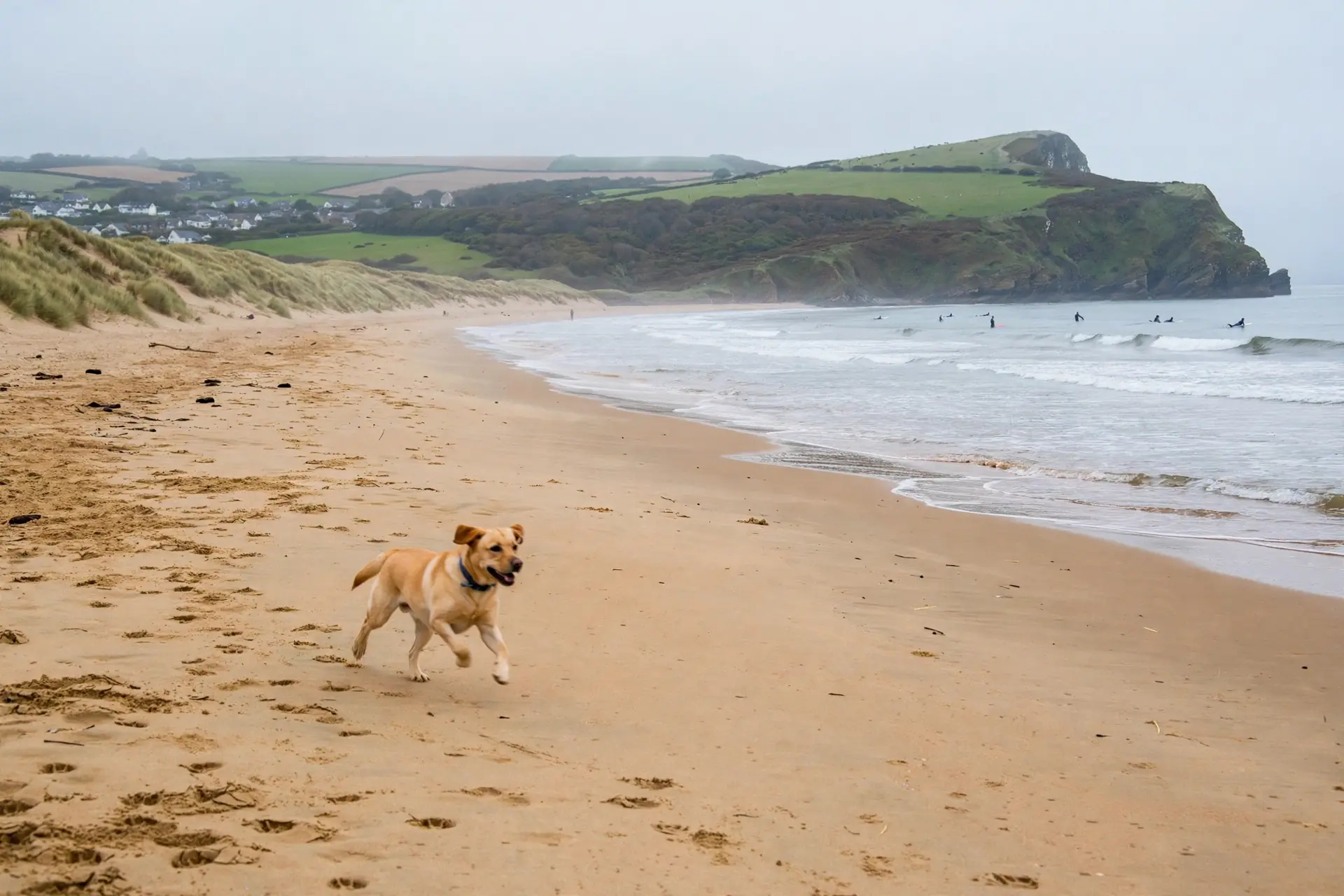
The shape of the place decides how the day runs. Croyde Beach is a broad curve of sand that changes size dramatically with the tide. At low water there is a long flat expanse for a steady walk, a run and a game that stays close to the ground. At high water the sand narrows to a strip, the surf reaches further up the beach, and the same walk becomes a short squeeze between the sea and the dunes. Check the tide times before you set off, and plan the beach walk for the falling or low tide rather than trying to fit it around a rising one.
The village itself is quieter than the beach on most days, and that contrast matters for dogs that find crowds hard. The beach car park and the sand in front of it carry the noise, the boards, the wetsuits and the excited groups. A few minutes inland, the lanes, the village green and the smaller shops feel slower and easier. If your dog is nervous around fast-moving people, boards carried at head height or children running across the sand, use the village end of the day as the calm part and keep the beach visit to a quieter hour.
Season changes the village as much as the weather does. In school holidays and on warm sunny weekends, Croyde is busy from late morning, parking fills, the beach is crowded and the surf schools are working at full pace. On a grey weekday outside the holidays, the same beach can feel wide and empty, and a dog can walk for a long time without meeting another group. Autumn and winter bring wind, rain and big seas, which suit a hardy dog and a waterproof coat far better than a summer crowd does. Choose the season for the dog you have, not for the photograph you imagined.
One more thing shapes every plan here: Croyde is a working surf beach, not a purpose-built dog beach. Surfers, bodyboarders, surf schools, swimmers, families and dogs all share the same sand and the same water. That sharing works when everyone gives the others room, and it fails when a dog runs through a lesson group or chases a board into the surf. Keep the dog close where people are learning, give surf schools a wide berth, and save the off-lead run for a quiet stretch of sand where nobody is trying to stand up on a board.
Croyde Beach: dog rules, zones and seasons
Dog access on Croyde Beach is seasonal, and the rules are set locally, so check the official guidance before you travel rather than relying on a memory from a previous summer. In general, dogs face restrictions on the main beach during the busiest summer months, and the rules are more relaxed outside that period. The exact dates, the area covered and any lead requirements can change from year to year, and the signs at the beach entrances are the version that applies on the day you arrive. Read them before you unclip the lead, even if you have walked this beach before.
That seasonal pattern has a practical logic. In July and August the beach is full of people sitting, sunbathing and learning to surf, and a loose dog weaving between towels and boards is a nuisance at best and a safety problem at worst. Outside the peak season the same sand is used by walkers, runners and a smaller number of surfers, and a well-behaved dog has far more room. If your trip can move by a few weeks, shifting it out of the summer restriction period is often the single change that makes the biggest difference to the day.
Where the rules allow dogs, use the beach with the same care you would use on any shared beach. Keep the dog in sight at all times, recall it before it reaches another group, and pick up after it immediately. The sand here holds paw prints, dropped food and fishing tackle, and a dog that scavenges will find all three. Carry more poo bags than you think you need, because the bins near the beach fill fast on busy days, and be ready to carry a tied bag back to the car park if the nearest bin is full.
Lead use on the beach is a judgement call that should follow the conditions, not a fixed habit. On a quiet morning in the low season, a dog with a reliable recall can enjoy a long off-lead walk along the firm sand at the waterline. On a busy afternoon, near a surf school, beside the stream or where other dogs are playing, a lead or a long line is the kinder and safer choice. A long line gives a dog room to run and sniff while keeping you in control near the water, and it is worth packing even if you expect to walk off lead for most of the day.
The sand itself needs a little thought. Wet sand at the waterline is firm and easy to walk on, while the dry soft sand higher up the beach is hard work for short legs, older dogs and dogs with joint problems. Plan the outward walk on the firm sand and the return on the same line, rather than cutting across the soft sand at the top of the beach. After the walk, check between the toes for sand and small stones, rinse sandy paws before the drive home, and watch for a dog that has swallowed too much salt water, which can cause sickness and thirst.
Finally, respect the marked zones. Surfing and swimming areas are often separated by flags or by habit, and a dog swimming across a surf zone puts itself in the path of boards. Keep the dog out of the flagged swimming and surfing areas, keep it away from anyone carrying a board, and do not let it chase a board or a surfer into the water. The beach is big enough for everyone when each group keeps to its own patch of sand and sea.
The dunes and the stream
Behind Croyde Beach lies a dune system that is easy to underestimate. From the sand it looks like a gentle bank of grass, but it is a fragile habitat, and the paths through it are there for a reason. Stay on the marked paths through the dunes, keep the dog on a lead in the dune area, and do not let the dog dig, chase or cut new tracks through the grass. Dune plants hold the sand in place, and a single afternoon of dogs running through the same patch can strip the cover and start a blowout that takes years to heal.
The dunes are also a wildlife area. Ground-nesting birds, small mammals and insects use the sheltered hollows, and a dog running off the path can disturb a nest or a burrow without its owner ever noticing. A lead through the dunes is not just a rule for the sake of it; it is the simplest way to keep the dog out of the places where wildlife is most vulnerable. The walk through the dunes is short, so the lead is only on for a few minutes, and the reward is a wide beach on the other side.
A small stream crosses the beach at Croyde, and it is one of the features dogs notice first. Most dogs will want to drink from it, paddle in it or lie down in it, especially on a warm day. That is understandable, but the stream is not a reliable drinking water source, and its flow and quality change with rain and with the season. Carry fresh water and a bowl, offer it regularly, and discourage the dog from drinking from the stream or from standing pools in the dunes. If the dog does drink from the stream and later seems unwell, note the time and contact a vet for advice.
The stream also changes the shape of the beach walk. At low tide it cuts a shallow channel across the sand, and dogs that jump it or splash through it will get wet feet and sandy legs. At higher water it can be deeper and faster than it looks, especially after heavy rain inland. Cross it at a shallow point, keep a small dog close, and do not let a dog chase a ball across it into deeper water. The stream is a pleasant feature on a hot day and a hazard after rain, and the difference is worth checking before you let the dog in.
Between the dunes and the beach there is often a line of wind-blown sand, marram grass and low fencing. Treat the fencing as a boundary, not as a suggestion. It marks areas that are being restored or protected, and stepping over it with a dog undoes the work that went into putting it there. If the path you want is closed or fenced off, take the next marked path instead. The beach is reached from several points, and a short detour through the dunes is a better outcome than a damaged habitat and a fine.
The Baggy Point walk
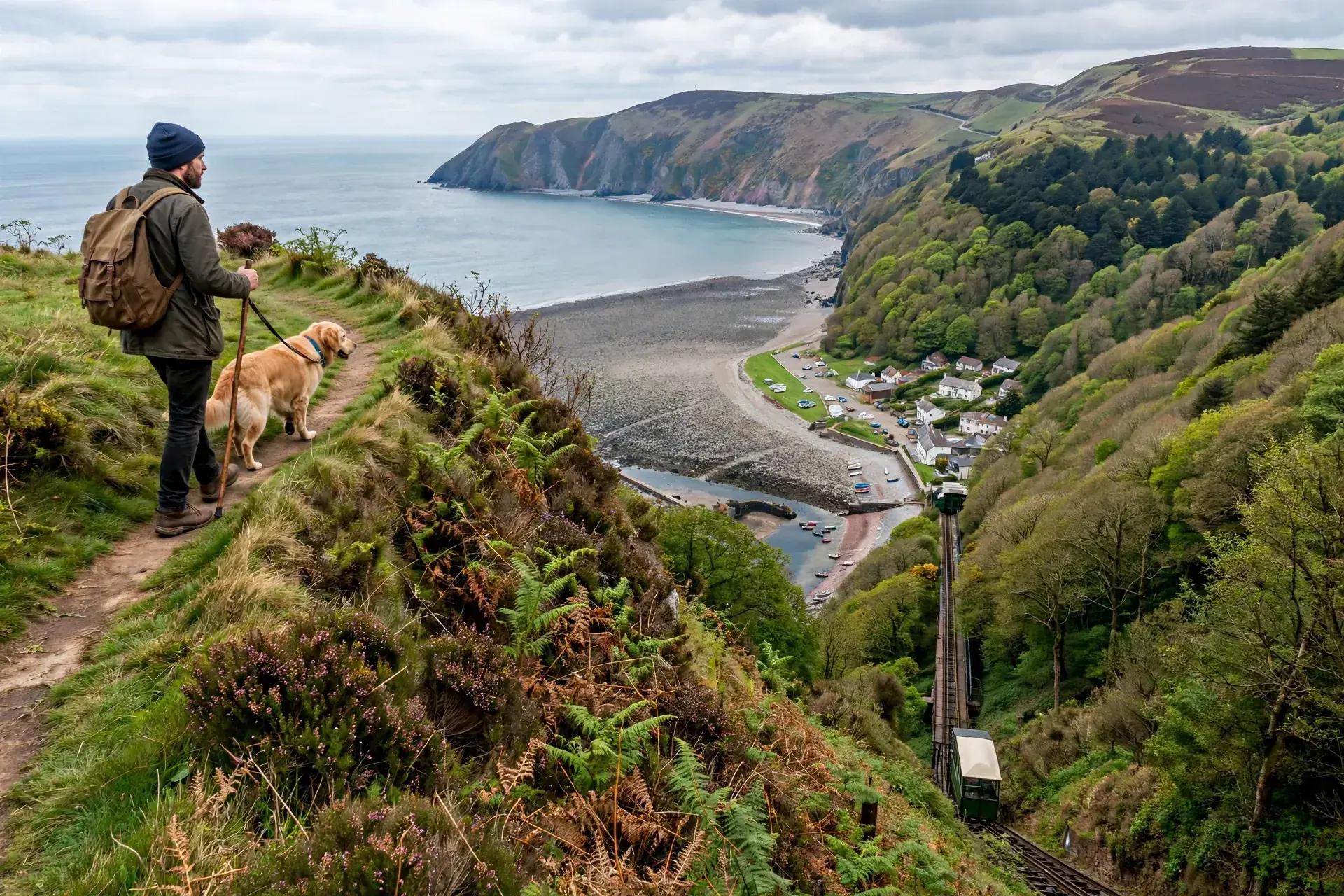
Baggy Point is the headland at the north-western end of Croyde Bay, and the walk out to it is the best half-day outing from the village with a dog that can handle a cliff path. The route climbs from the beach and the dunes onto open grassland and then onto the cliff top, where the views open up across the bay, back towards Croyde and out to sea. On a clear day the sense of space is the point of the walk. On a windy day the same openness is the challenge, because there is very little shelter once you leave the dunes behind.
Start the walk with the dog on a lead and keep it on for the whole cliff section. The path runs close to the edge in places, the ground can be uneven and slippery after rain, and a dog that chases a rabbit or a seabird can be over the edge before you have time to react. The lead is also the right choice where the path passes through grazing land. Livestock, including sheep and cattle, graze the headland, and dogs must be kept under close control near them. If cattle are on the path, give them a wide berth, keep the dog on a short lead, and do not walk between a cow and its calf.
Allow more time than the distance suggests. The climb from the beach is steady rather than steep, but the path is uneven, the wind slows progress, and a dog will want to stop and sniff at every new smell on the headland. Carry water for the dog and offer it before the dog looks thirsty, because there is no reliable drinking water on the headland itself. A collapsible bowl weighs almost nothing and is worth carrying on every cliff walk, in every season.
The headland is exposed to the weather from the west, and conditions can change while you are out there. A calm morning in the village can become a strong wind on the point, and sea mist can reduce visibility quickly. Check the forecast before you set off, look at the sea state from the beach before you climb, and turn back if the wind rises, if the dog is struggling or if the path ahead looks too exposed. There is no shame in a shorter walk that ends with a happy dog; there is a real risk in pushing on to the point because the plan said so.
At the point itself, keep the dog close and do not let it run ahead to the edge. The views are best enjoyed from a few steps back from the drop, with the dog sitting beside you on a lead. Photographs can wait until the dog is settled, and a treat or a short rest gives the dog a reason to stay still. On the return leg, the walk back to Croyde feels different because the wind is now behind you, and the dunes and the village come back into view gradually. That is a good moment for a slow walk, a drink and a check of the dog's paws for grit and sore spots.
If the full walk to Baggy Point is too much for your dog, a shorter version still works. Walk from the beach to the first viewpoint, enjoy the bay from there, and return the same way. The dog gets the climb, the sea air and the new smells without the long exposed section, and you get the same view in miniature. A dog day is judged by the dog's comfort at the end of it, not by the furthest point reached.
The South West Coast Path from Croyde
Croyde sits on the South West Coast Path, which runs along the North Devon coast in both directions, and that gives a dog walker two very different choices. North-west from the beach, the path climbs to Baggy Point and then continues towards Woolacombe and Mortehoe. South-east from the village, the path heads towards Saunton Sands and Braunton, across lower ground and through the dunes. Both directions are worth knowing about, because the right one depends on the weather, the tide and the dog's energy on the day.
The northern route is the wilder of the two. It is a cliff path with climbs, descents and long exposed stretches, and it suits a fit adult dog with good recall and a owner who is comfortable with heights. The southern route is gentler and flatter, and it suits older dogs, puppies that are still building up distance, and days when the wind on the headland would be too much. Do not choose the northern route because it sounds more impressive; choose the route that matches the dog in front of you.
Waymarking on the coast path is generally good, but it is not a substitute for attention. Follow the acorn signs, check the path ahead before a descent, and keep the dog on a lead where the path narrows, where it runs beside a road or where livestock are grazing. If you meet other walkers on a narrow section, step aside with the dog on the inland side of the path and let them pass. A dog that greets every walker by jumping up will make a narrow cliff path unpleasant for everyone.
Distance on the coast path is deceptive. A few miles on a map can take much longer than the same distance on a flat beach, because the path climbs and falls, the surface is uneven and the dog stops often. Plan a shorter distance than you would on a beach walk, build in time for rests and water breaks, and have a turn-back point in mind before you set off. The coast path will still be there tomorrow; a dog that is pushed too far today will remember the walk for the wrong reasons.
For a longer stay, the coast path also links Croyde to the wider North Devon coast, and that opens up day walks that do not need a car at all. A walk north towards Woolacombe and back by the same route, or a walk south towards Saunton and back through the dunes, can fill a whole morning without moving the car. If you want to go further afield, our guide to Bude with a dog covers another North Devon surf town further down the coast, and our Exmoor dog guide covers the moorland and coast walks inland from Lynmouth, where the walking is wilder and the livestock rules matter even more.
The village, parking and surf schools
Croyde village is small enough to walk across in a few minutes, and that is part of its charm for dog owners. There is a village centre with shops, cafes and places to eat, a church, a village green and a handful of lanes that lead down to the beach. The pace is slower than the beach, the traffic is lighter, and a dog on a lead can walk the whole village without the noise and speed of a town centre. Use the village for the slow parts of the day: a morning coffee, a browse in the shops, a quiet lunch and a last walk before the drive home.
Parking is the one part of Croyde that needs a plan. The main beach car park is close to the sand and the dunes, which makes it the obvious choice with a dog, but it fills early on sunny days, at weekends and in school holidays. Arrive early, ideally before late morning, and have a second option in mind in case the beach car park is full. Do not circle the village hoping for a space while the dog waits in a warm car. If the beach car park is full, consider a quieter day, a later arrival or a different beach altogether, and check the official guidance before you travel for current charges and any restrictions on vehicle size or overnight parking.
Never leave a dog in a parked car in Croyde, even for a few minutes. The beach car park is exposed to the sun, the temperature inside a car rises fast, and a dog in a car on a warm day is in danger even with the windows open a crack. If you need to go into a shop or a cafe that does not allow dogs, take it in turns, use a dog-friendly terrace or leave the dog with another member of your group in the shade. A short wait in the shade with water is safe; a wait in a car is not.
The surf schools are based around the beach and the beach car park, and they are a defining feature of Croyde in the summer. Groups of learners, instructors and boards gather at the edge of the sand, and lessons move into the water in a loose group. Give the schools room, keep the dog on a lead when you pass a lesson group, and do not let the dog run through a group that is carrying boards. If your dog is interested in surfing, that is a reason to keep it further away, not closer, because a dog that chases a board into the water is at risk from the board, the surfer and the current.
If you want to try surfing yourself, book a lesson in advance in the summer and ask the school about its dog policy before you go. Some schools are happy for a dog to wait with a non-surfing member of the group on the beach, while others prefer the dog to stay away from the lesson area altogether. Do not assume that a dog can wait unattended by the boards while you are in the water. A dog left alone on a busy beach will bark, wander or follow you into the sea, and none of those outcomes is fair on the dog or on the other beach users.
The village also has practical stops that matter on a dog day: a shop for water, snacks and extra poo bags, public toilets near the beach, and bins for dog waste. Use them before the beach walk rather than after it, because the walk back from the beach with a tired, sandy dog is the wrong moment to discover that you are out of bags. A small rucksack with water, a bowl, bags, a towel and a spare lead keeps the whole day in one place and leaves your hands free for the lead.
Pubs, cafes and takeaways with a dog
Eating and drinking in Croyde with a dog is usually straightforward, because the village is small and many places are used to walkers and their dogs. The pattern is familiar from other North Devon villages: some pubs welcome dogs in the bar area or on the terrace, some cafes have a dog-friendly corner or an outside area, and takeaways are the easiest option of all when the dog is tired or wet. Check before you travel or ask at the door, because a policy that applied last summer may have changed, and a landlord's decision on the day is the one that counts.
A pub lunch after a beach walk is the classic Croyde routine, and it works best when the dog is already tired. A dog that has walked the beach and the dunes will settle under a table far more easily than a dog that has been waiting in the car while its owner surfed. Choose a table at the edge of the room, put a mat down for the dog, offer water as soon as you sit down, and keep the lead short enough that the dog cannot wander into the path of staff carrying food. If the dog cannot settle, finish quickly, pay and leave; a pub is not the place to train a restless dog.
Cafes near the beach are a good option for a mid-morning stop, especially on a windy day when the sand is blowing. A warm drink, a snack and a few minutes out of the wind can reset the whole morning, and a dog that has been running on the sand will appreciate the rest. Look for a cafe with a dog-friendly area rather than asking a cafe that does not welcome dogs to make an exception. The dog-friendly places are easy to spot: a water bowl by the door, a mat under a table and a staff member who greets the dog by name are all good signs.
Takeaway food is the most flexible choice with a dog in Croyde. Buy food from a cafe or a takeaway, find a bench or a patch of grass with a view of the bay, and eat with the dog beside you. The village green and the area near the beach are natural places for a picnic, provided you keep the dog on a lead, clear up all litter and do not feed the dog from the table. A takeaway also avoids the problem of a dog that barks in a pub, a dog that is too wet to go indoors or a group that wants to eat at different times.
Food safety matters as much as manners. Do not feed the dog chips, ice cream, chocolate or food dropped on the beach, and keep the dog away from other people's picnics. The beach is full of dropped food, fish and chip wrappers and fishing bait, and a scavenging dog will eat something it should not. Bring the dog's own food and treats, offer them at the same time as your own meal, and the dog will be far less interested in what is on your plate.
Finally, plan the timing of meals around the dog, not around the kitchen. A dog that has just run on the beach needs water and a rest before food, and a dog that has just eaten should not run hard on the sand straight after. Build a gap between the beach walk and the meal, and another gap between the meal and the next walk. A slow lunch after a morning on the beach, followed by a quiet afternoon in the village, is a better day for a dog than a rushed meal squeezed between two long walks.
Staying overnight in and around Croyde
Croyde works well as an overnight base, because the village, the beach and the coast path are all within walking distance of each other. Staying overnight changes the day completely: you can walk the beach early before the crowds arrive, rest in the middle of the day while the beach is busiest, and walk again in the evening when the light is softer and the sand is quieter. For a dog, that rhythm is far easier than a single long day trip that tries to fit everything into a few hours.
Accommodation in and around Croyde includes cottages, bed and breakfasts, campsites and holiday parks, and the dog rules vary from place to place. Some places welcome dogs in every room, some only in selected rooms or units, and some charge a pet fee per dog per night. Ask for the written dog policy before you book, confirm the number of dogs allowed, the fee, the areas where dogs are welcome and the rule about leaving a dog alone in the room. A place that welcomes dogs in the garden but not in the breakfast room is a different stay from a place that welcomes dogs everywhere, and the difference matters at 8am.
When you compare places, look beyond the headline price. A cottage with a small enclosed garden near the village is worth more to a dog owner than a larger cottage beside a busy road. A ground-floor room with a door to the garden is easier for an older dog than a first-floor room with stairs. A campsite with a flat pitch near a toilet walk is better than a scenic pitch at the far end of the field. Ask about the garden fence, the gate, the distance to the nearest walk and the noise from neighbouring units, and choose the place that fits the dog you have.
Staying just outside Croyde can also work well. Braunton, a short drive inland, has more shops, a larger choice of accommodation and easy access to the Tarka Trail, a flat traffic-free path that suits dogs that prefer a level walk to a cliff path. Woolacombe, a short drive north, has a longer beach and a larger village, but it is busier in the summer and the parking is a separate problem. Staying in Croyde itself keeps the car parked and the walks on foot, and for a short break that simplicity is often worth more than a larger choice of rooms elsewhere.
On arrival at overnight accommodation, give the dog the same calm first hour you would give it at a holiday park. Walk the garden and the boundary, check the gate and the fence, find the nearest toilet walk, put the dog's bed in its usual place and offer water. Photograph any existing damage, move cleaning products and food out of reach, and keep the first evening quiet. A dog that settles on the first night will enjoy the second day far more than a dog that spends the first night pacing a strange room.
If you are staying for several nights, use the extra time to vary the walks. One day can be the beach and the village, the next can be Baggy Point, and the third can be a quieter walk south towards Saunton or a drive to Exmoor. Our Exmoor dog guide is a useful starting point for that kind of longer stay, because it covers moorland walking, livestock, ticks and the darker, quieter side of North Devon that Croyde does not show. A dog that has three different walks in three days will come home more tired and more content than a dog that has repeated the same beach walk three times.
Surf, tides, cliffs and livestock
Croyde Beach is a surf beach first and a swimming beach second, and the sea here deserves respect. The surf that makes Croyde famous also creates strong currents and rip currents, which can pull a swimmer or a dog away from the shore faster than either can swim back. A dog that is a confident swimmer in a lake or a river is not automatically safe in the sea at Croyde. Keep the dog out of deep water, keep it away from the surf zone where boards are moving, and never throw a ball or a stick into the waves for the dog to fetch.
Tides are the other sea risk, and they are easy to overlook on a sunny day. The tide at Croyde comes in across a wide flat beach, and a dog that is playing at the waterline can find the water rising around it while its owner is watching the horizon. Check the tide times before the walk, note the time of high water, and start the return walk well before the tide turns. If you are walking towards Baggy Point or along the coast path, the tide matters even more, because some sections of the shore are cut off at high water. Stay on the cliff path, not on the rocks below it, when the tide is rising.
Cliffs are the third risk on a Croyde walk, and they are the reason the lead stays on near the edge. The cliff top at Baggy Point is grassy and inviting, and a dog will want to run to the edge to see what is below. The edge can be undercut, the grass can be slippery after rain, and a dog that slips will not be able to climb back. Keep the dog on a lead on the cliff top, keep it on the inland side of the path, and do not let it run ahead around a blind bend. A dog on a lead is a dog that comes home.
Livestock grazing is common on the headland and on the coast path, and the rules are simple. Keep the dog on a lead near sheep and cattle, do not let the dog chase or worry livestock, and if cattle approach, let the dog go only if you are in danger and the dog can get away safely. The legal and practical position is the same: a dog that worries livestock can be shot by a farmer, and a dog owner can be liable for the damage. That sounds harsh, but it is the reason the lead rule exists, and it is worth remembering on every walk through grazing land.
Adders are present in parts of Devon, including in dune and heathland areas, and they are most active in warm weather. A dog that sniffs in long grass or under a rock can disturb an adder, and a bite needs veterinary attention quickly. Keep the dog on the path in the dunes, do not let it nose into dense vegetation, and know the signs of a bite: sudden pain, swelling, limping or distress after a yelp in long grass. If you suspect a bite, keep the dog calm and still, carry it if you can, and contact a vet immediately.
Other beach hazards are smaller but still worth knowing. Broken glass, fishing hooks, sharp shells and discarded food are all found on the sand, and a dog that scavenges or runs barefoot over the wrong patch can cut a paw. Check the dog's paws after every beach walk, rinse them in fresh water, and carry a simple first-aid kit with a bandage and antiseptic. Save the number of the nearest vet in your phone before the walk, not after the dog is hurt, and note the location of the nearest veterinary practice in Braunton or Barnstaple in case of an emergency.
What to pack for a Croyde dog day
Packing for Croyde is packing for three different environments in one day: a sandy beach, a windy cliff and a small village. A lead and a long line cover the beach and the cliff. A towel and a drying coat cover the wet dog after a paddle or a rain shower. A mat covers the pub and the cafe. Fresh water and a bowl cover all three, because the dog will need water on the beach, on the headland and in the village. Pack for the whole day, not just for the first hour.
Water is the item that owners underestimate most often at Croyde. A dog running on sand, climbing to a headland and walking in the wind uses more water than a dog walking on a flat pavement, and the sea is not a substitute. Carry at least a litre of fresh water for a half-day walk, more on a hot day, and offer it every half hour rather than waiting for the dog to look thirsty. A collapsible bowl fits in a pocket and weighs almost nothing. If the dog drinks sea water, it will become thirstier and may be sick, so fresh water is both a comfort and a safety measure.
Sun and wind protection matter in both directions. On a sunny day, a light-coloured dog, a dog with a thin coat or a dog with a pink nose can burn on the beach, and the sun reflects off the sand and the sea. A shaded rest, a damp towel and a dog-safe sun cream on the ears and nose help, but the simplest protection is to avoid the middle of the day on the sand. On a windy day, the same beach can be cold and the wind can chill a wet dog quickly. A drying coat after a paddle, a windproof coat for a small or older dog and a sheltered rest in the village are all worth packing.
The practical kit list is short: a lead, a long line, a spare lead, fresh water and a bowl, poo bags, a towel, a drying coat, a dog mat, a snack and a small first-aid kit. Add a phone charger, because a phone is the map, the tide table and the vet number in one device, and add a car shade or a reflective windscreen cover if the dog will wait in the car for a few minutes in the shade while you load or unload. Do not pack a retractable lead for the cliff path; a fixed lead gives you far more control near the edge.
Before you leave home, check the dog itself as well as the kit. Is the dog fit enough for a cliff walk, or would a beach walk and a village stroll be enough? Are the claws trimmed, the paws checked and the coat brushed? Has the dog eaten at its usual time, and will it need food during the day? A dog that starts the day comfortable will finish the day comfortable, and a dog that starts with sore paws or an empty stomach will struggle by the afternoon.
Finally, pack a plan for the drive home. A wet, sandy dog in a car is a familiar problem, and a towel, a blanket on the seat and a drying coat make the journey far more pleasant for everyone. Offer water before the drive, give the dog a last toilet walk before you set off, and stop for a break on a long drive home. A dog that arrives home dry, watered and rested will remember Croyde as a good day out, and that is the outcome that matters most.
A calm one-day plan with a dog
A good Croyde day with a dog is a slow day, not a full one. Arrive early, park at the beach car park, and walk the beach while the tide is low and the sand is quiet. Let the dog sniff, paddle at the edge and run on the firm sand, but keep the walk short enough that the dog is still fresh when you leave the beach. An hour on the sand is enough for most dogs, and a dog that has had an hour of beach time will settle far more easily for the rest of the day than a dog that has been run for three hours and is now overtired.
After the beach, walk through the dunes on a lead and back to the village for a drink and a rest. This is the moment to use the village properly: a coffee, a snack, a browse in the shops and a quiet sit in a dog-friendly cafe. The dog can rest on its mat, drink water and watch the village go by, and you can check the weather and the tide for the afternoon. If the wind has risen, skip the headland and stay in the village. If the day is still calm, the afternoon is the time for Baggy Point.
The afternoon walk to Baggy Point works best as a there-and-back from the beach, with the dog on a lead for the whole cliff section. Walk slowly, stop for water, enjoy the view from a few steps back from the edge and turn back while the dog is still enjoying the walk. On the return, the dunes and the village will feel familiar, and the dog will know that the day is winding down. A short final walk on the beach at low water, if the tide allows, is a pleasant end, but it is optional, not essential.
If the weather turns, Croyde still has a plan. A wet day is a village day: a slow morning in a cafe, a short walk in the rain with a waterproof coat, a drive to Braunton for the shops and the Tarka Trail, and an early return to your accommodation. A dog does not need a perfect day to have a good day, and a wet walk in the rain followed by a warm dry rest is often the walk a dog remembers most fondly. Do not force a cliff walk in rain and wind because the plan said so.
For a longer stay, repeat the same rhythm with different walks. One day can be Croyde Beach and Baggy Point, the next can be a quieter walk south towards Saunton, and the third can be a drive to a different part of North Devon. Our guide to Bude with a dog covers a surf town further along the coast for a change of scene, and the Exmoor dog guide covers the moorland walks that make a good contrast to a beach day. Three different days, each planned around the dog, will always beat three repeats of the same walk.
End the day the way you started it: slowly. Offer water, check the paws, dry the coat, give the dog its usual food at its usual time and let it rest. A dog that sleeps soundly after a Croyde day has had enough exercise, enough new smells and enough rest, and that balance is the real measure of a good day out. Croyde is not a place to rush. It is a small village, a wide beach and a windy headland, and the best way to enjoy it with a dog is to take your time, follow the tide and let the dog set the pace.
Practical questions
Before you go
Are dogs allowed on Croyde Beach all year?
Croyde Beach has seasonal dog rules, so the answer depends on the date and the part of the beach you use. Check the official guidance before you travel, look for the signs at the beach entrances, and keep your dog on a lead where the signs ask for it. Out of the main summer season the beach is usually a much easier place for a dog walk.
How long is the walk from Croyde to Baggy Point with a dog?
From the village and beach area to Baggy Point and back is a half-day outing rather than a quick loop, and the cliff-top section is exposed with steep drops. Allow plenty of time, carry water for the dog, keep the dog on a lead near the cliff edge and livestock, and turn back early if the wind rises or the dog is tiring.
Is Croyde Beach safe for dogs to swim in?
Croyde is a surf beach with strong currents and rip currents, so it is not a safe place for a dog to swim freely. Let the dog paddle at the edge only when conditions are calm, stay well away from surfers and board users, keep the dog on a long line if you are unsure, and never let the dog chase waves out into deeper water.
Where can I park in Croyde with a dog?
The main beach car park sits close to Croyde Beach and the dunes, which keeps the walk to the sand short. It fills quickly on sunny weekends and school holidays, so arrive early, have a back-up plan, and never leave a dog in a parked car. Check the official guidance before you travel for current charges and any height or overnight restrictions.
Can dogs go into pubs and cafes in Croyde village?
Some pubs and cafes in Croyde welcome dogs, often in a bar area, on a terrace or in a defined dog-friendly section, while others do not. Rules change with the season and with the landlord, so check before you travel or ask at the door, keep the dog on a lead under the table, and bring a mat and water bowl so the dog can settle quietly.
What should I pack for a dog day out in Croyde?
Pack a lead and a long line, fresh water and a bowl, poo bags, a towel and a drying coat, a dog mat for cafes, a snack, and sun or wind protection for the season. Add a first-aid kit, a spare lead, and the number of the nearest vet. Sandy paws, salt water and a windy cliff walk all use up more water than a short village stroll.