This guide is independent and contains no paid placement. Road, path and access conditions in a remote dale can change, so check local signs on the day.
Plan Dent as a remote-valley visit: save routes offline, drive slowly on narrow roads, park without blocking lanes or gateways, walk village lanes on a lead, and choose valley routes with a clear return. Weak signal is normal here, so preparation before arrival matters more than any app on the day.
Getting there: driving into Dentdale
Reaching Dent is part of the experience, and it deserves the same planning as the walk itself. Dentdale is reached by narrow, winding roads that climb, descend and bend through the Dales, with stone walls, passing places, farm traffic and occasional livestock on the road. For a dog, the drive matters too: a long, winding journey can cause travel sickness, anxiety or restlessness, especially for puppies, older dogs and dogs that rarely travel on rural roads. Plan the drive with breaks, water, ventilation and a secure, comfortable travelling position for the dog, and allow far more time than a navigation app suggests.
Before leaving home, check the route, save it offline, and note the key junctions, because mobile signal in Dentdale can be weak or absent, and a navigation app that loses signal at a critical junction is worse than no app at all. A paper map, written directions, or a saved offline map all provide a fallback that does not depend on coverage. Charge phones fully, carry a car charger, and tell someone your planned route and expected arrival time, especially if you are travelling alone or in poor weather. That simple message is a safety net if the car breaks down or the route becomes impassable.
Drive slowly and patiently on narrow Dales roads. Use passing places correctly, give way to larger vehicles and farm traffic where it is safer to do so, and watch for walkers, cyclists and dogs on lanes with no pavement. A dog in the car should be secured with a harness, crate or guard, and should not be allowed to distract the driver on winding roads. If the dog becomes distressed, find a safe place to stop, offer water and a toilet break, and allow it to settle before continuing, rather than pushing through a long, stressful drive.
Village lanes and stone cottages
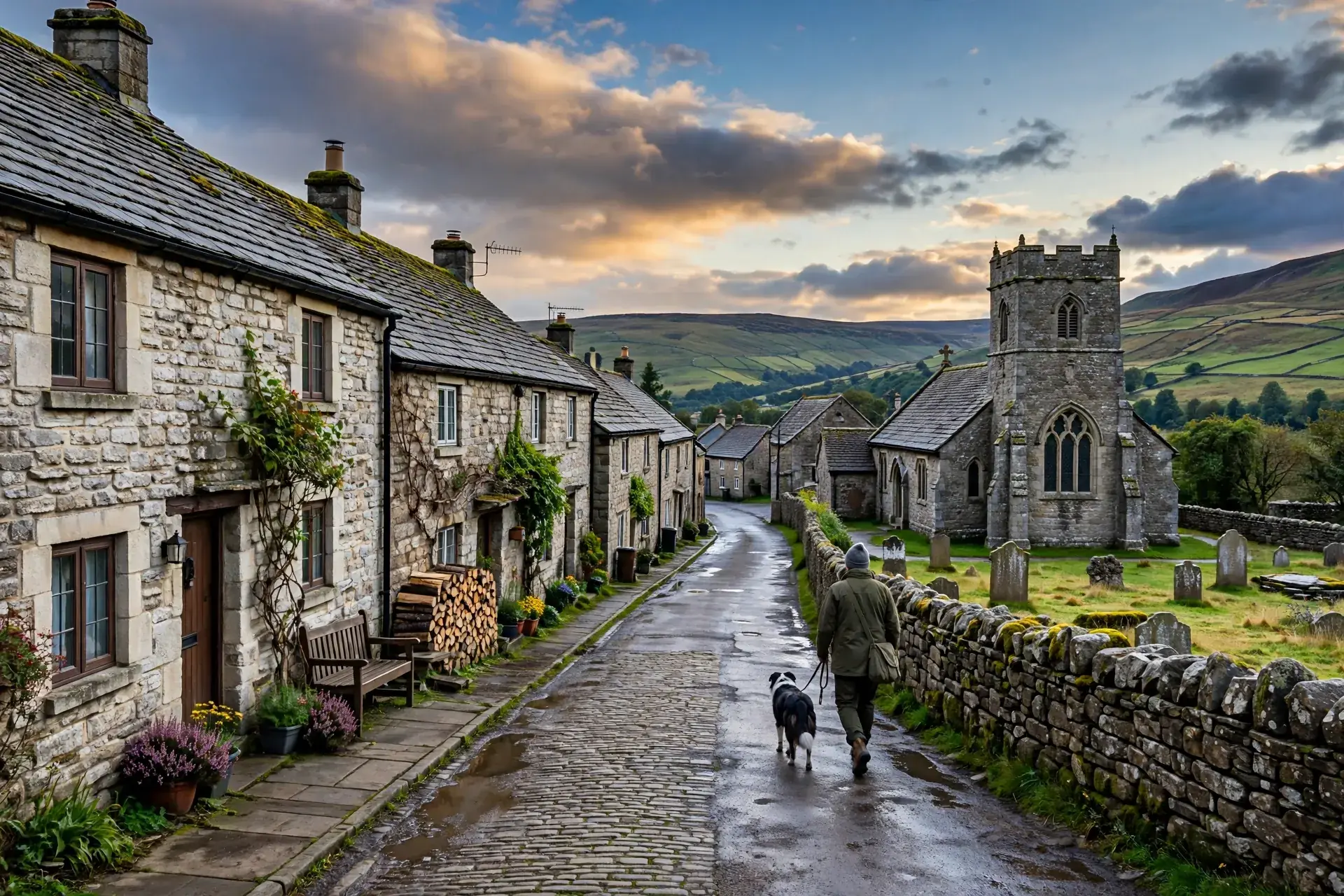
Dent village itself is the quiet heart of the visit. Stone cottages, narrow lanes, a church, a village green or square, and small bridges create a compact, walkable centre that suits dogs far better than a busy town. Walk the village slowly, on a lead, allowing the dog to sniff walls, hedges and verges, and to take in the scale of a place where traffic is light and people move at a walking pace. That slowness is Dent's main attraction: it is a village where a dog can walk without constant close passes, loud traffic or crowded pavements, provided the owner respects the village's quiet character.
Narrow lanes still need care. Delivery vehicles, farm vehicles and residents' cars use the same lanes as walkers, and a dog off lead around a blind corner can meet a vehicle, another dog or livestock very quickly. Keep the dog on a short lead, walk on the side with the best visibility, pause at corners, and step onto a verge or into a gateway where it is safe to let a vehicle pass. Do not allow the dog to enter private gardens, yards or farm entrances, and keep it away from garden gates where resident dogs may bark or rush the fence.
Respect the village as a living community, not just a visitor attraction. Residents live, work and park in Dent, and their access, gates and quiet enjoyment matter. Clean up promptly, keep noise low, do not block gateways or narrow lanes with a parked car or a group, and keep the dog under control near houses, gardens and other visitors. Small courtesies like these keep remote villages welcoming for dogs, because residents notice them far more than they notice a single well-behaved visit.
Parking in a small village
Parking in Dent requires more thought than parking in a town, because space is limited and narrow lanes leave little room for error. Use the village car park or other signed parking, note its exact location, and avoid parking on narrow lanes, in passing places, across gateways, or in a way that blocks residents, farm vehicles or emergency access. A car parked inconsiderately in a small village causes immediate problems, and it reflects badly on all dog owners. If the main car park is full, wait, use a signed alternative, or accept a slightly longer walk, rather than squeezing into an unsuitable spot.
Once parked, give the dog a toilet and water stop before exploring the village, and note the route back to the car. In a small village, that return route is usually short, but it can become confusing in rain, low light or after a longer valley walk, when the dog is tired and the owner is focused on the car rather than the village. A clear, remembered route back, plus a final toilet stop before the drive, makes the end of the visit calm rather than rushed.
Dentdale changes the maths of a short stop. There is no corner shop a two-minute dash away, no covered forecourt to duck into, and no second car park just around the bend, so anything left behind in the village, or anything the dog needs mid-visit, has to be carried from the start or done without. That remoteness also settles how indoor stops should work: if a building does not admit dogs, one person goes in while the other waits outside with the dog, and then you swap, rather than treating the parked car as a place to park the dog as well. A vehicle sitting on a valley lane in sunshine warms fast, and shade in a small dale car park is patchy at best, so the dog should never be left alone inside it while the humans wander off, however brief the errand feels. In cold or wet weather the problem flips. A damp dog cools quickly once the walking stops, especially after a valley lane in rain, so a dry coat, a thick rug and a towel kept in the boot let the dog warm up before the winding drive home, instead of shivering through it. Ventilation helps only while someone is actually with the dog; an open window does not make an empty car safe, and a quiet lane is no substitute for a person staying put.
Viaduct and valley walks
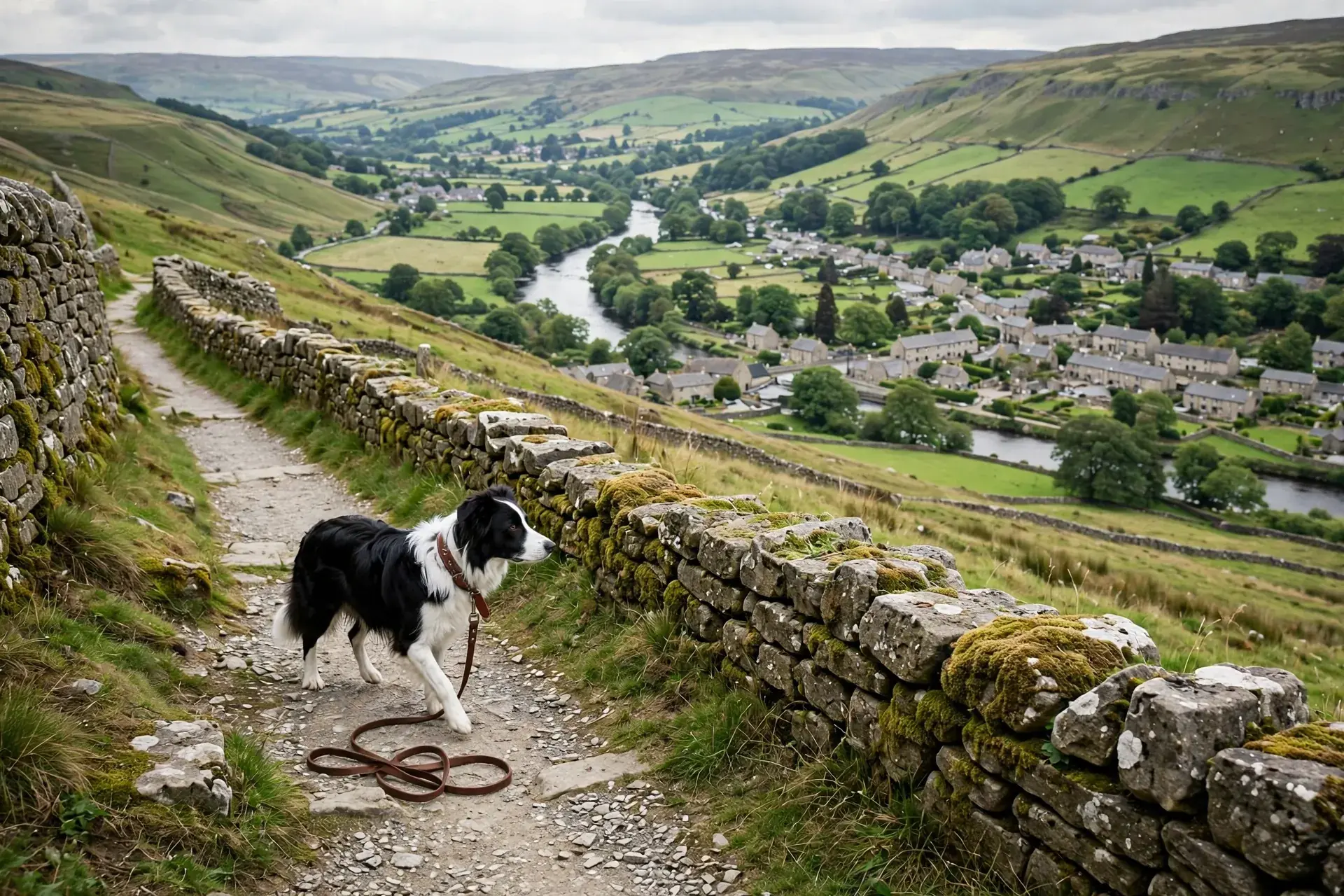
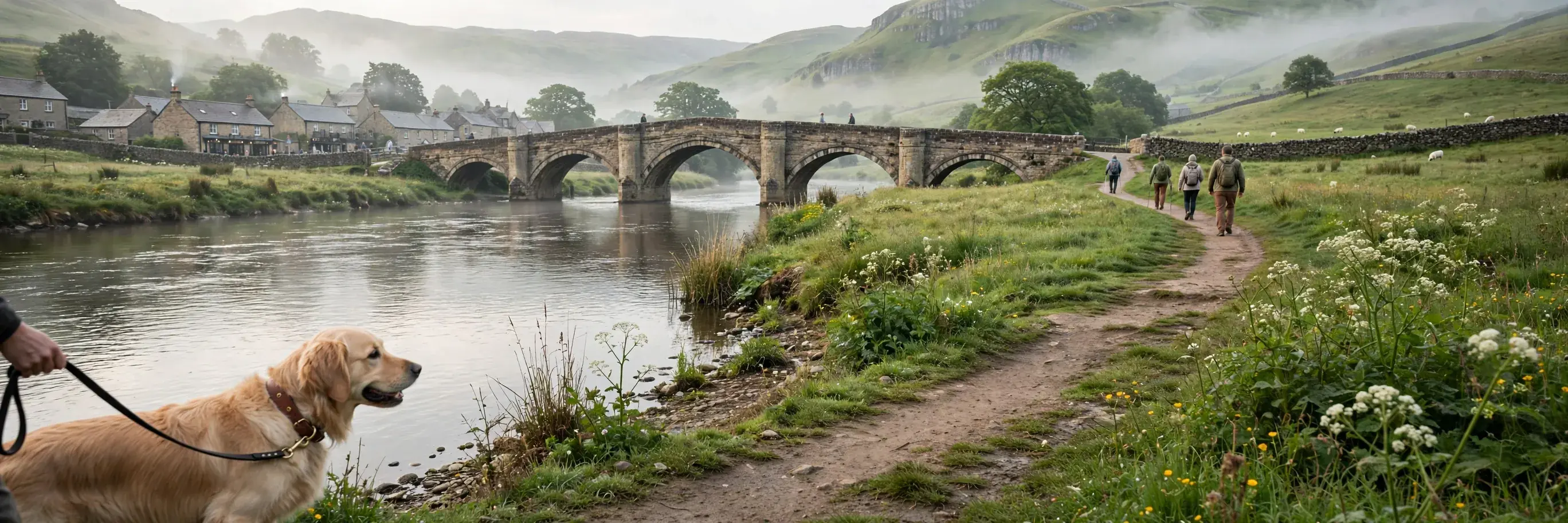
Valley walks from Dent, including routes towards viaducts and along Dentdale, offer some of the most rewarding walking in the Yorkshire Dales, provided the route is chosen for the dog in front of you. Viaduct viewpoints are impressive, but the walks to them can involve gradients, uneven surfaces, road sections, railway lines and livestock fields, all of which need care. Choose a route length that leaves energy for the return, check the surface and gradient in advance, and check local signs for access, livestock and railway safety rules. A short valley loop that ends with a settled dog is a better walk than a long viaduct route that ends with an exhausted dog.
Valley paths around Dent narrow without warning, and that narrowing is where a lead earns its keep. A lane bends into a farm track, the track crosses a road stretch, the road stretch runs beside the railway, and suddenly the dog is within a few strides of three different hazards at once, with a stone wall on one side and a drop or a fence on the other. Keeping the lead clipped on through those pinch points, rather than clipping it on after a problem appears, is the habit that matters here. Open ground is not a reason to relax either: a sheep flock scattered across a hillside, a train passing below a viaduct embankment, or another walker coming around a blind bend can all turn a loose dog into a chase in seconds. For the legal detail behind lead use around roads, livestock and local orders, see our guide to dog on lead law in the UK. Even a dog whose recall is excellent at home deserves the same caution on a Dentdale route, because the valley gives a bolting dog nowhere harmless to run to.
Decide what to carry by asking what a Dentdale walk would look like if something went mildly wrong. The nearest shop is not at the end of the lane, the phone may show no bars at all, and a bright morning can turn to valley rain before the halfway point, so the bag has to cover warmth, water, navigation and a muddy dog without a top-up stop. Start with a written route note and a charged phone holding the saved map, because those two together replace the live connection you will not have. Add layers for the dog as well as for yourself, a spare lead in case one clip fails on a gate, and enough drinking water plus a collapsible bowl for the full loop rather than the first half of it. Poo bags, a small first-aid pouch, a torch for a dull afternoon under low cloud, and a towel for the car ride home round out the load, in that spirit of self-sufficiency rather than as a checklist ticked in the same order every time. On the walk itself, watch the dog rather than the destination: lagging, heavy panting or a stiffening gait are the valley's way of saying the route should shorten, and a pleasant turning point reached early beats a viewpoint reached with a spent dog.
Weak signal: prepare before you arrive
Weak mobile signal is a normal feature of Dentdale, not an occasional fault, and planning should assume it. Save maps, routes, parking locations, cafe opening times and any other information you may need while you still have coverage, before entering the valley. Download offline maps for the whole Dentdale area, save the route as a file or a screenshot, and carry a paper map or written directions as a fallback. A phone with no signal is still useful for offline maps, photographs and a torch, but it cannot be relied on for live navigation, calls or internet searches in the valley.
Charging and battery management matter more in a weak-signal area, because phones searching for signal drain batteries faster. Charge fully before arrival, carry a portable charger, turn on battery-saving settings if needed, and avoid unnecessary phone use on valley walks. Tell someone your plans, route and expected return time before setting out, especially on longer or more remote valley walks, because that message is a safety net if you cannot call for help from the valley itself.
Weak signal also affects practical tasks such as finding a vet, checking a cafe's opening times, or booking accommodation. Do those tasks before entering Dentdale, while you have coverage, and save the results offline. Note the nearest vet's location and phone number on paper, save accommodation details offline, and check weather forecasts before arrival, because a forecast checked in the valley may be outdated or unavailable. Preparation before arrival is not extra work; it is the work that makes a remote valley visit safe and enjoyable.
Finally, embrace weak signal as part of Dent's charm, rather than fighting it. A valley walk without constant phone notifications is often calmer for both dog and owner, because attention stays on the path, the dog and the landscape. Use the phone for offline maps and photographs, and leave live messages, social media and work until you return to coverage. That break, combined with a quiet village and a calm dog, is part of why visitors return to Dentdale.
Weather, livestock and lead rules
Weather in Dentdale can change quickly, with wind, rain and low cloud arriving over the hills with little warning. Check the forecast before setting out, carry waterproofs and a towel, and choose valley routes with a clear, short retreat to the village or the car. If visibility drops, wind strengthens, rain becomes heavy, or the dog becomes cold or reluctant, turn back early rather than pushing on to a viaduct or a summit. Retreat is a skill, not a failure, and it protects both dog and owner in a remote valley where help may be far away and signal weak.
Sheep are not scenery in Dentdale; they are the working life of the hillsides, and they spill onto valley paths, lane verges and open fell in a way that makes every walk a livestock walk. A flock may be grazing just over a rise, lambs may be tucked against a wall out of sight, and a ewe with young at foot will read a bounding dog as a threat long before the walker sees her. Clip the lead on well before the flock comes into view, swing wide around grazing animals instead of threading between them, and keep the dog from staring, stalking or barking across a wall, since trouble starts with attention, not with contact. Spring needs extra restraint, when ewes are at their most protective and farmers are at their busiest, and any gate sign about that particular field outranks a general habit formed elsewhere. If a route's livestock situation looks unclear from the lane, choose another lane for the day rather than testing it.
Ground conditions also deserve attention. Valley paths can be muddy, slippery and uneven after rain, with stream crossings, stiles and gates that challenge smaller, older or less mobile dogs. Choose routes with surfaces your dog can manage, allow extra time for gates and stiles, and check paws after muddy walks for grit, cuts and irritation. A drying towel and a coat for short-coated dogs help after wet valley walks, and a warm, dry place to recover afterwards is especially important in a remote valley where the next warm shelter may be a walk away.
Pubs, cafes and rests
Pubs and cafes in Dent offer a welcome rest after village or valley walks, provided dog policies are checked first. Ask staff where dogs are welcome, choose a table near a wall or corner, settle the dog on a mat, and keep the lead short and out of walkways. A dog that has walked a valley route will be tired, muddy and thirsty, so offer water, dry paws, and allow time to settle before ordering. Our guide to dog friendly cafes explains how to check policies and settle a dog indoors, and those principles apply directly to Dent's pubs and cafes.
A Dent pub room is small, and that smallness shapes the whole stop. Tables sit close together, the door opens straight onto the lane, and there is often no spare corner to tuck a restless dog away from feet, food and other people's dogs, so the first job after arriving is not ordering but settling: find a spot against a wall, lay the mat down, let the dog drink and dry off, and wait until its breathing has slowed before anyone thinks about menus. Children passing with plates, the smell of a kitchen at lunchtime and a neighbouring dog under the next table can each lift a tired dog's excitement in turn, which is why a first visit here works best as a brief trial. Slip out while the dog is still lying calmly, on a good note, instead of stretching the stay until fidgeting, whining or staring takes over. Should a particular room not admit dogs that day, a drink taken outside on a village bench keeps the day intact without tying the dog up alone or returning it to the car.
Think about the return to the car after a pub or cafe rest. A dog that has rested, drunk and dried will be ready for a short village walk and a toilet stop before the drive, while a dog that is still wet, tired or overstimulated may struggle with a long drive on winding roads. Allow time for that final village walk, offer water, and settle the dog comfortably in the car before departing. A calm departure from Dent is the sign of a well-planned remote valley visit.
A sample Dent day
A sample Dent day might begin with a careful drive in, using saved offline directions, and an arrival at the village car park with time to spare. A toilet and water stop, followed by a slow village lane walk, lets the dog adjust to Dent's quiet pace before any longer walk. A pub or cafe rest, with the dog on a mat, gives both dog and owner time to recover and to check the weather and route for the valley walk. That slow start, deliberately unhurried, sets the tone for the whole day.
Midday is a good time for a valley walk, when light is best and there is still plenty of time to return before dark. Choose a route that suits the dog's fitness, keep the dog on a lead near roads, railways and livestock, and allow time to sniff, rest and enjoy the valley without rushing to a viewpoint. A short valley loop, with a clear return, is ideal for a first Dent visit, and it leaves energy for a final village walk and a cafe rest afterwards. End the day with a toilet stop, water, and a quiet route back to the car, and a careful drive out of the valley, with the dog settled and comfortable. That rhythm, drive, village, rest, valley, rest, is what makes Dent enjoyable for dogs, because it respects the valley's remoteness instead of fighting it.
Which dogs enjoy Dent most
Calm, confident dogs that enjoy quiet lanes, valley walks and car travel will find Dent straightforward, especially on quiet weekdays. Young dogs can also enjoy Dent, but they need shorter valley walks, more frequent rests and careful management on narrow lanes and near livestock, because their impulse control and fitness are still developing. Puppies should have very short village and valley exposure, with rest and sleep prioritised, and should not be taken on long, winding drives or steep valley routes that strain developing joints.
For a dog that startles or reacts, Dent's value lies in its room to manoeuvre, not in any promise of empty lanes. A weekday morning on a village lane usually offers long sightlines, grass verges to step onto, and gateways to duck into, which together let an owner create distance before an encounter becomes a confrontation. That only works if the route is chosen backwards from its escape points: a lane with a verge, a passing place or a side gateway every short stretch gives the dog an exit, while a walled lane with no gaps turns every oncoming walker, farm vehicle or loose farm dog into a head-on meeting. Early starts help, as does keeping the lead short but slack through bends, and watching the dog's body rather than the map, so a tightening lead, a frozen stance or a hard stare becomes the signal to step aside early. When those signals stack up, walking back to the car or to a quiet stretch of lane is not giving up; it is the decision that keeps the next outing possible.
An older dog, or one whose joints complain on gradients, gets a different kind of Dent day, built around level ground and the freedom to stop. The village lanes themselves, plus the flatter stretches of valley floor, offer short out-and-back walks where the return is never further than the distance already covered, and where a gateway or a grassy verge can serve as a rest stop at any moment. That shape matters more than total distance: a lane that climbs steadily to a stile, with no way back except over the same stile, commits a stiff dog to a route it cannot easily abandon, while a lane that simply peters out into a farm track lets the pair turn around at the first sign of slowing. Keep the pace to the dog's gait, not the walker's stride, build in pauses for sniffing and drinking, and carry a mat so rests happen on something dry rather than on cold stone. A visit that ends with the dog still keen to walk to the car, rather than being coaxed along the last lane, is the right length for that dog, and it is the length most likely to be enjoyed again.
Dentdale by lane: Cowgill, Gawthrop and the upper dale
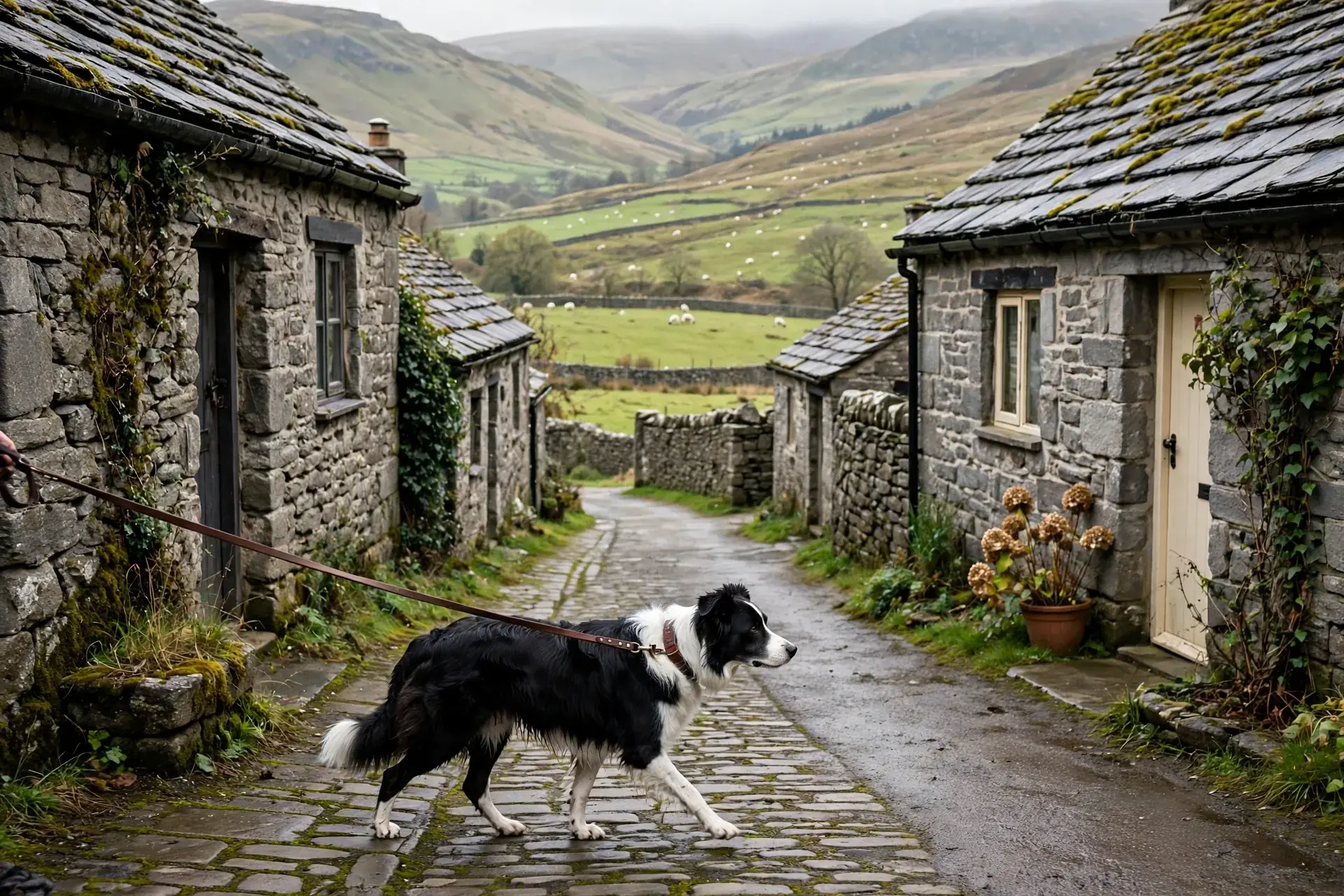
The lanes that lead out of Dent village towards Cowgill and Gawthrop are the quietest walking in Dentdale, and they suit a dog precisely because they ask so little in the way of drama. There are no visitor honeypots along them, no wide car parks disgorging crowds, and no surfaced promenade; instead there is a narrow tarmac ribbon between stone walls, grass growing down the middle in places, and long views up a dale that narrows and steepens as it climbs. Walking here is an exercise in lane manners. The dog stays on a lead, close to the walker's side, because every bend can hide a vehicle, and the walker stays alert for the sound of an engine long before the vehicle itself appears. That alertness is part of the pleasure too: the lane rewards slow walkers, people who stop to let the dog sniff a wall, watch a dipper in a beck, or simply stand and look back down the valley towards the village they left behind.
Passing places are the social contract of these lanes, and a dog walker needs to understand them before setting out. A passing place is a widened bay in the verge or a gateway recess, and its whole purpose is to let two vehicles pass on a road built for one. When a car, a van or a tractor approaches, the walker steps into the nearest bay, pulls the dog in close against the wall or hedge, shortens the lead, and waits, facing the traffic, until the vehicle has gone by. Dogs that lunge at wheels or bark at engines need particular care here, because a passing place puts dog and vehicle only a few feet apart, and a startled driver on a narrow lane has nowhere to swerve. The courteous move, and the safe one, is to step aside early, even when the vehicle is still some distance away, rather than hoping it will slow to a crawl for a dog in the middle of the road. Farm vehicles deserve extra patience: a tractor with a trailer needs far more room than a car, may be unable to stop quickly on a gradient, and may be followed by a second vehicle that is invisible around the bend.
Farm traffic is not an interruption on these lanes; it is the reason the lanes exist, and a dog walker is a guest in a working landscape. Tractors move between fields and farmyards, quad bikes buzz along tracks to check stock, and Land Rovers with dogs of their own pull out of gateways without warning. Sheep movements add another layer: a farmer moving a flock along a lane will fill the whole width of the road with woolly bodies, and the only sensible response is to step well off the lane, hold the dog firmly, and wait until the flock has passed and the farmer has waved the walker on. Dogs should never be allowed to run at the tail of a moving flock, chase a stray sheep back towards the group, or bark from a gateway while sheep file past, since a single frightened animal breaking away can scatter the whole flock and put both sheep and dog at risk. Watching a flock move along a Dentdale lane, from a safe verge with a settled dog, is one of the most memorable sights of the dale, and it costs nothing except patience.
Gates are the punctuation marks of a lane walk in the upper dale, and each one deserves a small ritual. Approach with the dog already on a short lead, check what lies beyond the gate before opening it, close it securely behind you, and never prop it open or climb over it with the dog loose beside you. Some gates lead into fields where sheep or cattle are grazing, and those fields are not dog-walking ground unless the right of way clearly runs through them and the animals can be given a very wide berth; on a lane walk, the lane itself is usually the route, and the gate is simply a boundary to respect rather than an invitation to enter. Other gates mark farmyards, private drives or gardens, and the same rule applies in reverse: keep the dog out, keep the gate shut, and do not let the dog nose through gaps or bark at farm dogs behind the gate. A dog that learns that gates mean pause, check and close will be welcome on far more lanes than a dog that treats every gate as a race to the other side.
Livestock on the upper dale lanes is a constant, low-level presence rather than a dramatic encounter, and that is exactly why it catches walkers out. Sheep graze the verges, rest against walls in the sun, and wander onto the tarmac where the grass is sweet, so a dog on a lane walk is almost always within sight of sheep even when no field is involved. The discipline is the same as on a valley path but quieter: lead on, distance kept, no staring matches across a wall, and no attempt to hurry past a ewe and lambs at close quarters. Cattle, where they appear, call for even wider margins, especially cows with calves, and the wise move is to take another lane for the day if a herd is standing across the route. Dogs that have never met livestock before should be introduced to Dentdale lanes gradually, on a short stretch near the village first, so the owner learns how the dog reacts to sheep smell, sheep sound and sheep movement before committing to a longer lane walk where turning back means retracing the whole route.
Every lane walk in the upper dale has a natural turning point, and recognising it is a skill worth practising. Sometimes the lane itself announces the end: the tarmac gives way to a rough farm track, the walls fall away into open fell, or the gradient steepens sharply and the surface turns to loose stone that is hard on paws. Sometimes the turning point is a junction where the lane splits, with no sign and no obvious onward route, and pressing on would mean guessing. Sometimes it is simply a gateway with a good view back down the dale, a flat grassy verge where the dog can drink and rest, or the moment when the dog's pace drops and its interest in sniffing fades. Any of these is a complete ending. Turning at a gateway above Gawthrop, or where the Cowgill lane begins to climb in earnest, still gives a walk of real character, and it leaves the dog with energy for the return, which is downhill in spirit even when the lane itself undulates. The return journey is not a retracing to be hurried through; it is a second walk, with different light, different smells, and a dog that now knows the lane well enough to relax into it.
A few practical habits make lane walking in Dentdale smoother for everyone. Carry water even for a short lane, because there is no tap, stream you can rely on, or shop along the way, and a dog that has been walking uphill in sun will need a drink long before the village reappears. Poo bags go in a pocket, not left on a wall or a gatepost for a later collection that never happens, and any bag carried out should be disposed of properly back in the village. Footwear matters as much for the walker as for the dog: lane surfaces are uneven, verges are soft after rain, and a twisted ankle on a remote lane is a long hobble from help, particularly where the phone shows no signal. Tell someone roughly which lane you took and when you expect to be back, especially on a longer upper-dale walk, and keep an eye on the weather building over the fells, since a lane with no shelter and no short cut home is a poor place to be caught in a downpour. Done with those habits, a lane walk to Cowgill or Gawthrop is Dent at its most unshowy and most satisfying: a dog, a lane, a working valley, and nowhere to be except back in the village in good time for a rest.
Arriving without a car: Dent station and the walk into the village
Dent station sits apart from the village it serves, high above Dentdale on the Settle to Carlisle railway, and that separation is the first thing a car-free visitor needs to understand. The station is remote even by Dales standards: a small halt in open country, with minimal facilities, no shop, no cafe, and no taxi rank waiting outside, surrounded by fell, stone walls and big skies. Trains on this line are a pleasure in themselves, winding through viaducts and tunnels, but the station is a starting point, not a destination, and the journey into Dent village still has to be walked. Anyone planning this arrival should confirm train times, service patterns and the current rules for dogs on trains before travelling, since rural services can change, engineering work can alter stopping patterns, and the details that matter for a dog, such as where dogs may travel in the carriage and whether a fare applies, are best checked with the operator rather than assumed from a previous trip.
The walk from the station down into Dent village is downhill for most of its length, which sounds like a gift until the return journey is considered. Going down, the lane drops steadily towards the village, with views opening up across Dentdale, stone walls on either side, and a sense of the valley unfolding below. For a dog, the descent is straightforward on the legs but full of distractions: sheep on the fell beside the lane, scents left by other dogs, farm vehicles using the same narrow road, and the occasional passing car with nowhere much to pull over. Keep the dog on a lead for the whole descent, step onto verges for traffic, and do not let the downhill ease lull anyone into letting the dog run ahead around bends. The surface is a country lane, not a pavement, so there is no raised footway to separate walker from vehicle, and the dog's safety depends entirely on the lead, the verge and the walker's attention to approaching engines.
Coming back up to the station is a different walk altogether, and honesty about it matters more than enthusiasm. The same lane that felt gentle on the way down becomes a long, steady climb on the way back, exposed to wind and weather, with no shelter, no bench of any reliability, and no short cut. A fit adult walker will manage it without drama, but a walker with a tired dog, heavy bags, or limited mobility may find it a serious undertaking, and a dog that has already walked all day in the village will feel the gradient in its legs too. Plan the return with that climb in mind: leave the village in good time for the train, carry the dog's water for the ascent, build in pauses at gateways and wider verges, and do not schedule the station climb immediately after the longest valley walk of the day. For some visitors, the sensible pattern is to walk down from the station in the morning, spend the day in and around the village, and then accept that the climb back is the final walk of the day, done slowly, rather than an afterthought squeezed between a pub stop and a departure time.
Packing for a station arrival is an exercise in self-sufficiency, because there is nothing to buy at the station end. Water for the dog and for the walker, a bowl, food or treats for the journey, poo bags, a towel for a wet day, layers for wind on the exposed upper lane, and a charged phone with the route saved offline all need to be in the bag before the train leaves its starting station. A torch is worth carrying outside summer, since a late train or a delayed return can mean walking the lane in fading light, and a paper note of accommodation details, the village location and a contact number covers the situation where the phone has no signal at all. Dog essentials deserve the same forethought: a lead that is comfortable for a long lane walk rather than a short pavement stroll, a harness that does not rub over distance, and, for a dog that chills easily, a coat for the wait on an exposed platform. There is no shop at the station to replace a forgotten lead, a missing bowl or an empty water bottle, and the village, once reached, is the first place where supplies can be found.
How a dog copes with the station-to-village route depends less on the train than on the dog's temperament on open, exposed ground. A confident dog will enjoy the space, the smells and the long views, but may also pull downhill with excitement, lunge at sheep glimpsed over a wall, or bark at a passing train, all of which need a firm, calm lead hand and early intervention. A nervous dog may find the open fell, the wind, and the sound of trains more unsettling than a village lane, and for such a dog the station walk works best as a gradual introduction: pause often, let the dog sniff and settle, keep the pace slow, and do not rush the descent in order to meet an imagined timetable. Dogs that are anxious about traffic need the same verge discipline as on any Dentdale lane, practised from the first bend rather than improvised halfway down. In all cases, the platform itself calls for care: keep the dog close, away from the platform edge, on a short lead while waiting, and settled before the train arrives, since a rural platform has little barrier between dog, track and a moving train.
The rewards of arriving by train are real, and they explain why many visitors choose this harder arrival despite its demands. The journey itself, across viaducts and through the high Dales, is a slow unfolding of landscape that a car journey on narrow roads never quite offers, and stepping off the train into open fell air, with the whole of Dentdale below, is a memorable start to a dog-friendly break. The village, when it finally appears around a bend in the lane, feels earned rather than driven to, and the dog that has walked down into it has already had a proper walk before the holiday has properly begun. That sense of arrival is worth protecting with honest planning: confirm the trains, pack as if there were no shop at either end of the lane, allow generous time for the climb back, and treat the station walk as a walk in its own right, with water, rests and lead discipline, rather than as a mere transfer. Done that way, Dent station is not an obstacle to a dog-friendly visit; it is the beginning of one, and the dog that trots down the lane into Dent, ears up and tail loose, has already learned the most important lesson of the dale, which is to take the valley at walking pace.
Practical questions
Before you go
Is Dent difficult to reach by car with a dog?
Dent is reached by narrow, winding Dales roads, so allow extra time, drive slowly, and plan a toilet and water stop before the narrowest stretches. Check your route in advance, save it offline, and do not rely on mobile signal for navigation in the valley.
Where can I park in Dent village with a dog?
Use the village car park or other signed parking, note its location, and avoid blocking narrow lanes, gateways or residents' access. Give the dog a toilet and water stop before exploring the village, and keep the car accessible for a quick retreat if the weather changes.
Can dogs walk to Dent Head Viaduct?
Viaduct and valley routes vary in length, gradient and surface, so choose a route that suits your dog and check local signs for access and livestock rules. Keep dogs on a lead near roads, railways and livestock, and check the official guidance before you travel if a route is unclear.
What should I do if mobile signal is weak in Dentdale?
Save maps and routes offline before you arrive, carry a paper map or written directions, tell someone your plans, and keep your phone charged. Do not rely on signal to find parking, a vet or a route, and download any information you may need while you still have coverage.
Are Dent village lanes suitable for nervous dogs?
Often yes, because Dent is quiet and its lanes are low-traffic, but narrow lanes can still bring sudden encounters with vehicles, other dogs and livestock. Keep the dog on a lead, use wide verges where available, and choose early or weekday visits for the quietest experience.