This guide is independent and contains no paid placement. If affiliate links are added later, they will be clearly marked and will not change our editorial checks.
Many Cornish beaches welcome dogs all year — Perranporth, Holywell Bay, Watergate Bay, Crantock and Mawgan Porth are the reliable names — while busy resort bays such as parts of Newquay and St Ives restrict dogs in summer, usually from Easter or 1 May to 30 September. The north coast is surf country with strong currents; the south coast is sheltered, with harbours and coves. Check the official guidance before you travel, check the tide, and carry fresh water.
The two lists: year-round and seasonal
Every Cornwall beach trip starts with the same question, and it has a two-part answer. Some beaches welcome dogs all year round, with no seasonal ban at all. Others restrict dogs during the summer, usually from Easter or 1 May until 30 September, and open up again for the winter. The two lists overlap in the same town — Newquay, St Ives and Penzance each have beaches in both categories — so knowing the name of the town is not enough. You need to know the name of the beach, and the dates that apply to that beach.
The year-round list is the one to learn first. It includes the long, open sands of the north coast around Perranporth and Newquay, the dune-backed bays of the central north coast, and a string of quieter coves on the south coast. These beaches are the backbone of a dog holiday in Cornwall: you can plan a week around them without worrying about the calendar, and you can visit them in August as happily as in February. They tend to be larger, less built-up and further from the busiest resort centres, which is why they have escaped seasonal bans — and why they suit dogs that need space.
The seasonal list is the one to check before every summer visit. It covers the main resort beaches: the central sands in Newquay, the harbour beaches in St Ives, the main beach at Penzance and the popular family bays that fill up with sunbathers and children in July and August. On these beaches dogs are usually banned from the whole beach or from a marked zone during the summer months, and the ban is enforced by the council under a Public Spaces Protection Order. The dates and the zone vary by beach, and councils review their orders every few years, so a beach that was open last summer may have a new restriction this year. Always check the official guidance before you travel, and read the signs at the beach entrance on the day — the sign is the rule that applies.
Use the two lists to plan, not to argue. If you arrive at a seasonal beach in August and find a ban in force, the sensible move is to drive ten minutes to the nearest year-round beach, not to test the ban. Cornwall is small enough that a back-up beach is rarely far away, and the year-round beaches are often the better ones for dogs anyway: more space, fewer crowds and a longer walk. Keep this guide's two lists in mind, check the council page for the beach you have chosen, and build your day around the year-round beaches in summer, saving the seasonal bays for the quieter months.
Year-round beaches: the reliable list
Perranporth is the classic year-round Cornish beach, and it is the one many dog owners return to year after year. At low tide it is a vast, flat expanse of sand, with a stream running across the beach that dogs love to paddle in, and cliffs at both ends that give the bay a sense of enclosure. The car park is close to the beach, the village has cafes and pubs that welcome dogs, and the beach is long enough that even on a busy summer day you can walk away from the crowds. Keep dogs away from the cliff base at high tide, and watch the stream after heavy rain, when it can run fast.
Holywell Bay is the quieter neighbour of Perranporth, a short drive away, and the walk in is part of the reason. From the car park the path runs through dunes to the sand, which puts off the casual visitor and leaves the beach feeling open, with room for a long straight run. The dunes are a sensitive habitat, so dogs stay on a lead and on the paths through them, and digging in the dune grass is off limits. In summer a lifeguard watches the beach, but the surf can be strong, so swimming belongs in the shallows unless the dog is a confident swimmer.
Watergate Bay is the big open one: wide, exposed to the Atlantic, and shared with surfers, kite surfers and horse riders. Dogs are welcome all year, but it is a working surf beach, so a nervous dog should stay on a long line until you see how it reacts to boards, kites and horses moving fast across the sand. At low tide the sand is firm and flat, which suits a long run, and the cliffs at the northern end give some shelter from the wind. A large car park sits above the beach, and the hotel and restaurant there welcome dogs, which makes it an easy base for a day out.
Crantock, near Newquay, has a river estuary at one end and a long sandy beach at the other. The estuary is beautiful and dangerous in equal measure: the tide runs fast through the river channel, and dogs should not swim across it. Walk on the sand, paddle in the shallows at the river mouth, and keep dogs on a lead near the estuary if they are inclined to chase birds. Mawgan Porth, a little further along the coast, is a sheltered, sandy cove with a stream, a car park close to the beach and a village with cafes — a good choice for families and older dogs. Further west, Porthcurnick and the beaches around the Roseland Peninsula offer quieter, year-round options on the south coast, with sheltered water and a village feel.
Summer-restricted beaches and dates
Summer restrictions fall hardest on the beaches that fill first, and in Newquay that means the town sands: Towan Beach, Great Western Beach and Tolcarne Beach all carry seasonal restrictions, while Perranporth, Watergate Bay and Crantock, a short drive away, stay open. Fistral Beach, the famous surf beach, restricts only part of its sand, so the marked zone decides where a dog can go. The pattern repeats across the county: the beach in front of the town is restricted, and the beach a short walk or drive away is open.
St Ives is the clearest example. Porthmeor Beach, the surf beach at the western end of the town, Porthminster Beach, the family beach near the harbour, and Porthgwidden Beach, the small cove below the island, all have seasonal restrictions in summer. The dates are usually from Easter or 1 May to 30 September, but they vary by beach and by year, so check the official guidance before you travel. Out of season, St Ives is a wonderful place to walk a dog: the harbour, the island and the beaches are quiet, the light is beautiful, and the cafes welcome dogs. In summer, the sensible move is to visit the town on a lead in the morning and drive to a year-round beach for the afternoon.
Penzance and the far west have a similar split. The main beach at Penzance has seasonal restrictions, while the neighbouring beaches at Marazion, with its view of St Michael's Mount, and at Praa Sands, a long sandy beach further along the coast, welcome dogs all year. Mousehole, the tiny fishing village, has a small harbour beach that is best visited on a lead, with the coast path offering a better walk for dogs. Sennen Cove, near Land's End, is a long sandy beach that welcomes dogs, with a car park close to the sand and a surf school that operates in summer — keep dogs on a lead near the surf school and the car park.
The dates matter, and they are not the same everywhere. Some bans start at Easter, which moves each year, while others start on 1 May or 1 July. Some end on 30 September, others on 31 October. A few beaches ban dogs only between 10am and 6pm, rather than all day, which means an early morning or evening walk is allowed even in summer. The only reliable source is the council's beach page and the sign at the beach. If you are planning a summer holiday, check the dates for every beach you intend to visit, write them down, and have a year-round back-up for each day. That small bit of planning saves a wasted journey and a disappointed dog.
North coast: surf beaches and safety
Cornwall's north coast faces the Atlantic, and the sea here is a different animal from the sheltered south coast. Waves break hard on the sand, rip currents form when the swell is up, and the tide can come in fast across a flat beach. That makes the north coast the most exciting place in Cornwall for a fit, confident dog — and the place that needs the most care. Choose a beach with a lifeguard in summer, swim only in the flagged zone if you swim at all, and keep dogs out of the water when the red flag is flying or when the surf is large.
A rip current does not look dangerous, which is the problem. It is a narrow channel of water running back out to sea, often through a gap in a sandbank, after waves have pushed water up the beach. A dog that swims into one gets carried out, and a panicking dog tires fast. Learn the signs before you go in: a patch of calm water between breaking waves, a line of foam or debris drifting seawards, or a patch of discoloured water. If you see any of those, keep the dog out of the water. If a dog does get caught, do not go in after it unless you are a confident swimmer and the conditions are safe — call the coastguard on 999 and ask for the coastguard, and keep the dog in sight.
On a surf beach the sand has its own hazards. Boards, bodyboards and kites move fast enough to hit a dog, so keep dogs on a long line near the surf zone and away from the strip where surfers carry their boards down to the water. In summer the dry sand can burn paws, so test it with your bare foot first and use the wet sand by the water if the dry sand is too hot. Weever fish bury themselves in the shallows in summer and their sting is painful: if a dog yelps after stepping on something under the water, keep it calm, keep the paw warm, and get veterinary advice.
For all that, the north coast is where many dogs have their best days. The beaches are long, the sand is firm, and the wind keeps the air cool even on a hot day. Perranporth, Watergate Bay and Mawgan Porth all have lifeguards in summer, and the RNLI publishes safety advice beach by beach. For the rules behind the signs, see our UK beach dog rules, bans and fines guide; if you are torn between counties, Cornwall vs Devon with a dog sets the coasts, rules and drive times side by side.
South coast: harbours and sheltered coves
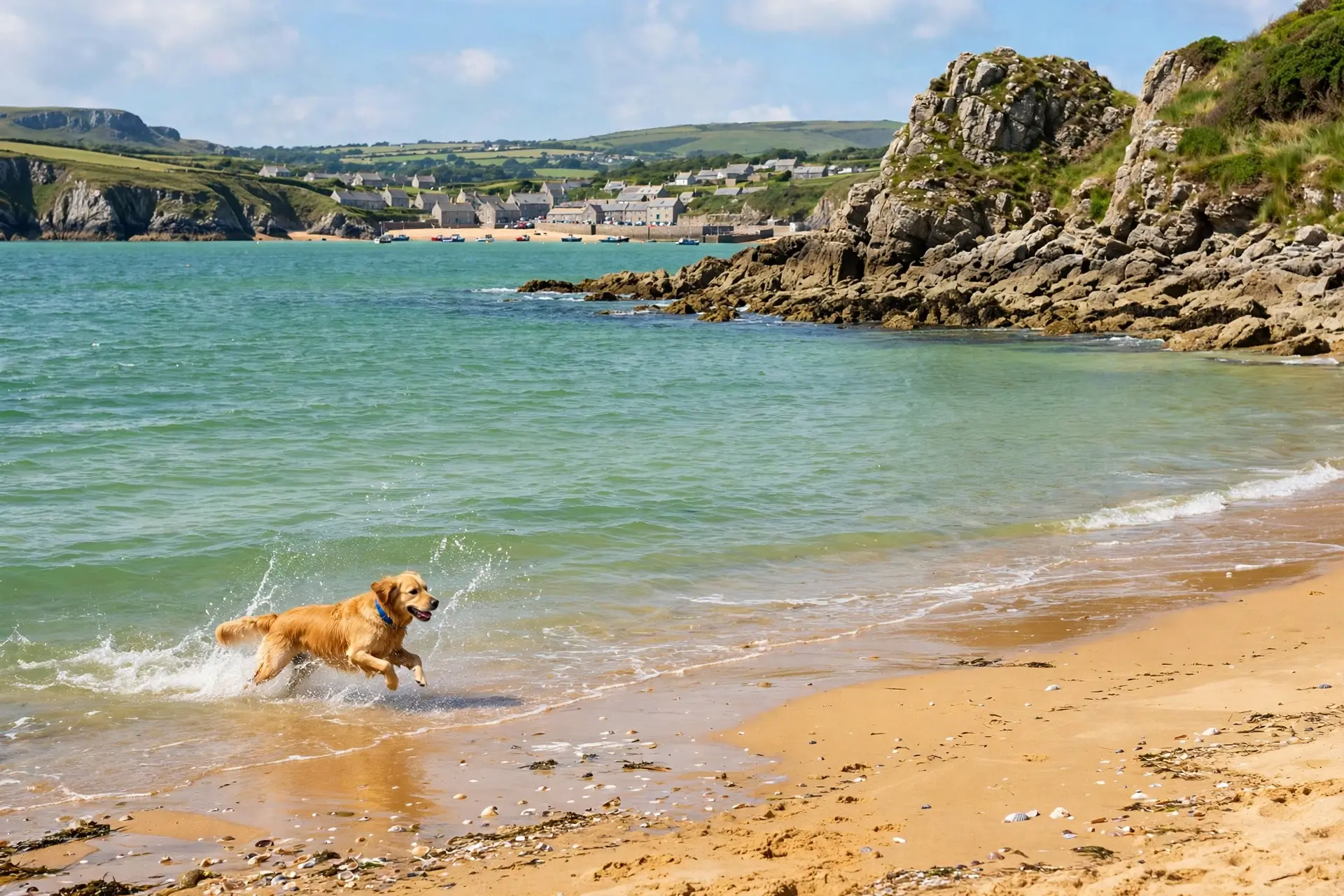
Cornwall's south coast is sheltered from the Atlantic swell, and the sea here is calmer, warmer and easier for dogs to swim in. The beaches are smaller and more varied: sandy coves, shingle shores, harbour beaches and estuary sands, each with its own character. The south coast suits older dogs, puppies and dogs that are nervous in big waves, because the water is shallow and the waves are small. It also suits owners who like a village walk, a harbour pub and a cream tea after the beach.
Falmouth has several beaches within a short walk of the town, including Gyllyngvase Beach, a sandy bay with a cafe and a car park, and Swanpool Beach, a quieter cove a little further along the coast. Both have seasonal restrictions on the main sands in summer, so check the dates, but out of season they are excellent dog beaches. The harbour at Falmouth is busy with boats, so keep dogs on a lead near the water and away from the ferry terminals. The walk from Falmouth to Pendennis Castle, along the coast path, is a good dog walk with views across the harbour.
East of Falmouth, the Roseland Peninsula strings together quiet beaches and coves — Pendour Cove, Porthcurnick Beach and the beaches around Veryan Green among them. They are small, sheltered and rarely crowded, with a village feel and a car park a short walk from the sand. The Helford River, between Falmouth and the Lizard, is creek country: its beaches and banks are best explored on foot, with the coast path giving views across the water. Keep dogs on a lead near the creeks, because the mud there can be deep and the tide can cut off a walk.
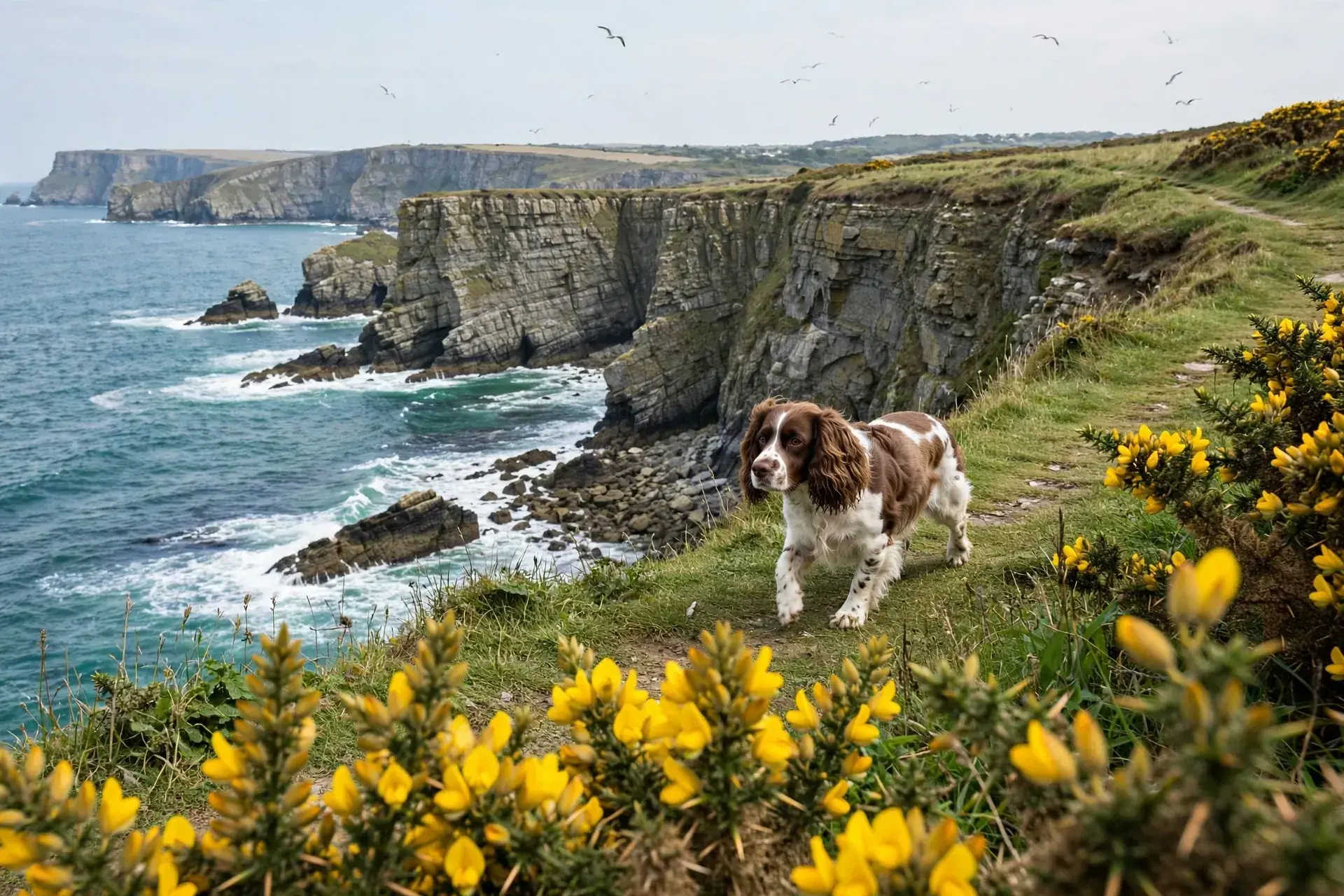
The Lizard Peninsula, the southernmost point of mainland Britain, has beaches that feel wild and remote. Kynance Cove, with its serpentine rock and turquoise water, is beautiful and busy in summer, with a car park a walk from the cove and a cafe that welcomes dogs. Kennack Sands, on the eastern side of the peninsula, is a long sandy beach that welcomes dogs, with a car park close to the sand and a quieter feel than Kynance. The cliffs around the Lizard are high and unfenced in places, so keep dogs on a lead near the cliff edge, and do not let them chase birds on the coastal grassland in spring and summer.
Tides, estuaries and river mouths
In Cornwall the tide decides the day. The range can be seven metres or more, so a beach a mile wide at low tide can vanish completely at high tide. To get the widest sand, aim to arrive two or three hours before low tide, and check the times for the exact beach you are visiting — the UK Hydrographic Office publishes them, and many beach car parks display them at the entrance. Do not borrow the times from a neighbouring beach: the tide can differ by half an hour or more along this coast.
On the Camel, the Fal and the Helford, the danger is not the open sea but the channel. All three estuaries — the Camel at Padstow and Rock, the Fal at Falmouth, the Helford River — carry fast water that fills quickly on a rising tide. A dog that walks out onto the sand at low tide can find a channel filling in behind it, and a dog that swims across a channel can be carried out to sea. Keep dogs on a lead near estuary channels, do not let them swim across a river mouth, and stay off estuary sands unless you know the area well. If you are unsure, ask a local or check the official guidance before you travel.
The north coast rivers are smaller but no safer. The Gannel at Crantock, the stream at Perranporth and the river at Mawgan Porth all run across the sand into the sea, and the current in the river channel strengthens after rain. Dogs love to paddle in a stream, but they should not swim across a river mouth, and they should not drink from a stream that runs through farmland, because it can carry bacteria. Let them paddle in the shallows, keep them clear of the main channel, and rinse them with fresh water afterwards.
If a dog gets stuck in estuary mud, the rescue matters more than the warning. On the Fal and the Helford the mud can be deep and soft, and a dog that runs onto it can sink in fast. Do not pull on the lead: hauling can injure the dog. Shout for help, talk to the dog calmly, and only lift it — supported from underneath — if you can reach it without risking yourself. In an emergency, call the coastguard on 999. The way to avoid all of this is simpler: stay on firm sand and the paths, and never let a dog chase birds out across the mudflats.
Parking, villages and facilities
Treat parking as the first booking of the day. On a sunny summer weekend the popular beach car parks are full by 10am, and the smaller cove car parks fill even earlier, so arrive early and keep a back-up beach in mind. Never park on double yellow lines or block a farm gate: the fines are real, and a blocked gate can stop a farmer reaching livestock. Most car parks are pay and display or pay by phone, at around 8 to 15 pounds for a full day in summer, and some sell a weekly ticket that pays for itself if you are staying for a week.
What the village gives you decides what to carry. The big Cornish beaches have toilets, a cafe, a shop and a lifeguard through the summer; the little coves have none of those things, and may not even have a tap or a patch of shade. Go prepared for the bare version. Village cafes and pubs usually welcome dogs, though some keep them to the terrace or one corner, so ask before you sit down. An outdoor tap by a toilet block is handy for paws, but it is a bonus, not a plan — bring water and a towel of your own.
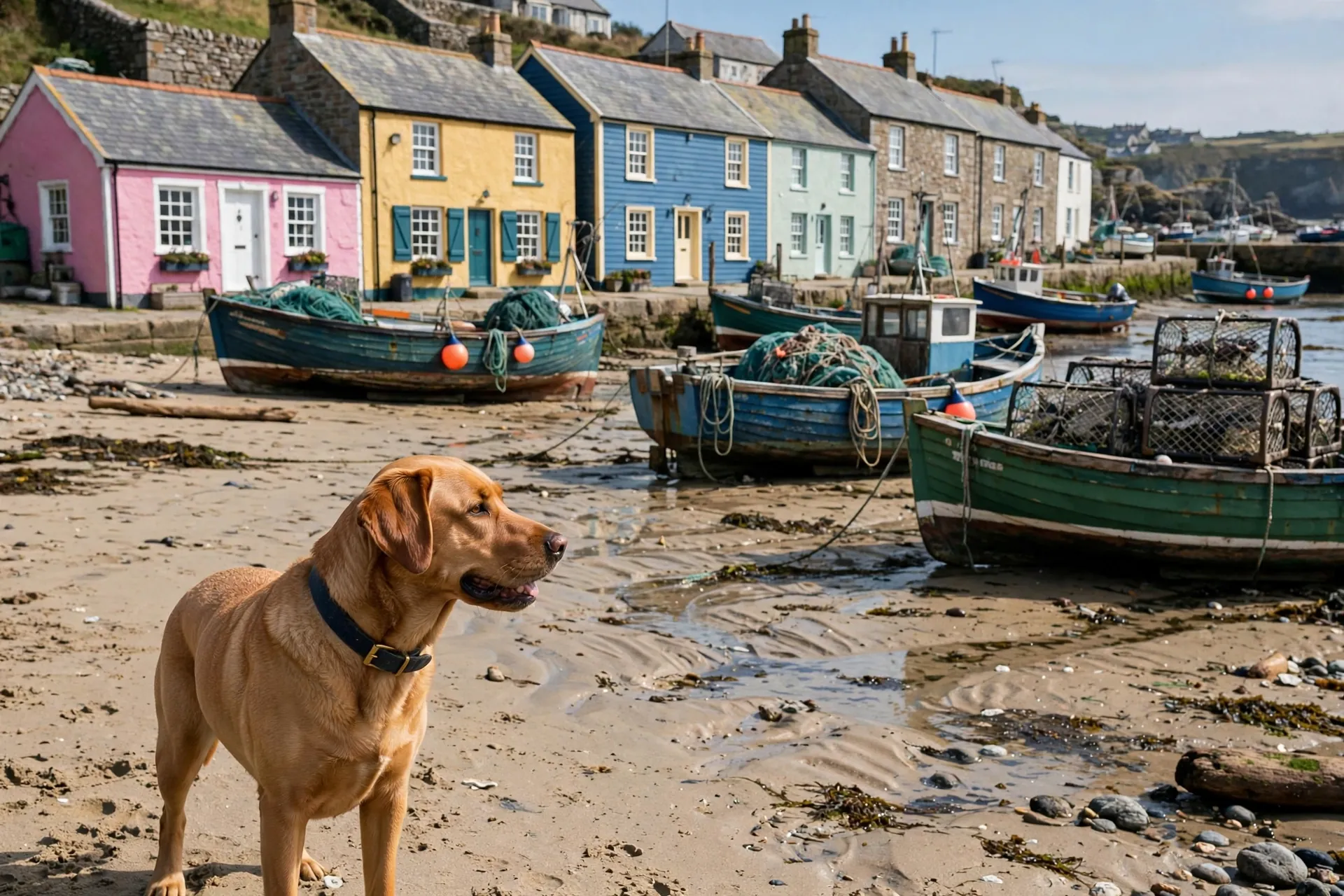
The villages are half the Cornish beach day, and they are worth a walk with a dog on a lead. Padstow, St Ives, Falmouth and Mousehole all have harbours, narrow streets and dog-friendly pubs, but in summer they are busy, and a dog that is nervous in crowds will find them stressful. Go early in the morning or in the evening, once the day-trippers have gone, and keep the dog on a short lead in the narrow streets. Village shops sell treats, poo bags and towels if you have forgotten something, but they cost more than a supermarket, so stock up before you arrive.
Water first, shade second — that is the summer order. Bring at least a litre of fresh water per dog, plus a bowl, and offer it often: the sea is not a substitute, and a dog that drinks seawater can become ill. There is little natural shade on an open Cornish beach, so bring a windbreak or a beach tent for the dog to lie under. A car with the windows cracked open still heats fast, so never leave a dog in one. And if you are walking the coast path, carry water for the dog as well as yourself, because there may be no fresh water on the path.
Linking beaches on the coast path
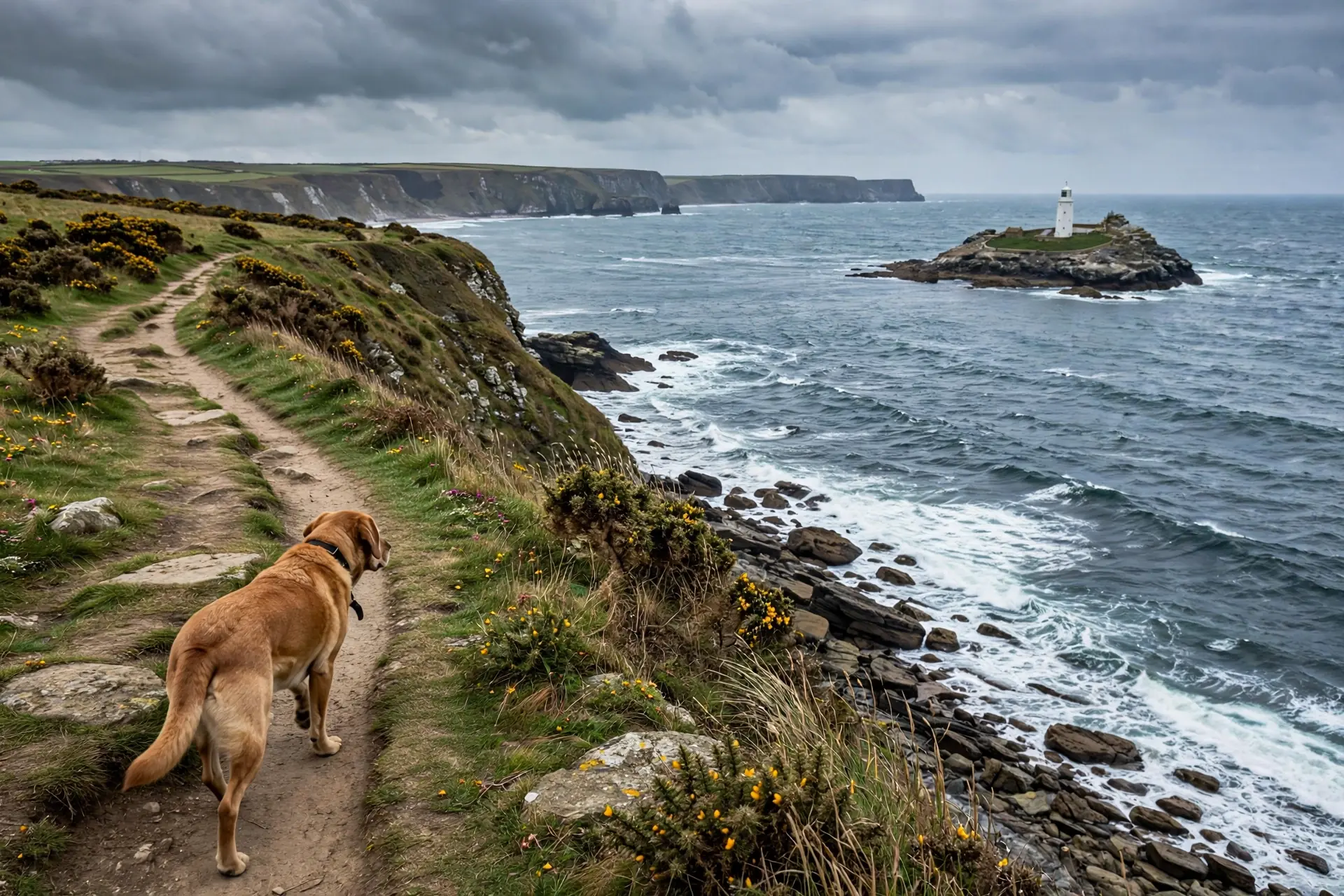
The South West Coast Path runs 630 miles around the south-west, and its Cornish stretch is one of the best parts. It joins beach to beach, cove to cove and village to village, and it is the best way to see this coast with a dog. There is no need to walk the whole thing: a short section of two or three miles makes a perfect dog walk, with a beach at each end. Look for the acorn symbol — the path is well waymarked, and the South West Coast Path Association maintains it.
Pick the stretch by the dog, not by the postcard. Perranporth to St Agnes is a gentle introduction, running along the cliff tops with views across the bay and no punishing climbs. St Ives to Zennor is wilder and rockier, with steep steps and uneven ground, and it suits a fit, confident dog. Around the Lizard the path is exposed and windy, with high cliffs, so dogs stay on a lead near the edge. Falmouth to the Helford is gentler, through woodland and creeks, and suits older dogs and families. For the full route, our South West Coast Path with a dog guide walks it section by section, including cliff safety, luggage transfers and a seven-day plan that actually fits a dog's pace.
Three ways home, and only one of them is the car. The coast path is linear, so the car ends up miles from where the walk finishes: take a bus back, take a taxi, or walk back along the beach at low tide. Country buses in Cornwall are thin on the ground, especially on Sundays, so read the timetable before you leave. Take water, a lead, poo bags and a phone, and let someone know your route if you are on your own. Rain turns the path muddy and the cliff tops stay windy, so wear sturdy shoes and a windproof layer, with a coat for a dog that feels the cold.
The cliffs and grassland are someone else's home first. In spring and summer they hold ground-nesting birds, including skylarks and meadow pipits, so dogs stay on a lead near nesting areas. Seals haul out on Cornish beaches and rocks, above all in autumn, and a dog that approaches one can be bitten or can make the seal abandon its pup — keep the dog on a lead, keep your distance, and do not let it near the water by a seal. Adders live in the coastal grassland in summer, so keep dogs on a lead in long grass and seek veterinary help immediately if you suspect a bite.
Choose the right beach for your dog
Four dogs, four beaches. The swimmer — confident, social, happiest in the water — belongs on a north-coast surf beach with a safe way in. The barker — reactive, needing room — wants a long, open beach where other dogs appear from far off, on a weekday when it is quiet. The puppy — first time at the sea — wants a sheltered, shallow south-coast cove and a short visit that ends while it is still having fun. The stiff-jointed older dog wants firm, flat sand, a short walk from the car and no steep steps or dunes: Perranporth and Marazion fit the bill.
Four coats, four rules. Start with the flat-faced dog: it tires fast, breathes hard, and should stay out of strong currents and cold water — the shallows are its limit. A pale or thin coat sunburns on the ears and nose, so ask your vet about a dog-safe sunscreen. A short coat chills in cold water and wind, so keep swims short and bring a coat for afterwards. A thick coat holds the heat, so a spaniel or a retriever needs shade and fresh water in summer and should stay out of the middle of the day.
Pick the cottage by the beach, not the beach by the cottage. A beautiful beach two hours away leaves a dog that has spent the journey in the car, and it will enjoy the sand far less than a beach ten minutes away. Staying for a week, make the nearest good beach your regular and return to it most days, with one or two day trips to a different coast for variety. A familiar routine helps the dog settle. If three days is all you have, our three-day Cornwall dog itinerary plans them around tides and geography — south-coast harbours, north-coast beaches, and swaps for wet days.
Etiquette, wildlife and paw care
Even where the dog may run free, it has to come back when called — above all near people, children and dogs on leads. Always clear up after your dog, and carry the bag away with you: never leave it on the sand or hanging from a fence. Ground-nesting birds on the dunes and estuaries need space in spring and summer, so do not let the dog chase them, and keep well away from a hauled-out seal: a close dog risks a bite, and a disturbed seal may abandon its pup. Cornish beaches stay open to dogs because owners act as if the welcome can be withdrawn.
The car-park check comes before the drive home. Start with a rinse: fresh water over paws and coat, then a look between the toes for shell pieces, grit and any small cuts. Salt dries skin and sand irritates paws, so a cut caught early heals quickly and one left alone can turn sore. Our dog paw care after the beach guide sets out the rinse-and-check routine step by step — worth a read before a Cornish holiday. Vomiting, diarrhoea or wobbliness after swimming can mean salt-water sickness, so see a vet promptly if you see those signs.
Take everything home, including the things the dog found. Seaweed swells in the stomach, dead fish can carry bacteria, and palm oil — a waxy white substance that washes up on some beaches — is toxic to dogs, so do not let the dog eat anything it finds on the sand. Fill in any hole the dog digs, and take all litter home. If you see litter or a hazard, tell the council or the coastguard about it. And if a Cornish beach gives you a great day, spend money with the dog-friendly businesses nearby: responsible owners are the reason a beach stays open.
Practical questions
Before you go
Which Cornwall beaches allow dogs all year round?
Perranporth, Holywell Bay, Watergate Bay, Crantock and Mawgan Porth all welcome dogs all year, and quieter coves on both coasts do too. Because councils update their orders, check the council's beach page before you set off and read the entrance signs on arrival.
When do Cornwall beach dog bans start and end?
Most run from Easter or 1 May to 30 September, but the dates vary by beach and by council. A few ban dogs only in the daytime in summer, and some restrict only part of the sand. The sign at the beach is the rule that applies, so check the official guidance before you travel.
Is it safe for dogs to swim at Cornish beaches?
Often yes, but the Atlantic coast has strong waves and rip currents, especially on surf beaches such as Fistral, Watergate Bay and Perranporth. Choose a sheltered bay for a first swim, keep dogs away from river mouths and harbour entrances, and never let a dog swim where the red flag is flying. Rinse with fresh water afterwards and do not let dogs drink seawater.
Do dogs have to be on a lead on Cornwall beaches?
Not everywhere. Leads are needed near car parks, on promenades, around wildlife and in some seasonal zones. Where off-lead exercise is allowed, keep the dog under control and call it back near people, dogs and livestock — and carry a lead at all times.
Where can I park near a dog friendly beach in Cornwall?
Popular beaches usually have a council or private car park close to the sand, around £8 to £15 for a full day in summer. Smaller coves may have only a small car park or roadside parking that fills early, so arrive early, check whether the car park takes card payment, and keep a back-up beach in mind.
What should I do if my dog cuts a paw on a Cornish beach?
Rinse the paw with clean fresh water, check for sand, grit or shell fragments between the toes, and apply gentle pressure if it is bleeding. Keep the dog off the sand until the bleeding stops, then cover the paw if you need to walk back to the car. See a vet promptly if the cut is deep, the dog will not put weight on the paw, or the wound looks dirty or swollen.