A vineyard is three places in one: the working vines, the winery buildings, and the hospitality areas. Dogs are usually welcome among the vines on leads and on outdoor terraces — it is the indoor tasting room and restaurant where the rules tighten. Ask about each zone when you book, visit outside harvest chaos, and the day works beautifully.
The three zones of every vineyard
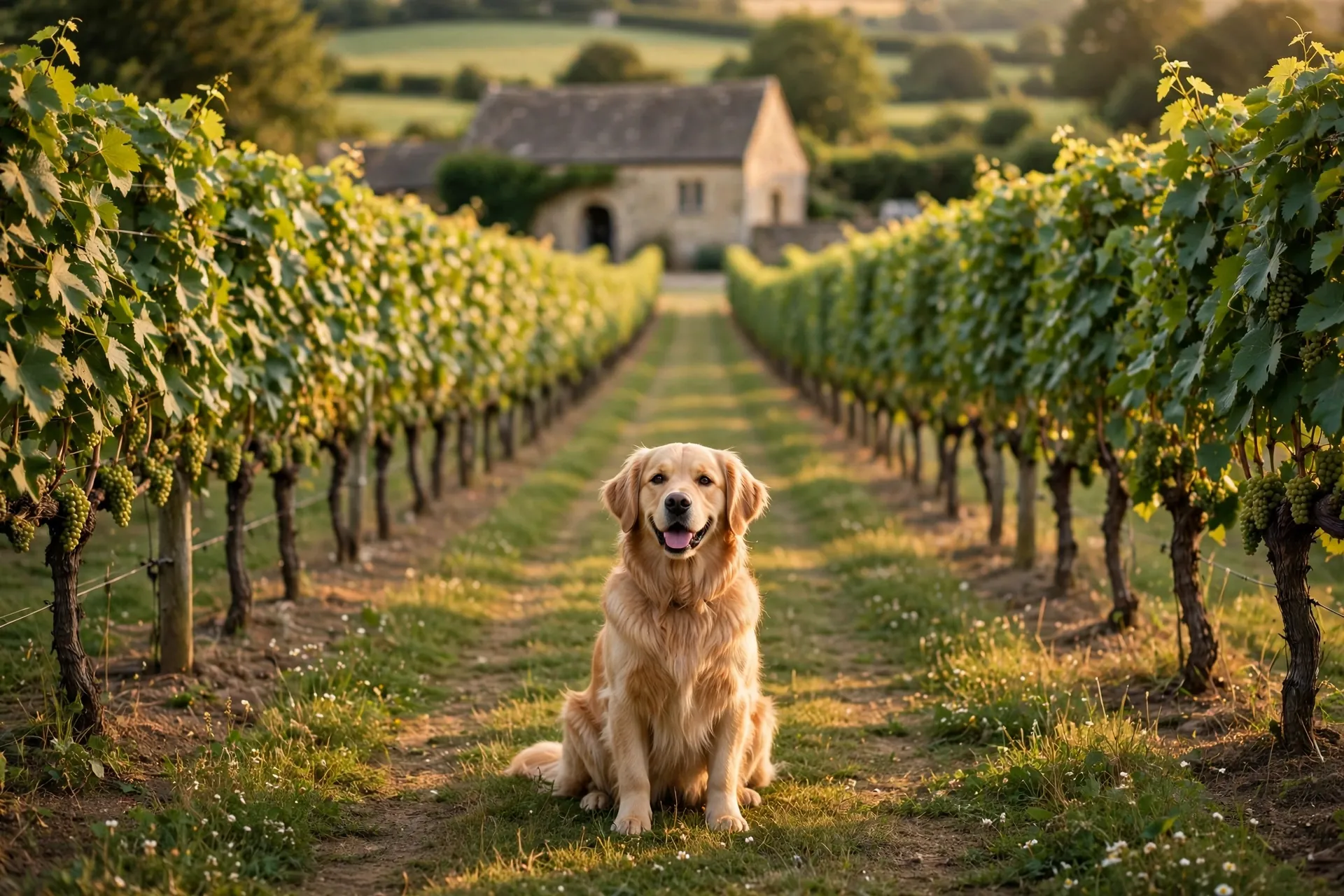
Nearly every "are dogs allowed at this vineyard?" confusion clears up once you stop treating the estate as one place. A working vineyard is three different environments stitched together, and each has its own logic. The first zone is the vines themselves — a field under cultivation, effectively a farm, where a dog on a lead is usually fine. The second is the winery: the pressing room, the barrel store, the bottling line. Dogs generally do not go there, for the same reasons they do not go into food factories. The third is hospitality — the tasting room, the shop, the restaurant terrace — and this is where policies fan out in every direction. Another grown-up day out where dog rules vary by venue is the National Trust with dogs — its pawprint ratings show where dogs can go.
Read an estate's website with these zones in mind and the wording suddenly makes sense. "Dogs welcome on the vineyard trail" means zone one. "Dogs welcome on the terrace" means zone three, outdoors. "We cannot accommodate dogs in the tasting room" is not a rejection of dogs — it is a food-hygiene constraint that applies to the indoor bit of zone three. When you phone to ask, name the zones: "Can the dog walk the vineyard trail with us on a lead, and can we take our tasting flight on the terrace?" That question gets a clear answer where "are you dog-friendly?" gets a vague one.
The practical payoff is that you stop choosing vineyards by marketing adjectives and start choosing by layout. An estate with a long self-guided trail, an estate shop with a lawn, and a terrace where tasting flights are served outdoors is a better dog day than a famous estate whose whole tasting experience happens inside a converted barn, even if both say "dogs welcome" somewhere on the website. Layout is the real policy.
Leads, gates and working land
Among the vines, treat the estate as working farmland, because that is what it is. Leads are non-negotiable between the rows. Some estates graze sheep between the vines in autumn and winter, and many vineyards back onto fields with livestock; the Dogs (Protection of Livestock) Act 1953 makes it an offence for a dog to be at large in a field with sheep, and farmers are within their rights to act on it. Keep the dog close, on a lead, and off any land with animals in it, no exceptions.
Public footpaths cross a surprising number of vineyard estates, which creates a subtle etiquette point: the footpath is your right of way, but the vineyard rows either side of it are someone's crop. Dogs should stay on the path itself, not wander into the rows to sniff the irrigation lines or relieve themselves against the end posts. Close gates behind you — vineyard gates often control access to machinery yards or livestock pens rather than keeping the public out — and if you meet a spraying tractor or a picking team, give them the whole width of the path and wait for a wave before passing.
One more land-level detail: vineyard fences are rarely dog-proof. The boundary of a vine parcel is often a low post-and-wire fence or nothing at all, which means a dog that spots a rabbit in the next field can be gone in seconds. If your dog has a strong chase drive, use a short lead rather than a long line near field edges, and think of the rows as lanes with exits at both ends — the dog at the row's end is beyond your control, so do not let it get there.
South East England: the sparkling wine heartland
The densest concentration of visitable vineyards sits on the chalk of the North and South Downs, across Kent, Sussex, Surrey and Hampshire. This is where English sparkling wine grew up, and it is also the most developed visitor infrastructure: signposted self-guided trails, timed tours, estate restaurants, and farm shops that sell cheese and charcuterie alongside the bottles. For a dog owner, the density is the point — you can reach several estates within one county, and most sit in genuinely walkable countryside with footpaths radiating from the car park.
The typical South East visit pattern suits dogs well. You arrive, walk the marked trail among the vines (usually free or a small charge, dog on a lead), browse the shop, then take a tasting flight on the terrace or picnic lawn. Many of these estates border or sit near larger walking country — the South Downs Way, the Kent Downs, Surrey Hills — so a full day combines the vineyard with a proper leg-stretcher nearby rather than making the vines carry the whole day. Rail links from London are good in this belt, though check station-to-estate distances, as some of the loveliest estates are a genuine country walk from the nearest platform.
Because competition for weekend slots is real here, book the tasting part ahead and say the dog is coming when you do. Weekday visits are calmer, easier for nervous dogs, and often mean staff have more time to talk you through the wines while the dog dozes under the table. If you are building a weekend around Kent's wine country, our Kent with a dog guide covers castles, cliffs and pubs to round out the trip.
Beyond the South East: a different rhythm
English wine does not stop at the Downs. The South West has vineyards tucked into orchard country, where the visit often blends with farm shops, cider traditions and cream-tea cafés — a more informal rhythm, and often more relaxed about dogs because the hospitality is smaller scale. East Anglia's vineyards tend to be compact estates where the tasting room doubles as the farm shop counter; the whole experience may take an hour, which is perfect when the dog has already had its walk.
Wales has a small but real wine scene, and here the pattern is family-run: the person pouring your tasting flight may also be the person who pruned the vines, and that directness usually extends to dog questions — a quick phone call gets you an honest answer rather than a policy page. The trade-off is infrastructure: fewer formal tours, shorter opening seasons, and visitor centres that may only open Thursday to Sunday. Check hours before you set off, especially outside summer.
These regions reward a different kind of planning. Rather than one big estate day, think of a circuit: vineyard in the morning, village pub with a garden for lunch, an afternoon walk somewhere properly dog-friendly, and a bottle from the morning's shop for the evening. The wine is a thread through the day rather than the whole of it, which suits most dogs far better than a full day standing at a tasting counter.
Where the dog sits while you taste
This is the section that decides the day, so be honest about your dog before you book. The typical arrangement at a dog-tolerant estate is a tasting flight served at an outdoor table — terrace, courtyard or lawn — with the dog on its blanket underneath. This works brilliantly for dogs that can settle, and it is exactly the same calm-under-the-table behaviour that makes pub gardens work. If your dog cannot lie quietly for forty-five minutes while you taste six wines, the vineyard is not the day's problem — the settling is.
Guided tours need separate consideration. Many estates run the tour as a walk through the vines followed by the tasting, and dogs on leads are often welcome on the walking part. The awkward moment comes at the transition: the group files into the tasting room or the barrel store while the dog, reasonably, is not invited. Solo visitors should ask what happens at that point — some estates let the dog wait in a shaded spot outside with water, some prefer the dog to skip the tour entirely, and a few will bring your flight outside to you at the end. Couples and groups can simply take turns: one person does the full tour while the other walks the vineyard trail with the dog, then swap for the tasting.
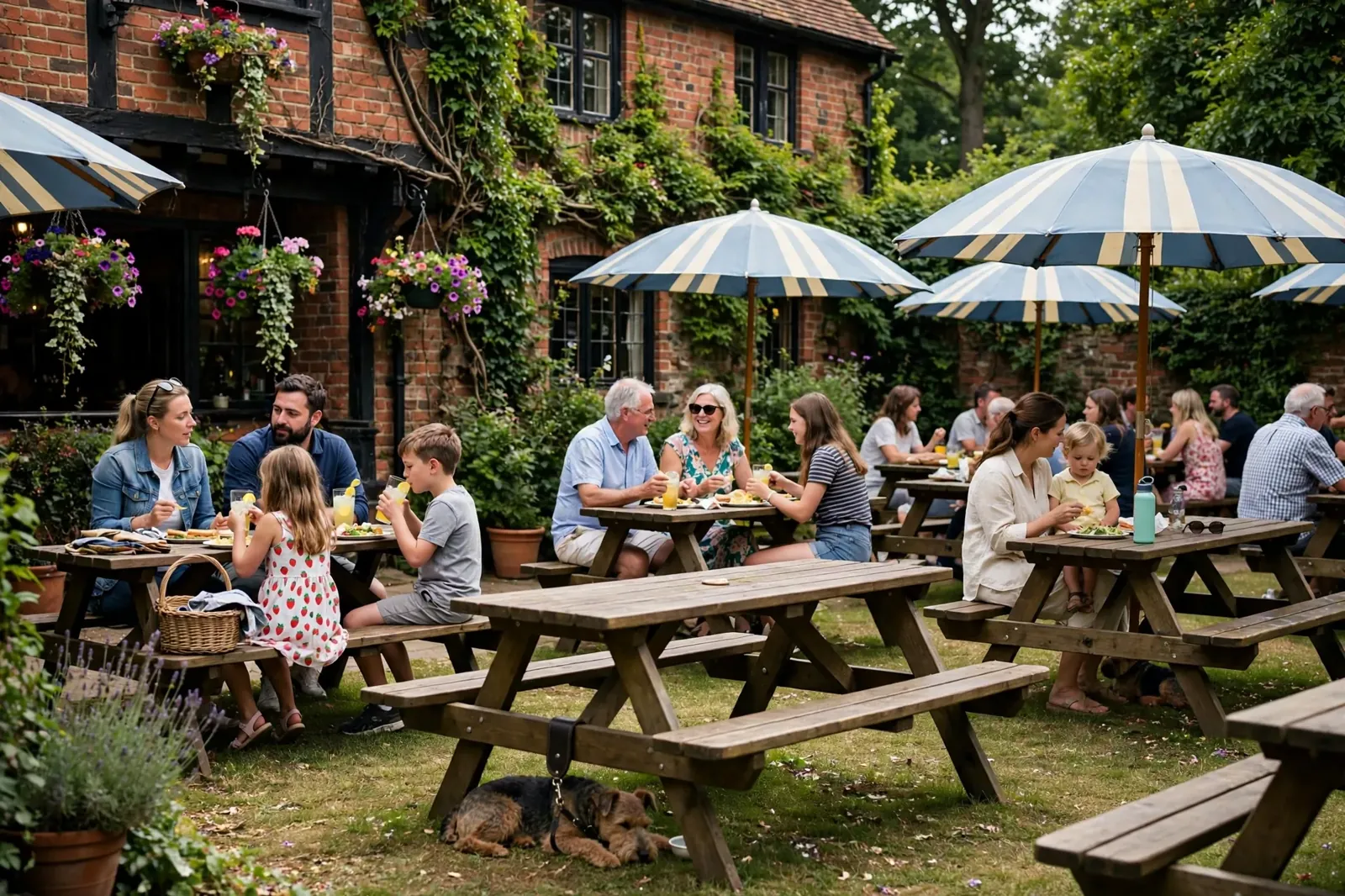
Estate restaurants follow the familiar British split: terraces and courtyards are commonly dog-friendly, indoor dining rooms usually are not. If lunch is part of the plan, book the terrace and mention the dog at booking — kitchens appreciate knowing a dog will be at a nearby table, and you avoid the midday shuffle of being re-seated. Water bowls are common at dog-aware estates; do not count on them, and bring your own collapsible bowl anyway. And note the snack trap: vineyard sharing boards almost always include grapes and cheese, and dropped grapes are a genuine hazard (more on that below).
A one-day vineyard itinerary with a dog
A good vineyard day with a dog runs on a simple principle: the dog's needs come first in the morning, yours in the afternoon. Start with a proper walk somewhere the dog can be a dog — a long sniff-heavy loop on a long line, not a forced march — before you arrive. A tired, emptied dog is a dog that will settle under a tasting table; a dog that has been in the car all morning and then asked to be calm is a dog being set up to fail.
Aim to arrive late morning. Walk the self-guided vineyard trail first (typically 45–90 minutes), which doubles as a sniff and settle period in a new place. Then the shop and a picnic: many estates sell picnic hampers or let you buy cheese, bread and something cold from the farm shop for the lawn. Lunch with the dog stretched out beside you is the middle of the day done right — and it keeps the dog away from the indoor tasting counter while you decide what you actually want to try.
Book the tasting flight for early afternoon, outdoors, and keep it to one structured flight rather than an open-ended afternoon of glass refills. Two people can each order a flight and share the pours, which halves the intake and doubles the range tasted. After the tasting, one more easy loop on the estate trail — the dog will be ready for it and so will you — then home. Total time on site: four to five hours. That is a full, unhurried day, and it is about the limit for most dogs before boredom sets in. If you are making a weekend of it, pair the vineyard day with a walking day either side rather than stacking two estate visits back to back.
Five questions to ask before you book
Vineyard websites are getting better at stating dog policies, but they are still inconsistent, and policies change with seasons, staffing and events. A two-minute phone call or email before you book removes every surprise. Ask these five, in this order:
- Can our dog walk the vineyard trail and join the tour route on a lead? This pins down zone one and the walking part of zone three. Listen for the harvest-season caveat — if the answer is "yes, except during harvest," ask when their harvest usually falls.
- Can we take our tasting flight outside with the dog? The exact wording matters: "tasting flight outside" is a concrete arrangement, while "dogs welcome" is a vibe. Ask whether outdoor tasting needs booking as a table or is walk-in.
- Are dogs allowed in the shop and the restaurant terrace? Shops are usually fine; terraces usually fine; it is the indoor dining room that varies. If you want lunch, get the terrace table confirmed.
- Is there shade and water where we will be sitting? Terraces in high summer can be exposed and hot, and a dog with no shade option is a dog you have to keep moving. Ask what the seating area is actually like.
- Anything different right now — harvest, events, spraying days? This catches the temporary stuff no policy page covers: a wedding taking over the terrace, picking teams in the rows, or a spray day when the vines are best avoided.
Judge the answers the way you judge any service business: specific is trustworthy, vague is not. "Dogs are welcome on the terrace; tasting flights are served there from 11am to 4pm; the indoor tasting room is dogs-except-assistance-dogs" is a policy you can plan around. "We love dogs!" with no detail is a shrug in friendly clothing — follow it up or pick another estate.
The vineyard calendar, dog edition
Vineyards change character dramatically through the year, and the dog-friendliest season is not the one you might expect. Late spring — May into June — is the sweet spot: the vines are in leaf, the trails are open, the weather is mild, and the estates are busy enough to have full opening hours but not yet packed. Early autumn, just after harvest, is nearly as good: the picking teams have gone, the land is quieter, and the light over the rows is at its best.
High summer is glorious and popular, which is exactly the problem. Weekend terraces fill up, parking gets tight, and exposed outdoor seating can be brutally hot for a dark-coated dog at midday. If summer is your only option, book the earliest tasting slot of the day, bring shade and water, and plan the big walk for the cool of the morning. Heatstroke in dogs is a genuine risk at an outdoor tasting that stretches into the afternoon — the wine slows you down while the sun does not.
Harvest — roughly September into October, weather-dependent — is the season to treat with the most respect. The estate is at its busiest: tractors, picking crews, early starts, and fruit everywhere. Dog rules tighten noticeably, some trails close, and guided tours may switch to a harvest-focused format that suits dogs less well. None of this means you cannot visit during harvest — it can be a fascinating time — but call ahead and expect a more restricted day. Winter, by contrast, is quiet and atmospheric: bare vines, pruning teams, shorter hours, and some visitor centres closing midweek. The dog will not mind the bare rows at all, and you may have the terrace nearly to yourselves.
The two hazards worth taking seriously
Most vineyard dangers are the ordinary outdoor ones — sun, heat, tired paws on hard tracks — but two are specific to vineyards and worth knowing cold. The first is the fruit itself. Grapes and raisins are toxic to dogs and can cause acute kidney failure; the dangerous dose is unpredictable, with some dogs reacting badly to a small handful. Vineyards mean fallen fruit on the ground from late summer onward, and tasting rooms mean sharing boards with loose grapes that roll. Keep the dog on a short lead among the rows rather than a long line, do not let them graze windfalls, and watch the ground around any table where food is served. If your dog eats any grapes at all, call your vet immediately — this is not a wait-and-see situation.
The second is vineyard spraying. Vines are sprayed against mildew and other diseases through the growing season, and estates observe re-entry intervals before the rows reopen — but a casual visitor will not know a spray day from any other. If you see a tractor with a sprayer working the rows, keep the dog well clear and out of the parcel entirely; if foliage looks freshly wet with spray, do not let the dog brush through it or drink from puddles at the row ends. Wipe or wash paws after walking the rows in the growing season, and if in doubt, ask at the shop whether spraying has happened recently — it is a normal question and staff answer it routinely.
A smaller third point: broken glass. Tasting terraces are places where glasses occasionally meet stone floors, and a dog padding barefoot around a busy terrace is more exposed than a human in shoes. Sweep the ground around your table with your eyes before the dog settles, and keep the blanket under the table rather than at the table's edge where the foot traffic passes.
What to pack for the vines
The vineyard kit is small but specific. A standard lead plus a long line covers both the estate trail and the terrace settle — the long line for the open trail, the short lead under the table. Bring water and a collapsible bowl regardless of what the estate provides; a blanket or settle mat that smells of home makes the forty-five-minute tasting dramatically easier for a dog that knows "mat means lie down." Poo bags, as always, and a towel for muddy paws, because vineyard tracks after rain are exactly as muddy as you would expect.
Add three less obvious items. First, high-value treats or a stuffed chew for the tasting: a dog with a long-lasting chew under the table is a dog not watching your glass. Second, a cooling aid in warm weather — a damp cooling coat or simply a wet towel in a bag — for the exposed terrace. Third, a backup plan in the car: a crate or a shaded parking spot and water, in case the day's arrangement changes (a sudden downpour moves the tasting indoors, say) and the dog needs to wait comfortably for twenty minutes. Never leave a dog in a parked car in warm weather, even briefly — the car heats far faster than people expect.
Finally, pack your own expectations correctly. A vineyard day is a slow day: walk, sit, taste, sit, walk. Dogs that thrive on constant novelty may find the afternoon stretches dull, which is fine — the stuffed chew and the blanket are there for exactly that. And take the bottle home rather than tasting a second flight: the drive home with a tired, contented dog asleep in the back is the proper end of the day.
Practical questions
Before you go
Are dogs allowed in UK vineyard tasting rooms?
It varies estate by estate, and policies change, so check the vineyard's official site before you travel. As a rule of thumb, indoor tasting rooms usually exclude dogs for hygiene and licensing reasons, while outdoor terraces, tasting lawns and self-guided vineyard trails often welcome dogs on leads. If the tasting room is the only indoor option, book an outdoor table or plan for one person to taste while the other walks the dog.
Can dogs join guided vineyard tours in the UK?
Often yes on self-guided trails, but guided group tours are less predictable: some estates welcome well-behaved dogs on leads on their tour walks, others ask dogs to wait outside or sit out the winery-buildings part. Harvest season (roughly September to October) brings extra restrictions because of machinery and picking teams. Ask the specific question — "can our dog walk the tour route with us?" — when you book.
Why are grapes dangerous for dogs?
Grapes and raisins can cause acute kidney failure in dogs, and the toxic dose varies unpredictably between individuals — some dogs react to a small number of grapes. Vineyards mean fallen fruit on the ground, especially around harvest and near tasting rooms with sharing boards. Keep your dog on a short lead among the rows, don't let them graze fallen grapes, and call your vet immediately if any are eaten, however few.
Are vineyard restaurants and cafés dog-friendly?
Outdoor seating is commonly dog-friendly; indoor dining rooms at vineyards usually are not. The split mirrors pub and restaurant norms across Britain: the terrace or courtyard is the dog's territory, the kitchen-adjacent dining room generally isn't. When booking a vineyard restaurant table, request terrace seating and mention the dog at booking so staff can seat you appropriately.
When is the best time of year to visit a vineyard with a dog?
Late spring and early autumn are the sweet spots: mild weather, open trails, and vineyards at their most photogenic without harvest chaos. Summer weekends are the busiest and can mean hot, exposed terraces with little shade. September and October harvest brings machinery, more staff on the land and tighter dog rules, so call ahead then. Winter visits are quiet and atmospheric but visitor centres may have reduced hours.
Do I need to book a vineyard visit in advance?
For tastings, usually yes — most estates run timed tasting flights and weekend slots sell out, especially in summer. Self-guided vineyard trails and estate shops are more often drop-in, but opening hours vary by season. Because dog policies differ so much between estates, booking in advance doubles as your chance to ask about dogs on the tour and at the tasting table, so you never arrive to a surprise.