This guide is independent and contains no paid placement. If affiliate links are added later, they will be clearly marked and will not change our editorial checks.
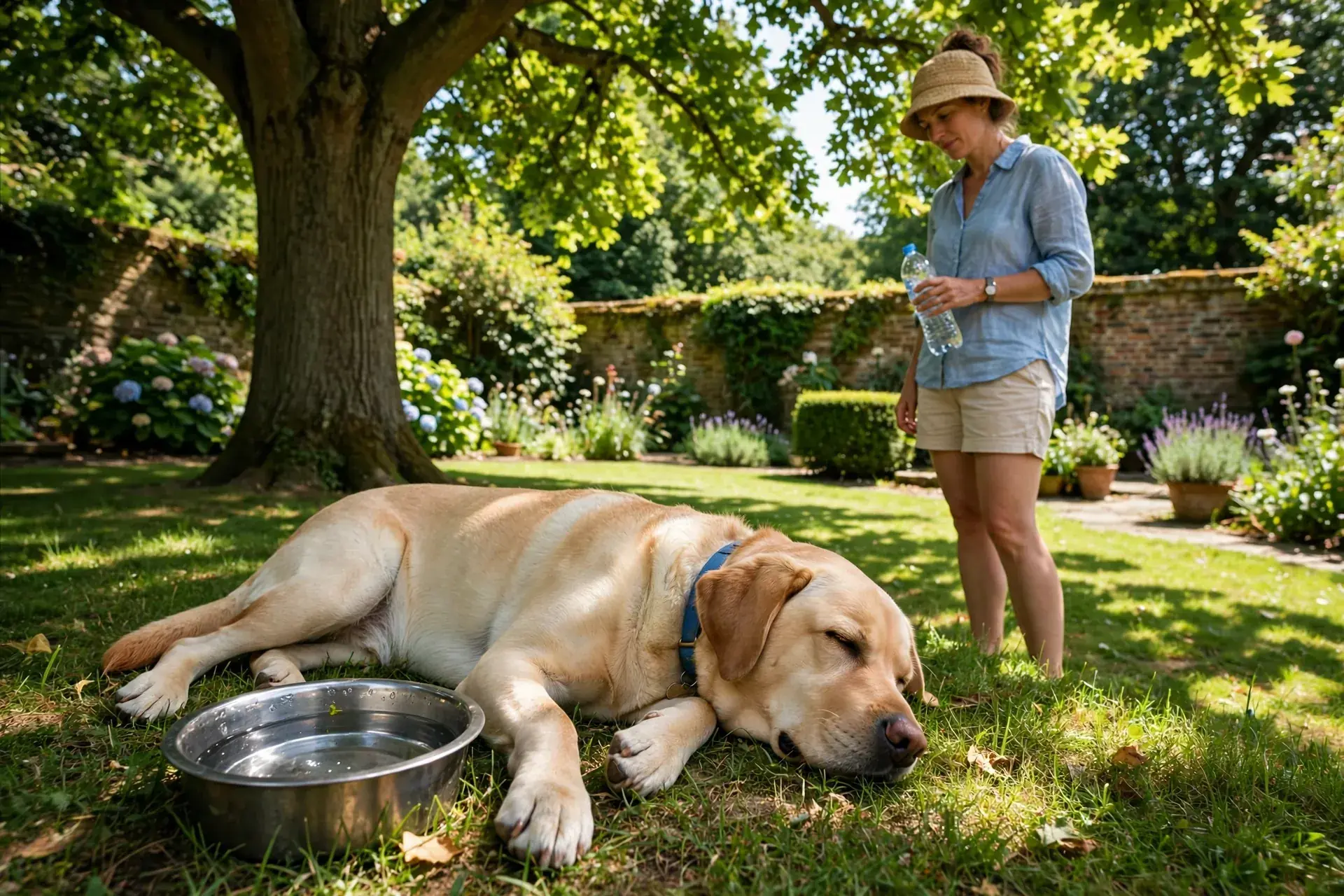
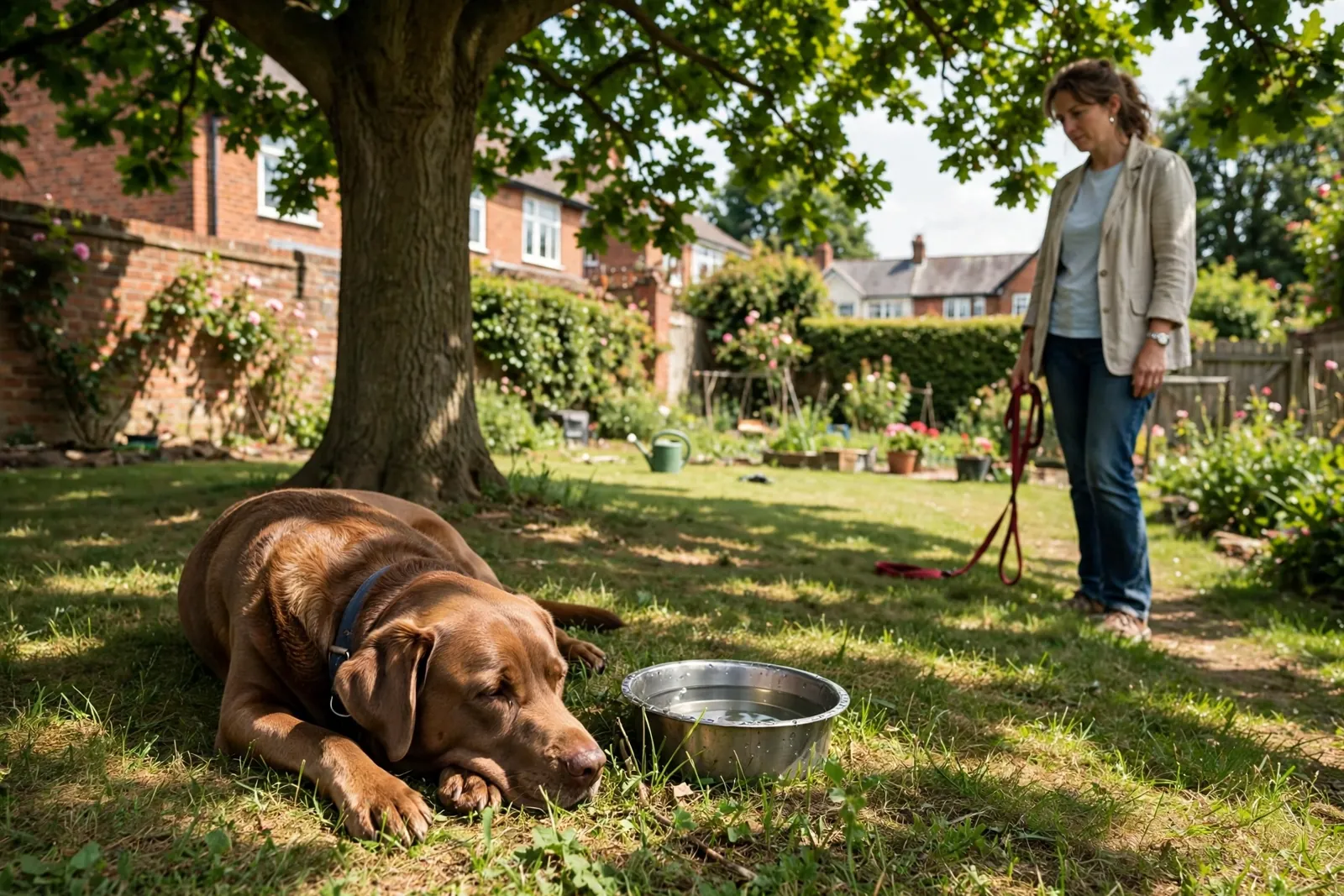
Heatstroke in dogs starts with heavy panting that will not settle, drooling and restlessness, and can move fast to weakness, vomiting and collapse. Move the dog to shade, cool the paws, belly and groin with cool (not icy) water, offer small sips, and call a vet straight away — do not wait to see if it passes. This guide is general information, not veterinary advice: in an emergency, contact a vet immediately.
Why dogs overheat faster than people
Dogs do not sweat the way people do. A person cools down by sweating all over the body; a dog has sweat glands mainly in its paw pads, which cover far too little skin to shed much heat. Instead, a dog relies mostly on panting — rapid, shallow breathing that moves air over the moist surfaces of the tongue and mouth so that heat escapes as water evaporates. It works well on a cool day and reasonably well in a breeze, but it has a hard limit. Once the air itself is hot and still, or the dog is generating heat faster than panting can dump it, the system falls behind and body temperature starts to climb.
The numbers explain why the margin is so thin. A healthy dog's normal temperature sits around 38 to 39 degrees Celsius, a little warmer than a human's. Heat exhaustion typically begins as the temperature pushes past about 40 degrees, and heatstroke — the dangerous, potentially organ-damaging stage — is generally recognised once it passes roughly 40 to 41 degrees, with temperatures above 41 degrees counted as a serious emergency. That is only two or three degrees above normal, which is why a dog can go from happily trotting along to seriously unwell in the space of a single long walk. Exercise alone can raise a dog's temperature by a degree or more, and a thick coat, a muzzle, a car interior or a sunny pavement can add to it faster than most owners expect.
British weather makes the risk easy to underestimate. We associate heatstroke with Mediterranean summers, yet the UK's danger days are often the mild-looking ones: 22 degrees with high humidity and no wind, a sunny 25-degree afternoon after a cool spring, or a cloudy morning that turns humid by lunchtime. Humidity matters because panting cools by evaporation, and evaporation slows when the air is already full of moisture. A dog that coped fine on a dry 24-degree day in Cornwall can struggle on a muggy 22-degree day in London. Acclimatisation matters too: dogs, like people, cope worse with the first hot spell of the year than with the third, because neither their bodies nor their owners' routines have adjusted yet.
Understanding this mechanism changes how you read your dog. Panting is not just a sign that a dog is warm; it is the dog's main cooling system working at full stretch. When panting becomes very loud, very fast, or oddly laboured, it means the system is struggling. When the tongue looks much wider than usual, dark red or almost purple, or the drool turns thick and sticky, the dog is losing the battle. The earliest useful habit you can build is a baseline: notice how your dog normally pants after a walk, how quickly it settles, and what its gums look like when it is comfortable. On a hot day, any clear change from that baseline is worth acting on, even if the dog still seems keen to carry on. Dogs are famously bad at self-limiting — a ball-obsessed spaniel will chase until it drops — so the judgement call has to come from you.
The early signs to watch for
Early heatstroke rarely announces itself with drama. It usually starts as a dog that is working a little too hard to stay cool, and the signs are easy to miss if you are chatting, checking a map or watching the scenery. The single most useful early sign is panting that does not settle. Normal post-exercise panting eases within a few minutes once the dog stops and finds shade. Heat-related panting stays loud, rapid and urgent long after the dog has stopped moving, and the tongue often hangs out much further and flatter than usual. If you stop, offer water and shade, and five minutes later the panting sounds the same, treat that as a warning and start cooling.
Drooling is the second sign to learn. A little drool after exercise is normal for many breeds, but heat-related drool tends to be thicker, stickier and more copious, sometimes stringing from the mouth or pooling on the chin. It often comes with a dry, tacky feeling inside the mouth and gums that look darker pink or red than usual. Press a fingertip gently against the gum: in a well-hydrated dog the pale spot should pink up again within about two seconds. A slow return, or gums that stay dark red, suggest the dog is dehydrated and its circulation is under strain. Do not try this check if the dog is distressed or snapping — step back and cool first.
Behaviour changes are just as telling, and they often arrive before the physical signs become obvious. A dog that was pulling ahead may start lagging, stopping in shade, lying down on cool grass or tiles, or refusing to walk further. Some dogs become restless instead, pacing, whining, seeking water obsessively or trying to lie in a stream or puddle. Others go quiet and glazed, staring without really focusing, or responding slowly to their name. A sudden loss of enthusiasm is the most honest signal a dog gives: a dog that normally begs to keep going and suddenly wants to stop is telling you something important.
Other early clues include a faster heartbeat that you can feel through the chest, warm or hot ears and paws, and a reluctance to eat treats the dog would normally snatch. Some dogs vomit a little bile or retch without producing anything, and some develop soft or loose stools on a hot day. None of these signs alone proves heatstroke — a dog can pant hard after a sprint and be perfectly fine — but two or three together, on a warm day, after exercise or time in a hot car or building, should be treated as the start of a problem, not the end of one. The right response at this stage is simple and cheap: shade, cool water, rest and a careful watch. Catching it here is the whole point of this guide, because everything after this stage gets harder, more frightening and more expensive.
- Panting that will not settle — loud, fast and unchanged after five minutes of rest in the shade.
- Thick, sticky drool — more than usual, stringing or pooling, with dry or dark-red gums.
- Seeking cool surfaces — lying flat on tiles, grass or in a stream, or refusing to move on.
- Restlessness or sudden quiet — pacing and whining, or the opposite: glazed, slow and unresponsive.
- Warm ears and a racing heartbeat — the body is working hard and losing the fight to shed heat.
- Nausea or loose stools — retching, vomiting a little bile, or diarrhoea on a hot day.
Danger signs and how serious they are
Once heatstroke moves past the early stage, the signs become harder to mistake — and the window for simple first aid narrows. The most serious red flags are weakness and wobbliness: a dog that staggers, sways, cannot stand steadily, or keeps sitting down and struggling to get up is in trouble. Disorientation is another: walking into things, staring blankly, not recognising familiar people, or seeming confused about where it is. Vomiting and diarrhoea, especially with blood in either, signal that the gut and circulation are being damaged. At this point the dog needs a vet urgently, and cooling should happen on the way to help, not instead of it.
It helps to think in three grades, because the right response depends on the grade. Mild heat stress is a dog that is panting hard, drooling and restless but still alert, still walking and still responding to you. Cool it, rest it in the shade, offer small sips of water, and watch it for at least an hour — if it does not improve steadily, call a vet. Moderate heatstroke is a dog that is weak, wobbly, vomiting, or panting so hard it can barely drink, with very dark or pale gums. Cool it actively and call a vet now, while you are cooling. Severe heatstroke is collapse, seizures, unconsciousness, or a temperature above 41 degrees: this is an emergency in the fullest sense, and every minute of delay adds risk. Cool the dog as you travel, keep the car air conditioning on, and phone the vet on the way so they are ready when you arrive.
Two signs deserve special emphasis because owners often misread them. The first is a dog that suddenly stops panting while still very hot. This can look like improvement, but it can also mean exhaustion: the cooling system has given up, and the temperature may still be rising. Do not be reassured by a dog that goes quiet and still after frantic panting — check whether it is alert, responsive and cooling down, and if in doubt, call a vet. The second is shivering or trembling in a hot dog. Shivering generates heat, so a shivering dog is not cooling effectively, and trembling can also be a sign of distress, pain or a seizure. Either way, it is not a sign to watch and wait on.
Gum colour is a useful triage tool once you know what to look for, and it is worth learning before you need it. Healthy gums are a soft bubblegum pink. Bright red or brick-red gums suggest overheating and poor circulation; very pale or white gums suggest shock; blue or grey gums suggest a lack of oxygen and are an emergency. Check the official guidance before you travel if you are unsure how to read gum colour in your own dog, because dark-pigmented gums in some breeds make this check harder, and your vet can show you what normal looks like for your dog. Whatever the grade, the rule is the same: if you are worried, call a vet. Vets would far rather reassure you about a dog that turns out to be fine than treat one that arrived an hour too late.
The five-minute cooling routine
The first five minutes matter more than anything else you do, because a dog's temperature keeps climbing while you decide what to do. Start by moving the dog out of the heat: into full shade, into an air-conditioned car or building, or at least onto a cool tiled or stone floor. If you have a fan, point it at the dog. Remove any coat, jumper or harness that traps heat, and loosen a muzzle if it is safe to do so — a muzzled dog cannot pant properly, which is why muzzles and hot weather are a dangerous combination. Then begin cooling with water, and keep it going while you assess and phone for help.
Use cool water, not ice-cold water, and apply it where it works fastest: the paw pads, the belly, the groin and the armpits, where blood vessels run close to the skin. Pour it gently, or use a damp towel, a soaked flannel or a spray bottle. Wet the ears and the head lightly too, but avoid pouring water over the face or into the nose and mouth, especially if the dog is confused or weak and might inhale it. If you have a paddling pool, a shallow stream or a hose on a gentle setting, standing the dog in cool water up to its belly is effective. Keep air moving over the wet fur — a fan, a car air vent, even a breeze — because evaporation is what actually carries the heat away.
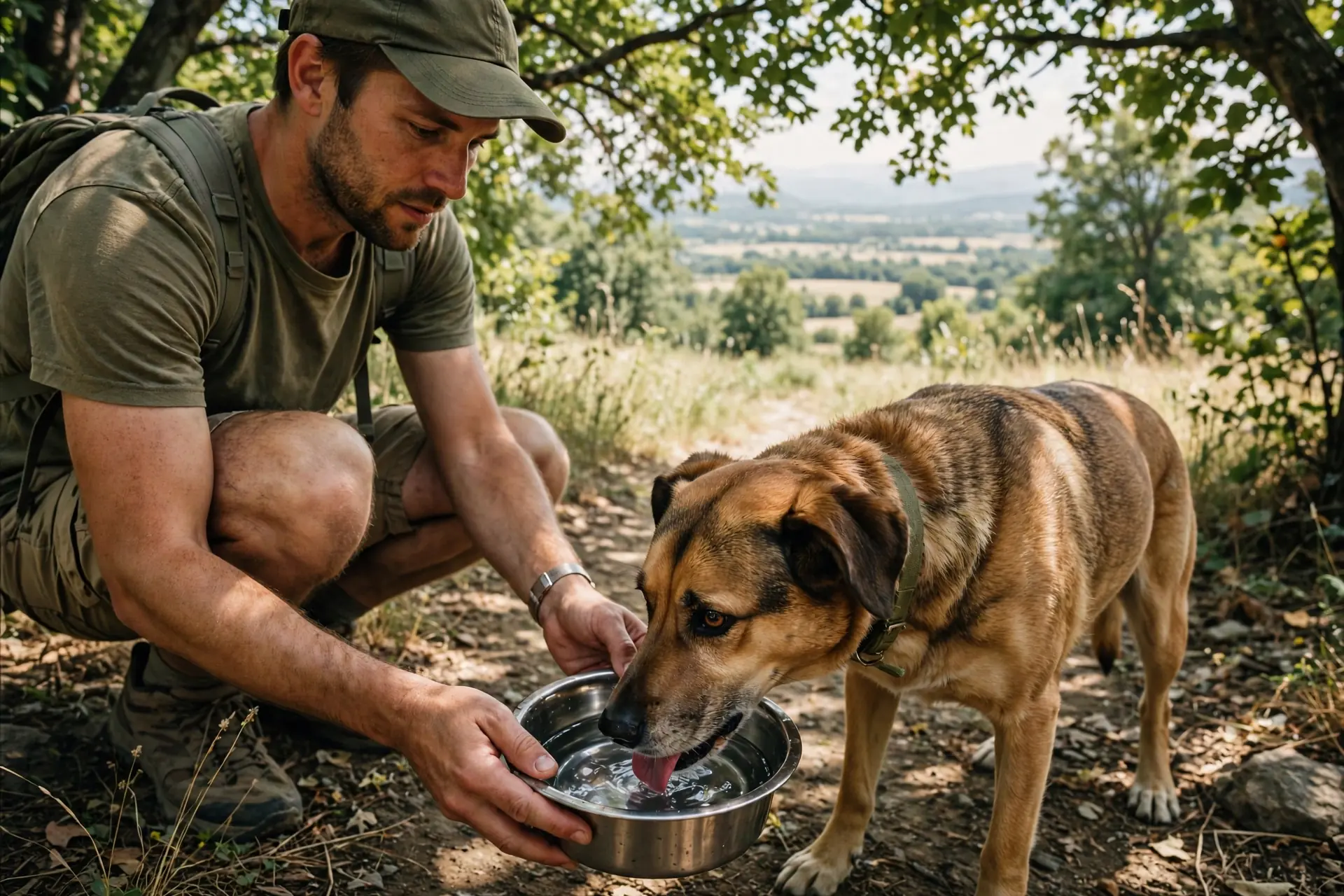
Offer water to drink, but in small sips, not a whole bowl at once. A hot, panting dog that gulps a litre of water can vomit it straight back up, and a weak or disoriented dog can choke. Offer a few mouthfuls, wait a minute, then offer a little more. If the dog will not drink, do not force it: wet its tongue and lips and concentrate on external cooling. Do not offer ice cubes to chew at this stage, and do not use alcohol, wet towels draped over the whole body for long periods, or any home remedy you have not checked with a vet — a soaked towel left in place quickly warms up and acts like a blanket, trapping heat instead of releasing it.
While you cool, keep the dog calm and still. Excitement, struggling and more exercise all generate heat, so talk quietly, keep other dogs and children back, and do not try to walk the dog home while it is still overheating. If you have a thermometer and know how to take a dog's temperature safely, a reading can help the vet, but do not delay cooling or the phone call to find one — and never attempt a temperature reading on a distressed or aggressive dog. After about five minutes of active cooling, check whether the panting is easing, the dog is more alert, and it can stand steadily. If it is improving, keep cooling gently and still call a vet for advice, because heatstroke can cause delayed damage to the kidneys, liver and gut that shows up a day or two later. If it is not improving, or if it is getting worse, get to a vet immediately and keep cooling on the journey.
- Move to shade or air conditioning and remove coats, jumpers and tight harnesses.
- Cool the paws, belly, groin and armpits with cool water, and keep air moving with a fan.
- Offer small sips of cool water — a few mouthfuls at a time, never forced.
- Keep the dog calm and still while you phone the vet and describe the signs.
- Reassess after five minutes — if there is no clear improvement, travel to the vet now.
What never to do
Well-meaning mistakes are common in heatstroke first aid, and some of them make things worse. The most dangerous is the ice bath: plunging a hot dog into ice water or covering it in ice packs. It sounds logical — the dog is too hot, so make it cold as fast as possible — but it backfires. Very cold water narrows the blood vessels near the skin, trapping hot blood in the core, and it can trigger shivering, which generates more heat. The dog's temperature can also drop too fast, overshooting into hypothermia while the core is still damaged. Cool water, applied steadily with airflow, lowers temperature safely; ice water does not.
Do not cover the dog in wet towels and leave them there. A damp towel feels cool for a minute, then warms to body temperature and becomes insulation, exactly the opposite of what you want. If you use towels, keep replacing them with freshly wetted, cool ones, or better still, pour water directly and let the air do the work. Do not give the dog alcohol to rub on its skin, paracetamol or ibuprofen, or any human medicine — several common painkillers are toxic to dogs, and a vet will not thank you for a dog that arrives with a drug problem on top of heatstroke. Do not force water down a weak dog's throat, and do not try to make it vomit.
Do not wait to see if it gets better on its own, and do not drive home first and then decide. Heatstroke is one of the few dog emergencies where the clock is genuinely ticking: organ damage accumulates with every minute the temperature stays high. The dogs that do worst are often the ones whose owners waited an hour because the dog "seemed a bit better" after a drink. Improvement after cooling is real, but it is not the same as recovery, and only a vet can check for the hidden damage — kidney strain, clotting problems, gut injury — that can appear 24 to 72 hours later. Similarly, do not try to finish the walk, carry the dog in a hot car without air conditioning, or leave it in a sunny conservatory "to rest". Rest means shade, cool air and stillness, not a warm room.
Finally, do not rely on a single trick you read online. Cooling vests, damp bandanas and paddling pools are all useful as prevention, but none of them is a treatment for a dog that is already in trouble. The treatment is cool water, airflow, rest and veterinary care, in that order. If you are ever unsure whether something is safe, the safest question is the one you ask your vet on the phone while you are cooling — they can talk you through it in real time, and that call costs nothing compared with the alternative.
When to call a vet immediately
Call a vet straight away if your dog collapses, has a seizure, is unconscious, vomits or has diarrhoea with blood, has blue or very pale gums, or is so weak it cannot stand. Call too if the temperature is above 41 degrees, if panting does not ease after ten minutes of active cooling, or if the dog was already weak, elderly or flat-faced before it got hot. These are not "wait and see" situations. Phone ahead, describe the signs and how long they have been going on, and follow the vet's instructions while you travel. Phoning ahead matters because the practice can prepare oxygen, intravenous fluids and cooling equipment before you arrive, and on a busy summer weekend that preparation can save vital minutes.
On holiday, the vet question needs answering before you travel, not during the emergency. Before you leave home, save the number of the nearest vet to your accommodation, and check its opening hours and whether it has an out-of-hours service. Many rural practices close early and hand out-of-hours cover to a regional emergency clinic that may be thirty minutes away, and that is a long drive with a collapsing dog if you discover it at the moment you need it. Save both numbers in your phone and keep them in the glove box as well. Our guide to an emergency vet on holiday explains how to register as a temporary client, what records to carry, and what to ask when you phone, so that the first call is not also the first time you have thought about it.
At the vet, expect blood tests, intravenous fluids, temperature monitoring and possibly an overnight stay, even if the dog looks much better by the time you arrive. This is normal and it is not over-treatment: heatstroke injures organs in ways that are invisible from the outside, and the blood results over the next day or two are what tell the vet whether the kidneys, liver and clotting system are recovering. The vet may also check for the original trigger — an infection, a heart problem or a medication that made overheating more likely — and advise you on what to change for the rest of the holiday. Ask what signs to watch for overnight, when to come back, and whether exercise should be restricted for a few days. Most dogs that reach a vet promptly and are cooled early do recover, but the recovery is a process, not a moment, and the follow-up appointment is part of it.
If you are unsure whether the situation counts as an emergency, treat it as one. The cost of an unnecessary vet visit is a consultation fee and a slightly embarrassed phone call; the cost of waiting too long can be a dog that does not come home. Vets expect these calls every summer and would far rather talk a worried owner through cooling a dog that turns out to be fine than meet one that arrived too late. Keep the vet's number somewhere you can find it with shaking hands — on the fridge, in your phone's favourites, on a card in the cooling kit — because in the moment, the hardest part is often not knowing who to call.
Cars, trains and travel days
Cars are the single most dangerous place for a dog in British summer, and the figures are stark: a car parked in the sun can reach lethal temperatures within minutes, even on a day that feels only pleasantly warm outside. On a 22-degree day, the inside of a car can pass 40 degrees in under half an hour, and cracking a window barely slows it down. Never leave a dog in a parked car on a warm day, even for "just five minutes", even with the windows open, even in the shade — shade moves, queues grow, and five minutes becomes twenty. In England and Wales, leaving a dog in a hot car can lead to prosecution, and members of the public are increasingly willing to call the police or break a window to free a distressed animal, so the legal and practical risks run in the same direction.
Travelling with a dog in hot weather needs a plan, not just good intentions. Before you set off, read our guide to travelling with a dog in hot weather, which covers car setup, journey timing and cool stays in detail. The essentials are: travel early or late in the day, use air conditioning rather than open windows at motorway speed, and stop every hour or two for water, shade and a short toilet break. A sunshade on the rear window, a light-coloured blanket over the boot, and a frozen water bottle wrapped in a towel can all help, but none of them replaces airflow. Never put a dog in a roof box, a closed boot without ventilation, or a crate covered by a dark blanket in the sun.
Trains, ferries and buses carry their own risks. A crowded summer train carriage can be hotter than the platform, with little airflow and no water, and a dog in a carrier under a seat can overheat unseen. Choose off-peak services, sit near a door or an opening window where you can, and carry water and a small folding bowl even for a short journey. On ferries, check the pet rules before booking — some routes require dogs to stay in the car on the vehicle deck, which is not safe in hot weather, while others provide kennels or pet lounges. If the route forces the dog to stay in the car, do not book that sailing on a hot day. At service stations, park in the shade, never leave the dog in the car while you queue for food, and take turns with your travelling companions so the dog is never alone in a hot vehicle.
Plan the whole travel day around the dog's temperature, not your schedule. That means leaving at dawn for a long drive, booking accommodation you can arrive at before the midday heat, and being willing to change plans — a delayed departure, a different route, an extra overnight stop — if the forecast turns hotter than expected. Check the official guidance before you travel if you are unsure about the rules for your route, because ferry, train and airline pet policies change, and the version you remember from last year may no longer apply. The dogs that cope best with summer travel are the ones whose owners treated the journey as part of the heat plan, not as a gap between two air-conditioned rooms.
Walk timing and hot ground
The simplest prevention is timing: walk early, walk late, and rest at midday. In a British heatwave, the safe walking windows are usually before about 9 in the morning and after about 7 in the evening, when the sun is low and the ground has had time to cool. The dangerous hours are roughly 11am to 3pm, when the sun is strongest and pavements, tarmac and sand are at their hottest. This is not just about air temperature — the ground itself is the hazard. On a 25-degree day, asphalt in full sun can reach 50 degrees or more, hot enough to burn a dog's paw pads in under a minute. If you cannot comfortably hold the back of your hand on the pavement for five seconds, it is too hot for your dog to walk on.
Choose your surfaces as carefully as your times. Grass, woodland trails, shaded riverside paths and damp earth stay far cooler than tarmac, paving slabs and sand, and they give the dog somewhere to lie down and cool off. A walk that follows a stream or passes a dog-friendly paddling spot is worth more than a longer walk on hot pavements. Keep the pace gentle, carry water and a collapsible bowl, and stop in the shade every ten or fifteen minutes on a warm day. Let the dog choose the pace and the shady side of the path — a dog that keeps pulling towards shade and water is managing its own temperature, and the kindest thing you can do is let it.
Shorten the walk before the dog tells you to. A fit dog on a cool day might happily manage two hours; the same dog on a humid 26-degree day may only manage thirty minutes before it starts panting hard. Cut the distance by a third or a half on the first hot day, and build back up only if the dog copes well. Skip ball games, frisbee and off-lead sprints at midday — short bursts of intense exercise generate heat far faster than a steady walk, and a dog chasing a ball will not stop to tell you it is overheating. Save the energetic play for the cool of the evening, and use the middle of the day for a gentle sniffing walk in the shade, or no walk at all. A bored dog in a cool house is a safe dog; an exhausted dog on a hot pavement is not.
After the walk, check the paws. Hot ground can blister pads, and the damage sometimes shows up hours later as limping, licking or reluctance to walk on hard floors. Look for redness, swelling, cracked pads or a pad that feels warmer than the others, and rinse the paws in cool water when you get home. If the pads are blistered or the dog will not put weight on a foot, call a vet rather than applying creams or bandages yourself. And remember that the walk home is part of the walk: a dog that coped on a grassy park may still have to cross a hot car park or a sunny pavement to reach the car, so carry the dog if it is small, or pick a shaded route back, even if it is longer.
Flat-faced and high-risk dogs
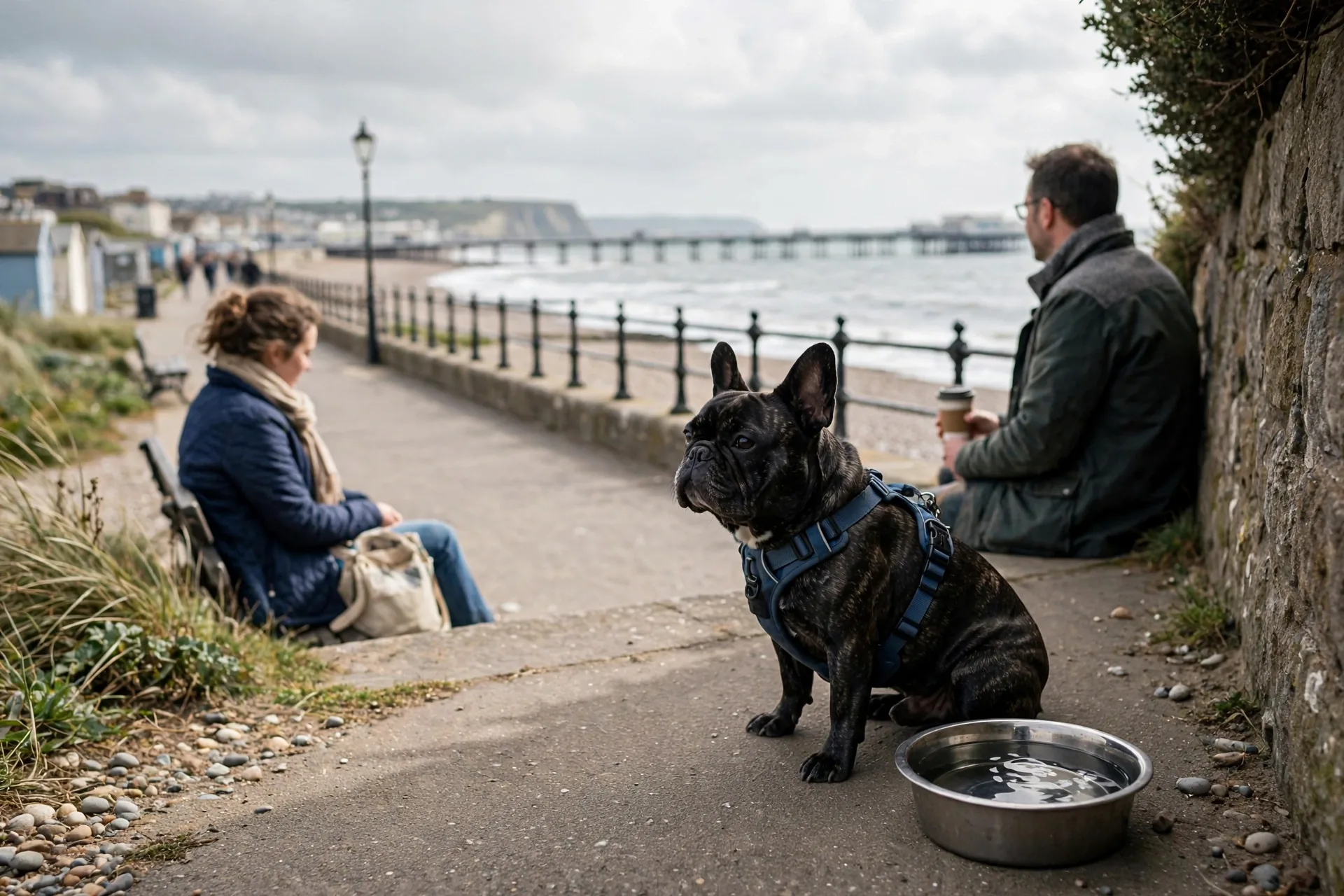
Some dogs are at far higher risk than others, and knowing whether yours is one of them should change your whole summer routine. Flat-faced breeds — French bulldogs, pugs, English bulldogs, Shih Tzus, Cavalier King Charles spaniels and similar — have shortened airways, narrower nostrils and often a longer soft palate, which means their panting is less efficient from the start. A brachycephalic dog can overheat on a day that a spaniel would find comfortable, and once it starts struggling to breathe, the situation can deteriorate very fast. For these dogs, the safe threshold is lower: shorter walks, cooler hours, no midday exercise at all, and a vet check before any summer holiday.
Age and weight matter just as much. Puppies and very old dogs regulate temperature poorly, and overweight dogs carry an extra layer of insulation and have to work harder for every step, which generates more heat. Dogs with heart disease, breathing problems, laryngeal paralysis or thick double coats — chow chows, huskies, malamutes and similar breeds — are also at higher risk, as are dogs on certain medications, so check with your vet if your dog takes regular medicine. A dog that has had heatstroke before is more vulnerable to it happening again, because the previous episode can leave lasting damage to the temperature-control system. If your dog falls into any of these groups, the advice in this guide applies twice over, and your vet can help you set a personal heat limit for your dog.
For high-risk dogs, prevention is not a list of tips but a different routine. Walk before 8am and after 8pm in a heatwave, keep walks short and on grass, and carry a cooling mat or a damp towel in the car. Consider a cooling vest soaked in cool water before the walk, but remember that it only helps while it stays damp and in airflow — a dry vest in the sun is just another layer. Never muzzle a flat-faced dog in hot weather unless a vet has specifically advised it, and never use a tight harness that restricts the chest. Keep the dog's weight in check before summer arrives, because every extra kilo is extra heat to shed, and keep the coat groomed — matted fur traps heat, while a well-brushed coat allows air to circulate. Check the official guidance before you travel if your breed has specific travel or health requirements, because some ferry and airline operators have additional rules for brachycephalic dogs.
Watch high-risk dogs even more closely for the early signs, and act sooner. For a pug or a bulldog, panting that sounds raspy, snorting or laboured is a warning even if the dog still seems keen, because their airways can swell and narrow as they overheat, creating a vicious circle: harder breathing generates more heat, which causes more swelling. If a flat-faced dog's breathing becomes noisy, its tongue turns dark, or it starts retching, cool it and call a vet immediately — do not wait for the full list of danger signs. Owners of these breeds often learn to read their dog's breathing the way other owners read a thermometer, and that skill is worth building before the hot weather arrives: sit with your dog on a normal day, listen to its breathing at rest and after a gentle walk, and learn what is normal for that dog, so that abnormal is obvious when it happens.
A holiday cooling kit
A small cooling kit, packed before you leave home, turns a frightening moment into a manageable one. It does not need to be expensive or bulky: a litre bottle of cool water and a collapsible bowl, a spray bottle, a couple of flannels or a small towel, a battery-powered fan, and a frozen water bottle wrapped in a tea towel will cover most situations. Add a light-coloured sunshade or an old sheet for shade, a cooling mat for the car or the accommodation, and a small first-aid card with your vet's number and the nearest vet to your stay. Keep the kit where you can reach it — in the day bag, not buried in the boot under the suitcases.
At the accommodation, set up a cool zone as soon as you arrive. Choose the shadiest, coolest room or corner, put the cooling mat or a damp towel on the floor, and make sure the dog always has access to fresh, cool water in a heavy bowl that cannot be tipped over. If the accommodation has a fan, position it so air moves over the dog's resting place; if it has air conditioning, learn how to use it before the hottest part of the day. Close curtains on sunny windows, and do not leave the dog in a conservatory, a glass porch or a top-floor room under a dark roof — these spaces can be many degrees hotter than the rest of the building, and dogs left in them can overheat while their owners are downstairs feeling perfectly comfortable.
Water is the most versatile item in the kit, and it is worth carrying more than you think you need. A dog on a hot walk can drink a surprising amount, and you need spare water for cooling as well as drinking. Freeze a bottle the night before so it stays cold through the morning, and carry a second bottle at normal temperature for drinking — very cold water on an empty, hot stomach can cause cramps or vomiting in some dogs. A garden spray bottle, the kind used for plants, is light and surprisingly effective for wetting paws and bellies, and a pack of dog-safe wet wipes can help clean paws and faces. Avoid wet wipes with alcohol or strong fragrance, and never use a hosepipe on full pressure on a small or frightened dog.
Finally, pack for the dog's comfort, not just its survival. A familiar blanket or bed helps a stressed dog settle in a cool spot rather than pacing in the sun; a long-lasting chew or a lick mat with frozen yoghurt can keep a dog happily occupied indoors during the midday heat, when going outside is not sensible. If you are staying somewhere new, bring the dog's usual food and a few days' extra supply, because a change of diet on top of heat stress is a recipe for an upset stomach. The kit is not just a bag of things — it is a reminder, packed in advance, that hot weather needs a plan, and that the plan starts before you leave the house.
Aftercare and recovery
A dog that has overheated needs careful aftercare even after it looks better. Keep it in a cool, quiet place for the rest of the day, offer small amounts of water regularly, and feed a light meal only once it is fully alert and has stopped panting hard. Restrict exercise for at least 24 to 48 hours, and longer if your vet advises it — a dog that goes straight back to a long walk the next day can relapse, because the body is still recovering. Watch for delayed signs over the next two to three days: lethargy, loss of appetite, vomiting, diarrhoea, dark urine, or a dog that just seems "not right". Any of these after a heat episode deserves a vet call, because kidney and liver damage from heatstroke can take a day or two to show up in behaviour and in blood tests.
Keep a simple record of what happened: the time the signs started, what the dog was doing, how hot it was, what cooling you did, and how long it took for the panting to settle. This helps your vet enormously, and it helps you too — it turns a frightening blur into a clear story, and it makes it easier to spot the pattern if it ever happens again. If the episode happened on holiday, tell your own vet when you get home, even if the holiday vet discharged the dog as recovered, so that the follow-up blood tests can be done at the right time. And be honest with yourself about what led to it: a walk that was too long, a car that was too hot, a midday game of fetch that should have waited until evening. Most heatstroke is preventable, and the lesson is usually about timing, not about bad luck.
Recovery is also a good moment to change the routine for the rest of the summer. Move walks earlier, buy the cooling mat you kept meaning to buy, and agree with everyone in the household what the dog's heat limit is — a single number, like "no walks above 24 degrees" or "no exercise between 11 and 4" — so that the decision is made in advance, not argued about on a hot pavement. Talk to your vet about whether your dog needs any extra checks before the next heatwave, especially if it is flat-faced, elderly, overweight or has had heatstroke before. The dogs that do best in British summers are not the toughest dogs; they are the ones whose owners learned the early signs, acted in the first five minutes, and then changed the routine so they did not need to do it again.
Practical questions
Before you go
What is the first sign of heatstroke in a dog?
Heavy, rapid panting that does not settle after a few minutes of rest in the shade is usually the first sign. Look for it alongside drooling, a dry or sticky mouth, restlessness and a dog that keeps seeking shade or water. If panting stays loud and fast once the dog has stopped moving, start cooling and watch closely.
How hot does a dog have to be to have heatstroke?
A healthy dog's normal temperature is around 38 to 39 degrees Celsius. Heatstroke is generally considered once the body temperature passes about 40 to 41 degrees, and it becomes a medical emergency above 41 degrees. You do not need a thermometer reading to act: if the dog is panting hard, weak or confused on a hot day, cool first and call a vet.
Should I put my dog in cold water if I think it has heatstroke?
No. Use cool, not ice-cold, water on the paws, belly, groin and armpits, and use a fan or air conditioning if you have it. Ice baths and very cold water can narrow blood vessels and cause shivering, which makes it harder for the body to lose heat. Offer small sips of cool water, keep the dog calm and call a vet straight away.
How long does it take for a dog to recover from heatstroke?
It depends on how hot the dog became and how quickly cooling and veterinary care started. A mild case caught early may settle within a few hours, while a severe case can need days of veterinary treatment and follow-up blood tests. Even a dog that looks better should be checked by a vet, because organ damage can appear a day or two later.
Can a dog get heatstroke in the UK if it is only 20 degrees?
Yes, especially in a car, a sunny conservatory, a crowded train carriage or during hard exercise. Cars heat up far faster than the air outside, and a dog running or playing in full sun generates a lot of its own heat. Humidity, thick coats, flat faces and old age all lower the threshold, so treat any hot, airless or sunny situation with care.
What should I do if my dog collapses in the heat?
Move the dog to shade or air conditioning immediately, start cooling with cool water on the paws, belly and groin, and call a vet or an emergency vet service at once. Do not force the dog to drink, do not cover it with wet towels for long, and do not wait to see if it recovers on its own. Collapse is an emergency, and the dog needs veterinary care even if it starts to come round.