This guide is independent and contains no paid placement. If affiliate links are added later, they will be clearly marked and will not change our editorial checks.
Do not pack one big bag for the dog. Pack five small zones instead: the dog's bag for food and rest, a car kit for the journey, an accommodation kit for the stay, a walk kit that leaves the house every day, and a health kit that is never unpacked into a drawer. If each zone is complete on its own, a forgotten item in one zone cannot quietly break the whole trip.
The forgotten item that ruins day one
Most ruined first days on a dog holiday are not caused by bad weather or a disappointing cottage. They are caused by one small, ordinary thing that was assumed to be in the bag and was not. The dog's medication is still in the kitchen cupboard at home. The food is in the car, but the scoop that measures it is not. The lead is packed, but the spare lead that covers a muddy breakage is still hanging by the front door. None of these items is dramatic on its own, yet each one turns arrival into a search: for an open shop, for a vet practice that has not closed, or for a substitute that the dog will not accept.
The pattern behind these failures is worth naming, because it explains why ordinary packing lists often fail. People pack by memory, in a hurry, on the morning of departure, and they pack the large and obvious things first: the bed, the crate, the big bag of food. The small and dog-specific things are packed last, if at all, because they are easy to picture as already done. Medication lives in a routine at home, so it feels packed even when it is not. The usual bowl feels like part of the kitchen, not part of the luggage. The result is a car full of bulky comfort items and a gap exactly where the dog's daily routine should be.
Day one is also the day with the least slack in it. Arrival times, check-in windows, an unfamiliar house, a tired dog and a driver who has just finished a long journey all arrive at once. There is no quiet hour to improvise a feeding routine or to drive twenty minutes to the nearest pet shop, and on a Sunday or a bank holiday there may be no shop open at all. A dog that misses a medication dose, eats an unfamiliar food, or cannot settle because its bed smells of nothing familiar is not being difficult. It is reacting to a routine that has been broken at the exact moment when everything else is new. That is why this guide starts with the problem rather than with a destination: the fix is not a better suitcase, it is a system that checks the small things before the big things are loaded.
The system in this guide is deliberately boring. It divides packing into five zones, gives each zone a single job, and ends with a tear-off checklist that can be printed, ticked with a pen, and checked again at the front door. The zones are designed so that a failure in one place is visible before departure, not discovered at a cottage at nine o'clock at night. If the health kit is incomplete, you see an empty pouch. If the walk kit is missing its spare lead, you see a hook with nothing on it. Visibility is the whole point: packing should be an inspection, not a memory test.
How the zone system works
Think of the five zones as five small bags or boxes, even if two of them share a larger bag in practice. The dog's bag holds everything the dog eats, drinks from and sleeps on. The car kit holds everything needed for the journey itself, and it stays in the car for the whole trip. The accommodation kit holds the items that make an unfamiliar room safe, clean and familiar. The walk kit is the small pouch or pocket load that leaves the accommodation on every walk. The health and emergency kit holds medication, first aid and the information needed if something goes wrong. When an item could belong in two zones, put it in the zone where it will be needed first, and then add a cheaper duplicate to the other zone if the item matters enough to justify the weight.
Three rules keep the system honest. First, each zone is packed and checked separately, in its own container, rather than thrown into one holdall and sorted later. Second, nothing is packed on the strength of a mental note: if it is not in the container, it is not packed, however certain you feel. Third, each zone has an owner for the final check, even in a household where packing is shared. One person checks the health kit, another checks the car kit, and the check is a physical look inside the container, not a question asked across the room. These rules sound fussy until they save a trip, and they take less time than a single emergency drive to find an open vet practice.
Weight and space are managed zone by zone as well, which is why the later section on car versus train travel matters. A car can absorb a heavy accommodation kit, but a train journey cannot, and a small car with a large dog may have less usable space than a train traveller with a single well-chosen rucksack. The zones let you shrink or expand the right part of the load: cut the accommodation kit for a train trip, cut the car kit for a short drive, but never cut the health kit, because its weight is small and its value is high. The printable checklist at the end of this guide follows the same order, so the packing routine and the checking routine are the same routine.
Finally, the system is built for real British conditions rather than for a perfect holiday photograph. Rain, mud, cold evenings, short winter days, livestock on paths, seasonal beach restrictions and rural vet opening hours all shape what should be packed. A drying coat matters more than a decorative blanket. A torch matters more than a second toy. A spare lead matters more than a third lead in a nicer colour. Every zone below explains not just what to pack, but why that item earns its place and what happens when it is missing, so the list can be adapted to your dog rather than followed blindly.
Zone 1: The dog's bag
The dog's bag is the core of the whole system. It contains the food, water equipment, rest equipment and daily routine items that the dog will use from the first evening onwards. If this zone is right, the dog can eat, drink, sleep and settle even if every other zone is still in the car. Pack it first, pack it completely, and keep it accessible on arrival: it should be the first bag carried into the accommodation, not the last bag found in the boot.
Food deserves the most careful treatment in this zone. Pack the dog's usual food for the entire trip, plus one extra day as a buffer for delays, road closures or a longer stay. Measure it in advance into daily portions in labelled bags or containers, rather than carrying one large sack and hoping the scoop is remembered. A sudden change of food on holiday is a common cause of stomach upsets, and a small rural shop may not stock the exact brand, flavour, kibble size or veterinary diet that your dog needs. If your dog eats wet food, pack a tin opener if the tins require one, and a small lidded container for an opened tin. If your dog eats raw food, check the official guidance before you travel and confirm with the accommodation that freezer space is available, because raw food without reliable cold storage is not a safe improvisation.
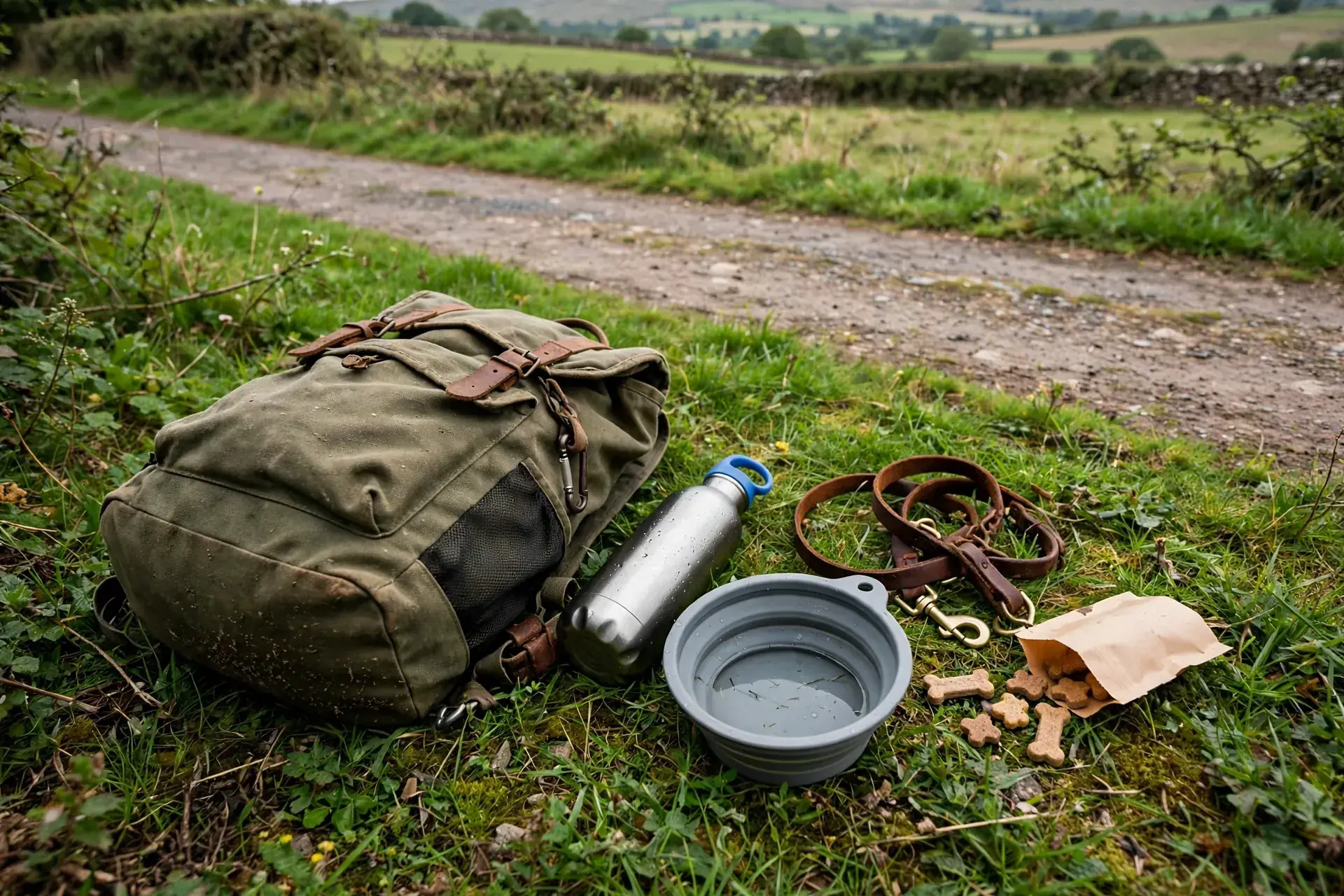
Water equipment is simpler but just as easy to forget. Pack the dog's usual bowl if it is light, or a stable travel bowl that will not slide across a hard floor. A collapsible bowl is useful for walks and car stops, but many dogs drink poorly from a bowl that collapses under their nose, so test it at home before relying on it on holiday. Add a water bottle reserved for the dog, so a walk or a car stop never depends on finding a tap at the right moment. In hard-water areas or on long drives, familiar water from home for the first day can help a sensitive stomach, although most dogs adapt quickly; the practical point is to have water available, not to carry a week's supply.
Rest equipment is about familiarity, not luxury. Pack the bed or blanket the dog already sleeps on, unwashed if possible, because its scent is what makes an unfamiliar room feel safe. A brand-new bed bought for the holiday looks tidy and smells of nothing, which is the opposite of what a nervous dog needs on the first night. Add a second, washable blanket for the car or for a muddy floor, and a crate or pen only if the dog already uses one happily at home. A crate introduced for the first time on holiday is a new stress, not a solution, and an unfamiliar dog in an unfamiliar crate in an unfamiliar room is a combination to avoid. For older dogs, add a non-slip mat for hard floors and a ramp if steps are a known problem, and check the accommodation's floor surfaces when you book.
Daily routine items complete the bag: the usual treats in a sealed container, a small supply of poo bags, grooming equipment suited to the coat, and any calming routine items the dog already knows, such as a familiar chew given only at rest times. Do not pack a new chew, a new toy or a new treat as a holiday surprise unless it has been tested at home first; a choking hazard, an allergic reaction or a stomach upset is much harder to deal with away from home. For a dog day trip packing list, the same principle applies on a smaller scale: the items that carry the daily routine are the items that prevent the day from unravelling.
Zone 2: The car kit
The car kit is everything needed for the journey and for stops along the way, and it stays in the car for the whole holiday. Its job is to make the drive safe, legal and calm, and to cover the stops that happen between home and the accommodation. Pack it the day before departure, not while the engine is running, and check it again before the return journey, because the return drive is when tired drivers and tired dogs are most likely to be careless.
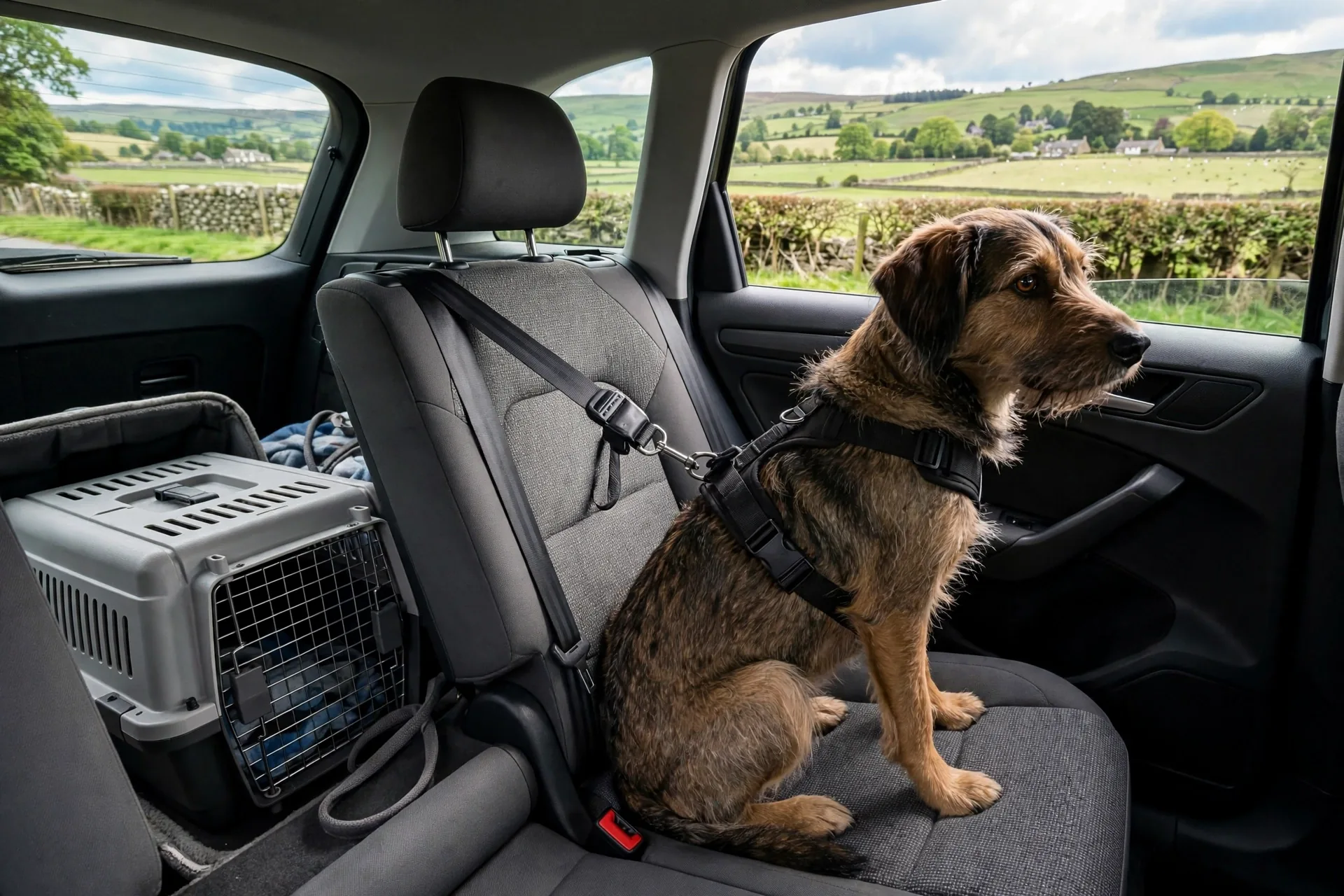
Safety comes first in this zone, and it is not optional. In the UK, the Highway Code requires that dogs are suitably restrained so they cannot distract the driver or injure themselves or others if the vehicle stops quickly. In practice this means a crash-tested harness on a seatbelt attachment, a secured crate in the boot, or a dog guard separating the boot from the passenger area, fitted to the specific car and the specific dog. A loose dog on a back seat, a dog on a driver's lap, or a crate that slides across the boot on every corner does not meet that standard. For a detailed comparison, see the guide to dog car safety, which compares harnesses and crates, fitting checks and boot layouts for different cars and dogs.
Comfort and cleanliness come next. Pack a waterproof seat cover or boot liner, a non-slip mat, a familiar blanket for the travelling position, and a towel for paws at service stops. Add a spill-proof water bowl or a bottle with a bowl attachment, and offer water at planned stops rather than while driving. Air temperature matters more than most drivers expect: a car parked in sun, even on a mild day, heats quickly, so never leave a dog alone in a parked car to run an errand, and plan stops where the dog can be taken out safely rather than left waiting. On long journeys, plan a stop every two hours for water, a toilet break and a short stretch, and choose service areas with a grass area away from heavy traffic where the dog can be walked on a lead.
The car kit also needs its own small emergency layer: a spare lead, a torch, a phone charger, a paper map or offline directions for areas with poor signal, and the accommodation address and check-in details on paper as well as on a phone. A flat phone battery in a rural area with no signal is a poor time to discover that the cottage postcode was only stored in an email. Add a roll of poo bags, a small bag for rubbish, and a change of clothes or at least a spare top for the driver, because a wet dog in a small car has a way of sharing the journey. Finally, pack the car kit so that the restraint, the water and the spare lead are reachable without unloading the whole boot: the items needed at a motorway stop should not be buried under suitcases.
Zone 3: The accommodation kit
The accommodation kit turns an unfamiliar room into a place where the dog can live for a week without damaging the property, disturbing neighbours or losing its routine. It is the zone most people under-pack, because the accommodation looks complete in photographs: there are floors, a kitchen and a garden. What the photographs do not show is where the dog will eat without sliding a bowl across a polished floor, where a wet dog will be dried without soaking a sofa, and where the dog will toilet at midnight without a long walk in the rain.
Start with floors and doors. Pack a washable mat for food and water bowls, a second mat or old towel for the entrance, and a door draft excluder or a portable door guard if the accommodation has gaps a small dog could exploit. Add a stair gate only if the dog already accepts one at home and the host permits it; check the official guidance before you travel if you are unsure about fixing anything to walls or doors in rented accommodation, and never drill, stick or screw anything without the host's written agreement. A simple, freestanding barrier is safer than a badly fitted gate. Photograph the room on arrival, including any existing marks on floors and furniture, and keep those photographs until you are home; they protect both you and the host if there is a dispute about damage.
Drying and cleaning equipment is the largest part of this zone in Britain, and it deserves more space than most people give it. Pack two towels at minimum, a drying coat if the dog uses one, a lidded box or bag for muddy leads and collars, and a small cleaning kit: kitchen roll, an enzyme cleaner suitable for pet accidents, and a spare set of bedding. A dog that swims, walks through mud or gets caught in rain will need drying every day, and a single towel that is still damp from yesterday is not a system. If the accommodation has a washing machine, confirm that pet bedding is permitted in it; if it does not, pack enough bedding to last the trip without washing. Laundry logistics are dull, but they are what keeps a cottage habitable by day four.
Settling equipment completes the kit: the dog's bed from the dog's bag, a familiar blanket for the sofa if dogs are allowed on furniture, a chew or long-lasting treat for quiet evenings, and a white-noise or radio routine if the dog is used to background sound at home. Check the accommodation rules before you travel for the points that most often cause trouble: whether the dog may be left alone, whether it may go upstairs, whether it may use the garden unsupervised, and whether there is a secure boundary. A garden described as enclosed may have a gate that a determined terrier can push open, a hedge gap, or a low wall that a larger dog can clear. Walk the boundary on arrival before letting the dog off the lead, and keep the lead on until you have checked every gate, gap and fence line yourself.
Zone 4: The walk kit
The walk kit is the smallest zone and the one used most often. It is the pouch, pocket load or small rucksack that leaves the accommodation on every walk, whatever the weather and whatever the route. Because it is used daily, it should be packed once, checked once a day, and never unpacked into a drawer on arrival. If the walk kit lives in one place by the door, the morning walk starts in two minutes instead of ten, and the evening walk in the rain is no longer an excuse to skip the spare lead.
The core of the walk kit is control and identification. Pack the usual lead, a spare lead, and a long line if the dog uses one, plus a harness or collar that fits after a wet walk when fur is heavier and a collar may sit differently. Add an identity tag with a mobile number that will be answered on holiday, and check that the microchip details are up to date before departure. A tag with a home landline number that nobody answers while you are away is a decoration, not identification. Add poo bags in a dispenser that can be operated with one hand, a small torch for winter afternoons and early mornings, and a whistle or recall aid only if the dog is already trained to it; a new whistle on holiday is a training project, not a safety device.
Weather and ground conditions shape the rest of the kit. In Britain, pack a dog coat for short-coated, older or small dogs in cold and wet weather, paw balm or boots if the dog is used to them and the route involves ice, salted roads or rough ground, and a small towel or drying mitt for the return. Do not introduce boots for the first time on a long holiday walk: a dog that has never worn boots will spend the walk trying to remove them, and a poorly fitted boot can rub a paw raw within an hour. Test new equipment on short walks at home, in dry weather, before it earns a place in the walk kit. Add a bottle of water and a collapsible bowl on warm days and on any walk longer than an hour, and carry a small snack or training treats in a sealed pouch, not loose in a pocket where they crumble and attract attention from other dogs.
Route awareness is the final part of the walk kit, and it costs no weight at all. Before a new route, check whether dogs must be on a lead, whether there are seasonal beach restrictions, whether livestock is present, and whether the path crosses farmland where dogs must be kept under close control. The rules vary by place and by season, so check the official guidance before you travel rather than assuming that a route that allowed dogs last year allows them this year. Carry a phone with offline maps for rural routes, and tell someone in the party where you are walking and when you expect to return, especially on remote moorland, coastal or mountain paths where signal is unreliable and weather changes quickly.
Zone 5: The health and emergency kit
The health and emergency kit is the zone that must never be cut for space, however tight the car or the train bag becomes. It is small, light and rarely used, and that is exactly why it is dangerous to leave behind: its absence is only noticed at the moment it is needed, when shops are closed, vets are on emergency cover, and the dog is distressed. Pack it in a single labelled pouch, keep it in the dog's bag or in hand luggage on a train, and never unpack it into a bathroom cabinet on arrival where it will be forgotten on departure.
Medication comes first, and it needs a routine of its own. Pack the full course for the trip plus a buffer of at least two extra days, in original packaging with the prescription label visible, and keep a note of the drug name, dose, timing and the prescribing vet's details. If medication needs refrigeration, confirm cold storage at the accommodation and pack a cool bag and ice packs for the journey, with a plan for what happens if the journey is delayed. Set phone reminders for dosing times, because holiday days do not run to the same clock as home days, and a missed dose discovered at bedtime is harder to correct than one caught at lunchtime. Never share medication between dogs, and never start a new medication on holiday unless a vet has advised it.
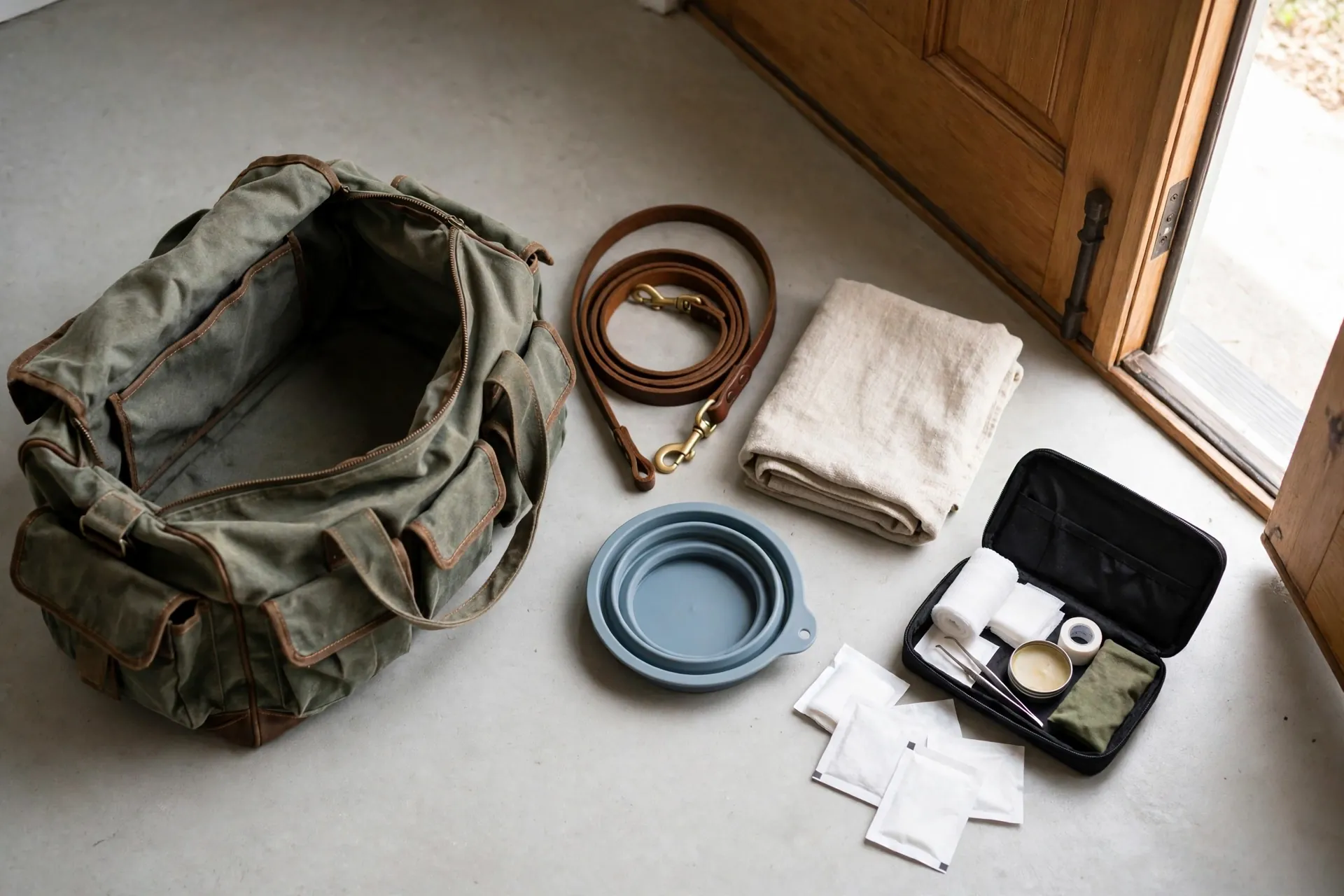
First aid comes next, and it should be practical rather than theatrical. A useful basic kit includes saline for flushing eyes and wounds, gauze and bandage material, adhesive tape that works on fur, blunt-ended scissors, a tick remover, tweezers, a small torch, disposable gloves, and a muzzle that the dog has been trained to accept, because even a gentle dog may bite when in pain. Add a foil blanket for shock or cold, a spare lead, and a clean towel that can double as a sling or a stretcher for a small dog. Keep the kit simple enough that any adult in the party can find the right item without instructions, and replace anything used or out of date as soon as you return home, so the kit is ready for the next trip.
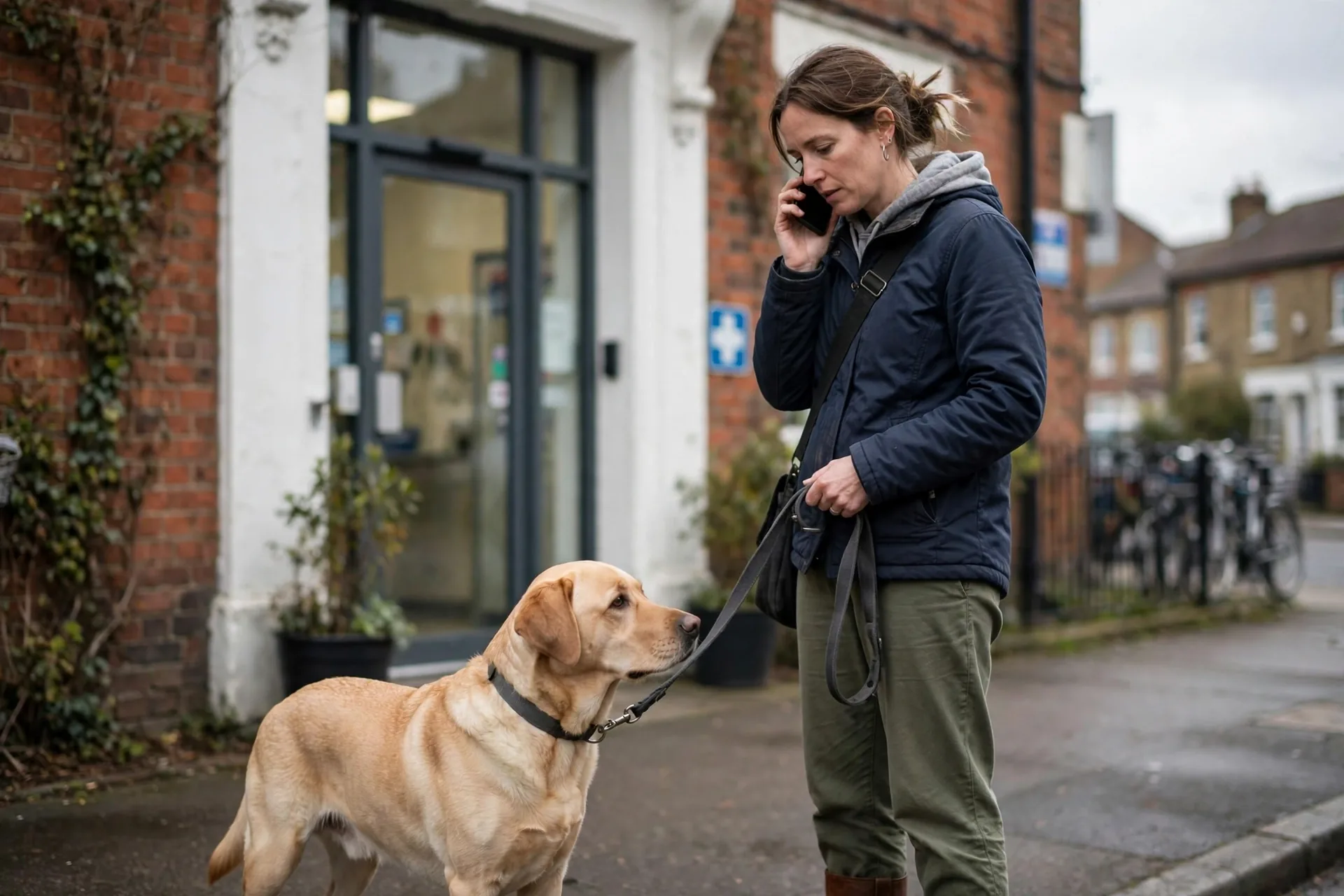
Information is the third part of the health kit, and it is as important as any bandage. Pack a card, on paper, with the local vet practice near the accommodation, the out-of-hours emergency vet number, your home vet's number, your pet insurance policy number and claims telephone number, and the dog's microchip number. Add vaccination records and any relevant medical history, because an unfamiliar vet will ask for them and a phone with no signal cannot produce them. For a fuller treatment of documents, see the dog travel documents checklist, and for what to do when something goes wrong, see the guide to finding an emergency vet on holiday. Save the local vet's number in every phone in the party before departure, and drive or walk past the practice on the first day if it is nearby, so the route is familiar before it is urgent. If you are unsure whether a symptom is an emergency, call the vet rather than waiting to see if it improves: a phone call costs minutes, and a delayed call can cost much more.
Printable tear-off checklist
Print this section, tick each item with a pen as it goes into its zone, and check the list again at the front door before you leave. The list is deliberately grouped by zone, so a missing tick points to a specific bag, not to a vague feeling that something has been forgotten. Cross out items that do not apply to your dog, and add your dog's specific items at the bottom before printing, so the printed list is your list, not a generic one.
The dog's bag
- ☐ Usual food for the trip plus one extra day, measured into daily portions
- ☐ Food scoop or measuring cup, tin opener if needed, lidded container for opened food
- ☐ Usual bowl, travel bowl, and a water bottle reserved for the dog
- ☐ Familiar bed or blanket, plus a washable second blanket
- ☐ Crate, pen, ramp or non-slip mat only if already used at home
- ☐ Usual treats in a sealed container, poo bags, grooming equipment
The car kit
- ☐ Harness, crate or dog guard fitted to the car and the dog
- ☐ Waterproof seat cover or boot liner, non-slip mat, familiar travelling blanket
- ☐ Water bottle and spill-proof bowl, towel for paws at stops
- ☐ Spare lead, torch, phone charger, paper copy of the accommodation address
- ☐ Poo bags, rubbish bag, spare top for the driver
The accommodation kit
- ☐ Washable mat for bowls, entrance mat or old towel, door check on arrival
- ☐ Two towels, drying coat if used, lidded box for muddy leads
- ☐ Enzyme cleaner, kitchen roll, spare bedding
- ☐ Familiar blanket for permitted furniture, quiet-evening chew or treat
- ☐ Photographs of the room on arrival, host rules confirmed in writing
The walk kit
- ☐ Usual lead, spare lead, long line if used, harness or collar
- ☐ Identity tag with a mobile number answered on holiday, microchip details checked
- ☐ Poo bag dispenser, torch, water bottle and collapsible bowl
- ☐ Dog coat, paw protection only if already tested at home, small towel
- ☐ Sealed training treats, phone with offline maps, route rules checked
The health and emergency kit
- ☐ All medication for the trip plus two extra days, in original packaging
- ☐ Prescription note with drug name, dose, timing and vet details
- ☐ Saline, gauze, bandage material, tape, blunt-ended scissors, tick remover
- ☐ Gloves, foil blanket, muzzle already trained, spare lead, clean towel
- ☐ Paper card with local vet, emergency vet, home vet, insurer and microchip number
- ☐ Vaccination records and relevant medical history
When every box is ticked, put the printed list in the dog's bag, not in a suitcase. On the return journey, tick the list again in reverse: medication, documents, bed, bowls and leads are the items most often left in a cottage, and a two-minute check at the door is cheaper than a parcel posted back or a replacement prescription requested from a vet who has never seen the dog.
Car versus train: weight and space logic
Car and train travel reward opposite packing decisions, and the zone system makes the trade-off explicit. A car rewards bulk: a heavy bed, a large crate, a full sack of food and a generous accommodation kit can all be carried without much penalty, provided the boot is loaded safely and the dog's restraint is not compromised by luggage shifting. The risk in a car is not weight but disorder: a boot packed to the roof, with the dog's bag buried at the bottom, turns every stop into an unpacking exercise and tempts the driver to leave the dog's water or spare lead behind because reaching it is too much trouble. Load the car by zone, with the car kit on top, the dog's bag next, and the accommodation kit underneath, and the journey stays orderly even when the boot is full.
Train travel rewards lightness and a single carrying system. Everything must be carried, often while holding a lead, through stations, up steps and onto a train where luggage space is shared and unpredictable. The accommodation kit should shrink first: choose a lightweight blanket instead of a full bed, a collapsible bowl instead of a ceramic one, and a small measured food supply rather than a sack. The walk kit and the health kit should not shrink at all, because they are small and because a train journey offers fewer places to buy a replacement. Keep the dog's bag as a single rucksack with a waist strap, keep the health pouch inside it, and keep the lead clipped to the bag when it is not in your hand, so a dropped lead on a platform is impossible rather than unlikely. Check the official guidance before you travel for the rules of the specific train operator, because dog policies, carriage restrictions and booking conditions vary, and a rule assumed from one operator may not apply to another.
Weight logic can be reduced to a simple test for each item: if the item is heavy, bulky and only used once, it probably stays at home on a train trip and earns its place only in a car. If the item is light, small and used daily, it travels however you travel. A full-size bed fails the train test. A familiar blanket passes it. A crate fails the train test unless the dog is small and the crate is the dog's normal carrier. A spare lead passes every test, because it weighs almost nothing and prevents a walk from ending early. Apply this test zone by zone, and the packing list adapts to the transport without needing a second list: the zones stay the same, only their size changes.
Space logic also applies to the return journey, which is easy to forget when packing for departure. A car that was full on the way out will be fuller on the way back if muddy towels, wet coats and half-used food are added without anything being discarded. Pack a large, sealable bag for dirty laundry, and plan to throw away or recycle packaging as the trip goes on, so the return load is no larger than the outward load. On a train, the same bag keeps wet and dirty items separate from clean clothes and prevents a muddy towel from soaking the dog's bed on the way home. A tidy return is not vanity: it is how the health kit, the documents and the dog's bed all arrive home instead of being left in a cottage cupboard.
What to leave behind
A packing system is only half a list. The other half is what is deliberately left behind, and this section is as important as any zone, because over-packing creates its own problems: a car so full that the dog's restraint is compromised, a train bag so heavy that the handler cannot control the lead, and a cottage so cluttered that the dog cannot find a calm corner. Leave behind anything that duplicates a job already covered, anything that has never been tested at home, and anything that is packed for a photograph rather than for a day of real use.
Start with duplicates. One spare lead is essential; three leads, two harnesses and a spare collar in a different colour are clutter. One familiar bed is essential; a second bed, a beanbag and a decorative cushion are clutter. One drying coat is useful; four towels, two drying coats and a hairdryer for a dog that hates noise are clutter. Duplication feels like safety, but it usually means the important item is harder to find among the unimportant ones. The exception is the health kit, where a spare lead and a spare copy of the vet card are justified because their weight is negligible and their failure would matter.
Next, leave behind new equipment that has not been tested. New boots, a new harness, a new crate, a new food, a new chew and a new calming product all belong in a trial at home, not in a holiday bag. A holiday is the worst place to discover that a harness rubs, a boot falls off, a food causes a stomach upset or a calming product makes a dog drowsy at the wrong time. If an item has not survived at least a week of normal use at home, it has not earned a place on the trip, however convincing its packaging may be. The same rule applies to bulk buying: a holiday is not the time to carry a month's supply of anything, because the extra weight is carried for days and the extra stock is usually left behind anyway.
Finally, leave behind items that depend on an unconfirmed assumption. Do not pack for a bath if the accommodation has no bath the dog can use. Do not pack for off-lead swimming if the local water has restrictions or hazards you have not checked. Do not pack a large freezer supply if freezer space has not been confirmed. Do not rely on leaving items at the accommodation for a future trip unless the host has agreed in writing, because most hosts will discard unlabelled items between guests. A packing list that respects what is confirmed, rather than what is hoped for, is shorter, lighter and far more reliable on the first morning, when the dog needs routine more than it needs novelty.
The packing-day routine
The routine that makes this system work takes about an hour, spread over two days, and it is worth protecting from last-minute changes. A week before departure, start the list: order medication, buy the right quantity of food, replace a worn lead, check the microchip details, and save the local vet's number. This is also the time to confirm the accommodation rules in writing, to check route restrictions for the walks you hope to do, and to check the official guidance before you travel for any transport or access rules that apply to your journey. A week is enough time to fix a gap; the morning of departure is not.
The day before departure, pack by zone. Pack the health kit first, then the dog's bag, then the walk kit, then the accommodation kit, and finally the car kit, in that order, because that is the order of importance if time runs short. Tick the printable checklist as each zone is packed, and place each completed zone in its own container by the front door. Feed the dog, walk the dog and settle the dog on the normal routine that evening, rather than introducing a new bedtime or a new food as a holiday treat. A calm evening before travel is worth more than any single packed item, because a rested dog travels better than a tired, over-excited one.
On the morning of departure, run the front-door check: health pouch, dog's bag, walk kit, car kit, accommodation kit, and the printed list itself. Check the dog's restraint in the car before loading luggage around it, offer water before setting off, and plan the first stop before the journey starts rather than when the dog becomes restless. On arrival, carry the dog's bag in first, walk the accommodation boundary, set up the bed and bowls in the same relative positions as at home, and give the dog a quiet sniffing walk before unpacking anything else. The first hour should be boring by design: water, bed, toilet walk, rest. Excitement can wait until the routine is in place, and a dog that settles on the first evening is a dog that will enjoy the rest of the holiday, rather than spending it recovering from a chaotic start.
Keep the system for the next trip, because it improves with use. After you return home, note what was never used, what was used every day, and what was missing, and adjust the printed list before filing it away. A list that is updated after every trip becomes, within a year, a precise record of your dog's needs rather than a generic guide. That is the real purpose of a packing system: not to pack perfectly once, but to pack a little better every time, until the forgotten item that once ruined day one is simply an item that can no longer be forgotten, because its zone, its container and its tick on the list will not let it be.
Practical questions
Before you go
What is the one item most dog owners forget on a UK holiday?
There is no single universal item, but the most disruptive omissions are usually small and dog-specific: the usual medication, the correct food measured for the trip, a spare lead, and the vet and insurance details. Pack those in the health and documents zone first, before adding comfort extras, and check them against the printable list at the end of this guide.
How do I pack for a dog holiday if I am travelling by train instead of by car?
Travel light and keep everything in one bag you can carry while holding a lead. Choose collapsible bowls, a compact blanket, a small measured food supply, and a single walk kit that clips to your bag. Leave bulky beds, crates and spare bulk food behind, and check the official guidance before you travel for the train operator rules that apply to your journey.
Should I pack my dog's usual food, or can I buy it at the destination?
Pack the usual food for the whole trip if you can. A sudden change of diet on holiday is a common cause of an upset stomach, and a small rural shop may not stock the exact brand, flavour or veterinary diet your dog needs. If you must buy locally, confirm stock before you travel and transition gradually if your vet advises it.
What should be in a dog first-aid kit for a UK holiday?
A basic kit should include your dog's regular medication, a tick remover, saline for flushing, gauze and bandage material, blunt-ended scissors, a spare lead, a muzzle your dog has been trained to accept, and a card with the local vet, your home vet and your insurer. Keep the kit in one labelled pouch so it can be grabbed without unpacking the whole bag.
Can I leave spare items at the accommodation to save space in the car?
Only with the host's agreement, and only for items that are cheap, clean and clearly labelled. Most hosts will not store food, medication or bedding between guests, and anything left behind may be discarded. It is usually simpler to pack a smaller version of each item than to rely on storage that has not been confirmed in writing.
How early should I start packing for a dog holiday?
Start the list a week before departure and pack the dog's bag the day before you leave. The week gives you time to order medication, buy the right food quantity and replace a worn lead. Packing the day before, rather than on the morning of travel, leaves time to notice what is missing while shops and vets are still open.