This guide is independent and contains no paid placement. If affiliate links are added later, they will be clearly marked and will not change our editorial checks.
When a dog is in a public place in the UK, its collar must carry a tag showing the owner's name and address. A microchip does not replace the tag, a telephone number is useful but not legally required, and owners can face a fine of up to £5,000 for breaking the rule. Check the tag before every trip: legible, up to date, and securely attached.
The law in one paragraph: Control of Dogs Order 1992
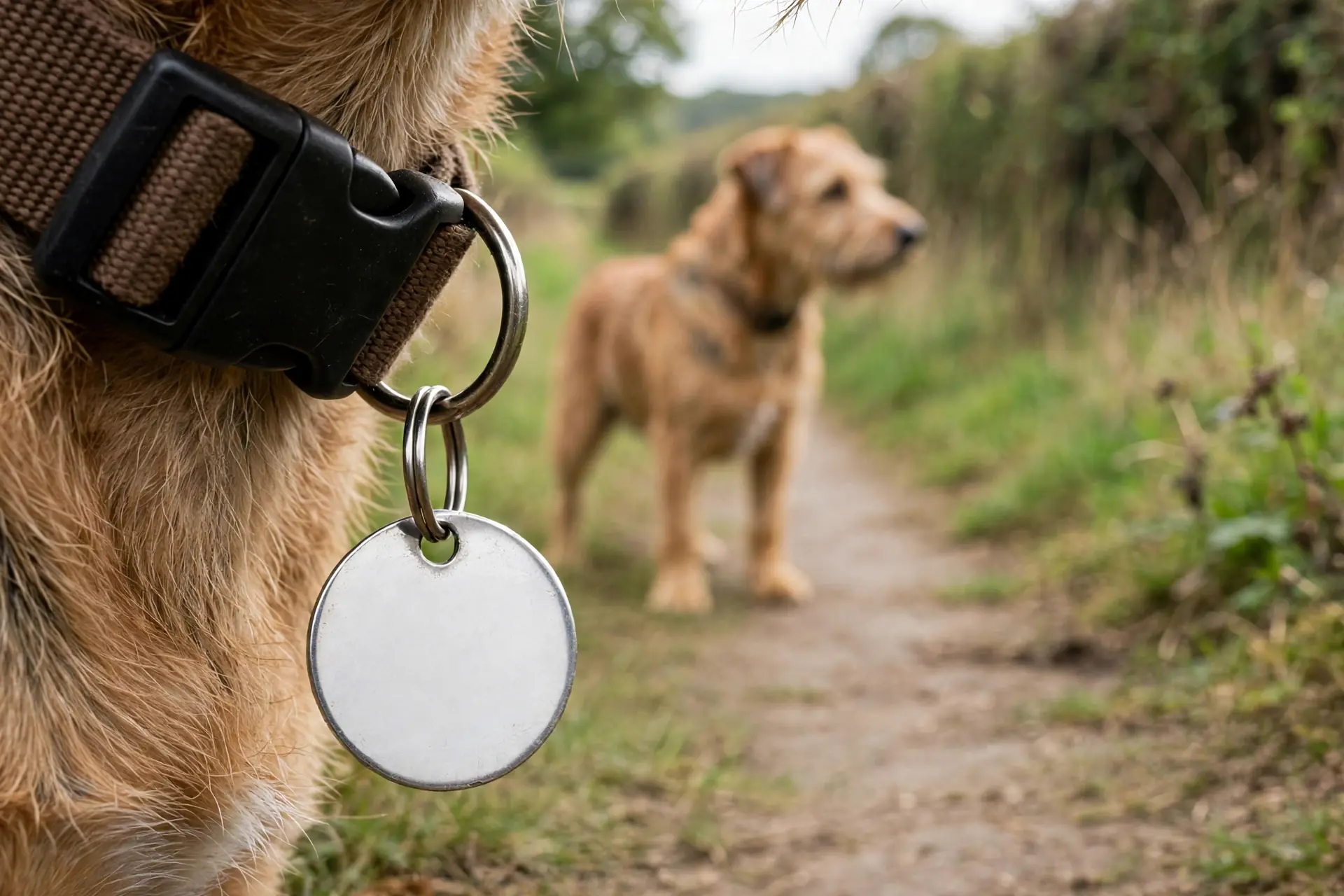
Picture the moment that every dog owner dreads. A gate is left ajar, a lead slips from a cold hand on a coastal path, or a spaniel follows a scent through a gap in a hedge and does not come back when called. Minutes later a stranger finds your dog standing alone on a lane, friendly but with no owner in sight. That stranger cannot read a microchip, cannot search a database from a lay-by, and cannot guess your telephone number. The only information they can read at once, without any equipment, is the small disc hanging from your dog's collar. That is why the law cares about ID tags, and why a tag is not a decorative extra.
The rule comes from the Control of Dogs Order 1992. In plain terms, it requires a dog in a public place to wear a collar carrying a tag on which the name and address of the owner are inscribed. The Order applies across Great Britain, and the same requirement is in force in Northern Ireland under its own dog control legislation, so owners travelling anywhere in the UK should treat the tag as compulsory rather than optional. The wording is deliberately simple: a collar, a tag, a name, an address. There is no minimum size for the tag in the Order, no prescribed font, and no requirement for a particular material, which is why so much of the practical advice in this guide is about making those simple words actually readable in real life.
It helps to understand what the Order is trying to achieve. It is not a tax, a registration scheme, or a test of how much an owner spends on accessories. It is a reunion mechanism. A legible tag turns a lost dog into a short phone call or a short walk to a front door, instead of a trip to a vet, a call to a dog warden, and a night in kennels while a scanner is found and a database is checked. That speed matters most on holiday, when the owner is miles from home, the dog is in unfamiliar territory, and every hour of delay makes the search area wider. The tag is the cheapest, simplest part of the whole system, and it is the part that works without electricity, appointments, or opening hours.
There are a small number of narrow exemptions in the Order, for example for certain working dogs in specific circumstances, and the details can change, so check the official guidance before you travel if you believe an exemption might cover your dog. Do not assume that a dog which is never off the lead, which only walks on private land, or which is microchipped is automatically exempt. The exemption question is separate from the practical question: even where an exemption might apply, a tag still helps your dog get home. Most owners will find that the simplest compliant position is also the safest one — tag on, every time the dog leaves the house.
What the tag must say: owner name and address
The legal minimum is short: the owner's name and address. That is all the Order requires, and it is worth taking the two words literally. The name should be the name of the owner — the person legally responsible for the dog — not the dog's name, not a nickname, and not a kennel name. If the dog is owned jointly, use the name of the owner who can be contacted most reliably. If a dog is kept by a family, the name on the tag should be the adult who will answer the telephone or open the door when a finder calls.
The address should be the owner's address, written clearly enough for a stranger to find it or to post a letter to it. In practice, that means the house number and street, the town or village, and the postcode. A postcode on its own is not an address, and a street name without a house number is not much better. Owners who live in a flat should include the flat number; owners in a rural area should include the house name if that is how the property is known locally. The point is not to satisfy a form, but to give a finder something they can act on without needing to ask a second question.
Space is the usual problem. A tag for a small dog may be only 20 millimetres across, and a full name plus a full address will not fit at a readable size. The answer is not to shrink the text until it is illegible, but to choose a larger tag, to use both sides, or to use a sensibly abbreviated address that still identifies the property. Put the surname and the house number and street on the front, and the town and postcode on the back, for example. Many engravers will advise on layout, and a tag that uses both sides is perfectly acceptable — the law does not say the information must all be on one face.
Keep the wording current. A tag engraved with a previous address is not just unhelpful; it can send a finder to the wrong house and waste the hours when a reunion would have been easiest. Check the tag every time you move house, change your surname, or take over a dog from another owner. The same check applies after a house renumbering or a postcode change, which happens more often in new developments than owners expect. If in doubt, order a new tag. It costs a few pounds, and it is the single most cost-effective item of dog equipment most owners will ever buy.
What the tag does not need to say
Several things that owners commonly put on a tag are not legally required, and knowing which is which helps you use the limited space well. The dog's name is the most common addition, and it is not required by law. Many owners include it anyway, because a finder can use it to call the dog, calm it, and reassure it while help is on the way. That is a good reason to include it if there is room, but it should never displace the owner's name and address. If space is tight, the owner's details come first and the dog's name can be left off or moved to the reverse.
A telephone number is also not legally required, which surprises many owners. The Order was written before mobile phones were universal, and it still only asks for a name and address. In practice, however, a telephone number is the most useful thing a tag can carry after the legal minimum. A finder who can telephone you can arrange a meeting point in minutes; a finder who only has your address may have to drive to your house, leave a note, or take the dog to a vet. Add at least one mobile number, and make it a number that will be answered while you are out walking, not a landline at an empty house. If two people share responsibility for the dog, a second number on the reverse is worth the space.
Other details are optional and should be weighed against readability. Some owners add a note such as "I am microchipped", a veterinary practice number, a medical warning such as a condition that needs medication, or a line like "I need medication". A medical note can be genuinely useful if the dog is found and needs urgent care, but keep it to a few words and do not let it crowd out the owner's details. Avoid adding anything that could help a thief, such as a reward amount that advertises value, or personal information that has no role in a reunion. A tag is read by strangers, so treat it as public information and keep it to what a finder needs.
One more common misunderstanding is worth clearing up: the law does not require the tag to say that the dog is microchipped, and it does not require the microchip number to appear on the tag. The chip number is long, easy to misread, and useless to a member of the public without a scanner and database access. Keep the chip number in your own records and on the database, and keep the tag for the human-readable information that gets your dog home fastest.
The microchip rule and how it differs from the tag
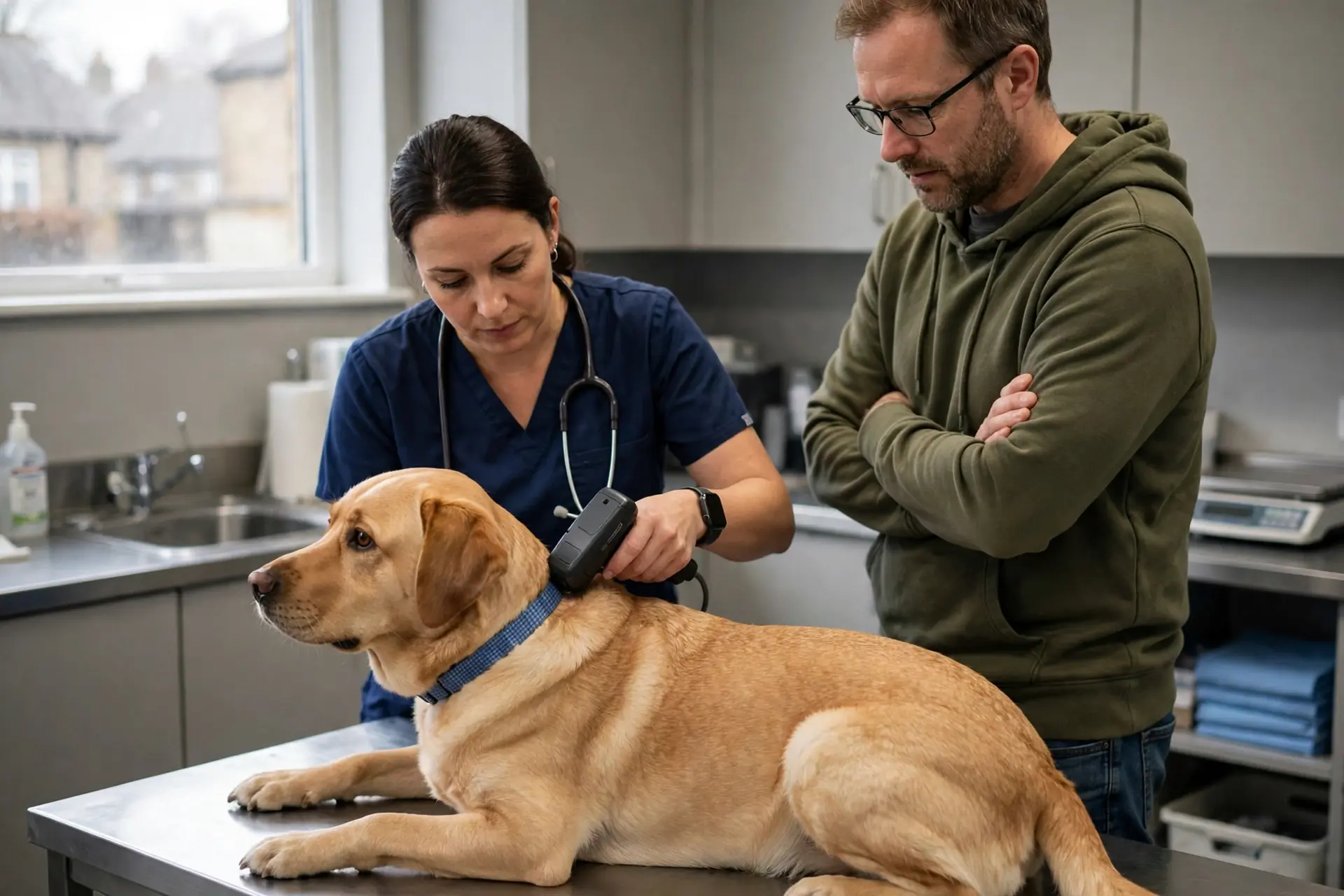
Microchipping and ID tags are often confused, because both are about identifying a dog and both are legally required. They are, however, two separate rules with two separate purposes, and complying with one does not excuse you from the other. A microchip is a tiny transponder, about the size of a grain of rice, implanted under the skin between the shoulder blades. It carries a unique number that links to a database record holding the keeper's contact details. It can only be read with a scanner, which is why it is a back-up system rather than a first line of defence.
The microchipping rules require dogs in England, Scotland and Wales to be microchipped by the time they are eight weeks old, with the keeper's details registered on a government-approved database and kept up to date. Northern Ireland has its own licensing and microchipping arrangements, so check the official guidance before you travel if your journey crosses the Irish Sea. The chip must be implanted by a trained professional — a vet, a vet nurse, or another suitably trained person — and the database record must be updated whenever the keeper, the address, or the telephone number changes. For a full walk-through of the database checks that matter before a trip, read our guide to microchip details before travel.
The practical difference is speed and audience. A tag speaks to anyone, immediately, in a field, on a beach, or at a roadside. A chip speaks only to someone with a scanner — a vet, a dog warden, a rescue centre, or a police officer — and only after the dog has been taken to them. If your dog is found by a walker who is happy to telephone you, the tag solves the problem in minutes. If the dog is found injured, frightened, or out of hours, the chip is what identifies the dog once it reaches professional help. Both systems fail in the same way, too: out-of-date details. A chip linked to an old telephone number is as useless as a tag engraved with an old address, so update both at the same time, every time your details change.
There is also a difference in how the two rules are enforced. Microchip enforcement usually begins with a notice giving the keeper 21 days to comply, and a fine of up to £500 can follow if the notice is ignored. Tag enforcement, covered in the penalties section below, can lead to a much larger fine. The contrast is a useful reminder of how the law sees the two systems: the chip is a database obligation with a correction window, while the tag is an immediate, visible duty every time the dog is in public. Treat them as a pair, and check both before you travel.
Penalties: fines and what enforcement looks like
The maximum penalty for failing to comply with the Control of Dogs Order 1992 is a fine of up to £5,000. That figure is often quoted without context, so it is worth understanding what it means in practice. The £5,000 figure is the maximum a court can impose, not a fixed penalty that every owner receives. It sits at the top end of the scale because the offence is dealt with in the magistrates' court, and it signals that Parliament regards a missing tag as a serious matter, not a trivial administrative slip.
In day-to-day enforcement, the experience is usually much less dramatic. Dog wardens, who are employed by local authorities, are the people most likely to notice a missing or illegible tag. A warden who stops an owner on a walk will often start with advice: a reminder of the rule, a note of the owner's details, and an expectation that a tag will be fitted promptly. Police officers can also enforce the rule, and a missing tag may come to light during an incident — for example, if a dog is found straying, involved in an accident, or reported as out of control. In those circumstances, the tag is rarely the only issue, and the absence of identification can make everything else harder, from returning the dog to establishing who is responsible.
The real cost of non-compliance is often not the fine at all. A dog found without a tag is harder to reunite with its owner, and a dog that cannot be identified quickly may be taken to kennels by a warden. Kennelling carries fees, which the owner is usually expected to pay, and it carries stress for the dog, particularly for older, nervous, or unwell animals. A dog held in kennels while its owner is searched for may also be away from medication, a special diet, or a familiar routine. The tag, by contrast, costs a few pounds and weighs a few grams. Viewed that way, the penalty that matters most is not the one a court might impose, but the night your dog spends in a strange kennel because nobody could read who it belonged to.
Owners should also remember that a fine is not the only legal consequence of an identification failure. If a dog causes damage or injury while unidentified, the question of who is responsible becomes harder to answer, and an owner who cannot be identified promptly may face additional complications. The sensible approach is to treat the £5,000 maximum as a warning and the warden's advice as the realistic outcome, and to make both irrelevant by keeping a legible tag on the collar. If you are ever unsure whether your tag complies — for example, after a move, a change of name, or a tag that has worn smooth — check the official guidance before you travel and replace the tag if there is any doubt.
Buying a tag: engraved vs printed, materials that last
Most UK dog tags fall into two broad types: engraved and printed. An engraved tag has the text cut into the metal, usually by a machine in a pet shop, a key-cutting shop, or an online engraver. The letters are recessed into the surface, so they survive rubbing, scratching, and weather far better than surface printing. A printed tag has the text applied to the surface, often under a coating, and can look sharper and more colourful when new, but the print can wear, fade, or peel with months of contact against a collar, a lead clip, and the dog's coat. For a legal document that must stay legible, engraving is the safer choice in almost every case.
Material matters as much as the method. Stainless steel is the workhorse choice: it resists rust, holds an engraving well, and is heavy enough to hang flat without flipping constantly. Brass is traditional and engraves deeply, but it tarnishes and needs occasional cleaning to stay readable; a brass tag that has gone dark in a drawer for a year may still be legible, but a finder in poor light will struggle with it. Aluminium is light and cheap, which suits very small dogs, but it is softer and the engraving can wear faster, particularly on an active dog that swims or scrambles through undergrowth. Plastic tags are the lightest of all and come in bright colours, but they scratch, crack, and fade, and they are best treated as a temporary or back-up option rather than the main tag.
Size and shape deserve the same attention as material. A tag should be large enough to carry the owner's name and address at a size a stranger can read without a magnifier, but small enough not to catch on fences, flap against the dog's chin, or weigh down a small collar. A disc of 25 to 30 millimetres suits most medium and large dogs; a 20-millimetre disc or a small bone shape may be better for a toy breed, with the address split across both sides. Avoid novelty shapes with narrow points that can snag, and avoid tags with a hole so close to the edge that the metal can tear. Ask the engraver to show you a proof, or at least to confirm the layout, before the tag is cut — a tag with the postcode wrapped around a curve is a tag that will be misread.
Buying is easy: pet shops, online engravers, and many key-cutting and shoe-repair shops offer same-day engraving, and a basic stainless-steel tag typically costs a few pounds. Online sellers offer more choice of shapes and fonts, but check the delivery time before a holiday and order at least a week ahead. Whatever you buy, keep a spare. A spare tag in a drawer, engraved with the same details, turns a lost tag on the morning of a trip from a crisis into a two-minute fix. If you move house, order two new tags at once — one for the collar and one for the drawer — and destroy or recycle the old ones so they cannot be fitted by mistake.
Fitting the tag: collar, harness and split rings
A tag only works if it stays on the dog, and the fitting is where many tags fail. The most common fitting is a split ring — the small double-loop metal ring, like a key ring — threaded through the hole in the tag and around the collar's D-ring. Split rings are cheap and secure when they are the right size, but a ring that is too small can be forced open by a strong dog, and a ring that is too large can catch on a fence or a crate door. Choose a ring that closes fully, with no gap between the ends, and check it monthly by tugging the tag firmly. Replace any ring that has stretched, rusted, or developed a sharp edge.
Some owners prefer a tag that slides onto the collar itself, or a tag holder that encloses the disc and clips to the collar. Slide-on tags sit flat against the collar, which reduces jingling and snagging, and they are a good choice for dogs that work in undergrowth or that are bothered by noise. Their drawback is readability: a slide-on tag can be partly hidden by the collar, and a finder may need to lift the collar to read it. A hanging tag, by contrast, is visible at a glance, which is what you want when a stranger is trying to help a nervous dog. Many owners use both — a hanging engraved tag as the main identification, and a slide-on tag as a back-up.
The collar itself is part of the legal picture. The Order requires a collar, and the tag must be on it, so a dog wearing only a harness does not meet the requirement, however well the harness is fitted. That does not mean the harness is a problem — many dogs walk far better on a harness, and a harness is often the safer choice for pulling dogs or for breeds prone to neck injury. It means the collar should be worn as well, even if the lead is attached to the harness. Fit the collar so that two fingers slide comfortably between the collar and the neck: tight enough that it cannot slip over the head, loose enough that it does not rub or restrict breathing. Check the fit every few weeks, and every week for a growing puppy.
Think about noise and comfort, too. A tag that jingles against a metal buckle on every step can irritate a noise-sensitive dog and can wear the engraving faster. A small rubber silencer, a tag pouch, or a felt backing can quiet the tag without hiding the text. For dogs that swim regularly, rinse the tag and ring in fresh water after a swim and dry them, because salt water accelerates corrosion and can dull an engraving. For dogs that work in mud, wipe the tag clean after a walk — a tag caked in clay is a tag that cannot be read, however well it was engraved.
Puppies, rescue dogs and borrowed dogs
Puppies are covered by the same rule as adult dogs once they are in a public place, so the tag should be fitted as soon as the puppy starts going out. That is usually after the first vaccinations, when the puppy begins short walks and socialisation trips. Choose a light collar and a small, light tag — a heavy steel disc on a tiny puppy is uncomfortable and will be chewed or pawed at. Check the collar fit every week, because a puppy can outgrow a collar in a fortnight, and a collar that was loose last week can be tight this week. The microchip rule also bites early: a puppy must be microchipped by eight weeks of age, and the breeder or rescue should have arranged this before the puppy leaves for its new home.
Rescue dogs bring a different timing problem. A dog that has just been rehomed may arrive with a tag bearing the rescue's details, the previous owner's details, or no tag at all. The new owner should fit a tag with their own name and address on the day the dog comes home, before the first walk, not after the first week. Rescue dogs are also more likely to slip a lead, bolt from a new garden, or panic at an unfamiliar sound in the first days, which is exactly when a correct tag matters most. Update the microchip database at the same time — the rescue should provide the transfer paperwork — and confirm that the database record shows your details, not the rescue's, before you rely on it. Our guide to a lost dog on holiday explains what to do in the first hour if a newly rehomed dog does go missing away from home.
Borrowed dogs — a friend's dog while they are away, a family member's dog for the weekend, a dog you are walking for a neighbour — need a clear answer to a simple question: whose name and address should be on the tag? The legal answer is the owner's, and the tag should show the owner's details, because the owner is the person legally responsible. The practical answer is that the person actually walking the dog should also be contactable. The simplest solution is a temporary tag, or a second tag on the reverse, showing the walker's mobile number and the words "walking for" followed by the owner's surname, if there is room. A luggage-label style temporary tag, written clearly and attached securely, is better than no tag at all for a single weekend, but it should never replace a properly engraved tag for a longer stay.
Foster carers face the same question over a longer period, and the answer is the same: fit a tag with the details of the person who can be reached fastest, and make sure the microchip database agrees. If the fostering arrangement changes, update both at once. For any dog that changes hands — through sale, rehoming, fostering, or a long loan — treat the tag and the chip as a single job, done on the day of the handover, and do not let the dog out in public until both are correct.
Travelling with your dog: tags, documents and temporary addresses
Holidays test the tag rule in a way that everyday walks do not, because the address on the tag is suddenly the wrong address. Your home address is still your legal address, and it is still the correct address for the tag, but a finder in Cornwall cannot easily return a dog to a house in Yorkshire. That is why a telephone number, though not legally required, becomes essential on holiday: it is the only detail on the tag that works at any distance. Before you travel, check that the number on the tag is the mobile you will actually be carrying, that it is switched on, and that it can receive calls in the area you are visiting — signal is patchy in parts of rural Britain, so tell a second person your plans if you will be out of coverage for part of the day.
A temporary tag is a practical addition for a longer stay. Some owners add a second tag for the holiday, showing the name of the cottage, caravan park, or campsite, the pitch or unit number, and the dates of the stay, alongside their mobile number. This is not a legal requirement, and it does not replace the home-address tag, but it gives a finder a local address to walk to, which can be faster than a telephone call if the dog is found near the accommodation. Keep the temporary tag clearly separate — for example, on a different ring — and remove it when you get home, so that an out-of-date holiday address cannot be mistaken for your home address on a later walk. If you are staying in more than one place, update the temporary tag at each stop, or rely on the telephone number alone.
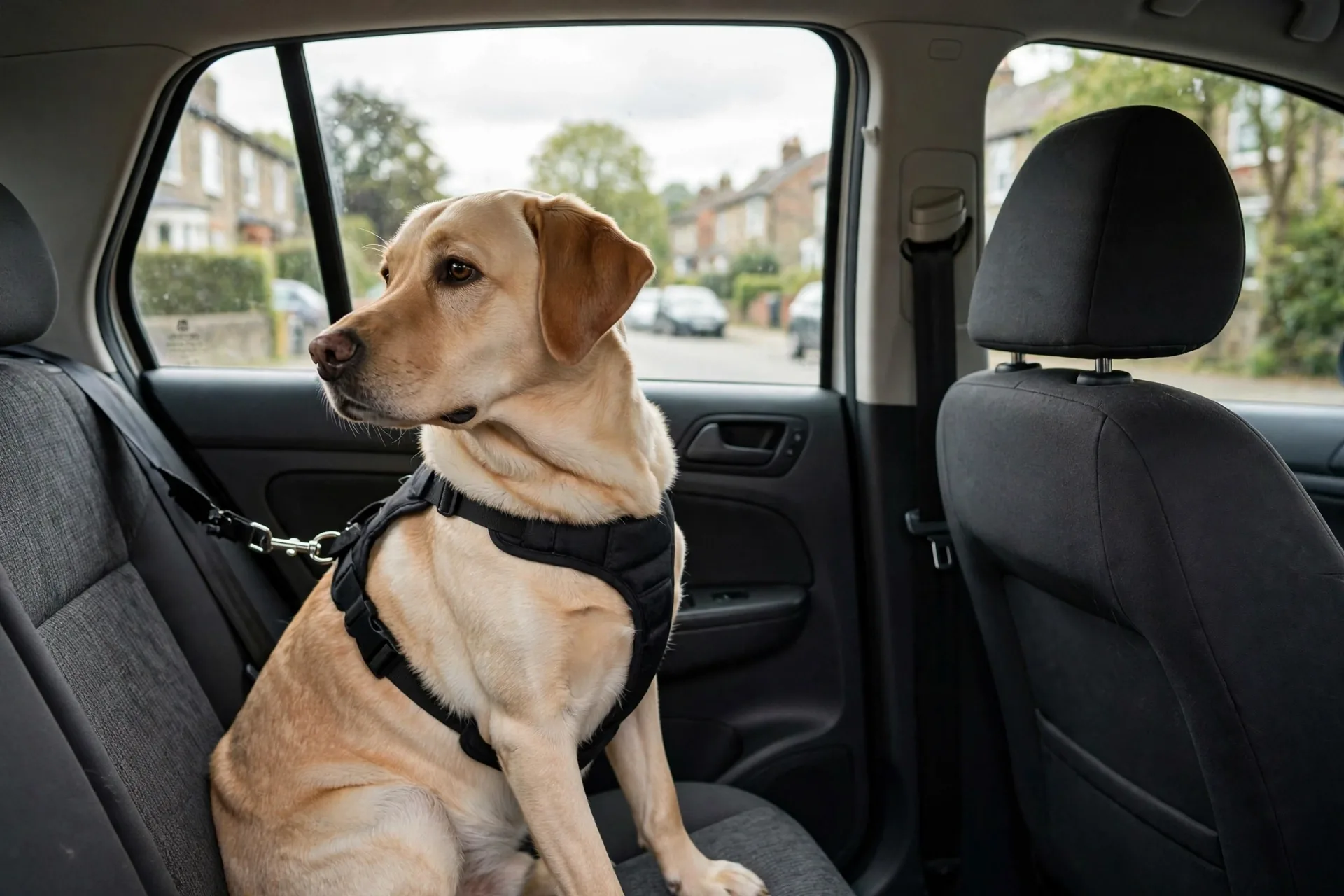
Documents travel with the tag, not instead of it. Before a trip, gather the microchip number, the database name and telephone number, the vet's details, and the dog's insurance information, and keep them in your phone and on a paper card in the car. If the dog is found and taken to a vet, those details speed up the scan and the database check. If you are driving, the restraint rules matter as well — our guide to driving with a dog in the UK covers Rule 57, harnesses, crates, and the penalties for an unrestrained dog in the car. A dog that is properly restrained in the car is also a dog that is less likely to bolt from an open door at a service station, which is one of the commonest ways holiday dogs go missing.
Finally, think about who else needs to know. Tell the accommodation provider that you have a dog, confirm the local vet's opening hours, and save the number of the nearest out-of-hours vet before you need it. If you are walking in an unfamiliar area, carry a spare lead and a spare tag in your pocket. If the dog's main tag is lost on a walk — a split ring can fail on a bramble — a spare in your pocket lets you fit a replacement on the spot, rather than walking the rest of the holiday with an untagged dog. A few minutes of preparation before departure is worth far more than a frantic search for an engraver in a town you do not know.
Service and assistance dogs
Service and assistance dogs — guide dogs, hearing dogs, medical alert dogs, and other dogs trained to support a disabled person — are subject to the same ID tag rule as any other dog in a public place. The Order does not exempt them, and there is no separate tag that replaces the owner's name and address. An assistance dog should therefore wear a collar with a tag showing the handler's name and address, in exactly the same way as a pet dog. The harness or jacket that identifies the dog as an assistance dog is additional identification for access purposes; it does not satisfy the tag requirement on its own.
In practice, assistance dog partnerships often carry more identification than the law requires, and that extra identification is useful. Many handlers add a tag or a card showing the assistance dog organisation, a telephone number for the organisation, and a note that the dog is a working assistance dog. This helps if the dog is found without its handler, because the organisation can be contacted even if the handler cannot be reached, and it helps a finder understand that the dog should not be distracted, fed, or separated from its handler unnecessarily. Keep the legal minimum — handler name and address — on the main tag, and put organisational details on the reverse or on a second tag if there is room.
Access rights are a separate question from identification, and owners sometimes confuse the two. The Equality Act 2010 gives assistance dog handlers the right to enter most public places, including shops, restaurants, and public transport, with their dog, and it is unlawful to refuse access because of the dog. That right does not depend on the tag, and a missing tag does not remove it, but it also does not excuse the tag: the two duties sit side by side. A handler who is challenged about access should not need to produce the tag to prove the dog is an assistance dog — the harness, the identification card, and the handler's own explanation are the usual evidence — but the tag should still be there, legible and up to date, as it should be for any dog.
Handlers travelling away from home face the same temporary-address question as other owners, with one added consideration: the dog may be the handler's only means of navigating an unfamiliar place, so a lost assistance dog is a more serious emergency than a lost pet. A second contact number — a family member, a friend, or the assistance dog organisation — on the reverse of the tag is worth the space, and a temporary holiday tag with the accommodation details is worth considering for a longer stay. If the dog is found, the finder should be encouraged to telephone the handler first, and to keep the dog with them rather than taking it to kennels, if that is safe and practical.
Common mistakes that leave owners non-compliant
The most common mistake is also the simplest: no tag at all. Owners who have a microchip, a smart collar, a GPS tracker, or a beautifully embroidered collar sometimes assume that one of those replaces the tag. None of them does. A GPS tracker tells you where the dog is, but only if you are looking at the app; a finder cannot read it. An embroidered collar can carry a telephone number, and some owners treat it as a tag, but embroidery wears, fades, and can be hard to read, and a collar on its own is not the tag the Order requires. The rule asks for a collar and a tag, and the safest way to meet it is to have both, with the tag as a separate, engraved disc.
The second most common mistake is an out-of-date tag. Owners move house and update the microchip database, the vet, and the insurance, but forget the small disc on the collar. Or they change mobile numbers and update every account except the tag. Or they inherit a dog and keep the previous owner's tag because it looks new. In each case, the tag is present, the collar is fitted, and the owner believes they are compliant, but the information on the tag is wrong, and a finder following it will be misled. The fix is a routine: check the tag whenever you check anything else about the dog — at the annual vet visit, at the insurance renewal, and before every holiday — and replace it the moment a detail changes.
The third mistake is an illegible tag. Engraving wears, particularly on soft aluminium tags, on tags that rub against a metal buckle, and on tags carried by dogs that swim in the sea or scramble through brambles. A tag that was clear when it was bought can become a smooth disc with faint scratches after a year of daily wear. Hold the tag up to the light once a month and read it as a stranger would: if you have to tilt it, squint, or guess at a digit, it is time for a replacement. The same test applies to printed tags that have faded in sunlight, and to tags that have been chewed by a puppy or a bored dog left alone with a collar on.
Other mistakes are smaller but still common. A tag attached with a paperclip, a cable tie, or a weak key ring can fall off on the first walk. A tag fitted to a harness instead of a collar leaves the dog without a tag when the harness comes off at home or at the beach. A collar that is too loose can slip over the dog's head, taking the tag with it, while a collar that is too tight is a welfare problem as well as a practical one. A tag with only the dog's name and a telephone number, and no owner name or address, fails the legal minimum, however helpful the number is. None of these mistakes is difficult to fix, and all of them are cheaper to fix before a holiday than after a dog goes missing.
Finally, watch for the mistake of assuming the rules are the same everywhere. The Control of Dogs Order 1992 covers Great Britain, and Northern Ireland has its own arrangements; the microchipping rules also differ in their detail between nations, and the rules for taking a dog abroad are different again. If you are travelling within the UK, the tag rule in this guide is the right starting point, but check the official guidance before you travel if your journey involves Northern Ireland, the Isle of Man, or the Channel Islands, or if you are taking the dog outside the UK. A few minutes of checking before departure is a small price for certainty.
Pre-travel compliance checklist
Use this checklist the day before every trip, and again on the morning of departure if anything has changed. It takes five minutes, and it covers the two legal duties — tag and microchip — together, because they are most useful when they are checked together. Work through it in order, and do not skip a step because it was fine last time: tags wear, numbers change, and collars stretch, and the point of a checklist is to catch the change you did not notice.
- Read the tag as a stranger would. Take it off the collar, hold it in daylight, and read every word aloud. Can you read the owner's name, the full address including house number and postcode, and the mobile number without guessing? If not, replace the tag before you travel.
- Check the details are current. Is the name still correct? Is the address the one you live at now? Is the mobile number the one you will be carrying on the trip? If any answer is no, order a new tag and fit it before departure.
- Check the fitting. Tug the tag firmly. Is the split ring fully closed, with no gap and no rust? Is the collar fitted so two fingers slide underneath, and is the buckle secure? Replace a stretched ring or a frayed collar now.
- Check the microchip. Confirm the chip number, the database name, and that the registered telephone number and address match the tag. If you have moved or changed numbers since the chip was registered, update the database before you travel — for the step-by-step checks, see our microchip details before travel guide.
- Pack spares. Put a spare tag, a spare lead, and a spare collar in the car or in your day bag. A spare tag is useless in a drawer at home when the main tag is lost on a coastal path.
- Save the numbers. Store the vet's number, the nearest out-of-hours vet at your destination, the microchip database helpline, and the local dog warden's number in your phone. Write them on a card as well, in case your phone runs out of charge.
- Plan for the first hour if the dog goes missing. Know who to call first, where the dog is most likely to go, and what the dog will respond to. Our lost dog on holiday guide sets out the first-hour steps in detail, including who to contact and what information to have ready.
- Check the journey rules. Confirm the dog will be properly restrained in the car, that the accommodation accepts dogs, and that any beach, park, or attraction on your route allows dogs on your dates. A compliant tag does not help a dog that is not allowed in the first place.
A tag is a small object, and it is easy to treat it as a small matter. The law treats it differently, and so does the stranger who finds your dog. A legible tag with your name, your address, and a telephone number that you will answer is the fastest route home your dog has, and it is the only route that needs no scanner, no database, and no office hours. Fit it, read it, keep it current, and check it before you travel. The rest of the holiday — the walks, the beaches, the long evenings in a cottage garden — is easier when you know that, if the worst happens, a stranger can read your dog's way home in a single glance.
Practical questions
Before you go
Is it illegal for a dog not to wear an ID tag in the UK?
Yes, in most cases. Under the Control of Dogs Order 1992, a dog in a public place in the UK must wear a collar with a tag showing the owner's name and address. A few narrow exemptions exist, so check the official guidance before you travel if you think one might apply to your dog.
What information must a dog ID tag include?
The tag must show the owner's name and address. That is the legal minimum. A telephone number is not legally required, but it is the fastest way for a finder to reach you, so most owners add a mobile number as well.
Does my dog still need a tag if it is microchipped?
Yes. A microchip and an ID tag do two different jobs. The chip can only be read with a scanner by a vet, a warden or a rescue, while a tag can be read at once by anyone who finds your dog. The law requires both: a microchip under the microchipping rules and a visible tag under the Control of Dogs Order 1992.
What is the fine for a dog without an ID tag?
Owners can face a fine of up to 5,000 pounds. In practice, enforcement often starts with advice or a warning from a dog warden, but the maximum penalty is substantial, and a missing tag can also delay a reunion if your dog is found by a member of the public.
Does a puppy need an ID tag?
Yes, once the puppy is in a public place, the same rule applies. A puppy also needs a microchip by the time it is eight weeks old, with the keeper's details registered on an approved database. Fit a light, correctly sized collar and a small tag early, and check the fit every week while the puppy grows.