This guide is independent and contains no paid placement. Venue rules change by season and by event night, so always check the official guidance before you travel.
Book an early timed slot on a dog-friendly night, keep the dog on a short lead with reflective kit and a light, steer clear of the fastest flashing displays if your dog is sensitive to them, and agree in advance where the dog can and cannot go in the food areas. A shorter, calmer trail finished early beats a long one finished cold and stressed.
Timed entry: book the slot, not just the date
Most large Christmas light trails now sell timed entry rather than open all-evening admission. That single detail shapes the whole night for a dog owner, because the slot you choose decides how long you queue outdoors, how crowded the first section feels, and whether you are still walking at the coldest, latest part of the evening. Do not treat the date as the booking and the time as an afterthought. Read the ticket page for the exact entry window, the last entry time, and whether late arrival means a shorter visit, a move to a later slot, or no admission at all. If the rules are unclear, check the official guidance before you travel, and keep a screenshot or email of the dog policy for the slot you booked.
Early slots suit most dogs, and the reasons are practical rather than sentimental. Arrival is easier while there is still a little daylight, so the dog can toilet on familiar ground, settle in the car park, and walk the first stretch before the paths fill. Queues at the gate tend to be shorter, the first installations are less congested, and you are more likely to finish before tiredness, cold and hunger start to stack up. A dog that has already had a normal day, a normal evening meal and a short garden walk will cope far better at six o'clock than at nine, when the same dog would normally be asleep. For households with children, an early slot also avoids the difficult trade-off between keeping children out late and keeping a dog comfortable.
Weekday evenings are usually calmer than Fridays and Saturdays, and the first week of a trail is often quieter than the final week before Christmas, when demand peaks and many venues add extra sessions. If your dog is reactive, nervous around pushchairs and wheelchairs, or unsettled by narrow paths, a quiet Tuesday is a different outing from a sold-out Saturday, even at the same venue. Some venues run dedicated dog-friendly evenings, and these are worth seeking out, but read the detail: a dog-friendly evening may still cap dog numbers, require dogs to stay on short leads throughout, or exclude dogs from particular zones. A label on a listings page is not a guarantee, so confirm the rule on the venue's own booking page.
Build slack into the journey. Winter roads, dark country lanes, flooded dips and full car parks all take longer than a summer drive, and a timed ticket does not wait for traffic. Aim to arrive at least thirty minutes before your slot, so the dog can have a calm toilet walk, a drink and a few minutes to sniff the car park edges before the gate opens. If you arrive flustered and rush straight into a tunnel of lights, the dog starts the trail already aroused, and every later decision becomes harder. A calm arrival is not wasted time; it is the cheapest insurance for the whole evening.
Ticket conditions also matter for multi-dog households, assistance dogs and children in the party. Check whether there is a limit on dogs per booking, whether assistance dogs follow a different rule from pet dogs, and whether children under a certain age need their own tickets. Some venues ask for dogs to be declared at booking, and undeclared dogs can be refused at the gate, which is a miserable outcome after a long drive. If you are booking for a group, make sure every adult knows the dog plan: who holds the lead at the gate, who stays with the dog if someone goes into an indoor cafe, and where you will meet if the party splits. A two-minute conversation in the car park prevents a confused search in the dark later.
Choose a trail your dog can actually enjoy
Not every light trail is a dog trail, and the difference is rarely about whether dogs are allowed through the gate. The useful questions are about length, surface, width, gradient, noise and escape routes. A trail of two miles on gravel paths with wide passing places is a different proposition from a one-mile route that funnels everyone through a narrow, echoing tunnel, a low bridge and a crowded grotto area. Look for a venue map before you book, and check whether the route is a loop, a there-and-back path, or a one-way system. One-way systems can be wonderful for crowd flow and difficult for a dog owner who needs to leave halfway, because the exit may be at the far end. If your dog might need an early exit, favour a loop with signed cut-throughs, or ask the venue where the emergency exits and staff points are.
Surface matters more at night than in daylight. Gravel, tarmac and boardwalk stay usable after rain, while grass, bark and bare earth turn to mud, ice or both. Short-legged dogs, older dogs and dogs with sore paws struggle on frozen ruts and on salted paths, so check whether the venue grits its routes and whether there are indoor or sheltered sections where a dog can warm up. Woodland trails add another layer: low branches, exposed roots, rabbit smells and wildlife sounds can excite or unsettle a dog that is calm on a city pavement. A torch helps you see the ground, but it does not remove a trip hazard, so keep the dog close on uneven stretches and let them sniff rather than pulling them past every distraction.
Length should be judged by the dog, not by the ticket price. Many trails advertise a walking time of sixty to ninety minutes, but that figure assumes a steady adult pace with no toilet stops, no queueing for photographs and no pauses at food stalls. With a dog, add time for sniffing, for passing other dogs calmly, and for standing aside on narrow paths. A dog that happily walks for an hour in daylight may tire faster in cold air, in a coat, on a short lead, surrounded by unfamiliar smells and sounds. It is better to choose a shorter trail and finish with a dog that still has energy than to choose the longest trail in the county and finish carrying a shivering dog past the last display. If a venue offers a short family loop and a longer full route, the short loop is often the wiser first visit, especially for puppies, older dogs and first-time night walkers.
Noise is the hidden variable. Light trails are rarely silent: there may be music at installations, recorded sound effects, generators, crowds talking, children shouting with excitement, and occasional fireworks or drone displays nearby. Dogs that are sound-sensitive, or that have never heard amplified music outdoors, can find this harder than the lights themselves. A venue that publishes a noise guide, a quiet session, or a sensory note is giving you genuinely useful information, so read it before you book. If no such note exists, a short visit on a quiet night is a better test than a long visit on the busiest night of the season. For more on settling a nervous traveller, see our guide to dog anxiety calming for travel in the UK, which covers early stress signals and desensitisation in practical detail.
Finally, think about the journey home as part of the trail choice. A venue an hour away means a dog that is wet, muddy and tired still faces an hour in the car, possibly after a late finish. A nearer venue, a daytime garden visit on another date, or a trail combined with a dog friendly Christmas stay nearby can all make the night more humane. The best trail for your dog is not necessarily the most famous one; it is the one whose length, surface, crowd level and exit options fit the dog in front of you.
Cold and dark: reflective gear that works
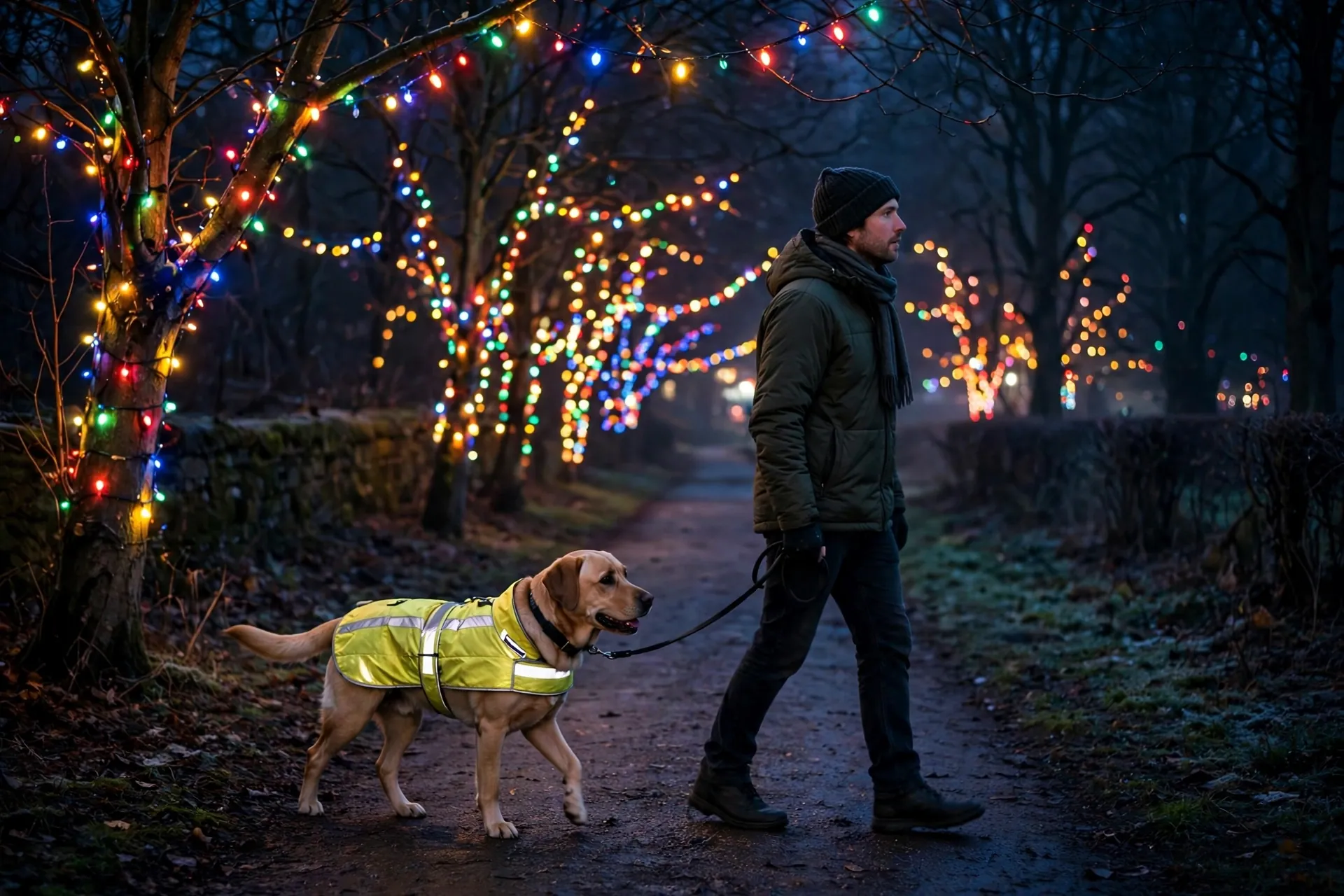
Winter night trails combine the two conditions that make dogs hardest to see and easiest to chill: darkness and cold. Reflective gear is therefore not an accessory but part of the basic kit, and it needs to work for other people as well as for you. A reflective strip that only shows when a car headlight hits it from directly behind is less useful on a woodland path than a light-up collar, a clip-on LED and reflective trim on a harness or coat that catches light from several angles. Test the kit at home on a dark evening before the trail: walk the dog around the block, ask a companion to stand twenty metres away, and check what is actually visible. If you can barely see the dog, other visitors, cyclists in the car park and drivers leaving the venue will see even less.
A short lead is the other essential. Long lines, retractable leads and off-lead walking have no place on a crowded night trail, where a dog on a long line can trip a child, tangle around a pushchair wheel, or reach a display cable before you can react. A standard lead of about one to two metres, held with a relaxed arm, gives the dog room to sniff without giving them room to lunge into the next group. Keep the lead attached to a harness rather than a collar if your dog pulls, because a sudden lunge in a crowd is harder on the neck and harder for you to control. Avoid leads with dangling decorations, bells that jingle constantly, or anything that can catch on a fence, a low branch or a light installation. Practical kit beats festive kit every time.
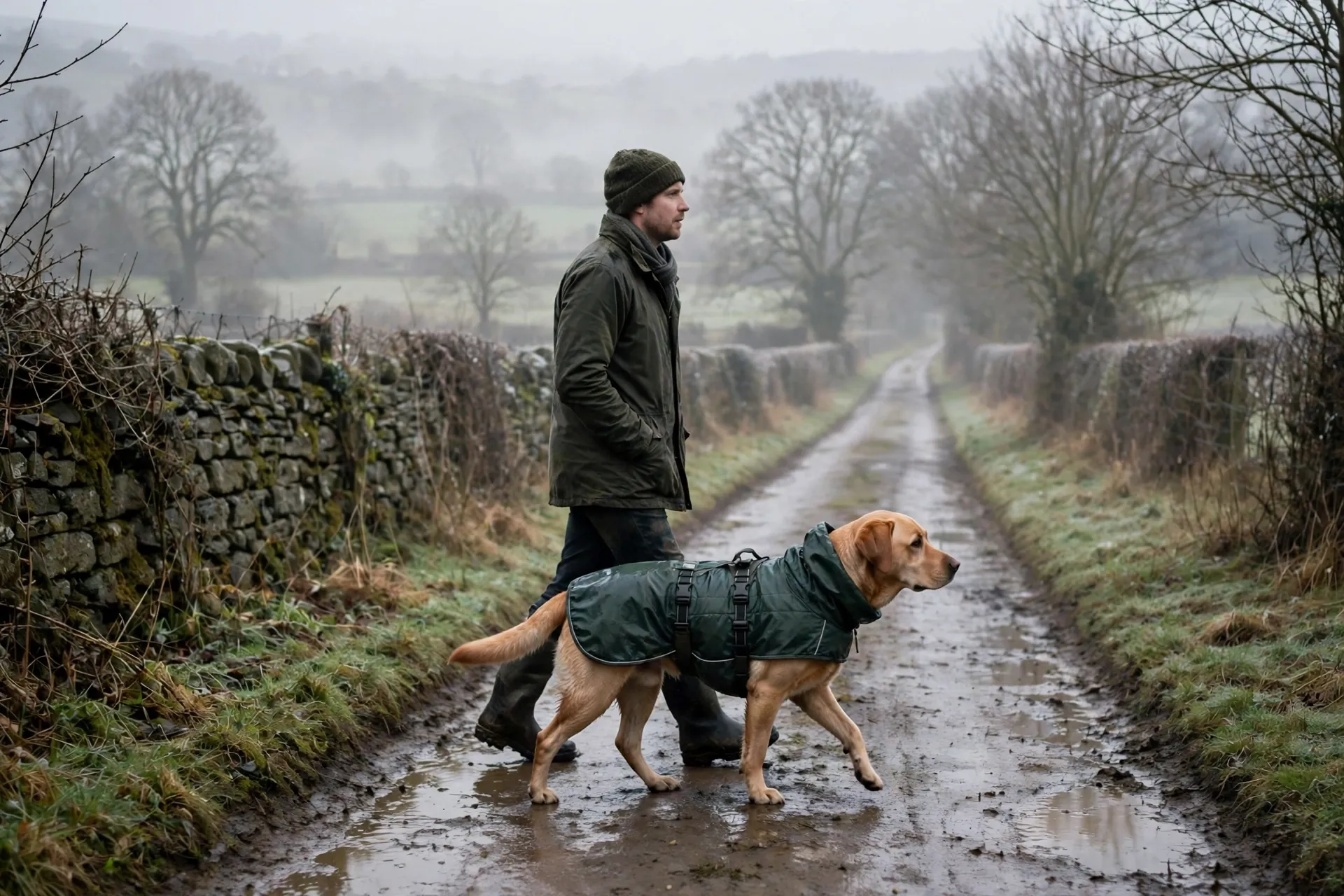
Cold affects dogs unevenly, and the trail will expose those differences. Short-coated breeds, puppies, older dogs, very small dogs and dogs that are used to a warm house will chill faster than a thick-coated working breed that is used to winter walks. A well-fitting coat helps, but fit matters: a coat that slips, rubs at the armpits, or covers the tail and hindquarters awkwardly will bother the dog all evening. Measure the dog before you buy, and try the coat on a normal evening walk first, so the trail is not the first time the dog wears it in public. For detailed measuring and fabric advice, see our dog winter coat guide UK, which covers fit, warmth and waterproofing for winter walks. On the night itself, add a drying coat or a thick towel in the car, so a wet dog can be dried and warmed immediately after the trail rather than sitting damp on the drive home.
Paws deserve their own check. Salted paths, grit, ice and muddy verges can all irritate paws, and a dog that starts lifting paws or limping is telling you to stop, not to push on. Rinse paws with lukewarm water when you get home, check between the toes for grit, ice balls or small cuts, and dry them thoroughly before the dog settles on bedding. Paw balm can help some dogs, but test it on a normal walk first, because a dog that hates the sensation will spend the trail trying to lick it off. If the forecast promises hard frost, consider whether a shorter trail, an earlier slot, or a different night is kinder than a long walk on frozen ground.
Darkness also changes how you manage the dog's senses. You cannot see what the dog is sniffing, stepping towards or reacting to until you are close to it, so a torch is essential for the handler, not just for the path. Use a small, steady torch for the ground in front of you, and avoid shining a bright beam into other visitors' faces or directly into the dog's eyes. A head torch keeps both hands free for the lead, a drink and a poo bag, but choose a low setting for crowded sections so you do not dazzle the group ahead. Keep spare batteries or a charged torch, because a dead torch halfway around a woodland trail turns a pleasant walk into a stressful one.
Finally, remember that you will get cold too, and a cold handler makes worse decisions. Warm, waterproof footwear with grip, gloves that still let you hold a lead and open a poo bag, and a hat that does not block your hearing will all help you stay patient when the dog needs time. If you are shivering and rushing, the dog will feel that urgency through the lead. Dress for standing still in a queue as well as for walking, because light trails involve both, and the standing still is usually when the cold bites hardest.
Flashing lights and light-sensitive dogs
Most dogs cope well with steady, warm-coloured lights, but fast flashing, strobing, rapid colour changes and sudden bursts of brightness are a different stimulus, and some dogs react strongly to them. The signs are not always dramatic. A sensitive dog may stare fixedly, freeze, pace in a small circle, pant when it is not warm, yawn repeatedly, lick its lips, tuck its tail, try to pull towards an exit, or become unusually clingy. These are stress signals, not disobedience, and they deserve a response: more space, a slower pace, a quieter side path, and if the signs persist, an early exit. Waiting to see whether the dog "gets used to it" while the flashing continues is rarely kind, because sensitisation can build over the evening rather than fade.
Plan around the brightest installations rather than discovering them by accident. Many venues publish a trail map with named zones, and some describe tunnels, canopies and animated displays in their access or visitor information. A tunnel of flashing lights that is thrilling for children can be overwhelming for a dog that has to walk through it on a narrow path with no side exit. If the map shows such a feature, ask staff whether there is a bypass, a viewing point from a distance, or a quieter alternative route. If there is no bypass and your dog is known to be light-sensitive, consider skipping that venue or choosing a trail that advertises gentle, steady lighting. There is no prize for completing every installation, and a dog that enjoys eighty percent of a trail is having a better night than a dog that is frightened by one section and stressed for the rest.
Speed and distance are your two best tools. Keep moving steadily through bright zones rather than stopping for photographs in the middle of a flashing display, because a stationary dog absorbs far more stimulation than a moving one. Give the dog as much lateral distance as the path allows: walk on the far side of the path, stand back from a fence line, and let other groups pass rather than bunching together at a viewpoint. If the dog fixates on a light, gently redirect with a familiar cue, a treat and forward movement, rather than pulling hard on the lead or forcing the dog to look away. A treat scatter on the ground, away from the display, can break fixation and give the dog a familiar, calming job to do.
Dogs with epilepsy, a diagnosed photosensitivity, a history of seizures, or a veterinary warning about flashing lights need extra caution. This guide cannot replace veterinary advice, and if any of those conditions apply, ask your vet before you book, describe the kind of trail you have in mind, and follow the vet's answer even if it means skipping the trail. The same caution applies to puppies in their first festive season and to rescue dogs whose history you do not fully know: a first trail should be short, gentle and easy to leave, so you learn how your dog responds without committing them to a long, intense evening. If you are unsure about any health question, check the official guidance before you travel and speak to your vet in good time, not on the day of the visit.
After the trail, watch the dog at home. Some dogs settle immediately, while others stay restless, pace, drink excessively or have a disturbed night after a stimulating evening. That delayed response is useful information for next time: it may mean a shorter trail, an earlier slot, a quieter venue, or no trail at all for that particular dog. Keep a short note of what worked — the slot time, the weather, the sections the dog enjoyed and the ones that caused trouble — because next December you will not remember the detail, and the note will save you from repeating a difficult night.
Food courts, cafes and catering rules
Food is where many light-trail visits become complicated for dog owners, because the catering rules are often different from the trail rules. A venue can welcome dogs on the trail and still exclude them from an indoor restaurant, a heated marquee or a covered seating area, and the distinction is easy to miss if you only read the headline dog policy. Before you book, look for the catering detail specifically: are dogs allowed in the outdoor food court, on the terrace, in the cafe, in the restaurant, and in any heated shelter? If the venue website does not say, check the official guidance before you travel, and ask the venue directly by email so you have a written answer to show at the gate if needed.
Outdoor food courts are usually the easiest option. Dogs can often stay with their owners, there is fresh air and space to stand aside, and dropped food is less of a crisis than in a crowded indoor room. Even outdoors, however, the rules vary: some venues require dogs to stay on a short lead and lie under the table, some provide a separate dog seating area, and some allow dogs only in a marked zone. Keep the dog close, keep the lead short, and do not let the dog approach other tables, however friendly they seem. Other visitors may have allergies, fears or their own dogs, and a food court is not the place to test sociability. Bring a small mat or blanket so the dog has a defined place to settle, and bring water, because a dog that has walked a trail in cold air still needs a drink, and venue water bowls are not always available or clean.
Indoor cafes and restaurants are the most likely exclusion, and they create the practical problem of who stays with the dog. If one adult wants a sit-down meal indoors while the dog cannot enter, the party must split, take turns, or choose the outdoor option instead. Decide this before you arrive, not in a queue with a hungry child and a tired dog. If you do split, agree a meeting point and a time, keep phones charged, and make sure the person with the dog has a torch, warm clothing and a plan for the wait. Never tie a dog up outside an indoor cafe while you eat inside: a tied dog in a busy, dark, noisy venue is vulnerable to theft, to teasing by strangers, and to panic if they cannot reach you. The same applies to leaving a dog in a car while you eat: a cold car, a dark car park and a long meal are a poor combination, and most venues and animal welfare guidance advise against it.
Festive food itself needs care. Christmas markets and trail food stalls sell roasted chestnuts, mince pies, chocolate treats, mulled wine, spiced drinks, rich sauces and foods containing onion, garlic, grapes, raisins and xylitol, all of which can be harmful to dogs in varying amounts. Keep food at table height, do not share tastes "just this once", and watch children in the party, who may offer food with the best intentions. If the dog does eat something worrying, note what it was, how much, and when, and contact a vet promptly rather than waiting to see whether symptoms develop. A small bag of the dog's own treats, kept in a pocket and used for settling and recall, removes the temptation to share human food and gives the dog a positive reason to lie quietly under the table.
Queues for food can also be a stress point. A long, slow-moving queue in a narrow, brightly lit food hall, with smells from every side and strangers standing close, is hard for many dogs. If the queue is long, consider buying food before the busiest stretch, eating earlier in the evening, or taking food to a quieter outdoor bench away from the main crowd. Some venues allow you to eat on the trail route itself at designated picnic spots, which can suit a dog far better than a crowded hall. Whatever you choose, keep the meal part of the outing short and calm, and remember that the dog's evening is already long: a quick, warm drink outdoors, followed by a prompt journey home, often beats a full meal in a busy venue.
The night itself: pace, toilets and crowds
A light trail is a social walk, not a training walk, so set the pace for the dog rather than for the group. Walk steadily, allow sniffing stops, and stand aside regularly to let faster groups pass. Standing aside is a skill worth practising before the visit: step off the main path where it is safe to do so, ask the dog to sit or stand beside you, reward calm watching, and rejoin the flow when there is a gap. Dogs that are constantly overtaken, bumped by pushchairs or squeezed between strangers on a narrow path will become aroused or fearful, and a few well-timed pauses prevent that build-up. If the path narrows to single file, keep the dog on your inside, away from the oncoming flow, and keep the lead short enough that the dog cannot step into someone's path.
Toilet planning is unglamorous and essential. Give the dog a proper toilet opportunity before entry, not just a quick stop in a busy car park, and carry more poo bags than you think you need, plus a spare bag and a torch for finding and clearing up in the dark. Many venues provide bins along the route, but bins fill quickly on busy nights, so be prepared to carry a used bag until you find one. Do not let the dog toilet on displays, cables, planted beds or seating areas, and clean up immediately even when it is dark and inconvenient: night trails rely on visitors keeping the grounds clean, and dog waste left on a lit path is both unpleasant and a reason venues tighten dog rules in future seasons.
Meeting other dogs is inevitable, and it needs a simple, consistent rule: no on-lead greetings unless both owners clearly agree, both dogs are calm, and there is space to move apart again. On a crowded trail, most greetings should simply not happen. Keep moving past other dogs with a cheerful voice, a treat and forward momentum, and cross to the other side of the path if a dog ahead is barking, lunging or clearly stressed. Puppies and adolescent dogs are often the most enthusiastic greeters, and also the most likely to learn bad habits from repeated, uncontrolled meetings, so a trail night is not the place to practise sociability. If your dog is reactive, walk at the edge of the group, use the quietest route, and be ready to step off the path entirely while a difficult dog passes.
Crowd density changes through the evening, and it is worth noticing the pattern. Entry points, tunnels, bridges, viewpoints and food courts bunch people together, while longer woodland stretches spread them out again. Use the spread-out stretches to let the dog decompress: slow down, allow sniffing, offer water, and let the dog walk on a loose lead for a few minutes. If you notice the dog's breathing quickening, their body stiffening, or their attention narrowing to a single stimulus, treat that as a signal to find a quieter stretch or to head for an exit, rather than pushing on to the next installation. A dog that has had a break will cope with the next busy section far better than a dog that has been pushed through three in a row.
Children, pushchairs, wheelchairs and mobility scooters all share the same paths, and a dog owner needs to be alert to them without resenting them. Keep the lead clear of wheels, do not let the dog jump up at children who are excited by the lights, and be ready to move aside at viewpoints so others can see. If a child asks to stroke the dog, it is perfectly acceptable to say no politely, especially in the dark, when the dog is tired, or when the dog is already aroused. A calm, brief answer — that the dog is resting, or that tonight is not a good time — protects both the child and the dog, and most families will understand immediately.
Packing for a winter night out
Pack the night before, not in the car park, and pack for the dog as carefully as for the humans. The core list is short: a well-fitting harness and short lead, a light-up collar or clip-on light, a coat if the dog needs one, a torch for the handler, water and a collapsible bowl, poo bags and a spare, a small bag of high-value treats, a familiar mat or blanket, a towel and a drying coat for the car, and any medication the dog needs. Add a spare lead in the car, because a broken clip or a chewed lead in the dark is not a problem you want to improvise around. Keep the dog's essentials in one bag by the door, so a last-minute change of plan does not leave the torch or the water behind.
Food and water need winter-specific thought. Cold air and excitement both increase thirst, but a dog that drinks a large amount immediately before a long walk may need to toilet urgently halfway around the trail. Offer a moderate drink before entry, carry water for top-ups during the trail, and offer a proper drink again at the end. Do not rely on venue water bowls, which may be empty, frozen or shared with many other dogs. For food, stick to the dog's normal diet and normal feeding times as far as possible: a trail night is not the time to try a new treat, a rich festive biscuit or a large meal just before walking. If the evening meal would normally fall during the trail, feed a smaller meal earlier, take treats for the trail itself, and feed the remainder when you get home.
Clothing and footwear for the humans matter for the dog too. Waterproof boots with grip prevent slips on icy boardwalks and muddy slopes, and a slip by the handler can jerk the lead hard enough to frighten the dog. Gloves that allow you to handle a lead, a torch and a poo bag without removing them will keep you warmer and calmer. A phone with a charged battery, the venue map saved offline, and the car park location noted will help if signal is poor in a rural garden or woodland. Tell someone outside the party where you are going and when you expect to be home, especially for a late, rural visit in winter weather.
For the car, prepare a warm, dry return. Lay a waterproof cover or old towels on the seat or boot, keep a dry coat and a thick towel within reach, and have a small amount of water for the journey home. Warm the car before the dog gets in if possible, and do not leave a wet dog in an unheated car while you queue for food or use the facilities. If the drive home is long, plan a safe stop where the dog can toilet and stretch, rather than driving straight through with a tired, wet dog. The journey home is part of the outing, and a calm return helps the dog settle and sleep well afterwards.
Weather, mud and busy nights
British winter weather can change a light trail from magical to miserable in a single evening, and the dog feels the change first. Rain soaks coats, chills small dogs, turns paths to mud and makes displays harder to see. Wind drives rain sideways, rattles temporary structures and carries unfamiliar sounds. Frost makes boardwalks and stone steps slippery, and fog reduces visibility for everyone on the path. Check the forecast for the venue, not just for your home town, and check again on the day, because a garden in a valley can be several degrees colder and foggier than a town a few miles away. If the forecast promises heavy rain, high winds or ice, consider moving the booking if the venue allows it, rather than hoping the dog will enjoy conditions you would not enjoy yourself.
Mud is the most common practical problem, and it is worth planning for rather than discovering. After rain, grass paths, unpaved woodland tracks and car park verges become deep mud, which clogs paws, soaks bellies and coats, and makes small dogs reluctant to walk. A drying coat, a towel, a boot mat and a change of car seat cover turn a muddy return into a manageable one. At home, rinse paws and belly with lukewarm water, dry thoroughly, and check for small cuts, thorns or grit before the dog settles. Dogs that repeatedly walk in muddy, wet conditions can develop sore paws or skin irritation, so a trail that was muddy this week may be a reason to choose a surfaced venue next week, rather than repeating the same route.
Busy nights amplify every other difficulty. Crowds mean narrower passing space, longer queues, more food smells, more dogs to pass, and fewer quiet stretches for decompression. If you arrive and the car park is overflowing, the gate queue is long and the first section is already congested, it is reasonable to ask staff whether a later entry, a quieter route or a rebooking is possible, rather than forcing a nervous dog into the busiest possible start. Some venues cap numbers per slot, which helps, but a cap is not a guarantee of space on a narrow path. Weekday evenings, early slots and the first week of the season remain the simplest ways to avoid the worst crowds, and they are worth the extra planning.
Special event nights deserve separate attention. Fireworks displays, drone shows, live music evenings, character appearances and Santa visits can all be part of a light trail programme, and each adds noise, crowds and sudden stimulation. If your dog is sound-sensitive or light-sensitive, check whether your chosen night includes any such event, and choose a plain trail night instead. If you are unsure, check the official guidance before you travel, and ask the venue whether the event is included in your slot or is a separate, avoidable part of the evening. A trail without fireworks is a better night for most dogs, however spectacular the display might be for the humans.
Finally, remember that venues sometimes close, shorten or reroute trails at short notice for safety reasons, including high winds, flooding or ice. Check the venue's social media or visitor information on the day of travel, and keep the booking confirmation and any contact details handy. A wasted journey is frustrating, but a journey to a closed venue in bad weather, with a dog in the car, is worse. A quick check before you leave home costs two minutes and can save an evening.
Leaving early is a good plan
The most useful mindset for a dog-friendly light trail is that leaving early is success, not failure. Agree the exit plan before you enter: who will suggest leaving, what signs will trigger it, and where the nearest exit is. Shivering, persistent panting, reluctance to walk, repeated attempts to turn back, hiding behind your legs, or a sudden change from a relaxed dog to a tense, scanning dog are all valid reasons to go. You do not need to wait for a dramatic incident, and you do not need to justify the decision to the rest of the party. A dog that leaves happily after forty minutes has had a good night; a dog that is dragged around for ninety minutes has not, however many photographs were taken.
Practical exit planning is simple. Note the exit points on the venue map, keep the car keys and torch accessible, and do not leave coats, towels or water in a locker or a distant car if you might need them quickly. If the party splits, agree a meeting point that is easy to find in the dark, such as the main exit or a named cafe, and a time to regroup. Keep phones charged and on a low brightness setting, so you can find each other without dazzling other visitors. If the dog is too tired or cold to walk back to the car, carry a small dog if you safely can, or ask staff for the shortest accessible route to the exit; most venues will help, especially if you explain calmly that the dog needs to leave.
After the visit, give the dog a proper wind-down. Dry and warm them, offer water and a small, familiar meal, check paws and coat, and let them settle in their usual sleeping place with minimal fuss. Avoid a second exciting activity the same evening, such as a visit to another lit venue or a busy pub, because the dog's stimulation budget for the night is already spent. A calm evening at home, with the lights low and the routine normal, helps the dog process the outing and sleep well. If the dog seems unusually restless, sore or unwell the next day, contact your vet, and note what happened for future planning.
For many households, the best festive pattern is not a single grand trail but a series of smaller, calmer outings: a daytime garden walk, a short local lights display on a quiet street, and one well-chosen trail night on a weekday, early in the season. That pattern gives the dog variety without overload, and it gives the humans a festive season that does not depend on one perfect night. If this year's trail does not suit your dog, that is useful knowledge, not a disappointment: next year you can choose a shorter trail, a quieter venue, or a different kind of festive outing altogether. The guides in the next section cover festive stays, winter coats and crowded events, so you can build a winter plan that fits the dog you actually have. For ideas beyond a single night, our dog-friendly festivals guide explains how to judge noise, crowds and exits at larger outdoor events.
Practical questions
Before you go
Are dogs allowed at all UK Christmas light trails?
No. Dog rules vary by venue, by date and sometimes by time slot. Some gardens welcome dogs on every trail night, some allow them only on selected dog-friendly evenings, and some do not allow dogs at all. Always check the official guidance before you travel and keep the booking confirmation that states the dog rule for your slot.
What time slot is best for a dog at a light trail?
An earlier slot is usually calmer: there is still some natural light for arrival, queues are often shorter, and the dog has not already waited through a long evening. Late slots can be busier, colder and harder for a tired dog. If your dog is nervous in crowds, choose a weekday evening and the earliest entry time you can manage.
Do flashing Christmas lights bother dogs?
Some dogs are unbothered, while others become restless, stare, pace, pant or try to pull away near fast-flashing displays, tunnels of light and sudden colour changes. Keep the dog moving at a steady pace, give plenty of space from the brightest installations, and leave early if the signs do not settle. If your dog has epilepsy or a diagnosed light sensitivity, ask a vet before you book and check the official guidance before you travel.
What should my dog wear on a winter night trail?
A well-fitting coat for cold or wet weather, a reflective harness or jacket, a light-up collar or clip-on light, and a short lead. Reflective trim helps other visitors, cyclists and drivers see the dog in car parks and on unlit paths. Avoid dangling decorations, loose scarves and anything that could snag on fences or low branches.
Can dogs go into the food and drink areas at light trails?
It depends on the venue. Outdoor food courts and terraces are often dog-friendly, while indoor cafes, restaurants and heated marquees may not be. Some venues allow dogs in one catering area but not another, and rules can change for a special event night. Check the venue map and the official guidance before you travel, and plan who stays with the dog if you want a sit-down meal indoors.
What should I do if my dog gets cold, muddy or overwhelmed?
Cut the walk short, find a quieter path or an exit, and warm the dog in the car with a dry coat and a towel. Shivering, lifting paws, reluctance to walk and seeking shelter are all reasons to stop rather than push on to the end of the trail. Bring water, a familiar blanket and a torch for the walk back, and do not leave a wet dog in a cold car while you finish the trail.